Wednesday, March 06, 2013

amplifying changes in successive frames of video that are too subtle for the naked eye


mitnews | At this summer's Siggraph — the premier computer-graphics conference — researchers from MIT's Computer Science and Artificial Intelligence Laboratory (CSAIL) will present new software that amplifies variations in successive frames of video that are imperceptible to the naked eye. So, for instance, the software makes it possible to actually "see" someone's pulse, as the skin reddens and pales with the flow of blood, and it can exaggerate tiny motions, making visible the vibrations of individual guitar strings or the breathing of a swaddled infant in a neonatal intensive care unit.

The system is somewhat akin to the equalizer in a stereo sound system, which boosts some frequencies and cuts others, except that the pertinent frequency is the frequency of color changes in a sequence of video frames, not the frequency of an audio signal. The prototype of the software allows the user to specify the frequency range of interest and the degree of amplification. The software works in real time and displays both the original video and the altered version of the video, with changes magnified.

 Although the technique lends itself most naturally to phenomena that recur at regular intervals — such as the beating of a heart, the movement of a vibrating string or the inflation of the lungs — if the range of frequencies is wide enough, the system can amplify changes that occur only once. So, for instance, it could be used to compare different images of the same scene, allowing the user to easily pick out changes that might otherwise go unnoticed. In one set of experiments, the system was able to dramatically amplify the movement of shadows in a street scene photographed only twice, at an interval of about 15 seconds. Fist tap Dale.

moar on scary droans


cnet | The U.S. Department of Homeland Security has customized its Predator drones, originally built for overseas military operations, to carry out at-home surveillance tasks that have civil libertarians worried: identifying civilians carrying guns and tracking their cell phones, government documents show.

The documents provide more details about the surveillance capabilities of the department's unmanned Predator B drones, which are primarily used to patrol the United States' northern and southern borders but have been pressed into service on behalf of a growing number of law enforcement agencies including the FBI, the Secret Service, the Texas Rangers, and local police.

Homeland Security's specifications for its drones, built by San Diego-based General Atomics Aeronautical Systems, say they "shall be capable of identifying a standing human being at night as likely armed or not," meaning carrying a shotgun or rifle. They also specify "signals interception" technology that can capture communications in the frequency ranges used by mobile phones, and "direction finding" technology that can identify the locations of mobile devices or two-way radios.

The Electronic Privacy Information Center obtained a partially redacted copy of Homeland Security's requirements for its drone fleet through the Freedom of Information Act and published it this week. CNET unearthed an unredacted copy of the requirements that provides additional information about the aircraft's surveillance capabilities.

Concern about domestic use of drones is growing, with federal legislation introduced last month that would establish legal safeguards, in addition to parallel efforts underway from state and local lawmakers. The Federal Aviation Administration recently said that it will "address privacy-related data collection" by drones.
The prospect of identifying armed Americans concerns Second Amendment advocates, who say that technology billed as securing the United States' land and maritime borders should not be used domestically.

Michael Kostelnik, the Homeland Security official who created the program, told Congress that the drone fleet would be available to "respond to emergency missions across the country," and a Predator drone was dispatched to the tiny town of Lakota, N.D., to aid local police in a dispute that began with reimbursement for feeding six cows. The defendant, arrested with the help of Predator surveillance, lost a preliminary bid to dismiss the charges.

"I am very concerned that this technology will be used against law-abiding American firearms owners," says Alan Gottlieb, founder and executive vice president of the Second Amendment Foundation. "This could violate Fourth Amendment rights as well as Second Amendment rights." Fist tap Arnach.

Tuesday, March 05, 2013

drones over brooklyn


gawker | The idea of drones over New York City have inspired art projects and a rap song. Now they may be a reality too. The FAA is investigating a report from an Alitalia passenger jet of a drone spotting over Brooklyn, as he approached JFK airport in Queens. "We saw a drone, ad drone aircraft," the pilot told controllers, according to audio played on Good Morning America, below.

The FAA told CNN in a statement that it is "investigating a report... he saw a small, unmanned or remote-controlled aircraft while on final approach to Runway 31 Right... The sighting was approximately four to five miles west of the airport at an altitude of approximately 1,500 feet." No other pilots reported seeing the drone, according to CNN.

Without any more description it's impossible to tell if this might be some sort of heavy-duty unmanned aerial vehicle, or a hobbyist remote controlled gadget, which we know take to the skies occasionally around New York. In any event, the NYPD doesn't currently use drones in New York, but it's only a matter of time.

Update: The FBI has released a statement saying they'd like your help in identifying the drone operator.
On Monday, March, 4, 2013, at approximately 1:15 p.m., the pilot of Alitalia Flight #608 spotted a small, unmanned aircraft while on approach to John F. Kennedy International Airport. The Alitalia flight was roughly three miles from runway 31R when the incident occurred at an altitude of approximately 1,750 feet. The unmanned aircraft came within 200 feet of the Alitalia plane.
The FBI is investigating the incident and looking to identify and locate the aircraft and its operator. The unnamed aircraft was described as black in color and no more than three feet wide with four propellers.
Update II: a Tipster points out that Floyd Bennet Field in Brooklyn, just a few miles from JFK, is a favorite spot for remote-controlled plane enthusiasts to fly. It even hosts an R/C air show in the summer. Maybe the drone launched from there?

wealth inequality in america


egypt sustains severe land loss to development and desertification


egyptindependent |  Egypt is losing land faster than any country in the world, according to UN estimates announced Friday on the World Day to Combat Desertification and Drought.

The Executive Secretariat of the United Nations Convention to Combat Desertification announced that Egypt ranked first in the rate of desertification, painting a bleak picture of fast-shrinking agricultural lands, deteriorating soil fertility and low productivity due to increased land abuse.

The UN report also said Egypt loses 3.5 acres per hour of fertile Delta agricultural land as a result of urban sprawl and construction, which is a record unprecedented in the global rate of deforestation.

‫Ismail Abdel Galil, the national coordinator for the UN Convention to Combat Desertification, said in press statements that the report did not include the painful reality of increasing construction on agricultural lands, which has jumped over the past three months to five acres per hour due to chaos and the lack of regulation.

He said Egypt is losing tracts of fertile lands formed by the Nile River's flooding over thousands of years that cannot be recovered, especially after the decline in land reclamation programs by the state.

Abdel Galil said the report emphasizes the growing size of the food gap and the inevitable increased reliance on food imports, which threatens Egypt's future and could put it on the brink of famine. He urged the government to take swift action to prevent such a crisis.

china losing vast tracts of arable land to desertification


SFGate | A new Chinese export has been spreading quietly across Asia and America: dust.

Violent sandstorms from China's expanding deserts have been battering Chinese cities, and their mustard-colored dust has begun reaching South Korea, Japan, and the West Coast of North America.

"People dusting off their cars in California or Calgary often don't realize the sand has come all the way from China," said Lester Brown, president of the Earth Policy Institute in Washington, D.C., who was in Beijing recently. "There is a dustbowl developing in China that represents the largest conversion of productive land to desert of any place in the world ... and it's affecting the world."

China has always suffered from aridity. About 25 percent of its landmass is composed of deserts made famous in tales about the Silk Road, which traversed many of them.

But the situation is getting worse.

Overgrazing, along with persistent drought, indiscriminate use of ground water, and rampant logging, are eroding the edges of China's deserts, allowing them to merge and spread. Recent satellite imagery shows that the Badain Jaran Desert in north-central China is pushing southward toward the nearby Tengger Desert to form a single, larger desert overlapping both northwestern Gansu province and neighboring Inner Mongolia.
Expanding deserts swallow almost a million acres of land every year, China's Environmental Protection Agency says. Soon, 40 percent of China could turn into scrubland, creating enormous social, economic and ecological challenges, including the problem of millions of "ecological refugees."

Monday, March 04, 2013

the arab spring and climate change


americanprogress | consider the following statements:
  • “A once-in-a-century winter drought in China contributed to global wheat shortages and skyrocketing bread prices in Egypt, the world’s largest wheat importer.” (Sternberg, p. 7)

  • “Of the world’s major wheat-importing companies per capita, “the top nine importers are all in the Middle East; seven had political protests resulting in civilian deaths in 2011.” (Sternberg, p. 12)

  • “The world is entering a period of ‘agflation,’ or inflation driven by rising prices for agricultural commodities.” (Johnstone and Mazo, p. 21)

  • “Drought and desertification across much of the Sahel—northern Nigeria, for example, is losing 1,350 square miles a year to desertification—have undermined agricultural and pastoral livelihoods,” contributing  to urbanization and massive flows of migrants. (Werz and Hoffman, p. 37)

  • “As the region’s population continues to climb, water availability per capita is projected to plummet. … Rapid urban expansion across the Arab world increasingly risks overburdening existing infrastructure and outpacing local capacities to expand service.” (Michel and Yacoubian, p. 45)

  • “We have reached the point where a regional climate event can have a global extent.” (Sternberg, p. 10)
These assertions are all essentially factual. None of them individually might be cause for alarm. Taken together, however, the phenomena they describe weave a complex web of conditions and interactions that help us understand the larger context for the Arab Awakening. Indeed, as Johnstone and Mazo argued as early as April–May 2011, in an article written just at the outset of the Tunisian and Egyptian revolutions, it was already possible to see that climate change played a role in the complex causality of the revolts spreading across the region. They called it a “threat multiplier.” It significantly increased the interactive effects—and hence the overall impact—of political, economic, religious, demographic, and ethnic forces.
This concept of a “threat multiplier” is a helpful way to think about climate change and security more broadly.

from my dinner with andre


Sunday, March 03, 2013

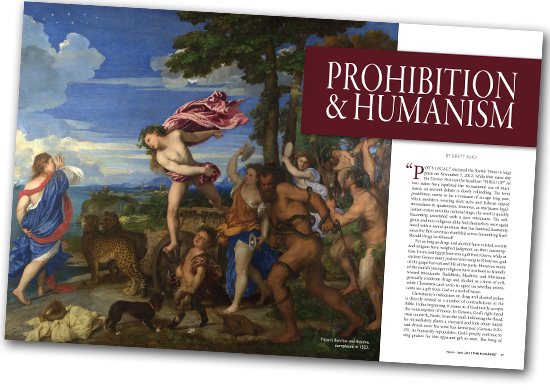
prohibition and humanism

thehumanist | The legislation of morality is widespread; from blasphemy to gay inequality to reproductive rights, religious majorities actively persecute those with differing values through the codification of morality. And while many of these marginalized groups have seen notable public support, the public is largely silent when it comes to the marginalization of those who choose to use drugs. Just as religion often labels those with alternative sexual preferences as morally corrupt or evil, so too does religion judge those who choose to use drugs and alcohol as morally inferior.

Part of the philosophy of humanism is to stand against outdated codes of morality that persecute and make life difficult for people. Just as LGBT issues are humanist issues, so too are drug and alcohol issues. When evaluating how society treats inebriants, science and reason should be the standards by which we create policy, not ancient religious texts. Most comparative policy studies agree that drug and alcohol abuse should be regarded as a public health issue, as opposed to a criminal justice issue, and that public funds are best spent on drug treatment and prevention rather than enforcement and incarceration.

Predominant theocratic norms have so influenced society that tacit acquiescence for religious prejudice has largely replaced critical analysis when it comes to social attitudes towards drug use. Indeed, there is little opposition, even among nontheists, to laws that persecute those who choose to use drugs. However, humanism and human decency afford that individuals with varying values and beliefs should be respected, not shunned.

One example of a largely unopposed, overly harsh drug law in the United States is the Higher Education Act’s Aid Elimination Penalty, which states that any individual with a misdemeanor drug offense is to be barred from receiving federal financial aid to attend college. Because of the provision, hundreds of thousands of promising students have been forced to drop out of college because of minor, nonviolent drug offenses. The penalty was introduced in 1998 by Rep. Mark Souder (R-IN), a Christian conservative whose battles included anti-abortion legislation and the prohibition of online gambling. Heavily influenced by his religion, when asked about his position on abortion, Souder responded, “the closer to the clearness of the Bible, the less ability I should have to compromise.” Ironically, this moral crusader left office in 2010 after admitting to an affair with a staffer, lamenting in his resignation speech that he had “sinned against God.”
- See more at: http://thehumanist.org/march-april-2013/prohibition-humanism/#sthash.pjJFzCvB.dpuf

While drug laws that prevent access to education have untold social costs, the financial burdens of the war on sin can be more easily calculated. In 2010 alone, the Office of National Drug Control Policy estimates that this so-called war cost the U.S. federal government $15 billion, and state governments another $25 billion. Incarceration costs alone can be staggering. In 2011 the State of California spent $45,006 per inmate and approximately 31 percent of all California inmates were booked on drug offenses. To put that into perspective, the state spent $8,667 per college student in the same year. Because of the war on drugs’ mandatory minimum sentencing laws, Americans now comprise 4.4 percent of the world’s population, but 23.4 percent of its prison population.

The Obama administration has at least vocalized concerns regarding the failure of national drug policy. As stated in its recently released 2012 National Drug Control Strategy: “science has shown that drug addiction is not a moral failing but rather a disease of the brain that can be prevented and treated.” However, upon review of the actual policy, many have concluded that the only thing changed is the wording. “This strategy is nearly identical to previous national drug strategies,” stated Bill Piper, the director for national affairs at the Drug Policy Alliance. “While the rhetoric is new, reflecting the fact that three-quarters of Americans consider the drug war a failure, the substance of the actual policies is the same.” Green Party presidential candidate Dr. Jill Stein raised similar concerns, noting that “President Obama promised to use a science-based approach to public policy. But when it comes to marijuana, he has continued the unscientific policies of George Bush, and has even gone far beyond Bush in his attacks upon medical marijuana clinics.”

Eighty-some years ago, the primary motivations for ending the alcohol prohibition were the staggering economic costs of enforcement, as well as the huge impact of lost tax revenues. A 1929 pamphlet distributed by the Association Against the Prohibition Amendment estimated that the total loss of federal tax revenues was $861 million, the equivalent of $108 billion dollars today. The nation, in the midst of the Great Depression, was in desperate need of these tax revenues to implement economic stimulus programs, and so in 1932 a bipartisan effort saw the passing of the Twenty-first Amendment. Perhaps a similar appeal to reason can be made in our current time of financial uncertainty. If nothing else, perhaps religious lawmakers can be made to see that their war on sin has failed in economic terms.

Ideally, a majority of lawmakers may eventually come to realize that drug experimentation is a natural human phenomenon—that humans are instinctively attracted to mind-altering substances.

the war against human nature strengthens the fear of one’s fellow man


laphamsquarterly | So again with the war that America has been waging for the last one hundred years against the use of drugs deemed to be illegal. The war cannot be won, but in the meantime, at a cost of $20 billion a year, it facilitates the transformation of what was once a freedom-loving republic into a freedom-fearing national-security state. The policies of zero tolerance equip local and federal law-enforcement with increasingly autocratic powers of coercion and surveillance (the right to invade anybody’s privacy, bend the rules of evidence, search barns, stop motorists, inspect bank records, tap phones) and spread the stain of moral pestilence to ever larger numbers of people assumed to be infected with reefer madness—anarchists and cheap Chinese labor at the turn of the twentieth century, known homosexuals and suspected Communists in the 1920s, hippies and anti-Vietnam War protestors in the 1960s; nowadays young black men sentenced to long-term imprisonment for possession of a few grams of short-term disembodiment.

If what was at issue was a concern for people trapped in the jail cells of addiction, the keepers of the nation’s conscience would be better advised to address the conditions—poverty, lack of opportunity and education, racial discrimination—from which drugs provide an illusory means of escape. That they are not so advised stands as proven by their fond endorsement of the more expensive ventures into the realms of virtual reality. Our pharmaceutical industries produce a cornucopia of prescription drugs—eye opening, stupefying, mood swinging, game changing, anxiety alleviating, performance enhancing—currently at a global market-value of more than $300 billion. Add the time-honored demand for alcohol, the modernist taste for cocaine, and the uses, as both stimulant and narcotic, of tobacco, coffee, sugar, and pornography, and the annual mustering of consummations devoutly to be wished comes to the cost of more than $1.5 trillion. The taking arms against a sea of troubles is an expenditure that dwarfs the appropriation for the military defense budget.

Given the American antecedents both metaphysical and commercial—Thomas Paine drank, “and right freely”; in 1910 the federal government received 71 percent of its internal revenue from taxes paid on the sale and manufacture of alcohol—it is little wonder that the sons of liberty now lead the world in the consumption of better living through chemistry. The new and improved forms of self-invention fit the question—to be, or not to be—to any and all occasions. For the aging Wall Street speculator stepping out for an evening to squander his investment in Viagra. For the damsel in distress shopping around for a nose like the one seen advertised in a painting by Botticelli. For the distracted child depending on a therapeutic jolt of Adderall to learn to read the Constitution. For the stationary herds of industrial-strength cows so heavily doped with bovine growth hormone that they require massive infusions of antibiotic to survive the otherwise lethal atmospheres of their breeding pens. Visionary risk-takers, one and all, willing to chance what dreams may come on the way West to an all-night pharmacy. The war against human nature strengthens the fear of one’s fellow man. The red, white, and blue pills sell the hope of heaven made with artificial sweeteners.

Saturday, March 02, 2013

putting the Internet of Things inside your body...,


wired | Chipmaker Freescale Semiconductor has created the world’s smallest ARM-powered chip, designed to push the world of connected devices into surprising places.

Announced today, the Kinetis KL02 measures just 1.9 by 2 millimeters. It’s a full microcontroller unit (MCU), meaning the chip sports a processor, RAM, ROM, clock and I/O control unit — everything a body needs to be a basic tiny computer.

The KL02 has 32k of flash memory, 4k of RAM, a 32 bit processor, and peripherals like a 12-bit analog to digital converter and a low-power UART built into the chip. By including these extra parts, device makers can shrink down their designs, resulting in tiny boards in tiny devices.

How tiny? One application that Freescale says the chips could be used for is swallowable computers. Yes, you read that right. “We are working with our customers and partners on providing technology for their products that can be swallowed but we can’t really comment on unannounced products,” says Steve Tateosian, global product marketing manager.

The KL02 is part of Freescale’s push to make chips tailored to the Internet of Things. Between the onboard peripherals and a power-management system tuned to the chemistry of current generation batteries, the KL02 is intended to be at the heart of a network of connected objects, moving from shoes that wirelessly report your steps (a natural evolution of Nike+) to pipes that warn you when they are leaking.

There are some clues we can glean about how this chip might end up inside our digestive tracts. Freescale already works with a variety of health and wellness customers. Both the Fitbit and OmniPod insulin pump use Freescale chips. It’s not hard to imagine a new generation of devices designed to monitor your internal health or release drugs and medicine from within your body. Such tiny implements, however, also creates the possibility that discarded micro-devices could soon collect in sewers and waste treatment plants.

Friday, March 01, 2013

internet of things coming soon...,


csmonitor | A car that tells your insurance company how you're driving. A bathroom scale that lets you chart your weight on the Web. And a meter that warns your air conditioner when electricity gets more expensive.

Welcome to the next phase of the wireless revolution.

The first wave of wireless was all about getting people to talk to each other on cellphones. The second will be getting things to talk to each other, with no humans in between. So-called machine-to-machine communication is getting a lot of buzz at this year's wireless trade show. Some experts believe these connections will outgrow the traditional phone business in less than a decade.

"I see a whole set of industries, from energy to cars to health to logistics and transportation, being totally redesigned," said Vittorio Colao, the CEO of Vodafone Group PLC, in a keynote speech at the Mobile World Congress in Barcelona, Spain. The British cellphone company has vast international interests, including its 45 percent ownership stake in Verizon Wireless.

Companies are promising that machine-to-machine, or M2M, technology will deliver all manner of services, from the prosaic to the world-changing. At U.S. chipmaker Qualcomm Inc.'s booth here at the show, there's a coffeepot that can be ordered to start brewing from a tablet computer, or an Internet-connected alarm clock. A former president of Costa Rica is also at the show, talking about how M2M can save massive amounts of greenhouse gases by making energy use more efficient — enough to bring mankind halfway to the goal of halting global warming.

The M2M phenomenon is part of the larger drive to create an "Internet of Things" —a global network that not only links computers, tablets and phones but that connects everything from bikes to washing machines to thermostats. Machina Research, a British firm, believes there will be 12.5 billion "smart" connected devices, excluding phones, PCs and tablets, in the world in 2020, up from 1.3 billion today.

But how does this transformation happen, and who stands to profit?

modeling social network topologies in elementary schools


Plosone | Complex networks are widely applied in disciplines as varied as economics [1], biology [2], information technology [3] and sociology [4], [5]. Further development of complex networks theory is therefore a vital research area, with recent efforts focusing on measurements [6], topologies [7], [8] and the way data is disseminated through them [9].

Complex networks are a tool for modeling systems in which elements interrelate. Social networks are systems that describe phenomena in which individuals interact within a society (e.g. people, companies, etc.); nodes represent individuals and links represent the social relationships between them. Recent research has focused on the patterns of face-to-face interaction dynamics. In one study, radio frequency identification devices were used to calculate the proximity and duration of interpersonal interactions, and thus create social networks to understand community behavior and apply diffusion processes for infectious diseases and information [10]. Using the same technology, studies have been done in high schools [11] and elementary schools [12] of the mixing patterns of students in a school environment that describe social network’s temporal evolution and apply infectious disease diffusion processes to identify high-risk situations and establish vaccination strategies.

When studying data dissemination within a social system, an understanding is needed of the network topology that models the interactions produced within it. To this end, the present study objective was to evaluate the properties of friendship and enmity networks representing interactions between elementary school students and develop models that reproduce them. This will facilitate future research into problems such as scholastic performance, disease transmission and evolution of the cultural environment, among other important phenomena occurring in schools which could benefit from the formalism of complex networks [13][15].

We describe the methodology used to collect the data and generate the databases used in developing the networks. These data have certain characteristics that are not reproduced by classic models of complex network theory. The tests used to analyze friendship networks are described in section ‘Friendship Networks Analysis’ and implementation of the proposed model is described in section ‘Friendship Network Model’, while the enmity networks are addressed in section ‘Enmity Network Analysis’ and the proposed descriptive model in section ‘Enmity Network Model’. Promising future research emphases are proposed.

Tuesday, February 26, 2013

why I'm quitting facebook


cnn | We Facebook users have been building a treasure lode of big data that government and corporate researchers have been mining to predict and influence what we buy and for whom we vote. We have been handing over to them vast quantities of information about ourselves and our friends, loved ones and acquaintances. With this information, Facebook and the "big data" research firms purchasing their data predict still more things about us -- from our future product purchases or sexual orientation to our likelihood for civil disobedience or even terrorism.

The true end users of Facebook are the marketers who want to reach and influence us. They are Facebook's paying customers; we are the product. And we are its workers. The countless hours that we -- and the young, particularly -- spend on our profiles are the unpaid labor on which Facebook justifies its stock valuation.

The efforts of a few thousand employees at Facebook's Menlo Park campus pale in comparison to those of the hundreds of millions of users meticulously tweaking their pages. Corporations used to have to do research to assemble our consumer profiles; now we do it for them.

The information collected about you by Facebook through my Facebook page isn't even shared with me. Thanks to my page, Facebook knows the demographics of my readership, their e-mails, what else they like, who else they know and, perhaps most significant, who they trust. And Facebook is taking pains not to share any of this, going so far as to limit the ability of third-party applications to utilize any of this data.

Given that this was the foundation for Facebook's business plan from the start, perhaps more recent developments in the company's ever-evolving user agreement shouldn't have been so disheartening. Fist tap Arnach.

the weirdest people in the world...,


psmag | again and again one group of people appeared to be particularly unusual when compared to other populations—with perceptions, behaviors, and motivations that were almost always sliding down one end of the human bell curve.

In the end they titled their paper “The Weirdest People in the World?” (pdf) By “weird” they meant both unusual and Western, Educated, Industrialized, Rich, and Democratic. It is not just our Western habits and cultural preferences that are different from the rest of the world, it appears. The very way we think about ourselves and others—and even the way we perceive reality—makes us distinct from other humans on the planet, not to mention from the vast majority of our ancestors. Among Westerners, the data showed that Americans were often the most unusual, leading the researchers to conclude that “American participants are exceptional even within the unusual population of Westerners—outliers among outliers.”

Given the data, they concluded that social scientists could not possibly have picked a worse population from which to draw broad generalizations. Researchers had been doing the equivalent of studying penguins while believing that they were learning insights applicable to all birds. Fist tap Dale.

snowed in today...,


Monday, February 25, 2013

inside job

Inside Job (2010) from THELIGHT on Vimeo.

DOCUMENTARY : 'Inside Job' provides a comprehensive analysis of the global financial crisis of 2008, which at a cost over $20 trillion, caused millions of people to lose their jobs and homes in the worst recession since the Great Depression, and nearly resulted in a global financial collapse. Through exhaustive research and extensive interviews with key financial insiders, politicians, journalists, and academics, the film traces the rise of a rogue industry which has corrupted politics, regulation, and academia. It was made on location in the United States, Iceland, England, France, Singapore, and China. Fist tap Big Don.

former federal reserve governor and columbia economist lying for $$$?


zerohedge | Some time ago we penned a post, titled"Mishkin On Iceland: "Nothing Is F*#&ed Here Dude" which discussed the former Fed director's March 2006 analysis "Financial (IN)Stability In Iceland." Those interested in our original observations of Mishkin's horrendous analysis (of what proved to be the first bankrupt European country of the new century, but certainly not last) can find them at the original link. Yet continuing with the Duderino references, today, new shit has come to light, which once again confirms that not only is the Fed populated by the most intellectually incapable and corrupt people, but that anything coming out of Columbia University (and the Ivy League in general) is not worth the paper it is printed on. Watch the attached clip to see a former Fed director go from comfortable, to fidgety, to stuttering, to thoroughly discredited, to in dire need of diaper change, in under 2 minutes. Last but not least, here is the soundbite of the year: "You have faith in the central bank." No further comment necessary. Fist tap Big Don.

Sunday, February 24, 2013

crucial crimogenic collusion...,


Bill Black: Clinton admin. thought that prosecuting big bank fraud wasn't worth the governments time and could destabilize banking system - Obama continues the policy today

Chipocalypse Now - I Love The Smell Of Deportations In The Morning

sky |   Donald Trump has signalled his intention to send troops to Chicago to ramp up the deportation of illegal immigrants - by posting a...