Sunday, June 17, 2012

many billions squandered, absolutely NOTHING to show for it...,


Economist | It has been many years since commercial flying was a glamorous experience, especially for those squashed in economy class. But the experience changed for the worse after the attacks on America on September 11th 2001. The exact nature of the weapons used by the terrorists to take control of the four planes will probably never be known, but their effectiveness jolted governments into much closer consideration of their airport-security procedures.

The Transportation Security Administration (TSA) was established two months later to improve security across America's transport systems: luggage screening was widely increased; cockpit doors were strengthened; and passengers were refused entry to the flight deck. In the years since, authorities have responded to further attempted attacks by adding new layers of security. Thanks to Richard Reid's mid-flight efforts to detonate a bomb in his shoe in late 2001, many passengers now have to remove their shoes when passing through security so they can be separately scanned. The arrest in August 2006 of a group of would-be bombers intending to blow up planes using liquid explosives led to the banning of liquids, aerosols and gels of any significant size from hand luggage. And Umar Farouk Abdulmutallab's December 2009 effort to blast a hole in a plane using explosives hidden in his underwear led indirectly to the roll out of full-body scanning machines at numerous airports.

Much has been done, and much money has been spent. So this debate is considering whether the changes made to security have actually made the situation worse—that they annoy passengers is not really in question. Are we less safe now than we were before 9/11? Many regular flyers will have their own stories of indignities suffered at the hands of airport-security staff; and the media revels in tales of the young, the old and the infirm being taken aside for intimate and humiliating searches for banned items. What sensible end does this serve, ask the critics. The whole apparatus of security at airports is sometimes derided as theatre, designed to give the appearance of security, while actually distracting attention and funding from other ways of keeping bombs and bad people off planes. Perhaps more money should be spent on intelligence gathering to try to ensure would-be terrorists don't even make it to the airport, or get jobs in sensitive roles. However, there has been no successful attack on a plane since 9/11, so perhaps we should be ready to give credit to the procedures now in place. They are responses to real threats, many of which the public will never know about, and they require passengers to suffer minor hassles for the good of all. Surveys show that passengers will accept more inconvenience if it makes them feel safer, and airport security does this.

Bruce Schneier, a security expert, is tasked with defending the motion. He says that neither the TSA nor its foreign counterparts have foiled a single terrorist plot in ten years, and that the security procedures put in place since 9/11 are not sufficient to stop well-financed, well-organised terrorists. He condemns developments in airport security as backward looking and overly specific, and argues for a return to the style of security in place before the 9/11 attacks, with money spent instead on investigation and emergency response.

He is opposed by Kip Hawley, who was the head of the TSA between July 2005 and January 2009. Mr Hawley defends the outfit, and says the ten years of safe flying it has overseen show that its methods are indeed working. He admits that the cost to passengers of increases in airport security has been great, but says these procedures are much more adaptable than their forebears, and that a programme made up of multiple layers of security, such as is being developed now, stands a greater chance of success.

Over the next ten days our guests will present further arguments and, I hope, answer the points made by their opponents. But the result of this debate rests in your hands: do not be afraid to vote immediately, as you can change your mind at any time. And once you have cast your vote, please add your voice to the debate and explain your decision. This debate may be American in tone—that is where the 9/11 attacks took place; that is where our debaters are from—but I would ask those of you familiar with airport security in other countries to take part with gusto, and make your experiences and opinions known.

Saturday, June 16, 2012

nerd scientist, evil scientist....,

wired | To many – too many – science is something like North Korea. Not only is it impossible to read or understand anything that comes out of that place, there are so many cultural differences that it’s barely worth trying. It’s easier just to let them get on with their lives while you get on with yours; as long as they don’t take our jobs or attack our way of life, we’ll leave them in peace.

That’s very frustrating to scientists, who often bemoan the lack of public interest in what science has to say. They’re right to be frustrated: all our futures are dependent on proper engagement with science. So, how to solve this problem?

In recent years, like fervent evangelicals, scientists have begun to instigate outreach programs. If people could only hear about how exciting science is, the thinking goes, they’ll be converted. Then we’ll finally be able to get on with tackling climate change, creationism in the classroom, stem cell research and so on.

The trouble is, those who are already fans of science lap it up while everyone else shrugs – and nothing has really changed. That’s because the problem doesn’t lie with the science. It lies with the scientists. Or rather the myth the scientists have created around themselves.

Just over a decade ago, a cadre of researchers carried out an interesting experiment at an elementary school in Raleigh, North Carolina. They showed the students a gallery of 10 portraits and asked them to identify which ones were scientists. The portraits were all scientists, in fact. However, the children “showed a decided tendency to identify the smiling pictures as not being scientists.” Clearly, scientists are not people who smile.

Then there’s the ongoing and ever-entertaining “Draw A Scientist” experiment. It’s been done in various ways since 1957, and the result has always been pretty much the same. Ask children in second grade and upwards to draw a scientist, and you are presented with a white male wearing a white lab coat, glasses and an excess of facial hair. This stereotype persists: when Seed magazine asked adults in New York’s Madison Square Park to take the test, they came out with the same stereotype. Hilariously, even scientists do it.

But this comical spectacle takes a more sinister turn when you ask children to draw a second scientist. In one fourth grade class set this task, almost half the children drew images containing danger and threat: Frankensteins, bombs, poisons and even one scientist holding a test tube high over his head while shouting, “With this I destroy the world”.

We are not consciously aware of it, but we have a deeply-rooted suspicion of scientists. They are not like us. They are not fun, they are not well turned-out human beings, and if pushed, we will admit we think they are dangerous. To find where this came from, we have to visit the post-war period of our history.

In a piece written for the January 1956 edition of the Bulletin of the Atomic Scientists the geneticist Jacob Bronowski makes a rather shocking claim. “People hate scientists,” he says. “There is no use beating about the bush here.”

This attitude arose, Bronowski said, as people learned about some of the recent achievements of science: atomic bombs, rocket-powered missiles, nerve gas tests carried out on unwitting soldiers and civilians and gruesome experiments on prisoners of war and concentration camp inmates. No wonder Winston Churchill declared in 1951 that it was “arguable whether the human race have been gainers by the march of science beyond the steam engines”. Fist tap Dale.

Friday, June 15, 2012

u.s colleges put low priority on student learning

aera-l | Norman Stahl of the LrnAsst-L list pointed to Julie Mack's report "U.S. colleges put low priority on student learning, say authors of 'We're Losing Our Minds' ". Mack writes that Richard Hersh, co-author with Richard Keeling of "We're Losing Our Minds" commented at a recent Educational Writers Association convention: "Higher education really needs to question its priorities, rewards, structures, principles and values. Learning itself must become a primary touchstone for decision-making."

Among other recent books critical of higher education are: (a) "Higher Education?: How Colleges Are Wasting Our Money and Failing Our Kids - and What We Can Do About It" (Hacker & Dreifus, 2010); (b) "Academically Adrift: Limited Learning on College Campuses" (Arum & Roksa, 2011), and (c) "College: What It Was, Is, and Should Be" (Delbanco, 2012).

Richard Wolin, in his insightful review of Delbanco's book, has this to say about the current state of higher education: "America's most prominent philosopher of democracy, John Dewey, devoted a considerable portion of his oeuvre to reflecting on the methods and goals of public education. . . . . In his view, the pedagogical key to cultivating the virtues of active citizenship lay with the antiauthoritarian, dialogic approach of the Socratic method: Dewey believed that democratic education, instead of acquiescing to the mind-numbing requirements of rote instruction, should focus on honing critical thinking, thereby nurturing autonomy. . . . ...although contemporary educators might agree about the indispensable value of liberal learning, if directly challenged to define its content and purport, they become stricken with paralysis. . . . THE END RESULT HAS BEEN THE CONFUSED INTELLECTUAL SMORGASBORD THAT DEFINES UNDERGRADUATE STUDY TODAY. . .[My CAPS]. . . Regrettably, one of the major casualties of the restructuring of undergraduate education along vocational and pre-professional lines has been Dewey's ideal of liberal study as training for democratic citizenship."

study drugs

NYTimes | A 16-year-old, determined to succeed on her own merits, who finally bends under the pressure. Students with legitimate prescriptions who are hounded for their pills. Young men and women whose use of stimulants spirals out of control.

After inviting students to submit personal stories of the abuse of prescription drugs for academic advantage, The Times received almost 200 submissions. While a majority focused on the prevalence of these drugs on college campuses, many wrote about their increasing appearance in high schools, the focus of our article on Sunday. We have highlighted about 30 of the submissions below, almost all written by current high school students or recent graduates.

In often vivid detail — snorting their own pills, stealing pills from friends — the students described an issue that they found upsetting, valuable, dangerous and, above all else, real. Most of them claimed that it was a problem rooted not in drugs per se, but with the pressure that compelled some youngsters to use them. — Alan Schwarz

louisiana dismantling public education

reuters | Louisiana is embarking on the nation's boldest experiment in privatizing public education, with the state preparing to shift tens of millions in tax dollars out of the public schools to pay private industry, businesses owners and church pastors to educate children.

Starting this fall, thousands of poor and middle-class kids will get vouchers covering the full cost of tuition at more than 120 private schools across Louisiana, including small, Bible-based church schools.

The following year, students of any income will be eligible for mini-vouchers that they can use to pay a range of private-sector vendors for classes and apprenticeships not offered in traditional public schools. The money can go to industry trade groups, businesses, online schools and tutors, among others.

Every time a student receives a voucher of either type, his local public school will lose a chunk of state funding.

"We are changing the way we deliver education," said Governor Bobby Jindal, a Republican who muscled the plan through the legislature this spring over fierce objections from Democrats and teachers unions. "We are letting parents decide what's best for their children, not government."

BIBLE-BASED MATH BOOKS

The concept of opening public schools to competition from the private sector has been widely promoted in recent years by well-funded education reform groups.

Of the plans so far put forward, Louisiana's plan is by far the broadest. This month, eligible families, including those with incomes nearing $60,000 a year, are submitting applications for vouchers to state-approved private schools.

That list includes some of the most prestigious schools in the state, which offer a rich menu of advanced placement courses, college-style seminars and lush grounds. The top schools, however, have just a handful of slots open. The Dunham School in Baton Rouge, for instance, has said it will accept just four voucher students, all kindergartners. As elsewhere, they will be picked in a lottery.

Far more openings are available at smaller, less prestigious religious schools, including some that are just a few years old and others that have struggled to attract tuition-paying students.

The school willing to accept the most voucher students -- 314 -- is New Living Word in Ruston, which has a top-ranked basketball team but no library. Students spend most of the day watching TVs in bare-bones classrooms. Each lesson consists of an instructional DVD that intersperses Biblical verses with subjects such chemistry or composition. Fist tap Big Don.

how to cheat in online courses...,


freakonomics | An article in Chronicle of Higher Education explains how the increase in online courses has made cheating a lot easier. For example, Bob Smith (not his real name) successfully arranged a test-cheating scheme with several friends. The tests “pulled questions at random from a bank of possibilities” and could be taken anywhere, but had to be taken within a short window of time each week:

Mr. Smith figured out that the actual number of possible questions in the test bank was pretty small. If he and his friends got together to take the test jointly, they could paste the questions they saw into the shared Google Doc, along with the right or wrong answers. The schemers would go through the test quickly, one at a time, logging their work as they went. The first student often did poorly, since he had never seen the material before, though he would search an online version of the textbook on Google Books for relevant keywords to make informed guesses. The next student did significantly better, thanks to the cheat sheet, and subsequent test-takers upped their scores even further. They took turns going first. Students in the course were allowed to take each test twice, with the two results averaged into a final score.

“So the grades are bouncing back and forth, but we’re all guaranteed an A in the end,” Mr. Smith told me. “We’re playing the system, and we’re playing the system pretty well.”

Researchers who study cheating are urging cooperation. “Historically this kind of research has been a bit of a black box,” says Neal Kingston, an education professor at the University of Kansas and the director of the school’s Center for Educational Testing Evaluation. “It’s important that the research community improve perhaps as quickly as the cheating community is improving.” Fist tap Big Don.

Thursday, June 14, 2012

arnach makes another modest proposal

Almost exactly a year ago that I proposed a subreal summer reading list. I hope y'all read, enjoyed, and learned something from those books. Especially you, BD.

This year, I would like to ask all subrealists to submit "The One Book" that all other subrealists should read. For me, the suggestion is easy:Thinking, Fast and Slow by Daniel Kahneman. Check out the NY Times review and yesterday’s New Yorker blog “Why Smart People are Stupid” by Jonah Lehrer.

You may need to read it more than once to absorb it all, but this book will change how you think. Good luck, and I look forward to your suggestions.

why smart people are stupid

New Yorker | Here’s a simple arithmetic question: A bat and ball cost a dollar and ten cents. The bat costs a dollar more than the ball. How much does the ball cost?

The vast majority of people respond quickly and confidently, insisting the ball costs ten cents. This answer is both obvious and wrong. (The correct answer is five cents for the ball and a dollar and five cents for the bat.)

For more than five decades, Daniel Kahneman, a Nobel Laureate and professor of psychology at Princeton, has been asking questions like this and analyzing our answers. His disarmingly simple experiments have profoundly changed the way we think about thinking. While philosophers, economists, and social scientists had assumed for centuries that human beings are rational agents—reason was our Promethean gift—Kahneman, the late Amos Tversky, and others, including Shane Frederick (who developed the bat-and-ball question), demonstrated that we’re not nearly as rational as we like to believe.

When people face an uncertain situation, they don’t carefully evaluate the information or look up relevant statistics. Instead, their decisions depend on a long list of mental shortcuts, which often lead them to make foolish decisions. These shortcuts aren’t a faster way of doing the math; they’re a way of skipping the math altogether. Asked about the bat and the ball, we forget our arithmetic lessons and instead default to the answer that requires the least mental effort. Fist tap Dale.

groupthink

New Yorker | In the late nineteen-forties, Alex Osborn, a partner in the advertising agency B.B.D.O., decided to write a book in which he shared his creative secrets. At the time, B.B.D.O. was widely regarded as the most innovative firm on Madison Avenue. Born in 1888, Osborn had spent much of his career in Buffalo, where he started out working in newspapers, and his life at B.B.D.O. began when he teamed up with another young adman he’d met volunteering for the United War Work Campaign. By the forties, he was one of the industry’s grand old men, ready to pass on the lessons he’d learned. His book “Your Creative Power” was published in 1948. An amalgam of pop science and business anecdote, it became a surprise best-seller. Osborn promised that, by following his advice, the typical reader could double his creative output. Such a mental boost would spur career success—“To get your foot in the door, your imagination can be an open-sesame”—and also make the reader a much happier person. “The more you rub your creative lamp, the more alive you feel,” he wrote.

“Your Creative Power” was filled with tricks and strategies, such as always carrying a notebook, to be ready when inspiration struck. But Osborn’s most celebrated idea was the one discussed in Chapter 33, “How to Organize a Squad to Create Ideas.” When a group works together, he wrote, the members should engage in a “brainstorm,” which means “using the brain to storm a creative problem—and doing so in commando fashion, with each stormer attacking the same objective.” For Osborn, brainstorming was central to B.B.D.O.’s success. Osborn described, for instance, how the technique inspired a group of ten admen to come up with eighty-seven ideas for a new drugstore in ninety minutes, or nearly an idea per minute. The brainstorm had turned his employees into imagination machines.

The book outlined the essential rules of a successful brainstorming session. The most important of these, Osborn said—the thing that distinguishes brainstorming from other types of group activity—was the absence of criticism and negative feedback. If people were worried that their ideas might be ridiculed by the group, the process would fail. “Creativity is so delicate a flower that praise tends to make it bloom while discouragement often nips it in the bud,” he wrote. “Forget quality; aim now to get a quantity of answers. When you’re through, your sheet of paper may be so full of ridiculous nonsense that you’ll be disgusted. Never mind. You’re loosening up your unfettered imagination—making your mind deliver.” Brainstorming enshrined a no-judgments approach to holding a meeting. Fist tap Arnach.

Wednesday, June 13, 2012

long awaited return to wonderful strange ports of call...,


gmanetwork | In the early years of China's rise to economic and military prowess, the guiding principle for its government was Deng Xiaoping's maxim: "Hide Your Strength, Bide Your Time."

Now, more than three decades after paramount leader Deng launched his reforms, that policy has seemingly lapsed or simply become unworkable as China's military muscle becomes too expansive to conceal and its ambitions too pressing to postpone.

The current row with Southeast Asian nations over territorial claims in the energy-rich South China Sea (also called West Philippine Sea) is a prime manifestation of this change, especially the standoff with the Philippines over Pantag (Scarborough) Shoal.

"This is not what we saw 20 years ago," said Ross Babbage, a defense analyst and founder of the Canberra-based Kokoda Foundation, an independent security policy unit.

"China is a completely different actor now. Security planners are wondering if it is like this now, what is it going to be like in 20 years time?"

As China also continues to modernize its navy at breakneck speed, a growing sense of unease over Beijing's long-term ambitions has galvanized the exact response Deng was anxious to avoid, regional security experts say.

In what is widely interpreted as a counter to China's growing influence, the United States is pushing ahead with a muscular realignment of its forces towards the Asia-Pacific region, despite Washington's fatigue with wars in Iraq and Afghanistan and the Pentagon's steep budget cuts.

And regional nations, including those with a history of adversarial or distant relations with the United States, are embracing Washington's so-called strategic pivot to Asia.

"In recent years, because of the tensions and disputes in the South China Sea, most regional states in Southeast Asia seem to welcome and support US strategic rebalancing in the region," said Li Mingjiang, an assistant professor and China security policy expert at Singapore's Nanyang Technological University.

"Very likely, this trend will continue in coming years."

Last week, US Defense Secretary Leon Panetta laid out the details of the firepower the Obama administration plans to swing to the Asia-Pacific region.

As part of the strategic pivot unveiled in January, the United States will deploy 60 per cent of its warships in the Asia-Pacific, up from 50 per cent now. They will include six aircraft carriers and a majority of the US navy's cruisers, destroyers, littoral combat ships and submarines.

china excluded from iran oil trade waivers


NYTimes | Less than three weeks before stringent American sanctions intended to reduce Iran’s oil exports take effect, the Obama administration announced on Monday that it would exempt seven major importers of Iranian oil — but not China — from the measures because these countries had “significantly reduced” their oil purchases from Iran.

Administration officials said the United States was continuing to negotiate with China, the world’s No. 1 buyer of Iranian oil, after a confusing period in which Chinese purchases dropped sharply during a price dispute with Tehran but later rebounded.

Secretary of State Hillary Rodham Clinton announced that the administration had issued waivers to India, Malaysia, South Korea, South Africa, Sri Lanka, Turkey and Taiwan. They joined Japan and 10 European countries that the United States had previously said would be exempt from sanctions for six months.

“Today’s announcement underscores the success of our sanctions implementation,” Mrs. Clinton said in a statement. “By reducing Iran’s oil sales, we are sending a decisive message to Iran’s leaders: until they take concrete actions to satisfy the concerns of the international community, they will continue to face increasing isolation and pressure.”

Still, the absence of China from the waiver list indicates the hurdles the administration faces in persuading Iran’s largest customer to curtail its purchases. And it sets up a potential collision with China, which along with the United States is a member of the group of major powers that is negotiating with Iran over the future of its nuclear program.

industrial scars...,

Tuesday, June 12, 2012

is the chinese kleptocracy like nothing in human history?


Business Insider | China is a kleptocracy of a scale never seen before in human history. This post aims to explain how this wave of theft is financed, what makes it sustainable and what will make it fail. There are several China experts I have chatted with – and many of the ideas are not original. The synthesis however is mine. Some sources do not want to be quoted.

The macroeconomic effects of the Chinese kleptocracy and the massive fixed-currency crisis in Europe are the dominant macroeconomic drivers of the global economy. As I am trying a comprehensive explanation for much of the world's economy in less that two thousand words I expect some kick-back.

China is a kleptocracy. Get used to it.

I start this analysis with China being a kleptocracy – a country ruled by thieves. That is a bold assertion – but I am going to have to assert it. People I know deep in the weeds (that is people who have to deal with the PRC and the children of the PRC elite) accept it. My personal experience is more limited but includes the following:

(a). The children and relatives of CPC Central Committee members are amongst the beneficiaries of the wave of stock fraud in the US,

(b). The response to the wave of stock fraud in the US and Hong Kong has not been to crack down on the perpetrators of the stock fraud (so to make markets work better). It has been to make Chinese statutory accounts less available to make it harder to detect stock fraud.

(c). When given direct evidence of fraudulent accounts in the US filed by a large company with CPC family members as beneficiaries or management a big 4 audit firm will (possibly at the risk to their global franchise) appear to sign the accounts knowing full well that they are fraudulent. The auditors (including and arguably especially the big four) are co-opted for the benefit of Chinese kleptocrats.

This however is only the beginning of Chinese fraud. China is a mafia state – and Bo Xilai is just a recent public manifestation. If you want a good guide to the Chinese kleptocracy – including the crimes of Bo Xilai well before they made the international press look at this speech by John Garnaut to the US China Institute.

if europe is a culture of peace, why nato?

aljazeera | It is undoubtedly true that the greatest unacknowledged achievement of the European Union is to establish "a culture of peace" within its regional enclosure for the 68 years since 1944. This has meant not only the absence of war in Europe, but also the absence of "war talk", threats, crises, and sanctions - with the single important exception of the NATO Kosovo War of 1999 that was part of the fallout from the breakup of former Yugoslavia. This legally controversial intervention was undertaken by the US-led alliance to achieve several goals: to rescue Albanian Kosovars from a feared imminent humanitarian catastrophe at the hands of their oppressive Serb occupiers; to facilitate the de facto independence of Kosovo from Serbian rule; to demonstrate the post-Cold War viability of NATO; and to reinforce the victory claims of the 1991 Gulf War, thereby showing that the West could win wars with minimal casualties on its side due to a recently acquired technological ability to shift the human burdens of war almost entirely to the adversary.

The contrast with the first half of the 20th century is stark when Europe seemed definitely the global cockpit of the war system in the East-West struggle for global supremacy. Tens of millions of Western soldiers and civilians died in response to the two German attempts by force of arms to gain a bigger role within this European nexus of geopolitics, as organised in the West. Germany challenged the established order, not only by recourse to massive aggressive wars in the form of World Wars I and II, but also by establishing a political infrastructure that gave rise in the 1930s to the violently genocidal ideology of Nazism, the most diabolical rendering of fascism.

'Culture of peace'

Even during the Cold War decades, Europe was not really at peace, but always at the brink of an unimaginably devastating third world war.

For the more than four decades of the Cold War there existed a constant threat of a war fought with nuclear weapons, a conflict that could have produced the scourge of apocalyptic warfare resulting from provocative US-led deployments of nuclear weapons or inflammatory Soviet interventions in Eastern Europe, or even from the periodically tense relations in the divided city of Berlin, or due to such mundane causes as human error and technological accident as with the misidentification of innocent behaviour as hostile.


Russia warns US over missile-defence shield

Also, to some extent the Soviet Union, with its totalitarian variant of state socialism, was as much European as it was Asian, and thus to a degree the Cold War was being fought within Europe, although its violent dimensions were prudently "outsourced" to the global periphery.

Despite the current plans to surround Russia with "defensive" missile systems, purportedly to construct a shield to stop Iranian missiles, there seems little threat of any war being fought within European space, and even a war-threatening diplomatic confrontation seems improbable at this point.

In many respects, the EU has incubated a culture of peace in its homeland, which although partial and precarious, has been transformative for Europeans - even if this most daring post-Westphalia experiment in regional integration and sovereignty has been wrongly assessed. It is almost always evaluated from an economistic perspective best appreciated by examining trade and investment statistics, monetary union, and regional economic management.

Monday, June 11, 2012

the solution is collapse


oftwominds | So the root problem is the system, human nature, blah blah blah. There are no "solutions" that can fix those defaults. Thus the "solution" is collapse.

Policies create incentives and disincentives. Some are intended, some fall into the category of unintended consequences. Regardless of their intention, policies that create windfalls ("easy money") or open spigots of "free money" (or what is perceived as free money by the recipient) quickly gather the allegiance of everyone reaping the windfall or collecting the free money.

This allegiance is soon tempered into political steel by self-justification: humans excel at rationalizing their self-interest. Thus my share of the swag is soon "absolutely essential."

Humans don't need much incentive to pursue windfalls or free money--seeking windfalls in the here and now is our default setting. Taking the pulpit to denounce humanity's innate greed, avarice and selfishness doesn't change this, as seeking short-term windfalls has offered enormous selective advantages for hundreds of thousands of years.

That which is painful to those collecting free money will be avoided, and that which is easy will be pursued until it's painful. Borrowing $1.5 trillion a year from toddlers and the unborn taxpayers of the future is easy and painless, as toddlers have no political power. So we will borrow from the powerless to fund our free money spigots until it becomes painful.

It won't become painful to borrow from our grandkids for quite some time, and it will probably not become progressively painful, either, because we will suppress the pain with superlow interest rates and other trickery. The pain will more likely be of the sudden, unexpected, "this can't be happening to me" heart-attack sort: the free-money machine will unexpectedly grind to a halt in some sort of easily predictable but always-in-the-future crisis.

in u.s. 46% hold creationist view of human origins

Gallup | Despite the many changes that have taken place in American society and culture over the past 30 years, including new discoveries in biological and social science, there has been virtually no sustained change in Americans' views of the origin of the human species since 1982. The 46% of Americans who today believe that God created humans in their present form within the last 10,000 years is little changed from the 44% who believed this 30 years ago, when Gallup first asked the question.

More broadly, some 78% of Americans today believe that God had a hand in the development of humans in some way, just slightly less than the percentage who felt this way 30 years ago.

All in all, there is no evidence in this trend of a substantial movement toward a secular viewpoint on human origins.

Most Americans are not scientists, of course, and cannot be expected to understand all of the latest evidence and competing viewpoints on the development of the human species. Still, it would be hard to dispute that most scientists who study humans agree that the species evolved over millions of years, and that relatively few scientists believe that humans began in their current form only 10,000 years ago without the benefit of evolution. Thus, almost half of Americans today hold a belief, at least as measured by this question wording, that is at odds with the preponderance of the scientific literature.

the theory of "intelligent falling"

the onion | As the debate over the teaching of evolution in public schools continues, a new controversy over the science curriculum arose Monday in this embattled Midwestern state. Scientists from the Evangelical Center For Faith-Based Reasoning are now asserting that the long-held "theory of gravity" is flawed, and they have responded to it with a new theory of Intelligent Falling.

"Things fall not because they are acted upon by some gravitational force, but because a higher intelligence, 'God' if you will, is pushing them down," said Gabriel Burdett, who holds degrees in education, applied Scripture, and physics from Oral Roberts University.

Burdett added: "Gravity—which is taught to our children as a law—is founded on great gaps in understanding. The laws predict the mutual force between all bodies of mass, but they cannot explain that force. Isaac Newton himself said, 'I suspect that my theories may all depend upon a force for which philosophers have searched all of nature in vain.' Of course, he is alluding to a higher power."

Founded in 1987, the ECFR is the world's leading institution of evangelical physics, a branch of physics based on literal interpretation of the Bible.

Saturday, June 09, 2012

joseph stiglitz: the price of inequality

project-syndicate | America likes to think of itself as a land of opportunity, and others view it in much the same light. But, while we can all think of examples of Americans who rose to the top on their own, what really matters are the statistics: to what extent do an individual’s life chances depend on the income and education of his or her parents?


Nowadays, these numbers show that the American dream is a myth. There is less equality of opportunity in the United States today than there is in Europe – or, indeed, in any advanced industrial country for which there are data.

This is one of the reasons that America has the highest level of inequality of any of the advanced countries – and its gap with the rest has been widening. In the “recovery” of 2009-2010, the top 1% of US income earners captured 93% of the income growth. Other inequality indicators – like wealth, health, and life expectancy – are as bad or even worse. The clear trend is one of concentration of income and wealth at the top, the hollowing out of the middle, and increasing poverty at the bottom.

It would be one thing if the high incomes of those at the top were the result of greater contributions to society, but the Great Recession showed otherwise: even bankers who had led the global economy, as well as their own firms, to the brink of ruin, received outsize bonuses.

A closer look at those at the top reveals a disproportionate role for rent-seeking: some have obtained their wealth by exercising monopoly power; others are CEOs who have taken advantage of deficiencies in corporate governance to extract for themselves an excessive share of corporate earnings; and still others have used political connections to benefit from government munificence – either excessively high prices for what the government buys (drugs), or excessively low prices for what the government sells (mineral rights).

Likewise, part of the wealth of those in finance comes from exploiting the poor, through predatory lending and abusive credit-card practices. Those at the top, in such cases, are enriched at the direct expense of those at the bottom.

It might not be so bad if there were even a grain of truth to trickle-down economics – the quaint notion that everyone benefits from enriching those at the top. But most Americans today are worse off – with lower real (inflation-adjusted) incomes – than they were in 1997, a decade and a half ago. All of the benefits of growth have gone to the top.

Defenders of America’s inequality argue that the poor and those in the middle shouldn’t complain. While they may be getting a smaller share of the pie than they did in the past, the pie is growing so much, thanks to the contributions of the rich and superrich, that the size of their slice is actually larger. The evidence, again, flatly contradicts this. Indeed, America grew far faster in the decades after World War II, when it was growing together, than it has since 1980, when it began growing apart.

This shouldn’t come as a surprise, once one understands the sources of inequality. Rent-seeking distorts the economy. Market forces, of course, play a role, too, but markets are shaped by politics; and, in America, with its quasi-corrupt system of campaign finance and its revolving doors between government and industry, politics is shaped by money. Fist tap Arnach.

half of US social program recipients believe they "have not used a government social program"

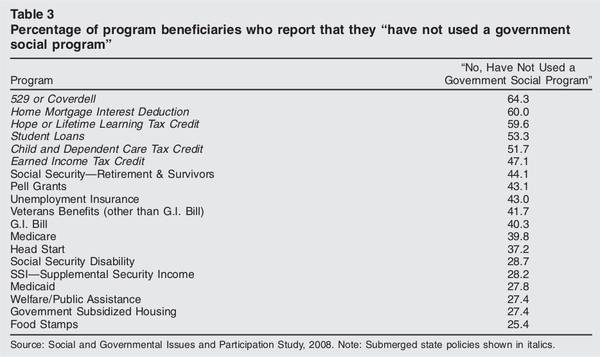
boingboing | "Reconstituting the Submerged State: The Challenges of Social Policy Reform in the Obama Era," a paper by Cornell's Clinton Rossiter Professor of American Institutions Suzanne Mettler features this remarkable chart showing that about half of American social program beneficiaries believe that they "have not used a government social program." It's the "Keep your government hands off my Medicare" phenomena writ large: a society of people who subsist on mutual aid and redistributive policies who've been conned (and conned themselves) into thinking that they are rugged individualists and that everyone else is a parasite. Reconstituting the Submerged State: The Challenges of Social Policy Reform in the Obama Era (PDF)

Chipocalypse Now - I Love The Smell Of Deportations In The Morning

sky |   Donald Trump has signalled his intention to send troops to Chicago to ramp up the deportation of illegal immigrants - by posting a...