Tuesday, March 11, 2014
crimea's case for leaving ukraine
By
CNu
at
March 11, 2014
0
comments
Labels: The Great Game
Monday, March 10, 2014
the professorial president and the small strutting hard man
By
CNu
at
March 10, 2014
1 comments
Labels: presstitution , The Great Game , What IT DO Shawty...
in the lawyers vs. warriors struggle, I'ma bet on the warriors....,
By
CNu
at
March 10, 2014
0
comments
Valodya role-ing like a BOSS!!!
By
CNu
at
March 10, 2014
0
comments
Labels: The Great Game
Sunday, March 09, 2014
blustering bankster beehotches be wyhlin....,
By
CNu
at
March 09, 2014
3
comments
Labels: banksterism , debt slavery , predatory militarism
war devolving back to its killer-ape roots...,
A reason for the Talibanisation is that only Islam appears capable of mobilising people prepared to fight to the death. This is important because wars are determined not by the number of people supporting a cause, but by the number prepared to die for it. Before the collapse of the Soviet Union, national causes were often led by communists, who might begin as a small minority, as they did in the Spanish Civil War, but rapidly expanded because of their organisation and fanatical commitment.
In the Middle East, there is a failing common to beleaguered regimes and their secular opponents that weakens them both. The old nationalist rulers of Egypt, Syria, Libya and Iraq from Nasser on justified their monopoly of political and economic power by claiming that only thus could they make national self-determination a reality. In the early stages they had their successes: Nasser triumphed over Britain and France in the Suez crisis in 1956; Gaddafi took over and raised the price of Libya’s oil in 1973, and Hafez al-Assad successfully confronted Israel in Lebanon in the 1970s and 1980s. By 2011, however, these governments had turned into self-serving cliques whose nationalist slogans were long discredited and whose corruption delegitimised the nation state.
The mistake of civic activists and non-sectarian revolutionaries in 2011 was not to see that emphasis on human and civil rights did not mean much unless a strong nation state could be regenerated. Nationalism may be out of fashion, but without it gluing society together, the alternative is sectarianism, tribalism and foreign domination. As paymasters, the Sunni oil states of the Gulf set the agenda and it is a deeply reactionary one. It is hypocritical and absurd for Western powers to pretend that they are seeking to build secular democracies in alliance with theocratic absolute monarchies in Saudi Arabia and the Gulf.
The future does not look bright. Once sectarian furies are released they become next to impossible to contain. For all the turmoil in Turkey, it is more of a complete nation state than elsewhere in the region. But then that is partly because a fifth of the Turkish population was Christian in 1914 and, following the Armenian massacres and the expulsion or exchange of the Greeks, the proportion fell to about 1 per cent 10 years later.
People ask why the revolutions in Eastern Europe at the time of the fall of communism were so much less violent than in the Middle East. A less than comforting answer is that the East European minorities had been murdered, expelled or forced to flee during or shortly after the Second World War. The same fate could be waiting for the minorities of Syria.
By
CNu
at
March 09, 2014
0
comments
Labels: neofeudalism , peasants
valodya shows admirable restraint in the blood vs. money conflict on his back porch....,
Before anything approaching stability and legitimacy has been obtained for the puppet government put in power by the Washington orchestrated coup against the legitimate, elected Ukraine government, the Western looters are already at work. Naive protesters who believed the propaganda that EU membership offered a better life are due to lose half of their pension by April. But this is only the beginning.
The corrupt Western media describes loans as “aid.” However, the 11 billion euros that the EU is offering Kiev is not aid. It is a loan. Moreover, it comes with many strings, including Kiev’s acceptance of an IMF austerity plan.
Remember now, gullible Ukrainians participated in the protests that were used to overthrow their elected government, because they believed the lies told to them by Washington-financed NGOs that once they joined the EU they would have streets paved with gold. Instead they are getting cuts in their pensions and an IMF austerity plan.
The austerity plan will cut social services, funds for education, layoff government workers, devalue the currency, thus raising the prices of imports which include Russian gas, thus electricity, and open Ukrainian assets to takeover by Western corporations.
Ukraine’s agriculture lands will pass into the hands of American agribusiness.
One part of the Washington/EU plan for Ukraine, or that part of Ukraine that doesn’t defect to Russia, has succeeded. What remains of the country will be thoroughly looted by the West.
The other part hasn’t worked as well. Washington’s Ukrainian stooges lost control of the protests to organized and armed ultra-nationalists. These groups, whose roots go back to those who fought for Hitler during World War 2, engaged in words and deeds that sent southern and eastern Ukraine clamoring to be returned to Russia where they resided prior to the 1950s when the Soviet communist party stuck them into Ukraine.
By
CNu
at
March 09, 2014
0
comments
Labels: banksterism , predatory militarism , What IT DO Shawty...
warsocialist welfare dug in deeper than an alabama tick...,
By
CNu
at
March 09, 2014
0
comments
Labels: deceiver , disinformation , warsocialism , What IT DO Shawty...
Saturday, March 08, 2014
"protect and serve" welfare recipients have no rights that the warsocialist state is bound to respect
By
CNu
at
March 08, 2014
24
comments
Labels: American Original , niggerization , unspeakable , warsocialism
warsocialist welfare support is concentrated in the confederate states of america...,
| Where poverty, obesity, smoking, ignorance, and disease prevail. Deep dysfunction where warsocialist welfare, social conservatism, and the political right-wing rule. |
By
CNu
at
March 08, 2014
0
comments
Labels: American Original , warsocialism
Friday, March 07, 2014
parliamentary sissies runnin nothin but they mouth...,
By
CNu
at
March 07, 2014
8
comments
Labels: The Hardline , unspeakable , you used to be the man
parliamentary sissies fabulous ballin...,
By
CNu
at
March 07, 2014
0
comments
Labels: global system of 1% supremacy , Pimphand Strong
parliamentary sissy fight signifying nothing...,
By
CNu
at
March 07, 2014
0
comments
Labels: 2parties1ideology , Cathedral
Thursday, March 06, 2014
social cognition and social decision-making
By
CNu
at
March 06, 2014
2
comments
Labels: neuromancy , What IT DO Shawty...
the real price of a cup of tetley tea...,
Poverty pay on tea estates in Assam fuels a modern slave trade ensnaring thousands of young girls. A Guardian/Observer investigation follows the slave route from an estate owned by a consortium, including the owners of the best-selling Tetley brand, through to the homes of Delhi's booming middle classes, exposing the reality of the 21st-century slave trade
By
CNu
at
March 06, 2014
0
comments
Labels: hardscrabble , helplessness , peasants
the kafala system
By
CNu
at
March 06, 2014
0
comments
Labels: hardscrabble , helplessness , peasants
Wednesday, March 05, 2014
a one-room school house for the 21st century..,
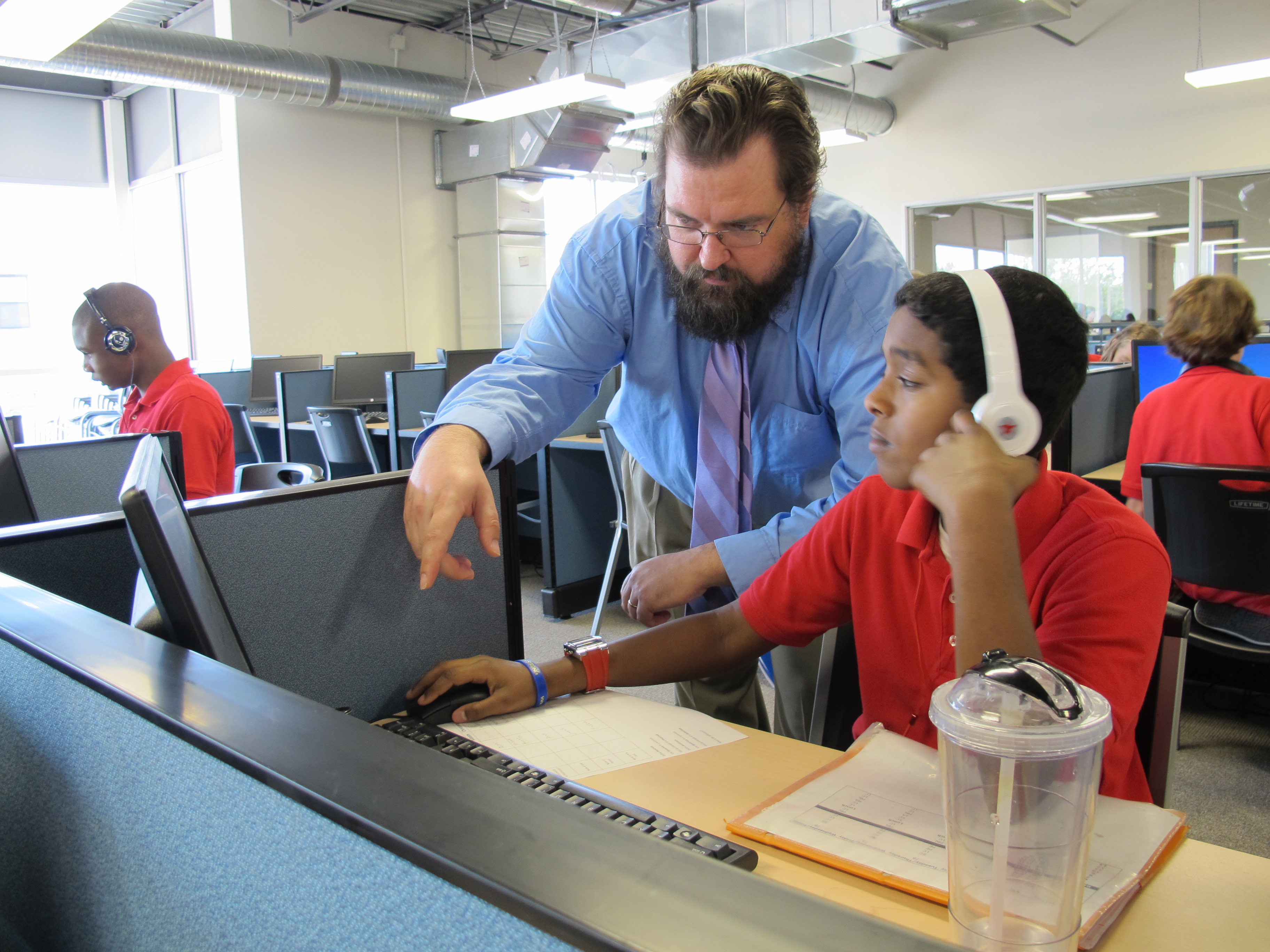
The Indianapolis campus is called Carpe Diem-Meridian. It's located on North Meridian Street, about two miles north of downtown, in a brand new two-story building across from a Wendy's and a liquor store. The school opened in August of 2012. It's designed for 300 students in grades six through 12; the first year there were about 90 students.
The school's founder, Rick Ogston, was a Christian pastor before getting into education. The idea for a school where students would spend part of their day learning on computer came to him after a prayer.
It was 2003. Ogston was running a charter school in Yuma, Arizona. He describes it as a "traditional" school with "traditional teachers, in traditional classrooms, doing traditional things." The school had been open for a few years and things were going pretty well. Test scores were fine. But Ogston felt something wasn't right.
One day he was walking the halls of the school, peering into classrooms. He saw students sitting quietly at their desks, listening to teachers lecture. Everyone looked kind of bored -- the teachers and the kids.
He went back to his office, put his head on his desk, and prayed for guidance.
When Ogston opened his eyes, the first thing he noticed was the cell phone clipped to his waist. Then he lifted his head, "and I looked on my desk and saw the computer." He scanned his office and noticed other forms of technology -- a copier, a fax machine. These were devices he rarely thought about, but now, looking around his office, he realized how much technology had changed the way he worked and lived his life.
Technology had not changed school, though. "We had some of it in classrooms," he says, "but it wasn't nearly being leveraged or used like it could be."
Ogston began to imagine a new kind of school, where students would use computers for their work as much as he did for his. Teachers could stop lecturing if students watched lectures on a computer instead. Teachers could then use class time to answer questions. Some teachers and professors around the country were already experimenting with this approach; it's known as "flipping the classroom." But Ogston didn't know about that. He was following his instincts.
Transforming his school from "traditional" to something new wasn't going to be an easy feat. He predicted teachers and parents would resist.
But then, as Ogston sees it, God intervened. The school lost its lease and the only space available in Yuma was a huge, open room in a University of Phoenix building. There was no way to turn the space into traditional classrooms. To keep operating, his school would have to do things differently. Ogston seized the opportunity to make his vision a reality. All of the students were going to be in one room, working independently on computers. It would be like a one-room schoolhouse for the 21st century.
By
CNu
at
March 05, 2014
25
comments
Labels: edumackation , What Now?
lack of individualization is the 19th century school model's fundamental defect
The first thing to know is that everyone likes to learn.
"There is a sense of satisfaction, of fulfillment, in successful thinking," writes Willingham.
But it's not fun to try to learn something that's too hard.
"Working on a problem with no sense that you're making progress is not pleasurable," writes Willingham. "In fact, it's frustrating."
Working on a problem that's too easy is no fun either. It's boring.
What people enjoy is working on problems that are the right level of difficulty.
"The problem must be easy enough to be solved yet difficult enough to take some mental effort," Willingham writes. He calls this the "sweet spot" of difficulty.
The problem with most schools is that kids don't get to their sweet spot enough. There are 20 other kids in the class - or maybe 30 or even 40. Everyone is in a slightly different place. Some kids get it and want to move ahead. Others are struggling to catch up and need more explanation. It's a challenge for teachers. The best teachers try to meet each student's needs. But a lot of teachers end up teaching to the middle. That leaves a lot of kids bored, or frustrated, or both.
"I think teachers are acutely aware that this is an enormous problem," Willingham said in an interview. "I don't think it's easily solved."
You can trace the roots of the problem back to the Industrial Revolution. That's when American public schools as we know them today got started.
Prior to the rise of factories and cities, most people lived on farms and in small villages. Children were typically educated in one-room schoolhouses. "In such environments, education could be individualized," says Angeline Lillard, a professor at the University of Virginia who has written about the history of education.
Not everything was perfect in the one-room school. But if you were 10 and needed to learn addition, that's what the teacher taught you. If you were 5 and already knew how to write your name, you'd move on with the older kids.
Then in 1847 in Quincy, Massachusetts a new kind of school appeared on the scene. Instead of being together in one room, students were separated into classrooms based on how old they were. It was seen as a more efficient way to educate children.
"The whole country was so taken by this idea that we could improve through industrialization," says Lillard. "Mass production was going to be the wings through which we could fly into the future. And schools were no different."
By the early 20th century, some education experts were actually referring to schools as factories. Elwood Cubberley, dean of Stanford University's School of Education from 1917 to 1933, put it bluntly: Schools were "factories in which the raw products (children) are to be shaped and fashioned into products to meet the various demands of life."
"What we lost from the one-room schoolhouse days was individualization," says Lillard. "We replaced that with an expectation that all children be the same."
Today it's a big challenge to deal with the 10-year-olds who haven't learned addition; they're supposed to be doing fifth-grade math. There's not a good way to deal with the 5-year-olds who are ready to move ahead either.
By
CNu
at
March 05, 2014
0
comments
Labels: common sense , edumackation
Chipocalypse Now - I Love The Smell Of Deportations In The Morning
sky | Donald Trump has signalled his intention to send troops to Chicago to ramp up the deportation of illegal immigrants - by posting a...
-
theatlantic | The Ku Klux Klan, Ronald Reagan, and, for most of its history, the NRA all worked to control guns. The Founding Fathers...
-
NYTimes | The United States attorney in Manhattan is merging the two units in his office that prosecute terrorism and international narcot...
-
Wired Magazine sez - Biologists on the Verge of Creating New Form of Life ; What most researchers agree on is that the very first functionin...