medialens | We live in a time when compassionate rhetoric is used as a weapon of
state-corporate control. The rhetoric focuses on ethical concerns such
as racial, gender and same-sex equality, but is disconnected from any
kind of coherent ethical worldview. Corporate commentators are thereby
freed to laud these moral principles, even as they ignore high crimes of
state-corporate power.
Thus, it was deemed 'historic', even 'epoch-making', by our corporate culture that Barack Obama was elected the first black president of the United States. And it certainly was
a triumph for racial equality. But the moral significance was hailed by
a media commentariat that proceeded to gaze with blank indifference at
the ethical trailblazer's bombing of seven countries, his deep
involvement in four ongoing, full-scale wars, his devastation of Libya,
and his abject failure to address the apocalyptic threat of climate
change.
Alongside these horrors, Obama's involvement in the Honduran coup,
his diplomatic and military support for Egypt's blood-soaked military
junta, and his $90bn in arms sales sent (in the last four years) to a
Saudi Arabian tyranny wreaking havoc in Syria and Yemen, are mere
footnotes.
None of this matters: for our corporate media, Obama remains, above all, the inspirational first black president.
Similarly, in evaluating Obama's possible successor, the Guardian's editorial 'view on Hillary Clinton' focuses on the problem that she is 'hammering the glass ceiling (again)' of gender inequality:
'with four years as her nation's chief diplomat on the world stage
under her belt, Mrs Clinton's personal gravitas is even harder to
quibble with than it might have been in 2008'.
So, for the Guardian editors, Clinton has more 'personal gravitas' now - she actually has more dignity, should be taken more seriously. A remarkable response, as we will see. The Guardian continues:
'On foreign policy, her spell as secretary of state leaves her with a
somewhat clearer record - she is associated with a rather more
interventionist approach than Mr Obama. Her admirers would describe her
as a happy mix of the smart and the muscular; doubters will recall her
vote for the ruinous invasion of Iraq in 2003, and prefer the
Obama-esque oath to first do no harm.'
The cognitive dissonance could hardly be more glaring: Obama's colour
and Clinton's gender are key ethical concerns, and yet Obama's
responsibility for mass killing is not only not a concern, it
is not even recognised. Instead, he continues to be presented as a
benevolent non-interventionist who has consistently chosen to 'do no
harm'.
FP |In
the end, the fate of Rwanda’s victims hardly figured at all in U.S.
calculations about the international community’s response to what turned
out to be the worst mass killing since the Holocaust, according to hundreds of pages of internal White House memos.
On the contrary, Richard Clarke, a special assistant to President
Bill Clinton on global affairs in the NSC and Rice’s boss, had already
been looking for a way out of Rwanda for months. Rwanda’s descent into
mass killing, paradoxically, provided a fresh opportunity.
“We make a lot of noise about terminating U.N. forces that aren’t
working,” Clarke wrote on April 9, just three days after the genocide
started. “Well, few could be as clearly not working. We should work with
the French to gain a consensus to terminate the U.N. mission.”
The Clinton administration’s failure to muster a credible
international response to Rwanda’s mass murder has been amply documented
over the past two decades. President Clinton and his key aides —
including National Security Advisor Anthony Lake, U.S. Ambassador to the
United Nations Madeleine Albright, and Rice, who has since risen to
become President Barack Obama’s top national security advisor — have all
publicly expressed regret that they didn’t do more to stem the killing.
But the recently declassified documents
— which include more than 200 pages of internal memos and handwritten
notes from Rice and other key White House players — provide a far more
granular account of how the White House sought to limit U.N. action.
They fill a major gap in the historical record, providing the most
detailed chronicle to date of policy instructions and actions taken by
White House staffers, particularly Clarke and Rice, who appear to have
exercised greater influence over U.S. policy on Rwanda than the White
House’s Africa hands.
The National Security Archive and the Holocaust Memorial Museum’s Simon-Skjodt Center
for the Prevention of Genocide obtained the documents during a
two-and-a-half-year effort to amass long-secret records of internal
deliberations by the United States, the U.N., and other foreign
governments. They add to a collection of some 20,000 declassified
documents from Britain, France, New Zealand, the Czech Republic, and the
United States. They were mhttps://temple3.wordpress.com/the-clinton-plan-for-africa/ade available exclusively in advance to Foreign Policy before their public release Thursday, which is Holocaust Remembrance Day.
The White House documents, which were secured through Freedom of
Information Act requests, largely confirm previous accounts that portray
the Clinton administration as reluctant to play the role of global
police force, stung by peacekeeping setbacks in Bosnia and Somalia and
faced with a hostile Congress bent on cutting funding for new U.N.
adventures.
But these documents also alter the public record. It was the White
House, not a beleaguered Belgian government that had just suffered the
brutal murder of 10 of its soldiers, that was the first to advocate a
pullout of U.N. blue helmets from Rwanda during the genocide, where they
served as a last line of defense for tens of thousands of terrified
Tutsi civilians.
A midlevel crisis
The documents provide few fresh insights into the thinking of
President Clinton, Secretary of State Warren Christopher, or other top
officials, reinforcing indications that Rwanda policy was left to
midlevel bureaucrats. They place Clarke and Rice — who were overseeing a
far-reaching review of U.N. peacekeeping — at the crux of American
efforts to limit U.N. involvement in Rwanda in the face of mounting
congressional pressure to rein in U.N. peacekeeping costs. The death of
18 U.S. Rangers in Mogadishu while participating in a raid on a Somali
clan on Oct. 3, 1993, less than six months before the genocide began,
only hardened the administration’s resolve to say no to an ambitious new
peacekeeping operation in a country with few historical links to the
United States.
WaPo | One month before his suicide, Tom Schweich announced that he was
running for governor. He looked pale and tired, with dark crescents
under his eyes, but he spoke with precision and force. He told
supporters he had learned to fight liberals by attending Harvard and
Yale, to fight corruption by serving as state auditor, and to fight
terrorism by serving the U.S. government in Afghanistan.
“At the
State Department, I negotiated with everybody from Chinese bureaucrats
to Afghan warlords,” he said. “And I’ll tell you: Negotiating with
Afghan warlords was really good practice for Missouri politics.”
On
the morning of Feb. 26, Schweich put a .22-caliber handgun to his left
temple and pulled the trigger. He left behind a wife, two children and a
Missouri Republican Party divided over the meaning of his death.
Four weeks later, Schweich’s loyal spokesman, Spence Jackson,
also fatally shot himself. The two suicides stunned political observers
far beyond Missouri’s borders and drew attention to the darkest
undercurrent of a race that had quickly turned nasty: allegations that
one of Schweich’s GOP rivals had made an insidious appeal to
anti-Semitism.
The rival denied the charge, and a police report
released this week found little evidence of a sustained campaign. But
Schweich’s friends insist that the whispered bigotry was real and that
it devastated the emotionally fragile Schweich
— who, the report said, had threatened suicide in the past. As the
governor’s race continues without him, his death has sparked a debate in
Missouri over the ugliness and innuendo that pervade modern politics.
Then there is the fridge in your kitchen.
A typical 20-cubic-foot refrigerator — Energy Star-certified, to fit
our environmentally conscious times — runs through 300 to 600
kilowatt-hours a year.
American
diplomats are upset that dozens of countries — including Nepal,
Cambodia and Bangladesh — have flocked to join China’s new infrastructure investment bank, a potential rival to the World Bank and other financial institutions backed by the United States.
The reason for the defiance is not hard to find: The West’s environmental priorities are blocking their access to energy.
A typical American consumes, on average, about 13,000 kilowatt-hours of
electricity a year. The citizens of poor countries — including Nepalis,
Cambodians and Bangladeshis — may not aspire to that level of use, which
includes a great deal of waste. But they would appreciate assistance
from developed nations, and the financial institutions they control, to
build up the kind of energy infrastructure that could deliver the
comfort and abundance that Americans and Europeans enjoy.
Too often, the United States and its allies have said no.
The United States relies on coal, natural gas, hydroelectric
and nuclear power for about 95 percent of its electricity, said Todd
Moss, from the Center for Global Development. “Yet we place major restrictions on financing all four of these sources of power overseas.”
RT | A top Federal Reserve official indicated Tuesday that the municipal
bankruptcies of Detroit, Michigan, and Stockton, California, could mean
further such filings in the future, more so that current bond ratings
suggest.
At a workshop on the US bankruptcy code for local governments, or
Chapter 9, New York Fed President William Dudley spoke of the
possibility for more US cities to fall into bankruptcy before
long.
"While these particular bankruptcy filings have captured a
considerable amount of attention, and rightly so, they may
foreshadow more widespread problems than what might be implied by
current bond ratings," Dudley said, according to a text
of his speech.
"We need to focus our attention today on addressing the
underlying issues before any problems grow to the point where
bankruptcy becomes the only viable option," he added.
Dudley did not mention any specific municipalities that could
join the likes of Detroit, but he did say that cities borrowing
money to pay for a current year's operating budget is
"equivalent to asking future taxpayers to help finance
today's public services."
Chicago is one city that is facing unfunded pension liabilities
of more than $35 billion, according to the Civic Federation.
Chicago received a warning just last week -- the same week it
reelected Rahm Emanuel as mayor -- from
Standard & Poor's over its debts, as the city has $8.3
billion in general obligation bond debt.
"In our view, if the city fails to articulate and implement a
plan by the end of 2015 to sustainably fund its pension
contributions, or if it substantially draws down its reserves to
fund the contributions, we will likely lower the rating,"
Standard & Poor's wrote. "This is regardless of whatever
relief the state legislature may or may not provide. We will
likely affirm the rating and revise the outlook to stable if
Chicago is able to successfully absorb its higher pension costs
while maintaining balanced budgetary performance and reserves at
or near their current level."
Unfunded pensions across the US could be as high as several
trillion dollars, Dudley said.
RT | The Tennessee House of Representatives has voted to make the Bible
the official state book. Legislators backed the measure despite
questions raised by the state’s attorney general about the bill’s
constitutionality and the governor’s stated disapproval.
Republican state Rep. Jerry Sexton, a pastor for 25 years before
being elected in November, sponsored the bill to make the Bible a
state symbol.
“History's going to tell us where we stand on this. I'm
grateful to have the opportunity to have the side that I'm
on,” Sexton said after the vote. “It may be kind to me
in the future and it may not be kind, and that's OK. I made a
decision for today and I feel good about it.”
The House was initially set to vote on the bill on Tuesday, but
waited until Wednesday after receiving the state attorney
general’s legal opinion on the issue, as requested by state Rep.
Bill Sanderson (R). The legislation passed 55-38 over the legal
objections of Tennessee Attorney General Herbert H. Slatery III.
“Yes,
designating The Holy Bible as the official state book of
Tennessee would violate the Establishment Clause of the First
Amendment to the federal Constitution and Article I, § 3, of the
Tennessee Constitution, which provides ‘that no preference shall
ever be given, by law, to any religious establishment or mode of
worship,’” Slatery wrote in his legal opinion.
“When the legislature chooses an official state symbol, it is
in effect saying that the symbol, whether it be a poem, a flag, a
rock, or a glass of milk, stands for and represents the State and
its values in a positive way,” Slatery wrote. “Thus,
these designations of ‘official state symbols’ inherently carry
the imprimatur and endorsement of the government.”
Rep. Marc Gravitt (R) said the attorney general's legal opinion
made it clear Tennessee could spend millions of dollars in a
losing effort to defend the measure if it becomes law, Reuters
reported.
NationalReview | One of the most frustrating aspects of the loud and vitriolic
debates over police shootings is the extent to which they ignore common
sense and human nature. In the quest to find grand narratives, we’re too
quick to discount the simple realities of how human beings react during
times of stress, and we minimize the reciprocal moral and legal
responsibilities that citizens owe police and police owe citizens.
First, when wary, angry, and/or frightened citizens interact with wary,
angry, and/or frightened police — often at odd hours and in moments of
maximum stress — there will inevitably be a certain number of both
tragic mistakes and heinous crimes. Thus, it stands to reason that we
should endeavor to decrease — not increase — such interactions. Yet our
regulatory state keeps criminalizing more and more conduct. In two of
the worst recent incidents, Eric Garner’s choking death and Walter’s
Scott’s apparent execution, the victims were facing prosecution for
violating petty or stupid criminal laws — selling loose cigarettes in
Garner’s case and failing to pay child support in Scott’s case.
Regarding child support, it’s idiotic policy to lock deadbeat dads in
debtors’ prisons. According to one study of South Carolina jails, one
out of every eight inmates was behind bars for falling behind on child
support. Yet inmates are notoriously poor earners, and stints in prison
tend to exacerbate chronic unemployment.
TPM | Fox News host Bill O'Reilly said Monday night that Hillary Clinton
has an edge in the 2016 presidential election because white men and
Christians are under attack in the U.S.
"Working Americans are still struggling to make money in the
marketplace and our traditional American values are under siege nearly
everywhere. If you’re a Christian or a white man in the U.S.A., it’s
open season on you. Therefore Hillary Clinton has an advantage," he said
on "The O'Reilly Factor."
O'Reilly added that he will be "fair" but "tough" to Clinton during the election.
"I don’t think gender matters one bit, and if this war on women
business is resurrected, we’ll have something to say about it," he said.
He also warned Clinton against aligning with "smear merchants" like Media Matters.
slate | There’s wide consensus around the video:
Walter Scott was shot and killed in cold blood as he ran for his life
from Michael Slager, the cop who stands charged with his murder in North
Charleston, South Carolina. But Scott’s demise was set in motion
moments earlier, when Slager decided to pull him over for a traffic
violation—a stop that never should have happened.
The dashcam video
leaves no doubt as to why Slager pulled over Scott: “The reason for the
stop is that your third brake light’s out,” Slager told Scott, minutes
prior to the fatal shooting.
Slager’s asserted “reason” had no premise in South Carolina law:
Scott’s vehicle was in full compliance. Lacking reasonable suspicion
that Scott was doing something illegal, Slager should’ve never pulled
him over in the first place, unless his true motive was something other
than a concern for enforcing the laws he took an oath to uphold.
Policing minor traffic violations as a pretext for more intrusive, “crime-fighting” stops is a real and dangerous problem—Slate’sJamelle Bouie broke down the numbers of how people of color are hit hardest by this rampant style of roadside discrimination.
But there’s another problem: The legal pretexts police use for such traffic stops can be plainly mistaken or made up.
South Carolina law is straightforward
on the issue of third brake lights. Motor vehicles must be equipped
with “a stop lamp on the rear”—a singular brake light, which is to be
maintained in good working order. A South Carolina appeals court has confirmed
this reading: A single operating brake light means a vehicle is “in
full compliance with all statutory requirements regarding rear vehicle
lights,” and a stop premised on requiring anything more is
“unreasonable” and thus a violation of the driver’s constitutional
rights.
So why did Slager pull over Scott? If what he said, as captured on
the dashcam account, is to be believed, Slager made a mistake and
decided to “seize” Scott for a law not in the books. In a perfect world,
such errors should never give a police officer an opportunity to stop
anyone.
salon | Hillary Clinton wants to run for president as an economic
populist, as a humane progressive interested in bolstering the fortunes
of poor and middle class Americans. But before liberals enthusiastically
sign up for Team Hillary, they should remember this: In the late 1990s,
Bill Clinton played in instrumental role in creating the world’s
largest prison system — one that has devastated our inner cities, made a
mockery of American idealism abroad, and continues to inflict needless
suffering on millions of people. And he did it with his wife’s support.
That
liberals are now being asked to get excited for Hillary’s Clinton’s
candidacy, announced on Sunday, almost requires the suspension of
disbelief. That the best progressive alternative to Clinton is a long-shot from Vermont is
a tragedy. This is not to say that President Hillary Clinton would
pursue the same prison policies as her husband — the political headwinds
on criminal justice reform have shifted considerably in the past two
decades, and the Clintons, accordingly, have shifted with
them. But past actions should matter, and what they show is that the
Clinton Dynasty embraced and exacerbated one of the late 20th Century’s
greatest public policy disasters.
The explosion of the prison system under
Bill Clinton’s version of the “War on Drugs” is impossible to dispute.
The total prison population rose by 673,000 people under Clinton’s
tenure — or by 235,000 more than it did under President Ronald Reagan,
according to a study by the Justice Policy Institute. “Under President
Bill Clinton, the number of prisoners under federal jurisdiction
doubled, and grew more than it did under the previous 12-years of
Republican rule,combined,” states the JPI report (italics theirs). The
federal incarceration rate in 1999, the last year of the Democrat’s
term, was 42 per 100,000 — more than double the federal incarceration
rate at the end of President Reagan’s term (17 per 100,000), and 61
percent higher than at the end of President George Bush’s term (25 per
100,000), according to JPI.
people-press | Democrats hold advantages in party identification among blacks, Asians,
Hispanics, well-educated adults and Millennials. Republicans have leads
among whites – particularly white men, those with less education and
evangelical Protestants – as well as members of the Silent Generation.
A new analysis of long-term trends in party affiliation among the
public provides a detailed portrait of where the parties stand among
various groups in the population. It draws on more than 25,000
interviews conducted by the Pew Research Center in 2014, which allows
examination of partisan affiliation across even relatively small racial,
ethnic, educational and income subgroups. (Explore detailed tables for 2014 here.)
The share of independents in the public, which long ago
surpassed the percentages of either Democrats or Republicans, continues
to increase. Based on 2014 data, 39% identify as independents, 32% as
Democrats and 23% as Republicans. This is the highest percentage of
independents in more than 75 years of public opinion polling. (For a timeline of party affiliation among the public since 1939, see this interactive feature.)
When the partisan leanings of independents are taken into account,
48% either identify as Democrats or lean Democratic; 39% identify as
Republicans or lean Republican. The gap in leaned party affiliation has
held fairly steady since 2009, when Democrats held a 13-point advantage
(50% to 37%).
A closer look at …
Race and ethnicity.
Republicans hold a 49%-40% lead over the Democrats in leaned party
identification among whites. The GOP’s advantage widens to 21 points
among white men who have not completed college (54%-33%) and white
southerners (55%-34%). The Democrats hold an 80%-11% advantage among
blacks, lead by close to three-to-one among Asian Americans (65%-23%)
and by more than two-to-one among Hispanics (56%-26%).
Gender. Women
lean Democratic by 52%-36%; men are evenly divided (44% identify as
Democrats or lean Democratic; 43% affiliate with or lean toward the
GOP). Gender differences are evident in nearly all subgroups: For
instance, Republicans lead among married men (51%-38%), while married
women are evenly divided (44% Republican, 44% Democratic). Democrats
hold a substantial advantage among all unmarried adults, but their lead
in leaned partisan identification is greater among unmarried women
(57%-29%) than among unmarried men (51%-34%).
Education. Democrats
lead by 22 points (57%-35%) in leaned party identification among adults
with post-graduate degrees. The Democrats’ edge is narrower among those
with college degrees or some post-graduate experience (49%-42%), and
those with less education (47%-39%). Across all educational categories,
women are more likely than men to affiliate with the Democratic Party
or lean Democratic. The Democrats’ advantage is 35 points (64%-29%)
among women with post-graduate degrees, but only eight points (50%-42%)
among post-grad men.
Generations. Millennials
continue to be the most Democratic age cohort; 51% identify as
Democrats or lean Democratic, compared with 35% who identify with the
GOP or lean Republican. There are only slight differences in partisan
affiliation between older and younger millennials. Republicans have a
four-point lead among the Silent Generation (47%-43%), the most
Republican age cohort.
Religion.
Republicans lead in leaned party identification by 48 points among
Mormons and 46 points among white evangelical Protestants. Younger white
evangelicals (those under age 35) are about as likely older white
evangelicals to identify as Republicans or lean Republican. Adults who
have no religious affiliation lean Democratic by a wide margins (36
points). Jews lean Democratic by roughly two-to-one (61% to 31%). The
balance of leaned partisan affiliation among white Catholics and white
mainline Protestants closely resembles that of all whites.
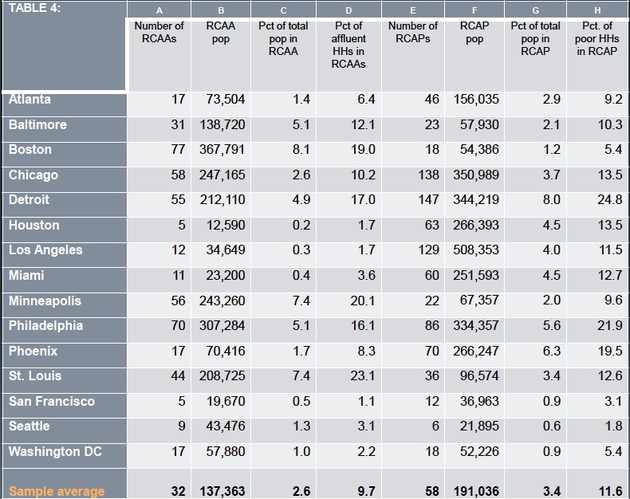
theatlantic | Public policy has “focused on the concentration of poverty and
residential segregation. This has problematized non-white and
high-poverty neighborhoods,” said Goetz, the director of the Center for
Urban and Regional Affairs at the University of Minnesota, when
presenting his findings at the Lincoln Institute of Land Policy. “It’s
shielded the other end of the spectrum from scrutiny—to the point where
we think segregation of whites is normal.”
Goetz and his team are still researching the effects of this
self-segregation of whites, but he thinks that a high number of RCAAs
may be a negative factor for cities.
“Some people argue that when whites and affluent people segregate
themselves, it can erode empathy, and it can inhibit the pursuit of
region-wide remedies,” he told me. “It can inhibit a sense of shared
destiny within a metropolitan area.”
This brings to mind a metro area such as Detroit, which emerged from bankruptcy
last year, and was characterized by a poor and segregated urban core
and wealthy white suburbs that did not contribute to the city’s revenue.
The executive of Oakland County, to Detroit’s north, which is one of
the whitest areas in the nation, has said publicly he doesn’t feel any incentive to help the city of Detroit.
Goetz and his team also researched the RCAAs’ and RCAPs’ distance to
downtown. Areas of affluence are located, on average, 21.1 miles from a
metro area’s downtown. In Detroit, racially concentrated areas of
affluence are, on average, 24.2 miles from the city’s downtown. In
Washington, D.C., racially concentrated areas of affluence are 25.1
miles from downtown; in Chicago, they’re 22.1 miles. Racially
concentrated areas of poverty, on the other hand, are on average 6.6
miles from downtown, and in cities such as Baltimore, St. Louis, and
Philadelphia, they’re much closer.
theatlantic | Now, Kansas's red ink has left the governor red- faced. Brownback is asking Republican state lawmakers to slow the income tax cuts over the next few years,
raise taxes on cigarettes and alcohol, overhaul school funding, and
divert money from the state's highway fund in order to balance the
budget. It's not as if he's abandoning his conservative economic
philosophy—he still wants to replace the state's income tax entirely
with consumption taxes over time. And like any politician on the ropes,
he is preaching patience. "These things take time," he said
last month. He also acknowledged the toll his stumbles have taken on
his image. "We're in Lent season, so I'm giving up worldly things, like
popularity," he joked to a small crowd. Brownback has blamed the budget
shortfall in part on automatic increases in education spending (a
subject of a long-running court dispute), and he's cited a recent uptick
in job growth as evidence that the tax cuts, on the whole, are working.
"Kansas is on the rise, and the state of our state is strong," the
governor proclaimed in an annual budget address in January.
Yet Brownback's latest proposals represent at least a partial
retreat, and it's unclear how many of them the legislature will approve.
"He’s trying to figure out how to save face. I think that’s the bottom
line," Rochelle Chronister, a former Republican state chairwoman, told
me. Chronister has led the GOP opposition to Brownback's agenda through
the group she founded, Traditional Republicans for Common Sense.
A separate anti-Brownback effort led more than 100 current and former
Kansas GOP officials to endorse Brownback's Democratic opponent, Paul
Davis, in the 2014 election. Brownback won anyway, 50 to 46 percent.
"He’s lived and died by this philosophy," Chronister said of the
governor, "and it’s becoming more and more obvious that it is not going
to be successful."
Lori McMillan, a law professor at Topeka's Washburn University
specializing in taxation, said Brownback's latest proposals were
"band-aids" and an example of a "reactionary, by-the-seat-of-your-pants
fiscal policy." The original tax plan went awry, tax analysts said, not
merely because it slashed rates but because it wasn't paired with deeper
structural changes to the budget. The exemption for businesses wasn't
tailored narrowly enough to encourage job creation, and so people rushed
to take advantage of it without actually boosting employment. "They
used a lot of adjectives I’m sure they now regret, like 'immediate' and
'shot-in-the-arm' and 'adrenaline,'" said Joseph Henchman of the Tax
Foundation. "Just cutting taxes, and so deeply, without really any plans
for how the state will pay for the spending that it’s not
cutting–that’s proven to be a big problem there."
theatlantic |Writing the final manuscript, he synthesized the team’s
research on racial discrimination in the United States, but he also
injected his untested hypothesis about white Americans. The first pages
of An American Dilemma stated that the race problem in the United
States was a moral issue: “The Negro is a ‘problem’ to the average
American partly because of a palpable conflict between the status
actually awarded him and those ideals.” Americans not only felt this
tension, he argued, but also acted on it to create positive social
change in the country. In the final chapter, he emphasized to his
American readers the global significance of living up to their
egalitarian ideals. However, he offered no empirical support for his
conclusion that Americans experienced a moral dilemma at the sight of
racial discrimination.
Reviewing Myrdal’s book, Howard University’s E. Franklin
Frazier wrote: “One would certainly agree with the author in the sense
that all social problems are moral problems. But it might be questioned
whether the problem is on the conscience of white people to the extent
implied in his statement of the problem.” Echoing Frazier in his own
review of An American Dilemma, Yale University sociologist Davie
reflected: “Though the treatment of the Negroes is without a doubt the
greatest challenge to American democracy, the conscience of white
America does not appear to be as aware and disturbed as Myrdal thinks it
is from the rational moral standpoint.”
The University of North Carolina’s Campbell tested the
hypothesis on nearly three hundred students at an un-disclosed public
university in the South that was likely his own. “Gunnar Myrdal
performed a disservice to our understanding of segregated social systems
by his drastic simplification of the normative dimensions of the
issue,” he concluded. “It seems apparent that the American Creed simply
is not transmitted to many people as a set of values pertinent to racial
issues. Further, a segregated system provides its own set of
counter-norms, a rationale that justifies the system while it helps the
actor in the system to compartmentalize or re-interpret the American
Creed.” Yes, racial discrimination in the United States conflicted with
the American Creed. And yet, Campbell’s study suggested that Americans
did not necessarily experience any moral angst about the contradiction.
Late-twentieth-century sociologists peppered journal articles
with doubts about Gunnar Myrdal’s claims. Nevertheless, the American
public embraced this image of itself. Even today, with little reflection
on whether it is true or not, Americans like to echo Myrdal’s
hypothesis that they belong to a people whose moral compass drives them
to address racial discrimination. When he spoke at Selma, President
Obama perpetuated this theory. Over seventy years after the publication
of An American Dilemma and in this moment of heightened
reflection on racial discrimination in the United States, though,
perhaps it is time for the American public to question that idea.
Myrdal’s theory of Americans as a moral people who champion
racial equality may seem harmless. After all, much as Myrdal imagined,
it might motivate Americans to achieve these ideals, and it can burnish
the image of the United States abroad. But however comforting and
flattering that image might be, and however politically useful it may
prove on the domestic and global stages, it obscures harder truths. As
Campbell discovered, many Americans felt that segregation was either
irrelevant to, or consonant with, these basic principles. Instead of
assuming, like Myrdal, that Americans will inevitably feel compelled to
rectify racial discrimination to meet their egalitarian ideals, perhaps
making progress on issues of race requires acknowledging that absent
difficult discussions on what equality means in the U.S. and conscious
organizing to bring it about, nothing will change at all.
theatlantic | THAT brings me to the issue of race consciousness. America in Black and White
takes a very strong line in favor of what might be called
"racelessness" for blacks (and whites). The authors castigate a black
high school student for speaking of "my people" in reference to people
of African descent. "His people" should be simply the American people,
they suggest. Would that it were so. Public expressions of racial
solidarity by blacks worry them. They call "racially divisive" a slogan
one used to see on T-shirts -- "It's a black thing, you wouldn't
understand." They go this far: The police in Boston, believing the story
of one Charles Stuart, a white man who alleged that his wife had been
killed by a black, laid down an invasive dragnet seeking the killer in a
largely black community. Later it was learned that Stuart himself had
slain his wife. The Thernstroms argue in this context that the credulity
of the police was understandable, in part because rap-music lyrics
declare all whites to be the enemy, and worthy objects of black
violence.
The Thernstroms know that race relations are not at a
happy juncture in America these days. They discuss the O. J. Simpson
trial, a source of much recent racial disharmony, at length. (All they
can find to say about that enormous expression of race consciousness,
the 1995 Million Man March, is that Minister Louis Farrakhan, who called
the march, gave a bizarre speech.) Their diagnosis of the problem
places great weight on a syllogism that may now be outmoded, proposed
originally by Shelby Steele: Blacks and whites are supposedly locked
into a relationship of mutual psychological dependence and reciprocal
cognitive dissonance. Blacks fear they may be inferior. Whites fear they
may be racist. Blacks want status achievement while avoiding true
competition, which might reveal their inferiority. Whites want to avoid a
confrontation with black claimants over the basis of black status, so
as not to appear to be racist. Blacks convey approval to whites,
certifying them as morally fit; and whites provide status to blacks,
protecting them from the reality of their competitive inadequacies.
This purported symbiosis accounts for blacks' aggressive displays of their sense of grievance. Thus
The relentless pretense that almost all whites are an enemy, that
white racism remains a constant, serves a purpose. It invites whites who
are nervous about their racial rectitude to remain supplicants. The
result is an unending game (black anger, white guilt) in which the white
score is always zero, and the illusion of power is bestowed upon a
group whose members seem to live in constant fear that their hard-earned
status is not quite real -- that they remain the "invisible" men and
women they once so clearly were.
This was a new insight a decade ago. It has not worn well over time, however. Events like the publication of
the 1994 elections, and the passage in California of Proposition 209
raise questions about the power of white guilt to drive political
culture in this country. Is it not enough to cast an eye over the scene
unfolding in inner-city America in order to grasp that blacks have real
reasons to be angry, and that the white score in the game that counts is
positive after all?
The authors of America in Black and White
blame the existence of affirmative action -- in college admissions, in
the drawing of voting districts, in employment -- for an excess of race
consciousness among blacks. This, they say, gives blacks an incentive to
sustain their belief in "the figment of the pigment." The authors
consider recommending that official government bodies do away entirely
with the use of racial categories in economic and social statistics, but
ultimately reject the idea. They note that in 1993 a group of big-city
mayors asked the U.S. Attorney General to cease collecting crime data by
race, because this information was of no use to policy and fostered
harmful stereotypes. These officials reasoned, not without some basis in
experience, that if people are constantly told that most criminals are
black, they may come to think that most blacks are criminal. The
Thernstroms chide these mayors for inconsistency -- the mayors want the
bad racial news suppressed, but welcome the collection of employment or
education data showing that blacks are underrepresented in some
desirable pursuit.
truthdig | Although the United States, in the words of columnist Nicholas
Kristof, is “the most powerful colossus in the history of the world,” it
lags significantly in quality of life for its citizens. In the Social Progress Index 2015
the U.S. does not make the top 10, or even top 15. The global study
measured “basic human needs,” “foundations of wellbeing” and
opportunity.
Overall, the U.S comes in at 16th, and some indices are particularly startling.
As Kristof writes
in The New York Times: “The index ranks the United States 30th in life
expectancy, 38th in saving children’s lives, and a humiliating 55th in
women surviving childbirth. O.K., we know that we have a high homicide
rate, but we’re at risk in other ways as well. We have higher traffic
fatality rates than 37 other countries, and higher suicide rates than
80. We also rank 32nd in preventing early marriage, 38th in the equality
of our education system, 49th in high school enrollment rates and 87th
in cellphone use.”
The top countries in the study are Norway, Sweden, Switzerland, Iceland,
New Zealand and Canada. Of the 133 countries rated, Central African
Republic comes in last, right after Chad and Afghanistan.
“One way of looking at the index,” says Kristof, “is to learn from
countries that outperform by having social indicators better than their
income levels. By that standard, the biggest stars are Costa Rica and
Uruguay, with New Zealand and Rwanda also outperforming.”
In a time of ever-greater economic inequality, it’s worth remembering
that everything isn’t just dandy if some Americans are doing extremely
well. What counts is how we are doing as a people.
UN | The General Assembly today adopted a resolution which for the
twenty-third year in a row called for an end to the United States
economic, commercial and financial embargo on Cuba.
Exposing an intractable demarcation of the international community,
188 Member States voted in favour and, as in previous years, the United
States and Israel voted against. Three small island States — Marshall
Islands, Federated States of Micronesia and Palau — abstained from the
vote.
By the terms of the text, the Assembly reiterated its call upon
States to refrain from promulgating and applying laws and regulations,
such as the 1996 Helms-Burton Act, the extraterritorial effects of which
affected the sovereignty of other States, the legitimate interests of
entities or persons under their jurisdiction and the freedom of trade
and navigation.
It once again urged States that had and continued to apply such laws
to repeal or invalidate them as soon as possible, in line with their
obligations under the United Nations Charter and international law.
In recent times, the blockade imposed by the United States against
Cuba had been tightened, and its extraterritorial implementation had
also been strengthened through the imposition of unprecedented fines,
the Minister for Foreign Affairs of Cuba told the Assembly as he
introduced the draft resolution. The accumulated economic damages of
the blockade totalled $1.1 trillion, based on the price of gold.
The representative of the target of the resolution, the United
States, disagreed with that assessment, saying in a statement explaining
its negative vote that Cuba’s economic woes were due to the policies it
had pursued over the last half century. And while Cuba’s fight against
Ebola was laudable, it did not excuse the country’s treatment of its
own people.
It was a sentiment echoed to some degree by Italy’s representative,
speaking on behalf of the European Union, who after criticizing the
embargo reiterated the Union’s call on the Cuban Government to fully
grant its citizens internationally recognized civil, political and
economic rights and freedoms.
But regionally, Barbados’s representative, speaking on behalf of the
Caribbean Community (CARICOM), chose to focus on how students from
CARICOM countries had benefited from free tertiary education in Cuba,
also noting with appreciation that Cuba was in the process of mobilizing
461 doctors and nurses to West Africa — the largest medical contingent
of any country to help in the fight against Ebola.
DailyMail | The
Cheyenne Mountain Complex is one of the icons of the Cold War - a
self-contained and sufficient town buried under the Rockies meant to be
impervious to a Soviet nuclear barrage.
It
was home to the North American Aerospace Command (NORAD), scanning the
skies for Russian missiles and the military command and control center
of the United States in the event of World War Three.
The
high tech base entered popular culture with appearances in the 1983
Cold War thriller War Games and 1994's Stargate - which imagined the
complex as a clandestine home for intergalactic travel.
It shut down
nearly ten years ago as the threat from Russia seemed to subside, but
this week the Pentagon announced that Cheyenne Mountain will once again
be home to the most advanced tracking and communications equipment in
the United States military.
The
shift to the Cheyenne Mountain base in Colorado is designed to
safeguard the command's sensitive sensors and servers from a potential
electromagnetic pulse (EMP) attack, military officers said.
The
Pentagon last week announced a $700 million contract with Raytheon
Corporation to oversee the work for North American Aerospace Command
(NORAD) and US Northern Command.
Admiral
William Gortney, head of NORAD and Northern Command, said that 'because
of the very nature of the way that Cheyenne Mountain's built, it's
EMP-hardened.'
theatlantic | In Safa al-Ahmad’s new documentary on the pitched battle for Yemen, which aired this week on Frontline,
the Saudi Arabian filmmaker passes by countless posters declaring—and a
number of schoolchildren gleefully chanting—a set of lines that may
sound familiar to Americans who lived through the Iran hostage crisis:
God is great Death to America Death to Israel God curse the Jews Victory to Islam
The chilling slogan belongs to the Houthis, the enigmatic rebel group that has taken over the Yemeni capital Sanaa and other parts of the country, and ousted Yemeni President Abd-Rabbu Mansour Hadi and his government. But the echoes of Iran's revolutionary "Death to America" chant don't necessarily mean, as manyhavesuggested,
that the Houthis are a proxy force for Shia-led Iran in its battle with
Sunni-led Saudi Arabia, which borders Yemen and has now launched air strikes against the Houthis.
The multi-front fight for Yemen—which involves numerous other factions
including al-Qaeda in the Arabian Peninsula and supporters of former
President Ali Abdullah Saleh—is far more complicated than a
straightforward sectarian proxy war, Ahmad says.
Celebrating 113 years of Mama Rosa McCauley Parks
-
*February 4, 1913 -- February 4, 2026*
*Some notes: The life of the courageous activist Mama Rosa McCauley Parks*
Mama Rosa's grandfather Sylvester Ed...
Monsters are people too
-
Comet 3I/Atlas is on its way out on a hyberbolic course to, I don't know
where. I do know that 1I/Oumuamua is heading for the constellation Pegasus,
and ...
Remembering the Spanish Civil War
-
This year marks the 90th anniversary of the launch of the Spanish Civil
War, an epoch-defining event for the international working class, whose
close study...
Return of the Magi
-
Lately, the Holy Spirit is in the air. Emotional energy is swirling out of
the earth.I can feel it bubbling up, effervescing and evaporating around
us, s...
Covid-19 Preys Upon The Elderly And The Obese
-
sciencemag | This spring, after days of flulike symptoms and fever, a man
arrived at the emergency room at the University of Vermont Medical Center.
He ...
-
(Damn, has it been THAT long? I don't even know which prompts to use to
post this)
SeeNew
Can't get on your site because you've gone 'invite only'?
Man, ...
First Member of Chumph Cartel Goes to Jail
-
With the profligate racism of the Chumph Cartel, I don’t imagine any of
them convicted and jailed is going to do too much better than your run of
the mill ...