globalresearch | The warnings about fallout from nuclear tests six decades ago often noted that cancers from the radiation would probably not begin appearing in large numbers for many years. But that time is now – and medical experts are wondering whether the surge in some cancers is a result.
Back in the 1950s and 1960s, the Atomic Energy Commission doused the entire United States with thyroid cancer-causing iodine-131 — and 300 other radioisotopes — by exploding atomic and hydrogen bombs above ground. To protect the dirty, secretive, militarized bomb-building industry, the government chose to warn the photographic film industry about the radioactive fallout patterns, but not the general public.
In 1951, the Eastman Kodak Company had threatened a federal lawsuit over the nuclear fallout that was fogging its bulk film shipments. Film was not packed in bubble wrap then, but in corn stalks that were sometimes being fallout-contaminated.
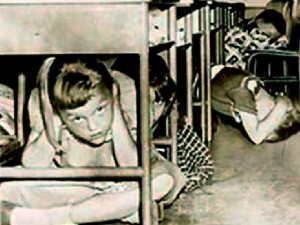
Image: During nuclear bomb drills in the 1950s, school children were ordered to hide under their desks.
By agreeing to warn Kodak, etc., the AEC and the bomb program avoided the public uproar — and the bomb testing program’s possible cancellation — that a lawsuit would have precipitated. The settlement kept the deadliness of the fallout hidden from farmers and the public, even though the government well knew that fallout endangered all the people it was supposed to be defending.
This staggering revelation was heralded on Sept. 30, 1997, in the New York Times headline, “U.S. Warned Film Plants, Not Public, About Nuclear Fallout.” The article began, “[W]hile the Government reassured the public that there was no health threat from atmospheric nuclear tests…” The fallout’s radioactive iodine-131delivered thyroid doses to virtually all 160 million people in the U.S. at the time.
According to the Institute for Energy and Environmental Research (IEER) in Takoma Park, Maryland, which discovered the cover-up, children were especially affected and received higher doses because they generally consumed more milk than adults and since their thyroids are smaller and growing more rapidly. The “milk pathway” moves radioiodine from grass, to cows, to milk with extreme efficiency — a fact known to the government as early as 1951.
Ingested iodine-131 concentrates in the thyroid gland where it can cause cancer. Average doses to children averaged between 6 and 14 rad, with some as high as 112 rad. Prior to 1997, the government claimed that thyroid doses to children were 15 to 70 times less.
The Arkansas Nuclear One nuclear reactor – operated by Entergy – suffered an accident yesterday which killed one and injured 8 workers.
The plant vented steam to cool the reactor. Air detection teams have
been deployed to the area, and local residents are worried. See this, this and this.
Only 40 miles from the nuclear plant, Arkansas was hit with a major oil spill.
NBC News is reporting
that an ExxonMobil pipeline rupture near Little Rock Friday evening has
resulted in a “major oil spill,” according to the Environmental
Protection Agency. And see this.
Why are nuclear and fossil fuel disasters happening at the same
time? Because the accidents are caused by the exact same thing: greed.
msn | It's already well known how devastating the March 2011 Fukushima nuclear
reactor meltdown was for Japan -- dramatic spikes in radiation-related
illnesses, an increase in likely cancer deaths over the next several
years, and pollution which may never truly be cleaned up.
A new study
suggests what many worldwide have feared -- that the devastation from
the traveling radiation has in fact sickened infants in other countries,
including babies born shortly after the incident in Hawaii, Alaska,
Washington, Oregon, and California.
The study,
conducted by scientists with the Radiation and Public Health Project,
found that babies born shortly after the incident were 28 percent more
likely to suffer from congenital hypothyroidism than were children born
in those states during the same period one year earlier. In the rest of
the U.S., which received less radioactive fallout, the risks actually
decreased slightly compared with the year before.
The explosions
produced the radioisotope iodine-131, which floated east over the
Pacific Ocean and landed through precipitation on West Coast states as
well as other Pacific countries. The levels of that isotope were
measured in levels hundreds of times greater
than supposedly safe levels. Radioactive iodine accumulates in human
thyroid glands, and, in babies and fetuses, the radiation can stunt the
growth and development of both the body and the brain. That condition
is congenital hypothyroidism (which, luckily, is treatable when and if
detected early).
Fukushima fallout appeared to affect all areas of
the U.S., and was especially large in some, mostly in the western part
of the nation, the study said. Even worse, other conditions affecting
babies born in that time frame may have been caused or worsened by
Fukushima, the researchers said.
guardian | Most of the world's people are decent, honest and kind. Most of those
who dominate us are inveterate bastards. This is the conclusion I've
reached after many years of journalism. Writing on Black Monday, as the British government's full-spectrum attack on the lives of the poor commences, the thought keeps returning to me.
"With
a most inhuman cruelty, they who have put out the people's eyes
reproach them of their blindness." This government, whose mismanagement
of the economy has forced so many into the arms of the state, blames the
sick, the unemployed, the underpaid for a crisis caused by the feral
elite – and punishes them accordingly. Most of those affected by the bedroom tax, introduced today, are disabled. Thousands will be driven from their homes, and many more pushed towards destitution. Relief for the poor from council tax will be clipped;
legal aid for civil cases cut off. Yet at the end of this week those
making more than £150,000 a year will have their income tax cut.
Two
days later, benefit payments for the poorest will be cut in real
terms. A week after that, thousands of families who live in towns and
boroughs where property prices are high will be forced out of their
homes by the total benefits cap. What we are witnessing is raw economic
warfare by the rich against the poor.
So the age-old question
comes knocking: why does the decent majority allow itself to be governed
by a brutal, antisocial minority? Part of the reason is that the
minority controls the story. As John Harris explained in the Guardian,
large numbers (including many who depend on it) have been persuaded
that most recipients of social security are feckless, profligate
fraudsters. Despite everything that has happened over the last two
years, Rupert Murdoch, Lord Rothermere and the other media barons still
seem to be running the country. Their relentless propaganda, using
exceptional and shocking cases to characterise an entire social class,
remains highly effective. Divide and rule is as potent as it has ever
been.
But I've come to believe that there's also something deeper
at work: that most of the world's people live with the legacy of
slavery. Even in a nominal democracy like the United Kingdom, most
people were more or less in bondage until little more than a century
ago: on near-starvation wages, fired at will, threatened with extreme
punishment if they dissented, forbidden to vote. They lived in great and
justified fear of authority, and the fear has persisted, passed down
across the five or six generations that separate us and reinforced now
by renewed insecurity, snowballing inequality, partisan policing.
Any
movement that seeks to challenge the power of the elite needs to ask
itself what it takes to shake people out of this state. And the answer
seems inescapable – hope. Those who govern on behalf of billionaires are
threatened only when confronted by the power of a transformative idea.
guardian | Millions of internal records have leaked from Britain's offshore
financial industry, exposing for the first time the identities of
thousands of holders of anonymous wealth from around the world, from
presidents to plutocrats, the daughter of a notorious dictator and a
British millionaire accused of concealing assets from his ex-wife.
The leak of 2m emails and other documents, mainly from the offshore haven of the British Virgin Islands
(BVI), has the potential to cause a seismic shock worldwide to the
booming offshore trade, with a former chief economist at McKinsey
estimating that wealthy individuals may have as much as $32tn (£21tn)
stashed in overseas havens.
In France, Jean-Jacques Augier,
President François Hollande's campaign co-treasurer and close friend,
has been forced to publicly identify his Chinese business partner. It
emerges as Hollande is mired in financial scandal because his former
budget minister concealed a Swiss bank account for 20 years and
repeatedly lied about it.
In Mongolia, the country's former
finance minister and deputy speaker of its parliament says he may have
to resign from politics as a result of this investigation.
But the
two can now be named for the first time because of their use of
companies in offshore havens, particularly in the British Virgin
Islands, where owners' identities normally remain secret.
The
naming project may be extremely damaging for confidence among the
world's wealthiest people, no longer certain that the size of their
fortunes remains hidden from governments and from their neighbours.
The online version of 2.002 offers video lectures searchable by keyword,
and organized as a tree of basic concepts that branch into related
subtopics.
mit | Jasmine Chan’s course schedule this semester would suggest that the MIT sophomore is more than a little overbooked.
Chan,
a mechanical engineering major, is taking two classes that meet at
exactly the same time. Despite this apparent scheduling snafu, she
hasn’t missed a single lecture in either course — and her approach to
juggling the conflicting courses may represent the future of ambitious
academic scheduling.
Chan is one of 11 students this semester
who are participating in i2.002, a new online version of 2.002
(Mechanics and Materials II), a core requirement in mechanical
engineering. The online course features videotaped lectures from 2.002,
as well as recitations and a discussion forum that are similar to
elements of edX, MIT’s OpenCourseWare, and other massive open online
course (MOOC) platforms.
What may set i2.002 apart is its ease
of searching: Search a key word or concept, and a video will start at
exactly the moment in a lecture when that concept is introduced.
“It’s
like Googling your class,” says Ken Kamrin, the Class of 1956 Career
Development Assistant Professor of Mechanical Engineering. “It’s a
clickable, searchable index of videos … something that might be
considered as part of the next generation of textbooks.”
“These
are exciting times for online education,” says Pedro Reis, the Esther
and Harold E. Edgerton Assistant Professor of Civil and Environmental
Engineering and Mechanical Engineering. “There’s huge momentum at the
moment for developing technology, through edX and other MOOC platforms,
to deploy to a very large number of students. We’re saying, ‘Let’s take
that approach and apply it to benefit our own students.’” Fist tap Dale.
cluborlov | A cultural flip is needed to change from impersonal, commercial
relationships to personal relationships based on trust, and the first
hurdle, for many people, is in understanding what trust actually is,
because there is no innate human quality called trustworthiness,
possessed by some people, lacking in others. Rather, it is more along
the lines of a generalization concerning a given individual’s behavior
over time, within a given relationship. Trust is transactional: a person
needs a reason to trust you, and you need a reason to trust that
person. There is, however, such a quality as trustfulness: this is the
property of small children, tame animals and, most unfortunately for
them, many regular, salt-of-the-earth, mainstream Americans. It is of
negative survival value in the context of financial collapse. It is
being exhibited for all to see by some of the people who recently lost
money when MF Global stole it to cover some private bets it had made.
They licked their wounds, complained bitterly, and then...went looking
for another financial company—to be taken advantage of again. Since the
head of MF Global wasn’t punished, why wouldn’t another company do the
same to them, knowing that it can do so with impunity?
There also seems to be a certain set of traits possessed in abundance by
a category of highly effective American financial operators that makes
it easy for them to prey on trustful people. It may be the suits they
wear, or the English they speak or their general demeanor—let us call it
“trustiness,” to go along with the “truthiness” of their financial
disclosures. Deep down, trustful people feel privileged to be robbed by
such superior specimens. The predator-prey relationship has been honed
to the fine point of a pen: told to sign their life away on the dotted
line, the besotted, trustful American gulps quietly—and signs.
Clearly, whenever there is an asymmetry between trustfulness and
trustworthiness, the trustful party loses. Trust is not the property of
one individual but the property of the relationship between individuals,
and it must be balanced. There are roughly three types of trust. The
first and best kind is trust borne of friendship, sympathy and love.
People simply do not want to lose the trust of those they care about,
and will do anything they can to make good on their promises. The second
type of trust is based on reputation. It is not quite as solid, because
someone’s reputation can be ruined without you knowing it. People who
realize that their reputation has been ruined tend to stop being
trustworthy rather suddenly, because they see that they have nothing
left to lose in the trust game. Rather, they try to salvage whatever
residual value their formerly trustworthy reputation still holds by
taking full advantage of anyone who is still trustful through force of
habit, lack of up-to-date information, inattention or sheer inertia. The
last category of trust, the worst kind, is coerced: it is a matter of
making it too expensive or too unpleasant for someone to break your
trust. If you are forced to do business with someone you don’t trust at
all, trade hostages for the duration of the transaction or come to some
other arrangement that compels good behavior from both sides. Fist tap Dale.
aera-l | Relevant to the recent Atlanta cheating scandal, a
byproduct of the draconian consequences of failure to meet AdequateYearly Progress targets of the No ChildLeft Behind act , I point to six empirical
"laws" related to "The Counterproductivity of Targets,"
five of which were listed EvalTalk's Bill Fear (2013) in his EvalTalk
post "The Performance Paradox...da da da!!". These are
epitomized by "Campbell's Law": "The more any
quantitative social indicator is used for social decision-making, the
more subject it will be to corruption pressures and the more apt it
will be to distort and corrupt the social processes it is intended to
monitor."
Fear (2013), wrote:
I first heard Frans Leeuw talk about the
"Performance Paradox" in relation to evaluation.
Unfortunately I don't think he wrote about it other than a thesis by
one of his students.
However, quite by chance I found some of the roots of it
today.
It seems that MarilynStrathernwas one of the
first to articulate this phenomenon in recent times. I like her
quote for it's brevity.
1. "When a measure becomes a target, it ceases to be a good
measure."
- Marilyn Strathern (1997)
2. Goodhart's Law "Any observed
statistical regularity will tend to collapse once pressure is placed
upon it for control purposes." Also: "Once a social or
economic indicator or other surrogate measure is made a target for the
purpose of conducting social or economic policy, then it will lose the
information content that would qualify it to play such a
role."
- Charles Goodhart (1981).
3. The Lucas critique "It is naïve to try
to predict the effects of a change in economic policy entirely on the
basis of relationships observed in historical data, especially highly
aggregated historical data."
- Robert Lucas (1976)
4. "A risk model breaks down when used for regulatory
purposes."
- Jon
Danželsson (2002)
5. Campbell's Law: "The more any quantitative social
indicator is used for social decision-making, the more subject it will
be to corruption pressures and the more apt it will be to distort and
corrupt the social processes it is intended to monitor."
- Donald Campbell (1976)
NYTimes | I recently watched my sister perform an act of magic.
We were sitting in a restaurant, trying to have a conversation, but
her children, 4-year-old Willow and 7-year-old Luca, would not stop
fighting. The arguments — over a fork, or who had more water in a glass —
were unrelenting.
Like a magician quieting a group of children by pulling a rabbit out
of a hat, my sister reached into her purse and produced two shiny Apple
iPads, handing one to each child. Suddenly, the two were quiet. Eerily
so. They sat playing games and watching videos, and we continued with
our conversation.
After our meal, as we stuffed the iPads back into their magic storage bag, my sister felt slightly guilty.
“I don’t want to give them the iPads at the dinner table, but if it
keeps them occupied for an hour so we can eat in peace, and more
importantly not disturb other people in the restaurant, I often just
hand it over,” she told me. Then she asked: “Do you think it’s bad for
them? I do worry that it is setting them up to think it’s O.K. to use
electronics at the dinner table in the future.”
I did not have an answer, and although some people might have
opinions, no one has a true scientific understanding of what the future
might hold for a generation raised on portable screens.
But Dr. Small says we do know that the brain is highly sensitive to stimuli, like iPads and smartphone screens, and if people spend too much time
with one technology, and less time interacting with people like parents
at the dinner table, that could hinder the development of certain
communications skills.
So will a child who plays with crayons at dinner rather than a coloring application on an iPad be a more socialized person? Fist tap Dale.
aps | Although "inquiry teaching" has been a hot topic in science education
for many years, it may be useful to reflect on some unresolved issues
associated with it. The main point of this essay is that the relative
effectiveness of different types of instructional "approaches" is not
always investigated with the same rigor that permeates all strong
scientific disciplines–clear definitions, well-defined empirical
procedures, and data-driven conclusions. The second–and more
contentious–point is that for many aspects of science instruction,
"discovery learning" is often a less effective way to teach than a
direct, didactic, and explicit type of instruction. Some in the physics
education community may view this assertion as a foolhardy heresy, while
for others it may be a dark secret that they have been reluctant to
share with their colleagues. But heresies and secrets are hardly the way
to discover and implement maximally effective instructional methods for
teaching science.
I am not alone in suggesting that common practices in physics education
may have scant empirical support. Several years ago Handelsman, et al.1
asked: " … why do outstanding scientists who demand rigorous proof for
scientific assertions in their research continue to use and, indeed,
defend on the basis of their intuition alone, teaching methods that are
not the most effective?" (p. 521) The specific lament in Handelsman et
al. is the claim that much science education is based on a traditional
form of didactic lecturing. However, one could just as well use that
very same critique about the lack of "rigorous proof" to challenge the
current enthusiasm for "inquiry approaches" to science education.
For example, an influential report from the NAS on inquiry approaches to science education2
states that "…studies of inquiry-oriented curriculum programs …
demonstrated significant positive effects on various quantitative
measures, including cognitive achievement, process skills, and attitudes
toward science." This would seem to be clear evidence in support of
inquiry-approaches to science instruction, except that the report goes
on to note, parenthetically, that "there was essentially no correlation
between positive results and expert ratings of the degree of inquiry in
the materials (p. 125)." Thus we have an argument for the benefits of a
particular pedagogy, but no consensus from experts about the "dose
response", i.e., the extent to which different "degrees of inquiry" lead
to different types or amounts of learning.
One wonders about the evidential basis for the wide-spread enthusiasm
for inquiry science, given the lack of operational definitions of what
constitutes an "inquiry-based" lesson–or entire curriculum–and what
specific features distinguish it from other types of instruction. There
is a particular irony here in that the very field that has developed
extraordinarily clear norms and conventions for talking about methods,
theories, instrumentation, measurement, underlying mechanisms, etc.
often abandons them when engaging in research on science education.
newscientist | ROB a bank and you risk a long stretch in jail. Run a bank whose dubious behaviour leads to global economic collapse and you risk nothing of the sort, more likely a handsome pay-off.
Illegal and dangerous mistakes associated with the financial industry have caused serious harm to US and world economies. That is beyond doubt. And the scandals keep coming – rate rigging, money laundering, mis-selling and sanctions busting. The wider backlash against the industry shows no sign of easing.
So given the scale of damage and public anger, fuelled by the industry's bonus culture, it is curious that those responsible have largely avoided punishment in the traditional judicial sense, despite the clamour for it.
That we so want those involved to get their just deserts has its roots in ancient human forms of social control, which led to our modern sense of morality.
In their rudimentary, hunter-gatherer forms, crime and punishment surely go back for tens of millennia. The case has been made that by 45,000 years ago, or possibly earlier, people were practising moralistic social control much as we do.
Without exception, foraging groups that still exist today and best reflect this ancient way of life exert aggressive surveillance over their peers for the good of the group. Economic miscreants are mainly bullies who use threats or force to benefit themselves, along with thieves and cheats.
All are free-riders who take without giving, and all are punished by the group. This can range from mere criticism or ostracism to active shaming, ejection or even capital punishment. This moral behaviour was reinforced over the millennia that such egalitarian bands dominated human life.
Then around 12,000 years ago, larger, still-egalitarian sedentary tribes arrived with greater needs for centralised control. Eventually clusters of tribes formed authoritative chiefdoms. Next came early civilisations, with centrally prescribed and powerfully enforced moral orders. One thing tied these and modern, state-based moral systems to what came before and that was the human capacity for moral indignation. It remains strong today.
So there is an inevitable outcry when bankers seem to "get away with it", offending this instinctive moral corrective sense.
And ultimately, such public opinion should strongly influence how we police fiscal deviants – but there are complicating factors that suggest this instinct is being undermined when it comes to taming the most harmful behaviour in the banking world.
socialevolutionforum | There are two main kinds of social glue: ‘social identification’ and ‘identity fusion’. The latter is most simply described as a visceral sense of oneness with others in one’s group. This may be manifested in a variety of ways. For instance, when another group member is threatened it prompts the same defensive reactions as a personal attack. For the fused individual, the boundary between the personal and social self is porous – activation of one’s sense of personal self also serves to activate feelings about the social self. Fused individuals regard other members of their group as irreplaceable, and seek to reform and reintegrate them when they violate their group’s norms rather than kicking them out for good. When the group is under attack, or their status threatened, fusion increases commitment to maintain the group.
Identity fusion is a widespread feature of kin groups and other small social units whose members share the trials and tribulations of life together. This sharing of experiences as well as the memories of those experiences, particularly of enduring and overcoming hardships, seems to be an important part of the mechanism generating fusion, most commonly within families but sometimes also within much larger groups.
My mother remembers how tightly glued together our family was throughout the war. During the Blitz they spent a lot of time huddled together in bomb shelters. One night, however, my mother’s uncle and aunt and their young son emerged before the All Clear had been sounded, and went inside. The last bomb of the air raid fell on their house and they were killed instantly.
An evacuee at the time, my mother only heard about the tragedy months later. She was on the top deck of a bus. She remembers it being a glorious day, the pretty summer dress she was wearing, that it was a treat to get the seat at the front. Her mother turned to her and said: “Your uncle and auntie’s house was bombed and they were inside it. Your cousin too.” That was all. It would have been improper to display emotion in public, so where better to deliver the news than on a crowded London bus? My mother was nine years old at the time.
It is very unlikely my mother would have remembered the weather or what she was wearing or even where she was sitting that day on the bus, were it not for the emotional impact of my grandmother’s words. Integral to our sense of self is a set of memories of past experiences, including episodes that are felt to be especially salient in forming who we are. Such episodes will often relate to painful or disturbing experiences because these are generally better remembered than pleasant or gratifying ones.
While these ‘bad’ experiences come to form part of our personal autobiographies that does not necessarily mean they are rehearsed as narratives. Often, there are social disincentives to talk about such experiences — because they conflict with idealized conceptions of family life, gender roles, Britishness, or whatever. But that doesn’t mean the memories are lost. They remain as part of our private sense of self. Indeed this sense of privacy, of experience that is internally generated rather than externally imposed, adds to the authenticity of these aspects of our self-conception.
The impression that highly salient personal experiences are shared by others fuels the fusion of self and other. It is as if those who have been through the same thing are more ‘like us’ and the boundary between self and other becomes more porous. This would help to explain why people who endure terrible ordeals, such as natural disasters or wars, or who have experienced persecution or oppression, often feel a special bond with their fellow sufferers. My mother, for example, felt a special connection with children who turned up at school with black armbands. And conversely, it can feel as if people who haven’t actually experienced your pain themselves cannot truly understand it, and may seem inauthentic if they talk about the subject with an air of authority.
In all these respects, identity fusion differs from what psychologists call ‘social identification’ (Swann et al. 2012). Social identity theorists have repeatedly shown that personal and group identities are non-overlapping. Social identity and group identity have a sort of hydraulic relationship to each other: the more one is activated, the less the other is. If your group identity prevails in your social life, the less prominently social identity willfeature. Attacks on the group activate social but not personal selves in people who identify with, but are not fused with, the group. Pro-group action is not motivated by the personal self. Members of the group are replaceable and norm violators can be more readily excluded from the group. When the status of the group is threatened, identification with the group is weakened.
plosone |Background Previous work has noted that science stands as an ideological force insofar as the answers it offers to a variety of fundamental questions and concerns; as such, those who pursue scientific inquiry have been shown to be concerned with the moral and social ramifications of their scientific endeavors. No studies to date have directly investigated the links between exposure to science and moral or prosocial behaviors.
Methodology/Principal Findings Across four studies, both naturalistic measures of science exposure and experimental primes of science led to increased adherence to moral norms and more morally normative behaviors across domains. Study 1 (n = 36) tested the natural correlation between exposure to science and likelihood of enforcing moral norms. Studies 2 (n = 49), 3 (n = 52), and 4 (n = 43) manipulated thoughts about science and examined the causal impact of such thoughts on imagined and actual moral behavior. Across studies, thinking about science had a moralizing effect on a broad array of domains, including interpersonal violations (Studies 1, 2), prosocial intentions (Study 3), and economic exploitation (Study 4).
Conclusions/Significance These studies demonstrated the morally normative effects of lay notions of science. Thinking about science leads individuals to endorse more stringent moral norms and exhibit more morally normative behavior. These studies are the first of their kind to systematically and empirically test the relationship between science and morality. The present findings speak to this question and elucidate the value-laden outcomes of the notion of science. Fist tap Dale.
frontiersin | A smile is a context-dependent emotional expression. A smiling face can
signal the experience of enjoyable emotions, but people can also smile
to convince another person that enjoyment is occurring when it is not.
For this reason, the ability to discriminate between felt and faked
enjoyment expressions is a crucial social skill. Despite its importance,
adults show remarkable individual variation in this ability. Revealing
the factors responsible for these huge individual differences is a key
challenge in this domain. Here we investigated, on a large sample of
participants, whether individual differences in smile authenticity
recognition are accounted for by differences in the predisposition to
experience other people's emotions, i.e., by susceptibility to emotional
contagion. Results showed that susceptibility to emotional contagion
for negative emotions increased smile authenticity detection, while
susceptibility to emotional contagion for positive emotions worsened
detection performance, because it leaded to categorize most of the faked
smiles as sincere. These findings suggest that susceptibility to
emotional contagion plays a key role in complex emotion recognition, and
point out the importance of analyzing the tendency to experience other
people's positive and negative emotions as separate abilities.
thefix | If you think great songs about the highs or horrors of drugs began in the rock 'n' roll era, think again. The likes of Cab Calloway, the Ink Spots and Fats Waller were way ahead of the game.
For better or worse, drugs and popular culture are irrevocably entangled. Nowhere is the link more pronounced than in popular music, an art form that has an almost symbiotic relationship with substances. Whether drugs influence music or vice versa is a subject for debate—but few would argue that the Beatles would have transformed popular culture as they did without the influence of psychedelics; that house music would have become the behemoth it did without ecstasy culture; or that punk would have been quite the same without the relentless energy of speed and the nihilistic black hole of heroin as the twin engines that drove it.
Many might lazily assume that drug culture started in the 1960s—the era when supposedly everybody started turning on, tuning in and dropping out. But the truth is, just as human beings have been getting high since practically the dawn of time, popular musicians have been recording songs about getting high since they first started pressing 78s. To prove it, here's my selection of amazing pre-rock 'n' roll tracks about shooting smack, snorting coke, getting blitzed on booze and dancing all night on speed. Ladies and gentlemen, we present your grandmothers’ favorite drug songs:
A computational model of greenish warbler evolution (left) fits
real-world patterns of the species (right). Color corresponds to degrees
of genetic difference. Image: Martins et al./PNAS
wired | What explains the incredible variety of life on Earth? It seems
obvious. Evolution, of course! But perhaps not the evolution most people
grew up with.
Some ecologists say the theory needs an update. They’ve proposed a
new dynamic driving the emergence of new species, one that doesn’t
involve adaptations or survival of the fittest.
Give evolution enough time and space, they say, and new species can just happen.
Speciation might not only be an evolutionary consequence of fitness
differences and natural selection, but a property intrinsic to
evolution, just as all matter has gravity.
“Our work shows that evolution wants to be diverse,” said Yaneer
Bar-Yam, president of the New England Complex Systems Institute. “It’s
enough for organisms to be spread out in space and time.”
In a March 13 Proceedings of the National Academy of Sciences
paper, Bar-Yam and his co-authors, Brazilian ecologists Ayana Martins
at the University of Sao Paulo and Marcus Aguiar at the University of
Campinas, modeled the evolution of greenish warblers living around the Tibetan plateau.
The warblers are what’s known as a ring species,
a rare phenomenon that occurs when species inhabit a horseshoe-shaped
range. Genes flow around the ring, passing between neighboring
populations — yet at the ring’s tips, the animals no longer interbreed
with one another.
By the usual standards, these end populations have become new
species. According to the researchers’ model of the process, no special
adaptations or differences in reproductive fitness are needed to explain
— or at least to computationally replicate — the greenish warblers’
divergence. Fist tap Dale.
biomedcentral |Background New gene emergence is so far assumed to be mostly driven by duplication and divergence
of existing genes. The possibility that entirely new genes could emerge out of the
non-coding genomic background was long thought to be almost negligible. With the increasing
availability of fully sequenced genomes across broad scales of phylogeny, it has become
possible to systematically study the origin of new genes over time and thus revisit
this question.
Results We have used phylostratigraphy to assess trends of gene evolution across successive
phylogenetic phases, using mostly the well-annotated mouse genome as a reference.
We find several significant general trends and confirm them for three other vertebrate
genomes (humans, zebrafish and stickleback). Younger genes are shorter, both with
respect to gene length, as well as to open reading frame length. They contain also
fewer exons and have fewer recognizable domains. Average exon length, on the other
hand, does not change much over time. Only the most recently evolved genes have longer
exons and they are often associated with active promotor regions, i.e. are part of
bidirectional promotors. We have also revisited the possibility that de novo evolution
of genes could occur even within existing genes, by making use of an alternative reading
frame (overprinting). We find several cases among the annotated Ensembl ORFs, where
the new reading frame has emerged at a higher phylostratigraphic level than the original
one. We discuss some of these overprinted genes, which include also the Hoxa9 gene
where an alternative reading frame covering the homeobox has emerged within the lineage
leading to rodents and primates (Euarchontoglires).
Conclusions We suggest that the overall trends of gene emergence are more compatible with a de
novo evolution model for orphan genes than a general duplication-divergence model.
Hence de novo evolution of genes appears to have occurred continuously throughout
evolutionary time and should therefore be considered as a general mechanism for the
emergence of new gene functions.
cshlp | At least since the publication of Susumu Ohno's Evolution by Gene Duplication (Ohno 1970),
the conventional wisdom has been that, in the emergence of novel genes,
“natural selection merely modified, while redundancy
created.” In other words, new genes generally arise by
the duplication of existing genes. While the notion that duplication
plays a prominent role in the emergence of novel genes
is perhaps most famously associated with Ohno, it actually traces back
to the early days of the modern evolutionary synthesis
(Bridges 1935; Muller 1936). Decades of modern sequence-based research have largely supported this general view (Graur and Li 2000).
In recent years, the classic model of whole gene duplication and
subsequent divergence has been enlarged to include phenomena
such as exon shuffling, gene fusion and fission,
retrotransposition, and lateral gene transfer (for review, see Long et al. 2003).
Nevertheless, despite their additional complexity, these mechanisms
remain essentially duplicative, in the sense that sequences
encoding one or more protein-coding genes are copied,
by one mechanism or another, and used as the starting point for a new
gene sequence. (An exception is the exonization of
noncoding transposable elements, such as Alus, but this process tends to generate individual exons rather than entire genes;Makalowski et al. 1994; Nekrutenko and Li 2001.)
By contrast, the origination of protein-coding genes de novo from
nonrepetitive, noncoding DNA has been thought to occur
only as an exceptionally rare event during evolution.
Indeed, the emergence of complete, functional genes—with promoters,
open reading frames (ORFs), and functional
proteins—from “junk” DNA would seem highly improbable, almost like the
elusive
transmutation of lead into gold that was sought by
medieval alchemists.
Over the past few years, this view has begun to change, with several reports of de novo gene origins in Drosophila and yeast (Levine et al. 2006; Begun et al. 2007; Chen et al. 2007; Cai et al. 2008). Zhou et al. (2008) have estimated that as many as ∼12% of newly emerged genes in the Drosophila melanogaster subgroup may have arisen de novo from noncoding DNA, independently of transposable elements. Recently, Toll-Riera et al. (2009) identified 15 such genes in primates. Now, in this issue, Knowles and McLysaght (2009)
demonstrate for the first time that human genes have arisen de novo
from noncoding DNA since the divergence of the human
and chimpanzee genomes. They identify and analyze
three human genes that have no known homologs, in the human genome or
any
other, and do not appear to derive from transposable
elements. Rather, these are cases in which mutation, natural selection,
and/or neutral drift have evidently forged ORFs and
functional promoters out of raw genomic DNA, like a blacksmith shaping
a new tool from raw iron.
pnas | Cells often perform computations in order to respond to environmental
cues. A simple example is the classic problem, first
considered by Berg and Purcell, of
determining the concentration of a chemical ligand in the surrounding
media. On general
theoretical grounds, it is expected that
such computations require cells to consume energy. In particular,
Landauer’s principle
states that energy must be consumed in
order to erase the memory of past observations. Here, we explicitly
calculate the energetic
cost of steady-state computation of ligand
concentration for a simple two-component cellular network that
implements a noisy
version of the Berg–Purcell strategy. We
show that learning about external concentrations necessitates the
breaking of detailed
balance and consumption of energy, with
greater learning requiring more energy. Our calculations suggest that
the energetic
costs of cellular computation may be an
important constraint on networks designed to function in resource poor
environments,
such as the spore germination networks of
bacteria.
sciencedaily | Swarming is the spontaneous organised motion of a large number of
individuals. It is observed at all scales, from bacterial colonies,
slime moulds and groups of insects to shoals of fish, flocks of birds
and animal herds. Now physicists Maksym Romenskyy and Vladimir Lobaskin
from University College Dublin, Ireland, have uncovered new collective
properties of swarm dynamics in a study just published in EPJ B.
Ultimately, this could be used to control swarms of animals, robots, or
human crowds by applying signals capable of emulating the underlying
interaction of individuals within the swarm, which could lead to
predicted motion patterns elucidated through modelling.
The authors were inspired by condensed matter models, used for
example in the study of magnetism, which were subsequently adapted to be
biologically relevant to animal swarms. In their model, in addition to
the ability to align with its neighbours, each model animal is endowed
with two new features: one for collision avoidance and another
preventing direction change at every step to ensure persistence of
motion.
Free To A Good Home
-
I know what gooning is same as I know what felching is but I don't care to
remind myself all that often about it. The Internet just keeps exposing the
ni...
Sex Dolls, Robots, and AI companions
-
It's not what you think.
YouTube:
In this episode, Dr. Rena Malik, MD is joined by sociologist Dr. Ken Hanson
to explore the surprising realities of s...
If Free Will Is False, Destiny Is True
-
Free will is like God: perhaps dead, its absence having something to say
about morality (what Nietzsche meant by “Gott ist tot” was that the
Christian God ...
FREE BOOK: On Nonviolence
-
“Michael Barker’s interrogation of nonviolent protest tactics and regime
change is both timely and important. Drawing on cases ranging from American
democr...
Return of the Magi
-
Lately, the Holy Spirit is in the air. Emotional energy is swirling out of
the earth.I can feel it bubbling up, effervescing and evaporating around
us, s...
Covid-19 Preys Upon The Elderly And The Obese
-
sciencemag | This spring, after days of flulike symptoms and fever, a man
arrived at the emergency room at the University of Vermont Medical Center.
He ...
-
(Damn, has it been THAT long? I don't even know which prompts to use to
post this)
SeeNew
Can't get on your site because you've gone 'invite only'?
Man, ...
First Member of Chumph Cartel Goes to Jail
-
With the profligate racism of the Chumph Cartel, I don’t imagine any of
them convicted and jailed is going to do too much better than your run of
the mill ...