seekingalpha |The IRS was Conceived 100 Years Ago Next Month
On
February 3, 1913, Delaware became the 36th state to ratify the proposed
16th Amendment authorizing income taxes. With three-fourths of the 48
states backing the resolution, the 16th Amendment became an official
part of the U.S. Constitution on February 25, while Republican William
Taft was a lame duck President awaiting the inauguration of Democrat
Woodrow Wilson a week later on March 4, 1913.
Six months later,
the Revenue Act of 1913 was signed into law on October 13, 1913
authorizing tax rates ranging up to 7% for those earning $500,000 or
more. The lowest (1%) income tax rate kicked in for single taxpayers
making $3,000 per year or couples making $4,000 or more. Therefore,
fewer than 5% of U.S. workers were obligated to pay any income tax at
first. Businessmen, proud of their success, showed off their tax bill in
bars as if to say "I'm one of the top 5%," a badge of honor in a
capitalist economy.
World War I changed all that. By 1917, President Woodrow Wilson raised the top tax rates tenfold.
In
1916, President Wilson campaigned against joining the "war to end all
wars," but just one month after his second inauguration, he pushed us
into World War I and used the income tax to fund that war effort. In
1917, the top income tax rate grew nearly tenfold, from 7% to 67% on top
income earners. The new income tax tool was powerful enough to fund
America's first entry into a major European conflict.
Unlike most politicians, who tend to mask their views in patriotic
pieties, Wilson clearly stated the pragmatism of his politics much
earlier in his 1889 book The State:
We are not bound to adhere to the doctrines held by the signers of the Declaration of Independence … Government does now whatever experience permits or the times demand.
Wow! Those last 10 words form a chilling expression of raw unprincipled
power. They are also applicable to today's fiscal cliff debate:
"Whatever experience permits or the times demand" is a fair description
of raising tax rates to fund runaway spending needs.
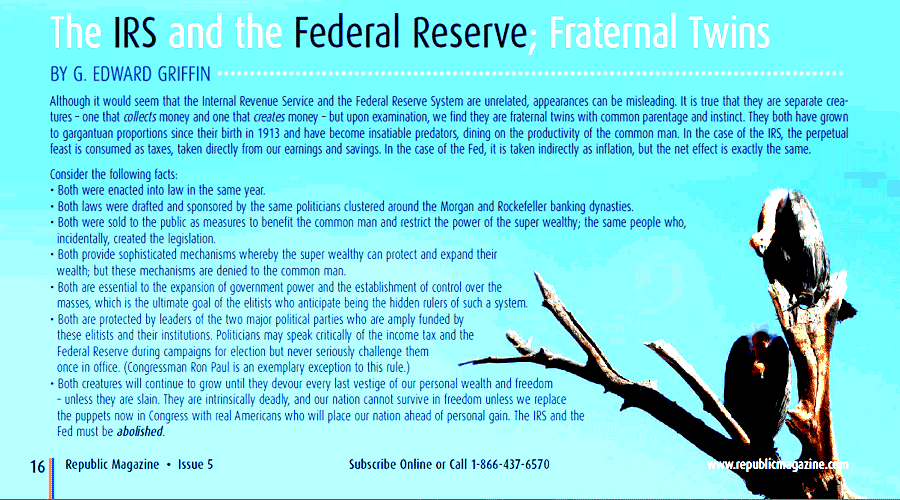
The Federal Reserve was also Born a Century Ago, in 1913
In a parallel track, the Federal Reserve was conceived and born a century ago this year. On March 31, 1913, J.P.
Morgan, America's unofficial one-man central bank, died in his sleep in
Rome. Like any good banking man, he died at the closing day of a
financial quarter handing new President Woodrow Wilson the opening to
create a central bank. After a close call in the Panic of 1907, J.P. Morgan,
then entering his 70s, told the nation he was retiring from the central
banking business, saying that the next panic would sink him - and the
country - even if other syndicate members joined him (as they usually
did).
The death of J.P. Morgan almost nine months later led to the centralized solution everyone seemed to favor then. At 6:02 pm on December 23, 1913, The Federal Reserve Act,
authorizing the creation of the Federal Reserve, was signed into law by
President Woodrow Wilson using four golden pens in a lightly-attended
ceremony during the Christmas break. Like income taxes, the Fed quickly
grew quite powerful.
The Federal Reserve took shape in stages, throughout 1914, with an
official launch date of November 16, 1914. Ironically, the Fed was
formed for the express purpose of avoiding the financial panics so
painful in recent memory - 1893 and 1907 - but the Fed merely continued
the same kind of boom-bust cycle of panics, ranging from a short, sharp
shock in 1920-21, to the long-term Great Depression of 1929 to 1941.
In
particular, the Fed fueled a huge wave of inflation after providing
liquidity for World War I spending. That was followed by a sharp cutoff
in liquidity and a "flash" depression in 1920. The Fed then fueled too
much liquidity throughout the 1920s, leading to a real estate and stock
market crash, followed by a sharp (33%) cut in liquidity between 1929
and 1932. The Fed just couldn't seem to find a balance.
The early Fed was quite clear in its mission. In its 1923 Annual Report, the Federal Reserve described its role clearly:
The Federal Reserve banks are…the source to which the member banks turn when the demands of the business community have outrun their own unaided resources.
This is why the Fed increased credit 61% in the 1920s, from $45.3 billion on June 30, 1921 to over $73 billion in July 1929.
The
Fed's inflationary monetary policies led to a nearly 99% decline in the
purchasing power of the U.S. dollar in gold terms. In 1913, gold traded
for $20.67 per ounce vs. around $1,690 today. Our official cost of
living increase since 1913 is +2,261%, meaning that an item costing $1
in 1913 costs $23.61 now. The Fed's policies have also led to a series
of stock market booms and busts over the century, begging the question
of whether the Fed has been any more effective than J.P. Morgan and his big-banker syndicate.
The Money Power Controlled by International Investment Bankers Dominates Business and Government
In the various actions which increase or decrease the supply of money, governments, bankers, and industrialists have not always seen eye to eye. On the whole, in the period up to 1931, bankers, especially the Money Power controlled by the international investment bankers, were able to dominate both business and government. They could dominate business, especially in activities and in areas where industry could not finance its own needs for capital, because investment bankers had the ability to supply or refuse to supply such capital. Thus, Rothschild interests came to dominate many of the railroads of Europe, while Morgan dominated at least 26,000 miles of American railroads. Such bankers went further than this. In return for flotations of securities of industry, they took seats on the boards of directors of industrial firms, as they had already done on commercial banks, savings banks, insurance firms, and finance companies. From these lesser institutions they funneled capital to enterprises which yielded control and away from those who resisted. These firms were controlled through interlocking directorships, holding companies, and lesser banks. They engineered amalgamations and generally reduced competition, until by the early twentieth century many activities were so monopolized that they could raise their noncompetitive prices above costs to obtain sufficient profits to become self-financing and were thus able to eliminate the control of bankers. But before that stage was reached a relatively small number of bankers were in positions of immense influence in European and American economic life. As early as 1909, Walter Rathenau, who was in a position to know (since he had inherited from his father control of the German General Electric Company and held scores of directorships himself), said, "Three hundred men, all of whom know one another, direct the economic destiny of Europe and choose their successors from among themselves."
The Power of Investment Bankers Over Governments
The power of investment bankers over governments rests on a number of factors, of which the most significant, perhaps, is the need of governments to issue short-term treasury bills as well as long-term government bonds. Just as businessmen go to commercial banks for current capital advances to smooth over the discrepancies between their irregular and intermittent incomes and their periodic and persistent outgoes (such as monthly rents, annual mortgage payments, and weekly wages), so a government has to go to merchant bankers (or institutions controlled by them) to tide over the shallow places caused by irregular tax receipts. As experts in government bonds, the international bankers not only handled the necessary advances but provided advice to government officials and, on many occasions, placed their own members in official posts for varied periods to deal with special problems. This is so widely accepted even today that in 1961 a Republican investment banker became Secretary of the Treasury in a Democratic Administration in Washington without significant comment from any direction.
The Money Power Reigns Supreme and Unquestioned
Naturally, the influence of bankers over governments during the age of financial capitalism (roughly 1850-1931) was not something about which anyone talked freely, but it has been admitted frequently enough by those on the inside, especially in England. In 1852 Gladstone, chancellor of the Exchequer, declared, "The hinge of the whole situation was this: the government itself was not to be a substantive power in matters of Finance, but was to leave the Money Power supreme and unquestioned." On September 26, 1921, The Financial Times wrote, "Half a dozen men at the top of the Big Five Banks could upset the whole fabric of government finance by refraining from renewing Treasury Bills." In 1924 Sir Drummond Fraser, vice-president of the Institute of Bankers, stated, "The Governor of the Bank of England must be the autocrat who dictates the terms upon which alone the Government can obtain borrowed money."
Secrecy Is One of the Elements of the English Business and Financial Life
This element of secrecy is one of the outstanding features of English business and financial life. The weakest "right" an Englishman has is the "right to know," which is about as narrow as it is in American nuclear operations. Most duties, powers, and actions in business are controlled by customary procedures and conventions, not by explicit rules and regulations, and are often carried out by casual remarks between old friends. No record perpetuates such remarks, and they are generally regarded as private affairs which are no concern of others, even when they involve millions of pounds of the public's money. Although this situation is changing slowly, the inner circle of English financial life remains a matter of "whom one knows," rather than "what one knows." Jobs are still obtained by family, marriage, or school connections; character is considered far more important than knowledge or skill; and important positions, on this basis, are given to men who have no training, experience, or knowledge to qualify them.
The Core of English Financial Society Consists of 17 Private International Banking Firms
As part of this system and at the core of English financial life have been seventeen private firms of "merchant bankers" who find money for established and wealthy enterprises on either a long-term (investment) or a short-term ("acceptances") basis. These merchant bankers, with a total of less than a hundred active partners, include the firms of Baring Brothers, N. M. Rothschild, J. Henry Schroder, Morgan Grenfell, Hambros, and Lazard Brothers. These merchant bankers in the period of financial capitalism had a dominant position with the Bank of England and, strangely enough, still have retained some of this, despite the nationalization of the Bank by the Labour government in 1946. As late as 1961 a Baring (Lord Cromer) was named governor of the bank, and his board of directors, called the "Court" of the bank, included representatives of Lazard, of Hambros, and of Morgan Grenfell, as well as of an industrial firm (English Electric) controlled by these.
Money Power Exercises Its Influence through Interlocking Directorates and Direct Financial Controls
From this date onward, financial capitalism grew rapidly in Britain, without ever achieving the heights it did in the United States or Germany. Domestic concerns remained small, owner-managed, and relatively unprogressive (especially in the older lines like textiles, iron, coal, shipbuilding). One chief field of exploitation for British financial capitalism continued to be in foreign countries until the crash of 1931. Only after 1920 did it spread tentatively into newer fields like machinery, electrical goods, and chemicals, and in these it was superseded almost at once by monopoly capitalism.... In addition, its rule was relatively honest (in contrast to the United States but similar to Germany). It made little use of holding companies, exercising its influence by interlocking directorates and direct financial controls. It died relatively easily, yielding control of the economic system to the new organizations of monopoly capitalism constructed by men like William H. Lever, Viscount Leverhulme (1851-1925) or Alfred M. Mond, Lord Melchett (1868-1930). The former created a great international monopoly in vegetable oils centering upon Unilever, while the latter created the British chemical monopoly known as Imperial Chemical Industries.
Banking Control of Government throughout the World
Financial capitalism in Britain, as elsewhere, was marked not only by a growing financial control of industry but also by an increasing concentration of this control and by an increasing banking control of government. As we have seen, this influence of the Bank of England over the government was an almost unmitigated disaster for Britain. The power of the bank in business circles was never as complete as it was in government, because British businesses remained self-financing to a greater extent than those of other countries. This self-financing power of business in Britain depended on the advantage which it held because of the early arrival of industrialism in England. As other countries became industrialized, reducing Britain's advantage and her extraordinary profits, British business was forced to seek outside financial aid or reduce its creation of capital plant. Both methods were used, with the result that financial capitalism grew at the same time as considerable sections of Britain's capital plant became obsolete.
The Money Trust Became Increasingly Concentrated and Powerful in the Twentieth Century
The control of the Bank of England over business was exercised indirectly through the joint-stock banks. These banks became increasingly concentrated and increasingly powerful in the twentieth century. The number of such banks decreased through amalgamation from 109 in 1866 to 35 in 1919 and to 33 in 1933. This growth of a "money trust" in Britain led to an investigation by a Treasury Committee on Bank Amalgamations. In its report (Colwyn Report, 1919) this committee admitted the danger and called for government action. A bill was drawn up to prevent further concentration but was withdrawn when the bankers made a "gentlemen's agreement" to ask Treasury permission for future amalgamations. The net result was to protect the influence of the Bank of England, since this might have been reduced by complete monopolization of joint-stock banking, and the bank was always in a position to influence the Treasury's attitude on all questions. Of the 33 joint-stock banks existing in 1933, 9 were in Ireland and 8 in Scotland, leaving only 16 for England and Wales. The 33 together had over £2,500 million in deposits in April 1933, of which £1,773 million were in the so-called "Big Five" (Midland, Lloyds, Barclays, Westminster, and National Provincial). The Big Five controlled at least 7 of the other 28 (in one case by ownership of 98 percent of the stock).
Although competition among the Big Five was usually keen, all were subject to the powerful influence of the Bank of England, as exercised through the discount rate, interlocking directorships, and above all through the intangible influences of tradition, ambition, and prestige.
The Techniques of Finance Capitalism Reach Levels of Corruption into America Higher Than Any Country in the World
By the 1880's the techniques of financial capitalism were well developed in New York and northern New Jersey, and reached levels of corruption which were never approached in any European country. This corruption sought to cheat the ordinary investor by flotations and manipulations of securities for the benefit of "insiders." Success in this was its own justification, and the practitioners of these dishonesties were as socially acceptable as their wealth entitled them to be, without any animadversions on how that wealth had been obtained. Corrupt techniques, associated with the names of Daniel Drew or Jay Gould in the wildest days of railroad financial juggling, were also practiced by Morgan and others who became respectable from longer sustained success which allowed them to build up established firms.
Close Alliance of Wall Street with Two Major Parties
Any reform of Wall Street practices came from pressure from the hinterlands, especially from the farming West, and was long delayed by the close alliance of Wall Street with the two major political parties, which grew up in 1880-1900. In this alliance, by 1900, the influence of Morgan in the Republican Party was dominant, his chief rivalry coming from the influence of a monopoly capitalist, Rockefeller of Ohio. By 1900 Wall Street had largely abandoned the Democratic Party, a shift indicated by the passage of the Whitney family from the Democrats to the Republican inner circles, shortly after they established a family alliance with Morgan. In the same period, the Rockefeller family reversed the ordinary direction of development by shifting from the monopoly fields of petroleum to New York banking circles by way of the Chase National Bank. Soon family as well as financial alliances grew up among the Morgans, Whitneys, and Rockefellers, chiefly through Payne and Aldrich family connections.
Finance Capitalism in New York Resembles a Feudal Structure
For almost fifty years, from 1880 to 1930, financial capitalism approximated a feudal structure in which two great powers, centered in New York, dominated a number of lesser powers, both in New York and in provincial cities. No description of this structure as it existed in the 1920's can be given in a brief compass, since it infiltrated all aspects of American life and especially all branches of economic life. At the center were a group of less than a dozen investment banks, which were, at the height of their powers, still unincorporated private partnerships. These included J. P. Morgan; the Rockefeller family; Kuhn, Loeb and Company; Dillon, Read and Company; Brown Brothers and Harriman; and others. Each of these was linked in organizational or personal relationships with various banks, insurance companies, railroads, utilities, and industrial firms. The result was to form a number of webs of economic power of which the more important centered in New York, while other provincial groups allied with these were to be found in Pittsburgh, Cleveland, Chicago, and Boston.
J. P. Morgan Dominates Corporate America (Now known as JP Morgan Chase - Morgan-Rockefeller alliance)
J. P. Morgan worked in close relationship to a group of banks and insurance companies, including the First National Bank of New York, the Guaranty Trust Company, the Bankers Trust, the New York Trust Company, and the Metropolitan Life Insurance Company. The whole nexus dominated a network of business firms which included at least one-sixth of the two hundred largest nonfinancial corporations in American business. Among these were twelve utility companies, five or more railroad systems, thirteen industrial firms, and at least five of the fifty largest banks in the country. The combined assets of these firms were more than $30 billion. They included American Telephone and Telegraph Company, International Telephone and Telegraph, Consolidated Gas of New York, the groups of electrical utilities known as Electric Bond and Share and as the United Corporation Group (which included Commonwealth and Southern, Public Service of New Jersey, and Columbia Gas and Electric), the New York Central railway system, the Van Sweringen railway system (Allegheny) of nine lines (including Chesapeake and Ohio; Erie; Missouri Pacific; the Nickel Plate; and Pere Marquette); the Santa Fe; the Northern system of five great lines (Great Northern; Northern Pacific; Burlington; and others); the Southern Railway; General Electric Company; United States Steel; Phelps Dodge; Montgomery Ward; National Biscuit; Kennecott Copper; American Radiator and Standard Sanitary; Continental Oil; Reading Coal and Iron; Baldwin Locomotive; and others.
The Economic Power of the Money Trust in America Is Almost Beyond Imagination
The economic power represented by these figures is almost beyond imagination to grasp, and was increased by the active role which these financial titans took in politics. Morgan and Rockefeller together frequently dominated the national Republican Party, while Morgan occasionally had extensive influence in the national Democratic Party (three of the Morgan partners were usually Democrats). These two were also powerful on the state level, especially Morgan in New York and Rockefeller in Ohio. Mellon was a power in Pennsylvania and du Pont was obviously a political power in Delaware.
The Morgan Hierarchy
In the 1920's this system of economic and political power formed a hierarchy headed by the Morgan interests and played a principal role both in political and business life. Morgan, operating on the international level in cooperation with his allies abroad, especially in England, influenced the events of history to a degree which cannot be specified in detail but which certainly was tremendous....
TheAtlantic |The Yale Agrarian Studies completist is always an easy person to buy for, but his smile may slip a notch when he unwraps Every Twelve Seconds: Industrialized Slaughter and the Politics of Sight.
As if the title weren’t off-putting enough, the cover photograph shows a
faceless man in full-body rubber apron and rubber boots, the whole
getup spattered with fresh blood. Is that an elastic band on the slick
red floor, or a tapeworm? Mercifully, the book deals only in small part
with the actual killing of animals, being a firsthand account of various
kinds of slaughterhouse work. Liver hanger, cattle driver,
quality-control worker: in five months undercover, Timothy Pachirat did
it all.
The comprehensiveness of his experience makes Every Twelve Seconds
especially valuable, considering the meat industry’s campaign to stamp
out precisely this sort of research. Iowa and Utah have already passed
laws making it a crime to gain employment at a slaughterhouse for the
purpose of documenting abuses and code violations; similar “ag gag”
bills have been proposed in other states. It is easy to imagine the
uproar that would ensue if the restaurant industry, which is a model of
hygiene in comparison, were to demand comparable protection from
whistle-blowers. When it comes to the meat supply, however, America
appears none too troubled by the prospect of its blindfolding; the
nation would rather take its chances with E. coli than risk
channel-surfing into a slaughterhouse. Though “foodie” writers
occasionally show interest in the act of slaughter, they prefer to
witness it outdoors, on some idyllic farm, the better to stylize it into
a time-hallowed, mutually respectful communing of man and beast.
Readers are left to infer that their local meat factory is merely
maximizing the number of communings per minute; the media fuss over
Temple Grandin, a purportedly cow-loving consultant to Big Beef, has an
obvious role to play here. But all this wishful thinking fails at the
slaughterhouse door. Barring recourse to the inducements the animals
get, it would be hard to coax average Americans inside even for a
minute. As George Bataille once wrote, in a remark that leads off
Pachirat’s first chapter: “The slaughterhouse is cursed and quarantined
like a boat carrying cholera.”
And it always has been. We are sometimes told that urbanization has
made us all squeamish about something people used to regard with a
manly, no-nonsense spirit. The opposite is closer to the truth. As the
great psychoanalyst Otto Rank pointed out, cave paintings and ancient
myths indicate that primitive man—with whom our so-called hunters love
to claim kinship—felt worse about killing animals than killing his own
kind. (We find a similar attitude among the rugged Cossacks in
Sholokhov’s The Quiet Don: “You should not kill an animal unless
it is necessary, but destroy man!”) If our ancestors had had—as we now
do—full awareness of animals’ sentience, and the wherewithal to live
without red meat, and the knowledge that red meat is harmful in even the
smallest quantities, would they have gone on eating it? We will never
know the answer. What is certain is that long traditions of stigmatizing
the slaughtering class started fading only after the factory farm made
slaughter invisible, inaudible, and unsmellable to everyone outside that
class. Of course, everyone has a pretty good idea what goes on, so that
parents whose child wanted to be a cow-killer when he grew up (as
opposed to, say, a soldier) would probably get him psychological
counseling, but the bulk of mankind now has the luxury of forgetting how
meat is made.
The most interesting aspect of Pachirat’s book is its discovery that
our slaughterhouse workers are themselves deeply uneasy about the
cruelty they are forced to inflict. This runs counter to the PR line
according to which everything runs wonderfully humanely except when some
psychopath slips into the system. Evidently there is no uncruel way to
kill a large and terrified animal every 12 seconds, the pace now set by
industry greed. Just moving the cattle along the chutes leaves employees
feeling shaken and ashamed.
"As a result of this audit, we now know that the Federal Reserve provided more than $16 trillion in total financial assistance to some of the largest financial institutions and corporations in the United States and throughout the world," said Sanders. "This is a clear case of socialism for the rich and rugged, you're-on-your-own individualism for everyone else."
Among the investigation's key findings is that the Fed unilaterally provided trillions of dollars in financial assistance to foreign banks and corporations from South Korea to Scotland, according to the GAO report. "No agency of the United States government should be allowed to bailout a foreign bank or corporation without the direct approval of Congress and the president," Sanders said.
For example, the CEO of JP Morgan Chase served on the New York Fed's board of directors at the same time that his bank received more than $390 billion in financial assistance from the Fed. Moreover, JP Morgan Chase served as one of the clearing banks for the Fed's emergency lending programs.
In another disturbing finding, the GAO said that on Sept. 19, 2008, William Dudley, who is now the New York Fed president, was granted a waiver to let him keep investments in AIG and General Electric at the same time AIG and GE were given bailout funds. One reason the Fed did not make Dudley sell his holdings, according to the audit, was that it might have created the appearance of a conflict of interest.
To Sanders, the conclusion is simple. "No one who works for a firm receiving direct financial assistance from the Fed should be allowed to sit on the Fed's board of directors or be employed by the Fed," he said.
After 100 years ...we find that the FED is corrupt and out of control
we didn't authorize the Fed to bail out corporations and banks over seas with US tax dollars and they expect the American people to delay their Social Security and cut Medicaid and Medicare because of Feds policies
realitysandwich | Pot-smokers of the world unite! You have nothing to lose but your pipe dreams.
Marijuana legalization is a beginning, not an end.
When residents of Colorado and Washington voted to legalize the adult
use of cannabis, it felt like a momentary rush of sobriety in a country
dazed by decades of anti-marijuana hysteria. But what comes next?
The drug war edifice is cracking and the end of prohibition may be nigh.
Or may not be. The way things play out is not preordained. Major
strategic differences among legalization proponents are surfacing about
how to proceed. Some drug policy reform leaders, fearing an official
backlash, are urging a cautious, go-slow, approach: make it as easy as
possible for the Feds to back off and let the states do their thing.
Other voices, claiming a pro-pot electoral mandate, are calling for
bold, assertive moves to implement the will of the voters.
Some medical marijuana dispensary operators are celebrating the prospect
of expanding into adult sales, while others worry about getting
squeezed out as weaker players fold in an increasingly competitive,
multibillion-dollar industry. Mom and pop growers in the Emerald
Triangle of Northern California, America's cannabis bread basket, who've
paid their dues over the years, cringe when they hear of post-election
overtures to tobacco companies from single-issue obsessed, DC-based drug
policy reform lobbyists who presume to speak for tens of millions of
cannabis consumers.
The future of cannabis is up for grabs -- as much as anything can be in
our ailing, corporate-dominated culture. So why not think big? Here are
some ideas:
NYTimes | Marijuana is illegal in Israel, but farms like this one, at a secret location near the city of Safed, are at the cutting edge of the debate on the legality, benefits and risks of medicinal cannabis. Its staff members wear white lab coats, its growing facilities are fitted with state-of-the-art equipment for controlling light and humidity, and its grounds are protected by security cameras and guards.
But in addition to the high-tech atmosphere, there is a spiritual one. The plantation, Israel’s largest and most established medical marijuana farm — and now a thriving commercial enterprise — is imbued with a higher sense of purpose, reflected by the aura of Safed, an age-old center of Jewish mysticism, as well as by its name, Tikkun Olam, a reference to the Jewish concept of repairing or healing the world.
There is an on-site synagogue in a trailer, a sweet aroma of freshly harvested cannabis that infuses the atmosphere and, halfway up a wooded hillside overlooking the farm, a blue-domed tomb of a rabbinic sage and his wife.
In the United States, medical marijuana programsexist in 18 statesbut remain illegal under federal law. In Israel, the law defines marijuana as an illegal and dangerous drug, and there is still no legislation regulating its use for medicinal purposes.
Yet Israel’s Ministry of Health issues special licenses that allow thousands of patients to receive medical marijuana, and some government officials are now promoting the country’s advances in the field as an example of its pioneering and innovation.
“I hope we will overcome the legal obstacles for Tikkun Olam and other companies,” Yuli Edelstein, the minister of public diplomacy and diaspora affairs, told journalists during a recent government-sponsored tour of the farm, part of Israel’s effort to brand itself as something beyond a conflict zone. In addition to helping the sick, he said, the effort “could be helpful for explaining what we are about in this country.”
Israelis have been at the vanguard of research into the medicinal properties of cannabis for decades.
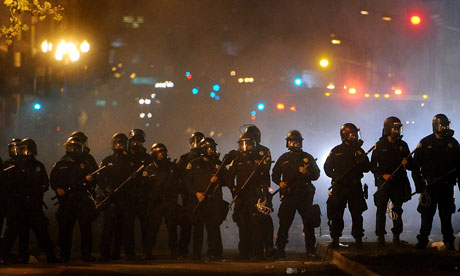
guardian | It was more sophisticated than we had imagined: new documents show
that the violent crackdown on Occupy last fall – so mystifying at the
time – was not just coordinated at the level of the FBI,
the Department of Homeland Security, and local police. The crackdown,
which involved, as you may recall, violent arrests, group disruption,
canister missiles to the skulls of protesters, people held in handcuffs
so tight they were injured, people held in bondage till they were forced
to wet or soil themselves –was coordinated with the big banks
themselves.
The Partnership for Civil Justice Fund, in a
groundbreaking scoop that should once more shame major US media outlets
(why are nonprofits now some of the only entities in America left
breaking major civil liberties news?), filed this request. The document –
reproduced here in an easily searchable format
– shows a terrifying network of coordinated DHS, FBI, police, regional
fusion center, and private-sector activity so completely merged into one
another that the monstrous whole is, in fact, one entity: in some
cases, bearing a single name, the Domestic Security Alliance Council.
And it reveals this merged entity to have one centrally planned, locally
executed mission. The documents, in short, show the cops and DHS
working for and with banks to target, arrest, and politically disable
peaceful American citizens.
The documents, released after long
delay in the week between Christmas and New Year, show a nationwide
meta-plot unfolding in city after city in an Orwellian world: six
American universities are sites where campus police funneled information
about students involved with OWS to the FBI, with the administrations'
knowledge (p51); banks sat down with FBI officials to pool information
about OWS protesters harvested by private security; plans to crush
Occupy events, planned for a month down the road, were made by the FBI –
and offered to the representatives of the same organizations that the
protests would target; and even threats of the assassination of OWS
leaders by sniper fire – by whom? Where? – now remain redacted and
undisclosed to those American citizens in danger, contrary to standard
FBI practice to inform the person concerned when there is a threat
against a political leader (p61).
"FBI
documents just obtained by the Partnership for Civil Justice Fund
(PCJF) … reveal that from its inception, the FBI treated the Occupy
movement as a potential criminal and terrorist threat … The PCJF has
obtained heavily redacted documents showing that FBI offices and agents
around the country were in high gear conducting surveillance
against the movement even as early as August 2011, a month prior to the
establishment of the OWS encampment in Zuccotti Park and other Occupy
actions around the country."
"This production [of documents],
which we believe is just the tip of the iceberg, is a window into the
nationwide scope of the FBI's surveillance, monitoring, and reporting on
peaceful protestors organizing with the Occupy movement … These
documents also show these federal agencies functioning as a de facto
intelligence arm of Wall Street and Corporate America."
The
documents show stunning range: in Denver, Colorado, that branch of the
FBI and a "Bank Fraud Working Group" met in November 2011 – during the
Occupy protests – to surveil the group. The Federal Reserve of Richmond,
Virginia had its own private security surveilling Occupy Tampa and
Tampa Veterans for Peace and passing privately-collected information on
activists back to the Richmond FBI, which, in turn, categorized
OWS activities under its "domestic terrorism" unit. The Anchorage,
Alaska "terrorism task force" was watching Occupy Anchorage. The
Jackson, Michigan "joint terrorism task force" was issuing a
"counterterrorism preparedness alert" about the ill-organized grandmas
and college sophomores in Occupy there. Also in Jackson, Michigan, the
FBI and the "Bank Security Group" – multiple private banks – met to
discuss the reaction to "National Bad Bank Sit-in Day" (the response was
violent, as you may recall). The Virginia FBI sent that state's Occupy
members' details to the Virginia terrorism fusion center. The Memphis
FBI tracked OWS under its "joint terrorism task force" aegis, too. And
so on, for over 100 pages. Fist tap Arnach.
Greenspan states that the Fed is above the law shortly after 7:30 in the interview
Churches, modern
banks and associated political
institutions are based largely on perception, and deception. In order
to work, they have to convince you that they are doing you a favor, bringing
value to the transaction in exchange for getting you
to relinquish real labor value to their custody.
In order to make the scam
complete, they must make the bank/church, its employees,
its building, its presentation - all look authoritative and legitimate. The bank
building, like a church or government
building, is large with pillars and official looking facades - conveying strength, stability and legitimacy.
Usually there's some
picture of an old guy or several guys with a big beard and royal/high
class clothing to make you feel like someone important is here. The altar/safe is placed in clear view
of the public to add to the deception. This is so when you enter the bank,
church etc, you feel a sense of safety, reverence and awe.
The entire
presentation is a scam or a confidence game of
the highest order. The whole objective is to rob you of your earned value,
and make you an obedient, pliable, reliable, submissive and easily
managed peasant.
The
big inside joke is that the only money the bank/church really has is the money
you are depositing in it plus the money they collected as fractional reserves to get
the banking/churching license in the first instance.
In
principle, as should be self-evident by now, money should be
intrinsically worthless, and only used as a means of exchange for things of
similar value. It should not be permitted for banks to create money,
unless they are carefully regulated (nature, type of loans and interest
rates) and/or the bank is in the public interest (usually with a public
bank, a nationally chartered bank), and has a measurable multiplier effect on
the economy.
The multiplier effect should be in the expansion of goods and
services which make society more productive. Like schools which
educate children (creating human capital), bridges, canals and roads
which expand trade, new technologies to exploit
natural resources, dams and power plants (which actually produce energy
to electrify towns and cities at an affordable price).
In this
regard, Alexander Hamilton insisted that credit for such products are
essential to a national economy (states included) and that debt for such
purpose can be a national blessing because it can be basis for
facilitating trade and national development. The notes were usually for
20 years at 5 percent. As such the price or interest rate should be
minimal and long term, providing a stable bill of exchange which could
be used for commercial transactions.
This later became known as
dollar bills and dollar notes. This is where
the whole concept of the dollar bill came from. The notes were
tied to productive legitimate investments so people were comfortable
using these as a medium of exchange. In fact, such bills of exchange
were more desirable than gold and silver (or private bank notes)
So federalized
(national) paper bills of exchange and other such instruments were
favored by small and medium size businesses since they knew they these
notes where for productive, useful activity for the commonwealth. This is how the Erie and Ohio Canals were built. This is the great innovation of Alexander
Hamilton, Benjamin Franklin and John Quincy Adams that freed the general
populace from reliance on England, Spain, the Netherlands, and France
for gold specie in order to promote business and the economy.
It was
the power of the sovereign to create money in the public interest and
use such dollar bills as currency directly tied to the productive
capacity of the nation. Gold, and silver, if necessary, was used for
payment of international trade, with countries who did not at that time
accept dollars bills as mediums of exchange.
Gold and silver (or other
precious metals) were preferred by kings and other sovereigns because
the quantity was usually in the hands of the powerful and wealthy, and
therefore could give them power over the general population. Bonds or
paper represented how much gold you had on reserve, not anything of real
value or use to the general population. It served the royalty, bankers
and aristocrats, not the peasantry and small businessmen.
Under the
old European system (represented by feudal lords, kings, bankers, etc),
in order to get credit you had to have gold, silver, and issue bond,
paper notes promising to pay the same in gold, silver, etc). This
severely restricted trade and made it difficult for the common man. His
economic destiny depended on whether he could convince some banker, or agent
of the king to part with his gold or lend against his gold for some purpose.
In this way, power over the peasantry was maintained.
Since peasants didn't have gold, they usually had to pledge their land, and anything
they had, sometimes even their wives and children, as collateral.
Taxes became oppressive and cruel. The church merely enforced the same
system under penalty of eternal damnation, etc. As a result, people
began to leave Europe in search of religious, political and economic
freedom. Most royalty and bankers were happy to see some peasants go as long as they continued to pay their taxes.
When
Americans didn't have any gold or precious metals (under the old
system), in the early days before it was discovered in the Southwest, it
forced the early settlers to innovate and create a new medium
which served the public interest. Benjamin Franklin was one of the
first do this in Massachusetts and later in Pennsylvania. Later
Hamilton, after the revolution, out of necessity and invention, expanded
this concept on national level for the American States. This type of
national economic independence (from Royalty and their bankers), coupled
with political independence (from Royalty and their bankers), and
religious freedom (from Royalty and their Church), created a potential
for enormous power and influence.
You can easily see the threat the American
System presented to the British crown. Before that time, all taxes had to be paid in gold, silver
and other coins, determined and controlled by the king, and credit was
not easily available for the commonwealth. All religion and worship
was to the official church. It was a syndicate. That's why
traditional gold has always been a bad medium of exchange for the
general population and has always wound up increasing the concentration of
private and/or aristocratic wealth.
In fact, there was no common-wealth concept. There was the king and his subjects. You
were not citizens with rights under law than any aristocrat was bound to acknowledge. You were peasants. The
American Revolution was a radical departure from this notion. It
threatened every Monarchy and Empire on the globe, except those who
allied with it and adopted some of its principles, as did Germany
(protective tariffs, technological innovation, and a credit system) as a
way to free itself from the same destructive economic policies.
The
key features of the American Revolution, the real one, not the fake
one, was political, religious, and economic independence. That is why,
despite all its problems and failures, it remains the number one threat
to the psychopathocracy and must be destroyed. It cannot be allowed to complete and further
its original vision.
That is why the history of the American
Revolution has been systematically redacted, and distorted, and replaced
with a false narrative that distorts their forgotten original meaning. For example, Free Trade (means Austrian/London
School financial capitalism with no barriers), Debt or Sound Money
(Interest based or Gold based), Individual Liberty (Ayn Rand
selfishness irrespective of morality and impact on
others), Property Rights (Ayn Rand type (discrimination, human
slavery, etc.)), Limited Government (no equal protection under the law, Confederacy/State's Rights and American Exceptionalism (Imperialism/Manifest Destiny, etc).
npr | Have you ever borrowed an e-book from a library? If the answer is no, you're a member of a large majority. A survey
out Thursday from the Pew Internet Project finds that only 5 percent of
"recent library users" have tried to borrow an e-book this year.
About
three-quarters of public libraries offer e-books, according to the
American Library Association, but finding the book you want to read can
be a challenge — when it's available at all.
Brian Kenney is
the director of the White Plains Public Library in New York. He tells
NPR's Audie Cornish about a library patron who wanted to check out a
digital copy of Walter Isaacson's biography of Steve Jobs.
"It
was a middle-aged guy, you know, had a high techno-comfort zone, he was
carrying his iPad, and he approached the desk carrying the Isaacson bio
and said, 'How do I download this,' " Kenney recalls. "And it was the
classic case where I had to explain to them, 'Well, sir, actually, you
can't download that from here.' And then ensues the discussion why, as
though somehow or other the library was stupid or failing in its job."
In
fact, Kenney says, it's not a failure on the part of the library —
Simon and Schuster, which published the book, would not license it to
the library for download.
You might think about all this as the
Wild West of digital licensing — a frontier environment where every
publisher has its own set of rules. Among the six biggest companies,
Simon and Schuster currently licenses none of its e-books to libraries.
The company says it simply hasn't found a model that works.
npr | What counts as a book these days, in a world of Kindles, Nooks and
iPads — and eager talk about new platforms and distribution methods?
Traditional
publishers are traveling a long and confusing road into the digital
future. To begin with, here's the conventional wisdom about publishing:
E-books are destroying the business model.
People expect them
to be cheaper than physical books, and that drives down prices. But the
story's not that simple. For one thing, digital publishers have the same
problem that record labels do: piracy. And there's just not the same
stigma attached to pirating an e-book as there is to holding up a Barnes
& Noble.
It turns out, though, that some publishers are
doing pretty well despite the piracy problem. "We've had an incredible
year," says Sourcebooks President Dominique Raccah. "Last year was the
best year in the company's history. This year we beat that, which I
didn't think was even possible." Raccah adds that her company is doing
well because of digital publishing, not in spite of it. "It's been an
amazing ride," she says.
It turns out there are some huge
advantages — at least for publishers. A big one: The price of an e-book
isn't fixed the way it is with physical books. Ten years ago, a
publisher would have sent out its books to the bookstore with the price
stamped on the cover. After that, it was done — the publisher couldn't
put it on sale to sell more books.
HuffPo | We are all on a journey. None of us know with absolute certainty what
happens next. All we can do is position ourselves for the future we
prophetically or delusionally imagine. History will judge us all. Those
who position correctly will be rewarded. Those who aren't prepared will
face the harsh realities of the future marketplace.
Every one of us holds the power to change the course of history by
taking actions today that enable the future we desire. Our actions
mirror our aspirations, which means the future of publishing will be
determined by our collective and sometimes competing aspirations.
Readers are our gatekeepers.
I challenge you, my dear writer, publisher or reader, to take charge
of your future. Imagine a brighter and better future ahead, where the
culture of books reigns supreme, where more people are discovering,
reading, purchasing, publishing, selling, and profiting-from books.
Imagine a future where more readers than ever before will enjoy a
greater diversity of books than ever before. Imagine a future where the
power center of the publishing business shifts from traditional
publishers to ordinary writers where it belongs.
The utopian and often self-serving aspirations of industry
participants don't always intersect. Sometimes, objectives are at odds
with one another, and at other times objectives are aligned. Our
experiences, biases and fears color our perceptions, and sometimes
distort them.
Much is at stake. The world's 50 largest book publishers alone achieved $68 billion in sales in 2011, according to Publishers Weekly. Pricewaterhouse Coopers (PwC) estimates the US consumer ebook market alone will surpass $10 billion
by 2016. When so much money and power is up for grabs, industry
players have a lot to fight over, and much to protect. Books are worth
fighting for, so fight for the future you want. Otherwise, someone else
may determine your future for you.
None of us can truly predict the future, but we can still prepare for
it by remaining flexible. We must be willing to roll with the punches
when fate tries to smack us upside the head, and adjust our course and
our beliefs when we make mistakes, or when we discover new opportunities
on the horizon.
The doubters like Donald Maass are becoming the exception, not the
rule, and that worries me. When everyone starts swimming in the same
direction and believing the same group think, that's when I start
wondering about what comes next. It's the job of any entrepreneur - and
we are all entrepreneurs of our own destiny - to prepare for the future
while surviving today.
Hearing the complaints of book buyers must be frustrating for publishers, because they actually have a pretty good case
for why e-books cost what they do. Although many see the price of
old-fashioned things like paper and printing presses and trucks to ship
them as a big cost for printed books, publishers like Penguin point out
that the main costs involve advance payments to authors, marketing and
other support expenses — things that also apply to e-books. As Wendig
puts it:
[P]roducing e-books costs more than you think. You’re
paying for editors and cover design and, of course, for the book itself,
and the mechanics of putting those things into a container are not the
bulk of a book’s cost. Hence, e-books are always going to be close to
their physical counterparts in cost.
But as the author also notes, consumers don’t really care what a publisher’s costs are,
nor are they likely to pay more simply because a publisher argues that
their content is really valuable. In the same way, movie-goers don’t
really care how many millions of dollars a movie studio spent on their
latest blockbuster — that has no bearing on whether they want to see it
or not. It is the perceived value of the e-book that matters, not the cost — and there are some good reasons why e-book consumers might want to pay less.
ala | As e-books and the emerging digital library occupy today’s headlines, there appears to be a tacit consensus emerging from the discourse among academics, journalists, and librarians about the future of the book. That vision of the future, as portrayed in the trade literature and popular press, consigns this centuries-old technology to obsolescence, as if it were merely another information format.
This report explores alternative scenarios, where the technology of the printed book does not disappear or become extinct, but occupies a different position in a technological ecology characterized by the proliferation of e-books and digital libraries. The printed book has for centuries been the chief cognitive object of the library. The future status of that object should be of interest to all librarians, especially as they plan for the future; therefore, this report intentionally favors the continued existence of the printed book as a viable technology.
The goal of this report is to draw attention to our assumptions about the future of the book, assumptions that are grounded in our current e-book zeitgeist. Strategic decisions are often based on underlying—and often unexamined—assumptions about the larger environment in which those decisions will be carried out. The future often turns out not as expected because we do not entertain alternative possibilities and base strategic thinking and actions on one specific belief about the future. Much of our current thinking about the future of libraries appears based on the assumption that printed books will give way to e-books and the digital transmission of textual objects.
This research report presents four scenarios so that academic and research librarians may expand their thinking about the future to include a richer set of environmental conditions:
Consensus: a scenario where e-books overwhelm and make obsolete the printed book
Nostalgic: a scenario where printed books are still highly in demand and e-books haveproven to be a fad
Privatization of the book: a scenario where printed books are vestigial to an ecology dominated bye-books
Printed books thrive: a scenario where e-books and printed books exist in balance and have equal importance
Scenario thinking exercises can help to develop situational awareness. Mica R. Endsley defines situational awareness as “the perception of elements in the environment within a volume of time and space, the comprehension of their meaning, and the projection of their status in the near future.”
Futuring is an exercise in expanding situational awareness by developing greater comprehension of the elements that make up the larger environment of libraries—indeed, viewing the library as a complex dynamic system affected not only by operational elements such as collections and user services but also by political, economic, social, and technological elements of the environment within which the library is situated. Beyond comprehending these elements and understanding the complex ways in which they interact, academic and research librarians must also be able to envision the future status of that system. We assume that the complex system that is the library will itself undergo change, and librarians must be able to anticipate those changes. Thus, using the language of situational awareness, scenarios should be viewed as one effort to describe a future state of the system in which decisions will need to be carried out. As academic and research librarians undertake strategic planning for their organizations, awareness of the larger environment and understanding the potential for changes in that environment will prove critical to improved decision making.
After reviewing each of the scenarios, those involved in strategic decision making should then consider their own plans—and their budgets— with respect to these questions:
Which state of the system do you believe best describes the environment in which your library’s strategic thinking and planning will unfold?
Which of these models of the future currently guides your strategic thinking and actions regarding printed books?
Note:
Reader’s Digest figures are revenue for the entire company. Book sales
in 2011 were $545 million and $590 million in 2010. Figures are based on
sales generated in calendar 2011 or—for corporations with a fiscal
year—from fiscal 2011. Data are from publicly available sources and
include sales of books, journals, and digital products. Because
publishing data were unavailable, Pannini, Weltbild, and Disney/Hyperion
are excluded from the rankings. The listing was compiled by
international publishing consultant Rudiger Wischenbart under the aegis of Livres Hebdo.
atkearney | The e-book revolution has begun, capturing consumers' imaginations
and pocketbooks. More people today are downloading e-books, a trend that
will only accelerate in the next decade and undoubtedly change the
publishing value chain. Core industry participants—printing companies,
distributors and book retailers—will find it difficult to adapt. While
some existing players and newcomers to the market—publishers, authors,
telecommunications operators and device manufacturers—will find this an
ideal time to capitalize on the opportunities.
In this paper, we analyze the evolution of the e-book market, the main factors around its
growth, recent trends in the United States and Europe, and the changing
structure of the publishing value chain. Our goal is to answer a larger
question: What should the publishing industry expect and how should
they prepare?
After years of false starts, e-books finally took off in the United States. While the overall publishing market has constricted slightly, e-book sales in the trade sector have grown five-fold in three years, to $165 million in 2009, or roughly 1.3 percent of the market, according to the International Digital Publishing Forum. It could reach 20 percent penetration within seven years (see sidebar: What Took So Long for E-Books?).
U.S. e-book penetration differs by segment and target sector. Within the non-trade sector, which includes educational, reference, technical and scientific books, e-book penetration is near 30 percent and rising, thanks to their easy access (from university workstations), search options (dictionaries and research papers) and storage capacity (educational books and technical manuals).
jakobgoesblogging | Enablers are the development of advanced hardware and software products as well
as the increased importance of internet and especially social networks.
During my research, I found a number of interesting statistics about
recent changes in the music industry. Based on this data I will try to
analyze each step of the value chain to explore how new technologies and
the change in customer behavior affect the companies’ business models
as well as the music industry as a whole.
Approach: After a short description of the music industry as it was some years
ago, I will have a look at the most recent trends. Based on that I will
point out the changes in the business model of record labels and
identify some important areas in which companies have to act in order to
stay competitive. To make this analysis more practical, I want to
include the income statement of Warner Music Group, a leading record
label to show how it is affected by recent industry chances.
The typical value chain in the music industry shows five steps. It starts
with creation of the content by the artist. Traditionally, the artist
tried to raise awareness by sending demo tapes to the record companies
and participate in band contests. The artist and repertoire (A&R)
unit is the division of a record label that is responsible for talent
scouting, contracting and overseeing the artistic development. Once the
contract is signed, the record company takes care of the financing and
records the songs. The next step is the promotion and PR of the album
done by the record company. The distribution traditionally was done
through merchants and retail stores. Most of them were independent but
there were also big retail chains, owned by the major record labels.
Celebrating 113 years of Mama Rosa McCauley Parks
-
*February 4, 1913 -- February 4, 2026*
*Some notes: The life of the courageous activist Mama Rosa McCauley Parks*
Mama Rosa's grandfather Sylvester Ed...
Monsters are people too
-
Comet 3I/Atlas is on its way out on a hyberbolic course to, I don't know
where. I do know that 1I/Oumuamua is heading for the constellation Pegasus,
and ...
Remembering the Spanish Civil War
-
This year marks the 90th anniversary of the launch of the Spanish Civil
War, an epoch-defining event for the international working class, whose
close study...
Return of the Magi
-
Lately, the Holy Spirit is in the air. Emotional energy is swirling out of
the earth.I can feel it bubbling up, effervescing and evaporating around
us, s...
Covid-19 Preys Upon The Elderly And The Obese
-
sciencemag | This spring, after days of flulike symptoms and fever, a man
arrived at the emergency room at the University of Vermont Medical Center.
He ...
-
(Damn, has it been THAT long? I don't even know which prompts to use to
post this)
SeeNew
Can't get on your site because you've gone 'invite only'?
Man, ...
First Member of Chumph Cartel Goes to Jail
-
With the profligate racism of the Chumph Cartel, I don’t imagine any of
them convicted and jailed is going to do too much better than your run of
the mill ...