Tuesday, September 04, 2012

what causes lightning?

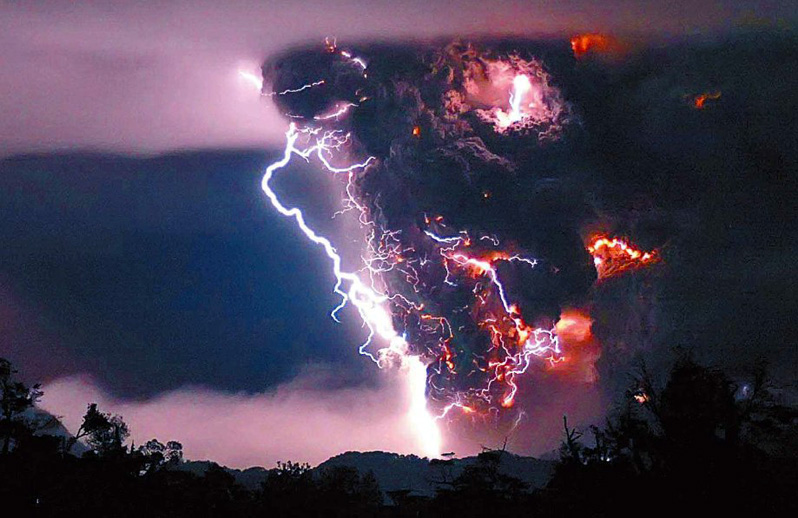
holoscience | Most people are unaware that we have no understanding of how lightning is created in clouds. The simplest answer is that lightning is not generated there at all. Clouds merely form a convenient path to Earth for electricity originating in space. Without clouds it is possible to have a “bolt from the blue”. That is happening on Venus (although the sky certainly isn’t blue). Weather systems are driven primarily by external electrical influences.

Consequently the Sun has weather patterns. And the most distant planet, Neptune, has the most violent winds in the solar system though it receives very little energy from the Sun. Electric discharges from space cause Mars’ huge dust devils and planet-wide dust storms. They are responsible for Jupiter’s Great Red Spot and the “spokes” in Saturn’s rings. It is why Venus has lightning in its smog-like clouds and its mountain-tops glow with St. Elmo’s fire. It is why the Earth has lightning stretching into space in the form of “red sprites” and “blue jets”, and why tethered satellites “blow a fuse”.

However, nobody is trained to consider electrical energy input to weather systems.

The image above is a NASA artist’s view of lightning on Venus during the descent of one of the Pioneer probes. Venus has smog-like clouds that are not expected to generate lightning and yet the planet suffers intense lightning. This argues against the popular notion of what causes lightning.

from plants and fungi to clouds

thescientist | The atmosphere is replete with aerosols made up of organic molecules, which are necessary for clouds to form, as well as for rain and other forms of precipitation to fall. However, how these organic aerosols form has largely remained a mystery to atmospheric scientists. Now, a new study published in Science this week (August 30) shows that salt compounds released by plants and fungi hover above the Amazon Rainforest, where the may exert a significant impact on the region’s weather by contributing to s aerosols to the atmosphere and serving as seeds for cloud and rain formation.

An international team of researchers led by biogeochemist Meinrat Andreae of the Max Planck Institute for Chemistry in Germany found the particles by climbing up a 262-foot tower and collecting air samples, PhysOrg reported. The main source of these particles, which are rich in potassium, is likely fungal spores, which have a gel coating that make it easy for water molecules to latch on, although plants had been previously shown to efficiently release salts into the air.

“Our findings support the hypothesis that the Amazonian rainforest ecosystem can be regarded as a biogeochemical reactor in which the formation of clouds and precipitation in the atmosphere are triggered by particles emitted from the biosphere,” the authors wrote in the Science paper.

Monday, September 03, 2012

the lost decade of the middle class; fewer, poorer, gloomier...,

pewsocialtrends | As the 2012 presidential candidates prepare their closing arguments to America’s middle class, they are courting a group that has endured a lost decade for economic well-being. Since 2000, the middle class has shrunk in size, fallen backward in income and wealth, and shed some—but by no means all—of its characteristic faith in the future.

These stark assessments are based on findings from a new nationally representative Pew Research Center survey that includes 1,287 adults who describe themselves as middle class, supplemented by the Center’s analysis of data from the U.S. Census Bureau and Federal Reserve Board of Governors.

Fully 85% of self-described middle-class adults say it is more difficult now than it was a decade ago for middle-class people to maintain their standard of living. Of those who feel this way, 62% say “a lot” of the blame lies with Congress, while 54% say the same about banks and financial institutions, 47% about large corporations, 44% about the Bush administration, 39% about foreign competition and 34% about the Obama administration. Just 8% blame the middle class itself a lot.

Their downbeat take on their economic situation comes at the end of a decade in which, for the first time since the end of World War II, mean family incomes declined for Americans in all income tiers. But the middle-income tier—defined in this Pew Research analysis as all adults whose annual household income is two-thirds to double the national

median 1 —is the only one that also shrunk in size, a trend that has continued over the past four decades.

in praise of the clash of cultures

NYTimes | Can we be sure that our beliefs about the world match how the world actually is and that our subjective preferences match what is objectively in our best interest? If the truth is important to us these are pressing questions.

We might value the truth for different reasons: because we want to live a life that is good and doesn’t just appear so; because we take knowing the truth to be an important component of the good life; because we consider living by the truth a moral obligation independent of any consequences; or because, like my Egyptian friends, we want to come closer to God who is the Truth (al-Haqq in Arabic, one of God’s names in Islam). Of course we wouldn’t hold our beliefs and values if we weren’t convinced that they are true. But that’s no evidence that they are. Weren’t my Egyptian friends just as convinced of their views as I was of mine? More generally: don’t we find a bewildering diversity of beliefs and values, all held with great conviction, across different times and cultures? If considerations such as these lead you to concede that your present convictions could be false, then you are a fallibilist. And if you are a fallibilist you can see why valuing the truth and valuing a culture of debate are related: because you will want to critically examine your beliefs and values, for which a culture of debate offers an excellent setting.

Of course we don’t need to travel all the way to Cairo to subject our beliefs and values to critical scrutiny; in theory we can also do so on our own. In practice, however, we seem to need some sort of unsettling experience that confronts us with our fallibility, or, as the great Muslim thinker al-Ghazâlî (d. 1111) puts it in his intellectual autobiography “The Deliverance from Error,” that breaks the “bonds of taqlîd” — the beliefs and values stemming from the contingent circumstances of our socialization rather than from rational deliberation.

In his own case, al-Ghazâlî writes, the bonds of taqlîd broke when he realized that he would have been just as fervent a Jew or Christian as he was a Muslim, had he been brought up in a Jewish or Christian community. He explains taqlîd as the authority of “parents and teachers,” which we can restate more generally as all things other than rational argument that influence what we think and do: from media, fashion and marketing to political rhetoric and religious ideology.
Related
More From The Stone

Read previous contributions to this series.

The problem of taqlîd (or what social psychologists today call “conformism”) has a long history. Socrates explained the need for his gadfly mission by comparing Athenian citizens to a “sluggish” horse that “needed to be stirred up.” Note that philosophers, too, fall prey to taqlîd. Galen, the second century Alexandrian doctor and philosopher, complained that in his time Platonists, Aristotelians, Stoics and Epicureans simply “name themselves after the sect in which they were brought up” because they “form admirations” for the school founders, not because they choose the views supported by the best arguments.

If we take taqlîd to be a fact about human psychology and agree that it is an undesirable state to be in — at least when it comes to the core convictions that underlie our way of life and worldview — then we should particularly welcome debates across cultural boundaries. For if we engage someone who does not share the cultural narratives we were brought up in (historical, political, religious etc.), we cannot rely on their authority, but are compelled to argue for our views — as I had to in my discussions with Egyptian students in Cairo.

Sunday, September 02, 2012

good...,


slate | Rev. Sun Myung Moon, the controversial founder of the Unification Church, died Monday in South Korea, two weeks after he was hospitalized with pneumonia, a church spokesman tells the Associated Press. He was 92.

Marijuana Legalization: What We Know and What We Don't


Rand | In November 2012, voters in multiple states will be asked to consider propositions concerning decriminalization and legalization of marijuana for commercial production and sale for general—not just medical—purposes. Medical marijuana and decriminalization are familiar concepts, albeit widely misunderstood by the public. Legalization of commercial sale and production, on the other hand, would constitute a revolution, one about which public opinion couldn't be more evenly divided. The latest Gallup poll reports that exactly half of Americans favor legalization, with indications of stronger support in states voting on it this year.

This briefing will examine
  • why the evidence on medical marijuana is inconclusive
  • what makes legalization so dramatically different from mere decriminalization
  • the possible consequences of a state legalizing marijuana for non-medical purposes, both for that state and spill-over effects on other states
  • important differences between the particular legalization measures that are on the ballot this year in Colorado and Washington
  • options and limits for federal response to state-level legalization.

Saturday, September 01, 2012

correspondence and collusion between the nytimes and the cia

Guardian | The rightwing transparency group, Judicial Watch, released Tuesday a new batch of documents showing how eagerly the Obama administration shoveled information to Hollywood film-makers about the Bin Laden raid. Obama officials did so to enable the production of a politically beneficial pre-election film about that "heroic" killing, even as administration lawyers insisted to federal courts and media outlets that no disclosure was permissible because the raid was classified.

Thanks to prior disclosures from Judicial Watch of documents it obtained under the Freedom of Information Act, this is old news. That's what the Obama administration chronically does: it manipulates secrecy powers to prevent accountability in a court of law, while leaking at will about the same programs in order to glorify the president.

But what is news in this disclosure are the newly released emails between Mark Mazzetti, the New York Times's national security and intelligence reporter, and CIA spokeswoman Marie Harf. The CIA had evidently heard that Maureen Dowd was planning to write a column on the CIA's role in pumping the film-makers with information about the Bin Laden raid in order to boost Obama's re-election chances, and was apparently worried about how Dowd's column would reflect on them. On 5 August 2011 (a Friday night), Harf wrote an email to Mazzetti with the subject line: "Any word??", suggesting, obviously, that she and Mazzetti had already discussed Dowd's impending column and she was expecting an update from the NYT reporter.

A mere two minutes after the CIA spokeswoman sent this Friday night inquiry, Mazzetti responded. He promised her that he was "going to see a version before it gets filed", and assured her that there was likely nothing to worry about:

"My sense is there a very brief mention at bottom of column about CIA ceremony, but that [screenwriter Mark] Boal also got high level access at Pentagon."

She then replied with this instruction to Mazzetti: "keep me posted", adding that she "really appreciate[d] it".

cause of destruction of venezuelan refinery under investigation..,

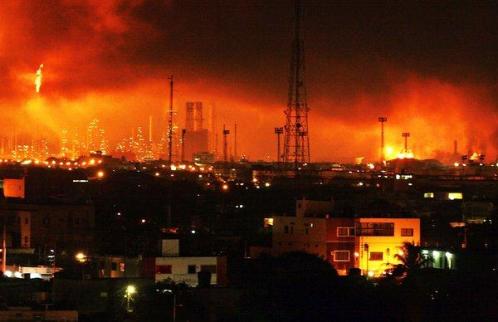
axisoflogic | A massive explosion at Venezuela's main oil refinery at the Amuay plant in Falcon State occurred at 1:11 a.m. this morning (Saturday, August 25).

The Dead and Injured
According to Vice President Elías Jaua, at least 24 people were killed, 17 of them members of the Venezuelan National Guard who provide security for the refinery and 60 were injured with 5 remaining hospitalized. Many homes in the area were evacuated and med-vac ambulances were used to take the injured to hospitals.

Update: The death toll has increased to 41 people. These included 18 National Guardsmen who were among those protecting the refinery; 17 civilians and six bodies have not yet been identified.

The Material Damage
Two refinery tanks were destroyed with significant damage to the infrastructure and houses in the area and the National Guard base in front of the refinery was completely destroyed. The refinery is one of the biggest in the world, producing 645,000 barrels of crude and 200,000 barrels of gasoline a day. Amuay, on the Paraguana Peninsula, is part of the Paraguana Refinery Complex, which also includes the adjacent Cardon. The entire complex has capacity to produce 956,000 bpd.

Energy Minister Rafael Ramirez said there are sufficient petroleum reserves in the country to continue the normal flow of exports and meet domestic demands even after the destruction that took place early this morning. Ramirez stated that all operations at the plant had stopped but he expected them to resume within two days.

Update: Rafael Ramírez, Venezuela's Energy Minister stated that nine crude-oil-storage tanks had been destroyed.

Cause of the Blasts
Energy Minister Rafael Ramirez reported on state television that a gas leak, which formed a cloud exploded, "igniting at least two storage tanks and other facilities at the refinery."

US Marine entered Venezuela illegally 2 weeks ago: Two weeks ago (August 10) we reported that the Venezuelan government captured a U.S. Marine entering the country from Colombia illegally, with "the look of a mercenary." He told the government that he "was fleeing from someone," but would not answer any questions asked during interrogation. He had stamps in his passport from visits to Iraq, Afghanistan and Libya and attempted to destroy his notebook when he was captured. But his notebook was reconstructed and found to contain "geographical coordinates." The Marine is still in Venezuelan custody and initially, the government reported that he was refusing to explain his reasons for entering the country illegally. President Chávez stated, "This [US] citizen wanted to enter the country illegally, for who knows what reason. He cannot say where he was going, or who was waiting for him." Since then, the government has not issued any additional reports.

At the time of the US Marine's arrest, President Chávez issued an alert to all Venezuelans related to possible sabotage of the presidential elections this year:
"A group of the bourgeoisie is preparing to reject the people's triumph, that's very clear. [They] are going to try to plunge the country into a political crisis and fill the country with violence. I urge everybody to be very alert."
Corporate Media Reporting: The BBC, Guardian, NYT, LAT, WP, Reuters, AP and other imperialist media jumped the gun and immediately blamed the Venezuelan government for this “accident.” They quote ex-employees of PDVSA who are telling them that the explosion is the result of poor maintenance of equipment and sub-standard safety measures by the government. One of them said the explosion is due to the oil minister working on President Chávez' re-election campaign this year instead of taking care of his responsibilities as oil minister. 18,000 of these employees were fired when they sabotaged and shut down PDVSA in 2002-2003. The imperialist media does not mention any of this, calling them "ex employees" or "retired employees" in their propaganda.

The BBC jumped on this story immediately, attributing the explosion to faulty government management before any investigation has been carried out:
"Analysts say refineries in Venezuela, South America's biggest oil producer, have suffered from a long list of problems including power failures and accidents."
The Guardian did the same with:
"Power faults, accidents and planned stoppages for maintenance have hit deliveries from South America's biggest oil exporter.“Eddie Ramirez, national co-ordinator for Gente del Petróleo, an organisation of ex-employees of PDVSA, said: "These accidents have been happening more and more frequently in the last couple years because of a neglect in safety and maintenance standards.

"Minister Ramirez dedicates his time to doing politics alongside the candidate, Hugo Chávez, instead of maintaining the level of infrastructure this kind of industry requires."
Gente del Petróleo has been attacking the Chávez government ever since the coup of 2002. They are comprised of many of the 18,000 PDVSA employees who were fired by the government after they sabotaged the Venezuelan oil industry, then abandoned their posts shutting down all oil production for 3 months and crippling the economy in 2003. On April 13, 2002, Eddie Ramirez, sought out and quoted by the Guardian for this story, sat with old PDVSA managers and defiantly cried in public while President Chávez was being held hostage, "Not one more barrel of oil for Cuba!”

The New York Times follows suit with:
“Pdvsa has been plagued by accidents and oil spills in recent years, which critics say are the result of poor management...

“José Bodas, an oil union leader, said that the company had failed to invest in maintenance.

“ 'This has as a consequence the increase in accidents and tragic deaths like what we are seeing today,' Mr. Bodas said in a telephone call to Globovision, a television channel associated with the political opposition to President Hugo Chávez.”
Rafael Ramírez, Venezuela's Oil Minister said PDVSA is investigating the cause of the gas leak that led to the explosion.

Friday, August 31, 2012

along with arctic ice, the rich world's smugness will melt...,

guardian | I have no idea what is coming to Europe and North America this winter and next summer, in the wake of the record ice melt, but it's unlikely to be pleasant. Please note that this record represents a loss of about 30% of Arctic sea ice, against the long-term average. When that climbs to 50% or 70% or 90%, the impacts are likely to be worse.

Our governments do nothing. Having abandoned any pretence of responding to the environmental crisis during the Earth summit in June, now they stare stupidly as the ice on which we stand dissolves. Nothing – or worse than nothing. Their one unequivocal response to the melting has been to facilitate the capture of the oil and fish it exposes.

The companies that caused this disaster are scrambling to profit from it. On Sunday Shell requested an extension to its exploratory drilling period in the Chukchi Sea, off the north-west coast of Alaska. This would push its operations hard against the moment when the ice re-forms and any spills they cause are locked in. The Russian oil company Gazprom is using the great melt to try to drill in the Pechora Sea, north-east of Murmansk. After turning its Arctic lands in the Komi republic into the Niger delta of the north (repeated oil spills are left unremediated in the tundra), Russia wants to extend this industry into one of the world's most fragile ecosystems, where ice, storms and darkness make decontamination almost impossible.

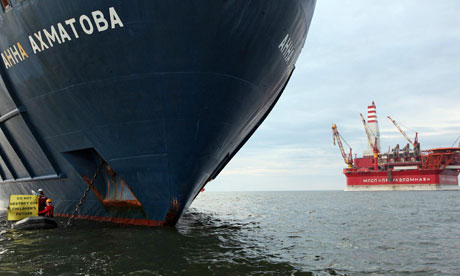
As I write, activists from Greenpeace, whom I regard as heroes, are chained to Gazprom's supply vessel, preventing the rig from operating. These people are stepping in where all governments have failed. David Cameron, who still claims to lead the greenest government ever, is no longer hugging huskies. In June he struck an agreement with the Norwegian prime minister "to enable sustainable development of Arctic energy". Sustainable development, of course, means drilling for oil.

Is this how our children will see it: that we destroyed the benign conditions that made our world of wonders possible, and then used the opportunity to amplify the damage? All of us, of course, can claim to have acted with other aims in mind, or not to have acted at all, as the other immediacies of life seemed more important. But – unless we respond at last – the results follow as surely as if we had sought to engineer them.

Stupidity, greed, passivity? Just as comparisons evaporate, so do these words. The ice, that solid platform on which, we now discover, so much rested, melts into air. Our pretensions to peace, prosperity and progress are likely to follow. "And like the baseless fabric of this vision, / The cloud-capp'd towers, the gorgeous palaces, / The solemn temples, the great globe itself, / Yea, all which it inherit, shall dissolve."

alaska fitna do a little "prepping"

BusinessWeek | Alaska is known for pioneering, self-reliant residents who are accustomed to remote locations and harsh weather. Despite that, Gov. Sean Parnell worries a major earthquake or volcanic eruption could leave the state's 720,000 residents stranded and cut off from food and supply lines. His answer: Build giant warehouses full of emergency food and supplies, just in case.

For some in the lower 48, it may seem like an extreme step. But Parnell says this is just Alaska.

In many ways, the state is no different than the rest of America. Most people buy their groceries at stores, and rely on a central grid for power and heat. But, unlike the rest of the lower 48, help isn't a few miles away. When a fall storm cut off Nome from its final fuel supply last winter, a Russian tanker spent weeks breaking through thick ice to reach the remote town.

Weather isn't the only thing that can wreak havoc in Alaska, where small planes are a preferred mode of transportation and the drive from Seattle to Juneau requires a ferry ride and 38 hours in a car. The state's worst natural disaster was in 1964, when a magnitude-9.2 earthquake and resulting tsunami killed 131 people and disrupted electrical systems, water mains and communication lines in Anchorage and other cities.

"We have a different motivation to do this, because help is a long ways away," said John Madden, Alaska's emergency management director.

The state plans two food stockpiles in or near Fairbanks and Anchorage, two cities that also have military bases. Construction on the two storage facilities will begin this fall, and the first food deliveries are targeted for December. The goal is to have enough food to feed 40,000 people for up to a week, including three days of ready-to-eat meals and four days of bulk food that can be prepared and cooked for large groups. To put that number into perspective, Alaska's largest city, Anchorage, has about 295,000 people, according to the U.S. Census Bureau, and Juneau, its third largest, about 31,000.

It's not unusual for states that routinely experience hurricanes or other large-scale disasters to have supplies like water, ready-to-eat meals, cots and blankets. But Alaska is interested in stocking food with at least a five-year shelf life that meets the nutrition, health and cultural requirements of the state's unique demographics. That means, as part of the effort, trying to incorporate cultural foods like salmon for Alaska Natives as well as foods that would be more common in urban areas, state emergency management spokesman Jeremy Zidek said.

An estimated 90 percent of commodities entering Alaska are delivered through the Port of Anchorage. Air service is also a critical link to the outside world and generally the only way to reach many rural communities. A volcanic blast emitting a large amount of smoke and ash could disrupt supply lines by air and water for an extended period, Madden said, and an earthquake could knock out airport runways or ports. Those are just some of the disasters that might require emergency supplies.

Parnell has made disaster readiness a priority of his administration. His spokeswoman said he has experienced firsthand the devastation of natural disasters, including heavy flooding that knocked some buildings off foundations in Eagle in 2009, when he was lieutenant governor, and the Joplin, Mo., tornado last year. Parnell and his wife visited Joplin with members of the relief organization Samaritan's Purse.

Madden said Alaska's readiness is better than it once was and it continues to improve.

Thursday, August 30, 2012

are manchurian candidates possible?


the intentional production of a crimogenic environment

neweconomicperspectives | Restoring the pre-1993 underwriting rules would impose no cost on honest lenders and would greatly reduce fraud and make it much easier to prove fraud when it occurred. The rule we adopted in 1984 restricting S&L growth rates doomed the accounting control frauds that we were not able to close because we had no funds. The rule targeted an accounting control fraud’s Achilles’ heel – the need to grow rapidly or collapse. The lack of a rule requiring Fannie, Freddie, the investment banks, and mortgage bankers to file criminal referrals was a major barrier to prosecuting.

The regulatory “black holes” exploited by fraudulent mortgage bankers created a superb criminogenic environment. The GAAP and international accounting rules of credit default swaps (CDS) and international accounting rules for allowances for loan and lease losses (ALLL) are open invitations for accounting control fraud.

The broader point is that without superb criminal referrals by the financial regulators and the “detailing” of dozens of bank examiners to the FBI it is impossible for the FBI to investigate effectively an epidemic of elite accounting control fraud. By 2006, there were over two million fraudulent liar’s loans being made annually. Long does not understand that the financial regulators are the “cops on the beat.” The NYC police department does not deal with elite financial crimes. The FBI white-collar crime staff is so tiny (fewer than two agents per U.S. industry) that it cannot walk a beat. The FBI only come and investigates in response to effective criminal referrals. Banks will virtually never make a criminal referral against their CEOs. One cannot combat such a fraud epidemic by having the FBI investigate the criminal referrals that the FDIC-insured banks make against individual borrowers.

The anti-regulators controlling the banking agencies under Clinton and Bush killed the criminal referral process. Obama has failed to reestablish it. Long does not understand the meaning of her own example about Geithner’s response to learning of the Libor frauds. Geithner and the Federal Reserve Bank of New York (FRBNY) did not use the word “fraud” in their communications with the Bank of England or their sister regulators. The FRBNY did not make a criminal referral or even alert the FBI and the Justice Department to the Libor frauds. Obama’s recently created “working group” on secondary mortgage market fraud does not even include representatives from the banking regulators. Chris Swecker, the senior FBI official who made the famous twin warnings in 2004 (there was an “epidemic” of mortgage fraud that would cause a financial “crisis” if it were not contained) informed the FCIC that no banking regulator ever contacted him in response to his warnings. Long’s anti-regulatory dogma would recreate the criminogenic environment and spark new fraud epidemics and lead to the three “de’s” (deregulation, desupervision, and de facto decriminalization). One cannot credibly call for jailing the crooks while pushing anti-regulatory creeds that produce fraud epidemics and make it certain that the elite crooks will not even be investigated, much less jailed.

Wednesday, August 29, 2012

ron paul channels putney swope


theamericanconservative | After Ron Paul’s speech Sunday evening—part of his “We are the Future Rally” held at the University of Florida Sun Dome—I set out to gauge audience reaction. “He hit a lot of the same points he normally hits,” said James Smack, vice chairman of the Nevada Republican Party and a Paul stalwart. “But there was a little more passion, a little more zest…”

This was also my impression. Some observers thought that Paul would strike a conciliatory tone to ingratiate himself (or more likely, his son Sen. Rand Paul) with the GOP establishment. But as Smack noted, “there were some solid shots taken at the RNC—merited shots.” Paul accused party insiders of flouting convention rules to disenfranchise his supporters.

But this was not what stood out most about the address. Over the course of an hour and 15 minutes, Paul was at his most subversive, demonstrating precisely why the Romney campaign offered him a convention speaking slot only under the condition that they be allowed to vet his remarks. (Paul declined.)

“Let me tell you, Bradley Manning didn’t kill anybody,” the Texas congressman declared at around minute 45, speaking of a “soft spot” in his heart for whistleblowers. “Bradley Manning hasn’t caused the death of anybody. And what he has exposed—he is the equivalent of Daniel Ellsberg, who told us the truth about Vietnam!” The crowd exulted. Paul then pivoted to a spirited defense of Julian Assange, chastising the government of Sweden for truckling to alleged American demands that the Aussie be extradited to the U.S. for prosecution.

Paul’s campaign has long touted the fact that he received an outsized percentage of donations from active-duty military. I couldn’t help but speculate that his position on Bradley Manning—who after all has been charged in military court with aiding and abetting al-Qaeda—might not be popular within those ranks. I mentioned this hunch to Kaleb Hornsby, a Paul district coordinator from Augusta, Georgia and Navy veteran. “To maintain good military discipline, order should be followed,” he said. “You make certain agreements when you go into the military. As a soldier, I don’t think Manning should have done it. I wouldn’t have done it.” Even so, Hornsby regarded himself as a supporter of WikiLeaks and admitted to struggling with the issue.

“It’s outstanding leadership,” another veteran, Marcelo Munoz, said of Paul’s comments on Manning and Assange. “You serve in the military, but you don’t serve the military. Ron Paul stands for principle, and it’s outstanding. That’s why he doesn’t sound like any other candidate.” Munoz served as Paul’s 2012 Alabama state chairman. “The principle here is, the soldier saw some stuff that the U.S. shouldn’t have been doing, and he exposed it. Like Ron Paul said, he’s a whistleblower. And whistleblowers are the ones that keep the government in check.”

Among military and civilian supporters alike, Munoz’s sentiment appeared to be the prevailing one. “I think Bradley Manning and Julian Assange are heroes to the world,” said Stephen Cossett, a Libertarian Party activist from Venice, California, who claimed he had overseen the most prolific pro-Ron Paul phonebanking operation in the nation. “Bradley Manning to the United States, and Julian Assange to the world, since as Ron Paul said, he’s not an American.” Cossett was an invited “guest” of the California delegation, and that allows him entry to the convention floor—an attempt at co-optation, he suspected. I asked Cossett if he thought it unusual for a politician of Paul’s stature to be making such pronouncements.

“Maybe of Paul’s stature, but not for Paul,” he replied. “We need to speak up for this stuff. We need information, that’s how we make decisions in a democracy.”

Monday, August 27, 2012

people before parasites: iceland was right, the imf was wrong...,

thestreet | For approximately three years, our governments, the banking cabal, and the Corporate Media have assured us that they knew the appropriate approach for fixing the economies that they had previously crippled with their own mismanagement. We were told that the key was to stomp on the Little People with "austerity" in order to continue making full interest payments to the Bond Parasites -- at any/all costs.

Following three years of this continuous, uninterrupted failure, Greece has already defaulted on 75% of its debts, and its economy is totally destroyed. The UK, Spain and Italy are all plummeting downward in suicide-spirals, where the more austerity these sadistic governments inflict upon their own people the worse their debt/deficit problems get. Ireland and Portugal are nearly in the same position.

Now in what may be the greatest economic "mea culpa" in history, we have the media admitting that this government/banking/propaganda-machine troika has been wrong all along. They have been forced to acknowledge that Iceland's approach to economic triage was the correct approach right from the beginning.

What was Iceland's approach? To do the exact opposite of everything the bankers running our own economies told us to do. The bankers (naturally) told us that we needed to bail out the criminal Big Banks, at taxpayer expense (they were Too Big To Fail). Iceland gave the banksters nothing.

The bankers told us that no amount of suffering (for the Little People) was too great in order to make sure that the Bond Parasites got paid at 100 cents on the dollar. Iceland told the Bond Parasites they would get what was left over, after the people had been taken care of (by their own government).

The bankers told us that our governments could no longer afford the same education, health care and pension systems which our parents had taken for granted. Iceland told the bankers that what the country could no longer afford was to continue to be blood-sucked by the worst financial criminals in the history of our species. Now, after three-plus years of this absolute dichotomy in economic policymaking, a clear picture has emerged (despite the best efforts of the propaganda machine to hide the truth).

In typical fashion, the moment that the Corporate Media is forced to admit that it has been serially misinforming us for the past several years; the Revisionists are immediately deployed to rewrite history, as shown in this Bloomberg Businessweek excerpt:

...the island's approach to its rescue led to a "surprisingly" strong recovery, the International Monetary Fund's mission chief to the country said.

In fact, from the moment the Crash of '08 was orchestrated and our morally bankrupt governments began executing the plans of the bankers, I have written that the only rational strategy was to put People before Parasites. While I wouldn't expect national policymakers to take their cues from my writing, when I wrote out my economic prescriptions for our economies I didn't base my views on compassion, or simply "doing the right thing."

Rather, I have consistently argued that it was a matter of simple arithmetic and the most-elementary principles of economics that "the Iceland approach" was the only strategy which could possibly succeed. When Plutarch wrote 2,000 years ago "an imbalance between rich and poor is the oldest and most fatal ailment of all Republics," he was not parroting socialist dogma (1,500 years before the birth of Socialism).

Plutarch was simply expressing the First Principle of economics; something on which all of the modern capitalist economists who followed in his footsteps have based their own theories. When modern economists produce their own jargon, such as the Marginal Propensity to Consume; it is squarely based on the wisdom of Plutarch: that an economy will always be healthier with its wealth in the hands of the poor and the Middle Class instead of being hoarded by rich misers (and gamblers).

So when the Bloomberg Revisionists attempt to convince us that Iceland's strong (and real) economic recovery was a "surprise"; this could only be true if none of our governments, none of the bankers and none of the media's precious "experts" understood the most-elementary principles of arithmetic and economics. Is this the message the media wants to convey?
"told you so" moments stacking up like hotcakes now...,

NYTimes | IN recent years, scientists have made extraordinary advances in understanding the causes of autism, now estimated to afflict 1 in 88 children. But remarkably little of this understanding has percolated into popular awareness, which often remains fixated on vaccines.

So here’s the short of it: At least a subset of autism — perhaps one-third, and very likely more — looks like a type of inflammatory disease. And it begins in the womb.

It starts with what scientists call immune dysregulation. Ideally, your immune system should operate like an enlightened action hero, meting out inflammation precisely, accurately and with deadly force when necessary, but then quickly returning to a Zen-like calm. Doing so requires an optimal balance of pro- and anti-inflammatory muscle.

In autistic individuals, the immune system fails at this balancing act. Inflammatory signals dominate. Anti-inflammatory ones are inadequate. A state of chronic activation prevails. And the more skewed toward inflammation, the more acute the autistic symptoms.

Nowhere are the consequences of this dysregulation more evident than in the autistic brain. Spidery cells that help maintain neurons — called astroglia and microglia — are enlarged from chronic activation. Pro-inflammatory signaling molecules abound. Genes involved in inflammation are switched on.

These findings are important for many reasons, but perhaps the most noteworthy is that they provide evidence of an abnormal, continuing biological process. That means that there is finally a therapeutic target for a disorder defined by behavioral criteria like social impairments, difficulty communicating and repetitive behaviors.

But how to address it, and where to begin? That question has led scientists to the womb. A population-wide study from Denmark spanning two decades of births indicates that infection during pregnancy increases the risk of autism in the child. Hospitalization for a viral infection, like the flu, during the first trimester of pregnancy triples the odds. Bacterial infection, including of the urinary tract, during the second trimester increases chances by 40 percent.

The lesson here isn’t necessarily that viruses and bacteria directly damage the fetus. Rather, the mother’s attempt to repel invaders — her inflammatory response — seems at fault. Research by Paul Patterson, an expert in neuroimmunity at Caltech, demonstrates this important principle. Inflaming pregnant mice artificially — without a living infective agent — prompts behavioral problems in the young. In this model, autism results from collateral damage. It’s an unintended consequence of self-defense during pregnancy.

Yet to blame infections for the autism epidemic is folly. First, in the broadest sense, the epidemiology doesn’t jibe. Leo Kanner first described infantile autism in 1943. Diagnoses have increased tenfold, although a careful assessment suggests that the true increase in incidences is less than half that. But in that same period, viral and bacterial infections have generally declined. By many measures, we’re more infection-free than ever before in human history.

Better clues to the causes of the autism phenomenon come from parallel “epidemics.” The prevalence of inflammatory diseases in general has increased significantly in the past 60 years. As a group, they include asthma, now estimated to affect 1 in 10 children — at least double the prevalence of 1980 — and autoimmune disorders, which afflict 1 in 20.

Sunday, August 26, 2012

the dead end of higher education as a means to prosperity in america...,

aljazeera | It is 2011 and I'm sitting in the Palais des Congres in Montreal, watching anthropologists talk about structural inequality.

The American Anthropological Association meeting is held annually to showcase research from around the world, and like thousands of other anthropologists, I am paying to play: $650 for airfare, $400 for three nights in a "student" hotel, $70 for membership, and $94 for admission. The latter two fees are student rates. If I were an unemployed or underemployed scholar, the rates would double.

The theme of this year's meeting is "Traces, Tidemarks and Legacies." According to the explanation on the American Anthropological Association website, we live in a time when "the meaning and location of differences, both intellectually and morally, have been rearranged". As the conference progresses, I begin to see what they mean. I am listening to the speaker bemoan the exploitative practices of the neoliberal model when a friend of mine taps me on the shoulder.
"I spent almost my entire salary to be here," she says.

My friend is an adjunct. She has a PhD in anthropology and teaches at a university, where she is paid $2100 per course. While she is a professor, she is not a Professor. She is, like 67 per cent of American university faculty, a part-time employee on a contract that may or may not be renewed each semester. She receives no benefits or health care.

According to the Adjunct Project, a crowdsourced website revealing adjunct wages - data which universities have long kept under wraps - her salary is about average. If she taught five classes a year, a typical full-time faculty course load, she would make $10,500, well below the poverty line. Some adjuncts make more. I have one friend who was offered $5000 per course, but he turned it down and requested less so that his children would still qualify for food stamps.

Why is my friend, a smart woman with no money, spending nearly $2000 to attend a conference she cannot afford? She is looking for a way out. In America, academic hiring is rigid and seasonal. Each discipline has a conference, usually held in the fall, where interviews take place. These interviews can be announced days or even hours in advance, so most people book beforehand, often to receive no interviews at all.

The American Anthropological Association tends to hold its meetings in America's most expensive cities, although they do have one stipulation: "AAA staff responsible for negotiating and administering annual meeting contracts shall show preference to locales with living wage ordinances." This rule does not apply, unfortunately, to those in attendance.

Saturday, August 25, 2012

the monkeywrench wars


archdruidreport | Among science fiction author Arthur C. Clarke’s many gifts was a mordant sense of humor, and a prime example of that gift in action was his 1951 short story Superiority. It’s the story of a space war told by the commanding general of the losing side; he is explaining to some interstellar equivalent of the Nuremberg war crimes tribunal how his forces managed to lose.

The question is of some interest, as the space fleets and resources of the losing side were far superior to those of the victors. So, however, was their technology. "However" is the operative word, for each brilliantly innovative wonder weapon fielded by their scientists turned out to have disastrous downsides when put into service, while the winning side simply kept on churning out unimaginative space battleships using old but proven technology. By the time the losing side realized that it should have done the same thing, it was so far behind that only a new round of wonder weapons seemed to offer any hope of victory—and a little more of that same logic finished them off.

It’s been suggested by more than one wit that life imitates art far more often than art imitates life. The United States military these days seems intent on becoming a poster child for that proposal. Industrial design classes at MIT used to hand out copies of "Superiority" as required reading; unfortunately that useful habit has not been copied by the Pentagon, and as a result, the US armed forces are bristling with brilliantly innovative wonder weapons that don’t do what they’re supposed to do.

The much-ballyhooed Predator drone is one good example among many. For those who don’t follow military technology, it’s a remote-controlled plane designed to fly at rooftop level, equipped with a TV camera and missiles. The operator, sitting in an air-conditioned office building in Nevada, can control it anywhere on Earth via satellite uplink, seek out suspected terrorists, and vaporize them. Does it work? Well, it’s vaporized quite a few people; the Obama administration is even more drone-happy than its feckless predecessor, and has been sending swarms of drones around various corners of the Middle East to fire missiles at a great many suspected terrorists.

You’ll notice that this has done little to stabilize the puppet governments we’ve got in the Middle East these days, and even less to decrease the rate at which American soldiers are getting shot and blown up in Afghanistan. There’s a reason for that. The targets for drone attacks have to be selected by ordinary intelligence methods—terrorists don’t go around with little homing beacons on them, you know—and ordinary intelligence methods have a relatively low signal-to-noise ratio. As a result, a lot of wedding parties and ordinary households get vaporized on the suspicion that there might be a terrorist hiding in there somewhere. Since tribal custom in large parts of the Middle East makes blood vengeance on the murderers of one’s family members an imperative duty, and there are all these American soldiers conveniently stationed in Afghanistan—well, you can do the math for yourself.

Thus the Predator drone isn’t a war-fighting technology, it’s a war-losing technology, pursued with ever-increasing desperation by a military and political establishment that has no idea what to do but can’t bear the thought of doing nothing.

photoleaks london popo plan to ambush wikileaks founder

Telegraph | A policeman has accidentally revealed a secret plan to seize Julian Assange “under all circumstances” if he steps outside the Ecuadorian embassy, in an embarrassment for Scotland Yard.

The uniformed Met officer was pictured holding a clipboard detailing possible ways the WikiLeaks founder could try to escape from the building he has been holed up in for the past two months.

His target, who is trying to avoid extradition to Sweden for questioning over alleged rape and sexual assault, is currently safe on diplomatic territory. He has been given political asylum by the Latin American country, on the grounds that he faces persecution in the USA over his whistle-blowing website, but faces arrest the second he steps outside because he has breached his bail conditions.

The policeman’s handwritten tactical brief, captured by a Press Association photographer as he stood outside the Knightsbridge embassy on Friday afternoon, discloses the “summary of current position re Assange”. It stated: “Action required – Assange to be arrested under all circumstances.”

The notes said should the maverick Australian should be taken even if he emerges in a vehicle, under diplomatic immunity or in a diplomatic bag, which may involve “risk to life”. There had been speculation that he could be smuggled out of the building in a parcel or given a post in the United Nations by Ecuador in an attempt to evade arrest.

The operational guidance, marked “restricted”, also warned of the “possibility of distraction”, suggesting that the Yard fears Mr Assange’s supporters could try to create a commotion outside the embassy, providing cover under which he could flee.

Further details of the notes, which were obscured by the officer holding them, appeared to relate to the “everyday business” of the embassy and the possible need for “additional support” from an unknown agency known as SS10. Scotland Yard said it did not know what this referred to.

The last few sentences referred to SO20, the counter-terrorism command, and included the words "welfare" and "standards".

A separate page carried by the uniformed officer, who was chatting to a colleague, showed an “event diary” including codes and phone numbers.

The blunder by the policeman, captured by a Press Association photographer on Friday afternoon, has echoes of the downfall of Britain’s senior counter-terrorism officer in 2009.

Friday, August 24, 2012

surprise: media routinely misrepresents neuroscience research to further ideological agendas

Neurobonkers | A paper published today in the journal Neuron describes how the mainstream media (specifically the Daily Telegraph, Times, Daily Mail, Sun, Mirror and the Guardian) have tackled the topic of neuroscience over the past decade. The paper is a damning indictment of how the press use neuroscience as a tool with which to “portray themselves as dispassionate” whilst preaching their trademark prejudices. The paper describes how the Telegraph used research to wrongly “assert that productive female participation in both the labor market and family life is neurobiologically impossible”, while the Daily Mail miscellaneously linked “women to irrationality” (amongst countless other crimes) and the Times absurdly squealed “are gays dopamine junkies?”. The paper lists a labyrinth of logical fallacies which the media use to misrepresent neuroscience, repeatedly highlighting a tendency for:

“overextensions of research, with implications drawn far outside the original research context. This overextrapolation of research was not limited to idle speculation but sometimes extended to calls for concrete applications.”

The paper assessed the contents of nearly 3,000 articles involving neuroscience over the past decade to see which topics came up most. It’s not hard to see how the data is skewed by the media’s recent obsessions such as fish oil and narcotics. I’ve tossed the figures in to Manyeyes to make the information a little easier to digest:

Chipocalypse Now - I Love The Smell Of Deportations In The Morning

sky |   Donald Trump has signalled his intention to send troops to Chicago to ramp up the deportation of illegal immigrants - by posting a...