
A paper prepared by 22 international scientists and just published in the journal Nature warns that overpopulation, environmental destruction and climate change have pushed the world toward a tipping point beyond which lie irreversible, frightening alterations in the biosphere that supports life on this lonely planet.
Of course, since this is not a movie and is, instead, just another surreal election year, the scientists’ alarming analysis will go unheeded. If the report is addressed at all by Republicans, it will be dismissed as another attempt by fiendish environmentalists to destroy the American economy by reining in polluting industries. If Democrats take note, they will tout their green jobs program as a panacea and quickly move on to a different, less disturbing, subject.
The fact is the scope of the problem as described by the scientists is so immense and so intractable that denial is a natural response. Here is what is happening as we cling to our ignorant bliss and bicker about the president’s birth certificate:
• The world population has passed 7 billion and will hit 9 billion before the middle of the century. To make room for all these people, 40% of the Earth’s surface will be cleared for farms and cities.
• Continued burning of fossil fuels will spew more carbon dioxide into the atmosphere, and that will make the oceans more and more acidic and literally lethal for sea life.
• All that CO2 will continue to push up global temperatures at a rate too quick for species to adapt. That, combined with the loss of habitat, will result in a massive extermination of bugs and birds and plants and fish and other links in the chain of life that humans depend on.
In an interview for a story by Los Angeles Times reporter Bettina Boxall, the report’s lead author, Anthony Barnosky, a professor of integrative biology at UC Berkeley, seemed to resist sounding too alarmist, but it was obviously hard for him to hold back.
 NYTimes | Lawmakers and policy planners must revive the search for safe ways to store used fuel rods from nuclear power reactors. The long-term solution favored by most experts, which we endorse, is to bury the material in geologically stable formations capable of preventing leakage far into the future.
 But no politically acceptable site has yet been found, and leaving the used fuel rods at each reactor — more than 62,000 metric tons had accumulated across the country by the end of 2009 — seems increasingly problematic. At least nine states have banned the construction of new reactors until a permanent storage site is found or progress toward finding one is made. The only potential permanent storage site examined so far — at Yucca Mountain in Nevada — has been blocked for more than two decades by technical problems, legal challenges and political opposition from the state.
President Obama pledged in the 2008 campaign to shut down the project, and his Energy Department withdrew its application for a license before the safety of the project could be evaluated. Mitt Romney said in a primary debate in Nevada that the state’s people should have the final say. Even without a permanent disposal facility, the Nuclear Regulatory Commission issued a “waste confidence decision” in 2010 that asserted that used fuel rods could be stored at power plants for 60 years after they close down. It also asserted that a permanent repository would be ready to handle such wastes “when necessary.”
That decision was challenged in federal court, and last month a three-judge panel of the United States Court of Appeals for the District of Columbia ruled that the commission had failed to prepare an adequate analysis of the future risks, such as leaks and fires, if the used fuel rods end up being stored at nuclear plants indefinitely. That decision could slow the commission’s ability to extend the licenses of existing plants or grant new licenses.


The nine Earth-System boundaries are associated with nine natural processes – including the freshwater cycle, climate regulation, and the nitrogen cycle – which are critical for keeping the planet in the stable state that has allowed civilizations to arise and thrive over the past 10,000 years. The area within the nine Earth-system boundaries was called "a safe operating space for humanity". This has been widely recognized as a powerful means of giving comprehensible visual focus to the limits that conventional growth economics is widely acknowledged to have failed to recognize.
For Oxfam, however, something critical is still missing from this representation. This "safe operating space" may serve to protect the environment, but it speaks little to the millions of people living in extreme poverty.
As Raworth notes, the concept of social boundaries therefore needs to be added to the picture. Just as there is an environmental ceiling of resource use, above which lies unacceptable environmental degradation, so too there is a social foundation of resource use, below which lies unacceptable human deprivation including hunger, ill-health, income poverty and energy poverty. Resource use has both an environmental ceiling and a social foundation, below which lies deprivation, but the doughnut-shaped space between the two demands attention. This "doughnut" is understood as bringing fresh meaning to the idea of sustainable development, because pictures have the power to reshape the way we think. The simple image of planetary boundaries and social boundaries is seen as a neat way of articulating a goal for 21st-century prosperity: meeting everyone's human rights within the planet's critical natural thresholds (Kate Raworth, The doughnut can help Rio+20 see sustainable development in the round, The Guardian, 16 June 2012). The "doughnut" framework has been endorsed by various NGOs and is now the focus of a new blog to encourage debate on "Doughnut Economics".
In its focus on a visual framework, the Oxfam doughnut contrasts markedly with the report to the Earth Summit of the UN Secretary General's High Level Panel on Global Sustainability (Resilient People, Resilient Planet: A Future Worth Choosing, 2012) -- which proved unable to embody its comprehensive vision in any visualization of significance.
In the spirit of recognizing both the value of a visual representation and what was missing from the environmental boundaries, the following is an exploration of the limitations of both the doughnut form and what is missing from the social dimensions it currently incorporates. As noted both with respect to Earth-System planetary boundaries and the Earth Summit preoccupations added by Oxfam, the concern is now how any significant political action is to be engendered -- hopefully at the Earth Summit in Rio de Janeiro at this time. In that respect there is widespread recognition of the inadequacies of outcomes of past Earth Summits and significant concern at the probability of major inadequacies as a consequence of the current event (Richard Black, Uncertainty Hampers Rio+20 Talks, BBC News, 16 June 2012).
It was for this reason that a previous comment on the Earth-System boundaries resulted in a focus on the "boundaries" to any effective political action (Recognizing the Psychosocial Boundaries of Remedial Action: constraints on ensuring a safe operating space for humanity, 2009). However the concern here with what might be "missing" from a "doughnut" representation goes further. The question, notably highlighted by the current global financial crisis, is how "thoughtlessness" is to be appropriately associated with a "doughnut" form -- if only in ignoring factors which inhibit strategic action. To what extent is global civilization effectively "unconscious", as suggested by John Ralston Saul (The Unconscious Civilization, 1995) -- or constrained in the application of its ingenuity, as argued Thomas Homer-Dixon (The Ingenuity Gap, 2000)?
From such a perspective is there some kind of "cognitive hole" which undermines the ability for coherent political action, as previously discussed (Unthought as Cognitive Foundation of Global Civilization, 2012)? The Oxfam report specifically attributes "critical human deprivations" to the central hole of the doughnut. The question explored further here is whether these "deprivations" have a cognitive dimension associated with thoughtlessness, carelessness and negligence.
Is there a danger that the Earth-System focus on a "a safe operating space for humanity" and the doughnut focus on a "a safe and just space for humanity" simply ensure together a space for modes of behaviour which are inherently unsustainable -- but to which the doughnut form fails to draw attention in the more comprehensive overview it offers? What vital significance might be attributed to the hole in the doughnut with respect to effective strategic action -- and the assiduous avoidance of its consideration?


Today, scientists revealed a small but intriguing chapter in that story: a genetic mutation that seemed like a real improvement in the tomato's quality, but which actually undermined its taste.
Before we get to the mutation, though, let's start with the old tomatoes — the varieties that people grew a century or more ago.
Thanks to enthusiastic seed savers and heirloom tomato enthusiasts, you can still find many of them. Eric Rice, owner of Country Pleasures Farm near Middletown, Md., first encountered heirloom tomatoes when he was a graduate student in North Carolina.
"I decided I really liked them," he says. He liked the vivid taste and the unusual colors, from orange to purple. These tomatoes also have great names: Cherokee Purple, Dr. Wyche's, Mortgage Lifter.
Rice now grows these tomatoes to sell at a farmers market in Washington, D.C. But he admits that all that tomato personality can make heirlooms harder to grow and sell. "Heirloom tomatoes don't ship very well because they're softer. And frankly, they're all different shapes and sizes." This makes them more difficult to pack.
There's something else you'll notice as these tomatoes start to get ripe — something central to this story. The part of the tomato near the stem — what's called the shoulder of the fruit — stays green longer.
"I think it is an issue for the consumer," says Rice, "because people do buy with their eyes. And green shoulders also mean it's not entirely ripe or not as soft and tasty there."
Those green shoulders turn out to be more significant than you might think. In this week's issue of the journal Science, scientists report that when they disappeared from modern tomatoes, some of the tomato's taste went with them.
Here's how. Sometime before 1930, somewhere in America, a tomato grower noticed a plant that was producing distinctive fruit. These fruit turned red from stem to tip in a uniform way. They didn't have any of those bothersome green shoulders.
It was a new mutation, and plant breeders saw it as the next big thing.
They called it the "uniform ripening" trait. In 1930, the agricultural experiment station in Fargo, N.D., released a new tomato variety containing this mutation. The variety was called All Red.



Food stamps can be spent on goods ranging from candy to steak and are accepted at retailers from gas stations that primarily sell potato chips to fried-chicken restaurants. And as the amount spent on food stamps has more than doubled in recent years, the amount of food stamps laundered into cash has increased dramatically, government statistics show.
But the government won’t say which stores are doing the most business in food stamps, and even it doesn’t know what kinds of food those taxpayer dollars buy.
Coinciding with lobbying by convenience stores, the U.S. Department of Agriculture, which administers the program in conjunction with states, contends that disclosing how much each store authorized to accept benefits, known as the Supplemental Nutritional Assistance Program (SNAP), receives in taxpayer funds would amount to revealing trade secrets.
As a result, fraud is hard to track and the efficacy of the massive program is impossible to evaluate.
As the House debates the once-every-five-years farm bill, the majority of which goes to food stamps, there is a renewed and fervent call from a broad spectrum of camps that the information — some of the most high-dollar, frequently requested and closely held secrets of the government — be set free.
“We can’t release it based on federal rules. If it were up to us, I wouldn’t have a problem releasing the information. It’s taxpayer money,” said Tom Steinhauser with the division of benefit programs for the Virginia Department of Social Services.
The District said it would be illegal to tell the newspaper how many food stamp dollars were flowing to each local vendor, but first offered to sell The Washington Times the information for $125,000.
“Why don’t you just pay the charges? Your paper has a lot of money,” said David Umansky, spokesman for the District’s chief financial officer.
Told that the newspaper would not pay, the CFO’s office then said that only JP Morgan, to which it contracted out operations, had access to the store totals and that the office had never looked at them. After six months of the local government attempting to extract the information from JP Morgan, the District finally said that releasing the information would be illegal.
States instructed not to tell
Maryland denied The Times’ request for data under the Freedom of Information Act, saying the information belonged to the federal government, which instructed states not to release it.
But that nul-space is growing and more than simply growing it is maturing.
Recently Off-shore havens have added to financial secrecy another valuable service – data and communications secrecy. There are now companies based in off-shore havens which offer to protect emails and data caches from prying regulatory or legal scrutiny. Take this company for example – Private layer. Private Layer operates out of Panama and Switzerland. It’s purpose? This is from its web site.
If News International had used their services there would be no phone hacking scandal and certainly no Leveson enquiry. An enquiry would have been impossible for the simple reason that Leveson would have got zero compliance. Private layer would have got their lawyers to write to Mr Leveson pointing out that he had no jurisdiction whatsoever over data held in Panama and that Panama had no treaty with the UK, or anyone else for that matter, obliging them to hand over data or to cooperate with any other nation’s enquiries. And that would have been the summary end of that.In the recent years, the amount of frivolous litigation that companies face has grown exponentially,…In many of these cases, companies are irreparably damaged when their private communications and company data is exposed to competitors and the public by frivolous blanket subpoenas. This problem can be easily circumvented by locating your communications and data in a jurisdiction that protects that corporate privacy and by choosing a hosting company that actually cares about your privacy.
 NYTimes | With public employee unions under attack in states like Wisconsin, and with cities across the country looking to trim budgets, behold a town built almost entirely on a series of public-private partnerships — a system that leaders around here refer to, simply, as “the model.”
Cities have dabbled for years with privatization, but few have taken the idea as far as Sandy Springs. Since the day it incorporated, Dec. 1, 2005, it has handed off to private enterprise just about every service that can be evaluated through metrics and inked into a contract.
To grasp how unusual this is, consider what Sandy Springs does not have. It does not have a fleet of vehicles for road repair, or a yard where the fleet is parked. It does not have long-term debt. It has no pension obligations. It does not have a city hall, for that matter, if your idea of a city hall is a building owned by the city. Sandy Springs rents.
The town does have a conventional police force and fire department, in part because the insurance premiums for a private company providing those services were deemed prohibitively high. But its 911 dispatch center is operated by a private company, iXP, with headquarters in Cranbury, N.J.
“When it comes to public safety, outsourcing has always been viewed with a kind of suspicion,” says Joseph Estey, who manages the Sandy Springs 911 service in a hushed gray room a few miles from city hall. “What I think really tipped the balance here is that they were outsourcing just about everything else.”
Does the Sandy Springs approach work? It does for Sandy Springs, says the city manager, John F. McDonough, who points not only to the town’s healthy balance sheet but also to high marks from residents on surveys about quality of life and quality of government services.
But that doesn’t mean “the model” can be easily exported — Sandy Springs has the built-in advantage that comes from wealth — or that its widespread adoption would enhance the commonweal. Critics contend that the town is a white-flight suburb that has essentially seceded from Fulton County, a 70-mile-long stretch that includes many poor and largely African-American areas, most of them in Atlanta and points south.
The prospect of more Sandy Springs-style incorporations concerns people like Evan McKenzie, author of “Privatopia: Homeowner Associations and the Rise of Residential Private Government.” He worries that rich enclaves may decide to become gated communities writ large, walling themselves off from areas that are economically distressed.
“You could get into a ‘two Americas’ scenario here,” he says. “If we allow the more affluent to institutionally isolate themselves, then the poor are supposed to do — what? They’re supposed to have all the poverty and all the social problems and deal with them?”
The champions of Sandy Springs counter that they still send plenty of tax dollars to the county and that race had nothing to do with the decision to incorporate. (The town’s minority population is now 30 percent and growing, they note.) Leaders here say they had simply grown tired of the municipal service offered by Fulton County.
“We make no apologies for being more affluent than other parts of the metro area,” says Eva Galambos, the mayor of Sandy Springs. And what does she make of the attitude of the town’s detractors? “Pure envy,” she says.

They've been working on the MQ-C4 Triton over the last several years, and it's now ready for test flights.
See what the drone offers;
With 360-degree scanning capability and an Automatic Identification System — meaning it can classify different types of ships by itself — the MQ-C4 is pegged to be the mainstay of the Navy's spying capabilities at sea from 2015 onwards.
But even without its state-of-the-art sensors and cameras, the aircraft itself is capable. It can fly for over a day at twice the altitude of commercial jets, reaching a maximum height of 60,000 feet (11 miles) overhead.
And Popular Mechanics explains that the drone is "vertically agile", so it won't have a problem quickly swooping down from high altitudes to take pictures of ships.
Apart from being used for combat-related surveillance missions, the drone could also keep tabs on piracy, human smuggling, fishery violations, and organized crime. Essentially, it's all-seeing.
Here's a break-down of the new drone and how it'll give the Navy even more control of the high seas. Fist tap Big Don.
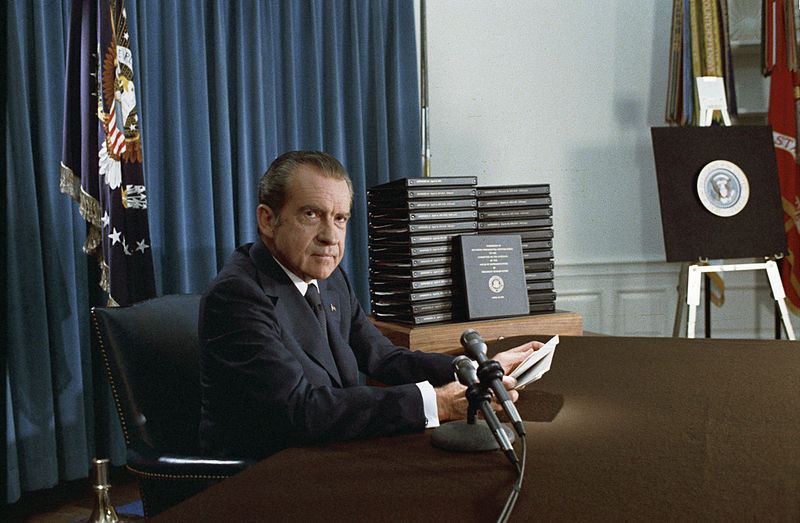
The origins of the Watergate scandal trace back to President Richard Nixon’s frantic pursuit of a secret file containing evidence that his 1968 election campaign team sabotaged Lyndon Johnson’s peace negotiations on the Vietnam War, a search that led Nixon to create his infamous “plumbers” unit and to order a pre-Watergate break-in at the Brookings Institution.
Indeed, the first transcript in Stanley I. Kutler’s Abuse of Power, a book of Nixon’s recorded White House conversations relating to Watergate, is of an Oval Office conversation on June 17, 1971, in which Nixon orders his subordinates to break into Brookings because he believes the 1968 file might be in a safe at the centrist Washington think tank.
Unknown to Nixon, however, President Lyndon Johnson had ordered his national security adviser, Walt Rostow, to take the file out of the White House before Nixon was sworn in on Jan. 20, 1969. Rostow labeled it “The ‘X’ Envelope” and kept it until after Johnson’s death in 1973 when Rostow turned it over to the LBJ Library in Austin, Texas, with instructions to keep it secret for decades.
Yet, this connection between Nixon’s 1968 gambit and the Watergate scandal four years later has been largely overlooked by journalists and scholars. They mostly have downplayed evidence of the Nixon campaign’s derailing of the 1968 peace negotiations while glorifying the media’s role in uncovering Nixon’s cover-up of his re-election campaign’s spying on Democrats in 1972.
One of the Washington press corps’ most misguided sayings – that “the cover-up is worse than the crime” – derived from the failure to understand the full scope of Nixon’s crimes of state.
Similarly, there has been a tendency to shy away from a thorough recounting of a series of Republican scandals, beginning with the peace talk sabotage in 1968 and extending through similar scandals implicating Ronald Reagan and George H.W. Bush – in the 1980 interference of President Jimmy Carter’s hostage negotiations with Iran, drug trafficking by Reagan’s beloved Nicaraguan Contra rebels, and the Iran-Contra Affair – and reaching into the era of George W. Bush, including his Florida election theft in 2000, his use of torture in the “war on terror” and his aggressive war (under false pretenses) against Iraq.
In all these cases, Official Washington has chosen to look forward, not backward. The one major exception to that rule was Watergate, which is again drawing major attention around the 40th anniversary of the botched break-in at the Democratic National Committee on June 17, 1972.
sky | Donald Trump has signalled his intention to send troops to Chicago to ramp up the deportation of illegal immigrants - by posting a...


