Video - Thorough analysis of the Fukushima Daiichi scope creep.
Friday, April 08, 2011

the japanese economy is in very dire straits
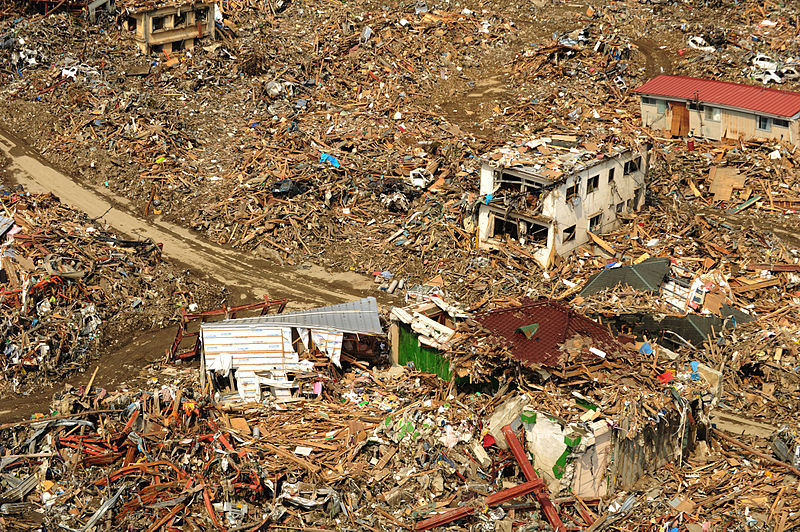 EconomicCollapse | Now that nearly a month has gone by since the horrific tsunami in Japan on March 11th, it is starting to become clear just how much economic damage has been done. The truth is that the Japanese economy is in much bigger trouble than most people think. This is almost certainly going to be the most expensive disaster in Japanese history. The tsunami that struck Japan on March 11th swept up to 6 miles inland, destroying virtually everything in the way. Thousands upon thousands of Japanese were killed and entire cities were wiped off the map. Yes, Japan is a resilient nation, but exactly how does a nation that is already drowning in debt replace dozens of cities and towns that are suddenly gone? The truth is that thousands of square miles have been more completely destroyed than if they had been bombed by a foreign military force. The loss of homes, cars, businesses and personal wealth is almost unimaginable. It is going to take many years to rebuild the roads, bridges, rail systems, ports, power lines and water systems that were lost. Nobody is quite sure when the rolling blackouts are going to end, and nobody is quite sure when all of the damaged manufacturing facilities are going to be fully brought back online.
The truth is that this is a complete and total economic disaster.
The Japanese economy is not going to be the same for many years to come. In fact, many are now warning that this could be one of the triggers that could lead to another major global financial crisis.
One of the big fears is that Japan will need to sell off a large amount of U.S. Treasuries to fund the rebuilding of that nation.
If that were to happen, it could result in a "liquidity crisis" similar to what we saw in 2008. Already the rest of the world is really starting to lose confidence in the U.S. dollar and in U.S. Treasuries, and if Japan starts massively dumping U.S. government debt things could get out of control fairly quickly.
In any event, it is undeniable that the Japanese economy has been absolutely devastated by this crisis. In fact, when you combine the tsunami and the nuclear crisis, this could be the biggest economic disaster that any major industrial power has faced since World War 2.
So will the crisis in Japan push the rest of the globe into another major recession?
Thursday, April 07, 2011
japan's peak oil dry run
 OurWorld | Each Monday for the next few weeks, in light of the recent triple disaster, our new Transition Japan series will consider the challenges faced by Japan in dealing with climate change, peak oil, food security and biodiversity loss. In today’s first installment, Brendan Barrett takes a look at how Japan’s post-tsunami response might help us to respond to peak oil.
For large parts of eastern Japan that were not directly hit by the tsunami on 11 March 2011, including the nation’s capital, the current state of affairs feels very much like a dry-run for peak oil. This is not to belittle the tragic loss of life and the dire situation facing many survivors left without homes and livelihoods. Rather, the aim here is to reflect upon the post-disaster events and compare them with those normally associated with the worst-case scenarios for peak oil.
The earthquake and tsunami affected six of the 28 oil refineries in Japan and immediately petrol rationing was introduced with a maximum of 20 litres per car (in some instances as low as 5 litres). On 14 March, the government allowed the oil industry to release 3 days’ worth of oil from stockpiles and on 22 March an additional 22 days’ worth of oil was released.
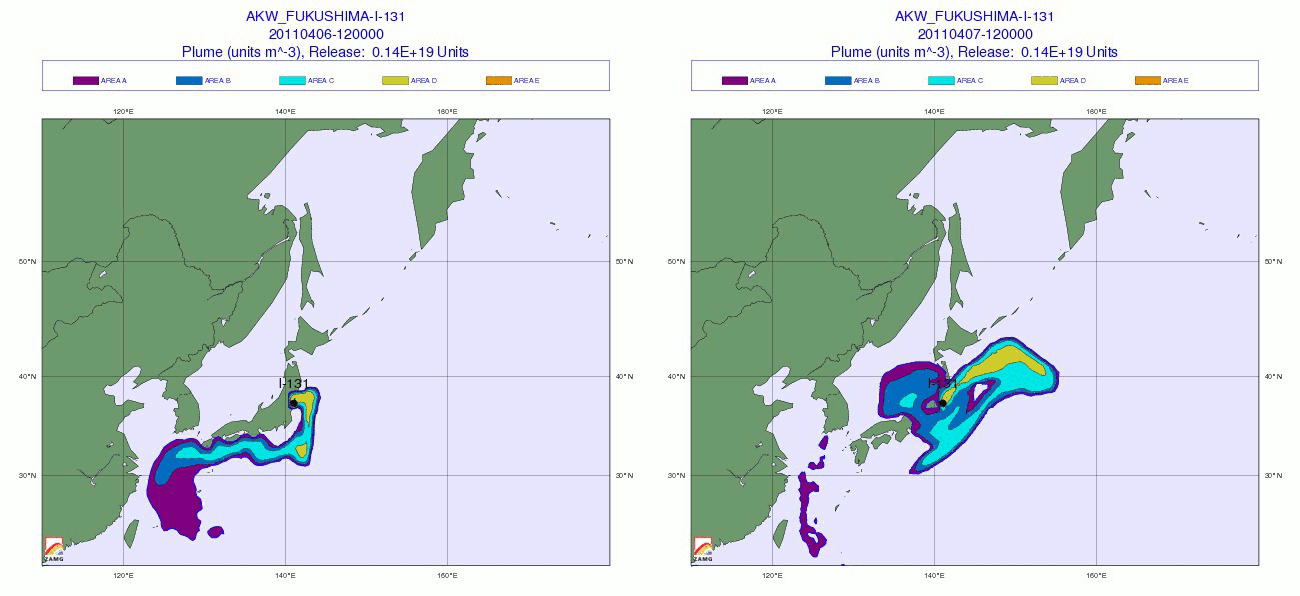
The Tokyo Electric Power Company (TEPCO), which serves a population of 44.5 million, lost one quarter of its supply capacity as a result of the quake, through the closedown of its two Fukushima nuclear power plants (Dai-ichi and Dai-ni), as well as eight fossil fuel based thermal power stations. Subsequently, from 14 March 2011 onwards, TEPCO was forced to implement a series of scheduled outages across the Kanto region (the prefectures of Gunma, Tochigi, Ibaraki, Saitama, Tokyo, Chiba, and Kanagawa).
While the thermal power stations may restart operations soon, the overall shortfall will become even more difficult to manage over the summer period when air conditioning is utilized. The reality is that these power cuts could continue for years, especially since the one of the two Fukushima nuclear plants has effectively become a pile of radioactive scrap.
Related to this, when the Tokyo Metropolitican Government began to announce levels of radioactive contamination of drinking water above permissible levels, this was immediately followed by the rapid sell-out of bottled water, even after the levels dropped again. When bottled water is on sale in local convenience stores after some restocking took place, each customer is only allowed to purchase one 2 litre bottle.
Immediately after the quake, supermarkets outside the disaster area in Tokyo and other major cities began to sell out of foodstuffs, including various instant meals. The electrical appliance stores sold out of batteries, flashlights and portable radios.
As we all know, the twin natural and human tragedies are having impacts beyond the Tohoku region where Fukushima lies, and the Greater Tokyo area. It has been difficult for Japan’s notoriously efficient industries to maintain production, given that they rely on just-in-time systems and which have supply plants (for needed parts) that are located in the zone impacted by these combined disasters. One example is in car production, where major firms have had to suspend work at their factories when key parts are no longer available from the affected region. The fragility of this system of industrial production is glaringly obvious and it is something that peak oil commentators have warned of multiple times.
These food and bottled water shortages, power cuts, fuel-rationing and breakdowns in just-in-time manufacturing have been anticipated by those who take peak oil seriously. It is almost as if eastern Japan is experiencing a peak oil rehearsal, although other regions of Japan are virtually unaffected. If proponents of peak oil are correct, then the rest of the world may experience something similar within the next 5 to 10 years, and hence it is important that we learn valuable lessons from Japan’s response to the current circumstances.
what we can learn from japan about sustainability
Video - Part (1/6) documentary history of the Edo period.
Cassandralegacy | what I would like to do today is to discuss what we can learn from Japan in terms of sustainability.
So, let me start with something about the history of Japan. You surely know of the early "Heian" or "Imperial" period that started long ago; it was the "classical" period of Japanese history. Then, the Heian age gave way to a period of civil wars; the sengoku jidai, the period of the Samurai. Many movies have shown it as a romantic age, but I am sure the people who lived in it didn't find it very romantic; it was a period of continuous wars and it must have been very hard for everyone. Anyway, that historical phase was over when Tokugawa Ieyasu emerged as the winner of the struggle and he became the shogun, the ruler of all Japan. That was around the year 1600 and it started the "Edo" period which was much quieter. The Edo period lasted until Commodore Perry arrived with his "black ships" in mid 19th century and that started the modern period.
Now, the two centuries and a half of the Edo Period are very interesting in terms of sustainability. It was not just a period of peace; it was also a period of stable economy and of stable population. Actually, that is not completely true, population increasing during the first part of the Edo period, but when it arrived to about 30 million, it stayed nearly constant for almost two centuries. I don't know of another society in history that managed such a period of stability. It was an example of what we call today "steady state" economy.
The reason why most societies can't manage to reach a steady state is because it is very easy to overexploit the environment. It is not something that has to do just with fossil fuels. It is typical of agricultural societies, too. Cut too many trees and the fertile soil will be washed away by rain. And then, without fertile soil to cultivate, people starve. The result is collapse - a common feature of most civilizations of the past. Jared Diamond wrote about that in a book of a few years ago; titled, indeed "Collapse".
Now, there is an interesting point that Diamond makes about islands. On islands, he says, people have limited resources - much more limited than on continents - and their options are limited. When you run out of resources, say, of fertile soil, you can't migrate and you can't attack your neighbors to get resources from them. So, you can only adapt or die. Diamond cites several cases of small islands in the Pacific Ocean where adaptation was very difficult and the results have been dramatic, such as in the case of Easter Island. In some really small islands, adaptation was so difficult that the human population simply disappeared. Everybody died and that was it.
And that brings us to the case of Japan; an island, of course, although a big one. But some of the problems with resources must have been the same as in all islands. Japan doesn't have much in terms of natural resources. A lot of rain; mostly, but little else and rain can do a lot of damage if forests are not managed well. And, of course, space is limited in Japan and that means that there is a limit to population; at least as long as they have to rely only on local resources. So, I think that at some point in history the Japanese had reached the limit of what they could do with the space they had. Of course, it took time; the cycle was much longer than for a small island such as Easter Island. But it may well be the civil wars were a consequence of the Japanese society having reached a limit. When there is not enough for everyone, people tend to fight but that, of course, is not the way to manage scant resources. So, at some point the Japanese had to stop fighting, they had to adapt or die - and they adapted to the resources they had. That was the start of the Edo period.
In order to attain steady state, the Japanese had to manage well their resources and avoid wasting them. One thing they did was to get rid of the armies of the warring period. War is just too expensive for a steady state society. Then, they made big effort to maintain and increase their forests. You can read something on this point in Diamond's book. Coal from Kyushu may have helped a little in saving trees, but coal alone would not have been enough - it was the management of forests that did the trick. Forests were managed to the level of single trees by the government; a remarkable feat. Finally, the Japanese managed to control population. That was possibly the hardest part in an age when there were no contraceptives. From what I read, I understand that the poor had to use mainly infanticide and that must have been very hard for the Japanese, as it would be for us today. But the consequences of letting population grow unchecked would have been terrible; so they had to.
We tend to see a steady state economy as something very similar to our society, only a bit quieter. But Edo Japan was very different. Surely it was not paradise on earth. It was a highly regulated and hierarchical society where it would have been hard to find - perhaps even to imagine - such things as "democracy" or "human rights". Nevertheless, the Edo period was a remarkable achievement; a highly refined and cultured society. A society of craftsmen, poets, artists and philosophers. It created some of the artistic treasures we still admire today; from the katana sword to Basho's poetry.
So, the Japanese succeeded in creating a a highly refined society that managed to exist in a steady state for more than two centuries. I think there is no comparable case in history. Why did Japan succeed where many other societies in history had failed? Well, I think that being an island was a major advantage. It shielded (mostly) Japan from the ambitions of their neighbors and also from the temptation that the Japanese might have had to invade their neighbors. And if you are not so terribly afraid of being invaded (and you have no intention of invading anyone) then you have no reason to have a big army and so no reason to increase population. You can concentrate on sustainability and on managing what you have. Then, of course, when Commodore Perry and his black ships arrived Japan was not an island any more; in the sense that it was not any longer isolated from the rest of the world. So growth restarted. But, as long as Japan remained isolated, the economy remained in steady state and, as I said, it was a remarkable achievement.
But I don't think that the fact of being an island explains everything about the Edo period. I think, that it would not have been possible without a certain degree of wisdom. Or, perhaps, a more correct term in this case is "sapience."
Cassandralegacy | what I would like to do today is to discuss what we can learn from Japan in terms of sustainability.
So, let me start with something about the history of Japan. You surely know of the early "Heian" or "Imperial" period that started long ago; it was the "classical" period of Japanese history. Then, the Heian age gave way to a period of civil wars; the sengoku jidai, the period of the Samurai. Many movies have shown it as a romantic age, but I am sure the people who lived in it didn't find it very romantic; it was a period of continuous wars and it must have been very hard for everyone. Anyway, that historical phase was over when Tokugawa Ieyasu emerged as the winner of the struggle and he became the shogun, the ruler of all Japan. That was around the year 1600 and it started the "Edo" period which was much quieter. The Edo period lasted until Commodore Perry arrived with his "black ships" in mid 19th century and that started the modern period.
Now, the two centuries and a half of the Edo Period are very interesting in terms of sustainability. It was not just a period of peace; it was also a period of stable economy and of stable population. Actually, that is not completely true, population increasing during the first part of the Edo period, but when it arrived to about 30 million, it stayed nearly constant for almost two centuries. I don't know of another society in history that managed such a period of stability. It was an example of what we call today "steady state" economy.
The reason why most societies can't manage to reach a steady state is because it is very easy to overexploit the environment. It is not something that has to do just with fossil fuels. It is typical of agricultural societies, too. Cut too many trees and the fertile soil will be washed away by rain. And then, without fertile soil to cultivate, people starve. The result is collapse - a common feature of most civilizations of the past. Jared Diamond wrote about that in a book of a few years ago; titled, indeed "Collapse".
Now, there is an interesting point that Diamond makes about islands. On islands, he says, people have limited resources - much more limited than on continents - and their options are limited. When you run out of resources, say, of fertile soil, you can't migrate and you can't attack your neighbors to get resources from them. So, you can only adapt or die. Diamond cites several cases of small islands in the Pacific Ocean where adaptation was very difficult and the results have been dramatic, such as in the case of Easter Island. In some really small islands, adaptation was so difficult that the human population simply disappeared. Everybody died and that was it.
And that brings us to the case of Japan; an island, of course, although a big one. But some of the problems with resources must have been the same as in all islands. Japan doesn't have much in terms of natural resources. A lot of rain; mostly, but little else and rain can do a lot of damage if forests are not managed well. And, of course, space is limited in Japan and that means that there is a limit to population; at least as long as they have to rely only on local resources. So, I think that at some point in history the Japanese had reached the limit of what they could do with the space they had. Of course, it took time; the cycle was much longer than for a small island such as Easter Island. But it may well be the civil wars were a consequence of the Japanese society having reached a limit. When there is not enough for everyone, people tend to fight but that, of course, is not the way to manage scant resources. So, at some point the Japanese had to stop fighting, they had to adapt or die - and they adapted to the resources they had. That was the start of the Edo period.
In order to attain steady state, the Japanese had to manage well their resources and avoid wasting them. One thing they did was to get rid of the armies of the warring period. War is just too expensive for a steady state society. Then, they made big effort to maintain and increase their forests. You can read something on this point in Diamond's book. Coal from Kyushu may have helped a little in saving trees, but coal alone would not have been enough - it was the management of forests that did the trick. Forests were managed to the level of single trees by the government; a remarkable feat. Finally, the Japanese managed to control population. That was possibly the hardest part in an age when there were no contraceptives. From what I read, I understand that the poor had to use mainly infanticide and that must have been very hard for the Japanese, as it would be for us today. But the consequences of letting population grow unchecked would have been terrible; so they had to.
We tend to see a steady state economy as something very similar to our society, only a bit quieter. But Edo Japan was very different. Surely it was not paradise on earth. It was a highly regulated and hierarchical society where it would have been hard to find - perhaps even to imagine - such things as "democracy" or "human rights". Nevertheless, the Edo period was a remarkable achievement; a highly refined and cultured society. A society of craftsmen, poets, artists and philosophers. It created some of the artistic treasures we still admire today; from the katana sword to Basho's poetry.
So, the Japanese succeeded in creating a a highly refined society that managed to exist in a steady state for more than two centuries. I think there is no comparable case in history. Why did Japan succeed where many other societies in history had failed? Well, I think that being an island was a major advantage. It shielded (mostly) Japan from the ambitions of their neighbors and also from the temptation that the Japanese might have had to invade their neighbors. And if you are not so terribly afraid of being invaded (and you have no intention of invading anyone) then you have no reason to have a big army and so no reason to increase population. You can concentrate on sustainability and on managing what you have. Then, of course, when Commodore Perry and his black ships arrived Japan was not an island any more; in the sense that it was not any longer isolated from the rest of the world. So growth restarted. But, as long as Japan remained isolated, the economy remained in steady state and, as I said, it was a remarkable achievement.
But I don't think that the fact of being an island explains everything about the Edo period. I think, that it would not have been possible without a certain degree of wisdom. Or, perhaps, a more correct term in this case is "sapience."
toyota north america plant shutdowns pending...,
 Kansas City | Toyota Motor Corp. said Monday that it's inevitable that the company will be forced to temporarily shut down all of its North American factories because of parts shortages due to the earthquake that hit Japan.
The temporary shutdowns are likely to take place later this month, affecting 25,000 workers, but no layoffs are expected, spokesman Mike Goss said. Just how long the shutdowns last or whether all 13 of Toyota's factories will be affected at the same is unknown and depends on when parts production can restart in Japan, he said.
So far the North American plants have been using parts in their inventory or relying on those that were shipped before the earthquake, Goss noted. But those supplies are running low.
"We're going to get to a point this month where that gap in the pipeline starts to show up. So we'll have to suspend production for a while," he said.
A March 11 earthquake and tsunami damaged auto parts plants in Northeastern Japan, causing shortages that idled most of the nation's car production. Japan's daily auto output has fallen by more than 500,000 vehicles since the disaster, says Scotiabank Senior Economist Carlos Gomes. Some manufacturers are bringing plants back on line, but only at low speeds due to a lack of parts.
Shortages of parts from Japan are also affecting manufacturers outside the country. Just last week, Ford Motor Co. and Nissan Motor Co. said that several North American plants would be closed for part of this month, and Chrysler CEO Sergio Marchionne has said his company will see disruptions.
Toyota only gets about 15 percent of its parts from Japan for cars and trucks built in North America, "but still you have to have them all to build the vehicles," Goss said.
alternatives to absurdity
Video - Hon.Bro.Preznit talking for 47 minutes on energy, and saying nothing.
Archdruid | The crowning bit of unintentional satire in recent news came from the White House. It’s a subtle joke, and one that seems to have gone over the heads of most of its listeners, but that’s one of the risks run by truly inspired humor. The comic routine in question, of course, was President Obama’s speech on energy policy last Wednesday.
More precisely, Obama’s speech outlined an energy nonpolicy. He seems to have had his speechwriters scrape up every cliché from every speech on energy policy made by every other resident of the White House since Richard Nixon, and the result was very nearly a nonspeech about his nonpolicy: a sort of verbal pantomime, in which Obama pretended to be doing something about energy in much the same way a mime pretends to be trapped inside a phone booth. He proposed, in effect, that the energy policy of the United States should include all the same things it’s included for the last thirty years, under the pretense that this is something new, and in the serene conviction that the same policy choices that backed us into our present corner will somehow succeed in getting us out of it.
What made Obama’s nonpolicy nonspeech such a bravura performance, though, was the easy grace with which it avoided mentioning any of the policy options that might actually do some good. The words “conservation” and “efficiency” appeared in the text only in reference to shiny new products that use up one set of resources to conserve another, and the only comments about solar energy referred to exactly the sort of complex, centralized approach that’s consistently proven uneconomical since the 1870s; mature, off-the-shelf technologies such as solar water heating and passive solar space heating, which could slice good-sized collops off our national energy use in a hurry, were never mentioned. None of the sensible steps that reduced US energy use by 15% between 1975 and 1985 had a place in Obama’s nonplan.
Mind you, Obama was quite right to suggest that America can cut its dependence on foreign oil by 30% by 2025. In fact, America will cut its dependence on foreign oil by at least 30%, and probably quite a bit more, by 2025; it’s just that the cut in question is not going to be made by any choice of ours, much less as a result of any of the fancy technological ventures Obama spent his speech promoting. It will be made because faltering oil production, rising competition for the oil that remains, and the decline of American imperial power compared to its emerging rivals, will slice a shrinking pie in new and, for Americans, distinctly unwelcome ways.
As that happens, the approaches ignored by Obama – and, to be fair, by the rest of today’s US political establishment, on both sides of the increasingly irrelevant divide between the major parties – are going to be among the very few options open to individuals in America and elsewhere who hope to ride the curve of energy decline to something like a soft landing. One example, which I’d like to explore in detail here, is the use of passive solar retrofits for domestic space heating.
Archdruid | The crowning bit of unintentional satire in recent news came from the White House. It’s a subtle joke, and one that seems to have gone over the heads of most of its listeners, but that’s one of the risks run by truly inspired humor. The comic routine in question, of course, was President Obama’s speech on energy policy last Wednesday.
More precisely, Obama’s speech outlined an energy nonpolicy. He seems to have had his speechwriters scrape up every cliché from every speech on energy policy made by every other resident of the White House since Richard Nixon, and the result was very nearly a nonspeech about his nonpolicy: a sort of verbal pantomime, in which Obama pretended to be doing something about energy in much the same way a mime pretends to be trapped inside a phone booth. He proposed, in effect, that the energy policy of the United States should include all the same things it’s included for the last thirty years, under the pretense that this is something new, and in the serene conviction that the same policy choices that backed us into our present corner will somehow succeed in getting us out of it.
What made Obama’s nonpolicy nonspeech such a bravura performance, though, was the easy grace with which it avoided mentioning any of the policy options that might actually do some good. The words “conservation” and “efficiency” appeared in the text only in reference to shiny new products that use up one set of resources to conserve another, and the only comments about solar energy referred to exactly the sort of complex, centralized approach that’s consistently proven uneconomical since the 1870s; mature, off-the-shelf technologies such as solar water heating and passive solar space heating, which could slice good-sized collops off our national energy use in a hurry, were never mentioned. None of the sensible steps that reduced US energy use by 15% between 1975 and 1985 had a place in Obama’s nonplan.
Mind you, Obama was quite right to suggest that America can cut its dependence on foreign oil by 30% by 2025. In fact, America will cut its dependence on foreign oil by at least 30%, and probably quite a bit more, by 2025; it’s just that the cut in question is not going to be made by any choice of ours, much less as a result of any of the fancy technological ventures Obama spent his speech promoting. It will be made because faltering oil production, rising competition for the oil that remains, and the decline of American imperial power compared to its emerging rivals, will slice a shrinking pie in new and, for Americans, distinctly unwelcome ways.
As that happens, the approaches ignored by Obama – and, to be fair, by the rest of today’s US political establishment, on both sides of the increasingly irrelevant divide between the major parties – are going to be among the very few options open to individuals in America and elsewhere who hope to ride the curve of energy decline to something like a soft landing. One example, which I’d like to explore in detail here, is the use of passive solar retrofits for domestic space heating.
Wednesday, April 06, 2011
blowing green smoke...,
 Kunstler | Blame Steven Chu, then, because when it comes to America's energy predicament, the president has been woefully misinformed. Mr. Obama pawned off a roster of notions and proposals already product-tested in the public meme-o-sphere. Almost everyone of these ideas is inconsistent with reality, based on faulty premises, or represents some kind of magical thinking. What they have in common is that they're ideas the public wants to hear, whether they are truthful or not, because we don't want to change the way we live.
The central idea in Mr. Obama's speech is that we will reduce our oil imports by one-third in a decade. This is a gross distortion of reality. The truth is that our oil imports will be reduced automatically, whether we like it or not. The process is already underway. The nations that export oil to us are using much more of their own oil even while their supplies have passed peak production and entered depletion. Countries like Saudi Arabia, Venezuela, and Mexico have some of the highest population growth-rates in the world. They sell gasoline to their own people for less than a dollar a gallon. At the same time China and India are driving more cars and importing a lot more of the world's declining supply. (China has perhaps the equivalent of a four-year supply of its own oil in the ground, and India has next-to-zero oil of its own).
One meme circulating around the Web these days is that the USA has the equivalent of "three Saudi Arabias" in the shale oil fields of North Dakota, Colorado, Wyoming, and Montana. That is not true. A lot of this magical thinking focuses on the Bakken fields of Dakota. We're currently producing less than 400,000 barrels a day out of Bakken and the projected maximum ten years from now is around 800,000. We use 20 million barrels a day in the US running suburbia, Wal Mart, and the US military. By the way, Bakken shale oil requires extensive rock fracturing operations - "fracking" - which means a lot of horizontal drilling, which means a lot of steel pipe. It is not just a matter of sticking a steel straw in the ground like we did in Texas in 1932.
Note: much of the shale "oil" in other western states is not actually oil. It is kerogen, an organic precursor to oil, in effect organic polymers that have not been subjected to enough heat and pressure to turn into oil. If you want to turn it into oil, you have to cook it - which takes energy! That's after the mining operation to scoop it out of the ground. That takes energy too. Or, you can send machinery into the ground and cook it in place. That takes energy, too. We are not going to get oil out of there anytime soon - and perhaps never.
The "drill drill drill" gang is under the impression that North America has vast unexplored regions where oil is just begging to be discovered. This is not true. The New York Times reported after Obama's speech - in a disgracefully dumb story by Clifford Krauss - that the eastern Gulf of Mexico and Atlantic Coast contain 3.8 billion barrels of oil. Really? Hello! The US uses over 7 billion barrels of oil every year. Does the Arctic National Wildlife refuge contain between 4 and 11 billion barrels (US gov estimate)? Great, that averages out to about a year or so of US supply. And I'm not even against drilling there, only against the idea that it represents a meaningful "solution" to our problem.
Meanwhile, the old standby Alaskan oil fields at Prudhoe Bay are depleting so remorselessly that there may not be enough flow in a year or so to move the oil through the famous pipeline.
How about Canada's tar sands? Well, first of all, they belong to Canada, not us, unless we want to change that - and that could be politically messy. The tar sands will never produce more than 3 million barrels a day. The operations are already too huge, costly, and damaging to the northern watershed. Canada is our number one source of imported oil, but China would also like to buy Canadian oil. Are we planning to invoke the Monroe Doctrine to prevent Canada from selling its oil to parties outside the Western Hemisphere? That could be messy, too.
obama will lose in 2012
 OfTwoMinds | There is nothing remotely ideological or personal in my prediction that President Obama will lose the 2012 election. Both parties are equally out of touch with reality in my view, and both suppport the same things: a global Empire, an increasingly intrusive Savior State, a shadow banking system which is no longer under the control of State institutions (rather, the banks control the institutions), and various crony-capitalist cartels which fund political campaigns and partner with the Central State's bloated, unaccountable fiefdoms. The only visible difference between the two parties is slight variations in the relative growth rates of the most-favored cartels and fiefdoms.
President Obama seems like a nice guy. Many people said the same thing about George W. Bush. While a likeable personality is a plus in a media-obsessed society, American elections boil down to this: Americans vote their pocketbook, and their pocketbooks will be a lot lighter by November 2012.
President Obama has several key flaws which have doomed his presidency.
1. His leadership style is one of consensus and compromise. This works OK in a caretaker setting in which there are no crises and no demands for bold changes of course. Unfortunately, this era is defined by structural crises, and a leadership based on gaining consensus and compromise is basically a rudderless one in this environment.
2. He does not understand economics or finance, nor is he secure about making decisions on financial topics. As a result he deferred to the "experts," who just happened to be Wall Street cronies and insiders who easily swayed the President with their hobgoblin stories of financial meltdown and ruin if we didn't "save the banking sector from losses."
3. His grasp of history is poor. The same can be said of most presidents, but Obama failed to grasp the historic opportunity to set a new sustainable course for the nation's banking and financial sectors, and thus for its economy. He opted instead to save and protect the corrupt and embezzlement-based banking sector from losses, and he continues to do so with "extend and pretend" policies.
In a similar fashion, he has allowed the National Security State and the Global Empire to expand without any limitations.
4. He has no visible core beliefs beyond a vague sense that the Federal government and its extension, the American Empire, are forces for good. His policies can be boiled down to: support and expand the Savior State and its many fiefdoms, support and expand the Global Empire and National Security State, and allow the banking system and its Power Elites to set the agenda and control the oversight agencies and institutions.
His signature accomplishment, the "Obama-care reform" of the nation's sickcare system, simply extends the power of existing cartels and fiefdoms and delivers an ever-larger slice of the national income to their coffers. In its basic parameters, the "reform" could easily have been supported and passed by socially liberal Republican presidents such as Richard Nixon. There is nothing remotely progressive or radical about "pooling" insurance cartels and wet-paper-bag bureaucratic tests of "the most effective treatments."
These are simply technocratic layers added to a bloated, corrupt, venal and destructive system that already costs twice as much as those of our advanced-economy competitors.
In addition to these flaws, he has made fatal policy errors which doom the economy to implosion by November 2012. All of his administration's policies can be distilled down to these three points:
1. The banking sector is the most important foundation of the economy. The Central State and its proxy, the Federal Reserve, pumped some $14 trillion (by some measures, $23 trillion) in cash, credit, guarantees and backstops into the banking sector and its cloaked twin, the Shadow banking System.
Meanwhile, little to nothing was done for the cash-strapped consumer or citizenry. Why?
2. The "problem" is lack of credit and "confidence." If the State and Fed flood the banking system with credit and "restore confidence" by goosing the stock market, then people will start borrowing and spending again, and everything will be "fixed."
This presumes demand is strong, and all that's needed is credit for people to satisfy their thirst for more goods and services.
Meanwhile, back in reality, people realized they didn't need a third car, fourth TV, 17th "cute blouse," 23rd pair of shoes, etc., and now that their home is worth less than their mortgage (or their remaining equity is minimal), they can't really afford the luxury travel, boats, etc. they enjoyed when they thought their house would keep rising in value forever and tapping that rising equity was painless.
Demand is slack because everyone who could afford more crap already owns more crap than they need or even want. The percentage of the populace who would like more stuff cannot afford more stuff. Their household incomes and wages are declining, and their expenses for essentials are rising.
The Fed's largesse to banks (free money in unlimited quantities) doesn't reach them; all it does is boost assets held by the top 10%.
3. Boosting the assets of this top 10% (or 20% if you include those who have equity of some sort beyond the $2,500 in their IRA) will cause a "wealth effect" that will "trickle down" to the lower 80% as the top 20% buy more Coach handbags, enjoy fine dining at tony upscale restaurants, etc.
Unfortunately, this may help boost Coach's profit margins, but the vast majority of the "trickle-down" consists of low-paying retail clerks and busboys.
fool us twice?
 Rall | Obama is good with words. But what can he possibly say for himself after this first fiddling-while-Rome-burns term?
The president only has one major accomplishment to his credit: healthcare reform. However—assuming Republicans don’t repeal it—it doesn’t go into effect until 2014. Which, from Obama’s standpoint, actually helps him. After people find out how it transforms the First World’s worst healthcare system into something even crappier and more expensive, they’ll be burning him in effigy.
“Socialized” (if only!) healthcare has driven away the Reagan Democrat swing voters who formed half of Obama’s margin of victory in 2008. Unless the GOP nominates some total loon (hi Michele) or past-due retread (what up Newt) these ideological reeds in the wind will blow Republican.
The other major component of the Obama coalition, young and reenergized older liberals, see ObamaCare as a right-wing sellout to corporations. Nothing less than single-payer would have satisfied them. On other issues it seems that Obama has missed few opportunities to alienate the Democrats’ liberal base.
“The combination of Afghanistan and Libya could bring a bitter end to the romance between Democratic liberals and Obama,” Steve Chapman writes in Reason magazine. “Many of them were already disappointed with him for extending the Bush tax cuts, bailing out Wall Street, omitting a public option from the healthcare overhaul, offering to freeze domestic discretionary spending, and generally declining to go after Republicans hammer and tong.”
Chapman predicts a strong primary challenge to Obama’s left flank—someone like Russ Feingold.
Lefties are also angry about Obama’s other lies and betrayals: keeping Gitmo open, signing off on assassinations and even the torture of U.S. soldiers (PFC Bradley Manning), redefining U.S. troops in Iraq as “support personnel.” Just this week he reneged on his promise to get rid of Bush’s kangaroo courts and put 9/11 suspects on trial.
Everyone—left, middle and right—is furious about his Herbert Hoover-like lack of concern over the economy. While the multimillionaire president blithely talks about a recovery as he heads off to golf with his wealthy friends, unemployment is rising and becoming structural. Obama will surely pay for the disconnect between reality (no jobs, shrinking paychecks, hidden inflation) and the rosy rhetoric coming out of the White House and U.S. state media.
What, exactly, will be Obama’s 2012 sales pitch? I seriously want to know. Think about it: how many other presidents have been so disappointing that they had to distribute lists of their accomplishments so their supporters would have talking points?
Tuesday, April 05, 2011
sustainable cities: feasible transition or oxymoron?
 Farmer Scrub | In my presentation on Self Sufficiency, Five Years In, I gave some back-of-the-envelope calculations on the carrying capacity of the city of Portland. If everyone in the city does a better job of feeding themselves and fueling their houses from local resources than we expect to manage on our own site, the city could support about 280,000 people. In this best-case scenario, the current population of 600,000 would have to kick out more than half the people to become sustainable.
Leonard emailed me a question about this, and I wanted to post his question and my reply. This illuminates my philosophy of sustainability and what I think it'll really take to adapt to a post peak oil world in a healthy manner.
Leonard asked: "One bit I wanted to question is your assumption about carrying capacity for Portland: it seems to assume that we would need to produce ALL food within city limits, and couldn't rely on a significant portion of land-extensive staple crops being produced on broadacre polycultural farms in our pretty-well-intact horticultural hinterlands. The future that I've envisioned is one in which intensive vegetable gardening for zone 1-3 crops happens in the city, with zone 3-5 crops coming largely from outside using appropriate (low-embodied energy) means of transport into the city."
My reply follows for the rest of this post:
Good question, and thanks for asking it. In short, my calculations are based on a long term stable, sustainable system. I recognize that in the short term, the city will have to transition from here to there. Your model could make sense as a transition strategy.
However, I think any scenario in which a city depends on the importation of resources perpetuates unsustainability, and a relationship of domination and exploitation, both of the landbase, and of the people working it. That is, it doesn't fulfil the "care for earth" and "care for people" ethics of permaculture. And the "redistribute the surplus" ethic continues as the current mostly one-way, coerced flow of resources into the city.
A lot of my thinking is based on Derrick Jensen's writings. I think his two volume Endgame is the most important reading for modern times; it gives a crucial analysis of the relationship between cities, civilization, and our landbases. Should be required reading for all permaculturists, activists, and anyone else working with the "invisible structures." You can read an excerpt here of Jensen's Endgame, talking about cities.
My first concern is that even with the best intentions, when third parties get between the consumers in the city and the producers outside the city, the loss of direct connection can quickly lead to over-harvesting of resources. The middle men have little reason to foster sustainable harvest, and focus instead on maximum production.
I think this can only be fully averted via direct relationships between buyers and sellers, complete with buyers being fully educated about the impacts of harvests on the landbase, and with visits to the sites of harvest to ensure sustainable operations. Theoretically feasible, but unlikely to actually happen. (And of course, for sustainability, you then have to deal with getting the waste products of the city, such as humanure, back out to the hinterlands.) Fist tap Dale.
our economic black hole
Video - End sequence from the 1979 Disney space odyssey.
PCI | In recent months economist and former Labor Secretary Robert Reich has been saying that the American economy is “in the gravitational pull of the Great Recession”. It’s an interesting metaphor. The U.S. economy is assumed to be a satellite of some heavy object, and just needs a little more push (in the form of Federal stimulus) in order to achieve escape velocity and go on its merry way.
Perhaps the metaphor makes more sense if it’s reframed slightly. Maybe it is more accurate to think of the economy itself as the black hole. At its heart is a great sucking void created in 2008 by the destruction of trillions of dollars’ worth of capital. The economy used to be a star, spewing out light and heat (profits and consumer goods), but it imploded on itself. Now its gaping maw will inevitably draw all surrounding matter into itself.
You can’t see the black hole, of course; it’s invisible. It is composed largely of unrepayable debt in the form of mortgages, and of toxic assets (mortgage-backed securities and related derivatives) on the books of major financial institutions, all of which are carefully hidden from view not just by the institutions themselves but by the Treasury and the Fed. Added to those there is also a growing super-gravitational field of resource depletion—which is again invisible to nearly everyone, though it does create noticeable secondary effects in the form of rising energy and food prices.
The Treasury and Fed are perhaps best thought of as a pair of powerful Battlestars orbiting just outside the singularity, zapping propulsive jolts of energy (in the forms of stimulus packages, bailouts, and quantitative easing programs) at hapless spaceships (banks and businesses) in the vicinity in order to keep them from falling into default, bankruptcy, and foreclosure. Unfortunately, the Battlestars—with their limited and depleting energy sources—are ultimately no match for the black hole, whose power grows silently and invisibly with every further addition to its hidden mass. The Battlestars will themselves eventually be assimilated.
PCI | In recent months economist and former Labor Secretary Robert Reich has been saying that the American economy is “in the gravitational pull of the Great Recession”. It’s an interesting metaphor. The U.S. economy is assumed to be a satellite of some heavy object, and just needs a little more push (in the form of Federal stimulus) in order to achieve escape velocity and go on its merry way.
Perhaps the metaphor makes more sense if it’s reframed slightly. Maybe it is more accurate to think of the economy itself as the black hole. At its heart is a great sucking void created in 2008 by the destruction of trillions of dollars’ worth of capital. The economy used to be a star, spewing out light and heat (profits and consumer goods), but it imploded on itself. Now its gaping maw will inevitably draw all surrounding matter into itself.
You can’t see the black hole, of course; it’s invisible. It is composed largely of unrepayable debt in the form of mortgages, and of toxic assets (mortgage-backed securities and related derivatives) on the books of major financial institutions, all of which are carefully hidden from view not just by the institutions themselves but by the Treasury and the Fed. Added to those there is also a growing super-gravitational field of resource depletion—which is again invisible to nearly everyone, though it does create noticeable secondary effects in the form of rising energy and food prices.
The Treasury and Fed are perhaps best thought of as a pair of powerful Battlestars orbiting just outside the singularity, zapping propulsive jolts of energy (in the forms of stimulus packages, bailouts, and quantitative easing programs) at hapless spaceships (banks and businesses) in the vicinity in order to keep them from falling into default, bankruptcy, and foreclosure. Unfortunately, the Battlestars—with their limited and depleting energy sources—are ultimately no match for the black hole, whose power grows silently and invisibly with every further addition to its hidden mass. The Battlestars will themselves eventually be assimilated.
Monday, April 04, 2011
"business" and "making money"
Condition | The evolution of tools and knowledge can generally be viewed as representative of the evolution of civilization, a 'machine that goes by itself' self-reflexively in (a) 'successively intelligencing resource/environment use' and (b) 'an easing of life'. 'Resource/environment use' and 'ease of life' are dynamically interrelated then, and they depend on 'the sophistication of humans regarding eventualities of an inevitably moribunding carrying capacity'. The peculiarity of thus-far human evolution however, is that it is also that, continuing, of a new, initially primitive and fundamentally pecking-ordered vertebrate diasporating into an econiche', thus knowledge of this situation comes about only by 'ignorantly hitting the wall' -circumstances effectively precipitating and forcing observation, or thru 'forcefully intelligencing observation' -circumstantiality, and 'learning to think about things in advance'.
'Lifestyle and the quality of life', in other words, is to a great degree still pecking-order-based in spite of 'existing knowledge and tools regarding those eventualities'; civilization is, rather, then, at a stage of 'cerebratively primitive' population growth, environment invasion and resource consumption, a stage of 'diasporatively and wantonly cheap natural resources and labor'.
'Lifestyle and the quality of life', in other words, is to a great degree still pecking-order-based in spite of 'existing knowledge and tools regarding those eventualities'; civilization is, rather, then, at a stage of 'cerebratively primitive' population growth, environment invasion and resource consumption, a stage of 'diasporatively and wantonly cheap natural resources and labor'.
Distinctly apart from human cooperation then ('Note' below -*5), pecking order generally identifies what power one has for determining (a) 'superiority of lifestyle and quality of life' with respect to others of a people, and (b -implicit) what least one has to do to maintain and even expand that in addition. Thus, in modern government/economies, money is power, and power, money, and 'You make as much money as you can with least effort you can' out of (c) the nature of government and its 'expression' (influence) or out of (d -economics) 'the production, distribution and consumption of goods and services' where the how and what of 'production et cetera' ('government' an evolving service) are 'optable' or manipulable to effect the pecking order of 'whom'. -Crucial here is that it is not possible to "Make as much money as I can and spend it any way I choose (as long as I do nothing illegal :-)" except out of 'diasporatively cheap natural resources and labor '
One 'makes money' and 'earns a living' in general, then, by working in either already existing 'production, distribution and consumption of goods and services' that support lifestyle-and-quality' (or so purport), or (and apart from the advance of science and technology)-
One makes money by 'conjuring' 'New and Improved!' goods and services into existence, goods and services that are 'Faster, Cheaper and Work Better!' (or 'Make you more money!)' than you already have or competitors sell' -a.-thus 'the business of making money' rarely entails any consideration of how it affects the resource/environment or posterity, the primary concerns being 'Is it doable?' and 'Does it make money?' -'carving wealth out of the wilderness' for example -strip-mining, clear-cutting, land-developing and snow-mobiling too -and necessarily then, it includes government and crime too where 'the production, distribution and consumption of goods and services' is influence, subversion and the evasion of government in favor of making money:
machine that goes by itself, inevitably, in goods and services 'YOU NEED AND DESERVE!' -anything that makes money, in other words, 'easy come, easy go', without respect to validity or merit -derivatives, eventually, making money by betting on the outcomes of money-making betting??
American free-enterprise, capitalist democracy and the right to make as much money as you can and spend it any way you choose -as long as there's no law against it! (that too, free-enterprise optable, however :-)-and all at the mindless waste of 'diasporatively and wantonly cheap natural resources and labor'.
One day, someone of the future will ask "What did they think they were doing?"
what I cannot build, I cannot understand
 The Scientist | It turns out that Craig Venter needs to brush up on his Richard Feynman history. When Venter and his team successfully constructed the first ever cell controlled by a synthetic genome last year, they cleverly placed some playful watermarks in the genetic code to prove that the bacterial cell really was running the inserted, synthetic DNA. Using an alphabetic code based on DNA's four nitrogenous bases -- A, T, C, and G -- the team encoded the names of the collaborators, some HTML code, an email address, and famous quotes, including one from famed quantum physicist Feynman.
The Feynman quote that the researchers coded into the synthetic DNA read, "What I cannot build, I cannot understand." But that isn't quite right. The quote, which Feynman famously scrawled on a Caltech chalkboard just before his death in 1988, really read, "What I cannot create, I do not understand." After getting grief from all angles, including a note from Caltech with a photo of Feynman's chalkboard bearing the quote, Venter recently announced at a presentation during this month's annual South by Southwest Festival in Austin, Texas, that his team will now go back into the synthetic cell's genome and correct the quote.
conservatives introduce legislation redefining pi as exactly 3
 HuffPo | Congresswoman Martha Roby (R-Ala.) is sponsoring HR 205, The Geometric Simplification Act, declaring the Euclidean mathematical constant of pi to be precisely 3. The bill comes in response to data and rankings from the Organisation for Economic Co-operation and Development, rating the United States' 15 year-olds 25th in the world in mathematics.
OECD is celebrating its 50th anniversary in 2011, and the Paris-based NGO released its international educational rankings, placing the US in a three-way tie for math, equaling Portugal and Ireland, just beneath No. 24 Luxembourg.
"That long-held empirical value of pi, I am not saying it should be necessarily viewed as wrong, but 3 is a lot better," said Roby, the 34-year old legislator representing Alabama's second congressional district, ushered into office in the historic 2010 Republican mid-term bonanza.
Pi has long been defined as the ratio of a circle's area to the square of its radius, a mathematical constant represented by the Greek letter "π," with a value of approximately 3.14159. HR 205 does not change the root definition, per se. The bill simply, and legally, declares pi to be exactly 3.
Roby, raised in Montgomery, Ala., is on the House Committee on Education and the Workforce, and the Subcommittee on Early Childhood, Elementary and Secondary Education.
"It's no panacea, but this legislation will point us in the right direction. Looking at hard data, we know our children are struggling with a heck of a lot of the math, including the geometry incorporating pi," Roby said. "I guarantee you American scores will go up once pi is 3. It will be so much easier."
Democrats first responded to the measure with a mixture of incredulity and amusement.
"Really?" asked George Miller (D-Calif.), the ranking member on the Education and Labor Committee. "Isn't that an awful lot like assuming only even numbers can be negative? You can't legislate math; that's like making it illegal to rain on the Fourth of July," the San Francisco Bay area representative chuckled.
Speaker John Boehner (R-Ohio) ridiculed objections from the left as further examples of classic elitist liberalism.
"Democrats don't want our children to succeed, they would actually feel better if France one day bests our kids on that test," Boehner said, unaware that, by tying Slovakia for 16th, France already does outrank the US in math. "Time after time, Democrats refuse to acknowledge American exceptionalism, and they're doing it again by trying to deny our children another tool for success."
Sunday, April 03, 2011
hitler's willing helpers, the police...,
 AFP | A new exhibition opened in Berlin Friday showing for the first time how enthusiastically the German police under the Nazis supported Hitler and became willing perpetrators of his crimes.
"Order and Annihilation" at the German Historical Museum also shows how for the most part, members of the police went unpunished after 1945, particularly in democratic West Germany.
It helps to shatter a popular myth that until relatively recently was widespread, including among the country's modern force, that it was just the Gestapo secret police who got blood on their hands, organisers said.
"Many people, well into the 1990s, thought the police was the only institution that was 'clean', spending their time directing traffic," said Wolfgang Schulte from the German Police University, which contributed to the exhibition.
In fact, ordinary policemen -- and a few policewomen -- helped the Nazi dictator brutally crush his political opponents in his rise to total power.
They also played a decisive role in the persecution, rounding up and mass murder of Jews and and other "undesirables" both inside Germany and in Nazi-occupied Eastern Europe.
As harrowing photos and other exhibits show, police murder squads in the occupied territories would murder local civilians -- men, women and children -- including with special "gas trucks".
"Dear Hanna," one policeman wrote home from Ukraine. "We are in a little town. All the Jews are being killed. But don't think too much about it. It has to be done."
In the parts of the Soviet Union controlled by the Nazis alone some 35 police units murdered more than a million people in 1941-2.
"Once World War II began, the police was one the main perpetrators of mass murder. This exhibition tries to make this clear," organiser Detlef von Schwerin said.
"I was amazed to discover all this, even though I have spent my entire adult life dealing with the Nazi era."
The exhibition, which runs to July 31, "follows directly on" from a successful recent one about Hitler that explored the personality cult of the Nazi dictator for the first time, museum head Hans Ottomeyer said.
"This one also tackles how the forces of order, which had the monopoly on violence, were turned on their heads to become helpers in the crimes of National Socialism and finally perpetrators of genocide," Ottomeyer said.
Subscribe to:
Comments (Atom)
Chipocalypse Now - I Love The Smell Of Deportations In The Morning
sky | Donald Trump has signalled his intention to send troops to Chicago to ramp up the deportation of illegal immigrants - by posting a...

-
theatlantic | The Ku Klux Klan, Ronald Reagan, and, for most of its history, the NRA all worked to control guns. The Founding Fathers...
-
 NYTimes | The United States attorney in Manhattan is merging the two units in his office that prosecute terrorism and international narcot...
 -
Wired Magazine sez - Biologists on the Verge of Creating New Form of Life ; What most researchers agree on is that the very first functionin...
