vice |New
York City’s mayor and the state’s governor, who have tied their
reputation to increasing the vaguely-defined feeling of safety that
people get on the subway, were alternately vague or quick to deflect
blame. When asked about the killing on Wednesday, Governor Hochul initially said,
"People who are homeless in our subways, many of them in the throes of
mental health episodes, and that's what I believe were some of the
factors involved here. There's consequences for behavior." It was not
clear who was deserving of consequences, in Hochul’s view, but many
interpreted it to be Neely.
On Thursday, Governor Hochul tried to strike a different tone, saying,
"I do want to acknowledge how horrific it was to view a video of
Jordan Neely being killed for being a passenger on our subway trains.
And so our hearts go out to his family. I’m really pleased that the
district attorney is looking into this matter. As I said, there had to
be consequences.” After apparently viewing the video, she said, “the
video of three individuals holding him down until the last breath was
snuffed out of him, I would say it was a very extreme response.”
Mayor
Eric Adams is more hesitant to denounce Neely’s killing.“There’s a lot
we don’t know about what happened here, so I’m going to refrain from
commenting further,” Mayor Eric Adams said in a statement to Gothamist.
“However,” he added in his statement, “we do know that there were
serious mental health issues in play here, which is why our
administration has made record investments in providing care to those
who need it and getting people off the streets and the subways.” In a CNN interview,
Adams called comptroller Brad Lander and others “irresponsible” for
labeling the man who killed Neely a vigilante and calling his killing a
lynching.
When
asked during the same interview whether it was right to intervene,
Adams, a former transit cop, told interviewer Abby Phillip of CNN: “We
have so many cases where passengers assist other riders. And we don't
know exactly what happened here,” he said.
The statement released
by Daniel Penny’s lawyers seemed to mostly reflect Adams’ perspective,
pointing to the mental health crisis as the real culprit. They also
presented Penny’s actions as a group attempt to maintain order and
safety: “Daniel, with the help of others, acted to protect themselves,
until help arrived,” they wrote.
The
idea that visible homelessness means public order is breaking down,
with an attendant rise in violent crime, is a powerful narrative being pushed by right-wingers and the wealthy, but Democratic mayors and civic leaders also participate in this rhetoric. Predictably, vigilantism has become normalized across the country.
There
have been a few high-profile cases just in the last few weeks where
these violent fantasies are on full display. In San Francisco, a
businessman named Don Carmigniani claimed to have been assaulted by an
unhoused person wielding a metal pipe on April 5, and a 24-year old man named Garrett Doty was arrested for it.
During
the criminal case against Carmigniani’s assailant, video was released
showing Carmigniani moments earlier approaching Doty while he was lying
on the sidewalk and appearing to spray him with bear spray before Doty,
startled, gets up and is confronted by Carmigniani, who a third party
witness said was threatening the unhoused man. Based on police reports,
defense attorneys alleged that Carmiginiani was regularly spraying
houseless people with bear spray. Prosecutors later told the 52-year-old
Carmigniani that they were dropping charges against Doty.
Public
camping bans have sprung up independently all over the country, and a
single conservative think tank headed by a co-founder of surveillance
tech company Palantir has successfully made it a felony to sleep outdoors in multiple states.
nps.gov | The Civilian Conservation Corps (CCC), established by Congress on March 31, 1933, provided jobs for young, unemployed men during the Great Depression. Over its 9-year lifespan, the CCC employed about 3 million men nationwide. The CCC made valuable contributions to forest management, flood control, conservation projects, and the development of state and national parks, forests, and historic sites. In return, the men received the benefits of education and training, a small paycheck, and the dignity of honest work. Three CCC companies operated in the North Dakota badlands between 1934 and 1941, contributing to projects that today’s visitors can still appreciate.
Companies and Camps The North Dakota State Historical Society sponsored the three CCC companies that worked in the badlands from 1934 to 1941. All three CCC companies in the badlands arrived in 1934. About 200 men were assigned to each company.
When CCC Companies 2767, 2771, and 2772 arrived, the men lived in tents until buildings could be erected at their camps. When completed, each camp included a full complement of buildings: barracks, mess hall, recreational hall, bath house, latrine, supply, garage, and headquarters. The camp complex also included its own classrooms, hospital, barber shop, post office, canteen, and sometimes a theater. The buildings were frame structures heated by wood and coal burning pot-belly stoves.
Company 2767’s camp was located on the west bank of the Little Missouri River in what is now the South Unit of Theodore Roosevelt National Park from July, 1934 to 1937. Companies 2771 and 2772 established camps adjacent to one another in 1934 on the north bank of the Little Missouri River near what is now the entrance to the North Unit of Theodore Roosevelt National Park. Company 2771 moved out in 1935, but Company 2772 remained until the fall of 1939. In 1939, Company 2771 moved to a site on the east bank of the Little Missouri River just south of Jones Creek, which they occupied until November, 1941.
The Work The CCC sought to provide the maximum opportunity for labor at a minimum cost for materials and equipment. With little more than strong backs, shovels, and picks, the CCC built roads, trails, culverts, and structures. When building structures, the CCC utilized native materials, such as the local sandstone, which they quarried themselves with star drills, sledge hammers, muscle, and sweat.
In the badlands, the CCC, along with the Emergency Relief Administration (ERA) and the Works Progress Administration (WPA), worked on numerous projects. Even as the men were working on these construction projects, it was unclear who would ultimately be responsible for managing these recreation areas; Theodore Roosevelt National Memorial Park was not established until 1947.
In the North Unit of the park, the CCC built the two picnic shelters in the Juniper campground area and the River Bend Overlook shelter. In the South Unit, the CCC built the now-abandoned East Entrance Station, the entrance pylons, and portions of the park's roads and trails. The CCC also built structures at the nearby Chateau de Mores State Historic Site.
CCC Work Crew A CCC veteran who worked in the badlands reflected on the 50th anniversary of the CCC, "You learned how to live with other men, you learned self esteem ... you learned about yourself."
The People The CCC was open to unemployed men ages 17 to 23.5 who were U.S. citizens. Enrollees served 6-month terms, and were allowed to re-enroll at the end of each term up to a maximum of two years. A CCC worker’s salary was $30 a month, most of which the men sent home to their families. Meals, lodging, clothing, medical, and dental care were all free for enrollees. The men generally spent $5 to $8 of their monthly salary on toiletries, postage, haircuts, and occasional entertainment. The few enrollees promoted to Assistant Leader and Leader positions earned a bit more, $36 and $45 per month, respectively.
While the CCC men lived and worked on a regimented schedule, there was time for continuing their education through evening classes and for leisure activities on Saturday afternoons and Sundays. Living and working together, the men learned to get along. Some formed life-long friendships.
As the generation who participated in the CCC passes, the legacy of their work lives on. When you visit Theodore Roosevelt National Park and drive the roads, stop at the River Bend Overlook, or hike out to the old East Entrance Station. Take a few moments to reflect on the CCC, the men who labored on these projects, and the investment America made during its most desperate economic period. The Civilian Conservation Corps' hard work all those years ago still continues to pay off today.
wikipedia | The Works Progress Administration (WPA; renamed in 1939 as the Work Projects Administration) was an American New Deal agency that employed millions of jobseekers (mostly men who were not formally educated) to carry out public works projects,[1]
including the construction of public buildings and roads. It was set up
on May 6, 1935, by presidential order, as a key part of the Second New Deal.
The WPA's first appropriation in 1935 was $4.9 billion (about $15 per person in the U.S., around 6.7 percent of the 1935 GDP).[2] Headed by Harry Hopkins, the WPA supplied paid jobs to the unemployed during the Great Depression in the United States,
while building up the public infrastructure of the US, such as parks,
schools, and roads. Most of the jobs were in construction, building more
than 620,000 miles (1,000,000 km) of streets and over 10,000 bridges,
in addition to many airports and much housing.
At its peak in 1938, it supplied paid jobs for three million
unemployed men and women, as well as youth in a separate division, the National Youth Administration. Between 1935 and 1943, the WPA employed 8.5 million people (about half the population of New York).[3] Hourly wages were typically kept well below industry standards.[4]: 196
Full employment, which was reached in 1942 and appeared as a long-term
national goal around 1944, was not the goal of the WPA; rather, it tried
to supply one paid job for all families in which the breadwinner suffered long-term unemployment.[5]: 64, 184
In one of its most famous projects, Federal Project Number One, the WPA employed musicians, artists, writers, actors and directors in arts, drama, media, and literacy projects.[1] The five projects dedicated to these were the Federal Writers' Project (FWP), the Historical Records Survey (HRS), the Federal Theatre Project (FTP), the Federal Music Project (FMP), and the Federal Art Project
(FAP). In the Historical Records Survey, for instance, many former
slaves in the South were interviewed; these documents are of immense
importance to American history. Theater and music groups toured
throughout the United States and gave more than 225,000 performances.
Archaeological investigations under the WPA were influential in the
rediscovery of pre-Columbian Native American cultures, and the
development of professional archaeology in the US.
The WPA was a federal program that ran its own projects in cooperation with state and local
governments, which supplied 10–30% of the costs. Usually, the local
sponsor provided land and often trucks and supplies, with the WPA
responsible for wages (and for the salaries of supervisors, who were not
on relief). WPA sometimes took over state and local relief programs
that had originated in the Reconstruction Finance Corporation (RFC) or Federal Emergency Relief Administration programs (FERA).[5]: 63
It was liquidated on June 30, 1943, because of low unemployment during
World War II. Robert D. Leininger asserted: "millions of people needed
subsistence incomes. Work relief was preferred over public assistance
(the dole) because it maintained self-respect, reinforced the work
ethic, and kept skills sharp."[6]: 228
livingnewdeal | The CWA was created on November 9, 1933 by Executive Order No. 6420B,
under the power granted to President Roosevelt by Title II of the
National Industrial Recovery Act of 1933 [1]. Harry Hopkins was made
head of the CWA.
Like other New Deal emergency employment programs, the CWA was
designed to put jobless Americans back to work and to use them on
beneficial public projects. More specifically, the CWA was designed to
be a short-lived program to help jobless Americans get through the dire
winter of 1933-34 [2]. It did just that: Two months after its start, the
CWA had 4,263,644 formerly unemployed workers on its payroll [3].
The CWA received funding from the Public Works Administration ($400
million), the Federal Emergency Relief Administration ($89 million), and
an appropriation from Congress ($345 million) [4]. At its launch, two
million workers came over from FERA and “Nine million people swarmed to
the [United States Employment Service] offices to apply for the other
two million slots” [5].
The accomplishments of the CWA included 44,000 miles of new roads,
2,000 miles of levees, 1,000 miles of new water mains, 4,000 new or
improved schools, and 1,000 new or improved airports [6].
Remarking on the program a few years after its termination, Harry
Hopkins wrote: “Long after the workers of CWA are dead and gone and
these hard times forgotten, their effort will be remembered by permanent
useful works in every county of every state. People will ride over
bridges they made, travel on their highways, attend schools they built,
navigate waterways they improved, do their public business in
courthouses and state capitols which workers from CWA rescued from
disrepair. Constantly expanded and diversified to offer use for the
special skills and training of different types of workers, the CWA
program finally extended its scope to almost every kind of community
activity. We had two hundred thousand CWA projects” [7].
The CWA ended in July of 1934 (although most employment ended by
March 31, 1934) [8], but its success was so remarkable and its closure
so clearly felt that it was recreated in the form of the Works Progress
Administration (WPA) in 1935; and the WPA was led by some of the same
administrative workers from FERA and CWA.
Sources: (1) The American Presidency Project, Franklin D. Roosevelt:
167 – Executive Order No. 6420B, November 9, 1933, University of
California Santa Barbara, https://www.presidency.ucsb.edu/ws/?pid=14548,
accessed February 9, 2015. (2) Harry L. Hopkins, Spending to Save: The
Complete Story of Relief, New York: W.W. Norton & Co., Inc., 1936,
p. 116. (3) Robert D. Leighninger, Jr., Long-Range Public Investment:
The Forgotten Legacy of the New Deal, Columbia, SC: University of South
Carolina Press, 2007, p. 47. (4) See note 2 at p. 117. (5) See note 3 at
p. 46. (6) Ibid. at 51. (7) See note 2 at p. 120. (8) Works Progress
Administration, Analysis of Civil Works Program Statistics, Washington,
DC, 1939, p. 6.
iai | The first affirmation of the possibility of a fourth spatial
dimension comes through the Cambridge Platonist Henry More in his book
of 1659, The Immortality of the Soul, where he calls the fourth dimension spissitude.
This rather spiritual apprehension of hyperspace was reflected in the
twentieth century by certain writings [31] of the Welsh, Oxford
philosopher H. H. Price – who, incidentally, was one of the first
philosophers to write on the psychedelic (mescaline) experience. [32] In
his later book of 1671, the Enchiridion Metaphysicum, More
explicitly writes that ‘besides the three dimensions which are filled
with all extended material things, a fourth must be admitted, with which
coincides the spirit’. [33] A century later in 1746, in his very first
publication, Immanuel Kant considers hyperspace as the condition of
other universes:
‘If it is possible
that there are extensions of different dimensions, then it is also very
probable that God has really produced them somewhere. For his works have
all the greatness and diversity that they can possibly contain. Spaces
of this kind could not possibly stand in connection with those of an
entirely different nature; hence such spaces would not belong to our
world at all, but would constitute their own worlds. I showed above
that, in a metaphysical sense, more worlds could exist together, but
here is also the condition that, as it seems to me, is the only
condition under which it might also be probable that many worlds really
exist.’ [34]
In Kant’s later transcendental idealism, space is not
taken as real but rather as a mere human mode of perception through
which we frame the real, noumenal, world. Consequently, one can say, the
three dimensions of space are but a human projection, not of necessity
an actual reality. If space is subjective, then its observed three
dimensions cannot be considered a necessarily objective limitation. One
of the pioneers of Relativity, the great French mathematician and
physicist Henri Poincaré was in agreement:
‘the
characteristic property of space, that of having three dimensions, is
only a property of our table of distribution, an internal property of
the human intelligence … . [We] could conceive, living in our world,
thinking beings whose table of distribution would be four dimensional
and who consequently would think in hyperspace.’ [35]
It was,
arguably, Kant’s conjectures that sparked the later interest in the
fourth dimension, especially in the later nineteenth century. As one of
the most prominent popularizers of hyperspace, the British mathematician
Charles Hinton, expressed it in 1888:
'the exploration of the facts of higher [dimensional] space is the practical execution of the great vision of Kant’. [36]
We
will leave to the side the controversial question as to whether time
can properly be a dimension of space. [37] But looking back in time, we
see that in the shadow of Kant, concepts pertaining to the fourth
dimension were being considered in serious fashion by a series of
first-rate mathematicians. [38] These mathematicians, first and foremost
the German Georg Friedrich Bernhard Riemann, discovered that spaces of
any number of dimensions, n-dimensional space, were not contradictory or paradoxical, but in fact intelligible and systematically congruent.
Riemann was the student of the equally great mathematician Carl Friedrich Gauss.
In
the words of the prominent logical empiricist Hans Reichenbach, ‘[in]
analogy to [Gauss'] auxiliary concept of the curvature of a surface …
Riemann introduced the auxiliary concept of curvature of space’.
[39] That is, the curvature of three-dimensional space itself into a
fourth dimension, analogous to the curvature of a two-dimensional sheet
into a third dimension. Riemann’s ultimate end was to simplify the laws
of nature through his complexification of the laws of geometry – for
instance by reducing “force” to curvature.
But the physics of
Riemann’s age was behind the mathematics, and so his endeavour to
explain natural law through geometry was unfulfilled. But his geometry
did enable the new physics to come: the theories of Relativity. As
physicist and a co-founder of string theory Michio Kaku puts it,
‘Einstein fulfilled the program initiated by Riemann 60 years earlier,
to use higher dimensions to simplify the laws of nature.’ [40] The
well-known instance of this is the reduction of the “force” of gravity
to spacetime curvature. As Bertrand Russell puts it:
‘the
sun exerts no force on the planets whatever. Just as geometry has
become physics, so, in a sense, physics has become geometry. The law of
gravitation has become the geometrical law that every body pursues the
easiest course from place to place, but this course is affected by the
hills and valleys that are encountered on the road.’ [41]
The notion that imperceptible spatial curvature is perceived through forced feeling rather than vision
is one that was brought out through the English translator of Riemann’s
aforementioned paper, the great mathematician and philosopher William
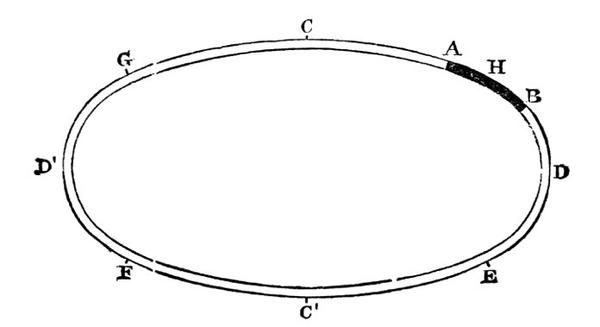
Kingdon Clifford. [42] In the 1870s Clifford wrote of a hypothetical
one-dimensional worm (AB) that lived in a thin oval tube, endlessly
circling it clockwise, without any degree of freedom to go
counter-clockwise let alone escape “up” or “down” (which would be
useless concepts or intuitions to the worm). The worm itself would not
even see the second dimension, that is, the oval-like shape in
which it lives its life. However it would perceive differences in
extra-dimensional curvature (i.e. two-dimensional curvature) as bodily feelings, because its body would curve more at points of acute curvature (viz. H, E, F, and G in Figure 2). [43]
Figure 2: Clifford’s one-dimensional worm
Clifford writes that:
‘a
being existing in these [<3] dimensions would most probably
attribute the effects of curvature to changes in its own physical
constitution in nowise connected with the geometrical character of its
space. … [If we consider ourselves,] changes in shape may be either
imperceptible … or if they do take place we may attribute them to
“physical causes” – to heat, light, or magnetism – which may be mere
names for variations in the curvature of our space. … [We may be]
treating merely as physical variations effects which are really due to
changes in the curvature of our space; … some or all of those causes
which we term physical may … be due to the geometrical construction of
our space … variation in the curvature of our space…’ [44]
Following
Einstein’s revelations [45] we see how advanced Clifford was, at least
with regard to the feeling of gravity. Yet there are perhaps further
developments to be made in this field relating extra-dimensional
curvature to qualia [46] – thereby correlating not just force to
geometry but qualia too. That is to say that a relation of
(n-dimensional) space and sentience is here suggested.
Mathematicians
and physicists, then, have given feasibility to the idea of
n-dimensional space. [47] We have seen how Clifford relates such space
to sentience, let us augment this relation by looking at the ideas of
John R. Smythies (1922 – 2019), a neurophilosopher and associate of
psychedelic cognoscenti Aldous Huxley and Humphrey Osmond. Smythies
provides two sub-theories through which we can understand the relation
of space to sentience:
Theory I: ‘Sense-data[48] ... are
spatial entities distinct from physical objects and bear temporal and
causal relations but no spatial relations to physical objects.’[49] –
i.e. an exclusive theory.
Theory II: ‘Sense data … are
spatial entities distinct from physical objects and bear both temporal
and causal relations and higher-dimensional spatial relations to
physical objects.’ [50] – i.e. an inclusive theory.
Theory I is taken by certain figures such as H. H. Price[51] and Bertrand Russell, [52] but Smythies considers Theory II preferable as it is more parsimonious and offers a contiguous spatial connection
between mind and matter; mind-matter spatial relations that would be
lacking in Theory I (which would then only have temporal (i.e.
successive) and causal (i.e. transordinal) relations between physical
space (PS) and visual space (VS).
Theory I advances that
all the three-dimensional spaces of all beings’ sense data, and the one
three-dimensional space of physicality are a multiplicity of separate spaces.
In emergentism, each VS would ‘emerge’ from sections (such as those
within brains) of the singular PS. We have already hinted at the
inadequacy of this mysterious transordinal upward transition. Theory I
would require causal rather than spatial relations between all myriad
spaces, and thus would be an emergentism, and thus the mystery of
transordinal nomology emerges once more. Thus we reject Theory I.
Theory II then advances the actuality of a unified space of multiple dimensions (= n-dimensional
space) in which all of VS and PS are cross-sections. Moreover, Smythies
agrees with psychiatrist Paul Schilder that the perception of
PS is VS. He quotes Schilder thus: ‘The space in which objects are
perceived and the space in which they are imaged, are one and the same.’
[53] This in turn implies, Smythies writes, that ‘[in] this n-dimensional space Scientific Space [PS] and a visual field [VS] would not be two different kinds of section but would merely be two different sections.’ [54]
This is not to say that PS is not real but rather to say that our access to it is through VS (plus other senses) which is prosaically
three-dimensional. Thus the reality of physical space as more than
three-dimensional is not falsified by our common perception of it as
three-dimensional. I write ‘prosaically’ because it may be possible to
visualize objects of more than three spatial dimensions – Smythies does
suggest that ‘[t]here is no a priori reason why we should not develop the ability to appreciate directly an n-dimensional spatial system’, and there are reports of such vision. [55] Indirectly,
we can easily conceptualize and work with[56] more than three
dimensions of space through algebraic topology using the Cartesian
coördinate system where points, areas and volumes, etc., can be located
by numeric variables of each dimension’s axis, e.g. point h: (x1, y2, z3). To locate a point in a four-dimensional space, one simply adds an axis and its variable, e.g. point h: (x1, y2, z3, w4). Ad infinitum. Alternatively, one can visually represent (though not prosaically present) [57] four-dimensional space through for instance a four-dimensional cube, or tesseract (hypercube) – see Figure 2.
The word tesseract
was coined by the aforementioned mathematician and author Charles
Howard Hinton, [58] whose work on the fourth dimension can be used to
our ends. In his essay of 1880, ‘What is the fourth dimension?’ –
published four years prior to the related book Flatland by Edwin A. Abbott–
Hinton employs analogy to lower dimensional worlds to elucidate a
speculated four-dimensional world. I shall briefly explain it, then
connect this four dimensional world to the n-dimensional world
of Broad and Smythies, so to entertain a theory of the relation between
space and sentience. Note that by four dimensions, we are speaking of
four spatial dimensions, not a fourth temporal dimension in addition to three spatial dimensions. [59]
Let us imagine a two-dimensional world, a plane, or a Flatland
as Abbott calls it, like a sheet of paper. Any beings therein would
only be aware of two dimensions, and would only be aware of borders
describable with two axes (x,y). Thus they would be unaware of the
existence (as we perceive it from our three-dimensional perspective) of
the top and bottom faces of their plane that is also contiguous, that
borders, their two-dimensional world. Now, we three-dimensional
observers could see a multiplicity of such planes, sheets, each floating
one above the other. Although each entity of the flatland could not
perceive the other flatlands (just as in our world we cannot perceive other entities’ experienced three-dimensional spaces), as they were not contiguous at the x and y axes, wecould
perceive the multitude of flatlands, or worlds, from our
higher-dimensional space – and we could perceive the spatial contiguity
(i.e. fundamental unity) of two-dimensional worlds in a
three-dimensional space. Thus though each such two-dimensional world
would not be contiguous with another two-dimensional world, [60] each
two-dimensional world would be contiguous with, i.e. within the same space as, all the other two-dimensional worlds via the intervening three-dimensional space. Thus the relationship between such flatlands would be spatial rather than merely causal,
under the perspective of a world with a higher dimensionality than that
of each two-dimensional world. The nomology would be of one order
rather than transordinal, because the levels would be unified here. Rather than one world emerging from another (as in emergentism), they would each be equally fundamental and unified. Now, let me allow Hinton, 1880, to shift the argument up a dimension:
‘Take
now the case of four dimensions. Instead of bringing before the mind a
sheet of paper conceive a solid of three dimensions. If this solid were
to become infinite it would fill up the whole of three-dimensional
space. But it would not fill up the whole of four-dimensional space. It
would be to four-dimensional space what an infinite plane is to
three-dimensional space. There could be in four-dimensional space an
infinite number of such solids, just as in three-dimensional space there
could be an infinite number of infinite planes.
Thus,
lying alongside our space, there can be conceived a space also infinite
in all three directions. To pass from one to the other a movement has
to be made in the fourth dimension, just as to pass from one infinite
plane to another a motion has to be made in the third dimension.’ [61]
Thus we place Smythies’ n-dimensional
spaces (i.e. PS with a multitude of beings’ VSs) within the Hintonian
four-dimensional space so to render intelligible the Theory II relation between VS and PS.
So: through this approach, we exhibit the possibility that though visual spaces and physical space are not strictly identical, refuting the Psycho-neural Identity Theory, they neither need be strictly distinct, as in Substance Dualism. Neither need one (VS) emerge
from the other (PS). Through a four-dimensional perspective, we can see
that the mental (all of which for James is necessarily spatial) [62]
and the physical can be both fundamental and unified, i.e. a mind-matter
monism. The imagined triangle and the physical correlates thereof are
both part of one n-dimensional space rather than members of distinct
categories. This is all to say that the More-Broad-Smythies Theory (Theory II) is one, albeit radical, way to respond to the mind-matter mystery. It is a radical monism of space and sentience.
Whether
we can call such a monism an identity theory is merely a matter of
definition. Spinoza’s system, for instance, is certainly a monism and
has certainly been classified as an identity theory.[63] In this regard,
it is interesting to note that Hinton, in the above-quoted 1880 essay,
also writes that:
‘In the
[four-dimensional manifold] which we have traced out, much that
philosophers have written finds adequate representation. Much of
Spinoza’s Ethics, for example, could be symbolized from the preceding pages.’ [64]
It
is also interesting to note here that Hinton corresponded with William
James on the subject of four-dimensional consciousness.[65] Both Spinoza
and James were, in the end, panpsychists, and the full extent of the
relationship between higher-dimensionality and panpsychism – or more
broadly, between n-dimensional space and sentience – is a woefully
underexplored world, [66] a world where one may find idios kosmos within koinos kosmos, thought within extension.
subtle.energy | We live in a realm of polarity. Polarity is observable in all things;
up and down, night and day, big and small, etc. When it comes to
harnessing natural forces for energy, humanity has recently become
proficient in utilizing the power of explosion to move our vehicles,
light our houses, and run our modern world. Currently, we look towards
heat-based technologies that utilize steam, gas pressure, and atomic
fission to fulfill the majority of our energy needs.
In our
quest to expand our knowledge of mastering this form of explosive
energy, we may have accidentally overlooked the potential for another
viable energy form, found in the equal-opposite force of explosion;
implosion. Renowned Austrian naturalist, scientist, inventor, author and
researcher, Viktor Schauberger, noticed this oversight and initiated
work to discover the promise that implosion power could hold for our
civilization.
Viktor Schauberger noticed that the interactions of opposites often
leads to a spiraling interchange between the extremes of polarity. For
example, when a cold front of weather meets currents of hot air, they
spiral in, to form a hurricane or tornado. All things move between their
extremes of polar opposites or di-polarity, towards the polarity of
greater perfection or destruction.
“Kapieren und kopieren,” or “comprehend and copy nature” is Viktor’s
motto, the method by which he gained his inspiration. He spent much of
his time in the forest, making great innovative contributions to the
timber industry by improving the efficiency of log flumes by directly
observing the behaviors of rivers. His deep understanding of water
earned him the nickname “Water Wizard.”
Explosion vs. Implosion
Schauberger observed
that if the driving force of movement was centrifugal, or spiraling
outwards, it would tend towards the being destructive. If the spin was
concentrated inwardly, centripetal, the force would favor nourishment
and growth. According to his work, Centrifugence led to friction, which
leads to heat, which he associated with the intensification of gravity.
Centripetence, the opposing force, would lead to cooling and a lack of
friction; therefore levitation.
For example, in nature, hot lava
flows deep under the earth’s crust, where gravity continually
intensifies towards the planet’s center. However, when water vapor
cools, it rises into the atmosphere and floats, essentially levitating
over us in the form of puffy clouds. Somewhere in the middle, these
forces converge. Water evaporates up in curling spirals, the earth’s
crust is whirled away, melted down into the lava.
By using suction, instead of pressure, with the proper applications,
energy as we know it today could be revolutionized. Not only would this
implosion energy be significantly cleaner than many of the leading
energy options of today, it would also lend itself to greater longevity
for the equipment used to generate it. Friction and heat can be taxing
on materials. This leads machinery to break down more quickly, and more
waste to be generated.
Schauberger considers the choice to rely on combustion engines to be a
great error. His belief is that the resources of the world are to be
protected and that we are using them up at a great cost, both
economically and ecologically. Just as we preserve the body’s fuel;
food, by keeping it in the freezer, we destroy its molecular bonds by
cooking. The same applies to mechanical fuel.
If we were to choose to include implosion technology or cooling
power, we may be able to stabilize our dependence on natural resources
and reach a new renaissance of clean, sustainable energy.
Looking Towards the Future
Schauberger also
maintains that the key to overcoming gravity and achieving levitation
can be found through implosion technology. Although this tenant is not
currently observed in modern scientific circles, recent mainstream media
news reports confirm that someone in the cosmos, maybe even from our
planet, has clearly mastered what is most likely levitation technology.
svpwiki |Viktor Schauberger (1885-1958) was an Austrian man
who spent much of his life as a forestmaster in his native country, and
as an inventor who had a deep understanding and appreciation for the life energy dynamics of what he quite clearly called water's life cycle. He put forth the scientific idea that water is indeed alive, and as such it can be sterile, immature or mature depending on the cluster size, treatment, motion and temperature of the water. An early invention was for a wooden pipe to carry water. It was believed by Schauberger
that in order for water to mature it must not be exposed to sunlight
and be allowed to flow undisturbed, meaning to be able to move in a
snakelike fashion. What is actually happening in a naturally coursing
stream is that there is a longitudinal whirling flow which forms along the length of the stream. In several books on his life and work such as 'Living Energies' by Callum gradient cycles in forests and rivers and
their importance to the quality of the water contained therein.
'Understand and duplicate nature' was one of Viktor's
most famous sayings, denoting his simple philosophy. In practice this
deep understanding of the treatment of water would lead him to create
several machines, such as the repulsine, that use the principle of vortex motion in their design. In the repulsine,
air is passed through a narrow corrugated chamber created by two plates
with impelling blades along the outer edge, so as to create a suction
turbine. In one experiment Viktor plotted the resistance of three test pipes to water flow. He found that the first, glass, increased at about a 40 degree angle on the chart. Copper
was a little less, about a 30 degree angle. A spiraling copper pipe
plotted a variation over various flow rates, however at one point on the
graph it drops below zero, denoting the 'sweet spot' where the flowrate
temperature and volume of the water all match up. Schauberger found that the ideal temperature for water is around +4°C where it is at its densest, before it starts expanding from heat
or expanding to crystallize. So in his inventions the suction action
would be used to further cool the water - if it can be controlled to
stay in the sweet spot by its own suction action, then efficiency goes
up considerably.
Viktor Schauberger was also an avid farmer. He devised a heart-shape spiral plough in which soil is turned out in a longitudinal
spiral as it passes through the blades of the plough. He alo found that
the copper content of the soil is important, and to use copper or
copper coated tools is much better than steel ones. The reasons involve
electrical charge of the water and how it interacts with dissolved
minerals in the soil. [no source given]
Viktor Schauberger on his observation of Nature, particularly water:
The Schauberger’s principle preoccupation was directed towards the
conservation of the forest and wild game, and even in earliest youth my
fondest desire was to understand Nature, and through such understanding
to come closer to the truth; a truth that I was unable to discover
either at school or in church.
In this quest I was thus drawn time and time again up into the
forest. I could sit for hours on end and watch the water flowing by
without ever becoming tired or bored. At the time I was still unaware
that in water the greatest secret lay hidden. Nor did I know that water
was the carrier of life or the ur-source of what we call consciousness.
Without any preconceptions, I simply let my gaze fall on the water as it
flowed past. It was only years later that I came to realise that
running water attracts our consciousnesses like a magnet and draws a
small part of it along in its wake. It is a force that can act so
powerfully that one temporarily loses one’s consciousness and
involuntarily falls asleep.
As time passed I began to play a game with water’s secret powers; I
surrendered my so-called free consciousness and allowed the water to
take possession of it for a while. Little by little this game turned
into a profoundly earnest endeavour, because I realised that one could
detach one’s own consciousness from the body and attach it to that of
the water.
When my own consciousness was eventually returned to me, then the
water’s most deeply concealed psyche often revealed the most
extraordinary things to me. As a result of this investigation, a
researcher was born who could dispatch his consciousness on a voyage of
discovery. In this way I was able to experience things that had escaped
other people’s notice, because they were unaware that a human being is
able to send forth his free consciousness into those places the eyes
cannot see.
By practising this blindfolded vision, I eventually developed a bond
with mysterious Nature, whose essential being I then slowly learnt to
perceive and understand. [Viktor Schauberger]
''Nature is not served by rigid laws, but by rhythmical, reciprocal
processes. Nature uses none of the preconditions of the chemist or the
physicist for the purposes of evolution. Nature excludes all fire on
principle for purposes of growth; therefore all contemporary machines
are unnatural and constructed according to false premises.
Nature avails herself of the bio-dynamic form of motion through which
the biological prerequisite for the emergence of life is provided. Its
purpose is to ur-procreate [re-create the primary, the essence of]
‘higher’ conditions of matter out of the originally inferior raw
materials, which afford the evolutionally older, or the numerically
greater rising generation, the possibility of a constant capacity to
evolve, for without any growing and increasing reserves of energy there
would be no evolution or development.
This results first and foremost in the collapse of the so-called Law of the Conservation of Energy, and in further consequence the Law of Gravity, and all other dogmatics lose any rational or practical basis.'' [Viktor Schauberger, source : from "Implosion" no. 81 re-printed in Nexus magazine Apr-May 1996]
the-sun | Drawing together the nuclear and underwater theories, Mr Heseltine
said: "If you think about it if there was World War 3 and we made toxic
all the water then that would affect their habitat.
"That's why I think think there's correlation with water - they have bases and we only know 5% of the ocean."
UAPs have become a hot topic issue as the deadline approaches for the
report, with more and more US military footage leaking and pressure
mounting on governments to come clean.
And so far there are no definitive public answers as to what appears to be happening in our skies.
However, US officials have started taking the unprecedented step of
confirming the authenticity of strange videos filmed by warships and
warplanes.
And they have admitted they do not know the origin of the unusual
objects as calls grow in the US for widespread disclosure to figure out
what - if anything - the world's governments are hiding on UFOs.
Competing theories on the strange videos continue to rage – with some
grounded on Earth claiming the videos capture never-before-seen
military aircraft or drones, while others claim it shows otherworldly
craft possibly piloted by aliens.
Others however are more skeptical and sometimes even dismissive,
claiming the bizarre videos may just be camera tricks, natural phenomena
or even outright hoaxes.
“We know that ultimately this conversation will lead to confirmation
that we’re being engaged with some kinds of intelligence that is likely
to be extraterrestrial,” Mr Heseltine told The Sun Online.
“The things that are being described now were seen and being described in the 1940s, 50s, 60s and 70s.
“Nothing has changed all we have is better technical equipment like
video on aircraft so we can pick things up easier, that’s why it’s being
seen more.
“We are saying you’ve got to start preparing people for a massive
psychological change – whether it’s now or six months or a year’s time
everything is pointing to ET or non-humans.
“Through awareness programmes we want to prepare people for the
shock of this new reality on a global scale because 95 per cent of the
world is in ignorance about it.
“Seventy years of past history would say they’ve been here all that time, they’re not a threat."
He explained ICER wants to make sure the public are ready for any
potentially bombshell revelations on UFO, saying "we should be preparing
the world now".
Mr Heseltine added ICER is working towards being an NGO that has United Nations special consultative status
vice | At
the time, they had been investigating a number of cases of pilots who'd
gotten close to supposed UAPs and the fields generated by them, as was
claimed by the people who showed up at my office unannounced one day.
There was enough drama around the Atacama skeleton that I had basically
decided to forswear all continued involvement in this area. Then these
guys showed up and said, ‘We need you to help us with this because we
want to do blood analysis and everybody says that you've got the best
blood analysis instrumentation on the planet.’ Then they started showing
the MRIs of some of these pilots and ground personnel and intelligence
agents who had been damaged. The MRIs were clear. You didn't even have
to be an MD to see that there was a problem. Some of their brains were
horribly, horribly damaged. And so that's what kind of got me involved.
Does the Department of Pathology at Stanford have a track record of pulling practical jokes on you?
I
thought it was a practical joke at the beginning. But no, nobody was
pulling a practical joke. And just as an aside, the school is completely
supportive, and always has been of the work that I've been doing. When
the Atacama thing hit the fan, they stepped in and helped me deal with
the public relations issues around it.
Are you able to mention which folks from which governmental departments other than aeronautics approached you? No, I'm not.
Can you describe the more anomalous effects on the brains you observed with the MRIs? If
you've ever looked at an MRI of somebody with multiple sclerosis,
there's something called white matter disease. It's scarring. It's a big
white blob, or multiple white blobs, scattered throughout the MRI. It's
essentially dead tissue where the immune system has attacked the brain.
That's probably the closest thing that you could come to if you wanted
to look at a snapshot from one of these individuals. You can pretty
quickly see that there's something wrong.
How many patients did you take a look at in that first phase? It
was around 100 patients. They were almost all defense or governmental
personnel or people working in the aerospace industry; people doing
government-level work. Here's how it works: Let's say that a Department
of Defense personnel gets damaged or hurt. Odd cases go up the chain of
command, at least within the medical branch. If nobody knows what to do
with it, it goes over to what's called the weird desk, where things get
thrown in a bucket. Then somebody eventually says, ‘Oh, there's enough
interesting things in this bucket worth following up on that all look
reasonably similar.’ Science works by comparing things that are similar
and dissimilar to other things. Enough people were having very similar
kinds of bad things happen to them, that it came to the attention of a
guy by the name of Dr. Kit Green.
He was in charge of studying some of these individuals. You have a
smorgasbord of patients, some of whom had heard weird noises buzzing in
their head, got sick, etc. A reasonable subset of them had claimed to
have seen UAPs and some claimed to be close to things that got them
sick. Let me show you the MRIs of the brains of some of these people.
We
started to notice that there were similarities in what we thought was
the damage across multiple individuals. As we looked more closely,
though, we realized, well, that can't be damaged, because that's right
in the middle of the basal ganglia [a group of nuclei responsible for motor control and other core brain functions].
If those structures were severely damaged, these people would be dead.
That was when we realized that these people were not damaged, but had an
over-connection of neurons between the head of the caudate and the
putamen [The caudate nucleus plays a critical role in various higher
neurological functions; the putamen influences motor planning, learning,
and execution]. If you looked at 100 average people, you wouldn’t see
this kind of density. But these individuals had it. An open question is:
did coming in contact with whatever it was cause it or not?
For
a couple of these individuals we had MRIs from prior years. They had it
before they had these incidents. It was pretty obvious, then, that this
was something that people were born with. It's a goal sub-goal setting
planning device, it's called the brain within the brain. It's an
extraordinary thing. This area of the brain is involved (partly) in what
we call intuition. For instance, Japanese
chess players were measured as they made what would be construed as a
brilliant decision that is not obvious for anybody to have made that
kind of leap of intuition, this area of the brain lights up.
We had found people who had this in spades. These are all so called
high-functioning people. They're pilots who are making split second
decisions, intelligence officers in the field, etc.
Everybody
has this connectivity region in general, but let’s say for the average
person that the density level is 1x. Most of the people in the study had
5x to 10x and up to 15x, the normal density in this region. In this
case we are speculating that density implies some sort of neuronal
function.
amidwesterndoctor | One of the fascinating things about science is that while it is an
excellent tool for discerning the nature of reality, it will
simultaneously refuse to look at data with implications that challenge
the existing scientific orthodoxy. So an unfortunate situation is
created where science advances knowledge to a point but then reverses
polarities and paradoxically becomes a barrier to that advancement.
An
excellent illustration of this dynamic can be seen with water, and as a
result, many of its properties are relatively unknown. One of the most
important properties is that provided ambient infrared energy is present
in the environment and a polar surface exists, water can assume a
semi-solid state where it behaves like a liquid crystalline structure.
Since a significant portion of the water within the body is in the
liquid crystalline state, the biological consequences of this water, in
my eyes, represent a key forgotten side of medicine.
In the first part of this series,
I discussed the long lineage of scientists who have studied this
semi-solid form of water, followed by listing some of the key properties
of this gel-like 4th phase of water and what causes it to form. Since
it has been studied by so many, it has many names (e.g., interfacial
water or EZ water) and hereafter will be referred to as liquid
crystalline water, which I believe is the most accurate description for
it.
In the second part of the series,
I discussed how water’s ability to become a partial solid through its
liquid crystalline phase explains many of the structural mysteries of
the body. The body and its tissues have a significant strength and
durability one would expect to find in a solid, but at the same time, it
has a high degree of flexibility and capacity for rapid movement one
would expect in a liquid.
Note: the references for the assertions in this section can be found within those two articles.
Because
liquid crystalline water is effectively both a solid and liquid, it can
accommodate these conflicting demands. An incredible degree of natural
engineering, in turn, exists within the body to utilize its properties
to accomplish both. In addition to creating structure (including, for
example, the barriers that protect your blood vessels from damage, which
also happen to be a vital target of the spike protein’s toxicity), the
body also frequently makes use of phase transitions between water’s
liquid crystalline state and its regular liquid state.
The
transitions are important because they provide the mechanisms that
underlie a variety of physiologic processes our existing models fail to
explain effectively. For example, as discussed in the article,
there are a variety of significant inconsistencies within the current
model to explain how muscles contract, but they have not been seriously
critiqued because no better model exists for muscle function.
The
phase transition model instead argues that muscles are designed to form
liquid crystalline water. The formation of that water inside the muscle
tissue naturally expands and stretches the muscle tissue. Then when the
liquid crystalline water is transitioned back to its regular liquid
state, the muscle rapidly contracts since an expansive pressure is no
longer present to resist the tension in its stretched proteins. Another
other interesting applications of this expansive force is that it
allows plants and seedlings to break apart rock solid objects as they
grow.
Similarly, the formation of liquid crystalline water (which
holds a negative charge) with an immediately adjacent layer of
positively charged protons creates an electrical charge gradient. Rather
than dissipating, this gradient persists (essentially functioning as a
battery), and this charge can be measured directly.
Thus, one of
the most interesting characteristics of liquid crystalline water is that
it effectively functions as an energy source living systems can
utilize. Its ability to spontaneously move into a more structured form
(which the muscles, for example, utilize) is one such example. Some of
the other critically important utilizations of water’s ability to
convert ambient infrared energy into a usable form of energy include:
•Photosynthesis.
To my knowledge, liquid crystalline water’s contribution to this
process has not yet been fully worked out. However, frequencies of light
that increase liquid crystalline water have been reported to increase
plant growth, and a particulate material that was designed to increase
the formation of liquid crystalline water was shown to create at least a 2-3-fold increase in root length and/or formation of shoots.
•Nerve
signal conduction (agents that block the formation of liquid
crystalline water block nerve function, and nerve signal conduction
depends upon a phase transition within the neuron).
•Cellular transport and division (these also appear to depend upon water’s phase transitions).
hameroff | Biomolecules have evolved and flourished in aqueous environments, and
basic interactions among biomolecules and their pervasive hosts, water molecules,
are extremely important. The properties of intracellular water are controversial.
Many authors believe that more than 90 percent of intracellular water is in the
“bulk” phase-water as it exists in the oceans (Cooke and Kuntz, 1974; Schwan
and Foster, 1977; Fung and McGaughy, 1979). This traditional view is challenged
by others who feel that none of the water in living cells is bulk (Troshin, 1966,
Cope 1976, Negendank and Karreman, 1979). A middle position is assumed by
those who feel that about half of “living” water is bulk and the other half
“ordered” (Hinke, 1970; Clegg, 1976; Clegg, 1979; Horowitz and Paine, 1979).
This group emphasizes the importance of “ordered” water to cellular structure and
function.
Many techniques have been used to study this issue, but the results still
require a great deal of interpretation. Nuclear magnetic resonance (NMR), neutron
diffraction, heat capacity measurement, and diffusion studies are all inconclusive.
Water appears to exist in both ordered and aqueous forms within cells. The
critical issue is the relation between intracellular surfaces and water. Surfaces of
all kinds are known to perturb adjacent water, but within cells it is unknown
precisely how far from the surfaces ordering may extend. We know the surface
area of the microtrabecular lattice and other cytoskeleton components is extensive
(billions of square nanometers per cell) and that about one fifth of cell interiors
consist of these components. Biologist James Clegg (1981) has extensively
reviewed these issues. He concludes that intracellular water exists in three phases.
1) “Bound water” is involved in primary hydration, being within one or two
layers from a biomolecular surface. 2) “Vicinal water” is ordered, but not directly
bound to structures except other water molecules. This altered water is thought to
extend 8 to 9 layers of water molecules from surfaces, a distance of about 3
nanometers. Garlid (1976, 1979) has shown that vicinal water has distinct solvent
properties which differ from bulk water. Thus “borders” exist between water
phases which partition solute molecules. 3) “Bulk water” extends beyond 3
nanometers from cytoskeletal surfaces (Figure 6.4).
Drost-Hansen (1973) described cooperative processes and phase transitions
among vicinal water molecules. Clegg points out the potential implications of
vicinal water on the function of enzymes which had previously been considered
“soluble.” Rather than floating freely in an aqueous soup, a host of intracellular
enzymes appear instead to be bound to the MTL surface within the vicinal water
phase. Significant advantages appear evident to such an arrangement: a sequence
of enzymes which perform a sequence of reactions on a substrate would be much
more efficient if bound on a surface in the appropriate order. Requirements for
diffusion of the substrate, the most time consuming step in enzymatic processes,
would be minimal. Clegg presents extensive examples of associations of
cytoplasmic enzymes which appear to be attached to and regulated by, the MTL.
These vicinal water multi-enzyme complexes may indeed be part of a cytoskeletal
information processing system. Clegg conjectures that dynamic conformational
activities within the cytoskeleton/MTL can selectively excite enzymes to their
active states.
The polymerization of cytoskeletal polymers and other biomolecules appears
to flow upstream against the tide of order proceeding to disorder which is decreed
by the second law of thermodynamics. This apparent second law felony is
explained by the activities of the water molecules involved (Gutfreund, 1972).
Even in bulk aqueous solution, water molecules are somewhat ordered, in that
each water molecule can form up to 4 hydrogen bonds with other water
molecules. Motion of the water molecules (unless frozen) and reversible breaking
and reforming of these hydrogen bonds maintain the far miliar liquid nature of
bulk water. Outer surfaces of biomolecules form more stable hydrogen bonding
with water, “ordering” the water surrounding them. This results in a decrease in
entropy (increased order) and increase in free energy: factors which would
strongly inhibit the solubility of biomolecules if not for the effects of hydrophobic
interactions. Hydrophobic groups (for example amino acids whose side groups are
non-polar, that is they have no charge-like polar groups to form hydrogen bonds
in water) tend to combine, or coalesce for two main reasons: Van der Waals
forces and exclusion of water.
Combination of hydrophobic groups “liberate”
ordered water into free water, resulting in increased entropy and decreased free
energy, factors which tend to drive reactions. The magnitude of the favorable free
energy change for the combination of hydrophobic groups depends on their size
and how well they fit together “sterically.” A snug fit between groups will
exclude more water from hydrophobic regions than will loose fits. Consequently,
specific biological reactions can rely on hydrophobic interactions. Forma, tion of
tertiary and quaternary protein structure (including the assembly of microtubules
and other cytoskeletal polymers) are largely regulated by hydrophobic
interactions, and by the effect of hydrophobic regions on the energies of other
bonding. A well studied example of the assembly of protein subunits into a
complex structure being accompanied by an increase in entropy (decrease in
order) is the crystallization of the tobacco mosaic virus. When the virus assembles
from its subunits, an increase in entropy occurs due to exclusion of water from the
virus surface. Similar events promote the assembly of microtubules and other
cytoskeletal elements The attractive forces which bind hydrophobic groups are distinctly different
from other types of chemical bonds such as covalent bonds and ionic bonds.
These forces are called Van der Waals forces after the Dutch chemist who
described them in 1873. At that time, it had been experimentally observed that gas
molecules failed to follow behavior predicted by the “ideal gas laws” regarding
pressure, temperature and volume relationships. Van der Waals attributed this
deviation to the volume occupied by the gas molecules and by attractive forces
among the gas molecules. These same attractive forces are vital to the assembly
of organic crystals, including protein assemblies. They consist of dipole-dipole
attraction, “induction effect,” and London dispersion forces. These hydrophobic
Van der Waals forces are subtly vital to the assembly and function of important
biomolecules.
Dipole-dipole attractions occur among molecules with permanent dipole
moments. Only specific orientations are favored: alignments in which attractive,
low energy arrangements occur as opposed to repulsive, high energy orientations.
A net attraction between two polar molecules can result if their dipoles are
properly configured. The “induction” effect occurs when a permanent dipole in
one molecule can polarize electrons in a nearby molecule. The second molecule’s
electrons are distorted so that their interaction with the dipole of the first molecule
is attractive. The magnitude of the induced dipole attraction force was shown by
Debye in 1920 to depend on the molecules’ dipole moments and their
polarizability. Defined as the dipole moment induced by a standard field,
polarizability also depends on the molecules’ orientation relative to that field.
Subunits of protein assemblies like the tobacco mosaic virus have been shown to
have high degrees of polarizability. London dispersion forces explain why all
molecules, even those without intrinsic dipoles, attract each other. The effect was
recognized by F. London in 1930 and depends on quantum mechanical motion of
electrons. Electrons in atoms without permanent dipole moments (and “shared”
electrons in molecules) have, on the average, a zero dipole, however
“instantaneous dipoles” can be recognized. Instantaneous dipoles can induce
dipoles in neighboring polarizable atoms or molecules. The strength of London
forces is proportional to the square of the polarizability and inversely to the sixth
power of the separation. Thus London forces can be significant only when two or
more atoms or molecules are very close together (Barrow, 1966). Lindsay (1987)
has observed that water and ions ordered on surfaces of biological
macromolecules may have “correlated fluctuations” analogous to London forces
among electrons. Although individually tenuous, these and other forces are the
collective “glue” of dynamic living systems.
ACS |You might call Gerald H. Pollack “the Teflon professor.”
Pollack, a bioengineering professor at the University of Washington,
Seattle, has been the subject of savage criticism for his heterodox
theories about water—yet he continues to enjoy great success.
In the past decade, Pollack claims to have amassed experimental
evidence that in addition to ice, liquid, and gas, water can form a
fourth, gel-like or liquid-crystalline phase, as well as store charge—a
property that would violate the law of electroneutrality in bulk fluids.
Most water and electrochemists dismiss his results, saying they can be
entirely explained by invoking basic water chemistry, and the presence
of impurities.
Pollack acknowledges that his research is controversial. “It’s
impossible to break new ground without arousing controversy,” he tells
C&EN. But, he adds, “I’ve somehow managed to stay funded.”
Despite—or perhaps because of—its ubiquity and central importance in
biology, chemistry, and physics, water has long been steeped in
controversy. In the 1960s, researchers debated the existence of
polywater, a polymerized form of liquid water with high boiling point
and viscosity. Polywater was eventually debunked, only to be replaced by
the concept of water memory in the 1980s. This idea that liquid water
can sustain ordered structures for long periods of time is one of the
key tenets of homeopathy, a scientifically suspect concept, in which
water supposedly “remembers” features of a solute even after repeated
dilutions that remove all solute molecules. Water memory has also been
debunked in the pages of Nature (1988, 334, 287).
In recent years, Pollack has moved outside the confines of the cell
to the structure of water in general. In an annual faculty lecture at
the University of Washington titled “Water, Energy, and Life: Fresh Views From the Water’s Edge,” which is also making rounds on YouTube,
Pollack describes what he calls an “exclusion zone” where microspheres
in a container of water pull away from the surface, while an organized
water gel thousands of layers thick forms. Any energy, whether from
sunlight or heat, puts energy into the system, helping to increase the
phenomenon, he says.
But as Pollack treads further into the territory of chemists,
criticisms of his ideas have become more pointed. A recent paper of his
in Langmuir, titled “Can Water Store Charge?”
made the argument that pure water, hooked up to electrodes, will form
large pH gradients that persist long after the current is turned off (Langmuir2009,25, 542). A firestorm ensued.
Until the early 2000s, most of Pollack’s publications centered on
bioengineering topics such as the behavior of muscle proteins. But in
2001, he published the book “Cells, Gels, and the Engines of Life,” in
which he dismantled the standard view of cells, including ion pumps and
membrane channels. He posited instead that the water inside cells is a
structured gel that plays a fundamental role in the organization and
action of cellular structures.
Some reviewers took Pollack to task: University of Colorado, Boulder,
biology professor Michael W. Klymkowsky criticized the book for an
“overall style reminiscent of creationist writings” (Nat. Cell Bio.2001,3,
E213). But some lauded the book’s fresh outlook. Harvard University
bioengineering professor Donald Ingber described the book as a “nicely
sculpted … polemic against complacency in the cell biology
establishment” (Cell2002,109, 688).
pollacklab | Water has three phases – gas, liquid, and solid; but findings from our
laboratory imply the presence of a surprisingly extensive fourth phase
that occurs at interfaces. The formal name for this fourth phase is
exclusion-zone water, aka EZ water. This finding may have profound
implication for chemistry, physics, and biology.
The
impact of surfaces on the contiguous aqueous phase is generally thought
to extend no more than a few water-molecule layers. We find, however,
that colloidal and molecular solutes are profoundly excluded from the
vicinity of hydrophilic surfaces, to distances up to several hundred
micrometers. Such large zones of exclusion have been observed next to
many different hydrophilic surfaces, and many diverse solutes are
excluded. Hence, the exclusion phenomenon appears to be quite general.
To test
whether the physical properties of the exclusion zone differ from those
of bulk water, multiple methods have been applied. NMR, infrared, and
birefringence imaging, as well as measurements of electrical potential,
viscosity, and UV-VIS and infrared-absorption spectra, collectively
reveal that the solute-free zone is a physically distinct, ordered phase
of water. It is much like a liquid crystal. It can co-exist essentially
indefinitely with the contiguous solute-containing phase. Indeed, this
unexpectedly extensive zone may be a candidate for the long-postulated
“fourth phase” of water considered by earlier scientists.
The
energy responsible for building this charged, low entropy zone comes
from light. We found that incident radiant energy including UV, visible,
and near-infrared wavelengths induce exclusion-zone growth in a
spectrally sensitive manner. IR is particularly effective. Five-minute
exposure to radiation at 3.1 µm (corresponding to OH stretch) causes an
exclusion-zone-width increase of up to three times. Apparently, incident
photons cause some change in bulk water that predisposes constituent
molecules to reorganize and build the charged, ordered exclusion zone.
How this occurs is under study.
Photons
from ordinary sunlight, then, may have an unexpectedly powerful effect
that goes beyond mere heating. It may be that solar energy builds order
and separates charge between the near-surface exclusion zone and the
bulk water beyond — the separation effectively creating a battery. This
light-induced charge separation resembles the first step of
photosynthesis. Indeed, this light-induced action would seem relevant
not only for photosynthetic processes, but also for all realms of nature
involving water and interfaces.
The work
outlined above was selected in the first cohort of NIH Transformative
R01 awards, which allowed deeper and broader exploration. It was also
selected as recipient the 2008 University of Washington Annual
Lectureship. Each year, out of the University’s 3,800 faculty members,
one is chosen to receive this award. Viewable here, the lecture presents the material in a lively manner, accessible to non-experts.
The
material now appears in a book, published 2013, entitled The Fourth
Phase of Water: Beyond Solid, Liquid and Vapor. Sample chapters are
freely accessible at www.ebnerandsons.com, which also contains published reviews. Reader reviews can be found on Amazon.com.
Many lectures and interviews on the material above can be found on the internet. Of interest are two TEDx talks. The original one presents an outline of the basic discoveries, designed for a lay audience. The second one, 2016, describes the relevance of EZ water for health.
Also of interest may be a short Discovery Channel piece that combines fourth phase water with snowboarding.
Celebrating 113 years of Mama Rosa McCauley Parks
-
*February 4, 1913 -- February 4, 2026*
*Some notes: The life of the courageous activist Mama Rosa McCauley Parks*
Mama Rosa's grandfather Sylvester Ed...
Monsters are people too
-
Comet 3I/Atlas is on its way out on a hyberbolic course to, I don't know
where. I do know that 1I/Oumuamua is heading for the constellation Pegasus,
and ...
Remembering the Spanish Civil War
-
This year marks the 90th anniversary of the launch of the Spanish Civil
War, an epoch-defining event for the international working class, whose
close study...
Return of the Magi
-
Lately, the Holy Spirit is in the air. Emotional energy is swirling out of
the earth.I can feel it bubbling up, effervescing and evaporating around
us, s...
Covid-19 Preys Upon The Elderly And The Obese
-
sciencemag | This spring, after days of flulike symptoms and fever, a man
arrived at the emergency room at the University of Vermont Medical Center.
He ...
-
(Damn, has it been THAT long? I don't even know which prompts to use to
post this)
SeeNew
Can't get on your site because you've gone 'invite only'?
Man, ...
First Member of Chumph Cartel Goes to Jail
-
With the profligate racism of the Chumph Cartel, I don’t imagine any of
them convicted and jailed is going to do too much better than your run of
the mill ...