Showing posts with label information anarchy. Show all posts

Saturday, February 18, 2012

who do you believe?


Libya was run by a long-governing, popular revolutionary leader -- Muammar Gaddafi -- who in the last decade of his rule, had begun to re-approach Western Powers, and was implementing a gradual (too gradual!) succession, transferring power to his well-educated and articulate elder son, Saif-al-Islam.

Gaddafi even organized meetings and summits with EU partners, in one of which -- an Arab League Summit in his home-town Sirte in September 2010 -- Italian PM Silvio Berlusconi even kissed Gaddafi's hand.

But all of that came too late. The Gaddafis made the worst mistake any sovereign country can make nowadays: they trusted the Western Powers. Huge lesson there!
Contrary to Bahrain, which houses US Naval forces; or Egypt, which is aligned to Israeli geopolitical interests; or Saudi Arabia, Kuwait, Qatar and UAE, which are playing fields for Western oil companies, Gaddafi's Libya kept its oil revenues for the Libyan people. They ran a central bank totally independent of the US Fed, Goldman Sachs, European Central Bank, JP Morgan Chase, HSBC...

They even planned to introduce a gold currency -- the Gold Dinar with real intrinsic value -- to trade North African oil, which would have swept aside the US Dollar and Euro funny-money paper currencies that have been hugely eroded by the bail-out of the Mega-Bankers running the US, UK and EU, as the Chinese understand so well... In other words, Libya was a sovereign country.

Monday, January 23, 2012

aljazeera goes in on russia today..,


aljazeera | Murder in Tehran could be the title of the latest Hollywood blockbuster, but this is not a movie.

On January 11, the fourth Iranian nuclear scientist to be assassinated in two years was blown up by a magnetic bomb attached to his car door. And while the media did not reveal Mostafa Ahmadi Roshan's assassin, they did reveal their own agendas and double standards.

Iranian media instantly pointed the finger at Israel. As ever, the Israelis neither confirmed nor denied. Over in the US and the UK, mainstream media outlets used his death as yet another beat in the drum roll for war against the Islamic Republic.

In this week's News Divide, we look at what the assassination of an Iranian nuclear scientist says about the news media and their own agendas.

Quick hits from Listening Post Newsbytes: Thousands of websites go offline to protest against proposed anti-piracy legislation; the Indian government backs a court order that could have implications for leading internet companies; the trial of a prominent Turkish-Armenian journalist comes to an end but the sentence is little comfort for supporters; and Pakistan's poor record on investigating murder cases involving journalists just got worse.

News channel or propaganda tool?

In 2005, the Kremlin created Russia Today, or RT, as it is now known. RT is an international news channel set up to rival Western news channels and to provide a Russian perspective. The network has since added two more channels, broadcasting in Spanish and Arabic. RT's English-language project is getting mixed reviews. Its criticism of Washington's political agenda is relentless and it has a penchant for off-beat stories and conspiracy theories.

In this week's feature, Listening Post's Ana de Sousa looks at a channel that seems more interested in reviving the Cold War than reporting what is really happening in Russia today.

Our Internet Video of the Week comes from a California-based duo named Corridor Digital. The pair spend their time producing mini-films that they post online. Their latest offering was shot in the streets of Los Angeles and shows a man fighting off death - with a spray can. Bringing graffiti to life, the video has racked up nearly two million hits online. We are sure you will like it as much as we did.

Friday, November 18, 2011

The power of a 'people's library'

aljazeera | The "People's Library" was at the heart of the OWS encampment at Zuccotti Park, and has played a similar role in other large occupations, such as Los Angeles. It is the necessary complement to the actual physical occupation of urban space represented by the OWS movement. Many people might wonder why it's so important for protesters permanently to camp when the reality, especially as the weather turns bad, is that few people are actually doing anything at night besides sleeping.

But the point of the occupation is precisely to reconquer space that has been taken over, either by the state or by private interests - a kind of "eminent domain" of, by and for the people - and create a permanent presence that can engender and nourish the kind of community and solidarity that have so disappeared in the United States in the last forty years. By permanently occupying Zuccottii and other parks, the OWS movement created a space where people could gather, create libraries, share books and ideas, and even meals. Where they could plan for another world that isn't merely possible anymore, but the only hope for the survival of humanity as a civilisation.

The library, which took weeks to establish, reflected the uniqueness and power of the still young 99 per cent movement. "From the very beginning, the OWS encampments were not just gestures of protest thinly focused on making statements about the ills of society, but were efforts to build community where people were knowledgeable and participated in informed dialogue. The libraries, at least in Zuccotti and in Los Angeles, have been central. Here in LA a graduate student made her entire personal library available to occupiers. These libraries have contemporary theory, classical literature, incisive analyses, and all sorts of books that have been marginalised from the mainstream media and culture. But when the history of this period will be written, these are the books that will be remembered."

So much did the "people's library" idea resonate that the OWS library couldn't keep up with all the donations they've received and encouraging people to take books out. The website lists some of the newest arrivals in the days before the raid: Not My Turn to Die: Memoirs of a Broken Childhood in Bosnia, by Savo Heleta, Nuclear Nebraska, by Susan Cragin, Nietzsche's Thus Spoke Zarathustra, From the Heat of the Day, by Roy A.K. Heath, Khaled Hosseini's A Thousand Splendid Suns, and innumerable other books that were opening the minds of all who passed through OWS and the many peoples' libraries it has fostered across the country.

Minsky continued, "This open philosophy stands in stark opposition to the world of corporate culture. Trashing the library was symbolic of what the combined forces of Bloomberg and the NYPD feel about learning and the society in which we live." (Indeed, Mayor Bloomberg, who claimed full responsibility for the raid's execution, had to know about the library. Yet his "minutely planned raid" - as the New York Times described it - shovelled thousands of books into garbage trucks to be carted away to the nearest sanitation facility).

It also stands in stark contrast to the earlier iterations of the anti-corporate globalisation and anti-war movements, especially when it came to recognising the role of the Middle East in the larger processes of globalisation that were at the heart of the struggles of both movements.

New forms of culture jamming
In fact, I wrote the book I donated to the People's Library, Why They Don't Hate Us, specifically in response the abject failure of the emerging anti-corporate globalisation movement of the late 1990s, and then the anti-war movement that coalesced after September 11, to engage with the Middle East and larger Muslim world's role in the development of globalisation, or with the many scholars of the region who had the expertise and experience to help develop a more effective counter-discourse to both Clintonian neoliberalism and Bush's full metal jacket neoconservatism.

Ironically, Adbusters magazine and the culture jamming movement it helped spawn were at the centre of both the pre-9/11 alter-globalisation movement and the OWS movement today. The problem with the first iteration of culture jamming imagined by the movement was that it was mostly negative, focusing on critiquing or subverting political or advertising messages by "jamming" symbols into them that expose the usually ugly realities beneath the sexy, cool or comfortable veneers (painting a skull and cross bones over the face of a Marlboro Man billboard is a seminal example of this practice).

Thursday, October 20, 2011

ows: the strategic brilliance of facelessness

crmbuyer | The Occupy Wall Street Movement has sometimes been criticized for having no demands and no distinct leader. However, this is one of its strengths. Leaders can be discredited on an individual basis, though in the days before all of our new social and mobile technology, it may have been necessary to operate close to the center with leaders and manifestos. Social media does that work now.

I am developing an appreciation of the Occupy Wall Street movement that surprises me. You know the news about it and how over the weekend the movement went global. You probably also know that the authorities are not dealing with it effectively. They've been content to watch and wait, hoping that the movement will exhaust itself. That's a good strategy for the last millennium, and the movement may wear out if only because as winter approaches it gets harder to remain committed to living on the street. But I wouldn't bet on it.

That end game is not assured, and my interest is in the day-to-day workings of the movement. There is no leader and as yet there are no demands, which is part of the brilliance of everything that has transpired. Let me tell you why I think so.

The Trouble With Spokespersons
Demands would require a leader, someone to give a face and a name to the demands. Without formal demands, we are left to presume from the actions of the loose group that it is protesting the situation that drove the economic crisis in 2008, which has not been resolved to anyone's satisfaction and which is responsible for the dismal economic outlook -- especially for people in their 20s looking for their first real jobs.

So there's neither message nor demands, but with a nod and a wink we all know what's unspoken. But look at the effect this has. No spokesperson means no individual for the media to fixate on, and that means the message can't be diverted very easily.

Compare this to the WikiLeaks situation. Julian Assange quickly became the focus of the controversy. His organization made the leaks, but Assange's personality was quickly the story, and it was instantly trashed, up to and including arrest on specious charges related to sexual misconduct. In short order, the controversy became the man, and the issues over which he'd hoped to spark a discussion evaporated when a more salacious story became available -- one that required much less effort on the part of the fifth estate to bring to us. This well-worn script suddenly isn't wearing well.

Tuesday, October 11, 2011

NYSE site has slowness on day of planned hack


Video - Operation Wall Street was a media scare tactic

WSJ | The New York Stock Exchange's website experienced slowness for a brief period of time Monday afternoon, on the same day that the hacker group "Anonymous" called for an attack against the Big Board operator's site.

There was some intermittent bandwidth saturation that prompted slowness on the site, according to a person familiar with the matter. But this person said the NYSE's internal systems weren't intruded upon and the site didn't experience an outage.

The slowness comes after Anonymous, a name used by an amorphous group of hackers, last week posted a YouTube video threatening to "erase" the stock exchange from the Internet. It claimed a denial-of-service-attack would occur on Oct. 10.

The call was made as a part of the Occupy Wall Street demonstrations in New York, which have been going on for weeks.

News reports said the NYSE's site had been interrupted between 3:35 p.m. EDT and 3:37 p.m.

A NYSE spokesman said trading wasn't affected. "We don't comment on security matters," he added. The spokesman said earlier Monday, before the opening bell, that NYSE was fully operational and ready for business as usual.

Wednesday, October 05, 2011

be wary of imitations - accept no substitutes!!!


Video - Invade Wall St. video

Village Voice | Occupy Wall Street is in its 18th day. Things are picking up steam a bit: the protesters have a big rally with the Transport Workers Union planned for tomorrow and they've also teamed up with a fancy PR firm, though they deny that they asked for any professional help with their media relations. But now Anonymous is messing with the game plan, as it's wont to do (not that there's necessarily a real game plan here). "Invade Wall Street" is a planned DDoS attack on the New York Stock Exchange. Sounds pretty typical, except Anonymous is denying that it's involved. Or is it? Here we go again.

Remember when Anonymous wanted to destroy Facebook? But they didn't actually want to destroy Facebook? This might be something like that.

The original call to action swears that ""On October 10th, NYSE shall be erased from the Internet. On October 10th, expect a day that will never, ever, be forgotten."

Thing is, Anonymous says the people behind Invade Wall Street are just imposters:
Citizens of the world

We are Anonymous! Recently something very disturbing has come to our attention. You must take all notices and information claiming to be 'Anonymous' with a grain of salt. Consider EVERYTHING.

Operation Invade Wall Street is bullshit! It is a fake planted operation by law enforcement and cyber crime agencies in order to get you to undermine the Occupy Wall Street movement. It proposes you use depreciated tools that have known flaws such as LOIC.

Anonymous would never tell you to use LOIC - Not after the arrests and failures of Operation Payback.

Anonymous wouldn't attack NYSE on a HOLIDAY - It is debatable if Anonymous would ever even attack NYSE.

Be wary friends!

We are Anonymous
We are Legion
We do not Forgive
We do not Forget
Expect Us
Be wary of imitations!
Or is that Anonymous? Christ. We're guessing that this one will turn out the same way the pretend Facebook attack did, but who knows -- if the NYSE is DDoS'able, some hacker out there could really be planning to DDoS the NYSE, whether or not it's Anonymous. That could catalyze the kind of shake-up OWS is looking for, but it's definitely not in in keeping with their M.O. up to this point.

An Occupy Wall Street rep had no knowledge of the Anonymous-or-not-Anonymous plan when we called this morning.

why so many demands for demands?


TheNation | Everybody has a piece of advice for the protesters at Occupy Wall Street. They should put their clothes on. They should stop raising their fists. They should fact-check their handwritten signs. They should appoint leaders who can give pithy quotes to reporters. They should get with an electoral program. Nicholas Kristof even offered to help them out with a neat list of demands, in case those holding signs saying “We Are the 99%” just needed to have the unfairness of the carried interest rule explained to them.

Indeed, their failure to present demands is the most frequently heard criticism of the OWS protesters, not just in the mainstream press but from veteran leftists as well. What do these wan, angry young people want, anyway?

If you spend an hour or two down at Liberty Plaza, as I did with my 8-year-old daughter this past weekend, it’s clear enough. She got the point, at least: especially from the signs that read, “You should teach your kids to share,” and, “Give my mom her money back!! A single working mom…not fair!”

It’s not that the demands being suggested by OWS’s volunteer policy advisors in the blogosphere are not worthy ideas. At a time when we desperately need to rein in financial speculation and change the incentives on Wall Street, a financial transactions tax is a terrific policy proposal. Dean Baker has been talking about it for years. The thing is, we on the left don’t have a scarcity of policy ideas. We are positively bursting with them. Create a housing trust fund! A national infrastructure bank! And, yes, sure, eliminate the carried interest loophole so fat cats don’t get a bigger tax break than working people. (Some even have more radical ideas, which are quite sensible too.) But at best, we get a polite hearing for these ideas, which then fade away or are hopelessly watered down. We simply lack the power to put them into practice.

And in the recent past, even the most smoothly organized, expertly messaged mass demonstrations have not made a whit of difference in this regard. Consider the last big march on Wall Street this past May 12. The coalition behind it was admirably diverse, including unions like the teachers and SEIU’s 1199, as well as local community organizations such as Citizen Action NY, Coalition for the Homeless and Community Voices Heard. The “May 12 Coalition,” which turned out thousands of protesters on the appointed day, presented the Bloomberg administration with a proposal that exhibited great thoughtfulness in its rigor and detail, asking banks like JPMorgan, Bank of America, and Morgan Stanley to take a 20 percent cut in their contracts to handle functions like child support disbursements or income tax remittances for the city. This would have saved $120 million, part of $1.5 billion that could have been extracted from the banking sector to prevent the city from having to slash education and social services, according to the coalition.

The May 12 marchers were many things the OWS protesters are not. They were orderly; they truly represented ordinary New Yorkers. They were concrete: they had a plan. But needless to say, the Bloomberg administration did not immediately recognize their plan’s superior logic and fairness and adopt it as a new template. In fact, it received no attention in the wake of the march. It was such a nonstarter that the city didn’t even bother to respond to it. And the media snoozed.

Friday, September 30, 2011

fit'na do this on monday - any thoughts, suggestions?


Video - brainzooming building the gigabit city

brainzooming | The area’s most avid internet users and innovators will convene with business, education and civic leaders to brainstorm ways to capitalize on Google’s bestowment of ultra-high speed fiber internet network upon Kansas City.

After Google announced last spring that Kansas City, Kansas and Kansas City, Missouri are the two initial cities to benefit from “internet access more than 100 times faster than what most Americans have today,” the task falls to the community to determine the best ways this technological gift should be used.

In response, the Social Media Club of Kansas City (SMCKC) will host “Building the Gigabit City: Brainstorming a Google Fiber Roadmap” October 3rd at the Kansas City (MO) Public Library Central Branch, one of the event’s major sponsors.

SMCKC member Mike Brown, founder of The Brainzooming Group, will lead the invitation-only, daylong work session. Brown volunteered to fully donate the company’s innovation services and the Brainzooming Methodology to the session that will bring together more than 50 individuals from SMCKC as well as the broader community—a combination of visionary entrepreneurs, developers, business leaders and creators.

A public presentation of preliminary results from the Gigabit City session and a call for public input will be conducted from 6:30 to 8 p.m. at the Kansas City Public Library Central Branch Helzberg Auditorium at 14 W. 10th Street in Kansas City, MO.

Monday, August 08, 2011

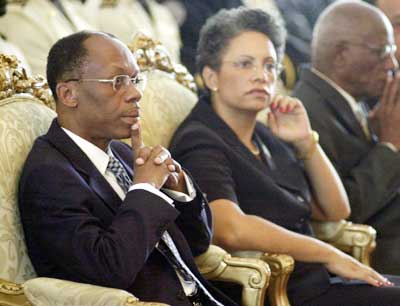
wikileaks haiti: the aristide files

The Nation | US officials led a far-reaching international campaign aimed at keeping former Haitian President Jean-Bertrand Aristide exiled in South Africa, rendering him a virtual prisoner there for the last seven years, according to secret US State Department cables.

The cables show that high-level US and UN officials even discussed a politically motivated prosecution of Aristide to prevent him from “gaining more traction with the Haitian population and returning to Haiti.”

The secret cables, made available to the Haitian weekly newspaper Haïti Liberté by WikiLeaks, show how the political defeat of Aristide and his Lavalas movement has been the central pillar of US policy toward the Caribbean nation over the last two US administrations, even though—or perhaps because—US officials understood that he was the most popular political figure in Haiti.

They also reveal how US officials and their diplomatic counterparts from France, Canada, the UN and the Vatican tried to vilify and ostracize the Haitian political leader.

For the Vatican, Aristide was an “active proponent of voodoo.” For Washington, he was “dangerous to Haiti’s democratic consolidation,” according to the secret US cables.

Aristide was overthrown in a bloody February 2004 coup supported by Washington and fomented by right-wing paramilitary forces and the Haitian elite. In the aftermath of the coup, more than 3,000 people were killed and thousands of supporters of Aristide and his Fanmi Lavalas political party were jailed.

The United States maintained publicly that Aristide resigned in the face of a ragtag force of former Haitian army soldiers rampaging in Haiti’s north. But Aristide called his escort by a US Navy SEAL team on his flight into exile “a modern-day kidnapping.”

Two months later, the UN Stabilization Mission in Haiti (MINUSTAH) was established, a 9,000-strong UN occupation force that still oversees Latin America’s first independent nation.

Aristide has spoken forcefully against the UN occupation, particularly in his 2010 year-end letter to the Haitian people. “We cannot forget the $5 billion which has already been spent for MINUSTAH over these past six years,” he wrote. “Anybody can see how many houses, hospitals, and schools that wasted money could have built for the victims” of the January 12, 2010, earthquake that destroyed much of Port-au-Prince and surrounding regions.

Such positions are major reasons Washington fought to get and keep Aristide out of Haiti, the cables make clear. “A premature departure of MINUSTAH would leave the [Haitian] government...vulnerable to...resurgent populist and anti-market economy political forces—reversing gains of the last two years,” wrote US Ambassador Janet Sanderson in an October 1, 2008, cable. MINUSTAH “is an indispensable tool in realizing core USG [US government] policy interests in Haiti.”

At a high-level meeting five years ago, top US and UN officials discussed how the “Aristide Movement Must Be Stopped,” according to an August 2, 2006, cable. It described how former Guatemalan diplomat Edmond Mulet, then chief of MINUSTAH, “urged US legal action against Aristide to prevent the former president from gaining more traction with the Haitian population and returning to Haiti.”

At Mulet’s request, UN Secretary General Kofi Annan urged South Africa’s President Thabo Mbeki “to ensure that Aristide remained in South Africa.”

President Obama and Kofi Annan’s successor, Ban Ki-moon, also intervened to urge Pretoria to keep Aristide in South Africa. The secret cables report that Aristide’s return to Haiti would be a “disaster,” according to the Vatican, and “catastrophic,” according to the French.

Monday, July 25, 2011

templar gang-bangin an professional dope-slangin?


Video - Aljazeera reports on Michoacan Knights Templar methamphetamine cartel.

Aljazeera | Pictures of the latest objects seized by the police in the Mexican state of Michoacan, revealed that the mysterious 'Knights Templar" drug cartel is more bizarre than most people imagine.

There were four hooded tunics, with a red cross, a metal helmet, and a pamphlet or Templar rule book. This drug cartel claims to draw inspiration from the medieval Christian warriors who fought to protect Jerusalem and the Holy Grail.

No one knows if its founder, Servando Gomez, a school teacher, was a history entuthiast or simply read the Da Vinci Code.

The rules in the modern day 'templar bible' call for observance of 'gentleman' like behaviour and respect for women – but also state that any disclosure of knights templar activities will result in the death of the person and his whole family, and confiscation by the cartel of the snitch’s property. Watch my tv report from Michoacan.

The cartel is like a secret society.

The Mexican Templars have an initiation ritual, which apparently includes dressing up like knights from the Middle Ages, and performing blood pacts.

The cartel recruits drug users and enrolls them in the organisation's rehabilitation centers; the process is closely monitored and has a strong religious component.

The double standard is striking: the Templars can not take drugs, and yet they run one of the biggest methamphetamines traffic corridors to the United States.

A resident of Morelia, the capital of the Michoacan province, tells me the cartel that preceded the Templars, La Familia, hired 'cooks' who had learnt to manufacture meth (known as ice or crystal) in the US.

As the government regulated the sale of one of meth's core components, pseudoephedrine (found in cold medicine), the 'crystal makers' or cristaleros moved back to Mexico and now get supplies from China through ports on the Pacific coast.

The young recruits are told to be 'gentlemen', the word for 'knight' in Spanish means a 'gentleman', but they have to kill those who they judge as thieves, rapists, or kidnappers, hanging them from bridges and attaching messages to their bodies.

The government of Felipe Calderon has declared war on the cartels.

It receives substantial military aid from the US to combat these drug gangs.

The national security spokesperson says the Templars are an offshoot of La Familia and their beliefs are a mere PR campaign to gain support of Michoacan residents.

President Calderon is from Michoacan, and his sister is running for governor.

But others see the religious element as a calculated move by its founder to prevent his hit men leaking information, while giving the group an aura of mystery that could inspire fear and respect. It is hard to know

The cartel's structure, wealth, and size. It is perhaps the second most notorious Mexican cartel in terms of killing methods, the most vicious one, the 'Zetas', is a group formed by Mexican army special forces in the 90s. Fist tap Dale.

Wednesday, July 20, 2011

The New York Times Questions The Journal's Integrity

The Atlantic | The Players: The New York Times vs. The Wall Street Journal

The First Serve: Yesterday, David Carr of The New York Times wrote a column questioning the future of Rupert Murdoch and News Corps. "The News Corporation may be hoping that it can get back to business now that some of the responsible parties have been held to account — and that people will see the incident as an aberrant byproduct of the world of British tabloids," he wrote. "But that seems like a stretch. The damage is likely to continue to mount, perhaps because the underlying pathology is hardly restricted to those who have taken the fall."

Carr also pointed to Murdoch's strategy of burying problems: "And the money the company reportedly paid out to hacking victims is chicken feed compared with what it has spent trying to paper over the tactics of News America in a series of lawsuits filed by smaller competitors in the United States."

Fellow columnist Roger Cohen, who had previously defended Murdoch, furthered the conversation in a column that appeared on The Times's site yesterday (and appears in the International Herald Tribune, a Times company, today) which questions Murdoch's character. "Murdoch is a flawed genius whose very ruthlessness has now led him to his comeuppance," he wrote. "He knew, more viscerally than anyone, what postmodern societies wanted to satisfy their twisted appetites and he provided that material in all its gaudiness. I don’t think he created those appetites. But he sure fed them"

Meanwhile, Monday The Wall Street Journal published an editorial defending its owner and its integrity (and was met with a chorus of social media jeers--covered here). The board did not stop there and took the opportunity to lob barbs at The New York Times and The Guardian.
"We also trust that readers can see through the commercial and ideological motives of our competitor-critics. The Schadenfreude is so thick you can't cut it with a chainsaw. Especially redolent are lectures about journalistic standards from publications that give Julian Assange and WikiLeaks their moral imprimatur. They want their readers to believe, based on no evidence, that the tabloid excesses of one publication somehow tarnish thousands of other News Corp. journalists across the world."
The Return Volley: Schadenfreude? Chainsaws? Joe Nocera of the The Times responded to the WSJ's allegation of schadenfreude. "Well, yes, the schadenfreude is pretty darn thick," he writes in today's column. "Who would deny it? The whole thing reminds me a little of the ending of Ian McEwan’s wonderful novel “Solar,” in which the many awful things the central character has done in his long life suddenly come together to bury him in an avalanche of comeuppance. I’m O.K. with that."

fox news cackling over anonymous roundup


Video - RT stirs to pot over a bit of lulzsec mischief

Forbes | The international wave of alleged hacker arrests associated with the digital vigilante movement Anonymous continued Tuesday, and this time on American soil. Fox News reports more than a dozen arrests across California, Florida and New Jersey, as well as FBI interviews and searches in Long Island and Brooklyn, New York.

Those police actions follow others in England, where an Anonymous-related hacker named Ryan Cleary was arrested last month in Essex, followed by more than 45 other arrests in Spain, Italy, Switzerland, and Turkey.

U.S. law enforcement have yet to reveal exactly what hacking charges those newly-arrested American suspects will face. Update: An FBI press release states that there are 14 suspects, and that they’ll be charged with “various counts of conspiracy and intentional damage to a protected computer” related to attacks on Paypal in December following the company’s decision to cut off service to WikiLeaks.

Within the hacker community, many are watching the fate of one individual who goes by the handle “Sabu” and who is suspected of involvement in multiple operations including the attacks on HBGary and later the hacking spree perpetrated by the Anonymous spinoff group LulzSec. Sabu has claimed involvement in yesterday’s hacking of the British newspaper The Sun, and wrote on his Twitter feed that LulzSec will soon release stolen emails from the News Corp-owned tabloid.

Sabu claimed Tuesday on Twitter that he was not involved in the day’s police operations, despite several attempts by hackers in opposition to Anonymous to publicly identify him. One hacker who goes by the name th3j35t3r recently published a suspected name and Portugese address for Sabu on his blog. The LulzSec hacker responded Tuesday by taunting th3j35t3r over the arrests: “Damn, it must hurt you emotionally that I was not part of that.”

Tuesday, June 21, 2011

finger in the dyke


Video - Especially those who work at the Cooper nuclear power plant in Browneville.

KCUR | The Missouri River approaching Kansas City is becoming more bloated than it's been in decades. Overflow, by millions-of-gallons a minute is being dumped from brimming reservoirs in the Dakotas. Interests along the river watch with a keen eye. They range from farmers to railroads to people who live behind levees. KCUR's Dan Verbeck has been attuned to the river for weeks and filed this account.

By time the river is past St. Joseph and Leavenworth, it's ready to push through curves and wriggles in its path toward the heart of the metro region.

We picked an arbitrary segment of flatland to watch. This extends from a few miles south of Weston down to the community of Waldron. Two levees guard it. The federal government paid for installation in the 1950's. Local taxes pay for upkeep.

Menno Attema farms 2500 acres of it and he's head of the levee board. The Army Corps of Engineers sets standards for how they're supposed to be built.. The Corps also is releasing the deluge upstream-- "there's no such thing as guarantees but I'm confident our system can withstand that. Its always to which degree because the Corps has indicated with their models, a low flow event. That means minimal rainfall for this area. We would be able to manage it relatively easy. During an extreme high rainfall situation, even our system would be challenged to withstand that." This is about protecting land from flooding. And people, ultimately.

Drivers passing on Missouri Highway 45, also known as Northwest 64th closer to Parkville, may not notice a lot of homes out in the flatland. The levee board president says--"There's 70 some homes still in the Farley-Beverly District. And then, in the Waldron area quite a bit less but still more than you would think." Attema and his family are among those 70 families and the levee holding is vitally important to them all.

Friday, May 20, 2011

ritual habitual: technology-enabled digital self-segregation


Video - Eli Pariser on the risk of Internet Filter bubbles.

CNN | Eli Pariser made his mark on the Internet as the executive director of MoveOn.Org, the liberal group that was perhaps the first to turn the Web into a tool for massive political action.

Now he's worried the Internet is becoming too polarized, politically and otherwise, because of tools used by some of the technology and social-media world's biggest players.

His new book, "The Filter Bubble: What the Internet Is Hiding from You," details the ways Facebook, Google, Aol and numerous other online hubs quietly are personalizing the Internet for their users.

The stated goal is to make it easier for Web users to find the things online that they like. (And, of course, to make it easier for advertisers to hawk things to you that you're more likely to buy).

But the end result, Pariser says, is a silent, subtle bubble that isolates users from new discoveries and insights that may fall outside of their usual tastes and interests.

Pariser stepped down as chief of MoveOn in 2008 but is still president of the group's board. He spoke to CNN.com on Tuesday, the day his book was released.

On "the filter bubble" and how it works

One of the things that's really interesting about the filter bubble is that it's invisible. You can't see how your Internet, the websites you visit, are different than what other people see. They are sort of slipping further and further apart.

A couple of years ago, when you Googled something, everyone would get the same result. Now, when I've done these experiments, you can really get these dramatically different results. One person Googles and sees a lot of news about protests and the other person gets travel agents talking about traveling to Egypt.

I'm basically trying to make visible this sort of membrane of personalized filters that surround us wherever we go online, and let's see what we see. Fist tap Arnach.

Sunday, May 15, 2011

wait for it, wait for it.., REALLY?!?!?!?!?!

Telegraph | One of the reactors at the crippled Fukushima Daiichi power plant did suffer a nuclear meltdown, Japanese officials admitted for the first time today, describing a pool of molten fuel at the bottom of the reactor's containment vessel.

Engineers from the Tokyo Electric Power company (Tepco) entered the No.1 reactor at the end of last week for the first time and saw the top five feet or so of the core's 13ft-long fuel rods had been exposed to the air and melted down.

Previously, Tepco believed that the core of the reactor was submerged in enough water to keep it stable and that only 55 per cent of the core had been damaged.

Now the company is worried that the molten pool of radioactive fuel may have burned a hole through the bottom of the containment vessel, causing water to leak.

"We will have to revise our plans," said Junichi Matsumoto, a spokesman for Tepco. "We cannot deny the possibility that a hole in the pressure vessel caused water to leak".

Tepco has not clarified what other barriers there are to stop radioactive fuel leaking if the steel containment vessel has been breached. Greenpeace said the situation could escalate rapidly if "the lava melts through the vessel".

Monday, May 09, 2011

media scrambles as bin laden story crumbles

NewAmerican | While the establishment media was busy parroting President Obama’s announcement of Osama bin Laden’s supposed assassination, reporting the unsubstantiated claims as if they were unquestionable facts, much of the so-called “alternative” press was far more cautious — and accurate, it turns out. But more importantly, with the new official storyline indicating that bin Laden was in fact unarmed, bigger and much more important questions are beginning to emerge.

In terms of coverage, it turns out that the skeptical approach proved far superior in terms of getting it right. Countless mainstream sources were so confident in Obama’s word that they reported many of the claims as fact without even attributing them to the President.

But the official White House narrative has been changed so many times in recent days that now it’s almost unrecognizable. There wasn‘t even a fire fight; yet this was one of the crucial elements of the original story that justified the assassination of a person the government painted as the most valuable source of information on the planet — the leader of al-Qaeda. And in reporting the statements as fact, the establishment press has officially been left with egg all over its face again.

"[Bin Laden] was engaged in a firefight with those that entered the area of the house he was in," said terror czar John Brennan. Similarly, Obama said that “after a firefight, they killed Osama bin Laden and took custody of his body.” The next day, however, the White House spokesman admitted bin Laden “was not armed." Trying to save face and justify the killing of an unarmed man, the spokesman added, without elaborating, that “resistance does not require a firearm."

More than a few other important parts of the storyline have been altered, contradicted, or simply exposed as false, too. Everything from which of bin Laden’s sons was supposedly killed to the claim that his wife was killed after being used as a “human shield” — all of it has changed for some reason or another. The transcript after Brennan’s speech was altered to change the name of the dead son. The new and improved narrative now says that not only was bin Laden’s wife not killed, but that she was not used as a human shield.

Originally the White House also suggested top officials watched the raid live through a video feed. Terror czar Brennan, for example, claimed that they “had real-time visibility into the progress of the operation.” CIA boss Leon Panetta later exposed that claim as false in an interview with PBS, saying: “There was a time period of almost 20 or 25 minutes that we really didn't know just exactly what was going on."

That means the “photo op” of Obama and other officials intently “watching” the operation in the “Situation Room” was almost certainly staged for the press. And almost every media outlet that ran the picture used inaccurate captions parroting the White House claims.

And there’s more.

Tuesday, May 03, 2011

the destruction of economic facts

Businessweek | During the second half of the 19th century, the world's biggest economies endured a series of brutal recessions. At the time, most forms of reliable economic knowledge were organized within feudal, patrimonial, and tribal relationships. If you wanted to know who owned land or owed a debt, it was a fact recorded locally—and most likely shielded from outsiders. At the same time, the world was expanding. Travel between cities and countries became more common and global trade increased. The result was a huge rift between the old, fragmented social order and the needs of a rising, globalizing market economy.

To prevent the breakdown of industrial and commercial progress, hundreds of creative reformers concluded that the world needed a shared set of facts. Knowledge had to be gathered, organized, standardized, recorded, continually updated, and easily accessible—so that all players in the world's widening markets could, in the words of France's free-banking champion Charles Coquelin, "pick up the thousands of filaments that businesses are creating between themselves."

The result was the invention of the first massive "public memory systems" to record and classify—in rule-bound, certified, and publicly accessible registries, titles, balance sheets, and statements of account—all the relevant knowledge available, whether intangible (stocks, commercial paper, deeds, ledgers, contracts, patents, companies, and promissory notes), or tangible (land, buildings, boats, machines, etc.). Knowing who owned and owed, and fixing that information in public records, made it possible for investors to infer value, take risks, and track results. The final product was a revolutionary form of knowledge: "economic facts."

Over the past 20 years, Americans and Europeans have quietly gone about destroying these facts. The very systems that could have provided markets and governments with the means to understand the global financial crisis—and to prevent another one—are being eroded. Governments have allowed shadow markets to develop and reach a size beyond comprehension. Mortgages have been granted and recorded with such inattention that homeowners and banks often don't know and can't prove who owns their homes. In a few short decades the West undercut 150 years of legal reforms that made the global economy possible.

The results are hardly surprising. In the U.S., trust has broken down between banks and subprime mortgage holders; between foreclosing agents and courts; between banks and their investors—even between banks and other banks. Overall, credit (from the Latin for "trust") continues to flow steadily, but closer examination shows that nongovernment credit has contracted. Private lending has dropped 21 percent since 2007. Outstanding loans to small businesses dropped more than 6 percent over the past year, while lending to large businesses, measured in commercial loans of more than $1 million, fell nearly 9 percent.

The importance of economic facts may not be obvious to Americans. "What does the fish know about the water in which it swims?" asked Albert Einstein. But it's easy to grasp from the perspective of the developing and former communist countries where I live and work. In these countries, most of our assets and relationships are in the informal sector, outside the legal economy. Because they're not recorded in public memory systems, they cannot be written up as facts and are, in effect, invisible. All we have are shadow markets.

Without standardization, the values of assets and relationships are so variable that they can't be used to guarantee credit, to generate mortgages and bundle them into securities, to represent them in shares to raise capital. Nor do they fit the standard slots required to enter global markets. That's why credit crunches and massive unemployment are chronic conditions for most people forced to operate in the informal economy. These are the ones you see protesting in the streets of Arab countries or living in tents surrounding Port-au-Prince. We know only too well that facts don't speak for themselves: They have to be constructed through legal processes and kept transparent. They have to be defended, too.

Tuesday, April 26, 2011

really mixed signals from media, TEPCO, and government..,


Video - SOS from Mayor of Minami Soma City, next to the crippled Fukushima nuclear power plant

JapanFocus | Mistrust of the media has surged among the people of Fukushima Prefecture. In part this is due to reports filed by mainstream journalists who are unwilling to visit the area near the crippled Fukushima Daiichi nuclear power plant. But above all it is the result of contradictory reportsreleased by the media, TEPCO and the government.

On the one hand, many local officials and residents in Fukushima insist that the situation is safe and that the media, in fanning unwarranted fears, are damaging the economy of the region.By contrast, many freelance journalists in Tokyo report that the central government is downplaying the fact that radiation leakage has been massive and that the threat to public health has been woefully underestimated. While the government long hewed to its original definition of a 20 kilometer exclusion zone, following the April 12 announcement that the Fukushima radiation severity level has been raised from a level 5 event (as with Three Mile Island) to a level 7 event (as with Chernobyl), the government also extended the radiation exclusion zone from 20 kilometers to at least five communities in the 30-50 kilometer range.

In recent weeks, many Fukushima residents who fled in the first week of the nuclear crisis have begun returning home and attempting to resume normal activities. For example, some local people in Iwaki city, 40-50 km from the Fukushima Daiichi reactor, are convinced that it is now safe to return despite the high radiation levels recorded. Here is one example.

In Japan, April’s cherry blossoms signal a symbolic beginning, a new stage in life. On April 6th, along with school children across the nation, Iwaki City, within the 40 km radiation exclusion zone, held many school entrance ceremonies for elementary, middle and high schools.

Iwaki's Yumoto Daini Middle School’s ceremony was a bit different: not only were there 33 new students, but refugees living on the school grounds and some members of the Self Defense Force also attended. Overall 107 people participated in the ceremony. Headmaster Sawai Shiro may have exceeded his authority in taking the humanitarian step of granting permission for the refugees to remain on campus as the school year begins, at the risk of being punished later for breaking rules.

Local sources report that in the first week or so after the nuclear crisis began, Iwaki City experienced difficulties in receiving supplies like food and fuel because many agents refused to deliver.Since early April, refugees who had evacuated outside the prefecture started returning. Restaurants in downtown Iwaki are reopening and many convenience stores boast reasonably well-stocked shelves, while gas, water and electricity have been restored. Iwaki City has repeatedly confirmed that “radiation is at a stable level which is not harmful to human health.” Iwaki officials explain that this judgment is based on figures provided by the Fukushima prefectural government regularly updated since March 11.

Principal Sawai began his welcome speech by saying, "I am glad to be able to confirm that all 33 new students are participating in this ceremony amidst a disaster that had forced many people to leave Yumoto.""In our district,” he continued,“some people survived by drinking water from their bath for weeks as there was no running water. I want you to care for each other especially for anyone who is in trouble." He concluded, "You young students, are the future of Japan. Now, we should be bound as one beyond differences in ideas, position or self interest."

Though all the new students attended, not all teachers were there. As a result of the catastrophe, personnel for the school was frozen and new teachers were not dispatched to the school, Sawai explained. As a result of the lack of teachers, there will be only one class run by a teacher for each grade.

School Doctor Informs Children “The radiation problem is already finished.”
Following the principal’s speech, the school’s doctor in his white coat stated matter-of-factly that, based on science, people should know that the worst of the earthquake damage had passed and that radiation leakages from the Fukushima Daiichi plant were decreasing and would soon fade away.

“The radiation problem is already finished,” he told the children and their parents. “You can go to school and go outside without any problem. You should not fear malicious gossip.”

Sunday, April 24, 2011

small town insurgency: the struggle for information dominance

Monterrey Herald | A Naval Postgraduate School study applying counterinsurgency theories to Salinas gang violence has come up with some startling conclusions: Street gangs control and exploit information better than law enforcement, giving them an "information advantage" that city officials must work to overcome.


After lengthy surveys of Salinas police, residents and city employees, three insurgency experts studying at NPS argue that superior control of the flow of intelligence — whether by the gangs or the authorities — will determine who comes out ahead.

For the city to win, the report concludes, a lot will have to change in the relationship between police and residents.

The masters' thesis, "Small Town Insurgency: The Struggle For Information Dominance to Reduce Gang Violence," was written by NPS researchers Laurence H. Arnold and Christopher W. O'Gwin — both U.S. Army majors — and Jeremy S. Vickers, a major in the U. S. Air Force.

The 272-page document was published in December but not distributed to the public until this month. The public version had to be slightly redacted to remove sensitive police information, said Rebecca Lorentz of NPS, who last month presented highlights of the authors' findings to the Community Alliance for Safety and Peace in Salinas.

Salinas Mayor Dennis Donohue said he's thrilled to have the help of staff and students at the naval school in tackling the city's youth violence.

"Think about it," he said. Fist tap ProfGeo.

Chipocalypse Now - I Love The Smell Of Deportations In The Morning

sky |   Donald Trump has signalled his intention to send troops to Chicago to ramp up the deportation of illegal immigrants - by posting a...