Showing posts sorted by relevance for query great game. Sort by date Show all posts

Thursday, July 21, 2022

Declaration On Allied Interaction In The Heartland

indianpunchline |  If the metaphor of the “Great Game” can be applied to the Ukrainian crisis, with the expansion of the North Atlantic Treaty Organisation (NATO) at it core, it has begun causing reverberations across the entire Eurasian space. The great game lurking in the shade in the Caucasus and Central Asian regions in recent years is visibly accelerating. 

The edge of the game is above everything else the targeting of Russia and China by the United States. This unfolding game cannot be underestimated, as its outcome may impact the shaping of a new model of the world order. 

Starting with the Caspian Summit in Ashgabat on June 29, the inter-connected templates of the great game in the Caucasus began surfacing. The fact that the summit was scheduled at all despite the raging conflict in Ukraine — and that Russian President Vladimir Putin took time out to attend it — testified to the high importance of the event. 

Basically, the presidents of the 5 littoral states — Kazakhstan, Iran, Turkmenistan, Azerbaijan and Russia — synchronised their watches, based on the Convention on the Legal Status of the Caspian Sea — the Constitution of the Caspian Sea — that was signed at their last summit in 2018. While doing so,  they considered the current international situation and geopolitical processes worldwide. 

Thus, one of the key points of the Final Communiqué of the Ashgabat Summit was the reiteration of a fundamental principle regarding the total exclusion of the armed forces of all extra-regional powers from  the Caspian Sea (which primarily meets the geopolitical interests of Russia and Iran.) The fact that the heads of the Caspian countries confirmed this in writing can be regarded as the main result of the Summit. Secondly, the leaders focused on the Caspian transport communications and agreed that the region could become a hub for the East-West and North-South corridors. 

The Caspian Summit was held just 5 weeks after Russian forces  gained control of Mariupol port city (May 21), which established its total supremacy over the Sea of Azov and the Kerch Strait in eastern Crimea. Kerch Strait has a strategic role in Russian policies, being the narrow maritime gateway (5 kms in length and 4.5 km. wide at the narrowest point) which links the Black Sea via the Sea of Azov to Russia’s major waterways including the Don and the Volga. 

In effect, it is yet to sink in that in the geopolitics of the entire Eurasian landmass, the liberation of Mariupol by Russian forces  was a pivotal event in the great game, since the Kerch Strait ensures maritime transit from the Black Sea all the way to Moscow and St Petersburg, not to mention the strategic maritime route between the Caspian Sea (via the Volga-Don Canal) to the Black Sea and the Mediterranean.
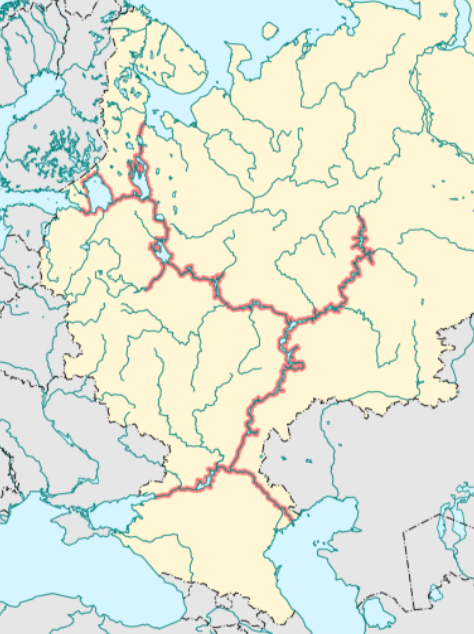
 
United Deep Waterway System of European Russia linking Sea of Azov and  Caspian Sea to Baltic Sea and the Northern Sea Route

Now, to get the “big picture” here, factor in that Volga River also links the Caspian Sea to the Baltic Sea as well as the Northern Sea Route (via the Volga–Baltic Waterway). Suffice to say, Russia has gained control of an integrated system of waterways, which connects the Black Sea and the Caspian Sea to the Baltic and the Northern Sea Route (which is a 4800 km long shipping lane that connects the Atlantic with the Pacific Ocean, passing along the Russian coasts of Siberia and the Far East.) 

No doubt, it is a stupendous consolidation of the so-called “heartland” — per Sir Halford Mackinder’s theory (1904) that whoever controls Eastern Europe controls the Heartland and controls the “world island.” 

Looking back, therefore, there is no question that the reunion of Crimea with the Russian Federation in 2014 was a major setback for the US and NATO. Putin caught Washington and its allies by total surprise. It complicated their objective to integrate Ukraine into the NATO.

Monday, January 01, 2018

MindSmash Pipes Up Into The Digital Catheter...,


endgadget |  The new replay tools offered in PlayerUnknown's Battlegrounds are so much more than standard video-capture technology. In fact, it isn't video capture at all -- it's data capture. The 3D replay tools allow players to zoom around the map after a match, tracking their own character, following enemies' movements, slowing down time and setting up cinematic shots of their favorite kills, all within a 1-kilometer radius of their avatar. It's filled with statistics, fresh perspectives and infinite data points to dissect. This isn't just a visual replay; it's a slice of the actual game, perfectly preserved, inviting combatants to play God.

PUBG is an ideal test case. It's a massively popular online game where up to 100 players parachute onto a map, scavenge for supplies, upgrade weapons and attempt to be the last person standing. Even though it technically came out in December, PUBG has been available in early access since March and it's picked up a considerable number of accolades -- and players -- in the process. Just last week, SteamDB reported PUBG hit 3 million concurrent players on PC, vastly outstripping its closest competitor, Dota 2, which has a record of 1.29 million simultaneous players.

Part of PUBG's success stems from developers' relentless focus on making the game fun to watch. Live streaming is now a major part of the video-game world, with sites like Twitch and YouTube Gaming growing in prominence and eSports bursting into the mainstream.

Kim says PUBG creator Brendan Greene and CEO Chang Han Kim built the idea of data-capture into the game from the beginning, and Minkonet's tech is a natural evolution of this focus. Minkonet and PUBG developers connected in late 2016 and started working together on the actual software earlier this year.

"One of their first visions was to have PUBG as not just a great game to play, but a great game to watch," Kim says. "So they were already from the very beginning focused on having PUBG as a great live streaming game; esports was also one of their sort of long-term visions."


Sunday, March 22, 2020

Are You F'ing Kidding Agnes?!?!?! (School Starts at 1:53:20)


Sincerity is the key to success. Once you've learned to fake sincerity, then you're in the game. The fundamental rule of the game is to "sincerely" believe and behave as if power holders are superior. You are expected to pretend that power holders are better than you. The problem for a great many objectively smart people is that they can't fake sincerity or mask their own objective and demonstrable superiority. When the only way to survive in a hierarchical environment is to lie, fake, or cheat, then everyone is complicit in the fraud and its accompanying narratives. And so, everyone has skin in the game of protecting the fraud and its concomitant beliefs and behaviors. If the next generation wants to rise they have to become complicit in protecting the fraud that their predecessors have institutionalized. THIS is the rot now pervasive in American institutions that has resulted in the hollowing out of innovation and achievement.

Pleasing white light at 1:53:00 and cleansing blue fire at 1:55:48

thepointmag |  In the Importance Game, participants jockey for position. This usually works by way of casual references to wealth, talent, accomplishment or connections, but there are many variants. I can, for instance, play this game by pretending to eschew it: “Let’s get straight down to business” can telegraph my being much too important to waste time with such games; or your being so unimportant as to render the game otiose.

The other game is the Leveling Game, and it uses empathy to equalize the players. So I might performatively share feelings of stress, inadequacy or weakness; or express discontent with the Powers that Be; or home in on a source of communal outrage, frustration or oppression.

A player of the Importance Game tries to ascend high enough to reach for something that will set her above her interlocutor, a player of the Leveling Game reaches down low enough to hit common ground. The former needs to signal enough power to establish a hierarchy; the latter enough powerlessness to establish equality.

The advanced games really are advanced, in the sense of being harder to play than the Basic Game. This is due to the fact that one must, while playing them, also pretend not to be playing them. It is not okay to approach a new acquaintance with: “Let us set up a contest to figure out which of the two of us is smarter.” Nor would it be reasonable for me to say to my colleague: “How the administration oppresses us! Let us unite in self-pity.” Or to an undergraduate who enters my office: “Let me tell you how overwhelmed I am, that will put us on equal footing.” (“Stars: they’re just like us!”)

Players of the Basic Game are permitted to come pretty close to explicitly saying “Let us see what places/people/interests we have in common.” With the other two games this kind of explicitness itself violates one of the rules of the game. Call this “The Self-Effacing Rule.” Why does this rule apply to the advanced games, but not the Basic Game?

Thursday, July 21, 2016

stripmining idealism and subverting class-cooperation via the rescue game


thearchdruidreport |  There’s plenty more that could be said here about the details of the Rescue Game and the narrative of race derived from it, but at this point I’d like to consider three broader issues. The first is the relation between the game and the narrative, on the one hand, and the realities of racism in today’s America. I don’t doubt that some readers of this essay will insist that by questioning the narrative, I’m trying to erase the reality.  Not so. Racial privilege, racial prejudice, and racial injustice are pervasive factors in American life today.  The fact that the approved narrative of race in today’s America is deceptive and dysfunctional doesn’t make racism any less real; on the other hand, the fact that American racism is a stark reality doesn’t make the narrative any less deceptive and dysfunctional.

The second issue I’d like to consider is whether the same game is played on other playing fields, and the answer is yes. I first encountered the concept of the Rescue Game, in fact, by way of a pamphlet lent to my wife by her therapist sister-in-law, which used it as the basis for an edgy analysis of class conflicts within the lesbian community. From there to the literature on transactional analysis was a short step, and of course it didn’t hurt that I lived in Seattle in those years, where every conceivable form of the Rescue Game could be found in full swing. (The most lively games of “Circular Firing Squad” in town were in the Marxist splinter parties, which I followed via their monthly newspapers; the sheer wallowing in ideological minutiae that went into identifying this or that party member as a deviationist would have impressed the stuffing out of medieval scholastic theologians.)

With impressive inevitability, in fact, every question concerning privilege in today’s America gets turned into a game of “Pin the Tail on the Persecutor,” in which one underprivileged group is blamed for the problems affecting another underprivileged group, and some group of affluent white people show up to claim the Rescuer’s role.  That, in turn, leads to the third issue I want to consider here, which is the question of who benefits most from the habit of forcing all discussion of privilege in today’s America into the straitjacket of the Rescue Game.

It’s only fair to note that each of the three roles gets certain benefits, though these are distributed in a very unequal fashion. The only thing the people who are assigned the role of Persecutor get out of it is plenty of negative attention. Sometimes that’s enough—it’s a curious fact that hating and being hated can function as an intoxicant for some people—but this is rarely enough of an incentive to keep those assigned the Persecutor’s role willing to play the game for long.

The benefits that go to people who are assigned the role of Victim are somewhat more substantial. Victims get to air their grievances in public, which is a rare event for the underprivileged, and they also get to engage in socially sanctioned bullying of people they don’t like, which is an equally rare treat. That’s all they get, though. In particular, despite reams of the usual rhetoric about redressing injustices and the like, the Victims are not supposed to do anything, or to expect the Rescuers to do anything, to change the conditions under which they live. The opportunities to air grievances and bully others are substitutes for substantive change, not—as they’re usually billed—steps toward substantive change.

The vast majority of the benefits of the game, rather, go to the Rescuers. They’re the ones who decide which team of Victims will get enough attention from Rescuers to be able to start a game.  They’re the ones who enforce the rules, and thus see to it that Victims keep on being victimized and Persecutors keep on persecuting.  Nor is it accidental that in every Rescue Game, the people who get the role of Rescuers are considerably higher on the ladder of social privilege than the people who get given the roles of Victims and Persecutors.

Step back and look at the whole picture, and it’s not hard to see why this should be so. At any given time, after all, there are many different Rescue Games in play, with affluent white people always in the role of Rescuers and an assortment of less privileged groups alternating in the roles of Victims and Persecutors. Perhaps, dear reader, you find it hard to imagine why affluent white people would want to keep everyone else so busy fighting one another that they never notice who benefits most from that state of affairs. Perhaps it hasn’t occurred to you that giving the underprivileged the chance to air their grievances and engage in a little socially sanctioned bullying is a great deal less inconvenient for the affluent than actually taking action to improve the lives of the underprivileged would be. Such thoughts seemingly never enter the minds of most Americans; I’ll leave it to you to figure out why.


Monday, December 22, 2008

All roads lead out of Afghanistan

Asia Times | It seems almost inevitable that Moscow and Tehran will join hands. In all likelihood, they may have already begun doing so. The Central Asian countries and China and India will also be closely watching the dynamics of this grim power struggle. They are interested parties insofar as they may have to suffer the collateral damage of the great game in Afghanistan. The US's "war on terror" in Afghanistan has already destabilized Pakistan. The debris threatens to fall on India, too.

Most certainly, the terrorist attack on Mumbai last month cannot be seen in isolation from the militancy radiating from the Afghan war. Even as the high-level Russian-Indian Working Group on terrorism met in Delhi on Tuesday and Wednesday, another top diplomat dealing with the Afghan problem arrived in the Indian capital for consultations - Iranian Deputy Foreign Minister Mohammad Mahdi Akhounjadeh.

Speaking in Moscow on Tuesday, chief of the General Staff of the Russian armed forces, General Nikolai Makarov, just about lifted the veil on the geopolitics of the Afghan war to let the world know that the Bush administration was having one last fling at the great game in Central Asia. Makarov couldn't have spoken without Kremlin clearance. Moscow seems to be flagging its frustration to Obama's camp. Makarov revealed Moscow had information to the effect that the US was pushing for new military bases in Kazakhstan and Uzbekistan.

Coincidence or not, a spate of reports has begun appearing that Russia is about to transfer the S-300 missile defense system to Iran. S-300 is one of the most advanced surface-to-air missile systems capable of intercepting 100 ballistic missiles or aircraft at once, at low and high altitudes within a range of over 150 kilometers. As long-time Pentagon advisor Dan Goure put it, "If Tehran obtained the S-300, it would be a game-changer in military thinking for tackling Iran. This is a system that scares every Western air force."

It is hard to tell exactly what is going on, but Russia and Iran seem to be bracing for a countermove in the event of the Obama administration pressing ahead with the present US policy to isolate them or cut them out from their "near abroad".

Tuesday, April 29, 2014

from the kwaku net: pookie's very last day on the job, ever...,


Donald Sterling, thank you for your honesty (they are the enemy/ that was his words in the audio) and the players take the court 24 HOURS later in the hunt for a championship and most black men turn on the TV and watch….. That says it all. (That showed how absolute power works and the difference between an owner and an employee) and how dumbed down the consumers have become and how much control sports have over the masses.

Donald Sterling said he did not want you in his arena, what part of that did you not understand? There is no need for a  great debate or some public apologies and the last thing we needed  was to let Doc Rivers have his let’s have a team meeting moment or chicken George AKA Charles BARKLEY opinion or any other coonery there was an opportunity to take a stand and once again we chose to be the cowards that we have become, from this point on if you are a black man in America shut the hell up and get back to work……  you race of cowards you race of good for nothings.

Black men are real tough when it comes to fighting and killing each other and tearing down their community and marrying white women and buying  Jordan’s and flooding our community with bastard babies but when it comes to fighting against white supremacy you become cowards….  Most Black man have become a Joke around the world….. Useless creatures, powerless modern slaves.   

We need more Donald Sterling moments and maybe channels on the idiotic box (TV) were all they do is let billionaires speak truth without emotional intelligence and allow the truth to flow like water. 

The masses are not only sleep they have fallen into a coma and the players taking the court on sunday were more despicable then a billionaire speaking his truth, there is nothing they can do to Donald Sterling he is not Pac man Jones.  He is the OWNER worst case they vote him out the league…… so what, he is still a billionaire and will push his agenda behind closed doors……. That is the reality of a billionaire vs the reality of peasant employees, Doc Rivers and the clipper players are no more then hired help.  If you don’t know what that looks like watch the game tonight and watch the LA Mandingo Clippers play in the LA plantation coliseum. We need more Donald Sterling moments.   

LeBron had the nerve to say this is our league we are a league of 80% black men….. Shut the hell up you don’t own a damn thing get your ass back in the lay-up line before we turn this into a whites only league boy, if it was not for white men you boys would not have a league, you don’t own a damn thing.

Black AMERICA needs to stop it. You don’t own any thing.  Get back in line and wait for the next game to come on the Idiot box, idiots.  There is nothing you can do because you are a powerless people. Don’t fool yourself the only thing that can really happen is Donald Sterling agrees to move on because it is no longer worth the trouble….. That’s it. 

First you get the money and then you get the power, he has the power and the money and the idea of hundreds of millions of other white men and he said the truth in the audio (I feed and clothe all of them) the truth hurts does it black America. We hate the truth but the lies are killing us slowly thank you Mr. Donald Sterling for allowing the world to see what absolute power looks like live in HD. 

Black Folk don’t even have a platform that is black owned to talk about this subject, if you are getting your information from ESPN and Stephan A Smith and crew - you need your ASS kicked….if they speak one ounce of truth they are fired. Stay in your lane.  You are in employee not the owner of ESPN we all know who owns that.

We are a group without power and there are many sick cowards in the village and I had to avoid listening or reading the response from Black men over the weekend. It was a lot of noise and slave talk and very little empowerment talk. Until we start practicing black empowerment like every other group does, and start owning things like white America does, and collaborating together like the Asians do, shut the hell up and watch the game you group of buffoons.

Time to move past watching sports....
The best thing that happened over the weekend for me, I had no idea that any of this was going on with the Clippers until after the fact. 

I have not watched any NBA this year and will never watch another game outside of a social environment where I have no control over the content.  I have no idea what is going on in the world of sports outside of sports law, social political and sports business - and I believe I will keep it that way.

I stop watching ESPN two years ago and the NBA/NFL/MLB is about to be on the same level as BET and MTV at my house permanently blocked…..have not watched that garbage in over five years. Time for a some new outlets.  Sports is a big soap opera and there is a lot of Shuckin' and jiving' going on in the world of sports.

There is a group in America that is not playing games and you will not find any of them in the layup line or the tackling drills in the NFL because they will leave that to the Mandingos because they are too busy owning and controlling the world. They own everything we do and every move we make.  If you like it or not, that is the reality of the game, no one cares about black rage because like he said……. we still own you.

Thank you once again Donald Sterling for teaching the real game it’s not called Basketball or football or baseball it’s called unapologetic power in the land of capitalism and if you don’t like it - who gives a damn?

Friday, January 16, 2009

Kyrgyzstan to demand U.S. army withdraw from Ganci air base

Mathaba | Kyrgyz President Kurmanbek Bakiyev will sign a decree demanding the retreat before his visit to Russia in the near future, the news agency said.

Kyrgyzstan will demand the U.S. army dismantle all its facilities at the Ganci base and halt all activities at the base within six months.

The move by Kyrgyzstan will have a positive influence on negotiations between Russia and Kyrgyzstan over the former providing 300 million U.S. dollars credit to the latter, the Russian Business Consulting Agency said.

Bakiyev also hopes Russia will write off about 180 million dollars in debt.

The United States set up the Ganci Air Base at Manas international airport in the suburb of Bishkek in 2001 in its war against Afghanistan.

In recent years, conflicts between U.S. troops and local residents have occurred from time to time. In Dec. 2006, U.S. soldiers stationed at the base killed a local airport worker, drawing resentment from the Kyrgyz public.

The Kyrgyz parliament has urged the government to reconsider the necessity of the existence of the Ganci base.
Kyrgyzstan will call for the U.S. army to withdraw from the Ganci Air Base near its capital Bishkek, Kazakhstan News Agency cited Russian media as reporting on Monday.
What does this mean? Hard to say exactly, but it cannot be great news for US military strategic planners. Is that great game they're all playing going to be heating up soon? Kyrgyzstan straddles the high ground between China and Russia and has great strategic value because of its unique geographic position.

Friday, March 07, 2008

The Great Game in the Second World

A Game Where Resources Dwindle and Partners Shift

In the 21st century the empires strike back. The United States, the European Union and China dare not call themselves imperial powers, Parag Khanna argues in “The Second World,” his sweeping, often audacious survey of contemporary geopolitics, but they are busy reshaping the globe to suit their interests. The game is afoot, with the natural resources and potential wealth of countries like Ukraine, Turkey and Brazil as the prize.

Mr. Khanna is the director of the Global Governance Initiative at the New America Foundation, a public policy institute. He strides the world in seven-league boots, armed with a powerful thesis: in the postcolonial, post-cold-war era, three superpowers have emerged with a ravenous appetite for energy and natural resources. Restlessly, they look to the second-tier economies of Latin America, the former Soviet bloc, the Middle East and Asia for partners or patsies. This argument was laid out recently in The New York Times Magazine in an excerpt it published from the book.

No shots will be fired. Instead the three imperial rivals will woo and coerce, relying on distinct styles. The United States offers military protection, along with the promise of democracy and human rights. The European Union dangles the prospect of membership in, or affiliation with, the world’s most successful economic club, provided that applicants undertake specific reforms. China talks trade, investment and infrastructure projects, with no annoying demands for political reform in its would-be client states.

“To a large extent, the future of the second world hinges on how it relates to the three superpowers,” Mr. Khanna writes, “and the future of the superpowers depends on how they manage the second world.”

Wednesday, October 26, 2011

profgeo leads the class to the root cause analysis

SFGate | What was the real cause of the Great Recession? More importantly, in a country accustomed to robust rebounds from burst bubbles, why is our economy stuck in neutral?

In his latest book, The Third Industrial Revolution, economist and author Jeremy Rifkin argues that the crash of the US housing market was not the proximate cause of the Great Recession, but was instead an aftershock of crude oil hitting a price of $147 per barrel oil in July 2008 – 60 days prior to the crash of the financial markets.

Mr. Rifkin makes a compelling case that our economy reached the end of the second industrial revolution in the 1980’s, and has been largely sustained by debt and the consumption of savings ever since. He argues that the kind of growth witnessed after the first and second industrial revolutions will be impossible to achieve without a third energy-communications revolution – one that leverages Internet-esque smart grids to transition from a centralized “elite” energy paradigm to a highly granular, lateral model. He contends that, as was the case with the first two industrial revolutions, the third revolution will be the foundation of the next great wave of economic growth.

Our energy infrastructure may not be the only thing that requires a rethink. In his book, Mr. Rifkin takes on Adam Smith, challenging classical economic theory with the contention that it does not take thermodynamics into account. The Third Industrial Revolution presents economic theory that incorporates entropy and the relationship between commerce and the planet.

Mr. Rifkin is the principle architect of the European Union’s Third Industrial Revolution long-term economic sustainability plan to address the triple challenge of the global economic crisis, energy security, and climate change. The Third Industrial Revolution was formally endorsed by the European Parliament in 2007 and is now being implemented by various agencies within the European Commission as well as in the 27 member-states. He has served as an advisor to Chancellor Angela Merkel of Germany, President Nicolas Sarkozy of France, Prime Minister Jose Socrates of Portugal, and Prime Minister Janez JanÅ¡a of Slovenia, during their respective European Council Presidencies, on issues related to the economy, climate change, and energy security.

Mr. Rifkin is president of the Foundation on Economic Trends and the author of seventeen bestselling books on the impact of scientific and technological changes on the economy, the workforce, society, and the environment. He has been a senior lecturer at the Wharton School’s Executive Education Program at the University of Pennsylvania since 1994, where he instructs CEOs and senior management on transitioning their business operations into sustainable Third Industrial Revolution economies.

Todd: So if we can, can we start by framing the discussion with the cause of the Great Recession. And I understand that your contention is that the Wall Street crash was not the proximate cause of the recession but was actually an aftershock of the real economic earthquake, which was $147 barrel oi

Jeremy: Yes. I spend the whole first chapter on the book on it because I’m at real odds with my colleagues as to what’s going on here. I think what happened is that when oil hit $147 a barrel back in July of 2008, purchasing power plummeted all over the world and the economy totally shut down in July – completely shut down.

And the reason, of course, is that everything’s made out of fossil fuels or run by them – pesticides, construction materials, pharmaceutical products, synthetic fiber, power, transportation – everything.

So what happened is, in late 2007, crude oil started going over $75 a barrel. What we saw is all the prices started going up across the supply chain. And then at $120 a barrel you remember we had food riots in 22 countries because 40 percent of the human race is living on $2.00 a day or less. Wheat, rye, barley and rice were doubling and tripling. And you remember, the UNFAO put out a report saying “We have an alert. We’ve got a billion people who could be in big trouble here.”

So what happened is speculators came in to game the market around $100 a barrel. But the reason this is happening, this is peak globalization – at least in the business community. I chair a group of 120 global companies that are involved in this. We now know the outer limits of how far we can globalize this economy based on fossil fuel energies, the technologies that go with them, and the infrastructure. It’s about $150 a barrel, and it’ll shut down every time.

This is an end game. And the reason it’s happening is we’ve hit peak oil per capita, and now peak oil production – both. Peak oil per capita no one talks about much.

Global peak oil production per capita is not well known. It happened in 1979, it’s not controversial. BP did the original study, and it’s been confirmed by everybody else since. If we had distributed all the crude oil we had at that point to everyone alive in the planet, that’s the most each person could have. We’ve found more oil since then but population rose quicker.

So if you distributed all the crude oil we have now to 6.8 billion people, there’s enough to go around. But then add to this – we hit global peak oil production as well. That’s when half the crude oil was used up by the geological bell curve. When half your crude oil is used up, you can’t afford it. Prices aren’t affordable. And that’s been pretty controversial about global peak oil when it would hit. The optimists’ spot maybe mid-2020’s to 30s, the pessimists’ models show 2010 to 2020.

Well, the IEA dropped the bombshell last December. That’s the International Energy Agency, and they’re the authoritative body for the oil industry and the energy industry. They said “It looks like we now peaked in 2006 at 70 million barrels a day. And we’re going to plan for around 69 billion barrels of crude oil for the next 20 years, but it’ll cost $7 trillion to get the remaining oil out.

So what happened is this. When China and India made a bid to drag a third of the human race into the game in the last 10 years, at an 8, 10, 12 percent growth rate, the actual aggregate demand for oil has just shot through the roof – and then all the other prices went up.

So what I’m suggesting is every time we try to regrow the global economy at the same rate we were growing before July 2008, oil prices go up – all the other prices made out of crude oil go up – purchasing power goes down – we collapse.

That’s what’s happening right now today. The economy was dead flat in 2009, so oil was $30 a barrel. Nobody was using it. As soon as we started to try to restart the engine, to replenish it towards 2010, oil shot to $100 a barrel for crude. Brent crude. That’s how we measure – not Texas crude.

And now what’s happened is all the other prices are going up, and purchasing power is going down, and we’re headed toward a second collapse right now. Fist tap and double-dap to ProfGeo.

Sunday, September 19, 2010

critical path redux


World Game Synergy


Critical Path | With legal planning of their lawyer-advised banking leaders, the "haves" have now succeeded in cornering all the world's monetary gold as well as the preponderance of the world's petroleum resources - along with their refineries and world-around petro-delivery systems together also with acquisitions of all the atomic power-generating plants, originally paid for by the US taxpayers - and thereafter in severing the monetary system from the wealth system while marking up the negotiable equity value of gold and petroleum tenfold.

They also have contrived their own game of international monetary banking of international balances of trade and credit accounting, greatly aided by the priorly established existence of 150 "sovereign" nations around planet Earth.

That division of world political power into 150 sovereign nations is a consequence of thousands of years of successive and individually independent contriving of history's most powerful leaders. The number-one strategy of the successful leaders of history's successively established supreme socioeconomic control systems has always been to induce the spontaneous self-divisioning of those designed to be conquered and to keep them spontaneously self-dividing and their divisions lethally interarrayed against one another in order to keep them conquered.

The longer the self-divisionings can be self-perpetuating, the more spontaneously are the divisions accepted institutionally by the successive generations as being "natural" divisions ... The prime vulnerabilities of humanity, which make it subject to spontaneous self-dividing, are those of different speech patterns, skin color, religions, social customs, class or caste systems, political preferences and all varieties of individually unique "troubles", suffering and discontent.

The historical consequence of this aeons-ago-commenced employment of this grand strategy of 'divide to conquer and keep divided to keep conquered" accounts for the "natural" acceptance today by world peoples of the seemingly "God-given" existance of 150 sovereign nations of the world and their respective geographical division of all the world's dry land. ...

The plotted curve of the rate of gain for increasing proportions of all humanity being thus swiftly advantaged by the doing more for more people with less and less matter and energy per function - all accomplished with computers, satellites, alloys, etc. - indicates that 100 percent of all humanity will be thus advantaged before 2000 A.D. In less than twenty years (less than one generation) all humanity is scheduled by evolution (not by any world planning body) to become physically more successful and,metaphysically more interestingly occupied than have any humans ever been in all known history-provided that humanity does not commit ignorance-, fear-, and -panic-induced total-species suicide.

Why might they panic? All the present bureaucracies of political governments, great religious organizations, and all big businesses find that physical success for all humanity would be devastating to the perpetuation of their ongoing activities. This is because all of them are founded on the premise of ameliorating individual cases while generally exploiting on behalf of their respective political, religious, or business organizations the condition of nowhere- nearly- enough-life-support-for-all and its resultant great human suffering and discontent.

Reason number two for fear-wrought panic is because all of the 150 nations of our planet are about to be desovereignized by evolution; that is, they are about to become operatively obsolete - about to be given up altogether. There are millions in the U.S.A., for instance, who on discovery that their government was about to become bankrupt and defunct would become activist "patriots," and might get out their guns and start a Nazi movement, seeking dictatorially to reinstate the "good old days." If people in many of the 150 nations succeeded in re-establishing their sovereignties and all the customs-barrier, balance-of-trade shacklings, it would soon be discovered that the 150 nations represent 150 "blood clots" imperiling the free interflowing of the evolution-producing metals and products recirculation as well as of the popular technical know-how disseminating.

We have today, in fact, 150 supreme admirals and only one ship - Spaceship Earth. We have the 150 admirals in their 150 staterooms each trying to run their respective stateroom as if it were a separate ship. We have the starboard side admirals' league trying to sink the port side admirals' league. If either is successful in careening the ship to drown the "enemy" side, the whole ship will be lost.

Long ago the world's great religions learned how to become transnational or more effectively supranational. Next the world's great ideologies learned how to become supranational. Most recently the world's largest financial- enterprise corporations have become completely supranational in their operation. Big religion, ideologies, and businesses alike found it intolerable to operate only within 150 walled-in pens. Freeing themselves by graduating into supranational status, they have left all the people in the 150 pens to struggle with all the disadvantages of 150 mutually opposed economic policies. The European Economic Community is a local attempt to cope with this world problem.

The United States of America is not a nation. Nations are large tribes of humans that have been geographically isolated for millennia and have progressively inbred the physical types surviving under those unique geographical conditions. As mentioned, the U.S.S.R. had 146 naturally evolved nations" to integrate, the physiognomies of each U.S.S.R. nation looking quite different from the others'. The United States of America is a crossbreeding integration of humans from all the nations of the planet Earth; though often speaking of itself as the United States of America, it is not America. Its population is only one-half that of North and South America. The North Americans, consisting of Canadians, the U.S. citizens, and Mexicans, are evolutionarily cross-breeding into a single hybrid family of world humans. ...

It is the invisibility of the alloys and chemistries and of the electronic circuitry of the design science revolution which finds that revolution to be as yet uncomprehended and ignorantly opposed by humanity's reliance only on yesterday's politically visible means of problem-solving. It is both the invisibility and misinformedness that occasions the lack of spontaneous popular support of the invisible design science revolution by the most powerful political and money-making systems. Big government can see no way to collect taxes to run its bureaucracy if people are served directly and individually by daily cosmic-energy-wealth income. Money-makers cannot find a way of putting meters between people and the wind, Sun, waves, etc. Neither big government nor big business pays any serious attention to the fact that we can live on our energy income, rather than on nature's energy savings account (fossil fuels), or by burning our Spaceship Earth's physical hull, which consists entirely of atomic energy in the form of matter. ...

World Game will become increasingly effective in its prognoses and programming when the world-around, satellite-interrelayed computer system and its omni-Universe-operative (time-energy) accounting system are established. This system will identify the kilowatt-hour-expressed world inventory of foods, raw and recirculating resources, and all the world's unique mechanical and structural capabilities and their operating capacities as well as the respective kilowatt-hours of available energy-income-derived operating power with which to put their facilities to work. All the foregoing information will become available in respect to all the world-around technology's environment-controlling, life-sustaining, travel- and communication-accommodating structures and machines. - Buckminster Fuller - Critical Path

Friday, March 14, 2014

why ukraine matters to many other nations


bloomberg | Ukraine doesn’t seem like the kind of place that world powers would want to tussle over. It’s as poor as Paraguay and as corrupt as Iran. During the 20th century it was home to a deadly famine under Stalin (the Holomodor, 1933), a historic massacre of Jews (Babi Yar, 1941), and one of the world’s worst nuclear disasters (Chernobyl, 1986). Now, with former President Viktor Yanukovych in hiding, it’s struggling to form a government, its credit rating is down to CCC, a recession looms, and foreign reserves are running low. Arseniy Yatsenyuk, head of the opposition party affiliated with former Prime Minister Yulia Tymoshenko, said on Feb. 24 in Parliament, “Ukraine has never faced such a terrible financial catastrophe in all its years of independence.”

But Ukraine is also a breadbasket, a natural gas chokepoint, and a nation of 45 million people in a pivotal spot north of the Black Sea. Ukraine matters—to Russia, Europe, the U.S., and even China.
President Obama denied on Feb. 19 that it’s a piece on “some Cold War chessboard.” But the best hope for Ukraine is that it will get special treatment precisely because it is a valued pawn in a new version of the Great Game, the 19th century struggle for influence between Russia and Britain.

Russia, which straddles Europe and Asia, has sought a role in the rest of Europe since the reign of Peter the Great in the early 18th century. An alliance with Ukraine preserves that. “Without Ukraine, Russia ceases to be a Eurasian empire,” the American political scientist Zbigniew Brzezinski wrote in 1998. Russian President Vladimir Putin wants Ukraine to join his Eurasian Union trade bloc, not the European Union. Russia’s Black Sea naval fleet is headquartered in Sevastopol, a formerly Russian city that now belongs to Ukraine. Last year Russia’s state-controlled Gazprom (OGZPY) sold about 160 billion cubic meters of natural gas to Europe—a quarter of European demand—and half of that traveled through a maze of Ukrainian pipelines. Those pipelines also supply Ukrainian factories that produce steel, petrochemicals, and other industrial goods for sale to Mother Russia. “Ukraine is probably more integrated than any other former Soviet republic with the Russian economy,” says Edward Chow, a senior fellow at the Center for Strategic and International Studies in Washington.

Friday, November 14, 2014

the 85 richest people in the world control as much wealth as the poorest 3.5 billion...,


imf |  Good morning. What a great privilege to be here among such illustrious guests to discuss such an important topic.

Let me thank Lady Lynn de Rothschild and the Inclusive Capitalism Initiative for convening today’s event. I would also like to recognize the great civic leaders here today—His Royal Highness, the Prince of Wales; President Clinton, and Fiona Woolf, Lord Mayor of the City of London.
We are all here to discuss “inclusive capitalism”—which must be Lynn’s idea! But what does it mean? As I struggled with the answer to that, I turned to etymology and to history.

Capitalism originates from the Latin “caput”, cattle heads, and refers to possessions. Capital is used in the 12th century and designates the use of funds. The term “capitalism” is only used for the first time in 1854 by an Englishman, the novelist William Thackeray—and he simply meant private ownership of money.

The consecration of capitalism comes during the 19th century. With the industrial revolution came Karl Marx who focused on the appropriation of the means of production—and who predicted that capitalism, in its excesses, carried the seeds of its own destruction, the accumulation of capital in the hands of a few, mostly focused on the accumulation of profits, leading to major conflicts, and cyclical crises.

So is “inclusive capitalism” an oxymoron? Or is it the response to Marx’s dire prediction that will lead to capitalism’s survival and regeneration—to make it truly the engine for shared prosperity?
If so, what would the attributes of inclusive capitalism be? Trust, opportunity, rewards for all within a market economy—allowing everyone’s talents to flourish. Certainly, that is the vision.

Most recently, however, capitalism has been characterized by “excess”—in risk-taking, leverage, opacity, complexity, and compensation. It led to massive destruction of value. It has also been associated with high unemployment, rising social tensions, and growing political disillusion – all of this happening in the wake of the Great Recession.

One of the main casualties has been trust—in leaders, in institutions, in the free-market system itself. The most recent poll conducted by the Edelman Trust Barometer, for example, showed that less than a fifth of those surveyed believed that governments or business leaders would tell the truth on an important issue.

This is a wakeup call. Trust is the lifeblood of the modern business economy. Yet, in a world that is more networked than ever, trust is harder to earn and easier to lose. Or as the Belgians say, “la confiance part à cheval et revient à pied” (“confidence leaves on a horse and comes back on foot”).
So the big question is: how can we restore and sustain trust?

First and foremost, by making sure that growth is more inclusive and that the rules of the game lead to a level playing field—favoring the many, not just the few; prizing broad participation over narrow patronage.

By making capitalism more inclusive, we make capitalism more effective, and possibly more sustainable. But if inclusive capitalism is not an oxymoron, it is not intuitive either, and it is more of a constant quest than a definitive destination.

I will talk about two dimensions of this quest—more inclusion in economic growth, and more integrity in the financial system.

Inclusion in economic growth
Let me begin with economic inclusion. One of the leading economic stories of our time is rising income inequality, and the dark shadow it casts across the global economy.

The facts are familiar. Since 1980, the richest 1 percent increased their share of income in 24 out of 26 countries for which we have data.

In the US, the share of income taken home by the top one percent more than doubled since the 1980s, returning to where it was on the eve of the Great Depression. In the UK, France, and Germany, the share of private capital in national income is now back to levels last seen almost a century ago.

The 85 richest people in the world, who could fit into a single London double-decker, control as much wealth as the poorest half of the global population– that is 3.5 billion people.

With facts like these, it is no wonder that rising inequality has risen to the top of the agenda—not only among groups normally focused on social justice, but also increasingly among politicians, central bankers, and business leaders.

Many would argue, however, that we should ultimately care about equality of opportunity, not equality of outcome. The problem is that opportunities are not equal. Money will always buy better-quality education and health care, for example. But due to current levels of inequality, too many people in too many countries have only the most basic access to these services, if at all. The evidence also shows that social mobility is more stunted in less equal societies.

Fundamentally, excessive inequality makes capitalism less inclusive. It hinders people from participating fully and developing their potential.

Disparity also brings division. The principles of solidarity and reciprocity that bind societies together are more likely to erode in excessively unequal societies. History also teaches us that democracy begins to fray at the edges once political battles separate the haves against the have-nots.

A greater concentration of wealth could—if unchecked—even undermine the principles of meritocracy and democracy. It could undermine the principle of equal rights proclaimed in the 1948 Universal Declaration of Human Rights.

Pope Francis recently put this in stark terms when he called increasing inequality “the root of social evil”.

Monday, February 16, 2009

it's a dirty job but someone had to do it

ChrisMartenson.com| Look, people at the supermarket checkout counter don't understand how serious the situation is. If we can't go on getting oil at the rate we have become accustomed to those shelves will be bare. The stuff's getting scarce now. The Chinese are after it; that's why they're supporting murderous regimes in Africa without asking any questions. Now you can't secure the stuff just by being nice and asking to buy some; you have to go after it strenuously and sometimes you have to throw a little weight around, or some other bastard will get it first. That's what geopolitics is about. It's dog eat dog and devil take the hindmost out there. Most wars in history have been about grabs for resources. That's what The Great game in central Asia has been about and is about now. We have to secure our oil fields and we have to get safe routes for those long pipelines to sea ports, through foreign countries, some of which don't like us much. We can't build them and we can't protect them unless we have military bases and unless we bribe or bully some of those regimes into doing what we want.

So can't you see that we had to take Iraq and Afghanistan. And what if Saddam had decided to stop trading oil in US dollars! GW and the team bit the bullet; they did what was necessary. And GW has been a great front man; he's taken the flak for a tough and dirty but crucial job. When everyone's criticising and you can't tell them what you are really doing its best if the mess looks like a mistake made by a buffoon.

Yes of course they were clumsy. In the past they have pulled off most of the coups and assassinations and invasions neatly and quietly - got rid of Noriega, Lumumba, the Sandinistas, put in the Shah, supported our kleptocrat Suharto in Indonesia for 30 years, eliminated deviance in Haiti and Grenada (especially important that, can't let the little ones get away with deviating - sets a bad example the rest might see they can follow) with not a grumble at home. Mind you they did stuff up a bit on Cuba and Venezuela.

So yes they did miscalculate in Iraq and Afghanistan but securing the empire is a difficult job, and it's a vital job. You cannot live in the way you have become accustomed, let alone have the 3% p. growth you insist on, unless we go on getting control of most of the dwindling resources an that means running those countries to our benefit not theirs. George and the Neo-cons have done it for you, in difficult circumstances. I think their critics should just be a bit more understanding and appreciative. If you want to go on living with your too-big houses and your plasmas and your jet-away vacations just quit the backchat and support your empire and those who secure it for you.

This letter to George Bush is an oldie but goodie written by Ted Trainer. Mr. Trainer's extensive writings on Farmer Brown and global livestock mismanagement can be found here.

Friday, July 29, 2016

Valodya and The Great Game


FP |  Russia’s push into Georgia in 2008, into Ukraine in 2014, and its recent campaign in Syria, as well as its efforts to consolidate a sphere of influence in the inner Eurasian heartland of the former USSR called the Eurasian Union, all are eerily foretold in geopolitical theory. Mackinder held that geography, not economics, is the fundamental determinant of world power and Russia, simply by virtue of its physical location, inherits a primary global role. Under President Vladimir Putin, the slightly kooky tenets of Mackinder’s theory have made inroads into the establishment, mostly because of one man, Alexander Dugin, a right wing intellectual and bohemian who emerged from the Perestroika era in the the 1980s as one of Russia’s chief nationalists.

 Largely thanks to Dugin’s murky connections within the elite, Geopolitics today is mainstream. Mackinder’s arguments were useful to Dugin and other hardliners who contended that conflict with the West was a permanent condition for Russia, though they had trouble explaining why. The reasons for the Cold War had seemingly evaporated with the end of ideological confrontation, in a new era of universal tolerance, democracy, and the “end of history.”

The Englishman’s elevation to the status of grand mufti of Atlantic power was assisted by Dugin, who in 1997 published The Foundations of Geopolitics, one of the most curious, impressive, and terrifying books to come out of Russia during the entire post-Soviet era, and one that became a pole star for a broad section of Russian hardliners. The book grew out of Dugin’s hobnobbing with New Right thinkers and his fortnightly lectures at the General Staff Academy under the auspices of General Igor Rodionov, the hardliner’s hardliner who would serve as defense minister from 1996 to 1997. By 1993, according to Dugin, the notes from his lectures had been compiled as a set of materials, which all entrants to the Academy were supposed to use, and which were frequently amended and annotated by new insights from the generals, or following the odd lecture by a right-wing ideologue flown in from Paris or Milan.

Dugin thus set out self-consciously to write a how-to manual for conquest and political rule in the manner of Niccolò Machiavelli. Like The Prince (which was essentially a fawning job application written to Florentine ruler Lorenzo de’ Medici after Machiavelli had been out of power and exiled for ten years), Dugin wrote his book as an ode to Russia’s national security nomenklatura from the depths of his post-1993 wilderness. Until 1991 he had been one of the hardliners’ chief propagandists, writing a combination of conspiracy theories and nationalist demagoguery for The Day, a newspaper funded by the defense ministry. But following the failed coup by the KGB and the Red Army in August of that year, Dugin had been in internal exile with little way to support himself.

Together with fellow nationalist intellectual Eduard Limonov he had founded a cantankerous political movement called the National Bolshevik Party (NBP), which he called a “political art project” and in addition he rather improbably landed a visiting lectureship at the Academy of the General Staff as a result of connections to the hardliners and to Rodionov. Drawing on his connections with military academics and sitting in the dirty basement of the NBP’s Frunzenskaya Street headquarters, Dugin wrote a book that would become a major influence on Russia’s hardliners.

In Dugin’s capable hands, Mackinder was transformed from an obscure Edwardian curiosity who never got tenure at Oxford, into a sort of Cardinal Richelieu of Whitehall, whose whispered counsels to the great men of state provided a sure hand on the tiller of British strategic thinking for half a century, and whose ideas continue to be the strategic imperatives for a new generation of secret mandarins.

Thursday, February 09, 2012

illusion of recovery - feelings vs. facts

Zero Hedge | The last week has offered an amusing display of the difference between the cheerleading corporate mainstream media, lying Wall Street shills and the critical thinking analysts like Zero Hedge, Mike Shedlock, Jesse, and John Hussman. What passes for journalism at CNBC and the rest of the mainstream print and TV media is beyond laughable. Their America is all about feelings. Are we confident? Are we bullish? Are we optimistic about the future? America has turned into a giant confidence game. The governing elite spend their time spinning stories about recovery and manipulating public opinion so people will feel good and spend money. Facts are inconvenient to their storyline. The truth is for suckers. They know what is best for us and will tell us what to do and when to do it.

The false storyline last week was the dramatic surge in new jobs. This fantastic news was utilized by the six banks that account for 80% of the stock market trading to propel the NASDAQ to an eleven year high and the Dow Jones to a four year high. The compliant corporate press did their part with blaring headlines of good cheer. The entire sham was designed to make Joe the Plumber pull out one of his 15 credit cards and buy a new 72 inch 3D HDTV for this weekend’s Super Bowl. When you watch a CNBC talking head interviewing a Wall Street shyster realize you have the 1% interviewing the .01% about how great things are.

What you most certainly did not hear from the MSM is that the NASDAQ is still down 42% from its 2000 high of 5,048. None of the brain dead twits on CNBC pointed out the S&P 500 is trading at the exact same level it reached on April 8, 1999. Twelve or thirteen years of zero or negative returns are meaningless when a story needs to be sold. On Friday the hyperbole utilized by the media mouthpieces was off the charts, leading to an all-out brawl between the critical thinking blogosphere and the non-thinking ”professionals” spouting the government sanctioned propaganda. Accusations flew back and forth about who was misinterpreting the data. I found it hysterical that anyone would debate the accuracy of BLS (Bureau of Lies & Swindles) data.

The drones at this government propaganda agency relentlessly massage the data until they achieve a happy ending. They use a birth/death model to create jobs out of thin air, later adjusting those phantom jobs away in a press release on a Friday night. They create new categories of Americans to pretend they aren’t really unemployed. They use more models to make adjustments for seasonality. Then they make massive one-time adjustments for the Census. Essentially, you can conclude that anything the BLS reports on a monthly basis is a wild ass guess, massaged to present the most optimistic view of the world. The government preferred unemployment rate of 8.3% is a terrible joke and the MSM dutifully spouts this drivel to a zombie-like public. If the governing elite were to report the truth, the public would realize we are in the midst of a 2nd Great Depression.

The unemployment rate during the Great Depression reached 25%. Without the BLS “adjustments” the real unemployment rate in this country is 23%. Cheerleading and packaging the data in a way to mislead the public does not change the facts:

There are 242 million working age Americans. Only 142 million Americans are working. For the math challenged, such as CNBC analysts, that means 100 million working age Americans (41.5%) are not working. But don’t worry, the BLS says the unemployment rate is only 8.3%. Things are going so swimmingly well in this country the other 33.2% are kicking back enjoying the good life.
The labor force participation rate and employment to population ratio are at 30 year lows. The number of Americans supposedly not in the labor force is at an all-time record of 87.9 million. A corporate MSM pundit like Steve Liesman would explain this away as the Baby Boomers beginning to retire. Great storyline, but the facts prove that old timers are so desperate for cash they have dramatically increased their participation in the labor market.

The data being dished out by the government on a daily basis does not pass the smell test. The working age population since 2000 has grown by 30 million people. The number of people working has grown by only 4.7 million. A critical thinker would conclude the unemployment rate should be dramatically higher than the reported 8.3%. But the government falsely reports the labor force has only increased by 11.8 million in the last eleven years. They have the gall to report that 17.9 million Americans just decided to leave the workforce. The economy was booming in 2000. It sucks today. Don’t more people need jobs when times are tougher? The Boomers retiring storyline has already proven to be false. The fact that 46 million (15% of total population) people are on food stamps is a testament to the BLS lie. A look at history proves how badly the current figures reek to high heaven:
2000 to 2011 - Not in Labor Force increased by 17.9 million.
1990?s – Not in Labor Force increased by 5 million.
1980?s – Not in Labor Force increased by 1.7 million.

The Not in the Labor Force category is utilized to hide how bad the employment situation in this country really is. They conclude that 17 million out of 38 million Americans between the ages of 16 and 24 are not in the labor force. That is complete bullshit. From the time I turned 16, I worked. Everyone I knew worked. I worked through high school and college. It is a lie that 45% of these people don’t want a job. If you dig into their data, you realize the horrific state of employment in this country:
74% of 16 to 19 year olds are not employed
85% of black 16 to 19 year olds are not employed
31% of black 25 to 54 year old men are not employed
40% of 20 to 24 year olds are not employed
22% of 25 to 29 year old males are not employed
22% of 50 to 54 year old males are not employed
According to the BLS, 11% of men between 25 and 54 are not in the labor force

Not only is real unemployment at Depressionary levels, but those that do have jobs are falling further and further behind. Wages have gone up less than 2% in the last year and have been rising at an annual rate below 3% for the last four years. According to our friends at the BLS, inflation has risen 3% in the last year. This is almost as ludicrous as their unemployment rate. Anyone living in the real world, as opposed to the BLS model world, knows that inflation on the things we need to live has been rising in excess of 10%. It is a fact that if you measure CPI exactly as it was measured in 1980, at the outset of our great debt inflation, it exceeds 10% versus the fake 3% reported without question by the MSM to a non-thinking public. A poor schmuck making the median salary of $25,000 who gets a 2% raise thinks he has $500 more to spend when in reality he has lost $2,000 of purchasing power. Federal Reserve created inflation is an insidious hidden tax that destroys the 99%, while enriching the 1%.

Monday, December 26, 2011

a christmas message from america's rich


RollingStone | It seems America’s bankers are tired of all the abuse. They’ve decided to speak out.

True, they’re doing it from behind the ropeline, in front of friendly crowds at industry conferences and country clubs, meaning they don’t have to look the rest of America in the eye when they call us all imbeciles and complain that they shouldn’t have to apologize for being so successful.

But while they haven’t yet deigned to talk to protesting America face to face, they are willing to scribble out some complaints on notes and send them downstairs on silver trays. Courtesy of a remarkable story by Max Abelson at Bloomberg, we now get to hear some of those choice comments.

Home Depot co-founder Bernard Marcus, for instance, is not worried about OWS:

“Who gives a crap about some imbecile?” Marcus said. “Are you kidding me?”

Former New York gurbernatorial candidate Tom Golisano, the billionaire owner of the billing firm Paychex, offered his wisdom while his half-his-age tennis champion girlfriend hung on his arm:

“If I hear a politician use the term ‘paying your fair share’ one more time, I’m going to vomit,” said Golisano, who turned 70 last month, celebrating the birthday with girlfriend Monica Seles, the former tennis star who won nine Grand Slam singles titles.

Then there’s Leon Cooperman, the former chief of Goldman Sachs’s money-management unit, who said he was urged to speak out by his fellow golfers. His message was a version of Wall Street’s increasingly popular If-you-people-want-a-job, then-you’ll-shut-the-fuck-up rhetorical line:

Cooperman, 68, said in an interview that he can’t walk through the dining room of St. Andrews Country Club in Boca Raton, Florida, without being thanked for speaking up. At least four people expressed their gratitude on Dec. 5 while he was eating an egg-white omelet, he said.

“You’ll get more out of me,” the billionaire said, “if you treat me with respect.”

Finally, there is this from Blackstone CEO Steven Schwartzman:

Asked if he were willing to pay more taxes in a Nov. 30 interview with Bloomberg Television, Blackstone Group LP CEO Stephen Schwarzman spoke about lower-income U.S. families who pay no income tax.

“You have to have skin in the game,” said Schwarzman, 64. “I’m not saying how much people should do. But we should all be part of the system.”

There are obviously a great many things that one could say about this remarkable collection of quotes. One could even, if one wanted, simply savor them alone, without commentary, like lumps of fresh caviar, or raw oysters.

But out of Abelson’s collection of doleful woe-is-us complaints from the offended rich, the one that deserves the most attention is Schwarzman’s line about lower-income folks lacking “skin in the game.” This incredible statement gets right to the heart of why these people suck.

Why? It's not because Schwarzman is factually wrong about lower-income people having no “skin in the game,” ignoring the fact that everyone pays sales taxes, and most everyone pays payroll taxes, and of course there are property taxes for even the lowliest subprime mortgage holders, and so on.

It’s not even because Schwarzman probably himself pays close to zero in income tax – as a private equity chief, he doesn’t pay income tax but tax on carried interest, which carries a maximum 15% tax rate, half the rate of a New York City firefighter.

The real issue has to do with the context of Schwarzman’s quote. The Blackstone billionaire, remember, is one of the more uniquely abhorrent, self-congratulating jerks in the entire world – a man who famously symbolized the excesses of the crisis era when, just as the rest of America was heading into a recession, he threw himself a $5 million birthday party, featuring private performances by Rod Stewart and Patti Labelle, to celebrate an IPO that made him $677 million in a matter of days (within a year, incidentally, the investors who bought that stock would lose three-fourths of their investments).

So that IPO birthday boy is now standing up and insisting, with a straight face, that America’s problem is that compared to taxpaying billionaires like himself, poor people are not invested enough in our society’s future. Apparently, we’d all be in much better shape if the poor were as motivated as Steven Schwarzman is to make America a better place.

But it seems to me that if you’re broke enough that you’re not paying any income tax, you’ve got nothing but skin in the game. You've got it all riding on how well America works.

Sunday, April 04, 2021

John Ioannides Takes A Hit For Questioning The Panicdemic Consensus

sciencebasedmedicine  |  As much as I used to admire him, since the pandemic hit John Ioannidis has consistently disappointed me to an extreme degree. In the last year, my disappointment with Prof. Ioannidis has gotten to the point where it’s hard for me to avoid lumping him with the COVID-19 minimizers/deniers like those who published and continue to promote the Great Barrington Declaration, one of whom was his co-author on his infamous Santa Clara seroprevalence study. The Great Barrington Declaration, boiled down to its essence, asserted that COVID-19 is not dangerous to the vast majority of the population, leading to its writers and signatories to conclude that governments should, in essence, let SARS-CoV-2, the coronavirus that causes the disease, run rampant through the population in order to achieve “natural herd immunity”, while putting in place measures designed to protect only those viewed as “at risk”, such as the elderly and those with significant co-morbidities. (Note that, at the time the Declaration was published, there was as yet no safe and effective vaccine against COVID-19, while now there are at least four.) Of course, as many noted, it is not possible to protect the vulnerable if COVID-19 is rampaging unchecked throughout the rest of the population. Also, as I noted when I wrote about it, the Great Barrington Declaration was the product of the American Institute for Economic Research, a right-wing, climate science-denying think tank, which recruited three ideologically—shall we say?—amenable scientists to sign on as authors of the declaration, which was basically, as I put it, “eugenics-adjacent” and full of misinformation and half-truths.

Moreover, I’m not the only one who’s now soured on Prof. Ioannidis. For example, Scientific American columnist John Horgan, someone with whom both Steve Novella and I have had disagreements based on his downplaying of skepticism in medicine with respect to homeopathy:

Optimism has also distorted my view of the coronavirus. Last March, I took heart from warnings by Stanford epidemiologist John Ioannidis that we might be overestimating the deadliness of the virus and hence overreacting to it. He predicted that the U.S. death toll might reach only 10,000 people, lower than the average annual toll of seasonal flu. I wanted Ioannidis to be right, and his analysis seemed plausible to me, but his prediction turned out to be wrong by more than an order of magnitude.

Horgan didn’t go quite far enough in his criticisms for my taste, but such is life.

Then there’s Alex Rubinstein:

“What a weird turn to see John Ioannidis pushing one of sloppiest studies in the deluge of Covid-19 papers,” Alex Rubinsteyn, an assistant professor of computational medicine and genetics at the University of North Carolina School of Medicine, wrote on Twitter. “If he weren’t an author I would expect [the study] to show up in one of his talks as a particularly potent cocktail of bad research practices.”

Then, of course, there are all the scientists on Twitter criticizing Prof. Ioannidis. In fairness, one has to acknowledge that there are things Prof. Ioannidis has argued that have some merit. His estimates of IFR were closer to the mark than some of the very high estimates early in the pandemic, but they were still off considerably in the other direction. He was not wrong about the poor quality of so much of the data and research on COVID-19; it’s just, in an amazing feat of lacking self-awareness, he himself contributed to it as well.

This brings me back to that discussion of Ioannidis’ paper claiming that the NIH is too conservative and that only conservative, “safe” science is funded. It was more than that, though. He claimed that the scientists on NIH study sections were no better than scientists not on NIH study sections. Before I get to that, though, I note that Ioannidis’ cardinal sin since the pandemic started is not to have been wrong, even repeatedly so. It’s been his extreme arrogance:

Instead, Ioannidis sounded sure of himself. He was right; the others had it wrong. He called out other research teams by name—Johns Hopkins, Imperial College London—to berate their findings as “astronomically wrong,” and “constantly dialed back to match reality.” Here he was, about to come out with an exciting and important finding—if he were right, it could change almost everything about how we deal with this virus—and he seemed unworried by the possibility that something might be amiss with the project.

If anyone should understand how the pressure to contribute to the science of the crisis might lead to flawed work and exaggerated claims, it ought to be Ioannidis, arguably the world’s most famous epidemiologist. Who knows? Perhaps like so many of us, he’s just stressed out by the whole damned thing. Maybe he’s just off his game.

The article from which this quote came dates back to May 2020. Now, eleven months later with the benefit of hindsight, I don’t think you can say that Ioannidis was “off his game”. With his attack on a graduate student, he’s continued to double down and, in fact, has even gone further than Freedman had previously described. That is what brings me back to my previous discussion of his article about those “safe” scientists at the NIH, with a funding process that he’d characterized as “conformity” and “mediocrity”. I wrote this over eight years ago:

In the end, as much as I admire Ioannidis, I think he’s off-base here. It’s not that I don’t agree that the NIH should try to find ways to fund more innovative research. However, Ioannidis’ approach to quantifying the problem seems to suffer from flaws in its very conception. In light of that, I can’t resist revisiting the discussion in my last post on the question of riskiness versus safety in research, and that’s a simple question: What’s the evidence that funding more risky research will result in better research and more treatments? We have lots of anecdotes of scientists whose ideas were later found to be validated and potentially game-changing who couldn’t get NIH funding, but how often does this really happen? As I’ve pointed out before, the vast majority of “wild” ideas are considered “wild” precisely because they are new and there is little good support for them. Once evidence accumulates to support them, they are no longer considered quite so “wild.” We know today that the scientists whose anecdotes of woe describing the depredations of the NIH were indeed onto something. How many more proposed ideas that seemed innovative at the time but ultimately went nowhere?

And my conclusion:

However, the assumption underlying Ioannidis’s analysis seems to be that there must be “bolts out of the blue” discovered by brilliant brave maverick scientists. It’s all very Randian at its heart. However, science is a collaborative enterprise, in which each scientist builds incrementally on the work of his or her predecessors. Bolts out of the blue are a good thing, but we can’t count on them, nor has anyone demonstrated that they are more likely to occur if the NIH funds “riskier research.” It’s equally likely that the end result would be a lot more dud research.

Maybe the problem with Prof. Ioannidis was there all along, and I just didn’t see it until the pandemic amplified it for all to see. He seems, dating back at least to 2012, have had the belief that conventional science is too “safe” and “conformist,” perhaps with a bit of a self-image of himself as being the “brave maverick doctor” or iconoclast. Maybe that’s why, during the pandemic, he was so easily drawn to being a “rebel” or a “contrarian,” whose findings bucked the existing consensus, and maybe that’s why he can’t give that up. After all, it’s happened to greater scientists than he. Moreover, Prof. Ioannidis seems to be an excellent cautionary tale at how being a critic doesn’t necessarily mean that you can do what’s being criticized that well. He’s very good at finding the flaws in studies, but his studies during the pandemic demonstrate that, when designing studies of his own, he’s prone to every bias and flaw that he criticizes in others.

In any event, I should go back and read some of Prof. Ioannidis’ old work in light of what I know about him now, with the realization that the pandemic has done me a favor. I wonder what I might find.

Chipocalypse Now - I Love The Smell Of Deportations In The Morning

sky |   Donald Trump has signalled his intention to send troops to Chicago to ramp up the deportation of illegal immigrants - by posting a...