Monday, March 15, 2021

Conspiracy Deniers Are Developmentally-Arrested Infants

reportingforbeauty |   To anyone in the habit of dismissing people who are questioning, investigative and sceptical as tin foil hat wearing, paranoid, science-denying Trump supporters, the question is: what do you believe in? Where have you placed your faith and why? How is it that while no one trusts governments, you appear to trust nascent global governance organisations without question? How is this rational? If you are placing faith in such organisations, consider that in the modern global age, these organisations, as extraordinarily well presented as they are, are simply grander manifestations of the local versions we know we can't trust. They are not our parents and demonstrate no loyalty to humane values. There is no reason to place any faith whatsoever in any of them. If you haven't consciously developed a faith or questioned why you believe as you do to some depth, such a position might seem misanthropic, but in truth, it is the opposite. These organisations have not earned your trust with anything other than PR money and glossy lies. True power remains, as ever, with the people.

There is a reason why Buddhists strongly advise the placing of one's faith in the Dharma, or the natural law of life, rather than in persons, and that similar refrains are common in other belief systems. Power corrupts. And, in the world today, misplaced and unfounded trust could well be one of the greatest sources of power there is.

Massive criminal conspiracies exist. The evidence is overwhelming. The scope of those currently underway is unknown, but there is no reason to imagine, in the new global age, that the sociopathic quest for power or the possession of the resources required to move towards it is diminishing. Certainly not while dissent is mocked and censored into silence by gatekeepers, ‘useful idiots’, and conspiracy deniers, who are, in fact, directly colluding with the sociopathic agenda through their unrelenting attack on those who would shine a light on wrongdoing. It is every humane being's urgent responsibility to expose sociopathic agendas wherever they exist - never to attack those who seek to do so. Now, more than ever, it is time to put away childish things, and childish impulses, and to stand up as adults to protect the future of the actual children who have no choice but to trust us with their lives.

This essay has focussed on what I consider to be the deepest psychological driver of conspiracy denial. There are certainly others, such as the desire to be accepted; the avoidance of knowledge of, and engagement with, the internal and external shadow; the preservation of a positive and righteous self-image: a generalised version of the 'flying monkey' phenomenon, in which a self-interested and vicious class protect themselves by coalescing around the bully; the subtle unconscious adoption of the sociopathic worldview (e.g. 'humanity is the virus'); outrage addiction/ superiority complex/ status games; a stunted or unambitious intellect that finds validation through maintaining the status quo; the dissociative protective mechanism of imagining that crimes and horrors committed repeatedly within our lifetime are somehow not happening now, not 'here'; and plain old fashioned laziness and cowardice. My suggestion is that, to some degree, all of these build on the foundation of the primary cause I've outlined here.

James Corbett And Whitney Webb About To Be Defunded And Deplatformed...,

off-guardian |  James Corbett is likely not long for the YouTube world, having received his second warning his channel is on the chopping block.

There are still many platforms on which you can follow his work (detailed in the above video), most importantly his website. We do suggest you subscribe either via email or RSS. (Also here is a list of Corbett’s videos that YouTube has already removed).

For creators out there, this is a timely reminder: ALWAYS have hardcopy back-ups of your work and sign up to multiple platforms. The indy platforms are growing in both number and size. From BitChute to LBRY.tv to social networks like Gab and Parler.

Corbett is not the only independent media facing increased censorship and denial of service. Whitney Webb, a great independent researcher and journalist who has written for many outlets and runs UnlimitedHangout.com, is also in danger of having her Patreon shut down.

Likewise, in just the last few weeks, The Last American Vagabond has had both its twitter shut down and its Patreon put “on review”.

Worrying signs. It looks like we might be in for a spring cull of the alternate media herd. Rest assured, we at OffG are already looking into alternate options, should Patreon (or PayPal) decide we are also persona non grata.

Sunday, March 14, 2021

Marvelous Marvin Hagler Killed By mRNA Jab (But Not According To Google Or MSM)

worldboxingnews |  Former middleweight rival Thomas Hearns has claimed Marvin Hagler’s death at the age of 66 was linked to the coronavirus vaccine he received recently. 

Hearns, known as ‘The Hitman’ during his career, took to social media to report that Hagler was ‘fighting for his life in the ICU’ on Saturday. The ex-boxer also added that Hagler was there due to the ‘after-effects of the vaccine.’ 

In a sad final statement, Hearns said he believed ‘he’ll be just fine, but we could use the positive energy and Prayer for his full recovery.’ Sadly, that didn’t happen, and Hagler passed away a short time later. 

Hearns’ revelation will be a massive blow to the continued roll-out of the vaccination program. Reports in Europe of the AstraZeneca/Oxford vaccine causing blood clots in three patients already dealt a debilitating thud as countries have paused using the UK-based jab. Social media conspiracy theories have gone into overdrive, and there will be some work to be done to assure those taking the vaccine that it’s safe.

Journalism Is Publishing What Someone Else Doesn't Want Reported, The Rest Is Public Relations....,

greenwald |  As it turns out, we did not have to wait long for the initiation of the censorship campaign aimed at Substack. It has arrived. And amazingly, the trigger for it was my criticism of the work of a front-page New York Times reporter which, as I wrote yesterday, is — like all criticisms of journalists in Good Standing and Decent Liberal Society — being recast as “abuse” and “harassment” and “violence” in order to justify the banning and outlawing of that criticism.

A long-time tech reporter at BuzzFeed who was fired by that outlet in June for serial plagiarism, Ryan Broderick, wrote an article on Wednesday night warning that Substack is now dangerously providing a platform to a “cadre of writers” which, in addition to me, includes such societal menaces as “Bari Weiss, Andrew Sullivan, Jesse Singal, and, I’d argue, Slate Star Codex writer Scott Alexander Siskind.” He darkly notes: “There are more.” This group of writers, he says, is “focusing on culture war Twitter drama about being ‘canceled’ and trans people in bathrooms and woke college students.”

Broderick detailed how he had carefully reviewed a prior article of mine, one that examined the emergence of “tattletale culture” in the country’s largest corporate media outlets, to determine — like the good little diligent junior-high hall monitor that he is — whether it ran afoul of Substack’s terms of service rules against “doxing” and “harassment.”

That article of mine was devoted to a critique of the prevailing journalistic practices at the most powerful and influential media corporations on the planet: The New York Times, CNN, and NBC News. But to Broderick, whether that article should be banned on the grounds of harassment is a close call. While reluctantly conceding that I did not “dox” anyone, he called the article “a vicious screed” and said that the danger signs from my critiques of corporate journalists are clear: “online harassment is a constantly evolving process of boundary testing.” He lamented that Substack’s terms of service are too permissive (“One thing that worried me was how simplistic their definition of harassment was”) and insisted that Substack is soon going to have to step in and put a stop to this:

Right now most of the abuse being carried out by this group is confined to Twitter, but it stands to reason that it will eventually spill over to Substack. And dealing with people like Greenwald is going to be much harder to moderate than your average troll.

[Please permit me to pause here just a moment and marvel at the towering irony that a journalist who spent years at BuzzFeed doing absolutely nothing of value and then got fired for serial plagiarism (again: he got fired for ethical breaches by BuzzFeed) is now, with a straight face, holding himself out as the Guardian and Defender of Real Journalism. Even more amazingly, he believes he is fulfilling that role by demanding that I — not a journalist but just a “troll” who is the enemy of Real Journalism despite having more impactful scoops and journalism awards and, as I detailed yesterday, resulting persecution campaigns from governments than all of these petulant fragile babies combined — be silenced in the name of saving journalism and protecting real reporters like him and his friends from harassment].

In case Broderick’s article was not explicit enough in his demand that Substack start censoring me and others, he took to Twitter to promote his article, where he made that even clearer. He described his article this way: “I wrote about the attacks against @TaylorLorenz and the growing community of right-wing culture warriors and TERFs that are using Substack to network and organize.”

If Corporate Media Hits You It's Journalism, If You Hit Them Back, It's VIOLENCE!!!

greenwald |  The most powerful and influential newspaper in the U.S., arguably the West, is The New York Times. Journalists who write for it, especially those whose work is featured on its front page or in its op-ed section, wield immense power to shape public discourse, influence thought, set the political agenda for the planet’s most powerful nation, expose injustices, or ruin the lives of public figures and private citizens alike. That is an enormous amount of power in the hands of one media institution and its employees. That’s why it calls itself the Paper of Record.

One of the Paper of Record’s star reporters, Taylor Lorenz, has been much discussed of late. That is so for three reasons. The first is that the thirty-six-year-old tech and culture reporter has helped innovate a new kind of reportorial beat that seems to have a couple of purposes. She publishes articles exploring in great detail the online culture of teenagers and very young adults, which, as a father of two young Tik-Tok-using children, I have found occasionally and mildly interesting. She also seeks to catch famous and non-famous people alike using bad words or being in close digital proximity to bad people so that she can alert the rest of the world to these important findings. It is natural that journalists who pioneer a new form of reporting this way are going to be discussed.

The second reason Lorenz is the topic of recent discussion is that she has been repeatedly caught fabricating claims about influential people, and attempting to ruin the reputations and lives of decidedly non-famous people. In the last six weeks alone, she twice publicly lied about Netscape founder Marc Andreessen: once claiming he used the word “retarded” in a Clubhouse room in which she was lurking (he had not) and then accusing him of plotting with a white nationalist in a different Clubhouse room to attack her (he, in fact, had said nothing).  

She also often uses her large, powerful public platform to malign private citizens without any power or public standing by accusing them of harboring bad beliefs and/or associating with others who do. (She is currently being sued by a citizen named Arya Toufanian, who claims Lorenz has used her private Twitter account to destroy her reputation and business, particularly with a tweet that Lorenz kept pinned at the top of her Twitter page for eight months, while several other non-public figures complain that Lorenz has “reported” on their non-public activities). It is to be expected that a New York Times journalist who gets caught lying as she did against Andreessen and trying to destroy the reputations of non-public figures will be a topic of conversation.

The third reason this New York Times reporter is receiving attention is because she has become a leading advocate and symbol for a toxic tactic now frequently used by wealthy and influential public figures (like her) to delegitimize criticisms and even render off-limits any attempt to hold them accountable. Specifically, she and her media allies constantly conflate criticisms of people like them with “harassment,” “abuse” and even “violence.”

That is what Lorenz did on Tuesday when she co-opted International Women’s Day to announce that “it is not an exaggeration to say that the harassment and smear campaign I have had to endure over the past year has destroyed my life.” She began her story by proclaiming: “For international women’s day please consider supporting women enduring online harassment.” She finished it with this: “No one should have to go through this.” Notably, there was no mention, by her or her many media defenders, of the lives she has harmed or otherwise deleteriously affected with her massive journalistic platform.


The Beltway Uniparty Intends To Impose Narrative Conformity

greenwald |  Not even two months into their reign as the majority party that controls the White House and both houses of Congress, key Democrats have made clear that one of their top priorities is censorship of divergent voices. On Saturday, I detailed how their escalating official campaign to coerce and threaten social media companies into more aggressively censoring views that they dislike — including by summoning social media CEOs to appear before them for the third time in less than five months — is implicating, if not already violating, core First Amendment rights of free speech.

Now they are going further — much further. The same Democratic House Committee that is demanding greater online censorship from social media companies now has its sights set on the removal of conservative cable outlets, including Fox News, from the airwaves. 

Since when is it the role of the U.S. Government to arbitrate and enforce precepts of “journalistic integrity”? Unless you believe in the right of the government to regulate and control what the press says — a power which the First Amendment explicitly prohibits — how can anyone be comfortable with members of Congress arrogating unto themselves the power to dictate what media outlets are permitted to report and control how they discuss and analyze the news of the day?

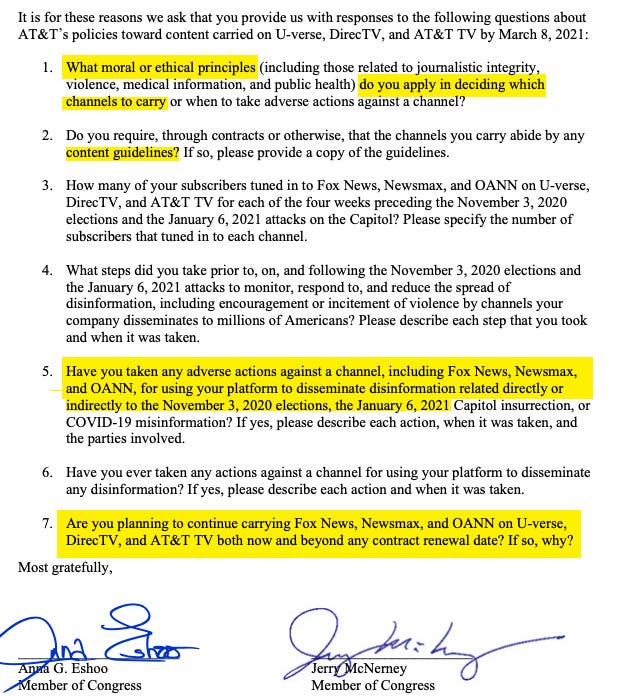
But what House Democrats are doing here is far more insidious than what is revealed by that creepy official announcement. Two senior members of that Committee, Rep. Anna Eshoo (D-Silicon-Valley) and Rep. Jerry McNerney (D-CA) also sent their own letters to seven of the nation’s largest cable providers — Comcast, AT&T, Spectrum, Dish, Verizon, Cox and Altice — as well as to digital distributors of cable news (Roku, Amazon, Apple, Google and Hulu) demanding to know, among other things, what those cable distributors did to prevent conservative “disinformation” prior to the election and after — disinformation, they said, that just so happened to be spread by the only conservative cable outlets: Fox, Newsmax and OANN.

In case there was any doubt about their true goal — coercing these cable providers to remove all cable networks that feature conservative voices, including Fox (just as their counterparts on that Committee want to ban right-wing voices from social media) — the House Democrats in their letter said explicitly what they are after: namely, removal of those conservative outlets by these cable providers:


Saturday, March 13, 2021

The Beltway Uniparty Business Model Is What Caused Trumpism

CTH  |  In modern politics not a single member of the House of Representatives or Senator writes a law, or puts pen to paper to write out a legislative construct. This simply doesn’t happen.

Over the past several decades a system of constructing legislation has taken over Washington DC that more resembles a business operation than a legislative body. Here’s how it works right now.

Outside groups, often called “special interest groups”, are entities that represent their interests in legislative constructs. These groups are often representing foreign governments, Wall Street multinational corporations, banks, financial groups or businesses; or smaller groups of people with a similar connection who come together and form a larger group under an umbrella of interest specific to their affiliation.

Sometimes the groups are social interest groups; activists, climate groups, environmental interests etc. The social interest groups are usually non-profit constructs who depend on the expenditures of government to sustain their cause or need.

The for-profit groups (mostly business) have a purpose in Washington DC to shape policy, legislation and laws favorable to their interests. They have fully staffed offices just like any business would – only their ‘business‘ is getting legislation for their unique interests.

These groups are filled with highly-paid lawyers who represent the interests of the entity and actually write laws and legislation briefs.

In the modern era this is actually the origination of the laws that we eventually see passed by congress. Within the walls of these buildings within Washington DC is where the ‘sausage’ is actually made.

Again, no elected official is usually part of this law origination process.

Almost all legislation created is not ‘high profile’, they are obscure changes to current laws, regulations or policies that no-one pays attention to.  The passage of the general bills within legislation is not covered in media.  Ninety-nine percent of legislative activity happens without anyone outside the system even paying any attention to it.


When Kamala Harris Was In A Position To Make A Difference....,

WaPo | We had our chance to elect a woman as president in 2016 — and we blew it. Not electing Hillary Clinton, a moderate, competent candidate, was one of the worst blunders in U.S. history. Odds are that, if Clinton had won, a lot of victims of covid-19 would still be alive. (The British medical journal the Lancet attributed 40 percent of U.S. coronavirus deaths to Trump’s “inept” response, while other studies suggest that female leaders did better at dealing with covid-19 than male counterparts.)

We are likely to have another opportunity to elect a woman as president in 2024. While there are two potential Republican contenders — former United Nations ambassador Nikki Haley and South Dakota Gov. Kristi L. Noem — the most likely woman, by far, to win the presidency is Vice President Harris. That’s not only because 15 previous vice presidents have become president, but also because Joe Biden, already the oldest U.S. president in history, will be 82 in 2024. He has previously spoken of himself as a “transition candidate” and signaled that he would serve only one term.

Of course, now that he has finally attained the presidency on his third try, Biden may not want to give it up, but it’s imperative that Harris acquire the stature and experience not only to win the next race but also to govern effectively. That’s especially important given the likelihood that Republicans will nominate either Trump or a Trump mini-me. America can’t survive another four years of Trumpism. Helping Harris get ready for the presidency, therefore, may be Biden’s most important job, beyond responding to immediate crises such as the coronavirus and global warming.

That’s why I was delighted to read a report from my Post colleague Olivier Knox that says Harris is taking an active role in foreign policy, including meeting regularly with the secretaries of state and defense, becoming a “vocal participant” in policy discussions regarding Iran and Saudi Arabia, and calling world leaders on her own. National security policy is the most important part of the president’s portfolio, but it is an area where Harris, a former attorney general of California and U.S. senator, does not have much experience. She has 1,337 days to fill that gap on her résumé and get ready to break the ultimate glass ceiling.

Useless And Destructive Lockdowns Fueled Unrest In America

acleddata |  In March 2020, the Trump administration declared the novel coronavirus pandemic a national emergency in the United States. Although the US is home to just 4% of the world’s population, it now accounts for a quarter of all confirmed COVID-19 cases and a fifth of the death toll (New York Times, 2021). A year on, more than half a million people have died of COVID-19 across the country (CDC, 2021), and the new Biden administration has officially extended the national emergency beyond its March 2021 expiration date (CNBC, 25 February 2021).

The health crisis has exacerbated existing inequalities and political faultlines in the US, contributing to a surge of unrest throughout the country. New analysis of ACLED data — now extended to the beginning of 2020 — reveals the full scope of the pandemic’s impact on American protest patterns for the first time.

Key Findings

Trends in pandemic-related demonstrations are closely correlated with trends in COVID-19 cases, with spikes in unrest matching infection waves reported throughout 2020. ACLED data show that the majority of these demonstrations have been organized around five main drivers: the risks faced by health workers, the safety of prisoners and ICE detainees, anti-restriction mobilization, the eviction crisis, and school closures.

  • Health workers have protested to call for safer working conditions and a stronger government response to the pandemic. Demonstrations organized by health workers have contributed to protest spikes throughout the year, with surges during each wave of the pandemic. These protests have been peaceful and less than 1% have faced intervention from the authorities. Health worker protests have taken place in 38 states and the District of Columbia.
  • Prisoners and ICE detainees are at high risk of contracting the coronavirus due to a combination of cramped quarters, poor ventilation, limited time outdoors, and restrictive measures that prevent the use of masks and other PPE. Demonstrations by and in solidarity with prisoners and ICE detainees have called on the government to reduce these risks, and have been organized in 37 states and the District of Columbia. Solidarity demonstrations have been overwhelmingly peaceful — over 99% of all events — and the majority of demonstrations involving prisoners and detainees have been peaceful as well — over 77% of all events. Nevertheless, demonstrations by prisoners are frequently met with force: in more than a third — over 37% — of all peaceful coronavirus-related protests held by prisoners and detainees, guards have used force like firing pepper spray and pepper balls.
  • Government measures to curb the spread of the coronavirus have prompted thousands of anti-restriction demonstrations calling for the country to reopen. These demonstrations have taken place in every state and the District of Columbia. Right-wing mobilization against COVID-19 restrictions has been a critical means for far-right armed groups to build networks around the country, serving as a key precursor to ‘Stop the Steal’ organizing after the election leading up to the US Capitol riot in January 2021. Over 23% of all demonstrations involving right-wing militias and militarized social movements across the country have been organized in opposition to pandemic-related restrictions. Anti-restriction demonstrations involving these groups turn violent or destructive over 55% of the time, relative to less than 4% of the time when they are not present, underscoring the destabilizing role that militias and other militarized movements can play in right-wing mobilization. 
  • Demonstrations over the eviction crisis triggered by the pandemic — largely spearheaded by the ‘Cancel the Rents’ movement — have urged the government to cancel rent and provide financial relief amid the economic downturn. These demonstrations — which have been overwhelmingly peaceful, at over 99% of all events — have fluctuated in response to federal and state relief packages as well as measures to postpone or ban evictions. These demonstrations have taken place in 35 states and the District of Columbia.
  • The battle around school reopenings has led to waves of protests both for and against a return to in-person teaching. School-related demonstrations account for approximately 25% of all coronavirus-related demonstrations in the US. Approximately two-fifths of these demonstrations have been organized against the reopening of schools (i.e. for continued online learning) while about three-fifths have been organized in favor of reopening (i.e. for in-person teaching). Both movements have been widespread geographically, with 43 states and the District of Columbia hosting demonstrations against reopening and all but Arkansas and District of Columbia hosting demonstrations in support of reopening.

The full picture of the Biden administration’s response to the crisis — and its impacts on pandemic-related protest patterns — remains to be seen. If the government is able to meet Biden’s promise that vaccines will be available to all Americans by the end of May 2021 (NPR, 3 March 2021), and if this in turn leads to a sustained decline in COVID-19 cases, pandemic-related mobilization may subside.

At the same time, much of the population remains resistant to vaccination (The Hill, 10 February 2021), which could stymie efforts to combat the virus and reopen the country. If partial vaccination prevents a decrease in new cases, or enables a future resurgence, it could prolong lockdown measures, prompting an increase in anti-restriction protests. Prolonged lockdowns will do additional harm to the economy, which will fuel further unrest over the eviction crisis as well as demonstrations calling for financial support. 

However, if the administration responds with a mandatory vaccination policy or imposes new national restrictions to curb the pandemic, it could reinvigorate right-wing mobilization, including militia activity, against the federal government. While right-wing organizing and militia activity has temporarily abated amid the crackdown on groups and individuals connected to the Capitol riot, these networks — bolstered during reopen rallies throughout 2020 — are likely to reactivate when the next politically salient moment arrives. The ‘anti-vax’ movement could serve as such a catalyst, as anti-vaccine activists are already a growing force at reopen demonstrations (New York Times, 4 May 2020), and have increasingly found common cause with right-wing anti-lockdown demonstrators as they shift their focus to the vaccination rollout (New York Times, 6 February 2021). Many of these demonstrators are new to the ‘anti-vax’ movement, joining as a reaction to the coronavirus pandemic and what they perceive as an attack on civil liberties mounted by the government in response to the health crisis (New York Times, 6 February 2021). Building on the reopen organizing that began in early 2020, organized opposition to the vaccine rollout in early 2021 could serve as an important nexus allowing militias, militant street groups, and other right-wing social movements to develop additional networks for future mobilization.

Friday, March 12, 2021

You Know How Drugged Up Cmdr. Cornpop Had To Be To Read That Teleprompter Yesterday?!?!?!

Even as the nation deals with multiple crises -- a deadly pandemic and the devastating economic fallout -- Biden has gone longer without facing extended questions from reporters than any of his 15 predecessors over the past 100 years.

The tough exchanges in such a setting can reveal much more to Americans about a president's thinking and test his explanations, as opposed to what so far have been Biden's brief answers -- often one-liner quips -- in the tightly-controlled and often-scripted events the White House has arranged to date.

The previous record was set by President George W. Bush, who waited 33 days before hosting a formal, solo press conference. But that was more of an anomaly: Many others held them within a handful of days or a few weeks of taking office, according to an analysis of documents in a database maintained by the American Presidency Project at the University of California, Santa Barbara.

CNN first reported on Biden surpassing his predecessors' record.

The White House last week pledged Biden would hold a news conference before this month was out, but it has not yet set a date. It did schedule his first primetime address for Thursday, though, "to commemorate the one year anniversary of the COVID-19 shutdown."

Trump held his first solo, formal news conference 27 days after assuming the presidency, while President Barack Obama did the same 20 days after taking office.

The Revolt Of The Public: Trouble Seeing Things That Erupt From Below

taibbi  |  The thesis of The Revolt of the Public is that traditional centralized powers are losing — have lost — authority, in large part because of the demystifying effect of the Internet. The information explosion undermined the elite monopoly on truth, exposing long-concealed flaws. Many analysts had noted the disruptive power of the Internet, but what made Gurri unique is that he also predicted with depressingly humorous accuracy how traditional hierarchies would respond to this challenge: in a delusional, ham-fisted, authoritarian manner that would only confirm the worst suspicions of the public, accelerating the inevitable throw-the-bums-out campaigns. This assessment of the motive for rising public intransigence was not exactly welcomed, but either way, as Kling wrote, “Martin Gurri saw it coming.”

Gurri also noted that public revolts would likely arrive unattached to coherent plans, pushing society into interminable cycles of zero-sum clashes between myopic authorities and their increasingly furious subjects. He called this a “paralysis of distrust,” where outsiders can “neutralize but not replace the center” and “networks can protest and overthrow, but never govern.” With a nod to Yeats, Gurri summed up: “The center cannot hold, and the border has no clue what to do about it.”

The Revolt of the Public became a cult classic in the Trump years for a variety of reasons, resonating with audiences spanning the political spectrum, from left to right to in between, everywhere except the traditional media consensus. It describes a basic problem of authority in the digital age and for that reason will continue to have relevance into the future. But its most striking feature is how completely it nailed the coming Trump era.

Published in 2014, The Revolt of the Public may be alone among the countless books about the Trump years to correctly peg its core destabilizing problem. While conventional pundits blame everyone from Russians to white nationalists to “fake news” for all that currently ails us, Gurri focused on the inherent problem of authority in the digital age. If you follow his thinking, the specific forms that recent revolts have taken — Brexit, Trump, etc. — have been far less important than what he describes as the “nihilist impulse” behind them, “the wish to smash down whatever stands.” In America, this impulse found Trump, not the other way around. It also could have (and has, in other countries) come from the left instead of the right. The relentless focus on Trump as the center of all evil on earth has mostly served to deflect from a broader narrative about distrust of institutional authority that far pre-dates Trump.

Through a series of case studies ranging from Egypt to Tunisia to Italy to the campaign of Barack Obama, Gurri lays out how snowballing disgust with the blundering arrogance of ruling parties was everywhere leading to upheavals. In the Italian general elections of February 2013, a new party called the “Five Star” movement won 25% of the vote. Inspired by a comedian-blogger named Beppe Grillo, named after the Jiminy Cricket character in Pinocchio, the party, Gurri wrote, “lacked a coherent program. The single unifying principle was a deep loathing of the Italian political establishment.”

Gurri saw such outbursts everywhere, even in the election of Barack Obama, since “the U.S. presidential elections of 2008 [were] an early instance of the public on the move against the established order.” The political scientists and pundits who puzzle over the fact that a great many people voted for both Obama and Trump, shouldn’t. Both men positioned themselves as outsiders, both were aided by a lack of a track record and a deliberately vague platform, making both effective vehicles for expressing popular discontent.


Andrew Cuomo A Case Study In The Loss Of Public Trust In Industrial "Democracy"

newyorker |  But why did it take two months for Boylan’s accusations to be taken seriously by reporters, lawmakers, and law-enforcement officials? Her December 13th tweet received some initial news coverage. “Bombshell Cuo Claim,” one headline in the New York Post read. But, by the end of the month, the bombshell had fizzled. In an Albany Times Union article on December 26th that recapped the Governor’s year in the “national spotlight,” Boylan merited just three sentences. Partly, this can be explained by Boylan’s decision in December not to talk to reporters, and by the fact that she was, at the time, a lone accuser, whereas now she is one of several. But there is another reason: soon after she went public, someone tried to damage Boylan’s credibility and undercut her accusations by leaking damaging information about her to the press.

Within hours of Boylan’s tweet on December 13th, several news outlets reported that they had “obtained” state-government documents relating to Boylan’s job performance in the Cuomo administration. The documents—described by the Associated Press as “personnel memos,” by the Post as “personnel documents,” and by the Times Union as “personnel records”—said that several women had complained to a state-government human-resources office that Boylan had “behaved in a way towards them that was harassing, belittling, and had yelled and been generally unprofessional.” According to the Post’s account, “three black employees went to state human resources officials accusing Boylan, who is white, of being a ‘bully’ who ‘treats them like children.’ ” According to the Associated Press, the documents said that Boylan resigned after being “counseled” about the complaints in a meeting with a top administration lawyer. Reporters who wanted to dig into Boylan’s accusations against Cuomo now had to contend with the possibility that there were people out there who might have accusations to make against Boylan. At best, the documents seemed to raise questions about Boylan’s reliability. At worst, they painted her as a racist.

In a statement, Boylan’s attorney, Jill Basinger, told me Boylan has never seen the documents that the news accounts referenced—which Basinger called a “supposed ‘personnel file.’ ” Basinger accused the Governor’s office of leaking the documents, and also said she expects that the attorney general’s investigation will look into the leak. “It is both shocking and disgusting that the governor and his staff would seek to smear victims of sexual harassment,” Basinger said. “Ms. Boylan will not be intimidated or silenced. She intends to cooperate fully with the Attorney General’s investigation.”

At a press conference last week, Cuomo said that he supported “a woman’s right to come forward,” and that he was “sorry for whatever pain I caused.” At the same time, he pleaded with New Yorkers to allow him some due process. “Wait for the facts from the attorney general’s report before forming an opinion,” he said. That’s how the Governor would like to be treated. But that’s not how he traditionally has treated others. For decades, the Governor has had a reputation for scorched-earth tactics, and for retaliating against those who corner him, threaten him, or simply displease him. As Boylan weighed whether to come forward last year, her lawyer told me, she “believed that she would be retaliated against for going public with her mistreatment.” One former senior official in the Cuomo administration whom I spoke to said it was impossible to imagine that Cuomo himself hadn’t approved the leak of the Boylan documents. “There’s no question he would know about it, and direct it,” the former official said. “That’s how he would think.”

In the nineteen-nineties, while Cuomo was the Secretary of Housing and Urban Development, under Bill Clinton, he fell into a long-running feud with Susan Gaffney, the agency’s inspector general. In 2000, Gaffney accused Cuomo of sexual discrimination. “Gaffney claims that Cuomo has called her at home on weekends to berate her, has started collecting information to smear her, and has leaked damaging information about her,” the Post reported, at the time. In the same story, a Cuomo spokesperson said, of Gaffney, “This is nothing more than a diversion from her misconduct regarding the downloading of pornography in her office and retaliation for our efforts to get to the bottom of it.”

In 2013, Michael Fayette, a state Department of Transportation engineer, gave a few quotes about his department’s operations during Hurricane Irene to the Adirondack Daily Enterprise. His statements were innocuous—“We were up for it,” he told the paper—but they hadn’t been cleared by the higher-ups in Albany. The press found out that Fayette’s superiors were moving to terminate him, and started asking how it was possible for someone to be fired over such a harmless episode. In response, a top Cuomo aide gave a radio interview during which he read aloud misconduct allegations contained in Fayette’s personnel files, including that he’d had an improper relationship with a subordinate. “They can run over you like you’re a freaking speed bump,” Fayette, who retired before he could be fired, told me, last week.

Thursday, March 11, 2021

Denmark Suspended Use Of The Astrazeneca mRNA Jabs

NYTimes |  Denmark suspended the use of the AstraZeneca vaccine because of concerns about possible links to an increased risk of blood clots, the Danish Health Authority announced on Thursday. Iceland and Norway later also announced suspensions in administering the shots.

Danish authorities said all use of the vaccine in the country would be halted for at least 14 days after several severe cases of clots were reported among people who had received the shot, the national broadcaster DR reported.

Still, Danish health officials said they could not yet know if the clots — including a case in which a patient died — were caused by the vaccine, and that an investigation was launched to be “on the safe side.”

Within hours, the European Medicines Agency said in a statement that there is currently no indication the vaccine “has caused these conditions.” The agency, which is Europe’s main drug regulator, said the vaccine’s benefits continue to outweigh its risks, and countries can continue to administer the vaccine while the cases of blood clots are investigated.

The agency’s safety committee is already looking into all cases involving blood clots reported after AstraZeneca vaccinations.

Amid the flurry of suspensions, the Netherlands announced that it would continue to administer the AstraZeneca vaccine despite the concerns voiced by other countries.

The company did not have an immediate response to the suspensions.

Magnus Heunicke, the Danish minister of health, posted a message on Twitter confirming that the use of the AstraZeneca vaccine had been suspended, “following a signal of possible serious side effects in the form of fatal blood clots.”


Moderna Jab Ate Up Young Healthy Utah Nurse Like Hotcakes!!!

NYPost |  A 39-year-old single mom in Utah with no underlying medical conditions died four days after receiving her second dose of the Moderna COVID-19 vaccine, according to a report.

Kassidi Kurill, a mother of one from Ogden, received the vaccine due to her work as a surgical tech for several plastic surgeons, KUTV reported.

“She was absolutely fine with getting it. In fact, she told all of us, ‘It’s fine, you guys should all get it,’” her father, Alfred Hawley, told the outlet.

Kurill experienced a sore arm after the first jab of Moderna, but had no other side effects.

But things took a tragic turn after she received her second dose on Feb. 1.

“She came in early and said her heart was racing and she felt like she need to get to the emergency room,” Hawley said.  

When they arrived at the ER, Kurill was throwing up. Hawley, a retired fighter pilot, told doctors his daughter had just received her second shot.

“They did a blood test and immediately came back and said she was very, very sick, and her liver was not functioning,” he told KUTV.

Kurill’s older sister Kristin, who lives in Arizona, said she knew her sister had gone to the hospital, but the

She thought her sister would get an IV and be back home in an hour, but Hawley knew they were not going home anytime soon.

“It was a total shock, and I was even afraid to tell my wife,” he told the news outlet.

Kurill was soon flown to Intermountain Medical Center in Murray, a trauma center, as her liver was failing and a transplant was believed to be her best chance at survival.

Kristin jumped on the first flight to Utah but was not allowed into the hospital because of coronavirus protocols, so she waited with her sister’s daughter Emilia, 9, as the family hoped for a miracle.

Kurill’s parents volunteered to donate a portion of their livers but never got the chance to offer the lifesaving gift when their daughter’s liver, kidneys and heart shut down.

She died 30 hours after arriving at the hospital.

speed at which she deteriorated was “so unexpected.”

Kansas Says "Get Your Ass Back In The Class - And Karen - You're On Your Own...,"

fox4kc  |  A big change is coming for students this fall in one of the metro’s largest school districts.

Shawnee Mission will not offer a remote learning option, so students will have to attend in-person or transfer elsewhere.

The news is welcomed by parents who’ve fought for full in-person learning to know remote school won’t even be on the table come fall. But no one can predict what the pandemic will be like in August, and that’s why other families are frustrated they may have to change schools to stay safe.

Remote learning are two words no one was ready for this time last year.

“It was kind of a shock, but you know I’ve got two children and have a compromised immune system so completely understood and supported that decision,” said Shawnee Mission School District parent Beth Koon.

With her family’s health concerns, Koon decided the best thing was to continue remote learning through Shawnee Mission Schools this year.

“That was just a very easy decision for us to decide to stay home with the kids and stay safe,” Koon said.

Koon said her kids are excelling in online classes. So she was stunned to see a letter from SMSD Tuesday, saying remote learning won’t be available next school year.

“To presume that the pandemic is over, there’s no spread and that adults or families like mine with immune compromised family members, who do need to make these decisions to isolate, to stay safe, to pull that rug out from under us I felt was very alarming,” Koon said.

While the district knows some kids have thrived in remote learning, others have struggled, and it wants to offer the best in-person experience possible. In a letter to parents, the district wrote, “Absent a pandemic, there is no legal way to continue providing the remote learning option.”

“We may still be in the pandemic to some degree. We won’t have kids vaccinated, but the changes that the governor had authority to put in place and that the Kansas Department of Education had authority to put in place, those will have expired and there’s no indication those will be renewed,” said David Smith, a SMSD spokesperson.


Politically Organized Law Enforcement Has Been Very Piggish At The Taxpayer Trough...,

NYTimes |  Ron DeLord, a fiery former Texas cop turned labor organizer, has long taught union leaders how to gain power and not let go. He has likened a police union going after an elected official to a cheetah devouring a wildebeest, and suggested that taking down just one would make others fall in line.

He helped write the playbook that police unions nationwide — seeking better pay, perks and protections from discipline — have followed for decades. Build a war chest. Support your friends. Smear your enemies. Even scare citizens with the threat of crime. One radio spot in El Paso warned residents to support their local police or face “the alternative,” as the sound of gunshots rang out.

“We took weak, underpaid organizations and built them into what everyone today says are powerful police unions,” Mr. DeLord said in a recent interview. “You may say we went too far. I say you don’t know how far you’ve gone until you’re at the edge of the envelope.”

That moment may be now.

Since the death of George Floyd at the hands of police last May set off protests nationwide, 27 states and Washington D.C. have adopted new police oversight and reform laws, according to the National Conference of State Legislatures. Officials in Boston, Los Angeles and other cities agreed to limit police spending. In November, voters overwhelmingly approved 17 ballot measures in six states to rein in police officers. 

Unions — many of which have dug in despite the protests and challenged officers’ firings in high-profile incidents — are also increasingly seen as out of step with the public. Officers in big cities can earn more than $100,000 a year, far more than citizens they are assigned to protect. That success has stoked a backlash. Many cities say they are unable, or unwilling, to pay for ever mounting police costs.

As cities from Portland, Ore., to Chicago negotiate new police contracts this year, local officials are seeking to gain back concessions made decades ago.

Union and city leaders are especially watching negotiations in San Antonio. Years ago, officers there locked in some of the most highly coveted perks and protections of any department in the country: rules that helped shield officers from discipline; fat pensions, Cadillac health insurance plans, even taxpayer-funded payments for divorce lawyers. Their success became a case study for unions nationwide.

During the last negotiations, city officials claimed the contract would bankrupt San Antonio. Now, city officials are focused on undoing some disciplinary protections. Adding pressure, a May ballot measure in the Texas city could eliminate the union’s ability to bargain — a devastating blow.


Economic And Cultural (Power) Discontents Of A Fallen Professional Class (Redux 9/30/20)

benjaminstudebaker  |  Then there are jobs that require a degree but which are less secure and less lucrative than they used to be. Attacks on teachers’ unions, for instance, are gradually eroding the benefits and security which teachers have traditionally enjoyed. As this happens, the distinction in living standard between teachers and ordinary workers becomes blurrier and blurrier. Tenured teachers still have a better situation than most workers, but fewer and fewer teachers are put in position to acquire tenure. Within teaching, then, there is a minority of secure, tenured faculty–who are part of the rump professional class. Then there are teachers who have no realistic path to tenure and have been effectively turned into casual workers. These teachers are part of the fallen professional class. The rump professional class and the fallen professional class have largely the same education, but are nonetheless treated very differently, because the system is not interested in rewarding their merit but in reducing the cost of the education system.

The fallen professionals want to be part of the rump professional class, but can no longer access it materially. They can only access it culturally, by maintaining their familiarity with the language and ideas of the rump professionals. For this reason, the fallen professionals try very hard to continue to be part of the culture of the rump professionals. This enables many rump professionals to make money off their fallen counterparts by selling an ersatz version of the experience of professional class life. This takes the form of podcasts, YouTube videos, and prestige TV shows and films. By consuming this media, the fallen professional continues to feel part of the rump professional class, even as the fallen professional is robbed of the material benefits of being a member.

Because the fallen professionals want to feel superior to the ordinary workers, the rump professionals have a financial incentive to sell ideas which flatter this superiority complex. This has led, in recent years, to the development of a woke industry which invents new terms and grounds for taking offence. By using these terms and taking offence in these ways, the fallen professionals feel they are participating in the culture of the rump professionals and they can distinguish themselves from the ordinary workers, who fail to use the language or to recognise the offensiveness.

The rump professionals justify this commercialisation of radicalism on the grounds that it is ostensibly morally committed to resisting racism, patriarchy, fascism, or even capitalism itself. But the main effect of the product is to create cultural barriers between the fallen professionals and the ordinary workers, so the fallen professionals will continue to politically identify with the rump professionals and therefore with the rich. The language is used to label the ordinary worker a deplorable bigot, and the ordinary worker responds by seeking the absolute destruction of these professionals through right nationalist politics. Mortified by the right nationalism of the workers, the rump and fallen professionals lean ever harder into denouncing them as bigots, creating a vicious cycle which pushes the workers further and further to the right.

For some time now, the left has sought to use these fallen professionals as “class traitors”. They are supposed to lead left-wing movements and organise on the ground. But the fallen professionals cannot do this, because they have contempt for the people they are trying to lead. This contempt is nurtured by the cultural content manufactured by the rump professionals.

None of this is anyone’s fault, individually. Because it’s getting harder and harder to be part of the rump professional class, would-be professionals must do everything they can to compete, and that means they have to look for money wherever they can find it. Those who make it must make money off those who do not. Those who do not were fed lies from childhood. They were told that a professional class life was achievable, and they were told it would be wonderful and fulfilling. Their desire to get the recognition and meaning they were promised is a reasonable consequence of the way they were socialised. And how can the ordinary worker react in any other way? The worker cannot have dignity without resisting a professional culture that constantly denigrates workers for lacking elite education.

Why Must These Union Big-Wigs ALWAYS Be Lying Butt-Ugly Trolls?

Newsweek |   A private Facebook group from a teachers union in Los Angeles warned members not to post images of Spring break vacations online after the union voted to remain closed for in-person instruction.

Members of the United Teachers Los Angeles (UTLA) union were told to avoid sharing images of vacations in a leaked private Facebook group to avoid controversy with parents, Fox 11 Los Angeles reported Monday.

"Friendly reminder: If you are planning any trips for Spring Break, please keep that off of Social Media. It is hard to argue that it is unsafe for in-person instruction, if parents and the public see vacation photos and international travel," the post said.

The private Facebook group, called "UTLA FB GROUP-Members Only" has about 5,700 members. UTLA represents teachers across Los Angeles Unified School District, the largest district in the state with about 600,000 students, or roughly 10 percent, of California's public schoolchildren

The warning came just days after UTLA overwhelmingly voted to remain closed for in-person learning, unless the union's full list of demands are met.

Those demands include that Los Angeles County has less widespread COVID infections, staff are fully vaccinated or provided access to full vaccines, and safety conditions are in put in place, according to the union's website. Los Angeles County is currently in California's purple tier of COVID-19 restrictions, meaning that the area has "widespread" infections with more than an 8 percent positivity rate.

"This vote signals that in these most trying times, our members will not accept a rushed return that would endanger the safety of educators, students, and families," UTLA President Cecily Myart-Cruz said in a statement.

"As much as educators long to be back to in-person instruction, it must be done safely for the sake of students, staff, and families. That has been our guiding principal from Day 1 of this pandemic," Myart-Cruz added.

Wednesday, March 10, 2021

200 Highly Skilled People Are Literally Transforming Human Life On Earth And Beyond

wired |  I think I felt a visceral resistance at times to the notion that we could edit the human genome, especially in ways that would be inheritable. But that changed both for me and for Doudna as we met more and more people who are themselves afflicted by horrible genetic problems, or who have children who are suffering from them. And when our species got slammed by a deadly virus, it made me more open to the idea that we should use whatever talents we have in order to thrive and be healthy. So I’m now even more open to gene editing done for medical purposes, whether that’s sickle cell anemia, or Huntington’s, or Tay-Sachs, or even to increase our resistance to viruses and other pathogens and to cancer.

I still have worries. One is I don’t want gene editing to be something only the rich can afford and it leads to encoding inequalities into our societies. And, secondly, I want to make sure we don’t reduce the wonderful diversity that exists within the human species.

Do you have any ideas for how to do that?

I spend the last few chapters of my book wrestling with that question. And I hope not to preach, but to allow the reader to go hand in hand with me and Jennifer Doudna and figure out on their own what their hopes and fears are about this so-called brave new world we’re all stepping into together. I once had a mentor say there are two types of people who come out of Louisiana: preachers and storytellers. He said, “For heaven's sake, be a storyteller, because the world’s got too many preachers.”

So by telling the tale of Crispr in all its scientific triumphs and rivalries and excitement, I hope to turn people on to the science. But I also want to make them more qualified to wrestle with one of the most important questions we’re going to face as a society over the next couple of decades: When we can program molecules the way we program microchips, what is it we want to do with this fire that we’ve snatched from the gods?


We Have The Technology: Now That "No Lives Matter" Let The Eugenic Games Begin!

corbettreport |  On November 10, 2020, Joe Biden announced the members of a coronavirus task force that would advise his transition team on setting COVID-19-related policies for the Biden administration. That task force included Dr. Ezekiel Emanuel, a bioethicist and senior fellow at the Center for American Progress.

JOE BIDEN: So that’s why today I’ve named the COVID-19 Transition Advisory Board comprised of distinguished public health experts to help our transition team translate the Biden-Harris COVID-19 plan into action. A blueprint that we can put in place as soon as Kamala and I are sworn into office on January 20th, 2021.

SOURCE: President-elect Biden Delivers Remarks on Coronavirus Pandemic

ANCHOR: We’ve learned that a doctor from our area is on the president-elect’s task force. Eyewitness News reporter Howard Monroe picks up the story.

THOMAS FARLEY: I know he’s a very bright, capable guy and i think that’s a great choice to represent doctors in general in addressing this epidemic.

HOWARD MONROE: Philadelphia health commissioner Dr. Thomas Farley this morning on Eyewitness News. He praised president-elect Joe Biden’s transition team for picking Dr. Ezekiel Emanuel to join his coronavirus task force. He is the chair of the Department of Medical Ethics and Health Policy at the University of Pennsylvania.

SOURCE: UPenn Dr. Ezekiel Emanuel To Serve On President-Elect Biden’s Coronavirus Task Force

That announcement meant very little to the general public, who likely only know Emanuel as a talking head on tv panel discussions or as the brother of former Obama chief of staff and ex-mayor of Chicago, Rahm Emanuel. But for those who have followed Ezekiel Emanuel’s career as a bioethicist and his history of advocating controversial reforms of the American health care system, his appointment was an ominous sign of things to come.

He has argued that the Hippocratic Oath is obsolete and that it leads to doctors believing that they should do everything they can for their patients rather than letting them die to focus on higher priorities. He has argued that people should choose to die at age 75 to spare society the burden of looking after them in old age. As a health policy advisor to the Obama administration he helped craft the Affordable Care Act, which fellow Obamacare architect Jonathan Gruber admitted was only passed thanks to the stupidity of the American public.

JONATHAN GRUBER: OK? Just like the people—transparency—lack of transparency is a huge political advantage. And basically, you know, call it the stupidity of the American voter or whatever, but basically that was really critical to getting the thing to pass.

SOURCE: 3 Jonathan Gruber Videos: Americans “Too Stupid to Understand” Obamacare

During the course of the deliberations over Obamacare, the issue of “death panels” arose. Although the term “death panel” was immediately lampooned by government apologists in the media, the essence of the argument was one that Emanuel has long advocated: appointing a body or council to ration health care, effectively condemning those deemed unworthy of medical attention to death.

ROB MASS: When I first heard about you it was in the context of an article you wrote right around the time that the Affordable Care Act was under consideration. And the article was entitled “Principles for the Allocation of Scarce Medical Interventions.” I don’t know how many of you remember there was a lot of talk at the time about [how] this new Obamacare was going to create death panels. And he wrote an article which I thought should have been required reading for the entire country about how rationing medical care—you think that that’s going to start with with the Affordable Care Act? Medical care is rationed all the time and it must be rationed. Explain that.

EZEKIEL EMANUEL: So there are two kinds of “rationing,” you might say. One is absolute scarcity leading to rationing and that’s when we don’t simply don’t have enough of something and you have to choose between people. We do that with organs for transplantation. We don’t have enough. Some people will get it, other people won’t and, tragically, people will die. Similarly if we ever have a flu pandemic—not if but when we have a flu pandemic—we’re not going to have enough vaccine, we’re not going to have enough respirators, we’re not going to have enough hospital beds. We’re just going to have to choose between people.

SOURCE: Dr. Zeke Emanuel: Oncologist and Bioethicist

The Panicdemic Has Scared Open The Floodgates Of Funding And Human Experimentation Opportunity

The Antibody Deception from Rosemary Frei on Vimeo.

off-guardian |  The world has been fixated for months on novel-coronavirus PCR testing, contact tracing and vaccination.

Meanwhile, another major part of the Covid biomedical complex has received far less attention: the use of antibodies for detecting, diagnosing and treating infection with the novel coronavirus.

Hundreds of antibodies have been approved for these purposes since January 2020. And hundreds more are poised to start being marketed soon.

This is part of the biomedical gold rush: by last summer already, antibodies were on track to become the most lucrative medical product, with global revenue projected to reach nearly half a trillion dollars by 2024. Profit margins in the range of 67% aren’t uncommon.

Pharma giants such as AstraZeneca, Novartis, GlaxoSmithKline and Eli Lilly are among the companies grabbing the largest chunks of the novel-coronavirus-antibody market. And some of the most muscular government agencies, including Anthony Fauci’s US National Institute of Allergy and Infectious Diseases and the US’s Defense Advanced Research Projects Agency, are part of the action (see, for example, the second-last section of this article, on antibodies used to treat Covid).

Virtually every study and piece of marketing material related to Covid is premised on scientists having positively and correctly identified the presence of the novel coronavirus (also known as SARS-CoV-2) in the material they’re working with.

The job of that identification is usually given to antibodies that are said to bind to the novel coronavirus. The assumption is these antibodies are able to pick out the virus and only the virus from among every other organism and substance surrounding it.

Unfortunately it turns out that the antibodies rarely (if ever) do that. This is because of, among other things, inadequate verification of the antibodies’ accuracy in targeting the virus by the companies that manufacture and sell them. And there’s even less verification by government regulators.

Let’s take a 30,000-foot tour of a couple of the main features of the antibody-industry landscape, which is awash in complexity and cash.

Chipocalypse Now - I Love The Smell Of Deportations In The Morning

sky |   Donald Trump has signalled his intention to send troops to Chicago to ramp up the deportation of illegal immigrants - by posting a...