johnhelmer | US Secretary of State Antony Blinken revealed publicly in Geneva on Friday, January 21, that he will not negotiate a no-war agreement with the Russians because he cannot. This is already understood by the Russians; by the French and Germans; and by several senior officials of the Biden Administration.
The evidence of Blinken’s incapacity is in the words he says.
It was during the last world war, when US policymakers had next to no intelligence on how their German counterparts were thinking and what they were intending, that a group of American sociologists were engaged by the War Department, as the Pentagon was called then, to do what was called content analysis of German propaganda. One of the sociologists, a Russian émigré Nathan Leites, went on to apply the same method to Soviet publications in order to uncover what Leites called the operational code of the Politburo. That was in 1951. It was immediately used by US negotiators during the Korean War armistice negotiations which began in July of that year and ran for two years. By then Leites had produced a sequel, A Study of Bolshevism. Both were paid for and published by RAND, the think-tank created in 1945 by the US Air Force, the Douglas Aircraft Company, and the War Department.
Since then the method has not been used on US Government officials, at least not by RAND nor publicly by any American sociologist.
When the RAND method is used to analyze what Blinken told the US press, following his meeting with Russian foreign minister Sergei Lavrov, it is revealed that Blinken has no intention whatever of negotiating a non-aggression pact with the Russians on any terms. According to the scientific method devised by the best and brightest Americans for dealing with their enemies, it’s now clear from Blinken’s own words that he is unable to understand what Russians tell him. In the mind behind the words there is only one compulsive idea – attack, punish, destroy Russia.
The State Department has published the transcript of Blinken’s statement and answers to questions at his press conference.
*****************************
The late senator John McCain described Blinken as not only unqualified but dangerous to America.
Blinken directed some of the most murderous initiatives of the Obama era: Libya, Syria, and Gaza. But worse, he then cashed-in withJohn Thain(of the gold-plated Merrill office with the $90K rug who insisted on $20 billion in bonuses from the government bail-out of the bankrupt firm) on thisPrivate Equity/SPACdesigned to cash-in on Blinken and Lloyd Austin’s connections, especially to skim Covid relief monies.
Thismurderous greed-headis a complete horror-show — emblematic of why the voters have deserted theshamelessly corruptDemocrats in droves. Blinken and Austin are transparently ginning-up this “crisis” in order to personally profit from arms sales by needlessly militarizing Eastern Europe against a non-existant “invasion” threat from Russia — whowillact to protect the large Russian populations stranded in the former SSR’s by the disorderly breakup of the Soviet Union from being liquidated.
theatlantic | Old songs now represent 70
percent of the U.S. music market, according to the latest numbers from
MRC Data, a music-analytics firm. Those who make a living from new
music—especially that endangered species known as the working musician—should
look at these figures with fear and trembling. But the news gets worse:
The new-music market is actually shrinking. All the growth in the
market is coming from old songs.
The 200 most popular new tracks now regularly account for less than 5 percent of total streams.
That rate was twice as high just three years ago. The mix of songs
actually purchased by consumers is even more tilted toward older music.
The current list of most-downloaded tracks on iTunes is filled with the
names of bands from the previous century, such as Creedence Clearwater
Revival and The Police.
I
encountered this phenomenon myself recently at a retail store, where
the youngster at the cash register was singing along with Sting on
“Message in a Bottle” (a hit from 1979) as it blasted on the radio. A
few days earlier, I had a similar experience at a local diner, where the
entire staff was under 30 but every song was more than 40 years old. I
asked my server: “Why are you playing this old music?” She looked at me
in surprise before answering: “Oh, I like these songs.”
Never
before in history have new tracks attained hit status while generating
so little cultural impact. In fact, the audience seems to be embracing
the hits of decades past instead. Success was always short-lived in the
music business, but now even new songs that become bona fide hits can
pass unnoticed by much of the population.
Only
songs released in the past 18 months get classified as “new” in the MRC
database, so people could conceivably be listening to a lot of
two-year-old songs, rather than 60-year-old ones. But I doubt these old
playlists consist of songs from the year before last. Even if they did,
that fact would still represent a repudiation of the pop-culture
industry, which is almost entirely focused on what’s happening right now.
Every
week I hear from hundreds of publicists, record labels, band managers,
and other professionals who want to hype the newest new thing. Their
livelihoods depend on it. The entire business model of the music
industry is built on promoting new songs. As a music writer, I’m
expected to do the same, as are radio stations, retailers, DJs,
nightclub owners, editors, playlist curators, and everyone else with
skin in the game. Yet all the evidence indicates that few listeners are
paying attention.
Consider the recent reaction when the Grammy Awards were postponed. Perhaps I should say the lack
of reaction, because the cultural response was little more than a yawn.
I follow thousands of music professionals on social media, and I didn’t
encounter a single expression of annoyance or regret that the biggest
annual event in new music had been put on hold. That’s ominous.
Can
you imagine how angry fans would be if the Super Bowl or NBA Finals
were delayed? People would riot in the streets. But the Grammy Awards go
missing in action, and hardly anyone notices.
eand.co |It is impossible — flatlyimpossible — for theaverage Americanto make ends meet.
I can tell you that as an economist, one of the only really good ones
America’s ever had. Americans grew poor because their economy failed
them. But a poor society can’t afford many things. Things which matter.
Like democracy, truth, reason, goodness, decency.
Societies faced with sudden descents into poverty implode into
authoritarianism, just the way America is. Greed broke America in this
larger, truer sense.
But
Americans don’t really understand it yet, I think, just how extreme and
out of control greed really is in America — and how, paradoxically, it
left society poor. Too poor to afford to even be a functioning country or democracy anymore, in the end, and so America’s just imploding now.
Let’s
do a little math first, to prove the point that it’s impossible to make
ends meet, and then I’ll teach you a little bit about how what’s normal
in America is completely and totally abnormal in the rest of the entire
world, more or less.
The median American income is about $35K.
That is what millions of Americans earn. For a “household,” meaning in
economic statistics, a family of four, it rises to about $60K.
It is impossible, and I mean impossible, to live on that level income. That is a median income more suited to a poor country than a rich one. But let’s prove it.
Rent? The average rent for an apartment was $1124 in 2021. That’s $14,000. That’s half of the average person’s income eaten up by rent alone. Now we have…all the other expenses of life. Let’s start with the other big one in America: healthcare. The average cost
for a family paying for healthcare was almost exactly the same: $1152.
Bang. Another $14K. That’s the average American’s entire income gone, on
just rent and healthcare.
But
maybe you object — my employer pays for my healthcare. Or maybe I don’t
even want healthcare (LOL, you mean you can’t afford it, I get it,
we’ll come back to that). Sure — it’s not going to make much difference
in the end. The average American spends about $1200
“out-of-pocket” even if they’re insured by their employer — let’s call
it $1500, because that’s surely an underestimate. That leaves us with
maybe about 14K of income per year for the average person — and we still
haven’t gotten to most bills.
You need a car in America, to get much of anywhere. You need insurance for it. The average monthly car payment is $600. Let’s call insurance another $100. That’s $700…a month. Or $8400 per year. Suddenly, we’re left with about $5K to cover everything else you need in life.
Water,
electricity, gas to put in the car. Internet. A mobile phone. The
average water bill’s around $100 per month — bang, another $1200 gone —
and now we’re down to just about $3800. Internet and a phone? Call them
another $100 per month. Now we’re down to $2600. Electricity? Another
$100 per month. Now we’re down to just $1400. Average annual cost of gas
to put in that car? It’s about $1100.
Now you’ve got just $300 left.
But you still have to feed and clothe yourself. Your kids. Pay
for random stuff like maybe a toy here and there, a treat. I’m sure
I’ve left plenty of stuff out that isn’t remotely a luxury — like paying
off student loans.
The point I’m trying to make should be crystal clear by now — not least because you’re probably living it. Making ends meet in America is flatly impossible. It
cannot be done. My lovely wife’s income is so low that it doesn’t even
cover her expenses — car, travel, a hotel every now and then because
she’s asked to work overtime regularly.
The economic effect of all this is somewhere between a joke and an embarassment. I’m
subsidising this world-famous billion dollar institution which pays its
“administrators” millions, because my wife isn’t even paid enough to
cover her basic living expenses. Think of how ridiculous that is. The reason those administrators earn millions is because I’m effectively paying them to employ my wife — after they get a cut of overcharging Americans for operations and medicine.But this story isn’t personal — it’s social. Those economics — people can’t make ends meet — are absolutely fatal for a society.
krcgtv | A St. Louis woman is jailed after she shot a worker at McDonald’s
after a dispute over a discount for french fries, St. Louis County
authorities said Friday.
Terika Clay, 30, was charged Thursday
with first-degree assault and armed criminal action. She was being held
on a $150,00 cash-only bond.
Clay was in a drive-through at a
McDonald’s in the St. Louis suburb of Normandy on Wednesday when she
argued with an employee over not getting a discount on her fries,
according to a probable cause statement from a Normandy detective.
The
argument continued when the employee went outside for a smoke break,
and Clay struck the employee with her gun and shot her, police said.
The shooting was captured on video, which led to Clay’s arrest, the St. Louis County Prosecutor’s office said in a news release.
The victim’s condition was not immediately available Friday.
Online court records don’t list an attorney for Clay.
Edwards
and his own 16-year-old daughter, who is described as Harris-Brazell’s
best friend, told police they coordinated with Harris-Brazell to stage
the robbery in order to steal money, according to the criminal
complaint.
The document showed no additional evidence
Harris-Brazell conspired with the two on the staged robbery, and her
family has argued she had no reason to steal money.
Ellis
was not in on the staged robbery and fired at the suspect after seeing
him leaning into a drive-thru window and waving a gun around in the
direction of Harris-Brazell.
Edwards and his
daughter did not tell police it was part of the plan for Edwards to lean
into the window. Edwards said he did so because Harris-Brazell, who was
working the drive-thru register, did not immediately hand over the
cash, court documents said.
The incident occurred the evening of Jan. 2, shortly after the restaurant closed.
Ellis
and Edwards are in Milwaukee County jail. As of Thursday morning, Ellis
did not have a first court appearance scheduled. Edwards’ cash bail was
set at $100,000 on Sunday.
According to court records:
Surveillance
camera footage shows that as Harris-Brazell alerted other coworkers to
the robbery, a manager at the restaurant called out to Ellis, who
usually carried a gun with him to work.
Ellis
peered around a door into the drive-thru window area as the robbery
suspect waived a gun around. From about 20 feet away, Ellis pressed his
body against the door and fired one-handed from around the corner of the
door.
Harris-Brazell stood in between Ellis and the suspect. She suffered gunshot wounds to her chest.
news4sanantonio | An argument over barbecue sauce left a teenager in intensive care after being shot in the head at a Wendy's drive-thru.
Now that teenager looks to be out of the woods and is recovering after the horrible ordeal.
Brian Durham Jr., 16, was rushed to a hospital on Jan. 13 after a
dispute in which he was reportedly not involved escalated into gunfire,
according to FOX 10 in Phoenix.
The teenage employee at Wendy's in Phoenix was in critical condition after being shot in the head while working the drive-thru.
"The
customer reportedly walked up to the drive-thru window, pulled out a
handgun and fired into the drive-thru window hitting the victim working
inside the store," said Sgt. Vincent Cole of the Phoenix Police
Department.
The shooter ran off after the incident, but police
were able to apprehend him later. He was identified Theotis Polk, 27,
according to FOX 10 in Phoenix.
Durham Jr.’s father, Brian Durham
Sr., said the incident started when the customer complained the
restaurant did not have barbecue sauce, FOX 10 reported.
"My son
just stayed quiet and had the guy’s change in his hand," Durham Sr. told
the news outlet. "[He] just stayed quiet while the other two was in
confrontation."
According to FOX 10, the bullet didn't hit Brian's brain, which helped minimize the potential long-term damage.
The over 17,000 signers of the declaration will be represented on Sunday, January 23, when Dr. Malone stands with fellow doctors and scientists on stage in Washington DC, as part of the Defeat the Mandates march Sunday, January 23, 2022. At the Lincoln Memorial, they will be joined by a wide range of featured guests for a series of inspiring talks and musical performances. Join us!
About the Global COVID Summit
Global Covid Summit is the product of an international alliance of doctors and scientists, committed to speaking truth to power about Covid pandemic research and treatment.
Thousands have died from Covid as a result of being denied life-saving early treatment. The Declaration is a battle cry from physicians who are daily fighting for the right to treat their patients, and the right of patients to receive those treatments - without fear of interference, retribution or censorship by government, pharmacies, pharmaceutical corporations, and big tech. We demand that these groups step aside and honor the sanctity and integrity of the patient- physician relationship, the fundamental maxim "First Do No Harm", and the freedom of patients and physicians to make informed medical decisions. Lives depend on it. More information here: https://globalCovidSummit.org
themarshallproject |“Tell Your Children: The Truth About Marijuana, Mental Illness,
and Violence” is an intensively researched and passionate dissent from
the now prevailing view that marijuana is relatively harmless. The book
is a “bullhorn” (his word) for scientists and physicians whose research
has, he argues, been drowned out by the triumphal cheers of the
marijuana lobby.
He exchanged emails with TMP’s Bill Keller.
The Marshall Project: Alex, you’re really swimming
against the tide. Both public opinion and the law have moved
dramatically in favor of marijuana, and you’re arguing that pot is
connected to psychosis and violent crime. Before we get to your
evidence, what drew you to this subject?
Alex Berenson: My wife Jacqueline is a forensic
psychiatrist. She evaluates the criminally mentally ill. She told me
that nearly all her patients had used marijuana heavily, many at the
times of their crimes. At first I didn't really believe her—stupidly—but
she encouraged me to evaluate the evidence myself. And the more I read,
the more I realized she was right. Marijuana drives a surprising amount
of psychosis, and psychosis—besides being a terrible burden for
sufferers and their families—is a shockingly high risk for violent
crime.
TMP: Last I checked, 33 states and the District of
Columbia had legalized marijuana specifically for medicinal purposes.
Doctors are apparently prescribing pot for pain, Parkinson’s, PTSD,
epilepsy, multiple sclerosis and most recently some forms of autism. Pot
has been held out as an answer to the opioid crisis—pain relief without
the risk of a lethal overdose. Are you saying all these politicians and
doctors are deluded?
AB: This question fundamentally misunderstands
medical marijuana. The confusion is not surprising, as the cannabis
advocacy community has done everything possible to confuse the way
medical legalization works in practice. Marijuana is not "prescribed"
for anything. It can't be, because the FDA has never approved it to
treat any disease, and there is little evidence that smoked cannabis or
THC extracts help any of the diseases you mention, except pain.
Physicians "authorize" its use, usually after very short visits by
patients who have come to them specifically to receive an authorization
card. By far the most common conditions for which medical marijuana is
authorized are pain and self-reported psychiatric conditions such as
anxiety and insomnia, not diseases such as Parkinson's.
After receiving an authorization card, "patients" can then buy as
much marijuana as they like for a year for any reason they choose.
Nearly all were recreational users before they became "patients." And
there is no difference between medical and recreational marijuana. They
are the same drug. Further, the vast majority of physicians will not
write authorizations, at least according to the states that keep track
of physician authorizations. A tiny number of doctors—so-called "pot
doctors"—write nearly all of them.
In other words, in nearly all cases, medical legalization is simply a
backdoor way to protect recreational users from arrest. This has been a
terrible mistake, mainly because it has further confused the public
about marijuana's relative risks and benefits.
TMP: Your other—perhaps more contentious—conclusion
is that marijuana may contribute to increases in violent crime. As you
know, establishing causal links between crime rates and, well, anything,
is extremely tricky. What convinced you that pot is a culprit?
AB: Psychosis is a known factor for violent crime.
People with schizophrenia commit violent crime at rates far higher than
healthy people - their homicide rates are about 20 times as high. Worse,
they commit most of that crime while they are under the influence.
Since cannabis causes paranoia—not even advocates dispute that fact—and
psychosis, it is not surprising that it would drive violent crime. And
in fact there are a number of good studies showing that users have
significantly higher violence rates than non-users. Further, in
researching the book, I found many, many cases where the causation
appeared clear. In some cases it was as simple and obvious as, this person—with no history of violence—smoked, became psychotic, and committed a homicide.
TMP: You write that you don’t believe people should
go to prison for using marijuana. How should the law deal with pot?
Should it be regulated? Should it carry a warning label?
neurosciencenews |Summary: Cannabis use leads to cognitive impairments that extend beyond the period of intoxication.
Source: Society for the Study of Addiction
A systematic review published today in the scientific journal Addiction has found that cannabis use leads to acute cognitive impairments that may continue beyond the period of intoxication.
This
Canadian-led meta-review (review of reviews) merged the findings of 10
meta-analyses representing more than 43,000 participants.
The study found that cannabis intoxication leads to small to moderate cognitive impairments in areas including:
making decisions,
suppressing inappropriate responses,
learning through reading and listening,
the ability to remember what one reads or hears, and
the time needed to complete a mental task.
“Our
study enabled us to highlight several areas of cognition impaired by
cannabis use, including problems concentrating and difficulties
remembering and learning, which may have considerable impact on users’
daily lives,” said the study’s co-author Dr. Alexandre Dumais, Associate
Clinical Professor of Psychiatry at Université de Montréal.
“Cannabis use in youth may consequently lead to reduced educational
attainment, and, in adults, to poor work performance and dangerous
driving. These consequences may be worse in regular and heavy users.”
Cannabis
is the third most consumed psychoactive substance in the world (after
alcohol and nicotine) and adolescents as well as young adults have the
highest rates of cannabis use.
Recent
global changes in the legalization of cannabis suggest that public
perceptions of its safety and acceptability are on the rise.
I listened to Fauci, Stephane Bancel (Moderna), Annalies Wilder-Smith, and Richard Hatchett discuss the future of covid at Klaus Schwab's WEF yesterday. Here are my notes. 🧵1/https://t.co/NvyMBrlzfy
courtlistener | The plaintiffs have moved the court to preliminarily enjoin the enforcement of two executive orders by the President. The first, Executive Order 14042, is already the subject of a nationwide injunction. Because that injunction protects the plaintiffs from imminent harm, the court declines to enjoin the first order. The second, Executive Order 14043, amounts to a presidential mandate that all federal employees consent to vaccination against COVID-19 or lose their jobs. Because the President’s authority is not that broad, the court will enjoin the second order’s enforcement.
The court notes at the outset that this case is not about whether folks should get vaccinated against COVID-19—the court believes they should. It is not even about the federal government’s power, exercised properly, to mandate vaccination of its employees. It is instead about whether the President can, with the stroke of a pen and without the input of Congress, require millions of federal employees to undergo a medical procedure as a condition of their employment. That, under the current state of the law as just recently expressed by the Supreme Court, is a bridge too far.
Letter of Support for Anthony Fauci - A statement from the scientific and public health communities to the American public in support of Dr. Anthony Fauci
Dr. Anthony Fauci has served the USA with wisdom and integrity for
nearly 40 years. Through HIV, Ebola, and now COVID, he has unswervingly
served the United States guiding the country to very successful
outcomes. He has our unreserved respect and trust as a scientist and a
national leader.
Throughout the COVID-19 pandemic, Dr. Fauci has provided the American
political leadership and the public with sagacious counsel in these most
difficult of times. His advice has been as well informed as data and
the rapidly evolving circumstances allowed. And importantly, he has
given his advice with humility, being clear about what we know and what
is unknown, but requires judgment. He has consistently emphasized the
importance of mask-wearing, social distancing and vaccination. These are
standard and necessary public health measures that we all support.
Scientists can and do express dissenting viewpoints, but a right to an
opinion does not mean the opinion is right. We are grateful that Dr.
Fauci has consistently stated the science in a way that represents the
facts as they emerge, without unwarranted speculation.
Sadly, in these politically polarized times where misinformation
contaminates the United States’ response to the pandemic, routine public
health measures have become unnecessarily controversial, undermining
the effectiveness of our country’s response.
We deplore the personal attacks on Dr. Fauci. The criticism is
inaccurate, unscientific, ill-founded in the facts and, increasingly,
motivated by partisan politics. It is a distraction from what should be
the national focus – working together to finally overcome a pandemic
that is killing about 500,000 people a year. We are grateful for Dr.
Fauci’s dedication and tireless efforts to help the country through this
pandemic and other health crises.
cia.gov |A total of 25,449 trials were conducted under a variety of protocols. Analysisindicates that the odds that our result are notdue to simple statistical fluctuationsalone are better than 2 X 10²⁰to 1 (i.e. 2 followed by 20 zeros). Using acceptedcriteriasetforthinthestandardbehavioralsciences,weconcludethatthisconstitutes convincing, if not conclusive.21
The psychogenetic effort has been divided into various categorieswithin these processes. The various categories within this domain are defined as follows: (1)Forced-Choice–remote viewing where the targets are drawn from a limited (andknown) set of potentialsymbols (e.g. the integers 0, 1)
(2)RV-Lab–remote viewing where the targets are drawn from a large set of potentialmaterials(e.g.photographsofnaturalscenes,naturalphysical locations), and the experiments are conducted under strict laboratory conditions.
(3)RV-Ops–remote viewing where the targets are drawn from specific targets of interest
(4)Search–remote viewing where the targets are generally known but their locationis unknown (e.g. a specific military aircraft is known to have crashed–where isit?)22
Theirpoint was clear that the remote viewing was convincing, if not conclusive, for thesefour categories, which wasapparentlyuseful to the military objective.
The CIA made acritical review on the remote viewing, even before the GRILL FLAME wasofficiallyestablished in the late 1970s.Dr. Ross Adey was asked to review the outcome in1984,and at the end ofthe1980s, the SRI itself wasordered todemonstratethe effectivenessof their researches.
medium | In the late 1940’s and early 50’s, Karl Pribram,
a neuroscientist, performed defining neuro-behavioural experiments that
established the underlying structure of the executive functions of the
prefrontal cortex and the limbic system.
In essence, the neural architectures of thought and feeling.
Additionally, he discovered that the sensory-specific associationcortex
of the parietal and temporal lobes, where associations are made between
the body’s senses in real-time, “operate to organize the choices we
make among sensory stimuli, and not the sensing of the stimuli themselves.”
But what Pribram is best known for is holonomic brain theory, which describes human cognition by modeling the brain as a holographic storage network, with consciousness being shaped by the quantum effects occurring within and between brain cells.
In 1975, Pribram was inspired by the work of Bohm who had noted that the universe would look like a hologram to us if we did not have the use of lenses.
Building on this insight, Pribram concluded that our view of the world would be a hologram — a diffuse scattering of the interference patterns of electromagnetic waves — if not for the lenses of our eyes.
And
that the neural processes of perception are formed by several stages of
transformation, each stage having its roots in quantum mechanics.
In a famous collaboration with Bohm that followed, Pribram laid the foundation for a quantum theory of consciousness, connecting Bohm’s theory of holomovment with the mathematics of holography and neuroscience.
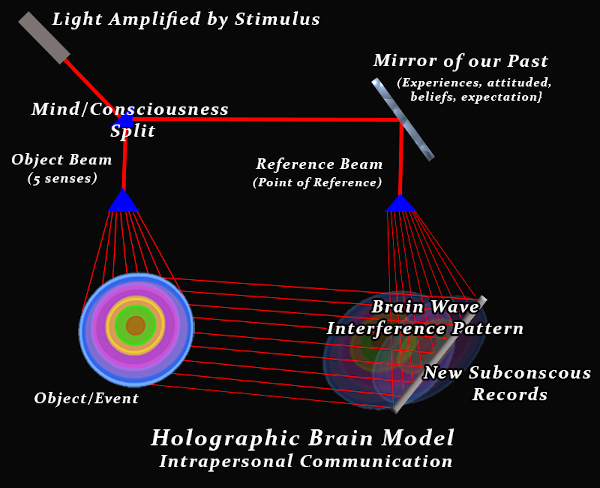
Pribram hypothesized that memory takes the form of interference patterns similar to those of holograms produced by a laser.
Pribram suggested that cognition involved electrical oscillations in the delicate fibers of the dendritic web, which are different from the more commonly known action potentials of axons and synapses.
In other words, the space between the neurons — and not the neurons themselves —was responsible for consciousness.
Pribram hypothesized that the fluctuations of brainwaves riding on gray matter, glial cells, and the synapto-dendritic web “create interference patterns in which memory is encoded naturally, and the waves may be analyzed by a Fourier transform.”
And remember, with a hologram,any part of it with sufficient size contains the whole of the stored information.
In
this theory, a piece of a long-term memory is similarly distributed
over a dendritic arbor so that each part of the dendritic network
contains all the information stored over the entire network.
This
structuring of the brain provides the capability of responding to
stimuli without specialized and constrained paths of nerve conduction.
Instead,
the brain operates as a general purpose computer with built-in
redundancy, each part receiving information about the whole and
performing a specific computation on it — at all scales.
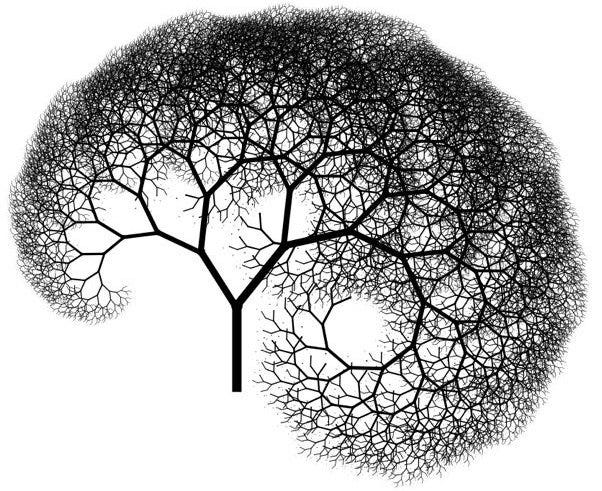
Like
many structures found in nature, the brain’s architecture is fractal.
And perhaps it follows that the algorithm is as well. Consciousness
itself.
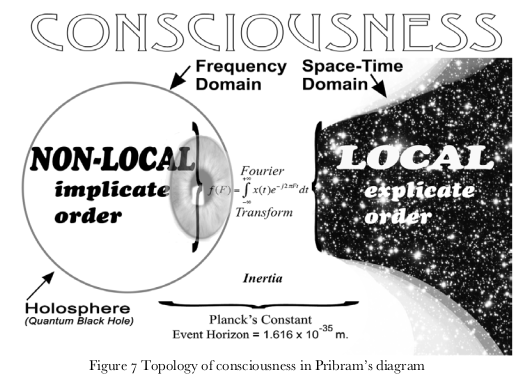
In this model, consciousness is expressed by a Fourier transform between the frequency and space-time domains of reality. It’s what reveals the available degrees of freedom with respect to the past and the future —in essence, it’s a function to decide what to pay attention to.
But ultimately, consciousness is really the platform for making a choice. A multi-dimensional awareness of and response to the environment. The basis for an informed decision, at any scale.
Perception,
then, is the re-construction of the hologram, a momentary collapse of
the wave-function into an explicate order. The filtering and focusing of
attention predicated on the past and future.
Perception is the simulation.
The
electrical signals of the nervous system are the read-write interface
to the hologram. And consciousness is what illuminates the choices
available now, in the present — focusing our attention — distorted and myopic as it may be.
Holographic Associative Memory
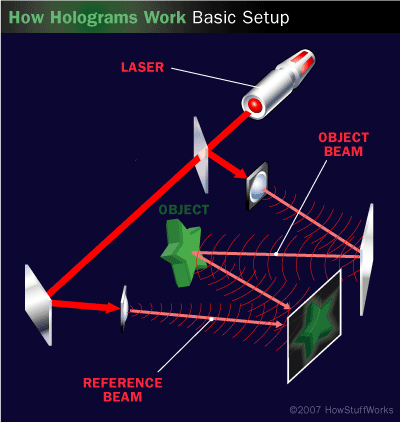
In
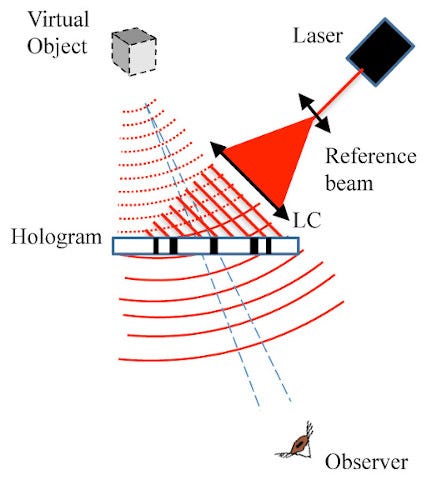
the typical operation of holograms, we shine a reference beam on a
holographic film to re-construct the visual image of the object beam,
thereby observing a virtual image in the reflected light.
And
in theory, we can also reverse the procedure, using the object beam to
illuminate the hologram, re-creating the original reference beam.
The light itself.
In
this dual mode of operation, a holographic associative memory —HAM, for
short— is a form of data storage where information from the object beam
and reference beam can be saved and retrieved by associating them with
one another in interference patterns. Each part of the pattern contains
them both, and each can be used to retrieve the other.
Experimental setup for a 3D holographic storage network
In other words, a hologram with a read-write interface.
HAM
is part of the family of analog, correlation-based, associative,
stimulus-response memories, where information is mapped onto the phase
orientation of complex numbers operating on a Riemann surface.
It can be considered as a complex valued artificial neural network.
The HAM also exhibits some remarkable characteristics, as it has been shown to be effective for associative memory tasks, generalization, and pattern recognition with changeable attention.
And the ability of dynamic search localization
is central to natural memory. For example, in visual perception, humans
always tend to focus on some specific objects in a pattern. Humans can
effortlessly change the focus from object to object without requiring
relearning.
HAM provides a computational model which can mimic this ability by creating a representation for focus
Stimulus-response associations are both learned and expressed in one non-iterative transformation. No backpropagation of error terms or iterative processing required.
The method forms a non-connectionist model
in which the ability to superimpose a very large number of
stimulus-response patterns or complex associations may be superimposed
or “enfolded” on a single neural element.
The generated phase angle communicates response information, andmagnitude communicates a measure of recognition (or confidence in the result).
The process permits a capability with neural system to establish dominance profile of stored information, thus exhibiting amemory profileof any range — from short-term to long-term memory.
The process follows the non-disturbance rule, that is prior stimulus-response associations are minimally influenced by subsequent learning.
The information is presented in abstract form by a complex vector which may be expressed directly by a waveformpossessing frequency and magnitude. This waveform is analogous to electro-chemical impulses believed to transmit information between biological neuron cells.
To the point, the universe is a HAM and the brain is it’s tuner.
dtic.mil | The natural evolution of Man is finished now, within the lifetime of the average reader. The fifth stage of planetary evolution of life is the final stage of evolution by natural selection. Thus, any "next step" in evolution must be taken technologically by the species itself if it is to be taken at all. Any such step to a sixth stage of evolution must paradoxically involve the reimposition of a sort of positive internal control, somehow without giving up genetic deprogramming.
The fact that rigid and foolproof control must be established to eliminate destructive competition, while at the same time genetic control must remain relinquished if intelligence is to be retained, is the precise, contradictory, solitary human problem. It is this hard nut that all systems, organizations, governments, societies, sciences, theorists, religious leaders, meglomaniacs, dictators, portificators, and well-meaning but ignorant visionaries and humanitarians have failed to chew and swallow since time immemorial. The usual solution advanced is this. "If everyone would just be a perfect citizen, behave ideally, and love and help everyone else always, then the problem would be solved."
Any fool will agree with that; the proposition is incredibly naive and a tautology. The question is, "How, pray tell, can one get all persons to be perfect?" Law, logic, philosophy, creed, religion, practice, love, sacrifice, money, the ballot, and the bullet -- all of these have empirically proven that they cannot solve the human problem for all humanity. Since none of the solutions advanced to date can solve the problem, we must discard them all and search for a new approach. And a Teilhardian solution indeed emerges if one ponders diligently. The solution can be synthesized into two parts: each individual human must possess an internal mechanism for generating appropriate limits to personal behavior, and there must exist a totally reliable external process to implant or induce the internal mechanism. And one would also hope for the "maximum individual freedom within the constraints of minimum essential inter-individual control."
The only viable solution is to link the brains of all men into one giant superbraln. it is the entire species which has been developing, and it is the entire species which now must be linked into one superbeing. Jung's collective unconscious must acquire a single integrated consciousness, instead of the fragmented billions it now possesses. Each mancell must function individually within its own sphere, but in intermancell harmony under the control of a single linked-species nervous
system.
This linkage must b6 accomplizhed technologically by creating and installing a system of direct communication links between all men's individual brains. A most curious phenomenon occurs whenever two nervous system brains are directly linked together so that each can perceive no temporal delay between the two; the engs, egos, and personalities o: the two brains integrate and merge into one being, one ego, and one personality. Thus linkage admirably ends the destructive competition between the formerly separated brains.
E.g., suppose you and I have linked our brains. If I am you and you are me, then "we" shall find it impossible to disadvantage "each other" since "we" and "each other" no longer exist. I.e., only one "I" remains in the two linked brains, integrated in both of them. So the "one" cannot kill the "other" because no "other" any longer separately exists.
In fact, absolute proof of the "single-being" identity of two linked brains unequivocally exists. The human brain (cerebrum) is composed of left and right hemispheres, completely separated except for a thick connecting cable of nerve fibers called the corpus callosum. Essentially the left cerebral hemisphere controls the right side of the body and the right cerebral hemisphere controls the left side of the body. With two brains in charge, one half (usually the left) almost always dominates, and each of the two halves specializes. However, signals from one half are immediately transmitted to the second half, preventing the second half from detecting any difference or time delay between itself and the primary half. I.e., the second half gets an immediate "wiggle" and perceives that it, the second half, originated the wiggle,
When consciousness can perceive no difference, identity results, just as separate movie frames appear continuous (each two appear one) when flashed at 22 framres per second. Thus in one's own body, two brains are integrated into one functional brain and one perceptual personaliLy. There is no conscious separation of the two brain hemispherical perceptions, and one consciously is aware of only one being or continuity, himself. In humans whose corpus callosums have been severed, the two brains exhibit separate consciousnesses and separate "personalities."
The photon interaction, however, constitutes a
time-differentiating operation imposed upon 4-dimensional Minkowskian
reality (which is unperceived reality), producing three-dimensional, objective, determined, past reality.
Photon absorption
constitutes dimensional differentiation of reality, while photon
emission constitutes dimensional integration. Objective concepts have
been developed in correspondence to the photon interaction.
In the two-slit experiment, the electron is
4-dimensional, not 3-dimensional. When shielded against the photon
interaction, it remains four-dimensional, possessing its time dimension, and capable of interacting in a time-like manner.
By wavelength one refers inversely to a time interval.
Synchronization
of time intervals between slit dimensions and electron
wavelength results in time interaction between the electron’s time
dimension and the time dimension of the two slits . Thus the electron
interacts with both slits if shielded against the
photon interaction, and time waves are propagated forward from both
slits. If the slits are made much larger, time synchronization is
destroyed and the classical effect reappears . If the photon interaction
is imposed upon the electron, it is time-differentiated
and becomes a classical object , having lost its time dimension.
When the electron encounters the screen, it meets a
region of randomly varying time oscillations of the orbital electrons
around the individual atoms comprising the screen . Thus the exact
location of the orbital electron in the screen
which will first precisely time-synchronize with the electron
wavelength reciprocally is a random choice , and the “place” where the
electron hits the screen is randomly selected along the screen, when the
electron is four dimensional. The time pattern of
the 4-d electron , however, had a distribution induced by its previous
time interaction with the two slits . The pattern of this time
distribution is wavelike, and is recovered when the distribution of the
number of electron hits per screen length (which
involves cumulation over time) is plotted .
Thus the two-slit experiment can be explained once
the fourth law of logic is comprehended , and once the dimensionality of
the electron and other parts of the experimental apparatus are taken
into account.
The author points out that ordinary instruments
and devices can be made to process entities in the unseparated state
(multi-ocular state) , as demonstrated by the two-slit apparatus itself .
Some consequences of this fact are mentioned, and the author refers to a basic mechanism he has proposed for the deliberate and controlled violation of objective reality
.
Free To A Good Home
-
I know what gooning is same as I know what felching is but I don't care to
remind myself all that often about it. The Internet just keeps exposing the
ni...
If Free Will Is False, Destiny Is True
-
Free will is like God: perhaps dead, its absence having something to say
about morality (what Nietzsche meant by “Gott ist tot” was that the
Christian God ...
FREE BOOK: On Nonviolence
-
“Michael Barker’s interrogation of nonviolent protest tactics and regime
change is both timely and important. Drawing on cases ranging from American
democr...
Return of the Magi
-
Lately, the Holy Spirit is in the air. Emotional energy is swirling out of
the earth.I can feel it bubbling up, effervescing and evaporating around
us, s...
Covid-19 Preys Upon The Elderly And The Obese
-
sciencemag | This spring, after days of flulike symptoms and fever, a man
arrived at the emergency room at the University of Vermont Medical Center.
He ...
-
(Damn, has it been THAT long? I don't even know which prompts to use to
post this)
SeeNew
Can't get on your site because you've gone 'invite only'?
Man, ...
First Member of Chumph Cartel Goes to Jail
-
With the profligate racism of the Chumph Cartel, I don’t imagine any of
them convicted and jailed is going to do too much better than your run of
the mill ...