Saturday, June 19, 2021

Davos Is Dead And I Have Embraced Islam...,

FT  |   Felix Marquardt, a former global schmoozer and current author of The New Nomads, explains why attempting to solve the world’s problems up a Magic Mountain in Switzerland over the course of a few short days, is a quick fix that does more harm than good. 

 A few weeks ago, the World Economic Forum (WEF) pulled the plug on its gathering in Singapore in August. The reasons invoked by the organisers for this third cancellation (plans for an alternative, exceptional meeting in Lucerne in May were also scrapped earlier this year) centred around health concerns and logistics. The truth is more complex and the malaise runs deeper. 

The pandemic has exposed the contradictions of the WEF as a project and its terminal lack of legitimacy and credibility in the post-Covid era. My inkling as an addict in recovery, is that the organisers are unable to come to terms with this because, just like others in the throes of active addiction, they are in denial. 

 I used to be a senior adviser to a number of global leaders and a Davos cheerleader. I also used to do a lot of drugs. I had my last drink and drug seven years ago. At the height of my substance abuse, I thought I couldn’t possibly be an alcoholic or an addict. Addicts were people shooting up on park benches or sucking on glass pipes in crack houses. I was flying around the world in business class, living in five star palaces, working for heads of state (including dictators), people running for office (including aspiring dictators) and CEOs of some of the world’s largest multinationals. 

A few years into recovery, I came to a different realisation: I had flourished in Davos and in other global circles of power not in spite of my being an addict, but in no small part because I was one. The high which proximity with power, fame and wealth fuelled in me wasn’t that different from the high I felt when I did drugs. So what do my experiences say about others in the WEF circus? 

The pandemic has sparked a global existential crisis in many of us, including pillars of the Davos establishment. It has been about recognising, belatedly, that what we’ve been calling “normal” is a form of civilisational suicide. Many of us are coming to terms with the fact that we don’t know how to decorrelate greenhouse gas emissions from economic growth and that the phrase green growth is, for now and the foreseeable future, an oxymoron. In a world where about 50 per cent of greenhouse gas emissions are produced by the 10 per cent wealthiest humans — those of us who earned not millions but $38,000 or more in 2015 — the climate crisis is fundamentally an inequality crisis. 

Yet from its inception, the WEF has hence been engaged in an exercise of contortion to not have a meaningful conversation on growth. It has since then been paid hundreds of millions, if not billions of dollars (governed by Swiss law, the finances of the WEF are frighteningly opaque) by entities whose shareholders are eager to avoid it. If we have indeed become addicted to carbon, growth and extraction, the techno-utopian verbiage which has become the lingua franca of Davos has become a liability. 

The author Lewis Hyde once wrote that the spread of alcoholism happens when a culture is dying. A healthy, functioning culture turns its children into grown-ups. Addicts in contrast are defined by Jung’s characterisation of the puer aeternus. That prism of addiction helps explain our culture’s childish “solutionism”. Like addicts in recovery who get a daily reprieve but are never “cured”, what we are dealing with are predicaments not problems. Problems, like the equations schoolchildren are asked to solve, have solutions. In contrast, you can respond to predicaments in a more or less constructive and healthy way but they cannot be solved. You have to live with them. 

The current, dominant, “feelgood” approach mirrors that of an addict, in recovery but secretly hoping that they will one day be able to “manage” their substance use. The Davos crowd seek quick fixes, takeaways, action points and deliverables, rather than dwelling on the thoroughly uncomfortable reality of our condition, for fear of going into depression or becoming paralysed by inertia. The sooner that is ditched, the better. “The highest form of hope,” the French author George Bernanos once wrote, “is despair overcome.” But to overcome it, you first need to go through the despair. You need to hit rock bottom.

Friday, June 18, 2021

Meanwhile: America's 50 Largest Inherited Wealth Dynasties Became Permanent and Invincible...,

commondreams |  A new report from the Institute for Policy Studies (IPS) finds that the U.S. continues to suffer from the extreme and growing wealth and power of inherited-wealth family dynasties – and the growth of their extreme wealth accelerated during the pandemic. 

The report, “Silver Spoon Oligarchs: How America’s 50 Largest Inherited-Wealth Dynasties Accelerate Inequality,” tracked the 50 wealthiest families from 1983 to 2020 using data from Forbes. IPS researchers found that by 2020, the 50 families had amassed $1.2 trillion in assets. For the 27 families on the Forbes 400 list in 1983, their combined wealth had grown by 1,007 percent and for the five wealthiest dynastic families, their wealth increased by a median 2,484 percent during 37 years. The Walton family led the pack with an increase of 4,320 percent, while the Mars candy family saw its wealth increase 3,517 percent.

“When we focus on the surging fortunes of first-generation billionaires – and their shocking tax avoidance – we forget to look at the troubling growth of dynastic families and the changes in tax policies that will enable the children of today’s billionaires to become tomorrow’s oligarchs,” said Chuck Collins, co-author of the report and author of the new book, The Wealth Hoarders: How Billionaires Pay Millions to Hide Trillions

“In a healthy democratic society with a functioning tax system, wealth disperses over decades as people have children, pay their taxes, and give to charity.  But with a weak tax system on wealth – as confirmed by the recent leak showing low billionaire taxes – we are now seeing wealth accelerate over generations, leading to consolidated wealth and power,” he said.

The report finds that inherited wealth dynasties are growing due to an inadequate tax system, excessive hiding of wealth in dynasty trusts, and low charitable giving by multi-generational wealth dynasties. It also finds that members of the inherited wealth generation are using their wealth and power to rig the rules to get more wealth and power. Some are even using their charitable donations and political giving to press for lower taxes.

Other key findings from the report include:

  • Dynastic wealth grows much faster than the wealth of ordinary families. The 27 families who were on the Forbes 400 list in 1983 had a median increase in their net worth, adjusted for inflation, of 904 percent over those 37 years. In contrast, between 1989 and 2019—the most recent year available—the wealth of the typical family in the U.S. increased by just 93 percent in inflation-adjusted dollars.

  • The wealth of the very top grew even faster. The five wealthiest dynastic families in the US have seen their wealth increase by a median 2,484 percent from 1983 to 2020. For example:

    • In 1983, Wal-Mart founder Sam Walton and his children were worth just $2.15 billion (or $5.6 billion in 2020 dollars). By the end of 2020, Walton’s descendants had a combined net worth of over $247 billion, an inflation-adjusted increase of 4,320 percent.

    • The Mars candy dynasty has seen its wealth increase 3,517 percent over the past 37 years, from $2.6 billion in 1983 (in 2020 dollars) to $94 billion by 2020. The Mars family also stands out for the miniscule amount of money they have stored in family foundations—$48 million as of 2018—in contrast to the large sums they have spent on public policy advocacy to change tax laws. 

    • Cosmetics magnate Estée Lauder and her descendants have seen their wealth grow from just $1.6 billion in 1983 (in 2020 dollars) to $40 billion in 2020. This is a growth rate of 2,465 percent. A hefty portion of that growth has come in just the past five years: the Lauder family’s assets have grown 119 percent since 2015, for an average growth rate of 16.9 percent each year.

  • Dynastic wealth is persistent and consolidating. Of the 20 wealthiest families on the list in 2020, 13 were already in the top 20 in 1983. Only 4 of the top 20 wealth dynasties are new to the list since 1983.

  • Wealth for dynastic families has grown significantly during the COVID-19 pandemic. Since the start of the pandemic in March 2020, the top 10 families on the Forbes dynasty list have had a median growth in their net worth of 25 percent.

  • Dynastically wealthy families wield a great deal of political power, and use it to further their interests. The report profiles dynastic family members who spend millions lobbying for favorable tax, labor, and trade policies, give to candidates, campaigns and PACs, serve on policy advisory boards; and even serve in government themselves. For example, members of the Busch, Mars, Koch, and Walton families have together spent more than $120 million over the past ten years on lobbying directly for tax, labor, and trade policies favorable to their businesses and investments.

  • Dynastic families exploit their philanthropic power too, through charities and foundations. The report examined more than 248 foundations set up by the top 50 families, housing more than $51 billion in assets. While many move much-needed revenue to broader public interest charities, others fund groups working to reduce taxes on the wealthy and roll back regulations that constrain corporate profits. Some funnel millions to donor-advised funds, which can fund dark-money political advocacy. And in a few cases, family members have used them to compensate themselves.

The report profiles all of the 50 families, including the Waltons, the Kochs, the Mars family, and many others, some well-known and some relatively unknown. The report explains the dangers from the extreme consolidation of dynastic wealth and power.

The Collapse Crime Epidemic Has Only Just Begun

cbsnews  |  Even as the nation rebounds from the coronavirus pandemic, more than 2 million homeowners are behind on their mortgages and risk being forced out of their homes in a matter of weeks, a new Harvard University housing report warns.

Most of the homeowners at risk of foreclosure are either low-income or families of color, said researchers who published the 2021 State of the Nation's Housing report. Congress has dedicated $10 billion to help homeowners get caught up on payments, but it's unclear if that funding will make it to families before mortgage companies begin sending out foreclosure notices, researchers say.

Separately, millions more renters are "on the brink of eviction," the Harvard researchers found. Census data show that 6 million households are still behind on rent and could face eviction at the end of June, when federal eviction protections expire. 

The Center for Disease Control order halting some evictions, and federal liminations on foreclosures for federally-backed housing, both expire on June 30. Housing advocates have pushed for the Biden administration to extend both, but there is no indication an extension will happen.

"With so many renters in financial distress, there are concerns about an impending wave of evictions," the Harvard report said.

More than 7 million homeowners took advantage of the foreclosure moratorium passed as part of the Coronavirus Aid, Relief and Economic Security Act last spring. The provision was later extended by the Biden White House. As of March 2021, most of those homeowners have started repaying lenders and some are even up to date with their lenders. But that leaves about 2.1 million still behind on their mortgages, researchers said.

American Cities Face A Collapse Crime Epidemic

NYTimes |  Most city leaders, eager to rejuvenate downtown economies, have lifted coronavirus restrictions. But rising violent crime has kept both residents and tourists at home.

Mayors of American cities have yearned for the moment they could usher in a return to normalcy, casting away coronavirus restrictions on bars, restaurants, parties and public gatherings.

Yet now, even with reopenings underway across the United States as the pandemic recedes, city leaders must contend with another crisis: a crime wave with no signs of ending.

They are cheerleading the return of office workers to downtowns and encouraging tourists to visit, eager to rejuvenate the economy and build public confidence. But they are also frantically trying to quell a surge of homicides, assaults and carjackings that began during the pandemic and has cast a chill over the recovery.

In Austin, Texas, for example, 14 people were injured early Saturday morning in a mass shooting as revelers jammed a popular downtown nightlife district.

Some city officials have touted progressive strategies focused on community policing in neighborhoods where trust between police officers and residents has frayed. Others have deployed more traditional tactics like increasing surveillance cameras in troubled areas and enforcing curfews in city parks to clear out crowds, as the police did in Washington Square Park in Manhattan in recent days.

In Chicago, which fully reopened on Friday, Mayor Lori Lightfoot made clear that her focus was on reducing violence over the summer, and that her administration would focus resources on 15 high-crime pockets of the city as part of that effort.

“We owe it to all of our residents, in every neighborhood, to bring peace and vibrancy back,” Ms. Lightfoot said.

Thursday, June 17, 2021

The American Economy Runs On Poverty And Precarity

NYTimes |  This is the conversation about poverty that we don’t like to have: We discuss the poor as a pity or a blight, but we rarely admit that America’s high rate of poverty is a policy choice, and there are reasons we choose it over and over again. We typically frame those reasons as questions of fairness (“Why should I have to pay for someone else’s laziness?”) or tough-minded paternalism (“Work is good for people, and if they can live on the dole, they would”). But there’s more to it than that.

It is true, of course, that some might use a guaranteed income to play video games or melt into Netflix. But why are they the center of this conversation? We know full well that America is full of hardworking people who are kept poor by very low wages and harsh circumstance. We know many who want a job can’t find one, and many of the jobs people can find are cruel in ways that would appall anyone sitting comfortably behind a desk. We know the absence of child care and affordable housing and decent public transit makes work, to say nothing of advancement, impossible for many. We know people lose jobs they value because of mental illness or physical disability or other factors beyond their control. We are not so naïve as to believe near-poverty and joblessness to be a comfortable condition or an attractive choice.

Most Americans don’t think of themselves as benefiting from the poverty of others, and I don’t think objections to a guaranteed income would manifest as arguments in favor of impoverishment. Instead, we would see much of what we’re seeing now, only magnified: Fears of inflation, lectures about how the government is subsidizing indolence, paeans to the character-building qualities of low-wage labor, worries that the economy will be strangled by taxes or deficits, anger that Uber and Lyft rides have gotten more expensive, sympathy for the struggling employers who can’t fill open roles rather than for the workers who had good reason not to take those jobs. These would reflect not America’s love of poverty but opposition to the inconveniences that would accompany its elimination.

Nor would these costs be merely imagined. Inflation would be a real risk, as prices often rise when wages rise, and some small businesses would shutter if they had to pay their workers more. There are services many of us enjoy now that would become rarer or costlier if workers had more bargaining power. We’d see more investments in automation and possibly in outsourcing. The truth of our politics lies in the risks we refuse to accept, and it is rising worker power, not continued poverty, that we treat as intolerable. You can see it happening right now, driven by policies far smaller and with effects far more modest than a guaranteed income.

GottDAYYUM..., Investment Firms Buying Up Trailer Parks Too!!!

newyorker |   One day in October, 2016, Carrie Presley was visiting her boyfriend, Ken Mills, when she received a phone call from a neighbor informing her that someone had just been shot outside her home. Presley lived with her seventeen-year-old daughter, Cheyenne, in a two-story clapboard house on Jackson Street, in the northern part of Dubuque, Iowa. The neighborhood was notorious for its street crime, and Presley, who was, as she put it, in “the housing community”—she received Section 8 housing vouchers—had grown used to the shootings and break-ins that punctuated life there. After talking to Cheyenne, who was in tears, Presley rode with Mills back to her house, where police were sweeping the perimeter of the property. As Presley recalled, Mills looked at her and said, “We’re not doing this anymore.” It was decided that Presley and Cheyenne would move in with Mills and his son Austin.

Mills, a long-haul truck driver and the father of four grown children, lived in a three-bedroom single-wide in the Table Mound Mobile Home Park, a quiet community of more than four hundred mobile homes arranged in a tidy grid. The homes in the park are not as portable as its name implies; they’ve been placed on foundations, and their hitches have been removed. From afar, they look a little like shipping containers sitting next to small rectangular lawns. In Iowa, park owners can choose whether to accept Section 8 vouchers—which are distributed to 5.2 million Americans—and many, including the owner of Table Mound, do not, citing the administrative burden. By moving, Presley would lose her government subsidy, and she and Cheyenne would have less space, but, as Presley told me, “I was sacrificing material goods for a sense of safety.” She and Cheyenne held a garage sale, and watched as their neighbors walked away with the kitchen table, a dresser, armoires, and most of their clothes.

In the U.S., approximately twenty million people—many of them senior citizens, veterans, and people with disabilities—live in mobile homes, which are also known as manufactured housing. Esther Sullivan, a sociologist at the University of Colorado Denver, and the author of the book “Manufactured Insecurity: Mobile Home Parks and Americans’ Tenuous Right to Place,” told me that mobile-home parks now compose one of the largest sources of nonsubsidized low-income housing in the country. “How important are they to our national housing stock? Unbelievably important,” Sullivan said. “At a time when we’ve cut federal support for affordable housing, manufactured housing has risen to fill that gap.” According to a report by the National Low Income Housing Coalition, there isn’t a single American state in which a person working full time for minimum wage can afford a one-bedroom apartment at the fair-market rent. Demand for subsidized housing far exceeds supply, and in many parts of the country mobile-home parks offer the most affordable private-market options.

In the past decade, as income inequality has risen, sophisticated investors have turned to mobile-home parks as a growing market. They see the parks as reliable sources of passive income—assets that generate steady returns and require little effort to maintain. Several of the world’s largest investment-services firms, such as the Blackstone Group, Apollo Global Management, and Stockbridge Capital Group, or the funds that they manage, have spent billions of dollars to buy mobile-home communities from independent owners. (A Blackstone spokesperson said, “We take great pride in operating our communities at the highest standard,” adding that Blackstone offers “leading hardship programs to support residents through challenging times.”) Some of these firms are eligible for subsidized loans, through the government entities Fannie Mae and Freddie Mac. In 2013, the Carlyle Group, a private-equity firm that’s now worth two hundred and forty-six billion dollars, began buying mobile-home parks, first in Florida and later in California, focussing on areas where technology companies had pushed up the cost of living. In 2016, Brookfield Asset Management, a Toronto-based real-estate investment conglomerate, acquired a hundred and thirty-five communities in thirteen states.

Canada Too..., We'll Rent You What We've Made It Impossible For You To Buy!!!

thestar |   A Toronto-based condo developer’s plan to buy $1 billion worth of single-family homes and use them as rental properties has sparked outrage from critics who say it’s an example of how corporations can profit from the country’s housing crisis.

Core Development Group, which develops and manages a wide range of real estate projects across Canada, said it plans to build a far-reaching single-family home rental business that will consist of 4,000 rental units in Ontario, Quebec, B.C. and Atlantic Canada.

The plan, first reported by the Globe and Mail, will target eight cities in Ontario — including Hamilton, London, Kingston, St. Catharines, Barrie, Peterborough, Cambridge and Guelph — before expanding outside Ontario by 2026.

Critics say the strategy mimics similar moves by American corporations in the aftermath of the 2008 financial crisis that bought swaths of housing stock and rented units to tenants while keeping the equity.

It’s called the ‘financialization’ of housing — where corporations and financial markets treat housing as a vehicle for wealth and investment rather than a social necessity, often to the detriment of individual homebuyers, says John Pasalis, president of Realosophy Realty.

“It’s hard enough for first-time homebuyers to get into the market. Now, they’re competing with billion-dollar investors who are just buying properties to rent them out, in a market where we’re not building enough single-family homes to begin with,” said Pasalis.

Real estate prices have soared during the pandemic, driven in part by low interest rates and rising demand. Toronto home prices jumped almost 30 per cent in May, to $1.11 million, while smaller cities and rural areas have seen increases as high as 50 per cent in one year.

Housing advocates have pointed to a critical lack of supply in single-family dwellings, forcing homebuyers to fight over the limited stock available while prices inflate. This problem is exacerbated, they say, by corporations that reduce the remaining supply by buying up homes and converting them to rentals.

“It’s wrong on all possible levels. It takes more properties out of our inventory, and can only do harm to an already-tight supply,” said Ron Butler, a mortgage broker with Butler Mortgage.

In an interview with the Star, Core founder Corey Hawtin defended the plans to purchase single-family homes, saying that the company is buying far less than one per cent of the homes that trade in the Ontario market on a yearly basis.

Wednesday, June 16, 2021

America Is Designed To Incentivize Crime At The Highest Levels

nakedcapitalism |  In America you always had two systems of justice, but it’s particularly bad right now. So it’s just like if you commit fraud, if murder people, as long as you do it with a spreadsheet, you get a bonus instead of a jail sentence. And I think that’s a crisis. It is also the crisis that we’re dealing with, with big tech. It is the crisis… Mark Zuckerberg and Facebook, they have been caught for fraud multiple times, lying to advertisers, lying to publishers knowingly to induce more spending on Facebook. There are multiple consent decrees with the Federal Trade Commission. It’s similar with the other firms as well. They routinely lie, commit perjury and whatnot. And that’s kind of like a legacy of this policy framework and ideological framework that we inherited from the Bush administration and the Obama administration of simply not enforcing the rule of law against the powerful.

So that’s I think the dynamic that we’re dealing with today and it’s across every sector of the economy, right? It’s not just opioids, it’s not just big tech, it’s kind of everywhere. And what this does is two things. When you have effectively lawlessness for white collar elites, it both penalizes honest business people who cannot compete when they’re not willing to lie, steal and cheat. If the other guy’s allowed to lie, steal and cheat and you don’t want to do that, you lose, right? So it undermines honest business. And then it also creates a situation where criminals become the pinnacle of society. And I think we saw that with Trump, where Trump… Cy Vance who was the DA of Manhattan, a Democrat. He had them dead to rights on real estate fraud years ago, way before he was kind of in politics. And he just… Trump’s lawyer gave Cy Vance campaign money and Cy Vance didn’t bring the case.

And so if he had just brought that case, if he had said, this is a criminal act to defraud people of their money, Trump wouldn’t have been in politics, right? But because he didn’t, Trump was in politics. And I think what people saw in 2016 was, well, they’re all crooks. So I’m going to pick the guy that appeals to me. And the thing is, is that analysis, they’re all crooks, is right. They are all crooks. Not everyone obviously. But the structure of our elite society, if you look at it, it’s just designed to incentivize criminal behavior, lying, cheating, and stealing at the highest level. And that’s the reaction… We’re seeing a reaction to that and there are many different reactions to that. One of them is this sort of Trumpist reaction. Another one is kind of the Lina Khan and the FTC reaction. But that’s where our politics is right now.

And the Biden administration is kind of a transition moment, right? Just like the Trump administration was kind of a transition moment to a new kind of politics. We’re not totally sure what that’s going to be. I think that, that’s similar with the Biden ministration. It’s a transition moment to a new form of politics. And we’re a little bit unsure about whether we’re going to address this problem with the rule of law. It’s not just criminal law. It’s also antitrust law, insider trading, kind of all of finance. And you can look at SPACs, that’s just corporate behavior, insider dealing. Are we going to address that in a meaningful way? Are we going to restore equal political rights to all, or are we going to go and kind of transition sort of officially into an oligarchy and shed the vestiges of democracy that we have?

Rob Johnson:

Well, I think the fact that Donald Trump got elected in 2016 and his, if you will, bumper sticker, his credo was the system is rigid and people felt like they were hearing what they understood and it appealed to them out of their despair or their despondency related to where the system was. And I would say what’s perhaps hopeful now is after four years of Donald Trump and the January 6th insurrection, some of the people in power are afraid of going back to that, to a repeat performance. And while they may be under the same pressures, money and politics and enforcements and revolving doors for senior public officials enticed what you might call to not enforce or to enforce and subsidize powerful interests, all of this collectively frightens elected officials that they may be sending us in the direction of an authoritarian and perhaps violent person who does not abide by any rules.

So I think that your diagnosis is exactly right, and this place, this limbo you describe with the Biden administration is fascinating. They are at what that blues singer with my name, Robert Johnson, called the crossroads. They got to choose the path. But let’s talk a little bit about… You’d said with regard to Mark Zuckerberg or others, who’s going to call out the truth here? I mean, you do, but many think tanks are tax deductible, what would you call it? Marketing institutions for power. That’s where they get their source of funding. Many institutions in the media depend on advertising. Many universities depend upon donors and wealthy alumni. And even the arts now depend on big corporate power for structure of live shows, radio promotion, visibility that inspire sales. Where does the truth come from and where does the impetus for deep structural reform in response to the despair of a Trump like return? How do you see that?

Matt Stoller:

It’s a really good question. And I think that the truth, this is going to sound cheesy, but I think that the truth lies in the heart of the public. I think the public has views about how politics works and politicians respond to those views. And you have a bunch of elite institutions, which I think are corrupt across the board. But the public kind of creates the wind. Those elite institutions are kind of like the sailboat, right? And you can put the sail in lots of different ways, but ultimately if the wind is blowing in one direction or the other, that determines what you can do more than how amazing the boat is.

But the boat is something that you can control. So you’re kind of looking at… Elites like to look at the boat and decide, should we do this thing or should we use that sail or this other mechanism? But the wind is what really matters. And I think one thing that I’ve noticed, and I think people don’t really… Particularly Democrats, they don’t want to admit it but Obama was a really bad president and it matters that he was a really bad president. That his policies-

… That he was a really bad president. He pursued policies that concentrated wealth and power into the hands of corrupt actors. Not necessarily for bad reasons. He might’ve been doing it in good faith. It’s not a personal comment on him. But the consequences of his policies were horrific, and they made us a weaker country, an angrier country, a more frustrated country. The opioid crisis exploded on his watch. And it wasn’t that the Republicans were mean to him. He had bad ideas. And he used his political power to pursue those bad ideas. He put people in like Geithner and Michael Froman and a whole bunch of others to do bad things, to offshore jobs. And they did it because they thought to bail out Wall Street, to enact a foreclosure crisis, to essentially grant amnesty for white collar executives for crime.

Geriatric Old Birds Dipping Their Felonious Bills On Capitol Hill...,

oldest |  Congress is made up of the House of Representatives and the Senate. Both houses of Congress have an age requirement: it is at least 25 years of age for the House and at least 30 years old for the Senate. While these age requirements are generally low, most members of Congress are nearly senior citizens.

This list contains current members of Congress in both the House of Representatives and the Senate. We have previously covered the Oldest Senators Ever as well as the Oldest U.S. Congressmen (House of Representatives) ever. Some of the people on this list are also on those lists as well.

As of May 2020, this list is as accurate as possible and will be updated as needed.

Eric Schmidt's Public/Private Connected Coalition Model Includes Reddit

mintpressnews |  Reddit is one of the world’s most influential news and social media platforms. The website attracted over 1.2 billion visits in April 2021 alone, making it the United States’ eighth most visited site, ahead of other leviathans like Twitter, Instagram and eBay. Now majority-owned by a much larger corporate publishing empire, Reddit is also far ahead of more established news sites, garnering three times the numbers of Fox News and five times those of The New York Times.

That is why it was so surprising that so little was made of the company’s decision to appoint foreign policy hawk Jessica Ashooh to the position of Director of Policy in 2017, at which time it was also the eight most visited site in the U.S. Ashooh, who had been a Middle East foreign policy wonk at NATO’s think tank the Atlantic Council, was appointed at around the same time that the Senate Select Intelligence Committee was demanding more control over the popular website, on the grounds that it was being used to spread disinformation. In her role as Director of Policy, she oversees all government relations and public policy for the company, in addition to managing content, product and advertising. Yet a Google search for “Jessica Ashooh Reddit” filtered between late 2016 and early 2017 (after she was appointed) elicits zero relevant results, meaning not one media outlet even mentioned the questionable appointment.

This is all the more hair-raising, given her resume as a high state official — all of which raises serious questions about the extent of collaboration between Silicon Valley and the national security state.

The Atlantic Council is the de-facto brains of the North Atlantic Treaty Organization and takes funding from the military alliance, as well as from the U.S. government, the U.S. military, Middle Eastern dictatorships, other Western governments, big tech companies, and weapons manufacturers. Its board of directors has been and continues to be a who’s who of high U.S. statespeople like Henry Kissinger, Colin Powell and Condoleezza Rice, as well as senior military commanders such as retired generals Wesley Clark, David Petraeus, H.R. McMaster, James “Mad Dog” Mattis, the late Lt. Gen. Brent Scowcroft, and Admiral James Stavridis. At least seven former CIA directors are also on the board. As such, the council chooses to represent both political wings of the national security state.

Between 2015 and 2017, Ashooh was Deputy Director of the Atlantic Council’s Middle East Strategy Task Force, working directly with and under Madeline Albright and Stephen Hadley. This is particularly noteworthy, given both these individuals’ roles in the region. As Bill Clinton’s secretary of state, Albright oversaw the Iraq sanctions and the Oil for Food Program, denounced as “genocide” by the successive United Nations diplomats charged with carrying them out. In an infamous interview with 60 Minutes, Albright casually brushed off a question about her role in the killing of half a million children, stating “the price is worth it.” Meanwhile, Hadley was deputy or senior national security advisor to the government of George W. Bush throughout the Afghanistan and Iraq invasions, surely the greatest crimes against humanity thus far in the 21st century.

Tuesday, June 15, 2021

That mRNA Spike Protein Is Very Dangerous

npr |  The largest U.S. database for detecting events that might be vaccine side effects is being used by activists to spread disinformation about COVID-19 vaccines.

Known as the Vaccine Adverse Event Reporting System, or VAERS, the database includes hundreds of thousands of reports of health events that occurred minutes, hours or days after vaccination. Many of the reported events are coincidental — things that happen by chance, not caused by the shot. But when millions of people are vaccinated within a short period, the total number of these reported events can look big.

Epidemiologists consider this database as only a starting point in the search for rare but potentially serious vaccine side effects. Far more work must be done before a cause-and-effect link can be determined between a reported health event and a vaccine.

"It's a very valuable system for detecting adverse events, but it has to be used properly," says William Moss, executive director of the International Vaccine Access Center at the Johns Hopkins Bloomberg School of Public Health. "And it's ripe for misuse."

In fact, VAERS has played a major role in the spread of misinformation about COVID-19 vaccines. The data is regularly appropriated by anti-vaccine advocates, who use the reports to claim falsely that COVID-19 vaccines are dangerous. They are aided by the fact that the entire VAERS database is public — it can be downloaded by anyone for any purpose.

"There's very little control over what can be accessed and what can be manipulated," says Melanie Smith, director of analysis at Graphika, a company that tracks vaccine misinformation online. She says that she sees VAERS data being shared across a wide variety of anti-vaccine social media channels. "I would say almost every mis- and disinformation story that we cover is accompanied by some set of VAERS data."

VAERS was established decades ago, partly in direct response to the anti-vaccine movement. In 1982, a TV documentary called DPT Vaccine Roulette aired nationwide. It was filled with unsubstantiated claims that the vaccine given at the time against diphtheria, pertussis and tetanus could lead to intellectual and physical disability.


Covid mRNA Therapeutic Mortality

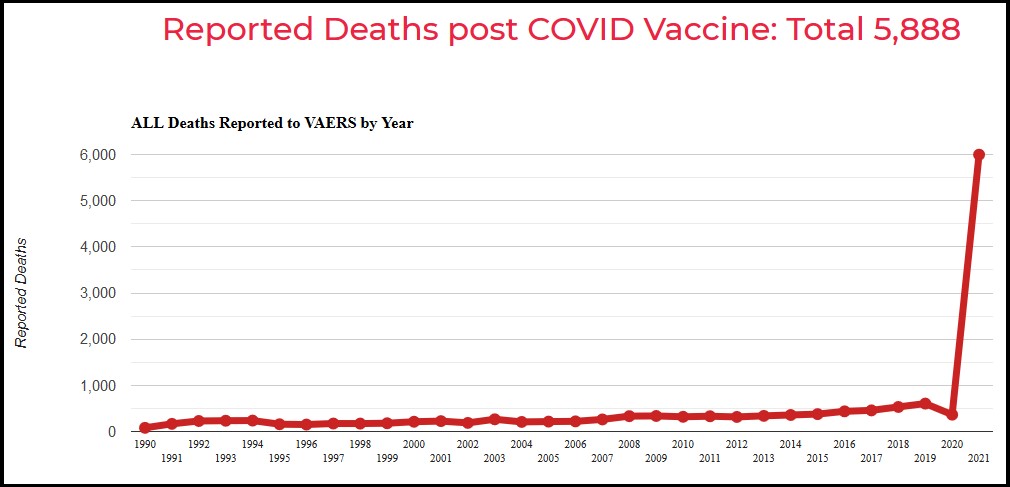
openvaers  |  According to the VAERS reporting system (within the CDC) there were 5,997 currently reported fatalities in 2021 attributed to vaccinations during the first half of this year.

Of that 5,997 number: 5,888 are directly attributed to COVID vaccinations.

Reported Deaths post COVID Vaccine: Total 5,888

U.S. District Judge Harshly Rejects Houston Nurses Compulsory Vaccination Lawsuit

Chron |  A federal judge threw out a lawsuit filed by employees of a Houston hospital system over its requirement that all of its staff be vaccinated against COVID-19.

The Houston Methodist Hospital system suspended 178 employees without pay last week over their refusal to get vaccinated. Of them, 117 sued seeking to overturn the requirement and over their suspension and threatened termination.

In a scathing ruling Saturday, U.S. District Judge Lynn Hughes of Houston deemed lead plaintiff Jennifer Bridges’ contention that the vaccines are “experimental and dangerous” to be false and otherwise irrelevant. He also found that her likening the vaccination requirement to the Nazis' forced medical experimentation on concentration camp captives during the Holocaust to be “reprehensible.”

Hughes also ruled that making vaccinations a condition of employment was not coercion, as Bridges contended.

“Bridges can freely choose to accept or refuse a COVID-19 vaccine; however, if she refuses, she will simply need to work somewhere else. If a worker refuses an assignment, changed office, earlier start time, or other directive, he may be properly fired. Every employment includes limits on the worker’s behavior in exchange for remuneration. That is all part of the bargain,” Hughes concluded.

Monday, June 14, 2021

Built To Rent Suburbs: Remember YOU Owning Nothing Is Part Of The Plan...,

WSJ |  Today, built-to-rent homes make up just over 6% of new homes built in the U.S. every year, according to Hunter Housing Economics, a real estate consulting firm, which projects the number of these homes built annually will double by 2024. The country’s largest home builders are planning for that future. Backed by banks and private investment firms, they have already bet billions on the sector, and will put down some $40 billion more during the next 18 months, Brad Hunter, founder of Hunter Housing Economics, projects. Built-to-rent subdivisions have been constructed or are under development in nearly 30 states. Taylor Morrison Home Corp. , Mr. Wood’s development partner and the nation’s fifth-largest builder, has said built-to-rent could soon become 50% of its total business. The company didn’t disclose the current share.

Homeownership is expected to decline over the next two decades—a trend that started with the generation after the baby boomers, according to the Urban Institute, a Washington, D.C., think tank that advocates for homeownership. Prices are rising faster than ever, leaving more people, including those with higher incomes, more likely to rent.

Built-to-rent subdivisions are attractive to some urban apartment renters who want to move to the suburbs but are unable or uninterested in buying a home. Many young professionals and families are less keen than their parents in being tied down by a 30-year mortgage, according to real-estate analysts, builders and tenants. They want the flexibility of renting and the freedom that comes with being able to pick up and leave after a lease. As they age, they may want the yard, garage, good schools and roomy basement, without the headaches of mowing that yard or buying a new motor when the garage door breaks.

Built-to-rent subdivisions are attractive to some urban apartment renters who want to move to the suburbs but are unable or uninterested in buying a home. Many young professionals and families are less keen than their parents in being tied down by a 30-year mortgage, according to real-estate analysts, builders and tenants. They want the flexibility of renting and the freedom that comes with being able to pick up and leave after a lease. As they age, they may want the yard, garage, good schools and roomy basement, without the headaches of mowing that yard or buying a new motor when the garage door breaks.

What The Whole And Entire F__k?!?!?!

centerforhealthsecurity |  The Center’s SPARS Pandemic exercise narrative comprises a futuristic scenario that illustrates communication dilemmas concerning medical countermeasures (MCMs) that could plausibly emerge in the not-so-distant future. Its purpose is to prompt users, both individually and in discussion with others, to imagine the dynamic and oftentimes conflicted circumstances in which communication around emergency MCM development, distribution, and uptake takes place. While engaged with a rigorous simulated health emergency, scenario readers have the opportunity to mentally “rehearse” responses while also weighing the implications of their actions. At the same time, readers have a chance to consider what potential measures implemented in today’s environment might avert comparable communication dilemmas or classes of dilemmas in the future.

The self-guided exercise scenario for public health communicators and risk communication researchers covers a raft of themes and associated dilemmas in risk communications, rumor control, interagency message coordination and consistency, issue management, proactive and reactive media relations, cultural competency, and ethical concerns. To ensure that the scenario accounts for rapid technological innovation and exceeds the expectations of participants, the Center’s project team gleaned information from subject matter experts, historical accounts of past medical countermeasure crises, contemporary media reports, and scholarly literature in sociology, emergency preparedness, health education, and risk and crisis communication.

The scenario is hypothetical; the infectious pathogen, medical countermeasures, characters, news media excerpts, social media posts, and government agency responses are entirely fictional.

Project team lead: Monica Schoch-Spana, PhD

Project team: Matthew Shearer, MPH; Emily Brunson, PhD, associate professor of anthropology at Texas State University; Sanjana Ravi, MPH; Tara Kirk Sell, PhD, MA; Gigi Kwik Gronvall, PhD; Hannah Chandler, former research assistant at the Center

Date completed: October 2017

Resources:

Finally, A Way To Privatize Public Housing - The Strings Attached Should Be Most Interesting

sacbee |  To fund the program, a “state-sponsored corporation” would make a one-time deposit using available dollars into a “new revolving fund.”

The state would then sell shares to investors to generate new revenue. As home values increase, so would the fund’s value, the Democrats say.

There is a chance that private companies and investors would replace the state-sponsored corporation to finance the fund, the plan’s blueprint includes. The state would provide tax incentives to inspire investment. The Democrats’ proposal states that the investors would help keep costs to the state low.

“So, Win-Win-Win,” the Democrats’ announcement reads. “Win #1 – homebuyers that can now afford a home and can thrive in the middle class and begin to build wealth; Win #2 – investors that get to protect and build their wealth by investing in California real estate; and Win #3 – California taxpayers and state budget that will face only minimal new costs.”


Read more here: https://www.sacbee.com/news/politics-government/capitol-alert/article250735029.html#storylink=cpy

Is There Nothing These Oxygen-Thieving Maggots Won't Parasitize?

WSJ  |  A bidding war broke out this winter at a new subdivision north of Houston. But the prize this time was the entire subdivision, not just a single suburban house, illustrating the rise of big investors as a potent new force in the U.S. housing market.

D.R. Horton Inc. DHI 1.01% built 124 houses in Conroe, Texas, rented them out and then put the whole community, Amber Pines at Fosters Ridge, on the block. A Who’s Who of investors and home-rental firms flocked to the December sale. The winning $32 million bid came from an online property-investing platform, Fundrise LLC, which manages more than $1 billion on behalf of about 150,000 individuals.

The country’s most prolific home builder booked roughly twice what it typically makes selling houses to the middle class—an encouraging debut in the business of selling entire neighborhoods to investors.

“We certainly wouldn’t expect every single-family community we sell to sell at a 50% gross margin,” the builder’s finance chief, Bill Wheat, said at a recent investor conference.

From individuals with smartphones and a few thousand dollars to pensions and private-equity firms with billions, yield-chasing investors are snapping up single-family houses to rent out or flip. They are competing for houses with ordinary Americans, who are armed with the cheapest mortgage financing ever, and driving up home prices.

“You now have permanent capital competing with a young couple trying to buy a house,” said John Burns, whose eponymous real estate consulting firm estimates that in many of the nation’s top markets, roughly one in every five houses sold is bought by someone who never moves in. “That’s going to make U.S. housing permanently more expensive,” he said.

The consulting firm found Houston to be a favorite haunt of investors who have lately accounted for 24% of home purchases there. Investors’ slice of the housing market grows—as it does in other boomtowns, such as Miami, Phoenix and Las Vegas—among properties priced below $300,000 and in decent school districts.

“Limited housing supply, low rates, a global reach for yield, and what we’re calling the institutionalization of real-estate investors has set the stage for another speculative investor-driven home price bubble,” the firm concluded.


Sunday, June 13, 2021

AG Merrick Garland Vows To Get Leakers Of Sacred Billionaire Tax Information

cracked |  On today's installment of our government undoubtedly having their priorities perfectly in check, newly-minted Attorney General Merrick Garland promised legislators that investigating the source of the alleged billionaire income tax data included in ProPublica's explosive report earlier this week stands firmly at the top of his agenda. 

“I promise you, it will be at the top of my list,” the former Supreme Court nominee told Sen. Susan Collins, during a Wednesday Senate Appropriations Committee budget hearing, per CNBC. Although the shocking ProPublica article, likely to be the first in a series, details how billionaires including Jeff Bezos, Elon Musk, Michael Bloomberg, and George Soros allegedly used legal loopholes to pay next to nothing in personal income taxes, Garland is seemingly more concerned with how, exactly, the outlet obtained the data than why the ultra-wealthy allegedly aren't paying their fair share.

“Senator, I take this as seriously as you do. I very well remember what President Nixon did in the Watergate period — the creation of enemies lists and the punishment of people through reviewing their tax returns,” Garland explained. “This is an extremely serious matter. People are entitled, obviously, to great privacy with respect to their tax returns.” 

Despite the AG's evident passion on maintaining the sanctity of the rich's tax returns, it seems officials are already on the case – namely IRS Commissioner, Charles Rettig. “He said that their inspectors were working on it, and I’m sure that that means it will be referred to the Justice Department,” Garland explained. “This was on my list of things to raise after I finished preparing for this hearing.” Mr. Garland, if you're reading this, I know I may be a constant source of embarrassment for our mutual alma mater – Niles West High School – but you're really giving me a run for my money with this nonsense. 

The report, which aims to dispel the long-running myth "that everyone pays their fair share and the richest Americans pay the most," claims that through a series of legal loopholes – namely the fact that intangible assets, like stock earnings and increases in property value, are not taxable – some of America's richest business people have been paying much less than what some say they should to Uncle Sam. While ProPublica has stayed tight-lipped on how, exactly, they obtained these documents illustrating this phenomenon, which they claimed they received in “raw form, with no conditions or conclusions," the information included seemingly passed a reportedly rigorous fact-checking process. "In every instance we were able to check — involving tax filings by more than 50 separate people — the details provided to ProPublica matched the information from other sources," they explained.


Pissants: Taxes Are For Thee!!! NOT For Me....,

propublica |  In 2007, Jeff Bezos, then a multibillionaire and now the world’s richest man, did not pay a penny in federal income taxes. He achieved the feat again in 2011. In 2018, Tesla founder Elon Musk, the second-richest person in the world, also paid no federal income taxes.

Michael Bloomberg managed to do the same in recent years. Billionaire investor Carl Icahn did it twice. George Soros paid no federal income tax three years in a row.

ProPublica has obtained a vast trove of Internal Revenue Service data on the tax returns of thousands of the nation’s wealthiest people, covering more than 15 years. The data provides an unprecedented look inside the financial lives of America’s titans, including Warren Buffett, Bill Gates, Rupert Murdoch and Mark Zuckerberg. It shows not just their income and taxes, but also their investments, stock trades, gambling winnings and even the results of audits.

Taken together, it demolishes the cornerstone myth of the American tax system: that everyone pays their fair share and the richest Americans pay the most. The IRS records show that the wealthiest can — perfectly legally — pay income taxes that are only a tiny fraction of the hundreds of millions, if not billions, their fortunes grow each year.

Many Americans live paycheck to paycheck, amassing little wealth and paying the federal government a percentage of their income that rises if they earn more. In recent years, the median American household earned about $70,000 annually and paid 14% in federal taxes. The highest income tax rate, 37%, kicked in this year, for couples, on earnings above $628,300.

The confidential tax records obtained by ProPublica show that the ultrarich effectively sidestep this system.


If Your Profession Is "Lying For Billionaires" You're In Trouble When The People Catch On...,

statnews  |  To understand why billionaires are a sign of moral and economic failure, look no further than the Covid-19 pandemic.

Drug corporations could earn $190 billion from Covid-19 vaccine sales this year. Pharmaceutical profits have minted nine new pandemic billionaires, and helped eight existing billionaires enlarge their fortunes. Several of these are founders and private investors in three pharmaceutical corporations — Moderna, BioNTech, and CureVac — whose vaccines use mRNA technology that was largely developed from publicly funded research.

Their financial bonanzas provide a disturbing contrast with vaccine apartheid. By the end of May, only 0.3% of all vaccine doses worldwide had been administered in low-income countries.

Facing condemnation for hoarding doses, the G-7 countries, which are meeting this weekend in England, are under pressure to launch a new plan to expand Covid-19 immunization globally. One hotly contested issue is whether they will call for mandatory sharing of mRNA vaccine technologies, including a proposed waiver of intellectual property rights for Covid-19 technologies.

Pandemic billionaires are speaking out against government intervention, warning it would undermine innovation and claiming that their firms can satisfy global demand for Covid-19 vaccines.

Because the public sector was largely responsible for developing mRNA technology and sharing it with corporations, the pandemic fortunes of these founders and investors stands in stark and repugnant contrast to billions of unvaccinated people.

Moderna, BioNTech, and CureVac are each led by founders or longtime executives with a key role in company decision-making: Stéphane Bancel is Moderna’s CEO, Özlem Türeci and Ugur Sahin are BioNTech’s co-founders, and Franz-Werner Haas is CureVac’s CEO. In addition to getting head starts from publicly funded research, these companies also relied on private investment provided through venture capital or family offices (privately held companies that handle investment and wealth management for wealthy families). Venture capital investors include Flagship Pioneering, a Boston-based firm whose founder, Noubar Afeyan, also serves as Moderna’s chair, and MIG AG, a German venture capital firm that made early investments in BioNTech. Other large investors in BioNTech and CureVac were German family offices, including investments by Dietmar Hopp in CureVac and the Struengmann brothers in BioNTech.

Founders, executives, venture capitalists, and family offices all held substantial ownership stakes in the three mRNA companies heading into the pandemic. All of them had a choice at the start of the pandemic: maximize profits or maximize low-cost, global production of vaccines.

The three firms chose profit maximization, partnering with multinational companies or forging partnerships with a few contract manufacturers. This year, these companies will have sold nearly all their limited supply of vaccines to wealthy countries at high prices.

They could have instead chosen to avoid scarcity and hoarding by sharing technology, know-how, and intellectual property with other manufacturers, thereby expanding and decentralizing production. It wouldn’t be like they were giving away their intellectual property for free: sharing would allow these companies to earn royalties — and profits.


Chipocalypse Now - I Love The Smell Of Deportations In The Morning

sky |   Donald Trump has signalled his intention to send troops to Chicago to ramp up the deportation of illegal immigrants - by posting a...