vice |Smith: Why does it seem like we're so ill-prepared?
Snowden:
There is nothing more foreseeable as a public health crisis in a world
where we are just living on top of each other in crowded and polluted
cities, than a pandemic. And every academic, every researcher who's
looked at this knew this was coming. And in fact, even intelligence
agencies, I can tell you firsthand, because they used to read the
reports had been planning for pandemics.
Are autocratic regimes better at dealing with things like this than democratic ones?I
don't think so. I mean, there are arguments being made that China can
do things that the United States can't. That doesn't mean that what
these autocratic countries are doing is actually more effective.
If you're looking at countries like China, where cases seem
to have leveled off, how much can we trust that those numbers are
actually true?
I don't think we can. Particularly, we see the
Chinese government recently working to expel Western journalists at
precisely this moment where we need credible independent warnings in
this region. It seems that [coronavirus] may be the greatest
question of the modern era around civil liberties, around the right to
privacy. Yet no one's asking this question. As authoritarianism
spreads, as emergency laws proliferate, as we sacrifice our rights, we
also sacrifice our capability to arrest the slide into a less liberal
and less free world. Do you truly believe that when the first wave, this
second wave, the 16th wave of the coronavirus is a long-forgotten
memory, that these capabilities will not be kept? That these datasets
will not be kept? No matter how it is being used, what’ is being built
is the architecture of oppression.
NationalReview | To describe as stunning the collapse of a key model the government
has used to alarm the nation about the catastrophic threat of the
coronavirus would not do this development justice.
In a space of just six days starting April 2, two revisions (on April
5 and 8) have utterly discredited the model produced by the University
of Washington’s Institute for Health Metrics and Evaluation. I wrote about the IHME’s modeling at National Review on Monday,
the day after the first revision — which was dramatic, but pales in
comparison to Wednesday’s reassessment. This was not immediately
apparent because the latest revision (April 8) did not include a side-by-side comparison, as did the April 5
revision. Perusal of the new data, however, is staggering, as is what
it says about government predictions we were hearing just days ago about
the likelihood of 100,000 deaths, with as many as 240,000 a real
possibility.
As I noted in my last post on this subject, by April 5, the
projection of likely deaths had plunged 12 percent in just three days,
93,531 to 81,766. Understand, this projection is drawn from a range; on
April 2, IHME was telling us cumulative COVID-19 deaths could reach as
high as approximately 178,000. The upper range was also reduced on April
5 to about 136,000.
On April 8, the projected cumulative deaths were slashed to 60,145
(with the upper range again cut, to about 126,000). That is, in less
than a week, the model proved to be off by more than 33 percent.
My use of the term “off” is intentional. There is no shortage of
government spin, regurgitated by media commentators, assuring us that
the drastic reductions in the projections over just a few days
powerfully illustrate how well social distancing and the substantial
shuttering of the economy is working. Nonsense. As Alex Berenson points out on Twitter, with an accompanying screenshot data updated by IHME on April 1, the original April 2 model explicitly “assum[ed] full social distancing through May 2020.”
The model on which the government is relying is simply unreliable. It
is not that social distancing has changed the equation; it is that the
equation’s fundamental assumptions are so dead wrong, they cannot remain
reasonably stable for just 72 hours.
And mind you, when we observe that the government is relying on
the models, we mean reliance for the purpose of making policy,
including the policy of completely closing down American businesses and
attempting to confine people to their homes because, it is said, no
lesser measures will do. That seems worth stressing in light of this
morning’s announcement that unemployment claims spiked another 6.6
million (now well over 16 million in just the past couple of weeks), to
say nothing of the fact that, while the nation reels, the Senate has now
chosen to go on recess, having failed, thanks to Democratic obstinacy, to enact legislation to give more relief to our fast-shrinking small-business sector.
bloomberg | The technology, known as contact-tracing, is designed to curb the
spread of the novel coronavirus by telling users they should quarantine
or isolate themselves after contact with an infected individual.
The Silicon Valley rivals said on Friday
that they are building the technology into their iOS and Android
operating systems in two steps. In mid-May, the companies will add the
ability for iPhones and Android phones to wirelessly exchange anonymous
information via apps run by public health authorities. The companies
will also release frameworks for public health apps to manage the
functionality.
This means that if a user tests positive for Covid-19, and adds that
data to their public health app, users who they came into close
proximity with over the previous several days will be notified of their
contact. This period could be 14 days, but health agencies can set the
time range.
The second step takes longer. In the coming months, both companies
will add the technology directly into their operating systems so this
contact-tracing software works without having to download an app. Users
must opt in, but this approach means many more people can be included.
Apple’s iOS and Google’s Android have about 3 billion users between
them, over a third of the world’s population.
The pandemic has killed more than 100,000 and infected 1.63 million people. Governments have ordered millions to stay home, sending the global economy into a vicious tailspin. Pressure is building to relax these measures
and get the world back to work. Contact-tracing is a key part of this
because it can help authorities contain a potential resurgence of the
virus as people resume regular activities.
SCMP | In
October, the US Senate Select Committee on Intelligence noted in the
first line of its report on Russia’s use of social media to meddle in
the 2016 US presidential election, that “information warfare [is]
designed to spread disinformation and societal division”. Zhao’s tweets
accomplished both. The disinformation was obvious. Critical thinking in
abeyance, plenty of people will believe a claim that the US Army
planted Covid-19 in Wuhan; even more will want it to be true.
When
US President Donald Trump, Secretary of State Mike Pompeo and others
began fighting back by loudly and repeatedly calling Covid-19 “the
Chinese virus”, social division in the US grew, if that is possible. The
media accused Trump of being racist and xenophobic, and inciting more
of the same towards Chinese-Americans. This only caused Trump to say it
louder and more often.
One
wonders how much longer Washington will continue fighting the
information war against Beijing with one arm tied behind its back.
Chinese media enjoy free run of the US, including on Twitter. The US has
no such freedom in China.
Not
a few pundits in these past few weeks have predicted Covid-19 will end
globalisation, or even “life as we know it”. That seems unlikely, given
the short-term nature of people’s memories and how profitable “life as
we know it” has been for so many. But given the mischief Zhao’s tweets
caused, Beijing’s days on Twitter might be numbered.
Thanks to Eric Weinstein, this year's curriculum kicked-off with an introduction to the concept of "preference falsification". The ongoing and encompassing tsunami of current events make it exceedingly germaine for you to revisit this little-known - but nevertheless determinative concept.
voxeu | We characterise the motivations central to the workings of civil
society by a series of other regarding or ethical values including
reciprocity, fairness, and sustainability. Also included is the term
identity, by which we refer to a bias in favour of those who one calls
“us” over “them.” We draw attention to this aspect of the civil society
dimension to stress that in insisting on the importance of community in
fashioning a response to the pandemic, we recognise the capacity of
these community-based solutions to sustain xenophobic, parochial, and
other repugnant actions.
Figure 2 illustrates the location in “institution-space” of different
responses to the epidemic. At the top left is the government as the
insurer of last resort. Neither market nor household risk-sharing can
handle an economy-wide contraction of activity required by containment
policies; and neither can compel the near-universal participation that
makes risk pooling possible.
Closer to the civil society pole are social distancing policies
implemented through consent. The triangle opens up space for modern-day
analogues of the so-called Dunkirk strategy – small, privately owned
boats took up where the British navy lacked the resources to evacuate
those trapped on the beaches in 1940. An example is the public-spirited
mobilisation by universities and small private labs of efforts to
undertake production and processing of tests and to develop new machines
to substitute for scarce ventilators.
These examples underline an important truth about institutional and
policy design: the poles of the institution space – at least ideally –
are complements not substitutes. Well-designed government policies
enhance the workings of markets and enhance the salience of cooperative
and other socially valuable preferences. Well-designed markets both
empower governments and make them more accountable without crowding out
ethical and other pro-social preferences.
Much of the content that we think is essential to a successful
post-COVID-19 economic vernacular is present in two recent advances in
the field.
The first is the insight – dating back to Hayek – that information is
scarce and local. Neither government officials nor private owners and
managers of firms know enough to write incentive-based enforceable
contracts or governmental fiats to implement optimal social distancing,
surveillance, or deployment of resources to the health sector, including
to vaccine development.
The second big change in economics gives us hope that
non-governmental and non-market solutions may actually contribute to
mitigating problems that are poorly addressed by contract or fiat. The
behavioural economics revolution makes it clear that people – far from
the individualistic and amoral representation in conventional economics –
are capable of extraordinary levels of cooperation based on ethical
values and other regarding preferences.
As was the case with the Great Depression and WWII, we will not be
the same after COVID-19. And neither, we also hope, will be the way
people talk about the economy.
But there is a critical difference between the post-Great Depression
period and today. The pandemic of that era – massive unemployment and
economic insecurity – was beaten new rules of the game that delivered
immediate benefits. Unemployment insurance, a larger role for government
expenditures and, in many countries, trade union engagement in
wage-setting and the introduction of new technology reflected both the
analytics and the ethics of the new economic vernacular. The result was
the decades of performance referred to as the golden age of capitalism,
making both the new rules and the new vernacular difficult to
dislodge.
It is possible, but far from certain, that the mounting costs of
climate change and recurrent pandemic threats will provide an
environment that supports a similar symbiosis between a new economic
vernacular and new rules of the game yielding immediate concrete
benefits.
CTH | AG Bill Barr notes John Durham will bring criminal charges against those
in the previous administration: “he is looking to bring to justice
people who were engaged in abuses if he can show that there were
criminal violations; and that’s what the focus is on.”
INGRAHAM – John Brennan was smashing the President’s firing of Inspector General Michael Atkinson, let’s listen:
BRENNAN
– “By removing Mr. Atkinson, and I think also sending a signal to
others, Mr. Trump continues to show his insecurity in terms of trying to
stop anybody who was going to expose, again the lawlessness, that I
think he not only has allowed to continue, but also that he abets.”
BARR – “I think the
president did the right thing in removing Atkinson. From the vantage
point of the Dept. of Justice, he had interpreted his statute; which is a
fairly narrow statute that gave him jurisdiction over wrong-doing by
intelligence people; and tried to turn it into a commission to explore
anything in the government, and immediately report it to congress
without letting the executive branch look at it and determine whether
there was any problem. He was told this in a letter from the department
of justice, and he is obliged to follow the interpretation of the
department of justice, and he ignored it. So I think the President was
correct in firing him.”
INGRAHAM – “An it’s the
second inspector general he’s fired since the beginning of this
pandemic. And of course that’s used to say: ‘well, the president doesn’t
want a watchdog’.”
BARR – “No, I think that’s true. I think he want’s responsible watchdogs.”
INGRAHAM
– What can you tell us about the state of John Durham’s investigation?
People have been waiting for the, the final report, on what happened
with this, what can you tell us?
BARR – “Well I think a
report y’know, may be, and probably will be, a by-product of his
activity; but his primary focus isn’t to prepare a report, he is
looking to bring to justice people who were engaged in abuses if he can
show that there were criminal violations; and that’s what the focus is
on. And, uh, as you know, being a lawyer yourself, building
these cases, especially the sprawling case we have between us that went
on for two or three years here, uh…, it takes some time, it takes some
time to build the case.”
“So he’s diligently pursuing it, uh.. My own view is that, uh, the
evidence shows that we’re not dealing with just mistakes or sloppiness,
there was something far more troubling here; and we’re going to get to
the bottom of it. And if people broke the law, and we can establish that with the evidence, they will be prosecuted.”
dailywire | LAURA: Bill Gates, the Gates Foundation are in favor of developing
digital certificates that would certify that individuals, American
citizens, have an immunity to this virus and potentially other viruses
going forward to then facilitate travel and work and so forth. What are
your thoughts from a civil libertarian point of view about these types
of – what some would say tracking mechanisms that would be adopted going
forward to reopen our broader economy?
BARR: Yeah, I’m very
concerned about the slippery slope in terms of continuing encroachments
on personal liberty. I do think during the emergency, appropriate,
reasonable steps are fine.
LAURA: But a digital certificate to
show who has recovered or been tested recently or when we have a vaccine
who has – of people who’ve received it. That’s his answer in a Reddit
ask me anything. They had a little forum.
BARR: Yeah, I’d be a
little concerned about that, the tracking of people and so forth,
generally, especially going forward over a long period of time.
LAURA:
Are you surprised at how wildly partisan a response to this pandemic
has become in the United States? I know everything’s political, but this
is about saving lives and saving the broader life of America, and yet
from a drug like hydroxychloroquine that’s been around for 65 years, 70
years, to other measures the president’s taken, working with Democrat
governors quite well, looks like, it never seems to be good enough.
BARR:
No, I have been surprised at it. In fact, it was very disappointing
because I think the president went out at the beginning of this thing
and really was statesman like, trying to bring people together, working
with all the governors, keeping his patience as he got these snarky,
gotcha questions from the White House media pool. And it – the stridency
of the partisan attacks on him has gotten higher and higher, and it’s
really disappointing to see. And the politicization of decisions like
hydroxychloroquine has been amazing to me. Before the president said
anything about it, there was fair and balanced coverage of this very
promising drug, and the fact that it had such a long track record, that
the risks were pretty well known, and as soon as he said something
positive about it, the media’s been on a jahad to discredit the drug,
it’s quite strange.
LAURA: There’s a lot of concern now, given the
— again, the length of this time, the concern when you hear Dr. Fauci
say, well we probably can’t go back to normal life until a vaccine,
would be like 12 months, 18 months, that if things don’t open up pretty
soon, over some gradual reopening with new protocols and all that,
there’s a concern about social unrest. You’re seeing a lot of stores
boarded up in San Francisco, Chicago, Detroit, St. Louis, and you’re
seeing more of that, small businesses affected, especially by theft and —
and other criminal activity. How concerned are you about the social
unrest and criminal activity in an ongoing shutdown?
BARR: I mean,
I think if we extend a full shutdown, that’s a real — that’s a real
threat in some of our communities. But, I don’t think it’s limited to
that. I think the president’s absolutely right, we cannot keep, for a
long period of time, our economy shut down. Just on the public health
thing, you know, it means less cancer — cancer researchers are at home. A
lot of the disease researchers, who will save lives in the future,
that’s being held in abeyance. The money that goes into these
institutions, whether philanthropic sources or government sources, is
going to be reduced. We will have a weaker healthcare system if we go
into a deep depression. So, just measured in lives, the cure cannot be
worse than the disease. But when you think of everything else,
generations of families who have built up businesses, for generations in
this country — and recent immigrants who have — who have built
businesses, snuffed out. Small business that may not be able to come
back if this goes on too long. So, we have to find, after the 30 day
period, we have to find a way of allowing businesses to adapt to this
situation and figure out how they can best get started. That’s not
necessarily instantaneously going back to the way life was —
LAURA: Well, people are going to be afraid to go out for a long period of time.
BARR: A period of time.
LAURA: And they’re going to be afraid to restaurants, not — maybe won’t go to the re-up at their health club —
BARR: Right. Right.
LAURA: — but people have to have confidence that it’s decently safe out there to move around.
BARR:
Right. And that’s why they have to be given accurate information. But
also we have to make PPE more broadly available. Restaurants have to
change their protocols, perhaps, or other businesses —
LAURA: A
lot of them can’t stay in business if they can’t pack it in. You know
D.C., and they’ve got to pack — that’s the only way they make money
paying these jacked up rents.
BARR: That’s — right, that’s a
danger. That’s a danger. So, I think we have to allow people to figure
out ways of getting back to work and keep their workers and customers
safe. I’m not suggesting we stop social distancing overnight. There may
come a time where we have to worry less about that. So, you know, I
don’t know when that will be.
LAURA: One question I didn’t ask
before — federalism, states rights, the president has been very clear on
that during this health crisis. Are you surprised that certain states,
New Jersey, in particular, had come in to say that gun stores are
nonessential, gun shops are nonessential, but abortion facilities are
essential, given — given what we’re facing?
BARR: Well, I’m not
surprised. I mean, that’s where our politics are these days. But,
obviously, the federal government agreed that gun stores are essential.
LAURA:
And abortion facilities in Texas deemed nonessential by the governor,
lieutenant governor very strong on that, that saw a lot of legal
challenges. Do you foresee —
mattstoller | Three weeks ago, the government passed a giant multi-trillion dollar
bailout. Supposedly, it was money for a host of stakeholders, including
hospitals, states, Wall Street banks, big business, the unemployed, and
small businesses. Today the Federal Reserve built on top of Congress’s
framework, announcing
yet another multi-trillion dollar set of facilities, on top of what it
already put out, to help cities, states, small businesses, main street
businesses, and so on and so forth.
So what has happened so far?
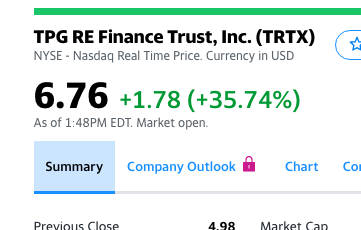
This is today’s change in stock price of a real estate venture run by
one of largest private equity funds in the world.
A
thirty five percent jump in a day is… a lot. The reason the stock
skyrocketed is because investors believe the new measures from the
Federal Reserve will bailout the debt of this private equity fund.
There’s a ‘monetary bazooka’ aimed at the economy. And yet there’s a
puzzle. If there’s money for the entire economy, why is that normal
people and small businesses can’t access unemployment insurance and
lending programs? To put it another way, why is the money meant for
everyone only showing up in the stock market?
The reason is
because money has to travel through institutions, and right now, the
institutions for the powerful function well, and those for the rest of
us are rickety and broken. So money gets to the rich first. Eventually,
some money will get to the rest of us, but in the interim period before
that money fully circulates, the wealthy can use their access to money
to buy up physical or financial assets.
An 18th century French
banker and philosopher named Richard Cantillon noticed an early version
of this phenomenon in a book he wrote called ‘An Essay on Economic Theory.’
His basic theory was that who benefits when the state prints a bunch of
money is based on the institutional setup of that state. In the 18th
century, this meant that the closer you were to the king and the
wealthy, the more you benefitted, and the further away you were, the
more you were harmed. Money, in other words, is not neutral. This
general observation, that money printing has distributional consequences
that operate through the price system, is known as the “Cantillon
Effect.”
sicsempercomments | Below is a link to the growth in the Fed's balance sheet over the past few months. You will note that the Fed began expanding its asset purchases by $500 billion in the last quarter of 2019 even before the China virus hit our shores and shutdown our economy. Credit was already leaking and the Fed which has given itself the mandate to backstop financial speculation was already delivering on the Fed put. The China virus has brought out the bazooka adding nearly $2 trillion to their balance sheet just in the last 30 days.
The Fed has announced several new programs in addition to the repo program it had already initiated last year for liquidity squeezed banks. One is the purchase of investment grade corporate bonds many trading close to junk. The second announced today is the purchase of junk bonds via ETFs. This allows financial investors holding these credit instruments to sell them to the Fed enabling them to essentially not take or reduce their losses. The Fed will now hold credit instruments that could default. The third is to provide dollar liquidity to foreign banks with dollar liabilities through their central banks. Essentially the Fed is now willing to buy assets no matter how dodgy with significant credit risk.
An example is the shale patch debt. Shale companies raised junk bond financing to explore and produce oil & gas. With the crushing of the oil price, much of that debt got downgraded. Investors holding that debt were sitting on significant losses. The Fed will now buy that debt from investors with an opaque pricing essentially making them whole.
This is very similar to what they did during the 2008 mortgage credit crisis when they purchased mortgage-backed securities from investors enabling them to get out from their underwater positions. At that time Bernanke said that it was emergency action to prevent the collapse of the financial system and they would reduce their balance sheet by selling all the securities they acquired when the financial system was able to stand up again. Now they're significantly higher than at the peak of the 2008 crisis.
Chamath and others like Jack are upset because if the Fed really wanted to help the actual economy they could monetize (print money to buy up) infrastructure bonds issued by the various state, and local municipalities that could run various construction projects. They could also monetize Treasury, state and municipal debt that could be used to pay all those locked down and unable to earn a paycheck. What they're doing here as they did in 2008 is to backstop speculative losses of the financial sector.
The other story is that post-2008 it became clear to large speculators that risk taking is rewarded as long as the scale was large enough. The use of debt to buyback stock to the outsized benefit of management was immense in scale. So too was the revived CLO and other structured debt product financings. The impending downgrade of much of this corporate debt to junk meant that all those securities would have to be ejected from the portfolios that could only hold investment grade. Like most pension funds and life insurance portfolios. This was a huge crisis for the massively leveraged funds.
I work at an investment advisory firm providing services to pension funds and insurance companies. The word on the street is to expect the Fed balance sheet to be expanded by $6-$10 trillion.
Unfortunately Mom & Pop businesses most hard hit by the shutdown have no ability to get a Wall St bank to underwrite a junk bond offering that could be sold to the Fed.
Finally, I'd like to leave you with this story. This is why some are getting angry.
jacobin | When it first became clear that Joe Biden was launching a 2020
campaign for president, a lot of us were amazed that centrist Democrats
would, in the #MeToo era, be stupid enough to back his candidacy. But we
shouldn’t have been surprised: their feminism is fleeting and
opportunistic.
This week, Tara Reade, a former Biden aide, detailed her 1993 experience of sexual assault
on “The Katie Halper Show” after trying for years to get someone to
listen. Reade has, predictably, been smeared as a Russian agent, because
that’s how mainstream Democrats respond to anything they don’t want to
hear. But she’s just one of seven women who have accused Biden of
horrible behavior, charges that have been public for years.
Democratic elites have known for years about Biden’s shabby, boorish treatment of Anita Hill,
the dignified law professor who accused Clarence Thomas of sexual
harassment in 1991. Hill brought workplace sexual harassment into the
public eye years before #MeToo. Biden was chair of the Senate Judiciary
Committee at the time. He has since said that he “wished he could have
done something” to ensure that her claims got a fair hearing, a pretty
inept apology considering he was in charge of the proceedings.
From mainstream feminists, we’re hearing little about Biden’s #MeToo
problems. In fact, some have flatly declined to be involved. As the Intercept reported
this week, the feminist legal group Time’s Up had refused to take
Reade’s case. In a twist, Anita Dunn, a top Biden adviser, is managing
director of Time’s Up’s PR firm, SKDKnickerbocker. In another twist,
Dunn also advised big Democratic donor (now convicted rapist) Harvey
Weinstein on how to handle his own rape allegations. Another partner in
SKDKnickerbocker, Hilary Rosen, has also been advising Biden’s
presidential campaign.
The allegations aren’t getting much play in the mainstream
media either. Sure, it’s a busy news cycle. And everything about Biden
is boring, even his sexual assault allegations. But the day Reade’s
charges went public, CNN ran an “analysis” by Chris Cillizza about Biden and gender. Its theme? “The Top 10 Women Joe Biden Might Pick as VP.”
By contrast, we’ve heard for years from these same quarters about the
supposed mean, sexist tweets of the Bernie Bros, and about Bernie
Sanders’s alleged tone-deafness on gender issues. But Sanders is the
only candidate now running for president with no sexual assault or
harassment charges against him. That’s obviously a low bar, and it’s
unfortunate we have to mention it. But, perhaps relatedly, Sanders is
also the only one in the race who has always been pro-choice,
has always been committed to full abortion access regardless of income,
and has been fighting for universal childcare for decades, as well as
for advancements that benefit working-class women
even more than men, like the $15 minimum wage and Medicare for All. Yet
if you relied on the mainstream media for information, you’d assume
that Biden was the feminist candidate in the primary, while Sanders was “problematic” for women.
mattstoller | Since 2016, the Republicans, long a party supportive of free trade
with China, began changing their relationship to both China and big finance.
Trump is a protectionist who loves tariffs and closing down borders.
But behind him, there is a notable new thought collective of populists
who pay attention to China, which includes figures like White House
advisor Peter Navarro, Fox News anchor Tucker Carlson, Senators Josh
Hawley, Marco Rubio, and Tom Cotton, American Compass founder Oren Cass,
Rising anchor Saagar Enjeti and United States Trade
Representative Robert Lighthizer. The shift is not party-wide by any
means, but it is substantial enough to massively influence policy.
This new populist thought collective includes some of the first major political figures
to really get the impact of the Coronavirus, and it also includes some
of the more assertive influencers of the policy debate. There is a deep
streak of raw nationalism here, with Tom Cotton almost seeking great
power conflict and acting reflexively hostile to multilateral
institutions. But the nationalist rhetoric and jingoism of Trump can
obscure a more sophisticated recognition by some people in this new
populist world that the core dynamic of the China-US relationship isn’t
two nation-states opposed to one another, it is an authoritarian
government in China that is deeply aligned with Wall Street, against the
public in both nations.
One way Rubio has tried to deal with Chinese control in the American economy is through industrial policy,
meaning the explicit shaping of industrial enterprises by state
financing and control. One of Rubio’s initial goals was to meet the
security threat from Huawei, the Chinese telecom giant that is
threatening to take over the global communications apparatus. But he’s
also gone more broadly into manufacturing in general, and small
business, which is a more Brandeis-style frame.
Regardless, the
intellectual ferment on the right is real, and fascinating. The first
fruits of this philosophical discourse is the massive SBA Paycheck
Protection Program, which is a $349 billion lending program to small
business negotiated with Democratic Senators. So far, the program
excludes private equity-controlled corporations, and though that may
change, such legislative design implies genuine skepticism of the role
of high finance. That’s a significant shift from traditional Republican
orthodoxy.
Operationally speaking the PPP is a mess, and
Republican populists will have to confront the many institutional
challenges involved in trying to get large amounts of money through the
‘rusty pipes’ of our banking system. But it’s still a remarkable
achievement.
caitlinjohnstone | If you ask a leftist what the west’s sudden uptick in anti-China
hysteria is about, they might say racism, xenophobia, and/or
anti-communism. If you ask a rightist, they might tell you it’s because
China lied about the virus, or because of communism, or because of
China’s economic relationship with the US, or because it’s a backwards
culture of people who eat different animals from us. If you ask someone
who occupies the mainstream so-called “center”, they might tell you that
it’s because of humanitarian concerns about China’s oppressive
government, along with racism or some mixture of the aforementioned
claims.
Ultimately though, it’s not about any of those things.
While racism, xenophobia, anti-communism, free trade deals,
authoritarianism and the virus are all real concerns which play a real
role in the propaganda campaign, it’s not ultimately about any of them.
Ultimately, like so much else, this is about power.
There can only be one top dog in a unipolar world. After the fall of the Soviet Union the prevailing philosophy slowly coalesced among US policymakers that
the world’s only remaining superpower needed to remain that way at any
cost in order to preserve the so-called liberal world order. This
philosophy rose to dominance when the neoconservatives took over the
Executive Branch during the George W Bush administration, and from there
their ideas simply became the mainstream orthodoxy. Now the
“unipolarity at any cost” ideology of neoconservatism is so pervasive
that when you see someone like Tulsi Gabbard basically just advocating
for pre-9/11 US foreign policy, you see them demonized as though they
supported child cannibalism.
Napoleon Bonaparte
once said, “China is a sleeping giant. Let her sleep, for when she wakes
she will shake the world.” Preventing the rise of China (and its loose
network of other unabsorbed allies like Russia) has been a lasting
agenda of the western world for generations, and the continuation of
this agenda has set the world on a trajectory toward aggressive confrontation. The US has been surrounding China with military bases,
many of them nuclear-armed, in preparation for a confrontation that it
sees as ultimately inevitable, since China has no interest in being
absorbed into the US power alliance and the US has no interest in
allowing China to surpass it as a superpower.
What this means for
us ordinary people is that we have found ourselves smashed between
steadily increasing escalations between two nuclear-armed nations and
their nuclear-armed allies hurtling toward a confrontation which
benefits none of us in the slightest, while propagandists spoon feed us
narratives about why this is something we should eventually support.
straightlinelogic | Anyone who thinks that “emergency” measures will be rescinded or will not serve as future precedents is referred to Draconian Emergency Measures Enacted By Governments Throughout History That Have Been Rescinded and Not Served as Precedents. It’s available for free on Amazon and takes only four seconds to read; the title is longer than the book.
Perhaps the most distressing aspect of
this whole ordeal is that Americans have surrendered to panic and
propaganda without a shot. Molon labe and They’ll take my gun when they pry it from my cold, lifeless fingers
patriots—bumper-sticker freedom fighters—are cowering in place, living
off their 3, 6, 12, 24, or 60 months of provisions, lest they encounter a
germ. Neighbors are reporting on neighbors who leave their houses, take
a walk, clear their throats, or other heretofore legal activities (they
would still be legal if the Constitution had any remaining relevance).
Apps have been developed to monitor and report people’s locations,
coughs, sneezes, sniffles, and runny noses. Can one that monitors and
reports social distances be far behind? If only one life is saved…
With a few noteworthy exceptions (lewrockwell.com) takes the gold medal), the alternative media has been a disappointment.
Bloggers who would normally cast darkly skeptical doubts if the
government announced the sun will rise tomorrow have accepted official
statistics, projections, propaganda, and draconian measures without a
peep of skepticism or doubt. Prepper sites have perpetuated and profited
from the panic, selling face masks, sanitizers, and reusable toilet
paper. More alternative media sites are glomming on to what’s happening
to civil liberties and the dark designs behind it, but their warnings
are too little, too late.
Surrendered without a shot—they’ve got us
by what’s left of our balls. The men and women who risked probabilities
of death far higher than some small fraction of one percent and paid the
ultimate price to defend our freedom and our lives are spinning in
their hallowed graves.
strategic-culture | In the Book of Revelation [13:16-17], there is a passage that has
attracted the imagination of believers and disbelievers throughout the
ages, and perhaps never more so than right now: “And he causeth all,
both small and great, rich and poor, free and bond, to receive a mark in
their right hand, or in their foreheads: And that no man might buy or
sell, save he that had the mark…”
Was John of Patmos history’s first conspiracy theorist, or are we
merely indulging ourselves today with a case of self-fulfilling
prophecy? Whatever the case may be, many people would probably have
serious reservations about being branded with an ID code even if it had
never been mentioned in Holy Scripture. But that certainly has not
stopped Microsoft founder Bill Gates, who has been warning about a
global pandemic for years, from pushing such controversial technologies
on all of us.
In September 2019, just three months before the coronavirus first
appeared in China, ID2020, a San Francisco-based biometric company that
counts Microsoft as one of its founding members, quietly announced
it was undertaking a new project that involves the “exploration of
multiple biometric identification technologies for infants” that is
based on “infant immunization” and only uses the “most successful
approaches”.
For anyone who may be wondering what one of those “most successful
approaches” might look like, consider the following top contender for
the contract. Researchers at the Massachusetts Institute of Technology
(MIT) have developed what is essentially a hi-tech ‘tattoo’ that stores
data in invisible dye under the skin. The ‘mark’ would be delivered
together with a vaccine, most likely administered by Gavi, the global vaccine agency that also falls under the umbrella of the Bill & Melinda Gates Foundation.
“The researchers showed that their new dye, which consists of
nanocrystals called quantum dots… emits near-infrared light that can be
detected by a specially equipped smartphone,” MIT News reported.
And if the reader scrolls to the very bottom of the article, he will
find that this study was funded first and foremost by the Bill and
Melinda Gates Foundation.
Today, with the global service economy shut down to prevent large
groups of infectious humans from assembling, it is easier to imagine a
day when people are required to have their infrared ID ‘tattoo’ scanned
in order to be granted access to any number of public venues. And from
there, it requires little stretch of the imagination to see this same
tracking nanotechnology being applied broadly across the global economy,
where it could be used to eliminate the use of dirty money. After all,
if reusable bags are being outlawed over the coronavirus panic-demic, why should reusable cash get special treatment?
economicoutlook | Today we consider the claim by the Financial Times editorial the
other day that “Radical reforms are required to forge a society that
will work for all”. It was an extraordinary statement from an
institution like the FT to make for a start. But it reflects the
desperation that is abroad right now – across all our nations – as the
virus/lockdown story continues to worsen and the uncertainty grows. But I
also think we should be careful not to adopt the view that everything
is going to change as a result of this crisis. The elites are a plucky
bunch, not the least because they have money and can buy military
capacity. Changing the essential nature of neoliberalism, even if what
has been displayed by all the state intervention in the last few months
exposes all the myths that have been used to hide that essential nature,
is harder than we might imagine. I think hard-edged class struggle is
needed rather than middle-class talkfests that outline the latest
gee-whiz reform proposals. The latter has been the story of the
Europhile progressives for two decades or so as the Eurozone mess has
unfolded. It hasn’t got them very far.
Financial Times goes all radical
Fear has a way of changing peoples’ minds. Ask any torturer.
Here is an essentially conservative voice and a doyen of the financial press coming out and saying:
1. “Radical reforms are required to forge a society that will work for all”.
2. The virus is shining “a glaring light on existing inequalities”.
3. That just like during the Great Depression and World War 2, which
moulded the social democratic era in the post-war period, maybe the
“current feelings of common purpose will shape society after the
crisis”.
4. How? To repair the “brittleness of many countries’ economies” –
their unprepared health systems, the lack of collective spirit that
neoliberalism has fostered as a way of redistributing income to the top
and depriving millions of jobs and opportunities for careers and
material security.
5. That the precarious labour markets are now making it more
difficult for governments “to channel financial help to workers with
such insecure employment”.
6. And while central bankers are hell-bent on saving the financial
system with even greater QE interventions, the FT thinks that they will
only help the “asset rich” while “underfunded public services are
creaking under the burden” of past austerity.
7. We have culled support mechanisms where cost-sharing (the FT call
it the sharing of “sacrifices”) can be accomplished with any sense of
equity. “Sacrifices are inevitable, but every society must demonstrate
how it will offer restitution to those who bear the heaviest burden of
national efforts.”
8. And then we start talking about:
Radical reforms — reversing the prevailing policy direction of the last
four decades — will need to be put on the table. Governments will have
to accept a more active role in the economy. They must see public
services as investments rather than liabilities, and look for ways to
make labour markets less insecure. Redistribution will again be on the
agenda; the privileges of the elderly and wealthy in question. Policies
until recently considered eccentric, such as basic income and wealth
taxes, will have to be in the mix.
theburningplatform | If you think about it, the timeout has now become the go-to move from
the gynocrats in charge of our culture. If you use the wrong word or
phrase on social media, you get put in timeout for 12-hours. If you
repeat the error, you end up in detention. Since the gynocrats have
replaced the parents, there’s no parent conference for those who can’t
conform to the rules. Instead, you are relegated to the trailers out
back, which for the internet means setting up an account on Gab or
Telegram.
This is just one reality of the world run by women. Since women have
come to dominate the workplace, the fastest growing parts of the economy
are those where women have the dominant position. For example, while
STEM jobs get outsourced to barbarians, either imported from tribal
areas or through outsourcing, health care, which is dominated by women,
has been booming. Tech workers have seen declining wages, but registered
nurses have seen their wages grow.
Of course, the feminization of society has been hardest on the
working classes, as the jobs for working class men are replaced by jobs
for women. The rise in death from despondency has been acute among
working class males. A man with no way to support a family, relegated to
living off a woman, has no reason to live. Inevitably, drugs, alcohol
and eventually suicide become the answer. The white death that has
afflicted our people is not all that different than what happened to the
Indians.
The middle-class males have not escaped the ravages of the gynocracy.
We’re onto at least the second generation of middle-class males raised
by women in a female dominated society. The process began with the
liberalization of divorce, which spread through the middle-class like a
plague in the 70’s and 80’s. By the 1990’s, the feminization of America
life was well underway. We’re onto our second generation of young
middle-class males raised to live in the gynocracy.
You see it in marriage and dating. With scrambled sex roles, the
males are ill-equipped to play their role, so they are less marriage
worthy to females. On the other hand, men instinctively suspect a career
woman will be a poor mother and mate. The subsequent drop in marriage
and fertility is hardly a surprise. For the young men in the gynocracy,
life is a bachelor’s ball on-line, punctuated by mock battles in video
games and mock intimacy in the form of pornography.
As an aside, this is why someone like Richard Spencer was so
appealing to young men in the alt-right days. He is the non plus ultra
of gynocritic male. He is reckless, feckless and irresponsible, but
immune to the consequences. Mom is always there to make everything
better. He is the perpetual adolescent, unable to care for himself, but
always in rhetorical revolt against the gynocracy. As a result, many
young middle-class white males saw him as the ultimate expression of
themselves.
wsws | Intended as a pilot for a potential full-length series, Black&Privileged
is set in a neighborhood on Chicago’s south side. Upon its July release
on Netflix, the film reached the top 10 most-viewed list on the
streaming platform and has been featured prominently at a number of
award ceremonies focused on African-American filmmaking.
While in reality a seriously impoverished community, the fictionalized version of Englewood in Black&Privileged
is a well-off neighborhood whose residents are mostly upper-middle
class African-American businessmen and women. One of the film’s central
characters explains, in regard to the neighborhood’s composition, “We
searched through the city of Chicago for folks who not only cared about
this community, but they cared about the people. And they had to
understand the value of money. So yes, we have our own schools, we have
our own banks, we hired our own police force.”
In Harris’s film, the lives of Englewood’s happy residents are
disrupted when a nearby housing project is torn down, causing low-income
blacks to turn up in the wealthy gated community. This sets off an
existential crisis among the well-heeled African Americans.
“If this happens, like, everybody’s going to leave—the doctors, the
lawyers, entrepreneurs like myself … They’re all gone,” warns Eldon
(Hendrix), on learning the unsettling news. The prosperous, self-deluded
denizens of Engelwood ludicrously choose to interpret the influx of
lower-income people as a scheme hatched by the “the [white] man” to
break up their idyllic community.
Black and Privileged is at its best when it skewers the
self-righteousness and hypocrisy of these layers. Another main
character, Dawn (Halfkenny), initially supportive of the new neighbors,
quotes W.E.B. DuBois: “To be a poor man is hard, but to be a poor race
in a land of dollars is the very bottom of hardships.” She insists it is
the community’s job to lend a “helping hand” to these poor souls. Her
enthusiasm turns to panic and hostility overnight, however, when she
discovers her new neighbors “standing in the middle of the street
drinking 40-ouncers.” Dawn demands that her husband (Henderson) call the
police on the new residents!
alt-market | Back in 2014 during the Ebola scare in the US I published an article
warning about how a global pandemic could be used by the elites as
cover for the implementation of an economic collapse as well as martial
law measures in western nations. My immediate concern was the way in
which a viral outbreak could be engineered or exploited as a rationale
for a level of social control that the public would never accept under
normal circumstances. And this could be ANY viral outbreak, not just
Ebola. The point is the creation of an “invisible enemy” that the
populace cannot quantify and defend itself against without constant
government oversight.
I noted specifically how the government refused to apply air travel
restrictions in 2014 to nations where the outbreak had taken hold when
they could have stopped the spread in its tracks. This is something
that was done again in 2020 as the UN's WHO and governments including
our government in the US refused to stop air travel from China,
pretending as if it was not a hot zone and that the virus was nothing to
worry about.
This attitude of nonchalance serves a purpose. The establishment
NEEDS the pandemic to spread, because then they have a rationale for
strict controls of pubic activities and movements. This is the end
goal. They have no care whatsoever for public health or safety. The
end game is to acquire power, not save lives. In fact, they might
prefer a higher death count in the beginning as this would motivate the
public to beg for more restrictions in the name of security.
Authorities went from downplaying the outbreak and telling people not to bother with preparations like purchasing N95 masks, to full blown crisis mode only weeks later. In January Trump initially claimed
he "trusted" the data out of China and said that "everything was under
control"; as usual only a couple months down the road and Trump
flip-flopped on both assertions. The World Health Organization refused
to even label this outbreak a "pandemic" until the virus was entrenched
across the globe. The question people will ask is, was this all due to
incompetence, or was it social engineering?
The Ebola event six years ago seems to have been a dry run for what
is happening today. I believe it is entirely deliberate, and I will
explain why in this article, but either way, governments have proven
they cannot be trusted to handle the pandemic crisis, nor can they be
trusted to protect the people and their freedoms.
At the same time, the pandemic itself is tightly intertwined with
economic collapse. The two events feed off one another. The pandemic
provides perfect cover for the crash of the massive debt bubble central
banks and international banks have created over the years. I noted in
February that the global economy was crashing long before the coronavirus ever showed up. At the same time, economic chaos increases 3rd
world conditions within each country, which means poor nutrition and
health care options that cause more sickness and more deaths from the
virus. As outlined in 2014:
“Who would question the event of an economic collapse in the
wake of an Ebola (virus) soaked nightmare? Who would want to buy or
sell? Who would want to come in contact with strangers to generate a
transaction? Who would even leave their house? Ebola (viral) treatment
in first world nations has advantages of finance and a cleaner overall
health environment, but what if economic downturn happens
simultaneously? America could experience third world status very
quickly, and with it, all the unsanitary conditions that result in an
exponential Ebola (pandemic) death rate.
...Amidst even a moderate or controlled viral scenario,
stocks and bonds will undoubtedly crash, a crash that was going to
happen anyway. The international banks who created the mess get off
blameless, while Ebola (viral outbreak), an act of nature, becomes the
ultimate scapegoat for every disaster that follows.”
wsws | Like every great crisis, the coronavirus pandemic has laid bare everything rotten and degenerate in capitalist society.
Nowhere
is that exposure more pronounced than in the case of the stock
market—that vast institutionalised mechanism through which the wealth of
society, produced by the labour of the working class, is siphoned to
its highest echelons at the expense of the mass of the population.
Corporations
are now lining up to receive a portion of the Trump administration’s
massive $2.2 trillion bailout. They are employing an army of lobbyists,
lawyers and financial advisers (all taking a fat fee for their services)
to maximise their gains as they plead that they are strapped for cash
and must be provided with money to “save the economy.”
But a report published in the Wall Street Journal
at the weekend reveals that one of the main reasons for the cash
shortage is the trillions of dollars spent by major corporations on
share buybacks, particularly over the decade since the global financial
crisis.
According to Brian Reynolds, the chief market analyst at
the research firm Reynolds Strategy, upon whose research the article is
based, corporate buybacks have been the “only net source of money
entering the stock market” since 2008.
The sole purpose of buyback
programs is to enhance the wealth of the executives who sit atop the
major corporations as well as hedge funds and other traders in shares.
By cutting the number of shares on issue, the stock of the corporation
rises. Executives and others can then exercise their stock options to
make a killing while hedge funds strike at the opportune time and rake
in billions.
The buybacks are financed by using the accumulated
profits of the company or, in some cases, by the raising of debt, taking
advantage of the ultra-low interest rate policies of the US Federal
Reserve.
According to the economist William O. Lazonick, the
proportion of corporate buybacks funded through the issuing of bonds
went as high as 30 percent in both 2016 and 2017.
By Reynolds’
calculations, since the beginning of 2009, buybacks have added a net $4
trillion to the stock market, an amount equivalent to one-fifth of the
total $20.9 trillion market value of the companies in the S&P 500
index.
Calculations by Lazonick put share buybacks as equivalent
to 52 percent of all corporate profits, with dividends on shares
accounting for another $3.3 trillion.
project-syndicate | Trump’s 2017 National Security Strategy
focused on great power competition with China. Many Americans of both
major political parties agree that Trump was correct to punish China for
cybertheft of intellectual property, coerced intellectual property
transfer, and unfair trade practices such as subsidized credit to
state-owned enterprises.
Reciprocity does need to be enforced. If China
can ban Google and Facebook from its market for security reasons, the US
can take similar steps against Huawei or ZTE.
Anger and mistrust
festers in both countries’ capitals.But what the COVID-19 crisis teaches
us is that this competitive approach to national security is
inadequate. And COVID-19 is not the only example. The information
revolution and globalization are changing world politics dramatically.
While trade wars have set back economic globalization, environmental
globalization, reflected in pandemics and climate change, obeys the laws
of biology and physics, not politics. In a world where borders are
becoming more porous to everything from drugs and illicit financial
flows to infectious diseases and cyber terrorism, countries must use
their soft power of attraction to develop networks and institutions that
address the new threats.
As technology expert Richard Danzig points out,
“Pathogens, AI systems, computer viruses, and radiation that others may
accidentally release could become as much our problem as theirs. Agreed
reporting systems, shared controls, common contingency plans, norms,
and treaties must be pursued as means of moderating our numerous mutual
risks.” Tariffs and border walls cannot solve these problems.
On transnational issues like COVID-19 and climate change, power becomes a positive-sum game. It is not enough to think of power over others; one must also consider power with
others. On many transnational issues, empowering others helps a country
accomplish its own goals. For example, all can benefit if others
improve their energy efficiency, or improve their public health systems.
All leaders have a responsibility to put their country’s interests
first, but the important moral question is how broadly or narrowly they
choose to define those interests. Both China and the US are responding
to COVID-19 with an inclination toward short-term, zero-sum, competitive
approaches, and too little attention to international institutions and
cooperation.
Claude's constitution and other matters AI
-
Ross Douthat, Is Claude Coding Us Into Irrelevance? *NYTimes*, 2.12.26.
Are the lords of artificial intelligence on the side of the human race?
That’s t...
Celebrating 113 years of Mama Rosa McCauley Parks
-
*February 4, 1913 -- February 4, 2026*
*Some notes: The life of the courageous activist Mama Rosa McCauley Parks*
Mama Rosa's grandfather Sylvester Ed...
Monsters are people too
-
Comet 3I/Atlas is on its way out on a hyberbolic course to, I don't know
where. I do know that 1I/Oumuamua is heading for the constellation Pegasus,
and ...
Remembering the Spanish Civil War
-
This year marks the 90th anniversary of the launch of the Spanish Civil
War, an epoch-defining event for the international working class, whose
close study...
Return of the Magi
-
Lately, the Holy Spirit is in the air. Emotional energy is swirling out of
the earth.I can feel it bubbling up, effervescing and evaporating around
us, s...
Covid-19 Preys Upon The Elderly And The Obese
-
sciencemag | This spring, after days of flulike symptoms and fever, a man
arrived at the emergency room at the University of Vermont Medical Center.
He ...
-
(Damn, has it been THAT long? I don't even know which prompts to use to
post this)
SeeNew
Can't get on your site because you've gone 'invite only'?
Man, ...
First Member of Chumph Cartel Goes to Jail
-
With the profligate racism of the Chumph Cartel, I don’t imagine any of
them convicted and jailed is going to do too much better than your run of
the mill ...