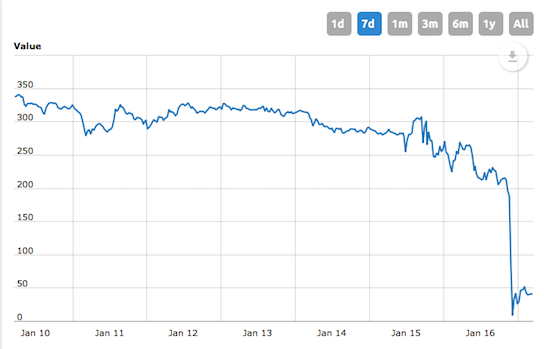
ibankcoin | Crypto currency Bitconnect (BCC) plunged from $321 to a tad over $35
today, a drop of more than 86% after regulators from state authorities
issued cease and desist letters for unauthorized sale of securities.
That’s right. Just because your shit is on the blockchain, that doesn’t
mean you get to solicit your fucking Ponzi scheme to people in America.
State regulators will have something to say about that.
Via the company’s website, as per the reasons for shutting down.
The reason for halt of lending and exchange platform has many reasons as follow:
The continuous bad press has made community members uneasy and created a lack of confidence in the platform.
We have received two Cease and Desist letters, one from the Texas State
Securities Board, and one from the North Carolina Secretary of State
Securities Division. These actions have become a hindrance for the legal
continuation of the platform.
Outside forces have performed DDos attacks on platform several times
and have made it clear that these will continue. These interruptions in
service have made the platform unstable and have created more panic
inside the community.
Price action.
What did Bitconnect do? They quite literally ran a Ponzi scheme. Look
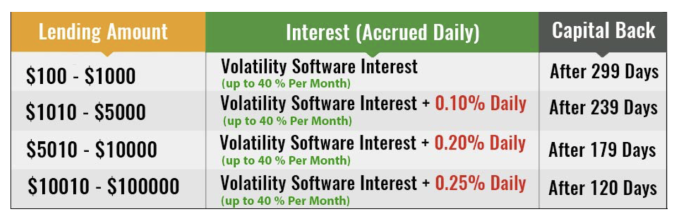
at one of their brochures, promising investors 40% returns, PER MONTH.
Via Tech Crunch:
Many in the cryptocurrency community have openly accused
Bitconnnect of running a Ponzi scheme, including Ethereum founder
Vitalik Buterin.
The platform was powered by a token called BCC (not to be confused
with BCH, or Bitcoin Cash), which is essentially useless now that the
trading platform has shut down. In the last The token has plummeted more
than 80% to about $37, down from over $200 just a few hours ago.
If you aren’t familiar with the platform, Bitconnect was an
anonymously-run site where users could loan their cryptocurrency to the
company in exchange for outsized returns depending on how long the loan
was for. For example, a $10,000 loan for 180 days would purportedly give
you ~40% returns each month, with a .20% daily bonus.
Bitconnect also had a thriving multi-level referral feature, which
also made it somewhat akin to a pyramid scheme with thousands of social
media users trying to drive signups using their referral code.
The platform said it generated returns for users using Bitconnnect’s
trading bot and “volatility trading software”, which usually averaged
around 1% per day.
Of course profiting from market fluctuations and volatility is a
legitimate trading strategy, and one used by many hedge funds and
institutional traders. But Bitconnect’s promise (and payment) of
outsized and guaranteed returns led many to believe it was a ponzi
scheme that was paying out existing loan interest with newly pledged
loans.
The requirement of having BCC to participate in the lending program
led to a natural spike in demand (and price) of BCC. In less than a year
the currency went from being worth less than a dollar (with a market
cap in the millions) to a all-time high of ~$430.00 with a market cap
above $2.6B.
Lenders into the Bitconnect Exchange have revealed the company is
closing out accounts, issuing BCC in exchange for their dollars — which
is causing the price to plummet.
Bitconnect is officially closing up. They sent me
33 BCC for my $11k+ in loans. Worth $6600 and dropping by the second.
Their exchange is down so the only option is to send the BCC to an
external exchange.
CounterPunch | Beneath the surface of meanness by the political elite are the needs
of corporate masters who anoint them to be our leaders. An essential
characteristic of twenty-first century capitalism is unending war to
complete the pillaging of resources from every corner of the Earth.
Those wars are best carried out by politicians who hate not just their
opponents but everyone around them. An economically destructive system
encourages, molds and rewards those individuals who are most vile to
their fellow humans.
Though Greitens is currently being investigated by St. Louis Circuit
Attorney Kim Gardner, it is not clear if criminal charges will be
filed. While local press are on his trail like a hound dog, the still
unidentified woman who reports being tied up, photographed and
blackmailed is currently protecting her identity by not pressing
charges. Missouri Republicans are saying it is “too early” to tell if
the entire affair will blow over. Greitens, who admits to an
extramarital affair while denying taking a photo for blackmail, is going
to each GOP legislator and personally apologizing for the Trump-like
insults that he hurled at them during the first year of his reign.
Also disturbing is the revelation that before his election Greitens
had reserved “Greitens for President” websites, revealing the
ego-maniacal core of his soul. Before the bondage scandal, Republicans
across the country were eyeing Greitens. They could still end up
thinking that someone who could escape prosecution for terrorizing a
woman and glorify gun-toting and union-smashing would, in fact, have
what it takes to be their man for the white house.
What could be more frightening? It’s the possibility that Greitens
would lose a presidential race to a Democrat who was worse. Isn’t it
time to put aside the fantasy that demonstrating the contemptible nature
of a Republican somehow proves that a Democrat is “better?”
oxforduniversitypress | At the centre of the modern theory of credit rationing, as observed
at the macro level, are banks—a critical institution which was missing
from DSGE models. This was a particularly peculiar omission because,
without banks, there presumably would be no central banks, and it is the
central bank’s conduct of monetary policy that is central in those
models. The fact that credit is allocated by institutions (banks),
rather than through conventional markets (auctions) is an important
distinction lost in the DSGE framework. Greenwald and Stiglitz (2003)
model banks as firms, which take others’ capital, in combination with
their own, obtaining and processing information, making decisions about
which loans to make. They too are by and large equity constrained, but
in addition face a large number of regulatory constraints. Shocks to
their balance sheets, changes in the available set of loans and their
expectations about returns, and alterations in regulations lead to large
changes in loan supply and the terms at which loans are made available.
Variations in regulations and circumstances of banks across states in
the US are helping validate the importance of variation in the supply
conditions in banking in the 2008 crisis and its aftermath.38
Given
how long it takes balance sheets to be restored when confronted with a
shock of the size of that of 2008, it is not surprising that the effects
persisted.39
But they seem to have persisted even after the restoration of bank and
firm balance sheets. That suggests that this crisis (like the Great
Depression) is more than a balance sheet crisis. It is part of a
structural transformation, in the advanced countries, the most notable
aspects of which are a shift from manufacturing to a service-sector
economy and an outsourcing of unskilled production to emerging markets;
for developing countries, the structural transformation involves
industrialization and globalization. Not surprisingly, such structural
transformations have large macroeconomic consequences and are an
essential part of growth processes. DSGE models are particularly
unsuited to address their implications for several reasons: (a)
the assumption of rational expectations, and even more importantly,
common knowledge, might be relevant in the context of understanding
fluctuations and growth in an agricultural environment with well-defined
weather shocks described by a stationary distribution,40 but it cannot describe changes, like these, that happen rarely;41 (b) studying these changes requires at least a two-sector model; and (c)
a key market failure is the free mobility of resources, especially
labour, across sectors. Again, simple models have been constructed
investigating how structural transformation can lead to a persistent
high level of unemployment, and how, even then, standard Keynesian
policies can restore full employment, but by contrast, increasing wage
flexibility can increase unemployment (see Delli Gatti et al., 2012a,b).
gurdjieffclub | To reflect on the relationship of religion to money, there is no better starting-point than "to go beyond time." In returning to the origin of the question, we may find a grain of truth and thus turn towards the remedy for an otherwise intractable problem. Countless volumes have appeared about the Church's attitude to war and sex but very little has been written about money.
William Desmonde shows1 that in some ancient cultures money was used as a symbol to replace food in sacrificial communion rituals. Participation in the meal implied a bond of loyalty with other members of the group and signified also entering into a covenant with the deity. Each communicant received a particular portion of the sacrificial flesh corresponding to his standing in the community. When money of different denominations began to be used in place of the portions of food, the establishment of a contractual; relationship between two individuals at first retained traces of the original bond of religious loyalty among participants in the same communion, with impersonal bargaining replacing the patriarchal redistribution of foods among the brotherhood.
In any case, there is good reason to suppose that money was originally a sacred device created by religious authority to facilitate the exchange of necessities in an expanding society. It was intended to be a means of recognizing that human beings have individual property rights and at the same time that no human being or family is self- sufficient. In support of this theory, Rene Guenon states2 that coins of the ancient Celts are covered with symbols taken from Druid doctrine, implying direct intervention of the Druid priests in the monetary system.
Given the sacred origin of money, solutions to the problem of religion and money on this level can never be found. A solution is achievable only through reinstating the individual's relationship to money within the whole scale of his spiritual studies and strivings, that is, through re-educating him to regard money transactions as a measure of his individual human relationships. For, like everything existing, money is a vital part of life on the planet and is worthy of respect, of course at its proper level. True religion views everything, including money, in relation to universal laws. In showing us our dependence on each other, money acts to remind us of these laws. The only thing wrong with money is our present view of it. This is what needs to be studied and understood.
Where to begin? It stands to reason that such a program of re-education cannot begin with the masses, who, in the last analysis, are not concerned with human values except in terms of physical survival.
Nor can much be expected from the many studies of money that are being made on the psychological level, although these may serve as useful shocks to our customary unconscious attitudes towards accumulation and waste. For example, Freud noted that in the modern Western world, the language of people of different nationalities is a mirror of their typical attitude to money. Germans earn money, Italians find it, the French gain or win it, the English have it or possess it, Americans make it. Freud pointed out also a common tendency among the clergy of his time to look on money as dirty, you mustn't touch it. He detected here some similarity to their attitude to sexual relations and even hinted at a direct connection between the problems of money and sex.
subrealism | However, money does not emerge from barter-based economic activities,
but rather from the sovereign's desire to organize economic activity.
The state issues currency and then imposes taxes. Because citizens are
forced to use the state's currency to pay their taxes, they can trust
that the currency will carry value in day-to-day economic activities.
Governments with their own currency and a floating exchange rate
(sovereign currency issuers like the United States) do not have to
borrow from "bond vigilantes" to spend. They themselves first spend the
money into existence and then collect it through taxation to enforce its
usage. The state can spend unlimited amounts of money. It is only
constrained by biophysical resources, and if the state spends beyond the
availability of resources, the result is inflation, which can be mitigated by taxation.
These simple facts carry radical policy implications.
theroot | I first met Zac Henson a few years ago when we were both invited to a
forum in Birmingham, Ala., to talk about economic development. He has
an unkempt beard and talks with a Southern accent as thick as Karo
Syrup. He looks like a redneck. He sounds like a redneck. I figured that
I would be the lone voice railing against the gentrification of one of
the blackest cities in America, until he spoke up.
It turns out that Henson is
a redneck. It also turns out that Henson is a UC Berkeley-educated
economist and scholar with a Ph.D. in environmental science, policy and
management and heads the Cooperative New School for Urban Studies and Environmental Justice.
Henson doesn’t consider the term “redneck” a pejorative, and defines a
redneck simply as “a white working-class Southerner.” He has been
working for years to separate redneck culture from its neo-Confederate,
racist past and redefine it according to its working-class roots.
“The only culture that white people and upper-middle-class white people have is whiteness,”Henson explains. “To
fit in that class, you must strip yourself of everything else. What I
would like to do is show white working-class whites that the
neo-Confederate bullshit is a broken ideology. ... A lot of the activism
in anti-racism is all about white people giving up their privilege in
regards to white supremacy. I believe that will never work with
working-class whites. You have to find a way to show working folks that
anti-racism is within the self-interests of working-class white people.
And you have to do that with a culture.”
Henson is one of the
people trying to renew the legacy of the Young Patriots and build the
anti-racism redneck movement. He is one of the people trying to spread
the message and history of the Young Patriots Organization and its
connection to redneck culture.
The
original YPO was led by William “Preacherman” Fesperman and made up of
“hillbillies” from Chicago’s South Side. They saw the similarity in how
the Chicago machine treated blacks and how it treated poor whites.
Preacherman believed that solidarity was the only answer.
“Let racism become a disease,” he said
at the 1969 conference. “I’m talking to the white brothers and sisters
because I know what it’s done. I know what it’s done to me. I know what
it does to people every day. … It’s got to stop, and we’re doing it.”
Modeled after the Black Panther Party, the YPO adapted the Panthers’ ideas into its platform. It used an 11-point plan (pdf) similar to the Panther Party’s 10-point plan. It opened a free health clinic like the Panthers. The YPO, too, was raided by the “pigs” (pdf).
Today
the Young Patriots Organization is looking to build on the legacy
interrupted by the death of Fred Hampton. It embraces the term “redneck”
as a cultural term and wants to build a movement that fights racism the
same way as the Black Panthers it modeled itself after almost five
decades ago.
Hy Thurman, an original member of the YPO who is
looking to resurrect the organization, says: “Racism was a demon that
had to be driven out and slain if we were going to have unity with other
groups and to believe that all people have a right to
self-determination and freedom. … We had to change to make life
tolerable, and for life to have some sort of meaning.”
Henson,
Thurman and the YPO chapters across the country are using their history
with the Panthers to fight racism, class warfare and oppression on all
fronts, and they are rounding up unafraid rednecks willing to fight the
power structure in any way possible.
theglobeandmail | The #MeToo moment is a symptom of a
broken legal system. All too frequently, women and other sexual-abuse
complainants couldn't get a fair hearing through institutions –
including corporate structures – so they used a new tool: the internet.
Stars fell from the skies. This has been very effective, and has been
seen as a massive wake-up call. But what next? The legal system can be
fixed, or our society could dispose of it. Institutions, corporations
and workplaces can houseclean, or they can expect more stars to fall,
and also a lot of asteroids.
If
the legal system is bypassed because it is seen as ineffectual, what
will take its place? Who will be the new power brokers? It won't be the
Bad Feminists like me. We are acceptable neither to Right nor to Left.
In times of extremes, extremists win. Their ideology becomes a religion,
anyone who doesn't puppet their views is seen as an apostate, a heretic
or a traitor, and moderates in the middle are annihilated. Fiction
writers are particularly suspect because they write about human beings,
and people are morally ambiguous. The aim of ideology is to eliminate
ambiguity.
The UBC Accountable
letter is also a symptom – a symptom of the failure of the University of
British Columbia and its flawed process. This should have been a matter
addressed by Canadian Civil Liberties or B.C. Civil Liberties. Maybe
these organizations will now put up their hands. Since the letter has
now become a censorship issue – with calls being made to erase the site
and the many thoughtful words of its writers – perhaps PEN Canada, PEN
International, CJFE and Index on Censorship may also have a view.
The
letter said from the beginning that UBC failed accused and complainants
both. I would add that it failed the taxpaying public, who fund UBC to
the tune of $600-million a year. We would like to know how our money was
spent in this instance. Donors to UBC – and it receives billions of dollars in private donations – also have a right to know.
In
this whole affair, writers have been set against one another,
especially since the letter was distorted by its attackers and vilified
as a War on Women. But at this time, I call upon all – both the Good
Feminists and the Bad Feminists like me – to drop their unproductive
squabbling, join forces and direct the spotlight where it should have
been all along – at UBC. Two of the ancillary complainants have now
spoken out against UBC's process in this affair. For that, they should
be thanked.
Once UBC has begun an
independent inquiry into its own actions – such as the one conducted
recently at Wilfrid Laurier University – and has pledged to make that
inquiry public, the UBC Accountable site will have served its purpose.
That purpose was never to squash women. Why have accountability and
transparency been framed as antithetical to women's rights?
A
war among women, as opposed to a war on women, is always pleasing to
those who do not wish women well. This is a very important moment. I
hope it will not be squandered.
WaPo | Thiel’s secret financing
of multiple suits against Gawker was legal. But that shouldn’t erase
the squeamishness brought on by a billionaire leveraging his wealth to
obliterate a media outlet, all as part of a personal vendetta. (Thiel
did not respond to request for comment.)
But more about Gawker’s coverage may have rankled Thiel
than, as he put it, the website’s “creepy obsession with outing closeted
men.” Gawker’s tech-focused website Valleywag trained a skeptical and
often searing eye on Silicon Valley culture. It reported on what tech
titans said they were about and what they actually did.
Thiel was
a titan, so he was also a target. Thanks to the lawsuits he funded,
Gawker had to stop bothering him. If he gets his way again, any trace of
that troublesome writing may be erased. This starts to look an awful
lot like book-burning.
The good news is that ALL institutions are currently in play. Been
taking a deep dive with the youngest into questions about dopamine
hegemony and the science and engineering of money. Cryptocurrency and
cryptocurrency-speculation being all the rage at the moment among the
young, dumb, and “want something for nothing” set.
Am absolutely loving the open warfare erupting in the Impyrian
heights among the oligarchs and then licking down like lightning to
destroy errant peasants who attempt to fly too high. Ahhhh.., the petty
satisfactions of pedestrian schadenfreude.
Anyway, what we can all know and see for certain at this moment, is
that the NYC-DC establishment is going into a strong second-half push in
this destroy Trump game. Now that russiagate has failed, it’s down to
adultery and faux racism. All just window-dressing over the real game in
play – that game being control of the money pump. The Koch/Thiel/Mercer
block is not going to easily surrender to the status quo whigs, and the
whigs are fresh out of new tricks against their invigorated asymmetrical
elite political adversaries.
One of the theoretical forerunners and bases of Modern
Monetary Theory (MMT) is chartalism, an economic theory which argues
that money is a creature of the state designed to direct economic
activity. The theory has recently been popularized by David Graeber’s
book Debt: The First 5,000 Years, a wide-ranging work that touches upon
issues ranging from gift economies, the linkage between quantification
and violence, and the relationship between debt and conceptions of sin.
In charting out the history of money, Graeber notes that, despite
anthropological evidence to the contrary, economists have long clung to
the myth of barter.
However, money does not emerge from barter-based economic activities,
but rather from the sovereign’s desire to organize economic activity.
The state issues currency and then imposes taxes. Because citizens are
forced to use the state’s currency to pay their taxes, they can trust
that the currency will carry value in day-to-day economic activities.
Governments with their own currency and a floating exchange rate
(sovereign currency issuers like the United States) do not have to
borrow from “bond vigilantes” to spend. They themselves first spend the
money into existence and then collect it through taxation to enforce its
usage. The state can spend unlimited amounts of money. It is only
constrained by biophysical resources, and if the state spends beyond the
availability of resources, the result is inflation, which can be
mitigated by taxation.
These simple facts carry radical policy implications. Taxes are not
being used to fund spending, but rather to control inflation and
redistribute income. Thus, we can make the case for progressive taxation
from a moral standpoint concerned with social justice:
Meanwhile, smart black folk recognizing the game of musical chairs on the deck of the Titanic - FULLY REALIZE the ruthless screwing handed down to us by the DC-NYC establishment over the past 50 years, with the replacement negroe program, mass incarceration, and systematic demonization
LATimes | The Missouri political establishment seemed surprised when the story broke.
In an audio recording broadcast Wednesday by KMOV-TV in St. Louis,
a hairstylist told her ex-husband that she’d had an affair in 2015 with
Eric Greitens — then philanthropist, now governor — and that he had
tied her to home exercise equipment, taken a photo of her naked and
threatened to publicly release it if she ever told anyone about him. She
said Greitens later apologized and said he’d deleted the photo.
Greitens, 43, who has been married since 2011, acknowledged having an affair but denied blackmailing or abusing the woman.
The
news raced across the internet and through the state’s halls of power.
Several of Greitens’ fellow Republicans expressed serious concern about
the allegations and urged the governor to be honest about his conduct;
some Democrats said he should resign. St. Louis Circuit Atty. Kimberly
Gardner said Thursday that she was launching an investigation.
But maybe the biggest surprise is how long it took for the story to go public.
Behind
the scenes, many state political figures and journalists had been aware
of rumors about Greitens’ affair with the woman, some of them for
months and even more than a year.
“This is the worst-kept secret
in the world,” said St. Louis attorney Albert S. Watkins. He represents
the woman’s ex-husband, who made and released the recording.
"National
media outlets, local media, local newspapers … political operatives
calling,” Watkins said. “It became clear that this was a story that was
going to get out at some point.”
Have you ever noticed how the Cathedral insincerely and
hypocritically uses language to enforce its orthodoxies and control the
free speech and actions of its political opponents?
What is the best way for this tactic to be effectively fought?
The only methods I can think of right now are words, votes, or bullets. Are there other ways?
cbsnews | Sen. Dick Durbin, D-Illinois, refuted President Trump's tweeted denials that he used the phrase "sh*thole countries" when discussing legal protections for immigrants from Haiti, El Salvador and African countries. Durbin, who was in the meeting with the president when he made the remarks, said of Mr. Trump's denial, "It's not true. He said those hateful things, and he said them repeatedly."
Durbin attended an event in Chicago Friday and then held a press conference on the president's comments afterward. He told reporters how the issue came up:
When the question was raised about Haitians, for example, we have a group that have temporary protected status in the United States because they were the victims of crises and disasters and political upheaval. The largest group is El Salvadoran. The second is Honduran and the third is Haitian, and when I mentioned that fact to him, he said 'Haitians? Do we need more Haitians?' And then he went on and started to describe the immigration from Africa that was being protected in this bipartisan measure. That's where he used these vile and vulgar comments, calling the nations they come from "sh*tholes" -- the exact word used by the president not just once, but repeatedly.
Mr. Trump on Friday morning tweeted that he had used "tough language" but denied he had used the profane phrase.
The language used by me at the DACA meeting was tough, but this was not the language used. What was really tough was the outlandish proposal made - a big setback for DACA!
And he also denied he had said anything insulting about Haitians, tweeting that he "Never said anything derogatory about Haitians other than Haiti is, obviously, a very poor and troubled country. Never said "take them out." Made up by Dems. I have a wonderful relationship with Haitians. Probably should record future meetings - unfortunately, no trust!"
Never said anything derogatory about Haitians other than Haiti is, obviously, a very poor and troubled country. Never said “take them out.” Made up by Dems. I have a wonderful relationship with Haitians. Probably should record future meetings - unfortunately, no trust!
Durbin said he tried to explain to him why it was he shouldn't use the phrase "chain migration," which refers to the process by which immigrants bring their extended family into the U.S. "When it came to the issue of 'chain migration,' I said to the president, 'Do you realize how painful that term is to so many people?'" Durbin recalled. "'African-Americans believe they migrated to America in chains and when you talk about chain migration, it hurts them personally.' He said, 'Oh, that's a good line.'"
This will not be the first time you've heard this from me, I've variously addressed it hereabouts under the rubrics neuroeconomics or dopamine hegemony - but this morning my very good friend Arnach hit me up back channel with a morsel supportive of the theory that global human governance boils down to the science of stimulating and controlling dopaminergy in the individual brain.
Scientific inspiration can derive from the most mundane experience. Archimedes was said to have figured out how to compute volume in his bathtub. When Uzma Khan had her eureka moment, she was sprawled on her couch, just back from a shopping mall where she had gone to avoid working on her dissertation.
Khan—then at Yale, now an assistant professor of marketing at the Graduate School of Business—knew all about the supposed levers of consumer behavior: supply, demand, advertising, discounting. Traditionally, business theorists described consumer behavior as being based on rational decisions about value and price. But as Khan looked at the shopping bags strewn around her apartment she realized that the conventional wisdom was, well, bankrupt. She was sure that her buying decisions had much less to do with price than they did her frayed nerves. She had gone shopping to feel better. Once home, the thrill was gone. “I looked at all that stuff, all those bags, and I thought, 'I don't need this stuff. I'm going to take most of it back. What was I thinking?'”
Khan's professional focus today is answering that question—what are we thinking when we go shopping? She is one of a growing number of researchers at Stanford and elsewhere working on consumer mysteries: Why are our needs and wants so disconnected? Why do people dig themselves into debt from foolish spending? Why do our brains perceive expensive products as superior? And what are the biological bases for the pleasures that shopping or even the anticipation of shopping can unleash?
So simple, elegant, and obvious. Selective governance via the natural tendency of the brain's neuronal circuits to Do What They Do..., what could be easier, more powerful, and more durable than that? The basic fact is that humans are routinely exploited by those with the wherewithal to "engineer" values in the outside world and a little knowledge of the workings of the "inside" world. - This takes us then to the meatus of the economic beatus - which isn't quantum mechanics - but a depth psychology informed by an expansive understanding fractal unfolding and the poised realm what that knowledge is and where exactly it came from.
A couple months ago, I introduced the concept of neuroeconomics in the context of collective psychology. It's time to take that a step further - a la the philosopher Daniel Dennett, channeling the late ATL Gurdjieffian prankster Jan Cox.
Several people have sent me notes about their problems and apparent failures, and have attempted to attribute a psychological basis to them. This is one of the great cutoff points. It is an immediate slap in the intellectual face: to a Revolutionist there is no such thing as "psychological." It is a flawed piece of data. It is as outmoded to a Revolutionist alive today as is the idea of a "capital-g" god. What is called "psychological" is serving, and has served, a purpose with some people. But you must see that any apparent psychological pressures arising from influences apparently "out there" -- your boss, your mother, your mate -- have to enter in through the five senses. Always stop and remind yourself of that even if you can't do anything else. If one or all of your senses were knocked out, you would not be suffering this "psychological pressure." You have to face up to that. Whatever is going on in you is chemical. There are really no such things as drunks; it is people with an alcohol deficiency. Absolutely religious people have a chemical deficiency. The same with people who have phobias, as they are called. It is a chemical imbalance outside the normal bell curve of the populace at their time and place. Jan Cox
From that earlier article I stated that "For decades it has been known that these neurons and the dopamine they release play a critical role in brain mechanisms of reinforcement. Many of the drugs currently abused in our society mimic the actions of dopamine in the brain. This led many researchers to believe that dopamine neurons directly encoded the rewarding value of events in the outside world."
Today's post is one of those hidden in plain sight elaborations on that theme, this time addressing the rewarding value of events in the INSIDE WORLD, the world comprised of the neurons making up your brain. Think about it. That's all I ever ask you to do, and in the process, you will inevitably be led to draw your own validating conclusions. Here's Dennett;
brain cells — I now think — must compete vigorously in a marketplace. For what?
What could a neuron "want"? The energy and raw materials it needs to thrive–just like its unicellular eukaryote ancestors and more distant cousins, the bacteria and archaea. Neurons are robots; they are certainly not conscious in any rich sense–remember, they are eukaryotic cells, akin to yeast cells or fungi. If individual neurons are conscious then so is athlete’s foot. But neurons are, like these mindless but intentional cousins, highly competent agents in a life-or-death struggle, not in the environment between your toes, but in the demanding environment of the brain, where the victories go to those cells that can network more effectively, contribute to more influential trends at the virtual machine levels where large-scale human purposes and urges are discernible.
I now think, then, that the opponent-process dynamics of emotions, and the roles they play in controlling our minds, is underpinned by an "economy" of neurochemistry that harnesses the competitive talents of individual neurons. (Note that the idea is that neurons are still good team players within the larger economy, unlike the more radically selfish cancer cells. Recalling Francois Jacob’s dictum that the dream of every cell is to become two cells, neurons vie to stay active and to be influential, but do not dream of multiplying.)
Intelligent control of an animal’s behavior is still a computational process, but the neurons are "selfish neurons," as Sebastian Seung has said, striving to maximize their intake of the different currencies of reward we have found in the brain. And what do neurons "buy" with their dopamine, their serotonin or oxytocin, etc.? Greater influence in the networks in which they participate.
So simple, elegant, and obvious. Selective governance via the natural tendency of the brain's neuronal circuits to Do What They Do..., what could be easier, more powerful, and more durable than that. The lengths to which some folks will go to furnish elaborate post hoc rationalizationsof What It Do - and how that basic fact is exploited by those with the wherewithal to "engineer" values in the outside world - just crack me up.
For decades it has been known that these neurons and the dopamine they release play a critical role in brain mechanisms of reinforcement. Many of the drugs currently abused in our society mimic the actions of dopamine in the brain. This led many researchers to believe that dopamine neurons directly encoded the rewarding value of events in the outside world.
That last one is a gem. Even though the discipline is barely aborning, it's already become value-laden and placed in the service of a political agenda.
Neuroeconomics has been described as:
"an emerging transdisciplinary field that uses neuroscientific measurement techniques to identify the neural substrates associated with economic decisions” (Zak, 2004, p. 1737)
“Economics, psychology and neuroscience are converging today in to a single unified discipline with the ultimate aim of providing a single, general theory of human behavior. (…) The goal of this discipline is thus to understand the processes that connect sensation and action by revealing the neurobiological mechanisms by which decisions are made". (Glimcher & Rustichini, 2004, p. 447)
“the program for understanding the neural basis of the behavioral response to scarcity” (Ross, 2005, p. 330)
Money's effect on the brain is faster than language processing or face recognition. Money is ancient tricknology and not the human cultural artifact we commonly take it for granted as being..., when you study money, you're studying biology - not culture.
LeMonde | Rape is a crime. But insistent or clumsy drag is not a crime, nor is gallantry a machismo aggression.
As a result of the Weinstein affair, there has been a legitimate awareness of sexual violence against women, particularly in the workplace, where some men abuse their power. She was necessary. But this liberation of speech turns today into its opposite: we are intimate to speak properly, to silence what is angry, and those who refuse to comply with such injunctions are regarded as treacherous, accomplices!
But it is the characteristic of Puritanism to borrow, in the name of a so-called general good, the arguments of the protection of women and their emancipation to better bind them to a status of eternal victims, poor little things under the influence of demon phallocrats, as in the good old days of witchcraft.
In fact, #metoo has led in the press and on social networks a campaign of public denunciations and impeachment of individuals who, without being given the opportunity to respond or defend themselves, were put exactly on the same level as sex offenders. This expeditious justice already has its victims, men sanctioned in the exercise of their profession, forced to resign, etc., while they were only wrong to have touched one knee, tried to steal a kissing, talking about "intimate" things at a business dinner, or sending sexually explicit messages to a woman who was not attracted to each other.
This fever to send "pigs" to the slaughterhouse, far from helping women to empower themselves, actually serves the interests of the enemies of sexual freedom, religious extremists, the worst reactionaries and those who believe name of a substantial conception of the good and Victorian morality that goes with it, that women are beings "apart", children with an adult face, demanding to be protected.
thecut | In
October, I created a Google spreadsheet called “Shitty Media Men” that
collected a range of rumors and allegations of sexual misconduct, much
of it violent, by men in magazines and publishing. The anonymous,
crowdsourced document was a first attempt at solving what has seemed
like an intractable problem: how women can protect ourselves from sexual
harassment and assault.
One
long-standing partial remedy that women have developed is the whisper
network, informal alliances that pass on open secrets and warn women
away from serial assaulters. Many of these networks have been invaluable
in protecting their members. Still, whisper networks are social
alliances, and as such, they’re unreliable. They can be elitist, or just
insular. As Jenna Wortham pointed out in The New York Times Magazine, they
are also prone to exclude women of color. Fundamentally, a whisper
network consists of private conversations, and the document that I
created was meant to be private as well. It was active for only a few
hours, during which it spread much further and much faster than I ever
anticipated, and in the end, the once-private document was made public —
first when its existence was revealed in a BuzzFeed article by Doree
Shafrir, then when the document itself was posted on Reddit.
A
slew of think pieces ensued, with commentators alternately condemning
the document as reckless, malicious, or puritanically anti-sex. Many
called the document irresponsible, emphasizing that since it was
anonymous, false accusations could be added without consequence. Others
said that it ignored established channels in favor of what they thought
was vigilantism and that they felt uncomfortable that it contained
allegations both of violent assaults and inappropriate messages. Still
other people just saw it as catty and mean, something like the “Burn
Book” from Mean Girls. Because the document circulated among
writers and journalists, many of the people assigned to write about it
had received it from friends. Some faced the difficult experience of
seeing other, male friends named. Many commentators expressed sympathy
with the aims of the document — women warning women, trying to help one
another — but thought that its technique was too radical. They objected
to the anonymity, or to the digital format, or to writing these
allegations down at all. Eventually, some media companies conducted
investigations into employees who appeared on the spreadsheet; some of
those men left their jobs or were fired.
None
of this was what I thought was going to happen. In the beginning, I
only wanted to create a place for women to share their stories of
harassment and assault without being needlessly discredited or judged.
The hope was to create an alternate avenue to report this kind of
behavior and warn others without fear of retaliation. Too often, for
someone looking to report an incident or to make habitual behavior stop,
all the available options are bad ones. The police are notoriously
inept at handling sexual-assault cases. Human-resources departments, in
offices that have them, are tasked not with protecting employees but
with shielding the company from liability — meaning that in the frequent
occasion that the offender is a member of management and the victim is
not, HR’s priorities lie with the accused. When a reporting channel has
enforcement power, like an HR department or the police, it also has an
obligation to presume innocence. In contrast, the value of the
spreadsheet was that it had no enforcement mechanisms: Without legal
authority or professional power, it offered an impartial, rather than
adversarial, tool to those who used it. It was intended specifically not
to inflict consequences, not to be a weapon — and yet, once it became
public, many people immediately saw it as exactly that.
Recent
months have made clear that no amount of power or money can shield a
woman from sexual misconduct. But like me, many of the women who used
the spreadsheet are particularly vulnerable: We are young, new to the
industry, and not yet influential in our fields. As we have seen time
after time, there can be great social and professional consequences for
women who come forward. For us, the risks of using any of the
established means of reporting were especially high and the chance for
justice especially slim.
truth-out | One of the theoretical forerunners and bases of MMT is chartalism,
an economic theory which argues that money is a creature of the state
designed to direct economic activity. The theory has recently been
popularized by David Graeber's book Debt: The First 5,000 Years,
a wide-ranging work that touches upon issues ranging from gift
economies, the linkage between quantification and violence, and the
relationship between debt and conceptions of sin. In charting out the
history of money, Graeber notes that, despite anthropological evidence
to the contrary, economists have long clung to the myth of barter.
However, money does not emerge from barter-based economic activities,
but rather from the sovereign's desire to organize economic activity.
The state issues currency and then imposes taxes. Because citizens are
forced to use the state's currency to pay their taxes, they can trust
that the currency will carry value in day-to-day economic activities.
Governments with their own currency and a floating exchange rate
(sovereign currency issuers like the United States) do not have to
borrow from "bond vigilantes" to spend. They themselves first spend the
money into existence and then collect it through taxation to enforce its
usage. The state can spend unlimited amounts of money. It is only
constrained by biophysical resources, and if the state spends beyond the
availability of resources, the result is inflation, which can be mitigated by taxation.
These simple facts carry radical policy implications. Taxes are not
being used to fund spending, but rather to control inflation and
redistribute income (and Trump's tax plan is certainly continuing the redistribution of income upward).
Thus, we can make the case for progressive taxation from a moral
standpoint concerned with social justice: We should tax rich people
because their wealth is the product of exploitation and an affront to
any truly democratic society, not because our transitional political
program depends upon it. Congress can simply authorize the Treasury and the Federal Reserve to spend the money necessary for single-payer health care.
If we apply MMT to Medicare for All, the aforementioned "viability"
debate and ungrounded fears about "printing money" fades into the
background. Rather, our concerns shift toward examining our available
resources and thinking about how to best provision them in such a way to
as to advance social justice. This means training doctors, nurses and
other medical practitioners. And it also means medical facilities being
supplied with the necessary instruments, tools and technologies to
provide care and treatment to patients and their communities.
This carries implications for policymaking beyond Medicare for All. If money belongs to the public,
then questions about who and what the public is will arise. By
extension, money, financing and investment should be subject to popular
control through directly democratic participatory processes.
nih.gov | Why are people interested in money? Specifically, what could be the
biological basis for the extraordinary incentive and reinforcing power
of money, which seems to be unique to the human species? We identify two
ways in which a commodity which is of no biological significance in
itself can become a strong motivator. The first is if it is used as a
tool, and by a metaphorical extension this is often applied to money: it
is used instrumentally, in order to obtain biologically relevant
incentives. Second, substances can be strong motivators because they
imitate the action of natural incentives but do not produce the fitness
gains for which those incentives are instinctively sought. The classic
examples of this process are psychoactive drugs, but we argue that the
drug concept can also be extended metaphorically to provide an account
of money motivation. From a review of theoretical and empirical
literature about money, we conclude that (i) there are a number of
phenomena that cannot be accounted for by a pure Tool Theory of money
motivation; (ii) supplementing Tool Theory with a Drug Theory enables
the anomalous phenomena to be explained; and (iii) the human instincts
that, according to a Drug Theory, money parasitizes include trading
(derived from reciprocal altruism) and object play.
WaPo | America woke up Monday with a crazy idea in its addled brain: Oprah Winfrey could be the next president of the United States.
The
notion has tugged at the imagination for as long as Winfrey has been
famous, but her barnstorming speech at the Golden Globes on Sunday
electrified much of the 56 percent of the populace that disapproves of
her fellow television personality, President Trump. The possibility of a
Winfrey campaign, on Monday at least, seemed capable of uniting both
ends of the political spectrum.
“I want her to run for president,” Meryl Streep told The Washington Post just after the Globes ceremony. “I don’t think she had any intention [of declaring]. But now she doesn’t have a choice.”
“Oprah.
#ImWithHer,” tweeted Bill Kristol, scion of neoconservatism and the
original promoter of Sarah Palin, whose tongue-in-cheek declaration gave
way to an objective case for her candidacy: “Understands Middle America
better than Elizabeth Warren,” he tweeted. “Less touchy-feely than Joe
Biden, more pleasant than Andrew Cuomo, more charismatic than John
Hickenlooper.”
The
question lingering under this surprising groundswell: Are we now at a
point where we believe celebrity is a prerequisite for winning (let
alone governing)? Jokes about Dwayne “The Rock” Johnson being so widely
likable that he, too, could run for president have recently morphed into
something like actual candidate buzz; the wrestler-turned-actor recently said he’s “seriously considering” a run.
“Arguably
Donald Trump is the most famous man in the world,” said GOP strategist
Rick Wilson, a never-Trump Republican. Under the new rules of political
engagement, “maybe you can only beat a celebrity with another
celebrity.”
Her chances of winning? “One hundred percent,” said
another Republican strategist who has worked on presidential campaigns
and who spoke on the condition of anonymity to speculate brazenly. “If
she runs for the Democratic nomination, I think it’s over.”
Three and a half years ago, I anticipated and wrote about what's now unfolding in the presidential election. Over the next few weeks, there'll be a lot of mendacious talkabout everything on the periphery of what just happened. But let me spell out the truth of the matter very simply and directly here and now.
John McCain's campaign Policy and People-Centric Leadership Challenged DNC Corporate Elites have just dropped an immense turd into the American political punchbowl. (no offense intended to Sarah Palin Oprah Winfrey who is just being ruthlessly exploited for GOP DNC political gain) So how do I know this? Up until a couple days ago, McCain had only ever had one telephone conversation with Palin over the prior 18 months! It's not as if he even knows her or cares to - instead - Palin Oprah is merely a convenient cog in the bottom-scraping GOP DNC political calculus.
The McCain campaign is Corporate Elites and the Deep State are categorically NOT about issues anymore, at all. Instead, it is a desperate and impulsive fin d'siecle crapshoot rooted in pure identity politics. The writing has been on the wall for a minute concerning the GOP DNC endgame, starting with McCain's attack on Obama's "celebrity". Here now is the gist of what I wrote few years ago, and a couple of very important links that may serve to better illuminate EXACTLY what the GOP strategists Corporate Elites and Deep State are attempting to do with the selection of Palin as McCain's running mate Oprah for Celebrity Clash of the Titans 2020.
First, everyone should read A Guide to the White Trash Planet for Urban Liberals. It is an eye-opening view into the next big job for Americans of good faith. Not only must we Work hard on increasing and enriching the level of interpersonal engagement within our own communities, the next evolutionary push will have to involve education, outreach, and socialization - interpersonal communion - with and among the masses of the poor, white, and pissed. This will not be easy. But it is most definitely necessary.
Not only will this enrich both our respective communities, it will comprise a bulwark against the genuinely evil predations that the backers of the present administration have in store for America. Second, folks need to read The Full Blown Oprah Effect, Reflections on Color, Class, and New Age Racism. This article drives home the necessity of enlarged, renewed, and full engagement on multiple fronts for any genuinely interested in seeing America politically work its way back out of the regressive nosedive engineered by the GOP.
Bottomline - we have all GOT to Work toward being on the same side, or, we will all surely lose in ways and to an extent never previously imagined.
Celebrating 113 years of Mama Rosa McCauley Parks
-
*February 4, 1913 -- February 4, 2026*
*Some notes: The life of the courageous activist Mama Rosa McCauley Parks*
Mama Rosa's grandfather Sylvester Ed...
Monsters are people too
-
Comet 3I/Atlas is on its way out on a hyberbolic course to, I don't know
where. I do know that 1I/Oumuamua is heading for the constellation Pegasus,
and ...
Remembering the Spanish Civil War
-
This year marks the 90th anniversary of the launch of the Spanish Civil
War, an epoch-defining event for the international working class, whose
close study...
Return of the Magi
-
Lately, the Holy Spirit is in the air. Emotional energy is swirling out of
the earth.I can feel it bubbling up, effervescing and evaporating around
us, s...
Covid-19 Preys Upon The Elderly And The Obese
-
sciencemag | This spring, after days of flulike symptoms and fever, a man
arrived at the emergency room at the University of Vermont Medical Center.
He ...
-
(Damn, has it been THAT long? I don't even know which prompts to use to
post this)
SeeNew
Can't get on your site because you've gone 'invite only'?
Man, ...
First Member of Chumph Cartel Goes to Jail
-
With the profligate racism of the Chumph Cartel, I don’t imagine any of
them convicted and jailed is going to do too much better than your run of
the mill ...