thedailybell | In other words, paranoia and conspiratorial cynicism need to be
damped for government to survive and perform its proper function.
Here:
Why, then, did a seasoned operator like Mr Comey, whose
judiciousness was praised by the Clinton campaign through the summer,
feel the need to divulge this half-baked and potentially insignificant
development before assessing it? There is one answer: fear of the mob.
The director of the FBI – those tough guys who smash in doors and
shoot people – was scared that if he didn’t talk now and the news leaked
out, it would confirm every conspiracy theory going about how the
agency was in the Clintons’ pocket. In other words, we’ve reached a
point in the politics of the world’s most powerful democracy where the
appearance of probity matters more than the reality.
This is a key point in the article. It is one that fully reveals the
cognitive dissonance at the heart of this particular argument. The idea
is that government is too delicate to sustain itself in the face of the
“mob.” The mob must therefore be silenced or “probity will matter more
than reality.”
But who is to determine what constitutes a “mob”? And who is determine that the mob’s “reality” is false?
Both the Sunstein article and now this one are erecting very specific
kinds of arguments. Government, we are told, is fragile and must be
protected from forces that will undermine its credibility.
But this conclusion is merely assumed. It is never proven.
This argument begins and ends with government. Yet the Internet and
its recovered history shows us clearly that Western governments
mostly provide concealment for the world’s real powers that prefer to
operate behind the scenes.
This is the reason for so much cynicism. Many have realized that the
society constructed around them is lie. They have reacted by distrusting
almost anything associated with modern society.
But in these articles, we can see the forces being marshaled against
this state of mind. The preferred antidote is simply to assert that
people’s distrust is corrosive to government authority and democracy
generally.
No logic bolsters this argument. That’s why it is an emergent elite meme.
The goal of an elite meme is to be convincing not truthful.
And if it is not convincing – and increasingly elite memes are not –
then its function is, anyway, to provide a justification for what we
call directed history. These are the authoritarian strategies that
elites wish to inflict on the rest of us.
This latter meme is an outgrowth of “populism versus globalism.”
Populists, as we’ve pointed out, are being cast as ignorant, violent and
intolerant. The current meme – let’s call it “conspiracy versus
government” – lumps in conspiracy with populism.
Populists, we learn, are apt to adopt an irrational distrust of
government. And what is government? It must comprise all that is good
and virtuous in an uncivil world.
Both populists and conspiracy theory are to be vanquished,
eventually, by wise globalists who understand that the absence of
government will lead to violent “anarchy.”
Would that it were true. It is not. Government is merely in this
day-and-age a curtain hiding the world’s real controllers who use
endless violence, monetary debasement and economic depression to
get their way.
Conclusion: We are watching the emergence of a new,
dangerous meme. Increasingly and forcefully, it is being argued
that “government” is good and that the truths people have discovered
about their lives and society are destabilizing to government, and
therefore “bad.” The idea will be to use these memes to make a case for
increased censorship and even, eventually, violent repression – and
worse.
theatlantic |Late one summer night in 1949, the British archeologist Jacquetta Hawkes went out into her small back garden in north London, and lay down. She sensed the bedrock covered by its thin layer of soil, and felt the hard ground pressing her flesh against her bones. Shimmering through the leaves and out beyond the black lines of her neighbors’ chimney pots were the stars, beacons “whose light left them long before there were eyes on this planet to receive it,” as she put it inA Land(1951), her classic book of imaginative nature writing.
We are accustomed to the idea of geology and astronomy speaking the secrets of ‘deep time,’ the immense arc of non-human history that shaped the world as we perceive it. Hawkes’s lyrical meditation mingles the intimate and the eternal, the biological and the inanimate, the domestic with a sense of deep time that is very much of its time. The state of the topsoil was a matter of genuine concern in a country wearied by wartime rationing, while land itself rises into focus just as Britain is rethinking its place in the world. But in lying down in her garden, Hawkes also lies on the far side of a fundamental boundary.A Landwas written at the cusp of the Holocene; we, on the other hand, read it in the Anthropocene.
The Anthropocene, or era of the human, denotes how industrial civilization has changed the Earth in ways that are comparable with deep-time processes. The planet’s carbon and nitrogen cycles, ocean chemistry and biodiversity—each one the product of millions of years of slow evolution—have been radically and permanently disrupted by human activity. The development of agriculture 10,000 years ago, and the Industrial Revolution in the middle of the 19th century, have both been proposed as start dates for the Anthropocene. But a consensus has gathered around the Great Acceleration—the sudden and dramatic jump in consumption that began around 1950, followed by a huge rise in global population, an explosion in the use of plastics, and the collapse of agricultural diversity.
theconversation | But of course events are unfolding in the world outside the
hypernormal narrative of business as usual: the well-documented forces
unleashed by the extraction and burning of fossil fuels, the ongoing
extinction and displacement of countless species, warming and acidifying
oceans, deforestation and arctic melting.
These forces are the product of industrial society and capitalism,
now exacerbated by the demands of a globalised consumerism. We know that
the practices and pastimes that make up these societies, including
frequent and long-haul flying, are unsustainable. Every government
leader in the world knows this. But the psychological and social
processes we engage in to avoid confronting the implications of climate
change are now well documented in the social sciences – as individual and collective forms of denial.
These dynamics of denial and displacement are precisely those that
reflect and maintain a state of hypernormalisation. So airport expansion
can be heralded unequivocally as “momentous”, “correct” and “bold” in
the same week that global concentrations of CO2 pass 400 parts per million. It is a policy move which simply does not make sense … unless we are operating in an atmosphere of hypernormalisation.
Defending it on behalf of our “economic future” is a grotesquely
comic perpetuation of that fakery. If it goes ahead, it is likely that
history will judge the expansion of Heathrow as an act of collusive
madness, a desperate attempt to add another coat to the painted theatre
set of the hypernormal.
NYTimes | It’s hard to imagine that any city in North America will escape the effects of climate change within the next 25 years.
But
some will be better positioned than others to escape the brunt of
“drought, wildfire, extreme heat, extreme precipitation, extreme weather
and hurricanes.”
Those
were some of the climate change-related threats listed by Benjamin
Strauss, who focuses on climate impacts at Climate Central, an
independent nonprofit research collaboration of scientists and
journalists.
Dr. Strauss, 44, identified cities where people could settle in the next two decades if they are aiming to avoid those threats.
“Cities
are certainly all going to be livable over the next 25 years, but
they’ll be increasingly feeling the heat,” Dr. Strauss said, adding that
political action could help cities mitigate the effects of climate
change.
I also spoke with David W. Titley, 58, a professor of meteorology at Penn State University, and Katharine Hayhoe, 44, a professor of political science at Texas Tech University who works with cities to build resilience to climate risks.
Just
because a city isn’t mentioned within this piece does not mean it is
not a good bet. My advice: If you’re looking for a place to live, pay
attention to the qualities of the cities more than the specific
locations.
All three emphasized that while certain cities were better bets, their safety was relative.
“I
don’t care if you found the safest place in the U.S.,” Dr. Titley said.
“We’re all going to pay, we’re all going to suffer that economic
disruption, we’re all going to pay for that relocation.”
bloomberg | World leaders have started to generate some real optimism with their
efforts to address global climate change. What’s troubling, though, is
how far we remain from getting carbon emissions under control -- and how
much wishful thinking is still required to believe we can do so.
The Paris agreement on climate change has garnered the national signatories needed to go into force on Nov. 4. Some economists see
it as a promising framework for cooperation among many different
countries, especially if those not pulling their weight suffer penalties
such as trade sanctions. There’s even talk of aiming for the more
ambitious goal of keeping global temperatures within 1.5 degrees Celsius
or less of their pre-industrial level, as opposed to the currently
agreed 2 degrees. Meanwhile, another major international deal
has been reached to phase out greenhouse gases used in refrigeration
systems, and solar energy technology continues its rapid advance.
For all the progress, though, the gap between what needs to happen and what is happening remains large. Worse, it’s growing.
Consider,
for example, how far the planet remains from any of the carbon emission
trajectories in which -- according to the Intergovernmental Panel on
Climate Change -- global warming would remain below 2 degrees. Even in
the most lenient scenarios, we would have to be cutting net emissions
already. Yet under the pledges countries have made in the Paris
framework, emissions will keep increasing sharply through at least 2030.
The gap is probably even bigger
than the chart suggests. As climate scientists Kevin Anderson and Glen
Peters argue, an element of magical thinking has crept into the IPCC
projections. Specifically, they rely heavily on the assumption that new
technologies will allow humans to start sucking carbon out of the
atmosphere on a grand scale, resulting in large net negative emissions
sometime in the second half of this century. This might happen, but we
don’t know how to do it yet.
unz | According to the mainstream media, in a recent speech in West Palm
Beach, Donald Trump finally completely lost it. Sawing the air with his
tiny hands in a unmistakeably Hitlerian manner, he spat out a series of
undeniably hateful anti-Semitic code words … like “political
establishment,” “global elites” and, yes, “international banks.” He even
went so far as to claim that “corporations” and their (ahem)
“lobbyists” have millions of dollars at stake in this election, and are
trying to pass the TTP, not to benefit the American people, but simply
to enrich themselves. He then went on to accuse the media of
collaborating with “the Clinton machine,” presumably to benefit these
“global elites” and “international banks” and “lobbyists.”
Now, a lot of folks didn’t immediately recognize the secret meanings
of these fascistic code words, and so mistakenly assumed that “global
elites” referred to the transnational capitalist ruling classes, and
that “lobbyists” referred to actual lobbyists, and that “banks” meant …
well … you know, banks. As it turned out, this was completely wrong.
None of these words actually meant what they meant, not in anti-Semitic
CodeSpeak. So the mainstream media translated for us. “Political
establishment” meant “the Jews.” “Global elites” also meant “the Jews.”
“Banks” meant “Jews.” “Lobbyists” meant “Jews.” Even “corporate media,”
meant “Jews.” Apparently, Trump’s entire speech was a series of secret
dog-whistle signals to his legions of neo-Nazi goons, who, immediately
following Clinton’s victory, are going to storm out of their hidey
holes, frontally attack the US military, overthrow the US government,
and, yes, you guessed it … “kill the Jews.”
OK, maybe I’m exaggerating the mainstream media’s reaction just a
little bit. Or maybe Trump’s speech really was that fascistic. Judge for
yourself. Read the transcript. (NPR offers a complete version of it here.) Then compare the reactions of The Wall Street Journal, The New York Times, Washington Post, The Inquirer, The Guardian, and other leading broadsheets, and magazines and blogs like Mother Jones, Forward, Slate, Salon, Vox, Alternet,
and a host of others, most of which rely on Jonathan Greenblatt, CEO of
the Anti-Defamation League and former Special Assistant to the
President, as their authoritative source on Trumpian cryptology. (Mr.
Greenblatt, incidentally, should know better, given the treatment he has
received from hard-line Zionist publications for refusing to demonize
Black Lives Matter, and for “taking sides against” the State of Israel.)
Look, I’m not defending Donald Trump, who I consider a
self-aggrandizing idiot and a soulless huckster of the lowest order, and
whose supporters include a lot of real anti-Semites, and racists, and
misogynists, and other such creeps. I’m simply trying to point out how
the corporate media have, for months, been playing the same hysterical
tune like an enormous Goebbelsian keyboard instrument, and how millions
of Americans are singing along (as they were before the invasion of
Iraq, which posed no threat to the USA , but which according to the
media had WMDs), and how terribly fucking disturbing that is. In case
you didn’t instantly recognize it, the name of the tune is “This guy is
Hitler!” and it isn’t the short vulgarian fingers of Donald Trump that
are tickling the ivories. And no, it isn’t “the Jews” either. It’s the
corporate media, and the corporations that own them, and the rest of the
global capitalist ruling classes … in other words, those “global
elites.”
The thing I find particularly disturbing is how these rather mundane
observations — i.e., (a) that a global ruling class exists, (b) that
it’s primarily corporate in character, (c) that this class is pursuing itsinterests and not
the interests of sovereign states — how such observations are being
stigmatized as the ravings of unhinged anti-Semites. This stigmatization
is not limited to Trumpists. Anyone to the left of Clinton is now,
apparently, an anti-Semite. For example, Roger Cohen, in The New York Times, riding the tsunami of condemnation of the insidious verbiage of Trump’s West Palm speech,executed an extended smear-job
on Jeremy Corbyn and his “Corbynistas” (they’re fond of coining these
epithets, the media), denouncing their virulent “anti-Americanism,”
“anti-Capitalism,” “anti-globalism,” and “anti-Semitic anti-Zionism.”
Which, let me hasten to add, and stress, and underscore, and
repeatedly emphasize, is not to imply that the Labour Party, or the
British Left, or the American Left, or any other Left, is
anti-Semitism-free. Of course not. There are anti-Semites everywhere.
That isn’t the point. Or it isn’t my point.
My point is that this stigmatization campaign is part of a much
larger ideological project, one that has little to do with Trump, or
Jeremy Corbyn, or their respective parties. Smearing one’s political
opponents is nothing new, of course, it’s as old as the hills. But what
we’re witnessing is more than smears. As I proposed in these pages back in July,
political dissent is being gradually pathologized (i.e., stigmatized as
aberrant or “abnormal” behavior, as opposed to a position meriting
discussion). Consider the abnormalization of Sanders, back when he was
talking about “banks,” “global elites,” and other things that matter, or
the media’s portrayal of British voters as racists in the wake of the
Brexit referendum. And, yes, the charges being leveled against Trump,
much as we might despise the man. Anti-Semitism, inciting violence,
paranoid conspiracy theorizing, insurrection, treason, et cetera — these
are not legitimate arguments one needs to counter with superior
arguments; they are symptoms of deviations from a norm, signs of
criminality or pathology, which is increasingly how the corporate ruling
classes are dismissing anyone who attempts to challenge them.
RT | Israel has condemned a “shameful” event hosted by the British
House of Lords in which Jews were blamed for the Holocaust and Israel
was compared to Islamic State (IS, formerly ISIS/ISIL).
The session marked the
launch of the Balfour Apology Campaign ahead of the Balfour Declaration
centenary. The 1917 declaration pledged British support for a Jewish
homeland in Palestine.
A spokesperson for the Israeli embassy said the gathering “gave voice to racist tropes against Jews and Israelis alike.”
According to the Times, an audience member was applauded after
suggesting Hitler only decided to kill Jews after being provoked by
anti-German protests led by a rabbi, Stephen Wise, in New York.
“[He]
made the boycott on Germany, the economic boycott… which antagonized
Hitler, over the edge, to then want to systematically kill Jews wherever
he could find them.”
The speaker also said Rabbi Wise told the New York Times in 1905 there were “6 million bleeding and suffering reasons to justify Zionism.” This quote is often used by Holocaust deniers to suggest the figure of 6 million Jews later killed by the Nazis was a myth.
The audience member – reportedly a member of the anti-Zionist strictly Orthodox Neturei Karta sect – also compared Israel to IS.
“Just
as the so-called Jewish state in Palestine doesn’t come from Judaism.
This Islamic State in Syria is nothing with Islam. It is a perversion of
Islam just as Zionism is a perversion of Judaism.”
Another audience member said, to applause: “If anybody is anti-Semitic, it’s Israelis themselves.”
ourfiniteworld |The very thing that should be saving us–technology–has side effects that bring the whole system down.
The only way we can keep adding technology is by adding more capital
goods, more specialization, and more advanced education for selected
members of society. The problem, as we should know from research
regarding historical economies that have collapsed, is that more
complexity ultimately leads to collapse because it leads to huge wage
disparity. (See Tainter; Turchin and Nefedov.)
Ultimately, the people at the bottom of the hierarchy cannot afford the
output of the economy. Added debt at lower interest rates can only
partially offset this problem. Governments cannot collect enough taxes
from the large number of people at the bottom of the hierarchy, even
though the top 1% may flourish. The economy tends to collapse because of
the side effects of greater complexity.
Our economy is a networked system, so it should not be surprising
that there is more than one way for the system to reach its end.
I have described the problem that really brings down the economy
as “too low return on human labor,” at least for those at the bottom of
the hierarchy. The wages of the non-elite are too low to provide an
adequate standard of living. In a sense, this is a situation of too low
EROEI: too low return on human energy. Most energy researchers
have been looking at a very different kind of EROEI: a calculation based
on the investment of fossil fuel energy. The two kinds of EROEI are
related, but not very closely. Many economies have collapsed, without
ever using fossil fuel energy.
While what I call “fossil fuel EROEI” was a reasonable starting place
for an analysis of our energy problems back in the 1970s, the
calculation now gets more emphasis than it truly deserves. The limit we are reaching is a different one: falling return on human labor EROEI,
at least for those who are not among the elite. Increasing wage
disparity is becoming a severe problem now; it is the reason we have
very divisive candidates running for political office, and many people
in favor of reduced globalization.
theoccidentalobserver |For the record, Istarted out on the leftduring the 1960s madness and only came to my present views after a lot of reading. Because I was intellectually on the left, the whole thrust of my work beginning in the 1980s was on thinking about culture from an evolutionary perspective and howculture could trump evolution. My first interest was in understanding European family patterns, particularly what Richard Alexander called socially imposed monogamy, where theemphasiswas on how the mating patterns of wealthy, powerful males were regulated by social pressures emanating from powerful institutions and lower status males. (This work eventually emphasized both culture and our unique biological heritage.) Evolutionary psychology tends to theorize in a vacuum in which sexual behavior is determined by evolved modules, with no consideration of how social/cultural processes involving conflicts of interest over mating can affect the actual mating behavior of even very powerful individuals (like European monarchs). Because of this interest in the social regulation of mating, it was a short step to the idea that groups could regulate themselves — whence the idea of cultural group selection which forms the basis ofA People That Shall Dwell Alone.Much ofPTSDA describes how traditional Jewish groups regulated behavior within Jewish groups and between Jews and non-Jews. I chose Judaism as the case study because it is so well documented and only much later became a critic of Jewish behavior because, quite frankly, I came to realize that there are and have always been conflicts of interest between Jews and non-Jews. These conflicts assume center stage in Separation and Its Discontents and, of course, The Culture of Critique. No evolutionist should be surprised that ethnic groups often have conflicting interests — or that conflicts of interest can range from territorial struggles to the ivied halls of elite academic institutions. The tragedy of evolutionary science is that, apart fromFrank Salterand me, the vast majority of evolutionists completelyignore selection against their own people that is occurring throughout the West.
WSJ |A QUICK RIDDLE: WHAT DO 100 works of classic
literature, a seed database from the nonprofit Crop Trust and the
Universal Declaration of Human Rights have in common? All of them were
recently converted from bits of digital data to strands of synthetic
DNA. In addition to these weighty files, researchers at Microsoft and the University of Washington converted a high-definition music video of “This Too Shall Pass”
by the alternative rock band OK Go. The video is an homage to Rube
Goldberg-like contraptions, which bear more than a passing resemblance
to the labyrinthine process of transforming data into the genetic
instructions that shape all living things.
This recent data-to-DNA conversion, completed in July, totaled 200
megabytes—which would barely register on a 16-gigabyte iPhone. It’s not a
huge amount of information, but it bested the previous DNA storage
record, set by scientists at Harvard University, by a factor of about
10. To achieve this, researchers concocted a convoluted process to
encode the data, store it in synthetic DNA and then use DNA sequencing
machines to retrieve and, finally, decode the data. The result? The
exact same files they began with.
Which raises the question: Why bother?
“We
are seeing this explosion in the amount of data that needs to be
stored,” says Karin Strauss, the principal Microsoft researcher on the
project. “To continue storing this information, we need radical new approaches.”
In an age of gargantuan, power-sucking data centers, the space-saving
potential of data stored in DNA is staggering. “You can archive all the
data on the internet in a shoebox,” says Luis Ceze, an associate
professor of computer science and engineering at the University of
Washington.
nanalyze | We now have 3 genetic engineering companies that have had an IPO and which you can now invest in; Editas Medicine (NASDAQ:EDIT), Intellia Therapeutics (NASDAQ:NTLA), and CRISPR Therapeutics
(NASDAQ:CRSP). Sure, they’re involved in “gene editing” but the label
of “genetic engineering” is much more appropriate for this article
because we’re going to talk about something that makes people feel
uncomfortable. We’re going to talk about genetic engineering in humans,
in particular, we’re going to talk about germline genetic engineering
which we can now do using the gene editing technologies offered by all 3
of these companies. “Germline” is a term used to refer to the source of
DNA for all other cells in the body. When performing genetic
engineering at the germline level in humans, it’s pretty much the
equivalent of genetically modifying our food to promote superior traits
except the ethical implications are far greater.
3 Stages of Genetic Engineering in Humans
Putting our ethics aside for a moment, here’s how we see that timeline progressing in 3 stages:
Gene editing is first used to genetically engineer embryos such that inherited diseases including cancer are made extinct.
Genetic
engineering is then used to modify genetic traits that inhibit
intelligence, starting with mental retardation, and move to traits that
advance intelligence
Genetic engineering is finally used to
create “designer babies” that look more visually appealing perhaps also
removing the mythical fat gene.
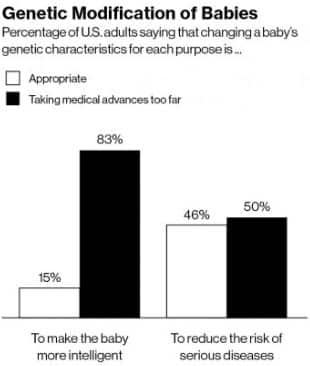
How thrilled is the general population about this sort of genetic engineering in humans? This thrilled:
Source: MIT
So almost 50% of people think that it’s okay to go mucking around and editing our germline as a species. The Chinese have already started researching this area though
everyone was up in arms over it. That’s crazy to think about. Right now
we are on the cusp of an era where we can essentially start to play
God. We’re already creating synthetic organisms at a massive scale. We’re doing things like taking bacteria and genetically modifying them so that they literally “sweat” biofuels. We’ve create an army of robots driven by artificial intelligence that are genetically modifying organism to save companies 10s of millions of dollars a year. We’re pretty sure that Stage 1 will eventually happen because disease is bad, right? The future seems bright and the opportunities endless. Fist tap Big Don.
aljazeera |Trump is the late Shah of Iran and the late Saddam Hussein of
Iraq put together. Trump is every single Arab general or dictator the US
has befriended and kept in power.
These and scores of other nasty, brutish, vile and vulgar
dictators are - and have been - supported, endorsed, kept in power, and
used and abused to serve the US and its favourite settler colony Israel
military and economic might, and they all fall into the category of
Roosevelt's "our sons of bitches".
"Yes, it would be worthwhile to study clinically, in detail, the
steps taken by Hitler and Hitlerism," Aime Cesaire said famously in his
Discourse on Colonialism, "and to reveal to the very
distinguished, very humanistic, very Christian bourgeois of the 20th
century that without his being aware of it, he has a Hitler inside him,
that Hitler inhabits him, that Hitler is his demon, that if he rails
against him, he is being inconsistent and that, at bottom, what he
cannot forgive Hitler for is not crime in itself, the crime against man,
it is not the humiliation of man as such, it is the crime against the
white man, the humiliation of the white man, and the fact that he
applied to Europe colonialist procedures which until then had been
reserved exclusively for the Arabs of Algeria, the coolies of India, and
the niggers of Africa."
Cesaire anticipated Trump and reaction to Trump too, for Trump is now
equally poised to do to America what Mussolini did in Libya, King
Leopoldo II in the Congo, the French in Algeria, the British in India,
the Spaniards in the Americas, the Israelis in Palestine. Obama is not
happy with Trump. He and his wife Michelle Obama and the entire
Democratic Party and liberal stalwarts like Elizabeth Warren are really
concerned what Trump might do to America what they have done to the
world at large.
Trump is the nasty Mr Hyde hiding inside the lovely looking Dr Barack Jekyll Obama, coming out unexpectedly for a house call.
Liberal America is up in arms capturing their Mr Hyde, hiding
it inside President Hillary Rodham Clinton in the White House so she can
do as US presidents habitually do, ripping the world to pieces and
keeping the liberal heart of this empire bleeding for "peace on earth"
just in time for next Christmas.
WaPo | The cost of WikiLeaks’s disclosures to our national security is
unfathomable. As former CIA and NSA director Michael Hayden has put it,
“We will never know who will now not come forward, who will not provide
us with life-saving information” because of WikiLeaks, “but we can be
certain that the cost will be great. And foreign intelligence services,
with whom we have established productive and legitimate partnerships,
will ask, ‘Can I trust the Americans to keep anything secret?’ ”
For
these and other crimes, Assange should be in jail. But instead, he is
being given sanctuary by the left-wing, anti-American government of
Ecuador. Moreover, let’s not forget that Assange is attacking Hillary
Clinton not because he thinks she is a corrupt liberal, but because he
believes that she is too interventionist. “She’s palled up with the
neocons responsible for the Iraq War,” Assange recently told Megyn
Kelly, “and she’s grabbed on to this kind of neo-McCarthyist hysteria
about Russia.” Assange wants the United States to pull back from Iraq
and Afghanistan and stop criticizing Russian President Vladimir Putin —
not exactly conservative priorities.
While the conservative
embrace of Assange is troubling, the hypocrisy displayed by some in the
media in not fully covering WikiLeaks’s Clinton revelations are equally
galling. They had no problem reporting on WikiLeaks’s revelations of
highly classified national security information, falling over themselves
to publish what amounts to espionage porn. But according to
the Media Research Center, between Oct. 7 and Oct. 13, “the morning and
evening news shows on ABC, CBS and NBC dedicated 4 hours and 13 minutes
to discussing the recent allegations of sexual misconduct surrounding
Donald Trump’s campaign,” while “the continual release of the WikiLeaks
emails from top Hillary staff [got] a comparatively puny 36 minutes of
coverage .” That is a ratio of 7 to 1. And much of that meager coverage
has been focused not on the revelations themselves, but on how the
emails were hacked and leaked.
The Clinton campaign has a clear
strategy for tamping down coverage of WikiLeaks — to paint the
revelations as an assault on American democracy. As Clinton put it
during the final debate, “What’s really important about WikiLeaks is
that the Russian government has engaged in espionage against Americans.
. . . Then they have given that information to WikiLeaks for the purpose
of putting it on the Internet . . . in an effort . . . to influence our
election.”
The Clinton machine’s message to the media: If you play down the
WikiLeaks revelations, you are not playing down bad news for Hillary
Clinton. No, you are defending democracy! You are refusing to help
Russia influence a U.S. election! You are morally free to ignore these
stories.
If members of the media were willing to use WikiLeaks’s
material when it was releasing top-secret intelligence, then they should
devote the same attention to WikiLeaks’s revelations about Clinton. And
while conservatives are understandably appalled by what we have learned
about Clinton from those emails, we should not forget the source.
Julian Assange is no friend of the United States. He is a left-wing
activist who heads a criminal enterprise operating out of the embassy of
an anti-American government.
RoyalSociety |Since we launched in 2014, the Royal Society’s broad interest open access journal Royal Society Open Science has been publishing high-quality research across the biological sciences, engineering and mathematics.
The journal is at the forefront of the Society’s mission to
disseminate high-quality science regardless of topic or likely impact,
and includes innovative features such as optional open peer review and Registered Reports.
As a broad interest journal, we’ve published many papers that have excited readers, and to celebrate Open Access Week, we wanted to share with you some of our most frequently read papers. We hope you’ll enjoy reading them as much as we have!
medialens | Consider the third of the claims: that 'All her life' Clinton 'has
fought the feminist cause', according to Toynbee, and is 'a proud
feminist woman', according to Penny.
So what is feminism? The dictionary definition is straight forward
enough: 'the advocacy of women's rights on the ground of the equality of
the sexes'. Wikipedia summarises the goal:
'to define, establish, and achieve equal political, economic,
personal, and social rights for women. This includes seeking to
establish equal opportunities for women in education and employment.
Feminists typically advocate or support the rights and equality of
women.'
Hannah McAtamney added an important observation on Huffington Post:
'Feminism is not the belief that one gender should be raised in power
above another. The very definition of feminism shows a complete
opposition to this belief.'
This is key: feminism is indeed in 'complete opposition' to the idea
that one gender should be raised in power above another. And yet it
could hardly be clearer from Clinton's ruthless service to elite power,
notably the military industrial complex, and from her leading role in
the destruction of whole countries like Libya, Honduras and Syria, that
she does just that. Clinton has certainly acted to ensure that the
interests of elite Western men and women are 'raised in power above' men
and women in these target countries.
A high-level state executive who manages a system that destroys and damages millions of lives in systematically subordinating both men and women
to state-corporate power cannot be described as a representative of
'centrist soft-liberal feminism', if the words have any meaning.
We strongly support authentic feminism as an obviously just response
to the inequality, exploitation, prejudice and violence facing women the
world over. The deepest support for equality of the sexes is found in
the practice of 'equalising self and others' propounded by many ancient
spiritual traditions, notably Mahayana Buddhism. This 'equalising'
begins when we accept that no person's happiness or suffering can be
considered more or less important than anyone else's. It is obviously
irrational and unfair to suggest that 'my' happiness matters more than
'your' happiness. When we reflect repeatedly on this equality of
importance, we can actually come to feel a sense of outrage at the idea
that 'I' should benefit at 'your' expense. 'I' can actually come to take
'your' side against 'my' own egotism.
From this perspective, it is absurd to suggest that a woman's
suffering matters less than a man's.
Similarly, it is absurd to suggest
that the suffering of a Libyan or Honduran man or woman matters less
than that of a male or female member of the American 1%.
The idea that Clinton is a 'feminist', that her presidency would
represent a victory for feminism, is a fraud. In reality, it would
involve the exploitation of that vital cause by violent, greed-based
power.
TheAtlantic | Clinton’s policy framework diverged
with that of his Republican predecessors in many ways, not just on
social policy but also on raising marginal tax rates on the wealthy. In
terms of concentrations of power in the private sector, however, it was
more a completion of what Reagan did than a repudiation of it.
From
telecommunications to media to oil to banking to trade, Clinton
administration officials—believing that technology and market forces
alone would disrupt monopolies—ended up massively concentrating power in
the corporate sector. They did this through active policy, repealing
Glass-Steagall, expanding trade through NAFTA, and welcoming China’s
entrance into the global-trading order via the World Trade Organization.
But corporate concentration also occurred in less-examined ways, like
through the Supreme Court and defense procurement. Clinton Library
papers, for example, reveal that the lone Senate objection to the
Supreme Court nominations of both Stephen Breyer and Ruth Bader Ginsburg
was from a lurking populist Ohio Democrat, Howard Metzenbaum, who
opposed the future justices’ general agreement with Bork on competition
policy. And in response to the end of the Cold War, the administration
restructured the defense industry, shrinking the number of prime defense
contractors from 107 to five. The new defense-industrial base, now
concentrated in the hands of a few executives, stopped subsidizing key
industries. The electronics industry was soon offshored.
But
who could argue? The concentration of media and telecommunications
companies happened concurrent with an investment boom into the newest
beacon of progress: the internet. The futurism, the political coalition
of the multiethnic cosmopolitans, the social justice of the private
centrally planned corporation—it worked. Clinton’s “Third Way” went
global, as political leaders abroad copied the Clinton model of success.
A West Wing generation learned only Watergate Baby politics, never realizing an earlier progressive economic tradition had even existed.
Despite
this prosperity, in 2000, the American people didn’t reward the
Democrats with majorities in Congress or an Oval Office victory. In
particular, the rural parts of the country in the South, which had been a
traditional area of Democratic strength up until the 1970s, were
strongly opposed to this new Democratic Party. And white working-class
people, whom Dutton had dismissed, did not perceive the benefits of the
“greatest economy ever.” They also began to die. Starting in 1998 and
continuing to this day, the mortality rate among white Americans,
specifically those without a high school-degree, has been on the
rise—leaving them scared and alienated.
Old problems also
reemerged. Financial crises unseen since the 1920s began breaking out
across the world, from Mexico to East Asia, prompted by “hot-money”
flows. Deflation, rather than inflation, and a capital glut, rather
than a capital shortage, started to concern policymakers. And it turns
out, according to a McKinsey study, that a disproportionately large
amount of the productivity gains from the remarkable computerization of
the economy were the result of just one company: Walmart, the new A&P. The mega store’s economic influence
“reached levels not seen by a single company since the 19th-century.”
The gains of the 1990s, it turns out, were not structural, but illusory.
Early in Bush’s term, the stock-market bubble burst and wages
collapsed. A few years later, a global banking crisis, induced by a
financial sector that had steadily gained power for 40 years, erupted.
Concentration of power in the private sector, it turned out, had its
downsides.
Two decades ago, the conservative social scientist Charles Murray co-wrote “The Bell Curve,” which argued that inherited I.Q., ethnicity, and professional success are strongly connected, thereby dooming government efforts to educate poor Americans into the middle class. The book generated great controversy, including charges of racism, and some of its methodology was exposed as flawed. In a more recent book, “Coming Apart,” Murray focusses on the widening divide between a self-segregated white upper class and an emerging white lower class. He concludes that “the trends signify damage to the heart of American community and the way in which the great majority of Americans pursue satisfying lives.”
Murray lives in Burkittsville, Maryland, an hour and a quarter’s drive from Washington, D.C. It’s a virtually all-white town where elements of the working class have fallen on hard times. “The energy coming out of the new lower class really only needed a voice, because they are so pissed off at people like you and me,” he said. “We so obviously despise them, we so obviously condescend to them—‘flyover country.’ The only slur you can use at a dinner party and get away with is to call somebody a redneck—that won’t give you any problems in Manhattan. And you can also talk about evangelical Christians in the most disparaging terms—you will get no pushback from that. They’re aware of this kind of condescension. And they also haven’t been doing real well.”
unz | When Putin came to power he inherited a Kremlin every bit as corrupt
and traitor-infested as the White House nowadays. As for Russia, she was
in pretty much the same sorry shape as the Independent Nazi-run
Ukraine. Russia was also run by bankers and AngloZionist puppets and
most Russians led miserable lives. The big difference is that, unlike
what is happening with Trump, the Russian version of the US Neocons
never saw the danger coming from Putin. He was selected by the ruling
elites as the representative of the security services to serve along a
representative of the big corporate money, Medvedev. This was a
compromise solution between the only two parts of the Russian society
which were still functioning, the security services and oil/gas money.
Putin looked like a petty bureaucrat in an ill fitting suit, a shy and
somewhat awkward little guy who would present no threat to the powerful
oligarchs of the semibankirshchina
(the Seven Bankers) running Russia. Except that he turned out to be one
of the most formidable rulers in Russia history. Here is what Putin did
as soon as he came to power:
First, he re-established the credibility of the Kremlin with the
armed forces and security services by rapidly and effectively crushing
the Wahabi insurgency in Chechnia. This established his personal
credibility with the people he would have to rely on to deal with the
oligarchs.
Second, he used the fact that everybody, every single businessman and
corporation in Russia, did more or less break the law during the 1990s,
if only because there really was no law. Instead of cracking down on
the likes of Berezovski or Khodorkovski for their political activities,
he crushed them with (absolutely true) charges of corruption. Crucially,
he did that very publicly, sending a clear message to the other
arch-enemy: the media.
Third, contrary to the hallucinations of the western human rights
agencies and Russian liberals, Putin never directly suppressed any
dissent, or cracked down on the media or, even less so, ordered the
murder of anybody. He did something much smarter. Remember that modern
journalists are first and foremost presstitutes, right? By mercilessly
cracking down on the oligarchs Putin deprived the presstitutes of their
source of income and political support. Some emigrated to the Ukraine,
others simply resigned, and a few were left like on a reservation or a
zoo on a few very clearly identifiable media outlets such as Dozhd TV, Ekho Moskvy Radio or the newspaper Kommersant.
Those who emigrated became irrelevant, as for those who stayed in the
“liberal zoo” – they were harmless has they had no credibility left.
Crucially, everybody else “got the message”. After that, all it took is
the appointment a few real patriots (such as Dmitri Kiselev, Margarita
Simonian and others) in key positions and everybody quickly understood
that the winds of fortune had now turned.
Fourth, once the main media outlets were returned back to sanity it
did not take too long for the “liberal” (in the Russian sense, meaning
pro-USA) parties to enter into a death-spiral from which they have never
recovered. That, in turn, resulted in the ejection of all “liberals”
form the Duma which now has only 4 parties, all of them more or less
“patriotic”.
That’s the part that worked.
So far, Putin failed to eject the 5th columnists, whom I call the
“Atlantic Integrationists” (for details, including their names, see here) from the government itself.. Even the notorious Alexei Kudrin was not fired by Putin, but by Medvedev. The security services succeeded in finally getting rid of Anatolii Serdyukov but they did not have power needed to put him in jail. I still think that a purge will happen while Alexander Mercouris disagrees.
Whatever may be the case, what is certain is that Putin has not tackled
the 5th columnists in the banking/finance sector and that the latter
have been very careful not to give him a pretext to take action against
them.
Russia and the USA are very different countries, and no recipe can
simply be copied from one to another. Still, there are valuable lessons
from the “Putin model” for Trump, not the least of which that his most
formidable enemies probably are sitting in the Fed. One Russian analyst –
Rostislav Ishchenko – has suggested that Trump could somehow force the
Fed to increase interest rates, which would result in a bankruptcy
domino effect for US banks which might be the only way to finally crush
the Fed and re-take control of US banking. Maybe. I honestly am not
qualified to have an opinion about that.
unz | Once we recognize that weakening the media is a primary strategic
goal, an obvious corollary is that other anti-establishment groups
facing the same challenges become natural, if perhaps temporary, allies.
Such unexpected tactical alliances may drawn from across a wide range
of different political and ideological perspectives—Left, Right, or
otherwise—and despite the component groups having longer-term goals that
are orthogonal or even conflicting. So long as all such elements in
the coalition recognize that the hostile media is their most immediate
adversary, they can cooperate on their common effort, while actually
gaining additional credibility and attention by the very fact that they
sharply disagree on so many other matters.
The media is enormously powerful and exercises control over a vast
expanse of intellectual territory. But such ubiquitous influence also
ensures that its local adversaries are therefore numerous and
widespread, all being bitterly opposed to the hostile media they face on
their own particular issues. By analogy, a large and powerful empire
is frequently brought down by a broad alliance of many disparate
rebellious factions, each having unrelated goals, which together
overwhelm the imperial defenses by attacking simultaneously at multiple
different locations.
A crucial aspect enabling such a rebel alliance is the typically
narrow focus of each particular constituent member. Most groups or
individuals opposing establishment positions tend to be ideologically
zealous about one particular issue or perhaps a small handful, while
being much less interested in others. Given the total suppression of
their views at the hands of the mainstream media, any venue in which
their unorthodox perspectives are provided reasonably fair and equal
treatment rather than ridiculed and denigrated tends to inspire
considerable enthusiasm and loyalty on their part.
So although they may
have quite conventional views on most other matters, causing them to
regard contrary views with the same skepticism or unease as might anyone
else, they will usually be willing to suppress their criticism at such
wider heterodoxy so long as other members of their alliance are willing
to return that favor on their own topics of primary interest.
NYTimes | Imagine receiving a phone call from your aging mother seeking your help because she has forgotten her banking password.
Except it’s not your mother. The voice on the other end of the phone call just sounds deceptively like her.
It
is actually a computer-synthesized voice, a tour-de-force of artificial
intelligence technology that has been crafted to make it possible for
someone to masquerade via the telephone.
Such a situation is still science fiction — but just barely. It is also the future of crime.
The
software components necessary to make such masking technology widely
accessible are advancing rapidly. Recently, for example, DeepMind, the
Alphabet subsidiary known for a program that has bested some of the top
human players in the board game Go, announced
that it had designed a program that “mimics any human voice and which
sounds more natural than the best existing text-to-speech systems,
reducing the gap with human performance by over 50 percent.”
The
irony, of course, is that this year the computer security industry,
with $75 billion in annual revenue, has started to talk about how
machine learning and pattern recognition techniques will improve the
woeful state of computer security.
But there is a downside.
“The
thing people don’t get is that cybercrime is becoming automated and it
is scaling exponentially,” said Marc Goodman, a law enforcement agency
adviser and the author of “Future Crimes.” He added, “This is not about
Matthew Broderick hacking from his basement,” a reference to the 1983
movie “War Games.”
The
alarm about malevolent use of advanced artificial intelligence
technologies was sounded earlier this year by James R. Clapper, the
director of National Intelligence. In his annual review of security, Mr.
Clapper underscored the point that while A.I. systems would make some
things easier, they would also expand the vulnerabilities of the online
world.
Claude's constitution and other matters AI
-
Ross Douthat, Is Claude Coding Us Into Irrelevance? *NYTimes*, 2.12.26.
Are the lords of artificial intelligence on the side of the human race?
That’s t...
Celebrating 113 years of Mama Rosa McCauley Parks
-
*February 4, 1913 -- February 4, 2026*
*Some notes: The life of the courageous activist Mama Rosa McCauley Parks*
Mama Rosa's grandfather Sylvester Ed...
Monsters are people too
-
Comet 3I/Atlas is on its way out on a hyberbolic course to, I don't know
where. I do know that 1I/Oumuamua is heading for the constellation Pegasus,
and ...
Remembering the Spanish Civil War
-
This year marks the 90th anniversary of the launch of the Spanish Civil
War, an epoch-defining event for the international working class, whose
close study...
Return of the Magi
-
Lately, the Holy Spirit is in the air. Emotional energy is swirling out of
the earth.I can feel it bubbling up, effervescing and evaporating around
us, s...
Covid-19 Preys Upon The Elderly And The Obese
-
sciencemag | This spring, after days of flulike symptoms and fever, a man
arrived at the emergency room at the University of Vermont Medical Center.
He ...
-
(Damn, has it been THAT long? I don't even know which prompts to use to
post this)
SeeNew
Can't get on your site because you've gone 'invite only'?
Man, ...
First Member of Chumph Cartel Goes to Jail
-
With the profligate racism of the Chumph Cartel, I don’t imagine any of
them convicted and jailed is going to do too much better than your run of
the mill ...