zerohedge | Just as was evidenced after the 2007 shootings at Virginia Tech,
after Columbine and Tucson in 2011, and following the theater shootings
in Aurora, Colorado in 2012, US gun sales have soared following the mass-shooting at Umpqua Community College in Oregon, which killed 10 people and injured seven others. As The FT reports, gun sales this year could surpass the record set in 2013, when gun purchases surged after the December 2012 Sandy Hook murders.
Business has been brisk for Larry Hyatt, owner of Hyatt Guns in North Carolina, since the Oregon community college shooting last week that left 10 people dead, including the 26-year-old suspect.
Mr Hyatt saw an even bigger surge in customers after the 2012 massacre at Sandy Hook Elementary School in Connecticut that left 26 people dead, including 20 children, before the gunman killed himself.
...
However, the calls for tighter gun laws lead to an increase in weapons sales. “Once the public hears the president on the news say we need more gun controls, it tends to drive sales,”
said Mr Hyatt, who owns one of the largest gun retailers in the US.
“People think, if I don’t get a gun now, it might be difficult to get
one in the future. The store is crowded.”
“We don’t want our business to be based on tragedy but we have to deal with what we have no control over,” Mr Hyatt said. “And after these shootings and then the calls for tougher gun laws, we see a buying rush.”
In the first nine months of this year, 15.6m of the
background checks needed to purchase guns from federally licensed
sellers have been processed, compared with the 15.5m applications in the
same period in 2013, according to the National Instant Criminal Background Check System.
Strong sales this year have also boosted the earnings for the two of the largest gun manufacturers in the US. Smith & Wesson and Sturm, Ruger & Co have seen their stocks rise this year by over 88% and 67% respectively.
yahoo | Kitchens that are
shared between office workers may soon be banned from storing pork
products like sausage rolls over fears that they are “offensive”.
New
guidelines proposed by interfaith group CoExist House say that
employers should consider worker’s religions before allowing ham
sandwiches placed in the fridge alongside other products. The group also suggests that alcohol should not be served at corporate events in case it upsets members of certain faiths.
Andy
Dinham, professor of faith and public policy at Goldsmiths, University
of London, is writing up the guidelines that will be put forward to
employers this week.
Defending
the controversial report, he told The Sunday Times: “It would be good
etiquette to avoid heating up foods that might be prohibited for people
of other faiths.
"The microwaves example is a good one.
“We also say, ‘Don’t put kosher or halal and other… special foods next to another [food] or, God forbid, on the same plate.”
He also said that religious people should be entitled to wear religious clothing and symbols as required.
He
added: "We have lost the ability to talk about religious belief because
of a century of secular assumptions, and most religious belief is
either highly visible and we don’t recognise it, or it’s invisible and
we miss it entirely.”
theatlantic |The ACLU of Southern California
has been working to understand how many people have been killed by law
enforcement in America’s most populous state. What they found is
alarming. Over a six-year period that ended in 2014, California’s
Department of Justice recorded 610 instances of law enforcement
committing homicide “in the process of arrest.”
That figure
is far from perfect. It excludes some homicides in 2014 that are still
being investigated. And it understates the actual number of people
killed by police officers and sheriffs deputies in other ways. For
example, after Dante Parker was mistaken for a criminal, stunned with a Taser at least 25 times, hog-tied face down, and denied medical care, California authorities classified his death as “accidental.”
Still, the official number is 610 homicides attributed to law enforcement “in the process of arrest.”
Officially, 608 are classified as
justified. Just two are officially considered unjustified. In one
unjustified killing, there’s video of a policeman shooting Oscar Grant in the head as he lay face down in a BART station. In the other, there is extended video of police brutally beating a mentally ill man, Kelly Thomas, to death.
Officially speaking, only police officers who were being filmed killed people in unjustified ways. Whether law enforcement performs less professionally when cameras are rolling is unclear.
But it seems more likely that the spread of digital-recording
technology will reveal that unjust killings are more common than was
previously thought.
downwithtyranny | It may be a see-saw course, but it's riding an uphill train.
A bit ago I wrote, regarding climate and tipping points:
The concept of "tipping point" — a change beyond which there's no
turning back — comes up a lot in climate discussions. An obvious tipping
point involves polar ice. If the earth keeps warming — both in the
atmosphere and in the ocean — at some point a full and permanent melt of
Arctic and Antarctic ice is inevitable. Permanent ice first started
forming in the Antarctic about 35 million years ago, thanks to global
cooling which crossed a tipping point for ice formation. That's not very
long ago. During the 200 million years before that, the earth was too
warm for permanent ice to form, at least as far as we know.
We're now going the other direction, rewarming the earth, and permanent
ice is increasingly disappearing, as you'd expect. At some point,
permanent ice will be gone. At some point before that, its loss will be
inevitable. Like the passengers in the car above, its end may not have
come — yet — but there's no turning back....
I think the American Southwest is beyond a tipping point for available fresh water. I've written several times — for example, here
— that California and the Southwest have passed "peak water," that the
most water available to the region is what's available now. We can
mitigate the severity of decline in supply (i.e., arrest the decline at a
less-bad place by arresting its cause), and we can adapt to whatever
consequences can't be mitigated.
But we can no longer go back to plentiful fresh water from the Colorado
River watershed. That day is gone, and in fact, I suspect most in the
region know it, even though it's not yet reflected in real estate
prices.
Two of the three takeaways from the above paragraphs are these:
"California and the Southwest have passed 'peak water'" and "most in the
region know it." (The third takeaway from the above is discussed at the
end of this piece.)
"For the first time in 120 years, winter average minimum temperature in the Sierra Nevada was above freezing"
My comment, that "most in the region know it," is anecdotal. What you're about to read below isn't. Hunter Cutting, writing at Huffington Post, notes (my emphasis):
With Californians crossing their fingers in hopes of a super El NiƱo to help end the state's historic drought,
California's water agency just delivered some startling news: for the
first time in 120 years of record keeping, the winter average minimum
temperature in the Sierra Nevada was above freezing. And across the
state, the last 12 months were the warmest on record. This explains why
the Sierra Nevada snow pack that provides nearly 30% of the state's
water stood at its lowest level in at least 500 years this last winter
despite precipitation levels that, while low, still came in above recent
record lows. The few winter storms of the past two years were warmer
than average and tended to produce rain, not snow. And what snow fell
melted away almost immediately.
Thresholds matter when it comes to climate change. A small
increase in temperature can have a huge impact on natural systems and
human infrastructure designed to cope with current weather patterns and
extremes. Only a few inches of extra rain can top a levee protecting
against flood. Only a degree of warming can be the difference between ice-up and navigable water, between snow pack and bare ground.
cbslocalsanfrancisco | California’s four year drought has the whole state in a water
crisis, but no area has been harder hit than the state’s Central Valley,
where the wells have run dry.
In the small town of Okieville, in Tulare County, residents are struggling to stay in their homes.
At Myra Marquez’s house, she checks the gauge on her 2500 gallon
water tank before she touches a faucet. The tank gets filled every
Monday.
Rationing 2000 gallons over five or six days is tough.
“It’s hard,” she said.
It’s become the way of life in Okieville, which has about 90
residents. The town was named after the people who migrated there in the
1930s during the Dust Bowl.
Homes like Marquez’s are stacked with boxes of drinking water, and
trucks haul in more to fill tanks, funded by the state’s Emergency
Drought Relief Program.
“So without this (tank), you know, we can’t take a shower. We can’t
wash clothes. We can’t do anything without it,” says Marquez.
In Tulare County, nearly 1700 household wells are dry. That’s more than all other counties combined.
Gilbert Arrendondo ran a pipe three blocks to tap into a neighbor’s well when his dried up last year.
“I’ve never seen this happen before because they would drill down and find a way to help us out,” said Arrendondo.
WaPo |“We know that states with the most gun laws tend to have the fewest gun deaths. So the notion that gun laws don’t work, or just will make it harder for law-abiding citizens and criminals will still get their guns is not borne out by the evidence.”
The
right the Court announces [in Heller] was not “enshrined” in the Second
Amendment by the Framers; it is the product of today’s law-changing
decision. . . . Until today, it has been understood that legislatures
may regulate the civilian use and misuse of firearms so long as they do
not interfere with the preservation of a well-regulated militia. The
Court’s announcement of a new constitutional right to own and use
firearms for private purposes upsets that settled understanding . . .
Justice Stevens and his colleagues were not saying, a mere seven years ago, that the gun-control legislation in dispute in Heller alone was constitutional within the confines of the Second Amendment. They were asserting that essentially every kind of legislation
concerning guns in the hands of individuals was compatible with the
Second Amendment—indeed, that regulating guns in individual hands was
one of the purposes for which the amendment was offered.
So
there is no need to amend the Constitution, or to alter the historical
understanding of what the Second Amendment meant. No new reasoning or
tortured rereading is needed to reconcile the Constitution with common
sense. All that is necessary for sanity to rule again, on the question
of guns, is to restore the amendment to its commonly understood meaning
as it was articulated by this wise Republican judge a scant few years
ago. And all you need for that is one saner and, in the true sense,
conservative Supreme Court vote. One Presidential election could make
that happen.
csmonitor | But there’s one topic that’s not getting enough discussion, he and
some others say: masculinity. “The elephant in the room with ... mass
shootings is that almost all of them are being done by men,” Professor
Kilmartin says. Male shooters often “project their difficulties onto
other people.... In this case, it sounds like he was blaming Christians
for his problems, but the masculinity piece is what is really missing in
the discussions about the equation.”
Men are often raised to be
stoic, to suppress emotions rather than understand them, and when they
struggle, often the only emotion that they see as sufficiently masculine
to express is anger, says Jon Davies, director of the McKenzie River
Men's Center in Eugene, Ore., and a former psychologist at the
University of Oregon. On top of that, he says, “it’s impossible to reach
the ideal of what it means to be a man.”
Fortunately, the vast
majority of men get enough support in their lives that those societal
pressures don’t turn into mass violence.
While mass shooters are
often seen as “outliers or oddballs ... we should actually think of them
as conformists,” says Tristan Bridges, a sociologist at The College at
Brockport, State University of New York, citing research on masculinity
by expert Michael Kimmel. “They’re over-conforming to masculinity,
because they perceive themselves, in some way or another, as
emasculated.... It’s a terrible statement about American masculinity, to
say that when you’re emasculated, one way to respond is to open fire.”
pbs | Zeno’s paradox is solved, but the question of whether there is a
smallest unit of length hasn’t gone away. Today, some physicists think
that the existence of an absolute minimum length could help avoid
another kind of logical nonsense; the infinities that arise when
physicists make attempts at a quantum version of Einstein’s General
Relativity, that is, a theory of “quantum gravity.” When physicists
attempted to calculate probabilities in the new theory, the integrals
just returned infinity, a result that couldn’t be more useless. In this
case, the infinities were not mistakes but demonstrably a consequence of
applying the rules of quantum theory to gravity. But by positing a
smallest unit of length, just like Zeno did, theorists can reduce the
infinities to manageable finite numbers. And one way to get a finite
length is to chop up space and time into chunks, thereby making it
discrete: Zeno would be pleased.
He would also be confused. While almost all approaches to quantum
gravity bring in a minimal length one way or the other, not all
approaches do so by means of “discretization”—that is, by “chunking”
space and time. In some theories of quantum gravity, the minimal length
emerges from a “resolution limit,” without the need of discreteness.
Think of studying samples with a microscope, for example. Magnify too
much, and you encounter a resolution-limit beyond which images remain
blurry. And if you zoom into a digital photo, you eventually see single
pixels: further zooming will not reveal any more detail. In both cases
there is a limit to resolution, but only in the latter case is it due to
discretization.
In these examples the limits could be overcome with better imaging
technology; they are not fundamental. But a resolution-limit due to
quantum behavior of space-time would be fundamental. It could not be
overcome with better technology.
So, a resolution-limit seems necessary to avoid the problem with
infinities in the development of quantum gravity. But does space-time
remain smooth and continuous even on the shortest distance scales, or
does it become coarse and grainy? Researchers cannot agree.
ted |the future is looking back 200 years,because next week is the 200th anniversary of Darwin's birth.And it's the 150th anniversary of the publication of "The Origin of Species."And Darwin, of course, argued that evolution is a natural state.It is a natural state in everything that is alive, including hominids.There have actually been 22 species of hominidsthat have been around, have evolved, have wandered in different places,have gone extinct.It is common for hominids to evolve.And that's the reason why, as you look at the hominid fossil record,erectus, and heidelbergensis, and floresiensis, and Neanderthals,and Homo sapiens, all overlap.The common state of affairs is to have overlapping versions of hominids,not one.
17:08
And as you think of the implications of that,here's a brief history of the universe.The universe was created 13.7 billion years ago,and then you created all the stars, and all the planets,and all the galaxies, and all the Milky Ways.And then you created Earth about 4.5 billion years ago,and then you got life about four billion years ago,and then you got hominids about 0.006 billion years ago,and then you got our version of hominids about 0.0015 billion years ago.Ta-dah!Maybe the reason for thr creation of the universe,and all the galaxies, and all the planets, and all the energy,and all the dark energy, and all the rest of stuffis to create what's in this room.Maybe not.That would be a mildly arrogant viewpoint.(Laughter)So, if that's not the purpose of the universe, then what's next?
18:07
I think what we're going to see is we're going to see a different species of hominid.I think we're going to move from a Homo sapiens into a Homo evolutis.And I think this isn't 1,000 years out.I think most of us are going to glance at it,and our grandchildren are going to begin to live it.And a Homo evolutis brings together these three trendsinto a hominid that takes direct and deliberate controlover the evolution of his species, her species and other species.And that, of course, would be the ultimate reboot.
paecon | Almost everyone recognizes that the media plays a crucial role in real
democracies. One must examine the media to understand its role in how
democracies work, including how it both enhances and detracts from how
well any democratic society works. Amartya Sen recognizes this basic
truth in the realms of capabilities, functionings, economics, and
freedom. However, there is a tension between this recognition and the
fact that Sen does not deeply develop the structural and institutional
aspects of the role of the media and of democratic society.
In many of his works, Amartya Sen has correctly pointed out the links
that exist between many kinds of freedom. One of the most important is
the connection between democratic participation, political freedom, and
the structure of the media. This is important because Sen argues that
direct or representative democracy prevents catastrophic famine. (Sen
1999, 2009) He has also forcefully argued that political participation
is important in its own right.
In order to reap the full benefits of democracy, Sen has argued that it
is crucial have a free press that allows for the free flow of ideas.
The free press helps a society decide which policies to pursue, since
these discussions lead to the direct consideration of the goals that
society thinks are worthwhile. These discussions also shape a society,
because they inform citizens how it might be best to pursue goals that
are already settled on. On this point, I agree with Sen.
However, there is a problem. Authors like Robert McChesney have argued
that the ownership structure of media companies limits debate over
economic and political policy. In the U.S., the primary concern seems
to be the potential for corporate censorship, while in other parts of
the world the main problem appears to be government censorship.
For the U.S., the argument goes like this. Media companies such as
Disney, Fox, and Turner have direct economic interests. Large media
companies are large corporations, and they sell advertising to other
large corporations. Management of these large corporations has the
responsibility to run the firms as profitably as they can. This is both
a competitive requirement, and in some ways a legal one. One could
argue that these firms have to please two masters, their shareholders
and their audience. Management is often legally bound to serve
shareholders first in case of a conflict between shareholder interests
and other competing interests, such as those of employees or the
audience. The corporate structure of these firms gives them an economic
incentive to consider the financial consequences to the corporation of
any particular story, regardless of its truth or potential social
importance even if they maintain a strict separation between the news
division and other divisions. Important aspects of any debate over
social, political, and economic policy may be sidestepped because of
corporate organization and the accompanying incentives. For example,
Stromberg (2004) developed a model that describes the links between the
mass media, political competition, and the resulting public policy. The
emergence of the mass media “may introduce a bias in favor of groups
that are valuable to advertisers, which might introduce a bias against
the poor and the old.” (Stromberg 2004, 281)
paecon | As the global crisis deepens and most industrialized and developing
countries continue facing the risk of a prolonged labour market
recession, it is leading to a catastrophic rise in unemployment and
decline in real wages. Several countries have used neoclassical tools
to mitigate this, primarily by moving legislation to have more flexible
labour markets. The oft-repeated neoclassical logic has been that
rigidities in labour markets are the barriers to recovery. The economic
mechanism being that of lowering interest and wage rate to incentivize
private investment; but the plans have not succeeded so far due to a
lack of effective demand. On the other hand, public investment driven
public work projects, by encouraging social participation, can be the
way to stimulate economic recovery and expansion in employment. Along
similar lines, the International Labor Organization (2009) reiterates
that it is crucial to implement a coherent, job-oriented recovery
strategy to address the basic needs of millions workers and their
families, and emphasizes that employment and social protection must be
at the centre of fiscal stimulus measures to protect the vulnerable
groups and to reactivate investment for raising aggregate demand in the
economy.
Public works become closely interlinked to social programs in
contemporary democracies under the tension of various kinds of identity
politics of exclusion and inclusion. It has the potential to alleviate
these tensions and contrariwise, if badly conceived such programs can
also heighten such tensions. This paper explores new frontiers of
public works program from this viewpoint; and investigates how public
work programs can be effective in combating labour market problems in
economically and socially meaningful ways. The paper consists of six
parts. The second part, after this introduction, reviews briefly the
theoretical debate of market mechanism and unemployment related to
classical and Keynesian paradigms regarding voluntary and involuntary
unemployment and their policy implications. Section three draws a clear
distinction between Keynesian demand management and new public works
programs with emphasis on the distinction between demand side and
supply side of the problem. Section four focuses on two issues which
could be the basis for demarcating new employment policies, i.e. public
works programs with and without skill components relating it to
questions of benefits, externality and labour productivity. Section
five discusses the principle of finance sharing of public works
programs and its possible effects on inflation and private investment.
In the last section, we conclude with a discussion of possible
inclusion benefits of newly designed public works programs.
paecon | This article analyses causes of high and persistent income inequality
in the U.S.2 The analysis provides an explanation of the interconnected
factors behind rising income inequality and the upward redistribution
of national income from labour to capital. Followed by a series of
reports about rising inequalities from various International
Organisations (IO) (ILO 2011; UNCTAD 2012; OECD 2011b), the interest
peaked after the publication of the English translation of Piketty’s
(2014) Capital in the Twenty-First Century. The publication triggered a
heated debate and brought widespread attention to the issue also from
non-academic circles ever since. Not surprisingly, there is as much
empirical evidence supporting as broad a variety of arguments as
scholars working on the subject.
The interaction between exogenous and endogenous drivers of inequality
is of particular interest. At first sight the global trend towards
increasing inequality across developed and developing economies
suggests that exogenous forces are the main driver of inequality.
However, the impact of exogenous drivers can be counteracted or
reinforced by national policies and are thus highly country-specific.
For example the experience of most countries in Latin America which
successfully reduced inequality while being subject to the same
exogenous drivers as other countries, suggests that countries do have
the means to reduce inequality. One major influence on inequality are
the policies adopted (or not adopted) by the respective governments.
Those vary considerably across regions and countries and alter the
distribution of income significantly. It is argued that the political
dimension as an endogenous driver of inequality has been neglected to
the benefit of economic-based explanations. Some political scientists
and sociologists have explored possible political explanations of
increasing inequality (DiNardo, Fortin, and Lemieux 1995; Bartels 2010;
DiPrete 2007; Rosenthal 2004), while economists have mostly neglected
the role of the political.
How and to what extent the political dimension has contributed to
increasing inequality has been under-researched. In order to analyse
the political causes of increasing inequality the U.S. has been chosen
as a case study. The research question reads as follows: Which factors
are the main drivers of income inequality in the U.S.? The U.S. is of
particular interest because the country has experienced a sharp
increase of inequality relative to other countries. In addition to that
the U.S. is one of the few countries where continuous and reliable data
is available. This enables the analysis and comparison of the changing
patterns of income inequality from the early 1950s onwards.
Partly, as it is argued, inequality has been caused by politically
induced decisions. Certain policies, such as the decreased support for
unions and tax cuts favouring the relatively well-off and corporations,
have benefitted a small minority of the population at the expense of
the majority and have thus contributed to widening income inequality.
It is argued that this particular type of income inequality leads to
representational inequality. High and persisting inequality in the U.S.
has contributed to the strengthening of an economic elite who have a
vested interest and the means to influence policies accordingly which
increases and perpetuates inequality. This in turn reduces the
purchasing power of the majority of the U.S. population (and hence
aggregate demand). Thus, growth stalls also due to decreasing means of
purchasing goods and services for the majority, or, contributes to
economic and financial instability because the stagnating real wages
are compensated by increasing accumulation of debts (Onaran and Galanis
2013, 88).
cnn | Puerto Ricans feel like second class citizens in the United States.
That's the message Puerto Rico's lone Congressman, Rep. Pedro
Pierluisi, had for his colleagues Tuesday in a harsh rebuke of Congress'
treatment of Puerto Rico.
"If you treat us like second class citizens,
don't expect us to have a first class economy," Pierluisi said to the
Senate Finance Committee in a hearing. "Congress treats Puerto Rico in a
discriminatory fashion under numerous programs."
Puerto Rico owes $72 billion to its creditors and the island's
governor, Alejandro Garcia Padilla, says the debts can't be paid.
High-skilled Puerto Ricans are leaving the island for mainland U.S. for
better-paying jobs.
The commonwealth's government offered an extensive plan to pay back its debt in early September, but even that falls short by $14 billion
of what's needed. The governor is demanding that Puerto Rico have
chapter 9 bankruptcy rights and that its creditors take a steep
discount.
"We cannot allow them to force us to choose between
paying for our police, our teachers, our nurses, and paying our debt,"
Padilla said in a televised announcement on June 29.
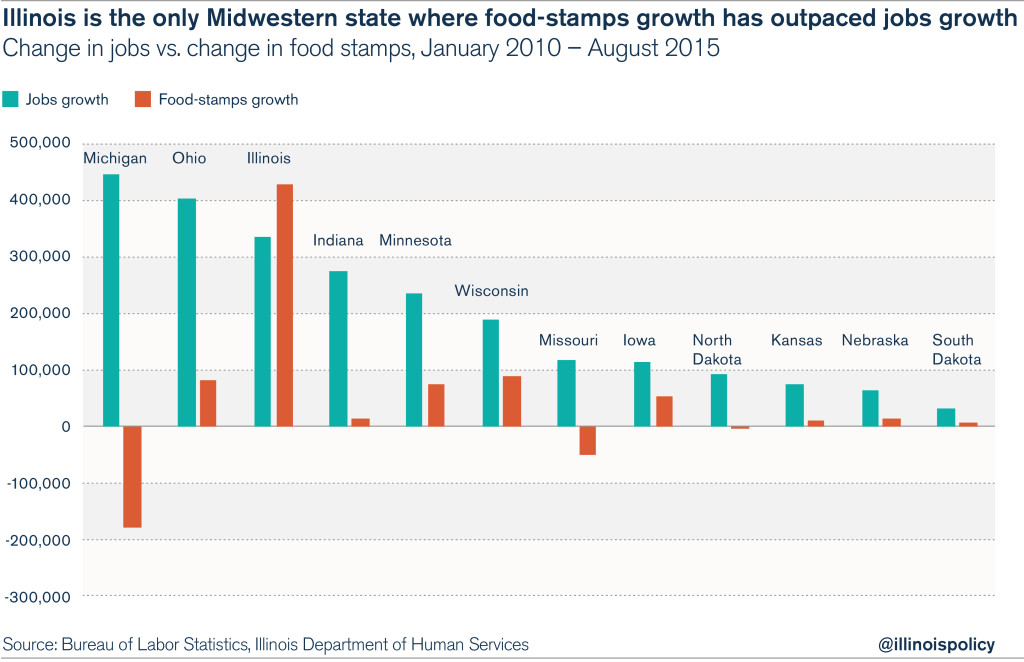
illinoispolicy | Illinois is the only state in the Midwest to have added more people
to food-stamp rolls than to employment rolls during the recovery from
the Great Recession. Job losses from the Great Recession occurred from
January 2008 to January 2010, and since then, states have had
five-and-a-half years of recovery.
During the recovery from the Great Recession, the Land of Lincoln,
alone in the Midwest, had more people enter the food-stamps program than
start jobs. Food-stamps growth in Illinois has outpaced jobs creation
by a 5-4 margin.
In every other Midwestern state, jobs growth has dramatically outpaced
food-stamps growth during the recovery. In fact, in every other state in
the region, jobs growth dwarfs food-stamps growth. But during the
recovery, Illinois put more people on food stamps than every other
Midwestern state combined.
The result for Illinois factory workers? The Land of Lincoln has put
25 people on food stamps for every manufacturing job created during the
recession recovery.
theatlantic | Cash-strapped cities have long looked
at privatizing services or selling off assets as a way to save money,
but Chicago in particular has a spotty record with the practice. In a
move orchestrated by Emanuel’s predecessor, Richard Daley, the city sold
off its parking meters to a private firm, allowing the company to reap
the revenues in exchange for a one-time, upfront payment. But the deal
has been widely criticized as a loser for the Windy City. The firm has already made
well over half as much revenue as the $1.2 billion lump sum it paid to
Chicago, and it will continue to earn 100 percent of the revenue for
nearly seven more decades under the agreement. Selling off the parking
meters and privatizing services is like “burning your furniture to heat
your house,” said Anders Lindall, a spokesman for the AFSCME Council
31, the union that represents city employees.
Emanuel,
a Democrat, ran for office criticizing the parking-meter deal, and in
his budget speech last week he specifically pledged not to sell off city
assets. That sale, and the political blowback it generated, is now
cited as a cautionary tale for mayors nationwide and has slowed the move
to privatization that began more than a decade ago.
“I think
since then the enthusiasm for privatization has tempered somewhat,” said
Ron Littlefield, the former mayor of Chattanooga, Tennessee.
Littlefield, who left office two years ago, told me that when they
looked at privatizing services, they focused on those “that don’t touch
citizens directly.”
In some ways, the 311 hotlines have become a
victim of their own success. The more calls come in, the more people you
need to answer the phone. The system had grown so popular in
Chattanooga, a city of 170,000, that the call center frequently ran
behind, Littlefield said, “because you just cant get people to keep up
with the calls.” But rather than outsource its operations, the former
mayor said that, like other cities, Chattanooga focused on encouraging
residents to contact 311 through its mobile app when possible. Reporting
a pot hole, for example, is now as easy as sending a photo with
embedded GPS coordinates—no phone call and no operator needed.
WaPo | Planned Parenthood president Cecile Richards on Tuesday for the first time directly addressed members of Congress about undercover videos purporting to show that the women’s health organization illegally sells fetal tissue for profit, telling members of the House Oversight committee that the allegations are “offensive and categorically untrue.”
At a hearing centering on whether federal funding should continue for the group, Richards forcefully defended her organization, calling it a critical source for cancer screenings, testing and treatment for sexually transmitted diseases, contraception care and other services for millions of women, particularly those who are low-income.
“For many American women, Planned Parenthood is the only health-care provider they will see this year,” she said during her opening testimony. “It is impossible for our patients to understand why Congress is once again threatening their ability to go to the health-care provider of their choice.”
But the hearing quickly turned into a grilling, with Republican lawmakers aggressively questioning Richards on everything from her annual salary to the support of Democratic candidates provided by the group’s political action committee; often delivering rapid-fire questions that left little time for her to respond.
guardian | Jeremy Corbynused his Labour conference speechto call for the Ministry of Justice to drop its bid for a Saudi prisons contract, citing the case of pro-democracy protester, Ali Mohammed al-Nimr, who has been sentenced to crucifixion.
Nimr is facing a death sentence, handed down when he was 17, which is largely based on a “confession” he was forced to sign following what he says were days of torture while in custody.
The sentence will be carried out in jail by the Saudi prison service. Corbyn called on the British government to protest against this sentence by dropping its bid for a £5.9m contract to provide prison expertise to the Saudis.
The bid was put in by Justice Solutions International, the commercial arm of the MoJ that was set up by the last justice secretary, Chris Grayling, to sell its expertise in prisons and probation – including in offender management, payment by results, tagging and privatisation – around the world.
Last month the new justice secretary, Michael Gove announced that he was closing down JSI, telling MPs it was because “of the need to focus departmental resources on domestic priorities”.
Claude's constitution and other matters AI
-
Ross Douthat, Is Claude Coding Us Into Irrelevance? *NYTimes*, 2.12.26.
Are the lords of artificial intelligence on the side of the human race?
That’s t...
Celebrating 113 years of Mama Rosa McCauley Parks
-
*February 4, 1913 -- February 4, 2026*
*Some notes: The life of the courageous activist Mama Rosa McCauley Parks*
Mama Rosa's grandfather Sylvester Ed...
Monsters are people too
-
Comet 3I/Atlas is on its way out on a hyberbolic course to, I don't know
where. I do know that 1I/Oumuamua is heading for the constellation Pegasus,
and ...
Remembering the Spanish Civil War
-
This year marks the 90th anniversary of the launch of the Spanish Civil
War, an epoch-defining event for the international working class, whose
close study...
Return of the Magi
-
Lately, the Holy Spirit is in the air. Emotional energy is swirling out of
the earth.I can feel it bubbling up, effervescing and evaporating around
us, s...
Covid-19 Preys Upon The Elderly And The Obese
-
sciencemag | This spring, after days of flulike symptoms and fever, a man
arrived at the emergency room at the University of Vermont Medical Center.
He ...
-
(Damn, has it been THAT long? I don't even know which prompts to use to
post this)
SeeNew
Can't get on your site because you've gone 'invite only'?
Man, ...
First Member of Chumph Cartel Goes to Jail
-
With the profligate racism of the Chumph Cartel, I don’t imagine any of
them convicted and jailed is going to do too much better than your run of
the mill ...