theatlantic | THAT brings me to the issue of race consciousness. America in Black and White
takes a very strong line in favor of what might be called
"racelessness" for blacks (and whites). The authors castigate a black
high school student for speaking of "my people" in reference to people
of African descent. "His people" should be simply the American people,
they suggest. Would that it were so. Public expressions of racial
solidarity by blacks worry them. They call "racially divisive" a slogan
one used to see on T-shirts -- "It's a black thing, you wouldn't
understand." They go this far: The police in Boston, believing the story
of one Charles Stuart, a white man who alleged that his wife had been
killed by a black, laid down an invasive dragnet seeking the killer in a
largely black community. Later it was learned that Stuart himself had
slain his wife. The Thernstroms argue in this context that the credulity
of the police was understandable, in part because rap-music lyrics
declare all whites to be the enemy, and worthy objects of black
violence.
The Thernstroms know that race relations are not at a
happy juncture in America these days. They discuss the O. J. Simpson
trial, a source of much recent racial disharmony, at length. (All they
can find to say about that enormous expression of race consciousness,
the 1995 Million Man March, is that Minister Louis Farrakhan, who called
the march, gave a bizarre speech.) Their diagnosis of the problem
places great weight on a syllogism that may now be outmoded, proposed
originally by Shelby Steele: Blacks and whites are supposedly locked
into a relationship of mutual psychological dependence and reciprocal
cognitive dissonance. Blacks fear they may be inferior. Whites fear they
may be racist. Blacks want status achievement while avoiding true
competition, which might reveal their inferiority. Whites want to avoid a
confrontation with black claimants over the basis of black status, so
as not to appear to be racist. Blacks convey approval to whites,
certifying them as morally fit; and whites provide status to blacks,
protecting them from the reality of their competitive inadequacies.
This purported symbiosis accounts for blacks' aggressive displays of their sense of grievance. Thus
The relentless pretense that almost all whites are an enemy, that
white racism remains a constant, serves a purpose. It invites whites who
are nervous about their racial rectitude to remain supplicants. The
result is an unending game (black anger, white guilt) in which the white
score is always zero, and the illusion of power is bestowed upon a
group whose members seem to live in constant fear that their hard-earned
status is not quite real -- that they remain the "invisible" men and
women they once so clearly were.
This was a new insight a decade ago. It has not worn well over time, however. Events like the publication of
the 1994 elections, and the passage in California of Proposition 209
raise questions about the power of white guilt to drive political
culture in this country. Is it not enough to cast an eye over the scene
unfolding in inner-city America in order to grasp that blacks have real
reasons to be angry, and that the white score in the game that counts is
positive after all?
The authors of America in Black and White
blame the existence of affirmative action -- in college admissions, in
the drawing of voting districts, in employment -- for an excess of race
consciousness among blacks. This, they say, gives blacks an incentive to
sustain their belief in "the figment of the pigment." The authors
consider recommending that official government bodies do away entirely
with the use of racial categories in economic and social statistics, but
ultimately reject the idea. They note that in 1993 a group of big-city
mayors asked the U.S. Attorney General to cease collecting crime data by
race, because this information was of no use to policy and fostered
harmful stereotypes. These officials reasoned, not without some basis in
experience, that if people are constantly told that most criminals are
black, they may come to think that most blacks are criminal. The
Thernstroms chide these mayors for inconsistency -- the mayors want the
bad racial news suppressed, but welcome the collection of employment or
education data showing that blacks are underrepresented in some
desirable pursuit.
truthdig | Although the United States, in the words of columnist Nicholas
Kristof, is “the most powerful colossus in the history of the world,” it
lags significantly in quality of life for its citizens. In the Social Progress Index 2015
the U.S. does not make the top 10, or even top 15. The global study
measured “basic human needs,” “foundations of wellbeing” and
opportunity.
Overall, the U.S comes in at 16th, and some indices are particularly startling.
As Kristof writes
in The New York Times: “The index ranks the United States 30th in life
expectancy, 38th in saving children’s lives, and a humiliating 55th in
women surviving childbirth. O.K., we know that we have a high homicide
rate, but we’re at risk in other ways as well. We have higher traffic
fatality rates than 37 other countries, and higher suicide rates than
80. We also rank 32nd in preventing early marriage, 38th in the equality
of our education system, 49th in high school enrollment rates and 87th
in cellphone use.”
The top countries in the study are Norway, Sweden, Switzerland, Iceland,
New Zealand and Canada. Of the 133 countries rated, Central African
Republic comes in last, right after Chad and Afghanistan.
“One way of looking at the index,” says Kristof, “is to learn from
countries that outperform by having social indicators better than their
income levels. By that standard, the biggest stars are Costa Rica and
Uruguay, with New Zealand and Rwanda also outperforming.”
In a time of ever-greater economic inequality, it’s worth remembering
that everything isn’t just dandy if some Americans are doing extremely
well. What counts is how we are doing as a people.
UN | The General Assembly today adopted a resolution which for the
twenty-third year in a row called for an end to the United States
economic, commercial and financial embargo on Cuba.
Exposing an intractable demarcation of the international community,
188 Member States voted in favour and, as in previous years, the United
States and Israel voted against. Three small island States — Marshall
Islands, Federated States of Micronesia and Palau — abstained from the
vote.
By the terms of the text, the Assembly reiterated its call upon
States to refrain from promulgating and applying laws and regulations,
such as the 1996 Helms-Burton Act, the extraterritorial effects of which
affected the sovereignty of other States, the legitimate interests of
entities or persons under their jurisdiction and the freedom of trade
and navigation.
It once again urged States that had and continued to apply such laws
to repeal or invalidate them as soon as possible, in line with their
obligations under the United Nations Charter and international law.
In recent times, the blockade imposed by the United States against
Cuba had been tightened, and its extraterritorial implementation had
also been strengthened through the imposition of unprecedented fines,
the Minister for Foreign Affairs of Cuba told the Assembly as he
introduced the draft resolution. The accumulated economic damages of
the blockade totalled $1.1 trillion, based on the price of gold.
The representative of the target of the resolution, the United
States, disagreed with that assessment, saying in a statement explaining
its negative vote that Cuba’s economic woes were due to the policies it
had pursued over the last half century. And while Cuba’s fight against
Ebola was laudable, it did not excuse the country’s treatment of its
own people.
It was a sentiment echoed to some degree by Italy’s representative,
speaking on behalf of the European Union, who after criticizing the
embargo reiterated the Union’s call on the Cuban Government to fully
grant its citizens internationally recognized civil, political and
economic rights and freedoms.
But regionally, Barbados’s representative, speaking on behalf of the
Caribbean Community (CARICOM), chose to focus on how students from
CARICOM countries had benefited from free tertiary education in Cuba,
also noting with appreciation that Cuba was in the process of mobilizing
461 doctors and nurses to West Africa — the largest medical contingent
of any country to help in the fight against Ebola.
DailyMail | The
Cheyenne Mountain Complex is one of the icons of the Cold War - a
self-contained and sufficient town buried under the Rockies meant to be
impervious to a Soviet nuclear barrage.
It
was home to the North American Aerospace Command (NORAD), scanning the
skies for Russian missiles and the military command and control center
of the United States in the event of World War Three.
The
high tech base entered popular culture with appearances in the 1983
Cold War thriller War Games and 1994's Stargate - which imagined the
complex as a clandestine home for intergalactic travel.
It shut down
nearly ten years ago as the threat from Russia seemed to subside, but
this week the Pentagon announced that Cheyenne Mountain will once again
be home to the most advanced tracking and communications equipment in
the United States military.
The
shift to the Cheyenne Mountain base in Colorado is designed to
safeguard the command's sensitive sensors and servers from a potential
electromagnetic pulse (EMP) attack, military officers said.
The
Pentagon last week announced a $700 million contract with Raytheon
Corporation to oversee the work for North American Aerospace Command
(NORAD) and US Northern Command.
Admiral
William Gortney, head of NORAD and Northern Command, said that 'because
of the very nature of the way that Cheyenne Mountain's built, it's
EMP-hardened.'
theatlantic | In Safa al-Ahmad’s new documentary on the pitched battle for Yemen, which aired this week on Frontline,
the Saudi Arabian filmmaker passes by countless posters declaring—and a
number of schoolchildren gleefully chanting—a set of lines that may
sound familiar to Americans who lived through the Iran hostage crisis:
God is great Death to America Death to Israel God curse the Jews Victory to Islam
The chilling slogan belongs to the Houthis, the enigmatic rebel group that has taken over the Yemeni capital Sanaa and other parts of the country, and ousted Yemeni President Abd-Rabbu Mansour Hadi and his government. But the echoes of Iran's revolutionary "Death to America" chant don't necessarily mean, as manyhavesuggested,
that the Houthis are a proxy force for Shia-led Iran in its battle with
Sunni-led Saudi Arabia, which borders Yemen and has now launched air strikes against the Houthis.
The multi-front fight for Yemen—which involves numerous other factions
including al-Qaeda in the Arabian Peninsula and supporters of former
President Ali Abdullah Saleh—is far more complicated than a
straightforward sectarian proxy war, Ahmad says.
vox | The core of the disagreement between Obama and his critics is over
the nature of the Iranian regime. Obama sees an Iranian government
that's hostile now, but one that can potentially be reasoned with on
specific issues if given the right incentives. "Iran may change. If it
doesn’t, our deterrence capabilities, our military superiority stays in
place," he told Tom Friedman
on Sunday. The deal is a "once-in-a-lifetime opportunity to see whether
or not we can at least take the nuclear issue off the table."
The deal's most vocal critics see Iran differently. They see it as essentially malevolent;
a government that's fundamentally hostile to the United States and
Israel by virtue of its very identity as a theocratic Islamist state.
This regime will game any compromise to its advantage, pursuing a
nuclear capability and violent foreign policy so long as it's able.
This isn't a fringe position. You hear it from rank-and-file Republicans on the Hill as well as presidential candidate Ted Cruz and likely presidential candidateMarco Rubio. Netanyahu will tell it to anyone who listens.
If you see Iran in this light, then there's only one real
alternative: crush the Iranians. Cotton has argued American policy in
Iran should be "regime change." Netanyahu's vision of a "better deal" depends on Iran being so beaten down by sanctions that it's essentially willing to give up everything to see them relaxed.
Obama thinks this is all pie-in-the-sky fantasizing. His view, laid
out very clearly at a Thursday press conference, is that war is the only
actual alternative to his deal that could prevent Iran from going
nuclear.
msnbc |Look, we’ve seen this play before, and we have a pretty good
idea how it turns out. When a right-wing neoconservative tells Americans
that we can launch a new military offensive in the Middle East, it
won’t last long, and the whole thing will greatly improve our national
security interests, there’s reason for some skepticism.
Tom Cotton – the guy who told voters last year that ISIS and Mexican drug cartels might team up to attack Arkansans – wants to bomb Iran, so he’s telling the public how easy it would be.
What the senator didn’t talk about yesterday is what happens
after the bombs fall – or even what transpires when Iran shoots back
during the campaign. Are we to believe Tehran would just accept the
attack and move on?
Similarly, Cotton neglected to talk about the broader
consequences of an offensive, including the likelihood that airstrikes
would end up accelerating Iran’s nuclear ambitions going forward.
There’s also the inconvenient detail that the Bush/Cheney administration weighed a military option against Iran, but it concluded
that “a military strike on Iran’s nuclear facilities would be a bad
idea – and would only make it harder to prevent Iran from going nuclear
in the future.”
But don’t worry, America, Tom Cotton thinks this would all be
easy and we could drop our bombs without consequence. What could
possibly go wrong?
WaPo | Iran’s supreme leader expressed pessimism Thursday about a deal
reached last week with six world powers to restrict the country’s
nuclear program, saying he neither supports nor opposes the accord and
demanding that all economic sanctions be lifted immediately upon any
final agreement.
The remarks by Ayatollah Ali Khamenei, Iran’s
ultimate religious and political authority, raised the prospect that
talks on a final accord, following last week’s framework agreement,
could bog down over what he described as “the details” ahead of a June
30 deadline.
In a televised speech marking Iran’s National Day of
Nuclear Technology, Khamenei also ruled out any “extraordinary
supervision measures” over Iran’s nuclear activities and said that
“Iran’s military sites cannot be inspected under the excuse of nuclear
supervision,” the Associated Press reported. But he also repeated his
denials that Iran has any intention of building nuclear weapons, which
he has declared to be forbidden by Islam.
In a separate speech earlier, Iranian President Hassan Rouhani took the
same position on economic sanctions as the supreme leader, saying that
all of them “must be lifted immediately” once a final nuclear deal is
implemented following talks under the framework agreement.
“We will not sign any agreement unless all economic sanctions are
totally lifted on the first day of the implementation of the deal,”
Rouhani said during a ceremony marking the nuclear technology day, which
celebrates the country’s nuclear achievements, AP reported.
FP | Did the Islamic State start a war between Saudi Arabia and Iran? The crisis in Yemen is one of the more complicated stories to emerge from a complicated region. It involves a cyclone of explosive elements: religious extremism, proxy war, sectarian tension, tribal rivalries, terrorist rivalries, and U.S. counterterrorism policies. There is little consensus on which element matters most, although each has its fierce partisans.
There was no shortage of events that could have ignited this volatile situation. Yet one in particular stands out: The March 20synchronized suicide bombingof two mosques in the Yemeni capital of Sanaa, which killed more than 140 people. The mosques were targeted specifically as gathering places for members of Yemen’s Houthi rebels, a political movement withroots in the minority Zaydi sect of Shiite Islam(although the coalition it leads in Yemen coversa number of different parties and issues).
The bombing provided a pretext for an already-surging Houthi rebellion to mass, mobilize, and deploy forces, advancing on the former government’s last major stronghold in the port city of Aden. This in turn prompted Saudi Arabia to begin airstrikes on Houthi positions and mass forces on its border with Yemen in advance of a possible ground invasion.
The Yemen branch of the Islamic State quickly claimed responsibility for the March 20 bombing. The attackwas disavowedalmost as quickly by its rival, al Qaeda in the Arabian Peninsula (AQAP), which said attacking a mosque was inconsistent with the guidelines for jihad put forward by al Qaeda’s increasingly absentee emir, Ayman al Zawahiri, which emphasize avoiding Muslim casualties.
Within Yemen, there are many conspiracy theories about the attack, including that it was carried out by a party (other than Islamic State) with a vested interest in providing a pretext for a Saudi invasion.
It’s getting hard to escape the feeling that the Sanaa bombing might be the Middle East’s “assassination of Archduke Franz Ferdinand” moment — the literal gunshot that has come to serve, if incompletely, as an answer to the question: “How did World War I begin?” (It should be noted that the assassin’s cause, which was more or less independence for Yugoslavia, was more or less achieved as a result of the ensuing war.)
mintpressnews | The UN defines a region as water stressed if the amount of renewable
fresh water available per person per year is below 1,700 cubic metres.
Below 1,000, the region is defined as experiencing water scarcity, and
below 500 amounts to “absolute water scarcity”.
According to the AWWA study, countries already experiencing water
stress or far worse include Egypt, Jordan, Turkey, Iraq, Israel, Syria,
Yemen, India, China, and parts of the United States. Many, though not all, of these countries are experiencing protracted conflicts or civil unrest.
The AWWA is an international scientific association founded to
improve water quality and supply, whose 50,000 strong membership
includes water utilities, scientists, regulators, public health experts,
among others. AWWA operates a partnership with the US government’s
Environment Protection Agency (EPA) for safe water, and has played a key
role in developing industry standards.
Study author Robert Patrick, formerly of PriceWaterhouseCoopers, is a
government consultant and water management specialist who has worked on
water scarcity issues in Jordan, Lebanon, New Mexico, California and
Australia.
His Journal of AWWA paper explains that the grain price spikes that
contributed to Egypt’s 2011 uprising, were primarily caused by “droughts
in major grain-exporting countries” like Australia, triggered by
climate change.
Patrick points out that such civil unrest could signal an Egyptian
future of continuing unrest and conflict. He highlights the risk of war
between Egypt and Ethiopia due to the Grand Ethiopian Renaissance Dam,
threatening to restrict Egypt’s access to the Nile River, which supplies
98% of Egypt’s water supply.
As Egypt’s population is forecast to double to 150 million by 2050,
this could lead to “tremendous tension” between Ethiopia and Egypt over
access to the Nile, especially since Ethiopia’s dam would reduce the
capacity of Egypt’s hydroelectric plant at Aswan by 40%.
royalsocietypublishing | Humans are perhaps the most social animals. Although some
eusocial insects, herd mammals and seabirds live in colonies comprising
millions of individuals, no other species lives in such a variety of
social groups as Homo sapiens. We live in many different sized
societies, from small, nomadic hunter-gatherer societies to cities
consisting of millions of people living in close proximity; we form
special social bonds with kin and many of us make lifelong commitments
to one socio-sexual partner, represented in the shape of a marriage.
Although the fledgling concept of social intelligence was formulated over 50 years ago by Chance & Mead (1953), and more explicitly by Jolly 13 years later (1966), it was perhaps Nick Humphrey's (1976)
seminal paper on the ‘social function of intellect’ that paved the way
for the past 30 years of productive research in so many seemingly
unrelated areas of the biological and social sciences. It is Nick's
significant contributions, as evidenced by the number of quotations to
his work in this special issue, and the anniversary of the birth of the
‘social intelligence hypothesis’ (SIH), that were celebrated at a
Discussion Meeting of the Royal Society on 22 and 23 May 2006 and which
form the basis of this special issue.
Humphrey (1976)
argued that the physical problems which primates face in their
day-to-day lives, such as finding and extracting food or hunting and
evading predators, are not sufficient to explain the differences in
intellectual capabilities of animals in laboratory tests. Indeed, many
animals with very different levels of cognitive ability have to solve
similar kinds of problems in their natural environment. So, why do
primates, especially humans, have such large brains? Observations of
social groups of gorillas in the field and macaques at the
Sub-department of Animal Behaviour, Madingley, led Humphrey to suggest
that recognizing, memorizing and processing ‘technical’ information was
not the driving force behind the evolution of primate intelligence. He
proposed that it was the intricate social interactions of these animals,
their ability to recognize individuals, track their relationships and
deceive one another, which occupied their time and substantial
brainpower. In particular, it was Humphrey's emphasis on the importance
of predicting and manipulating the behaviour and minds of conspecifics
which led to the development of ‘theory of mind’ as a major research
focus in both comparative and developmental psychology. The question of
whether animals possess a ‘theory of mind’ occupies many researchers to
this day, and forms a major focus in this special issue in the papers by
Barrett et al. (2007), Clayton et al. (2007), Moll & Tomasello (2007) and Penn & Povinelli (2007).
feelguide | Tensions are high in the state, and small conflicts are breaking out as people are beginning to steal water from others. Caroline Stanley ofRefinery 29writes: “As Tom McKay points out, the water crisis will likely have the biggest impact on the state’s agricultural community — which currently accounts for a whopping 80% of its water usage. (According toCarolee Krieger, president and executive director of the California Water Impact Network, the almond crop alone uses enough water to supply 75 percent of the state’s population.)
But, recently, your average citizens are feeling it, too. People in the Bay Area are actuallystealing water from their neighbors.”
So what will happen when California turns into a dust bowl? Will the beauty and rich fabric of California’scultural historyevaporate as well?SF Weeklyput together a list of the top 51 reasons why California is America’s greatest state, and you can read themHERE.
BuzzFeedalso points out the 32 reasons why California is the most beautiful place in the world and you can read them atBuzzFeed.comas well. And what about the amazing culture of spirituality, peace, tolerance, ingenuity, and love that permeates the Golden State — would we lose that too?
From another perspective, the North American food supply will also suffer a devastating blow because the state’s agricultural production zone is smack dab in the middle of the drought’s most severely hit area. And not only will California’s farming industry come to a screeching halt — the little water that is left will be so filled with toxins and pollutants that it will be undrinkable for local residents.Mother Jonesput together an eye-opening set of infographics which paint a disturbing picture, and you can study them below.
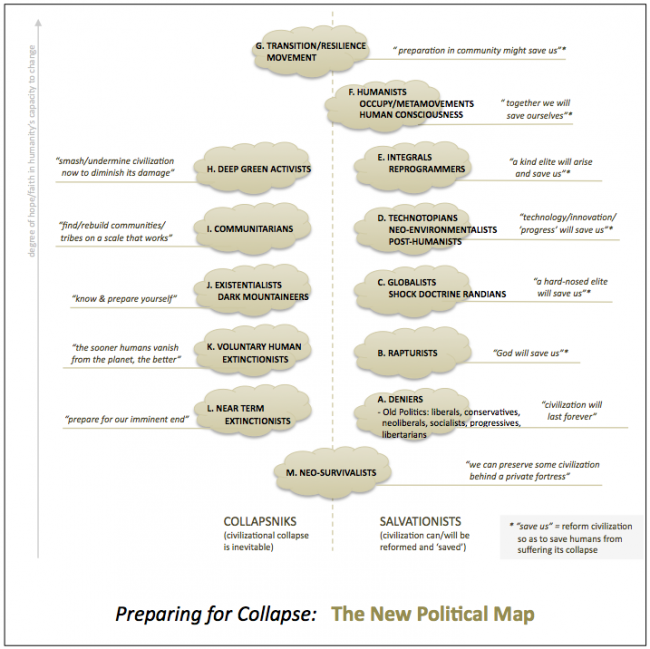
utopiathecollapse |April 2015 – CIVILIZATION –The
enormous cognitive dissonance between our growing awareness of our
civilization’s accelerating collapse, and the ‘news’ in the media and
the subjects of most public discourse, continues to baffle me. Though I
suspect it shouldn’t. We are all slow learners, preoccupied with the
needs of the moment, with a preference for reassurance over truth. I
often find myself, these days, at social and other events, at a loss for
words, not saying anything, as a result. It’s as if I speak an utterly
different language from the people I meet in my day-to-day life, so
what’s the point of saying anything? Perhaps this is Gaia’s way of
teaching me patience. I continue to vacillate back and forth all the way
from the humanist worldview (F. on the ‘map’ above’) to the near-term
extinctionist worldview (L.), depending on what I’m doing and who I’m
doing it with, or what I’m reading (Charles Eisenstein seems to best
represent worldview F. and Guy McPherson best articulates worldview L.,
and I greatly admire them both). I’m happy with company anywhere along
that continuum — they both speak my newly-acquired language, though with
very different dialects. It’s sad to me that most people find collapse
too terrifying to contemplate. I find it liberating.
ips-dc | Poor people, especially people of color, face a far greater risk of
being fined, arrested, and even incarcerated for minor offenses than
other Americans. A broken taillight, an unpaid parking ticket, a minor
drug offense, sitting on a sidewalk, or sleeping in a park can all
result in jail time. In this report, we seek to understand the
multi-faceted, growing phenomenon of the “criminalization of poverty.”
In many ways, this phenomenon is not new: The introduction of public
assistance programs gave rise to prejudices against beneficiaries and to
systemic efforts to obstruct access to the assistance.
This form of criminalizing poverty — racial profiling or
the targeting of poor black and Latina single mothers trying to access
public assistance — is a relatively familiar reality. Less well-known
known are the new and growing trends which increase this criminalization
of being poor that affect or will affect hundreds of millions of
Americans. These troubling trends are eliminating their chances to get
out of poverty and access resources that make a safe and decent life
possible.
In this report we will summarize these realities, filling out the
true breadth and depth of this national crisis. The key elements we
examine are:
the targeting of poor people with fines and fees for misdemeanors,
and the resurgence of debtors’ prisons – the imprisonment of people
unable to pay debts resulting from the increase in fines and fees;
mass incarceration of poor ethnic minorities for non-violent
offenses, and the barriers to employment and re-entry into society once
they have served their sentences;
excessive punishment of poor children that creates a “school-to-prison pipeline”;
increase in arrests of homeless people and people feeding the
homeless, and criminalizing life-sustaining activities such as sleeping
in public when no shelter is available; and
confiscating what little resources and property poor people might have through “civil asset forfeiture.”
WaPo | “If you think you can only do very little and be very incremental,
then you’ll work only on very incremental things. It’s self-fulfilling,”
Thiel, who is 47 and estimated to be worth $2.2 billion, said in an interview. “It’s those who have an optimism about what can be done that will shape the future.”
He and the tech titans who founded Google, Facebook, eBay, Napster
and Netscape are using their billions to rewrite the nation’s science
agenda and transform biomedical research. Their objective is to use the
tools of technology — the chips, software programs, algorithms and big
data they used in creating an information revolution — to understand and
upgrade what they consider to be the most complicated piece of
machinery in existence: the human body.
The entrepreneurs are driven by a certitude that rebuilding,
regenerating and reprogramming patients’ organs, limbs, cells and DNA
will enable people to live longer and better. The work they are funding
includes hunting for the secrets of living organisms with insanely long
lives, engineering microscopic nanobots that can fix your body from the
inside out, figuring out how to reprogram the DNA you were born with,
and exploring ways to digitize your brain based on the theory that your
mind could live long after your body expires.
“I believe that evolution is a true account of nature,” as Thiel put
it. “But I think we should try to escape it or transcend it in our
society.”
thescientist | On April 15, 2014, the US Patent and Trademark Office (USPTO) awarded the first patent for use the CRISPR/Cas system to edit eukaryotic genomes to Feng Zhang
of the Broad Institute and MIT. Originally a bacterial or archaeal
defense system that uses viral DNA inserted into the genome (CRISPR) as a
guide to cut the genomic material of invading viruses with a
CRISPR-associated enzyme (Cas), researchers have found many ways to turn
the system into a potent and quick way to edit specific genetic
sequences. Although there are a handful of other CRISPR-related patents,
covering everything from the system’s use in yogurt production
to a potential treatment for Huntington’s disease, Zhang’s patent was
the first to be granted that covers the technology itself as a platform
for a wide array of applications.
However, a patent application filed by Jennifer Doudna of the University of California, Berkeley, and Emmanuelle Charpentier,
currently at the Helmholtz Center for Infection Research in Germany,
predates Zhang’s by seven months. Zhang’s was most likely granted first
because he applied for a fast-track patent, which awarded his
intellectual property (IP) six months after he applied. “I think without
Zhang fast-tracking his application, the PTO would have flagged it for
being in conflict with Doudna’s earlier application,” Jacob Sherkow of the New York Law School wrote in an e-mail to The Scientist.
Had his application not been expedited, “we may have been living in a
world where there were no issued CRISPR patents” until 2017, he added.
The Doudna/Charpentier patent application, assigned to the University of
California and the University of Vienna, claims much of the same
technology as the Zhang patent, and could be read to cover
genome-editing either solely in prokaryotes or in both prokaryotes and
eukaryotes. “It’s hard to reconcile 100 percent of both of them,” said
Sherkow.
14:49: Since the rise of western monotheism the human
experience has been marginalized. We have been told that we were
unimportant in the cosmic drama. But we now know from the feedback that
we're getting from the impact of human culture on the earth that we are a
major factor shaping the temperatures of the oceans, the composition of
the atmosphere, the general speed and complexity of speciation on the
planet... A single species, ourselves, has broken from the ordinary
constants of animal nature and created a new world, an epigenetic
world,...a world based on ideas...downloaded out of the human
imagination and concretized in three dimensional space... 29:29:
Consciousness is the generalized word that we use for this coordination
of complex perception to create a world that draws from the past and
builds a model of the future and then suspends the perceiving organism
in this magical moment called the now where the past is coordinated for
the purpose of navigating the future. McLuhan called it "driving with
the rear-view mirror" and the only thing good about it is it's better
than driving with no mirror at all. 36:10: Reality is accelerating
towards an unimaginable Omega Point. We are the inheritors of immense
momentum in our social systems, our philosophical and scientific and
technological approaches to the world. Because we're driving the
historical vehicle with a rear-view mirror it appears to us that we're
headed straight into a brick wall at a thousand miles an hour. It
appears that we are destroying the earth, polluting the atmosphere,
wrecking the oceans, dehumanizing ourselves, robbing our children of a
future, so forth and so on.
I believe what is in fact going on
is that we are burning our bridges. One by one we're burning our bridges
to the past. We cannot go back to the mushroom-dotted plains of Africa
or the canopied rainforests of 5 million years ago. We can't even go
back to the era of...200 years ago. We have burned our bridges. We are
preparing for a kind of cultural forward escape. 39:35: Nobody's in
charge. 41:16: We are central to the human drama and to the drama of
nature and process on this planet. 41:34: Every model of the
universe has a hard swallow...a place where the argument cannot hide the
fact that there's something slightly fishy about it. The hard swallow
built into science is this business about the big bang. Now let's give
this a little attention here. This is the notion that the universe, for
no reason, sprang from nothing in a single instant. Before we dissect
this, notice that this is the limit test for credulity. Whether you
believe this or not, notice that it is not possible to conceive of
something more unlikely, or less likely to be believed. I defy anyone.
It's just the limit case for unlikelihood: that the universe would
spring from nothing in a single instant for no reason....It makes no
sense. It is in fact no different than saying, "and then God said, 'Let
there be light!'".
What the philosophers of science are saying
is "give us one free miracle and we will roll from that point forward,
from the birth of time to the crack of doom. Just one free miracle and
then it will all unravel according to natural law and these bizarre
equations which nobody can understand but which are so holy in this
enterprise." Well I say then if science gets one free miracle then
everybody gets one free miracle.
WaPo | If you want to be a true innovator, be prepared to leave everyone behind. (Christof Stache/AFP/Getty Images) The
individuals who have founded some of the most success tech companies
are decidedly weird. Examine the founder of a truly innovative company
and you’ll find a rebel without the usual regard for social customs.
This
begs the question, why? Why aren’t more “normal” people with refined
social graces building tech companies that change the world? Why are
only those on the periphery reaching great heights?
If you ask
tech investor Peter Thiel, the problem is a social environment that’s
both powerful and destructive. Only individuals with traits reminiscent
of Asperger’s Syndrome, which frees them from an attachment to social
conventions, have the strength to create innovative businesses amid a
culture that discourages daring entrepreneurship.
“Many of the
more successful entrepreneurs seem to be suffering from a mild form of
Asperger’s where it’s like you’re missing the imitation, socialization
gene,” Thiel said Tuesday
at George Mason University. “We need to ask what is it about our
society where those of us who do not suffer from Asperger’s are at some
massive disadvantage because we will be talked out of our interesting,
original, creative ideas before they’re even fully formed. Oh that’s a
little bit too weird, that’s a little bit too strange and maybe I’ll
just go ahead and open the restaurant that I’ve been talking about that
everyone else can understand and agree with, or do something extremely
safe and conventional.”
An individual with Asperger’s Syndrome
— a form of autism — has limited social skills, a willingness to obsess
and an interest in systems. Those diagnosed with Asperger’s Syndrome
tend to be unemployed or underemployed at rates that far exceed the
general population. Fitting into the world is difficult.
While
full-blown Asperger’s Syndrome or autism hold back careers, a smaller
dose of associated traits appears critical to hatching innovations that
change the world.
frontiersin | Ingroup favoritism—the
tendency to favor members of one’s own group over those in other
groups—is well documented, but the mechanisms driving this behavior are
not well understood. In particular, it is unclear to what extent ingroup
favoritism is driven by preferences concerning the welfare of ingroup
over outgroup members, vs. beliefs about the behavior of ingroup and
outgroup members. In this review we analyze research on ingroup
favoritism in economic games, identifying key gaps in the literature and
providing suggestions on how future work can incorporate these insights
to shed further light on when, why, and how ingroup favoritism occurs.
In doing so, we demonstrate how social psychological theory and research
can be integrated with findings from behavioral economics, providing
new theoretical and methodological directions for future research.
Across many different contexts, people act more
prosocially towards members of their own group relative to those outside
their group. Consequently, a number of scientific disciplines concerned
with human cognition and behavior have sought to explain such ingroup favoritism (also known as parochial altruism). Here we explore to what extent ingroup favoritism is driven by preferences concerning the welfare of ingroup over outgroup members, vs. beliefs about the (future) behavior of ingroup and outgroup members.
In this theoretical review we combine insights from a
behavioral economic approach with knowledge from social psychological
research on social identity processes in intergroup behavior to explain
the proximate psychological causes of ingroup favoritism. We expand upon
previous discussions about ingroup favoritism by using a conceptual
framework of preferences and beliefs to review present findings
demonstrating ingroup favoritism in economic games. Although we focus on
economic games here, we also selectively draw upon other related
research to highlight how social-psychological theory and research can
be incorporated with findings from behavioral economics to provide
exciting new directions for research. We therefore provide an
integrative review of ingroup favoritism in economic games, identifying
key gaps in the literature, as well as providing suggestions on how
future work can incorporate these insights to shed further light on
when, why, and how ingroup favoritism occurs.
Social Identity and Group Behavior
From the dawn of our species to the present day, humans
have lived, eaten, worked, and reproduced—that is, survived—in groups.
These groups have expanded from small, primarily kin-based ties to
groups based on language, nationality, religion, current geographical
location, and even seemingly arbitrary characteristics such as the
ownership of a particular brand of electronic device. As a species, we
appear to have a remarkable tendency to seek out and identify with
groups, and it has been suggested that cooperation with the ingroup and
competition with the outgroup may have co-evolved (c.f. Rusch, 2014).
Indeed, it is in our group-based character that the angels and demons
of human nature can be seen: on the one hand, the success of intragroup
cooperation that has given us democracy and civil rights; and on the
other hand, the darkness of intergroup conflict that has given us the
collective stains on human history of genocide and war.
The concept of social identity (Tajfel, 1970, 1974, 1982)
is key to this review—and more broadly most contemporary social
psychological work on intergroup processes. Social identity is “that
part of an individual’s self concept which derives from his knowledge of
his membership of a social group (or groups) together with the value
and emotional significance attached to that membership” (Tajfel, 1974,
p. 69). We use here the definition of a group from work on intergroup
relations in social psychology: a social group is a collection of
individuals who perceive themselves to be members of the same social
category, and therefore share a social identity (Tajfel and Turner, 1979; Turner et al., 1987; Ellemers et al., 2002; Ellemers and Haslam, 2011; Turner and Reynolds, 2011).
Social groups can be based on a range of objective and subjective
criteria—from ethnic background to gender to nationality to occupation
to religion. An intergroup context emerges when social identities are
salient and individuals interact with one another in terms of these
social group identities (Turner et al., 1987).
Indeed, even assignment to random groups can be sufficient to engender a
relevant intergroup context in which intergroup behavior is observed (Tajfel, 1974). Once groups have been formed, how does this influence behavior?
Claude's constitution and other matters AI
-
Ross Douthat, Is Claude Coding Us Into Irrelevance? *NYTimes*, 2.12.26.
Are the lords of artificial intelligence on the side of the human race?
That’s t...
Celebrating 113 years of Mama Rosa McCauley Parks
-
*February 4, 1913 -- February 4, 2026*
*Some notes: The life of the courageous activist Mama Rosa McCauley Parks*
Mama Rosa's grandfather Sylvester Ed...
Monsters are people too
-
Comet 3I/Atlas is on its way out on a hyberbolic course to, I don't know
where. I do know that 1I/Oumuamua is heading for the constellation Pegasus,
and ...
Remembering the Spanish Civil War
-
This year marks the 90th anniversary of the launch of the Spanish Civil
War, an epoch-defining event for the international working class, whose
close study...
Return of the Magi
-
Lately, the Holy Spirit is in the air. Emotional energy is swirling out of
the earth.I can feel it bubbling up, effervescing and evaporating around
us, s...
Covid-19 Preys Upon The Elderly And The Obese
-
sciencemag | This spring, after days of flulike symptoms and fever, a man
arrived at the emergency room at the University of Vermont Medical Center.
He ...
-
(Damn, has it been THAT long? I don't even know which prompts to use to
post this)
SeeNew
Can't get on your site because you've gone 'invite only'?
Man, ...
First Member of Chumph Cartel Goes to Jail
-
With the profligate racism of the Chumph Cartel, I don’t imagine any of
them convicted and jailed is going to do too much better than your run of
the mill ...