NYTimes | Mr. Giuliani has plainly not mellowed in his prosperity. Representative
Peter T. King, a Long Island Republican who has known him for decades,
said the former mayor was “very personally angry” in his remarks, on
and off the stage at the fund-raising event on Wednesday evening.
“This is as emotional as I’ve seen him. He was in some ways more
emotional than he was after 9/11,” said Mr. King, who spoke alongside
Mr. Giuliani at a private “super PAC” fund-raising event at the Women’s
National Republican Club in Manhattan.
John A. Catsimatidis, the billionaire grocery store magnate, attended
the same fund-raiser and, on a whim, invited Mr. Giuliani to join him
at a meet-and-greet for Mr. Walker with members of the New York
financial elite. Mr. Catsimatidis, a frequent Republican donor,
lamented that Mr. Giuliani’s unplanned speech became an enveloping
spectacle.
“The focus of the event should not have been that,” Mr. Catsimatidis
said, adding: “Look, Rudy is Rudy. He’s not going to run for anything
himself. Maybe he wanted to get it off his chest.”
To some in Republican politics, Mr. Giuliani’s public eruption looks
like the product of slack political instincts, the shoot-from-the-lip
behavior of a former champion who has lost self-awareness with each
year removed from office. The former mayor’s political career has
sloped precipitously downward since his ill-fated 2008 campaign; while
he remains an occasional fund-raising attraction, his time as a
national Republican leader is past.
For all the criticism Mr. Giuliani’s comments attracted from Democrats
and members of the Republican establishment, there are quarters of the
right where his remarks struck a chord. The talk-radio host Rush
Limbaugh crowed about “getting texts praising Rudy to the rooftops.”
Joe M. Allbaugh, a former Giuliani adviser who led the Federal
Emergency Management Agency during the World Trade Center attacks, said
he applauded Mr. Giuliani’s candor.
“He represents a lot of Americans who are scratching their heads
wondering why our president — the president of the United States —
doesn’t defend our culture the way he defends everybody else’s
culture,” Mr. Allbaugh said.
Ask Regina Peruggi, the second cousin he grew up with and married, who
was "offended" when Rudy later engineered an annulment from the priest
who was his best man on the grounds, strangely enough, that she was his
cousin. Or ask Donna Hanover, the mother of his two children, who found
out he wanted a separation when he left Gracie Mansion one morning and
announced it at a televised press conference.
Or ask Judi Nathan, his third wife, whom he started dating while still
married to Hanover and New York mayor. In two SUVs, he and an entourage
of six or seven cops traveled 11 times to Judi's Hamptons getaway at a
taxpayer cost of $3,000 a trip. That's love.
Rudy knows so much about love that he declared the other day that President Obama "doesn't love you" and "doesn't love me" at a private party of GOP fat cats.
The onetime presidential candidate also revealed at the party that
Obama "doesn't love America," an echo of a speech he'd delivered to
delirious cheers in Arizona a week earlier when he declared: "I would go
anywhere, any place, anytime, and I wouldn't give a damn what the
President of the United States said, to defend my country. That's a
patriot. That's a man who loves his people. That's a man who fights for
his people. Unlike our President."
Rudy may have forgotten the half-dozen deferments he won ducking the
Vietnam War, even getting the federal judge he was clerking for to write
a letter creating a special exemption for him. And remember Bernie
Kerik? He's the Giulaini police commissioner, business partner and
sidekick whose nomination as homeland security secretary narrowly
preceded indictments. He then did his national service in prison.
Giuliani went so far as to rebuke the President for not being "brought
up the way you were and the way I was brought up through love of this
country," a bow no doubt to the parenting prowess of Harold Giuliani,
who did time in Sing Sing for holding up a Harlem milkman and was the
bat-wielding enforcer for the loan-sharking operation run out of a
Brooklyn bar owned by Rudy's uncle.
Though Rudy cited Harold throughout his public life as his model
(without revealing any of his history), he and five Rudy uncles found
ways to avoid service in World War II. Harold, whose robbery conviction
was in the name of an alias, made sure the draft board knew he was a
felon. On the other hand, Obama's grandfather and uncle served. His
uncle helped liberate Buchenwald, which apparently affected him so
deeply he stayed in the family attic for six months when he returned
home.
H+ |DARPA,
the Defense Research Projects Agency, is perhaps best known for its
role as progenitors of the computer networking and the Internet. Formed
in the wake of the Soviet Union’s surprise launch of Sputnik, DARPA’s
objective was to ensure that the United States would avoid technological
surprises in the future. This role was later expanded to causing
technological surprises as well.
And although DARPA is and has been the leading source of funding for
artificial intelligence and a number of other transhumanist
projects, they’ve been missing in action for a while. Nothing DARPA has
worked on since seems to have had the societal impact of the invention of the Internet. But that is about to change.
The current director of DARPA is Dr. Arati Prabhakar. She is the second female director of the organization, following the previous and controversial director Regina Dugan
who left the government to work at Google. The return to big visions
and big adventures was apparent and in stark contrast to Dugan’s
leadership of the organization.
Quoted in WIRED, Dugan had, for example, stated that “There is a time
and a place for daydreaming. But it is not at DARPA,” and she told a
congressional panel in March 2011, “Darpa is not the place of dreamlike
musings or fantasies, not a place for self-indulging in wishes and
hopes. DARPA is a place of doing.”
Those days are gone. DARPA’s new vision is simply to revolutionize
the human situation and it is fully transhumanist in its approach.
The Biological Technologies Office or BTO was announced with little
fanfare in the spring of 2014. This announcement didn’t get that much
attention, perhaps because the press release announcing the BTO was published on April Fool’s Day.
But DARPA is determined to turn that around, and to help make that
happen, they held a two day event in the SIlicon Valley area to
facilitate and communicate about radical changes ahead in the area of
biotechnologies. Invitees included some of the top biotechnology
scientists in the world. And the audience was a mixed group of
scientists, engineers, inventors, investors, futurists, along with a
handful of government contractors and military personnel.
WaPo | There’s a scene
in Stanley Kubrick’s comic masterpiece “Dr. Strangelove” in which Jack
D. Ripper, an American general who’s gone rogue and ordered a nuclear
attack on the Soviet Union, unspools his paranoid worldview — and the
explanation for why he drinks “only distilled water, or rainwater, and
only pure grain alcohol” — to Lionel Mandrake, a dizzy-with-anxiety
group captain in the Royal Air Force.
Ripper: “Have you ever heard of a thing called fluoridation? Fluoridation of water?”
Mandrake: “Ah, yes, I have heard of that, Jack. Yes, yes.”
Ripper: “Well, do you know what it is?”
Mandrake: “No. No, I don’t know what it is, no.”
Ripper:
“Do you realize that fluoridation is the most monstrously conceived and
dangerous communist plot we have ever had to face?”
The
movie came out in 1964, by which time the health benefits of
fluoridation had been thoroughly established and anti-fluoridation
conspiracy theories could be the stuff of comedy. Yet half a century
later, fluoridation continues to incite fear and paranoia. In 2013,
citizens in Portland, Ore., one of only a few major American cities that
don’t fluoridate, blocked a plan
by local officials to do so. Opponents didn’t like the idea of the
government adding “chemicals” to their water. They claimed that fluoride
could be harmful to human health.
Actually fluoride is a natural
mineral that, in the weak concentrations used in public drinking-water
systems, hardens tooth enamel and prevents tooth decay — a cheap and
safe way to improve dental health for everyone, rich or poor,
conscientious brushers or not. That’s the scientific and medical
consensus.
To which some people in Portland, echoing anti-fluoridation activists around the world, reply: We don’t believe you.
We live in an age when all manner of scientific knowledge — from the safety of fluoride and vaccines
to the reality of climate change — faces organized and often furious
opposition. Empowered by their own sources of information and their own
interpretations of research, doubters have declared war on the consensus
of experts. There are so many of these controversies these days, you’d
think a diabolical agency had put something in the water to make people
argumentative.
WaPo | Walker had decided to challenge Gwen Moore (D),
an African American woman who represented a partly white and deeply
Democratic state assembly district that surrounded Marquette, Hiller
said.
Republican leaders welcomed Walker’s bid. He wouldn’t win,
but he would still force Moore to spend money and time defending the
seat. (Walker later moved to suburban Wauwatosa, and it was there that
he won his seat in 1993.)
In 1990, the 22-year-old Walker spent
days knocking on doors in the district, preaching a get-tough message.
He wanted 200 more cops on the street and stronger mandatory sentences
for drug dealers.
“The number one fear is crime,” he wrote in a
letter to Marquette students, asking them, again, to vote for him. “For
too long, we have ignored this issue and now it is time to do something
about it.”
Moore, who is now a member of Congress, said: “His
campaign was one big dog whistle.” She believed that Walker’s anti-crime
message was a way to speak to white voters’ fears of blacks without
saying them aloud. “He had sort of insinuated sort of the worst
stereotypes about black people [and] innate criminality.”
Hiller,
Walker’s campaign treasurer, said that Moore was entirely wrong about
Walker’s message. “There was no racial angle,” he said. “It never
crossed our minds.”
On election night, Walker’s chances looked so
terrible that Walker and Hiller left the district and the city of
Milwaukee behind. They started driving to Madison, the state capital, to
attend parties for other Republicans who had a chance.
Then, for a minute, something strange happened.
“We’re
listening to election returns on the radio, and the guy comes on: ‘In a
surprise in the [7th District], Scott Walker is ahead of Gwen Moore,’ ”
Hiller said. “Literally, I pulled off the road.”
The two young
men sat there on the shoulder, blindsided by the idea that Walker — a
politician who hadn’t won anything he really wanted — might be about to
win. Fist tap Vic.
mintpressnews | “We’re currently in one of the hottest periods of extremist activity
in the United States that I’ve seen in my 20-year career. This blows
what we saw pre-Oklahoma City out of the water and makes it look like a
kindergarten picnic,” Daryl Johnson, a domestic terrorism expert and
founder of DT Analytics, a private consulting firm for law enforcement
and Homeland Security professionals, says during an interview for the recent Vice News documentary. Johnson was also the main author of the intelligence assessment issued by DHS in 2009.
Yet, rather than acting on the information gathered in the
assessment, the government cancelled all of its domestic terrorism
reporting and law enforcement training after the report was leaked and
politicized by conservative media outlets and politicians.
One such publication
described “the piece of crap report” as “a sweeping indictment of
conservatives.” It continues, “In Obama land, there are no coincidences.
It is no coincidence that this report echoes Tea Party-bashing
left-wing blogs … and demonizes the very Americans who will be
protesting in the thousands on Wednesday for the nationwide Tax Day Tea
Party.”
Conservative news organizations interpreted the publication of the
report as a political power play by Obama to demonize the right, rather
than an impartial analysis of domestic terrorism that could help law
enforcement.
In 2011, two years after the report was released, Johnson said he was
deeply disheartened by how the report was characterized. Johnson told Joe Hamilton at the Muskegon Chronicle
that he was “a former intelligence analyst and counterterrorism expert
for the U.S. Army, an Eagle Scout, Mormon, one-time church missionary,
an anti-abortion gun owner, and third-generation lifetime registered
Republican.” In short, he said he is a conservative. Johnson added that
the report could not have been a political move on the part of Obama,
since he was hired in 2004 by the George W. Bush administration.
Following Hamilton’s opinion piece, Johnson penned his own article for Salon, “Daryl Johnson: I tried to warn them.” In it, he makes a damning indictment of the DHS decision not to follow through on recommendations made in his report.
splcenter |At 9:02 a.m. on April 19, 1995, a 7,000-pound truck bomb,
constructed of ammonium nitrate fertilizer and nitromethane racing fuel
and packed into 13 plastic barrels, ripped through the heart of the
Alfred P. Murrah Federal Building in Oklahoma City. The explosion
wrecked much of downtown Oklahoma City and killed 168 people, including
19 children in a day-care center. Another 500 were injured. Although
many Americans initially suspected an attack by Middle Eastern radicals,
it quickly became clear that the mass murder had actually been carried
out by domestic, right-wing terrorists.
The slaughter
engineered by Timothy McVeigh and Terry Nichols, men steeped in the
conspiracy theories and white-hot fury of the American radical right,
marked the opening shot in a new kind of domestic political extremism — a
revolutionary ideology whose practitioners do not hesitate to carry out
attacks directed at entirely innocent victims, people selected
essentially at random to make a political point. After Oklahoma, it was
no longer sufficient for many American right-wing terrorists to strike
at a target of political significance — instead, they reached for higher
and higher body counts, reasoning that they had to eclipse McVeigh's
attack to win attention.
What follows is a detailed listing
of major terrorist plots and racist rampages that have emerged from the
American radical right in the years since Oklahoma City. These have
included plans to bomb government buildings, banks, refineries,
utilities, clinics, synagogues, mosques, memorials and bridges; to
assassinate police officers, judges, politicians, civil rights figures
and others; to rob banks, armored cars and other criminals; and to amass
illegal machine guns, missiles, explosives and biological and chemical
weapons. [Each of these plots aimed to make changes in America through
the use of political violence.] Most contemplated the deaths of large
numbers of people — in one case, as many as 30,000, or 10 times the
number murdered on Sept. 11, 2001.
Here are the stories of
plots, conspiracies and racist rampages since 1995 — plots and violence
waged against a democratic America.
politico | Rudy Giuliani went straight for the jugular Wednesday night during a
private group dinner here featuring Wisconsin Gov. Scott Walker by
openly questioning whether President Barack Obama “loves America.”
The former New York mayor, speaking in front of the 2016 Republican
presidential contender and about 60 right-leaning business executives
and conservative media types, directly challenged Obama’s patriotism,
discussing what he called weak foreign policy decisions and
questionable public remarks when confronting terrorists.
“I do not believe, and I know this is a horrible thing to say, but I do
not believe that the president loves America,” Giuliani said during the
dinner at the 21 Club, a former Prohibition-era speakeasy in midtown
Manhattan. “He doesn’t love you. And he doesn’t love me. He wasn’t
brought up the way you were brought up and I was brought up through
love of this country.”
With Walker sitting just a few seats away, Giuliani continued by saying
that “with all our flaws we’re the most exceptional country in the
world. I’m looking for a presidential candidate who can express that,
do that and carry it out.”
nationaljournal | Google is warning that the government's quiet plan to expand the
FBI's authority to remotely access computer files amounts to a
"monumental" constitutional concern. The
search giant submitted public comments earlier this week opposing a
Justice Department proposal that would grant judges more leeway in how
they can approve search warrants for electronic data.
The
push to change an arcane federal rule "raises a number of monumental and
highly complex constitutional, legal, and geopolitical concerns that
should be left to Congress to decide," wrote Richard Salgado, Google's director for law enforcement and information security.
The
provision, known as Rule 41 of the federal rules of criminal procedure,
generally permits judges to grant search warrants only within the bounds
of their judicial district. Last year, the Justice Department
petitioned a judicial advisory committee to amend the rule to allow
judges to approve warrants outside their jurisdictions in cases where
authorities are unsure where a computer is located.
Google,
in its comments, blasted the desired rule change as overly vague,
saying the proposal could authorize remote searches on the data of
millions of Americans simultaneously—particularly those who share a
network or router—and cautioned it rested on shaky legal footing.
"The
serious and complex constitutional concerns implicated by the proposed
amendment are numerous and, because of the nature of Fourth Amendment
case law development, are unlikely to be addressed by courts in a timely
fashion," Salgado wrote.
The
Justice Department has countered that the rule change amounts to a
small-scale tweak of protocol, one that is necessary to align
search-warrant procedures with the realities of modern technology. In
its own comments, the Justice Department accused some opponents of the rule change of "misreading the text of the proposal or misunderstanding current law."
"The
proposal would not authorize the government to undertake any search or
seizure or use any remote search technique not already permitted under
current law," Deputy Assistant Attorney General David Bitkower said in a
memorandum written late last year and made public Tuesday. He added
that investigators are "careful to avoid collateral damage when
executing remote searches, just as [they are] careful to avoid injury to
persons or damage to property in the far more common scenario of
executing physical warrants."
telegraph | Hong Kong’s unpopular chief executive has infuriated pro-democracy campaigners
by using a Chinese New Year message to urge the former colony's citizens to
act more "like sheep".
“Last year was no easy ride for Hong Kong. Our society was rife with
differences and conflicts,” the chief executive of the former British colony
said.
“In the coming year, I hope that all people in Hong Kong will take inspiration
from the sheep's character and pull together in an accommodating manner to
work for Hong Kong's future.”
In case his message had been missed, Mr Leung noted that the 12 animals in the
Chinese zodiac had 12 individual "character types". "Sheep
are widely seen to be mild and gentle animals living peacefully in groups,"
he said.
proceduralfairness | The theory behind procedural fairness, or procedural justice as it is
sometimes called, has developed over a period of more than 25 years.
Tom Tyler, one of the key figures in the field of procedural fairness,
provides a concise overview for members of the court community in his
article "Procedural Justice and the Courts."
In a recent lecture,
Professor Tyler further explores and highlights the implications of
procedural fairness on several aspects of the justice system.
Judges Kevin Burke and Steve Leben authored an extensive white paper on procedural fairness entitled, "Procedural Fairness: A Key Ingredient in Public Satisfaction."
The paper examines core research in the area and recommends various
changes to "improve" the daily work of the courts and their judges. Click here to access the spanish version of the paper.
In a December 2011 presentation to the Conference of State Court
Administrators, Judge Kevin Burke presented an overview of procedural
fairness and its practical applications. A copy of the powerpoint from
his presentation can be found here.
Other scholars have explored the connection between procedural fairness and other areas of research. The article Fair Procedures, Yes. But We Dare Not Lose Sight of Fair Outcomes
by Brian Bornstein and Hannah Dietrich discusses procedural justice and
its interrelation with distributive justice. Similarly, Jonathan
Jackson discusses procedural justice as an important aspect of
criminology's definition of legitimate authority in his chapter, On the Dual Motivational Force of Legitimate Authority.
An Argument for Procedural Fairness
Professor Tom Tyler's presentation to a 2007 Harvard Law School
Conference focuses on how legitimacy, which is rooted in procedural
justice, is important in decisions to adhere to social rules. The
presentation is broken into three parts below:
WaPo | Over the holiday weekend, I waited for something that never came. Given FBI Director James Comey’s powerful and direct speech
on law enforcement and race at Georgetown University on Thursday, I
thought for sure hellfire would rain down upon him from the right. After
all, in tone and word, he echoed the sentiments expressed by President
Obama and Attorney General Eric Holder on the same topic. Yet instead of
being accused of having blood on his hands or labeled a race-baiter,
Comey and his “hard truths” have been met with silence.
The four
“hard truths” articulated by Comey were tough on police. “Much of our
history is not pretty,” he said as he acknowledged law enforcement’s
role in maintaining the status quo against “disfavored groups.” He
talked about the unconscious bias that grips many in law enforcement. He
discussed the “different flavors of cynicism” that cops “work hard to
resist.” And he talked about the staggering problems facing many young
men and boys of color that become part of officers’ “life experience.”
In addition, Comey called on police to “better understand the people we
serve and protect — by trying to know, deep in our gut, what it feels
like to be a law-abiding young black man walking on the street and
encountering law enforcement.”
That’s strong stuff. And yet,
those easily irritated folks on the right who slammed Obama and Holder
for saying similar things over the past six months have been rendered
mute. No doubt it is because the new messenger is a white, 54-year-old
Republican son of Irish immigrants and grandson of a police chief.
What’s disturbing is that they willingly ignore Comey’s entreaties while
trivializing the same from the president and the attorney general.
WaPo | Abdisalam Adam is a public school teacher and imam from St. Paul,
Minn., and a model for how the White House and U.S. law enforcement hope
to avoid an American version of the Charlie Hebdo attacks in Paris. By
working within local communities and with civic leaders, they aim to
prevent the radicalization and recruitment of young people into
extremist organizations.
But even Adam — whose work in this area will be highlighted during this week’s White House Summit on Countering Violent Extremism
(CVE) — has to fight deep suspicions among his fellow Somalis that the
government efforts are just a guise for intelligence gathering.
“Is
the government sincere about this?” Adam said. “That’s a big question.
The trust is not completely there.” But he added that communities such
as his have little choice. “Personally, I think if it’s done right and
the government’s sincere, it’s the right thing to do.”
The
three-day gathering, which has been in the works since the fall but has
attracted significant attention in the wake of terrorist attacks in
Paris and elsewhere, will launch a new U.S. framework aimed at
preventing potential extremists from launching strikes in the United
States or joining the fight overseas.
Expanding beyond the work already underway, the White House’s approach
aims to enlist the help of social-service providers and religious
leaders to avert future conversions to radicalism.
Senior
administration officials, speaking to reporters Monday, said that while
the initiative would not end terrorist acts like those undertaken in Copenhagen and Libya in the past few days, they are part of the broader answer to such threats.
“I
think we need to be realistic that this is a long-term investment,”
said one official, who asked for anonymity to discuss the event in
advance. “And so, ultimately, we hope to get to a place where we just
have much greater resilience and greater action across communities. But
that is not something we’re going to see tomorrow.”
***************
One of the senior administration officials said Monday that “there’s
no profile that we can point to to say this person is from this
community, is going to be radicalized to violence,” adding, “I think
that we make a mistake as a government if we focus on stereotypes.”
Nicholas J. Rasmussen, director of the National Counterterrorism Center, testified
this month before the House Homeland Security Committee that these
initiatives should not be “perceived as intimidating” and that several
communities have responded positively to the government’s overtures.
theatlantic | Where did it come from, and what are its intentions? The simplicity
of these questions can be deceiving, and few Western leaders seem to
know the answers. In December, The New York Times published
confidential comments by Major General Michael K. Nagata, the Special
Operations commander for the United States in the Middle East, admitting
that he had hardly begun figuring out the Islamic State’s appeal. “We
have not defeated the idea,” he said. “We do not even understand the
idea.” In the past year, President Obama has referred to the Islamic
State, variously, as “not Islamic” and as al-Qaeda’s “jayvee team,”
statements that reflected confusion about the group, and may have
contributed to significant strategic errors.
The group seized Mosul, Iraq, last June, and already rules an area
larger than the United Kingdom. Abu Bakr al-Baghdadi has been its leader
since May 2010, but until last summer, his most recent known appearance
on film was a grainy mug shot from a stay in U.S. captivity at Camp
Bucca during the occupation of Iraq. Then, on July 5 of last year, he
stepped into the pulpit of the Great Mosque of al-Nuri in Mosul, to
deliver a Ramadan sermon as the first caliph in generations—upgrading
his resolution from grainy to high-definition, and his position from
hunted guerrilla to commander of all Muslims. The inflow of jihadists
that followed, from around the world, was unprecedented in its pace and
volume, and is continuing.
Our ignorance of the Islamic State is in some ways understandable: It
is a hermit kingdom; few have gone there and returned. Baghdadi has
spoken on camera only once. But his address, and the Islamic State’s
countless other propaganda videos and encyclicals, are online, and the
caliphate’s supporters have toiled mightily to make their project
knowable. We can gather that their state rejects peace as a matter of
principle; that it hungers for genocide; that its religious views make
it constitutionally incapable of certain types of change, even if that
change might ensure its survival; and that it considers itself a
harbinger of—and headline player in—the imminent end of the world.
The Islamic State, also known as the Islamic State of Iraq and al-Sham (ISIS),
follows a distinctive variety of Islam whose beliefs about the path to
the Day of Judgment matter to its strategy, and can help the West know
its enemy and predict its behavior. Its rise to power is less like the
triumph of the Muslim Brotherhood in Egypt (a group whose leaders the
Islamic State considers apostates) than like the realization of a
dystopian alternate reality in which David Koresh or Jim Jones survived
to wield absolute power over not just a few hundred people, but some 8
million.
We have misunderstood the nature of the Islamic State in at least two
ways. First, we tend to see jihadism as monolithic, and to apply the
logic of al‑Qaeda to an organization that has decisively eclipsed it.
The Islamic State supporters I spoke with still refer to Osama bin Laden
as “Sheikh Osama,” a title of honor. But jihadism has evolved since
al-Qaeda’s heyday, from about 1998 to 2003, and many jihadists disdain
the group’s priorities and current leadership.
Bin Laden viewed his terrorism as a prologue to a caliphate he did
not expect to see in his lifetime. His organization was flexible,
operating as a geographically diffuse network of autonomous cells. The
Islamic State, by contrast, requires territory to remain legitimate, and
a top-down structure to rule it. (Its bureaucracy is divided into civil
and military arms, and its territory into provinces.)
We are misled in a second way, by a well-intentioned but dishonest
campaign to deny the Islamic State’s medieval religious nature. Peter
Bergen, who produced the first interview with bin Laden in 1997, titled
his first book Holy War, Inc. in part to acknowledge bin Laden as
a creature of the modern secular world. Bin Laden corporatized terror
and franchised it out. He requested specific political concessions, such
as the withdrawal of U.S. forces from Saudi Arabia. His foot soldiers
navigated the modern world confidently. On Mohammad Atta’s last full day
of life, he shopped at Walmart and ate dinner at Pizza Hut.
NYTimes | In
a report to be published on Monday, and provided in advance to The New
York Times, Kaspersky Lab says that the scope of this attack on more
than 100 banks and other financial institutions in 30 nations could make
it one of the largest bank thefts ever — and one conducted without the
usual signs of robbery.
The
Moscow-based firm says that because of nondisclosure agreements with
the banks that were hit, it cannot name them. Officials at the White
House and the F.B.I. have been briefed on the findings, but say that it
will take time to confirm them and assess the losses.
Kaspersky
Lab says it has seen evidence of $300 million in theft through clients,
and believes the total could be triple that. But that projection is
impossible to verify because the thefts were limited to $10 million a
transaction, though some banks were hit several times. In many cases the
hauls were more modest, presumably to avoid setting off alarms.
The majority of the targets were in Russia, but many were in Japan, the United States and Europe.
No
bank has come forward acknowledging the theft, a common problem that
President Obama alluded to on Friday when he attended the first White
House summit meeting on cybersecurity and consumer protection at
Stanford University. He urged passage of a law that would require public
disclosure of any breach that compromised personal or financial
information.
But
the industry consortium that alerts banks to malicious activity, the
Financial Services Information Sharing and Analysis Center, said in a
statement that “our members are aware of this activity. We have
disseminated intelligence on this attack to the members,” and that “some
briefings were also provided by law enforcement entities.”
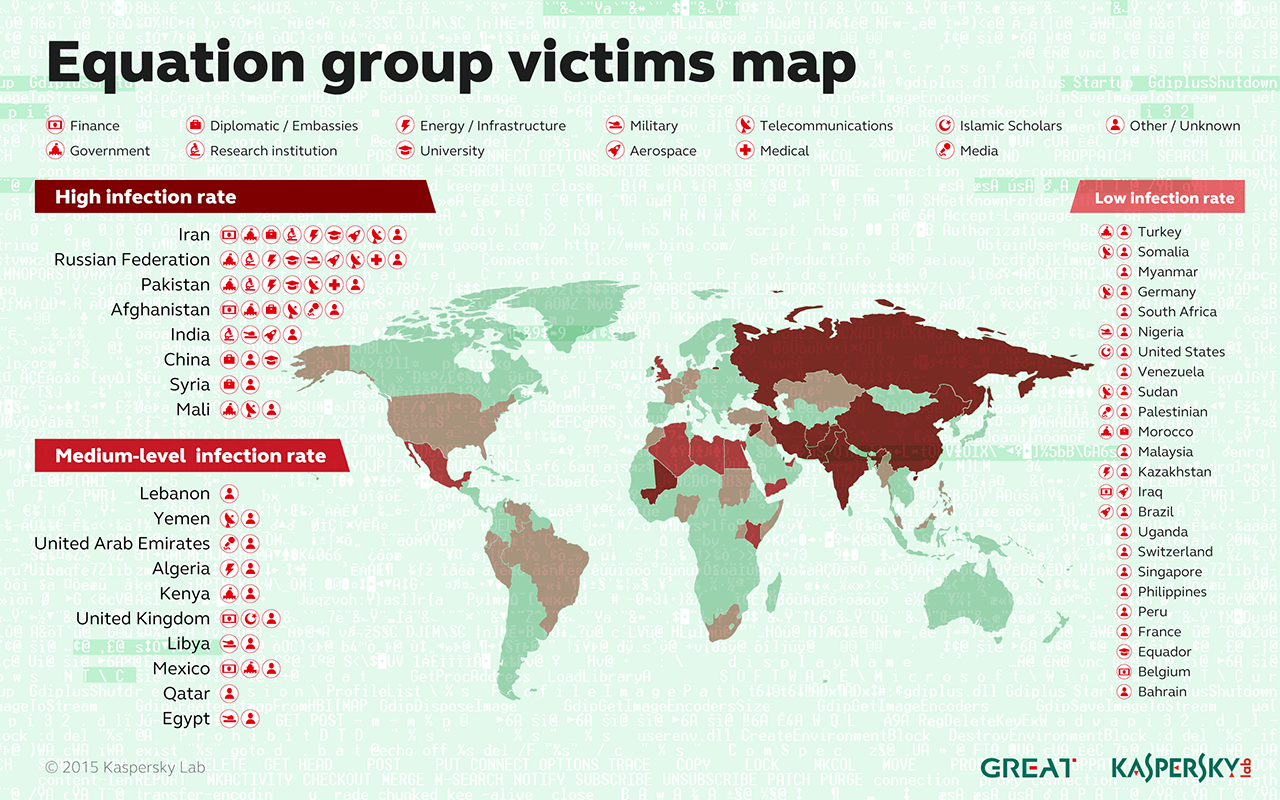
arstechnica | A long list of almost superhuman technical feats illustrate Equation Group's extraordinary skill, painstaking work, and unlimited resources. They include:
The stashing of malicious files in multiple branches of an infected
computer's registry. By encrypting all malicious files and storing them
in multiple branches of a computer's Windows registry, the infection was
impossible to detect using antivirus software.
Redirects that sent iPhone users to unique exploit Web pages. In
addition, infected machines reporting to Equation Group command servers
identified themselves as Macs, an indication that the group successfully
compromised both iOS and OS X devices.
The use of more than 300 Internet domains and 100 servers to host a sprawling command and control infrastructure.
USB stick-based reconnaissance malware to map air-gapped networks,
which are so sensitive that they aren't connected to the Internet. Both
Stuxnet and the related Flame malware platform also had the ability to bridge airgaps.
An unusual if not truly novel way of bypassing code-signing
restrictions in modern versions of Windows, which require that all
third-party software interfacing with the operating system kernel be
digitally signed by a recognized certificate authority. To circumvent
this restriction, Equation Group malware exploited a known vulnerability in an already signed driver for CloneCD to achieve kernel-level code execution.
Taken together, the accomplishments led Kaspersky researchers to
conclude that Equation Group is probably the most sophisticated computer
attack group in the world, with technical skill and resources that
rival the groups that developed Stuxnet and the Flame espionage malware.
"It seems to me Equation Group are the ones with the coolest toys,"
Costin Raiu, director of Kaspersky Lab's global research and analysis
team, told Ars. "Every now and then they share them with the Stuxnet
group and the Flame group, but they are originally available only to the
Equation Group people. Equation Group are definitely the masters, and
they are giving the others, maybe, bread crumbs. From time to time they
are giving them some goodies to integrate into Stuxnet and Flame."
NHTSA | Background and Introduction
While the extent of use of alcohol by drivers and the risks
posed by alcohol use have been well known for many
decades, relatively little has been known about the use of
other drugs by drivers and the associated risks. However,
drug-impaired driving has recently become an issue of
increasing public and governmental concern in the United
States and in many other countries (Compton et al., 2009;
Asbridge et al., 2012; ICADTS, 2007). While it is readily
apparent that driving-related skills can be impaired by
a wide variety of illegal substances and medications, the
nature and scope of the drug-impaired driving problem
has been difficult to define (Jones et al., 2003; DuPont et
al., 2012; Houwing, 2013). In the United States, recent State
actions to legalize the use of marijuana for medical and
recreational use have further exacerbated concern over
potential risks of driving impaired by marijuana.
Marijuana is the most frequently detected drug (other
than alcohol) in crash-involved drivers as well as the general
driving population (Terhune, 1982; Terhune et al., 1992;
Lacey et al., 2009; Walsh et al., 2005). There is evidence
that marijuana use impairs psychomotor skills, divided
attention, lane tracking, and cognitive functions (Robbe
et al., 1993; Moskowitz, 1995; Hartman and Huestis, 2013).
However, its role in contributing to the occurrence of
crashes remains less clear. Many studies, using a variety
of methods have attempted to estimate the risk of driving
after use of marijuana (Li et al., 2012; Asbridge et al., 2012).
The methods have included experimental studies, observational
studies, and epidemiological studies. While useful
in identifying how marijuana affects the performance
of driving tasks, experimental and observational studies
do not lend themselves to predicting real world crash risk.
Epidemiological Studies
Epidemiological studies differ in how they estimate risk.
Culpability studies compare the rate at which crash-involved,
drug-positive drivers and drug-negative drivers
are deemed to be at fault for their crashes. Case-control
studies compare drug use by crash-involved drivers to
drug use by non-crash involved drivers. In general, the
case-control method is preferable since it can eliminate
more sources of potential bias in estimating crash risk
resulting from drug use (e.g., alcohol use is much higher
at night and on weekends than during the day or on
weekdays). The existing epidemiological research (both
culpability and case-control studies) have produced contradictory
estimates of risk for marijuana use. Some of
these studies have suggested that marijuana use has minimal
or no effect on the likelihood of crash involvement,
while others have estimated a small increase in the risk of
crash involvement.
Two recent population-based case control studies have
estimated the crash risk of drug use by drivers by using
NHTSA’s Fatality Analysis Reporting System (FARS) 2007
data for the crash-involved driver population and the
2007 National Roadside Survey of Alcohol and Drug Use
by Drivers for the control drivers (Lia, Bradya, & Chen,
2013; Romano, Torres-Saavedra, Voas, & Lacey, 2014). The
Li study estimated the increased risk of crash involvement
for drivers using marijuana at 1.83 times that of drug-free
drivers, while the Romano study found no increased risk
of crash involvement for those drivers testing positive
for THC (the main psychoactive substance in marijuana).
However, current limitations in the FARS dataset do not
allow calculation of unbiased, reliable and valid estimates
of the risk of crash involvement that results from drug use.
thefourthway | Q. Does school stand for self-initiation?
A. What does self-initiation mean? It is all words. What would it mean?
Q. If schools are so important, why do they not have more influence in the world?
A. Schools can only act through people who are interested in them. They
can do nothing if they are surrounded by people who are indifferent.
The possibility of schools influencing life is conditioned by the
general attitude to schools. In order to have influence, schools must
have people who are interested and who would obey. But this must come
from below, it cannot be produced by schools. Schools can throw B
influences into the world, but if people are not interested in them,
they can do nothing. They cannot use violence.
Q. Can a school lose by giving away its knowledge?
A. A school can lose in many different ways. We shall come to this
question later on. It depends whom it gives to. If it gives just in
general and does not receive anything, certainly it will lose. If one
has money and begins to give it to everybody, whether they deserve it
or not, certainly one will lose one's money.
Q. You said that if we want a school we must take part in building it. How can we do that?
A. You must remember that the level of a school depends on the level of
being of the people who constitute it. If there are not enough people
with magnetic centre, there can be no school. But it is not simply
coming to lectures and accepting what one hears that shows the presence
of a
magnetic centre.
Q. Would the spreading of school ideas and school language among other
people be of any help from the point of view of the school?
A. Ideas cannot be spread in the right form—it is important to
understand that. It would be very good if it could be done, but it
cannot. Words would remain, but the ideas themselves would be
different. If it were enough to spread them, why are schools necessary?
The language will spread itself, maybe even in our lifetime, but the
ideas will enter into the general currency in a wrong form. For
instance, there would be no distinction between 'doing' and 'happening'.
Q. We talk of schools and different levels. Is it not rather confusing? What do higher levels mean?
A. Why do you find the idea of higher levels confusing? For instance,
we can take this idea of levels quite simply in relation to ourselves:
using all our mental capacities we can think only up to a certain
level, but if we could use higher centres, for instance higher
emotional centre which already needs more or less complete
self-remembering, then certainly on the same subject we could think
quite differently and find many more connections in things which we do
not notice now. That shows different levels of thinking, and sometimes
we actually have glimpses of a higher level of thinking, so we may have
some material for observation, because even now we can think
differently on the same subject.
And as regards different levels of people, we meet with results of work
of people obviously belonging to higher planes; we cannot say that our
experience of ordinary life is limited to results of work of people
like ourselves. Take the New Testament, and there are also works of
art, esoteric writings, Christian literature and so on which obviously
cannot belong to ordinary people. The existence of people of higher
development is not imagination, not a hypothesis, but an actual fact.
So I do not understand in what way it is confusing; I do not see how
one can think without recognizing this fact. It is a definite fact that
people live not only on the level on which we are but can exist on
different levels.
From this point of view humanity can be regarded as divided into four
concentric circles. The three inner circles are called Esoteric,
Mesoteric and Exoteric. The fourth is the outer circle where men 1, 2
and 3 live. Schools act as gates through which man No. 4, who is
between the outer and the Exoteric circle, can pass. Man No. 5 belongs
to the Exoteric circle, man No. 6 to the Mesoteric and man No. 7 to the
Esoteric or the innermost circle. The outer circle is also called the
circle of the confusion of tongues, for in this circle people cannot
understand one another. Understanding is possible only in the inner
circles.
All this means there are degrees.
A man who lives in the outer circle is under the law of accident, or,
if he has a strongly expressed essence, his life is more governed by
the laws of his type or the laws of fate. But when a man begins to work
towards consciousness, he already has direction. This means a change,
perhaps not perceptible, but nevertheless cosmically a change. Only
individual effort can help man to pass from the outer circle into the
Exoteric circle. What refers to a man in the outer circle does not
refer to a man who begins to work. He is under different laws, or
rather, different laws begin to touch a man who begins to work. Each
circle is under different laws.
RT | A German rapper who joined the Islamic State in Syria is overseeing
the extremist group’s effort to recruit Britons. Denis Cuspert, from
Berlin, has become the jihadist group’s main propagandist, managing its
sophisticated media operation.
Cuspert is reportedly
responsible for recruiting Britons by using English-speaking
jihadists as poster children, the Daily Mail reports.
He is said to be the mastermind of a campaign to attract
foreigners, including German Salafists and other impressionable,
radicalized youths.
Cuspert is now fighting under the name Abu Talha al-Almani. The
former rapper is also reportedly the leader of a combat unit of
German-speaking Islamic State (IS, formerly ISIS) jihadists
called the German Brigade of Millatu Ibrahim.
The 39-year-old was born in Berlin to a German mother and a
Ghanaian father. He became a rapper under the artist name Deso
Dogg.
The would-be propagandist converted to Islam in 2007 following
nine years imprisonment for manslaughter.
He is thought to have travelled to Syria in early 2013, swearing
his allegiance to the self-proclaimed IS caliph Abu Bakr
al-Baghdadi.
Last week, Cuspert appeared in a video alongside other fighters,
in which at least three opponents were executed.
“That's why they've received the death sentence,”
Cuspert says in German in the video, while another fighter
explains in Arabic that the victims belonged to the Syrian Al
Sheitaat tribe.
Although Cuspert is not shown killing any of the men, the German
jihadist poses with the severed head of one of the victims. The
video contradicts earlier reports that Cuspert was killed in
Syria.
According to the German security agency Verfassungsschutz,
Cuspert is part of a “terrorist establishment” and is
said to have become a member of the IS inner circle. The jihadist
was reportedly seen beating a corpse with a stone in a video from
July, filmed near Homs in Syria.
aeon | I stare out the window from my tiny flat on the 300th floor,
hermetically sealed in a soaring, climate-controlled high-rise,
honeycombed with hundreds of dwellings just like mine, and survey the
breathtaking vistas from my lofty perch more than half a mile above
ground: the craftsman cottages with their well-tended lawns, the emerald
green golf courses, the sun-washed aquamarine swimming pools and the
multimillion-dollar mansions that hug the sweeping sands from Malibu to
Palos Verdes. These images evoke feelings of deep nostalgia for a Los
Angeles that doesn’t exist anymore, back in the halcyon days before my
great-grandparents were born, when procreation wasn’t strictly regulated
and billions of people roamed freely on Earth.
There are only about 500 million of us left, after the convulsive
transformations caused by climate change severely diminished the
planet’s carrying capacity, which is the maximum population size that
the environment can sustain. Most of us now live in what the British
scientist James Lovelock has called ‘lifeboats’ at the far reaches of
the northern hemisphere, in places that were once Canada, China, Russia
and the Scandinavian countries, shoehorned into cities created virtually
overnight to accommodate the millions of desperate refugees where the
climate remains marginally tolerable.
Despite all this, history offers a game plan for our species to
survive. In analysing his copious research, Parker came to a startling
conclusion: the deprivations of the 17th century laid the basis for the
welfare state that became the ‘hallmark of all economically advanced
states’ by the 19th century. ‘In the 21st century, as in the 17th,
coping with catastrophes on this scale requires resources that only
central governments command,’ he notes in his book. ‘Despite the many
differences between the 17th and the 21st centuries, governments during
the Little Ice Age faced the same dilemma. . . [they ultimately
realised] that, in the long run, it was economically cheaper and more
efficient (as well as more humane) to support those who became old,
widowed, ill, disabled or unemployed, thus creating the first “welfare
state” in the world.’
Likewise, we are too technologically advanced – and, one hopes, too
socially sophisticated – for the doomsday scenarios some foresee.
Instead of fighting it out in barbaric, Mad Max-style, dystopian
colonies reminiscent of the American West, humanity’s 500 million
remaining souls, fed by artificially concocted edibles or even a 23rd
century version of Soylent Green, will no doubt be crammed into towering
high rises in dense urban areas creating their culture anew atop the
world.
Free To A Good Home
-
I know what gooning is same as I know what felching is but I don't care to
remind myself all that often about it. The Internet just keeps exposing the
ni...
If Free Will Is False, Destiny Is True
-
Free will is like God: perhaps dead, its absence having something to say
about morality (what Nietzsche meant by “Gott ist tot” was that the
Christian God ...
FREE BOOK: On Nonviolence
-
“Michael Barker’s interrogation of nonviolent protest tactics and regime
change is both timely and important. Drawing on cases ranging from American
democr...
Return of the Magi
-
Lately, the Holy Spirit is in the air. Emotional energy is swirling out of
the earth.I can feel it bubbling up, effervescing and evaporating around
us, s...
Covid-19 Preys Upon The Elderly And The Obese
-
sciencemag | This spring, after days of flulike symptoms and fever, a man
arrived at the emergency room at the University of Vermont Medical Center.
He ...
-
(Damn, has it been THAT long? I don't even know which prompts to use to
post this)
SeeNew
Can't get on your site because you've gone 'invite only'?
Man, ...
First Member of Chumph Cartel Goes to Jail
-
With the profligate racism of the Chumph Cartel, I don’t imagine any of
them convicted and jailed is going to do too much better than your run of
the mill ...