Monday, November 18, 2013

sleepers will find collapse swift, brutal, and shocking...,


The myth of human progress, the unexamined belief in the ability of our industrial and technological society to save us from collapse, is a form of magical thinking. These forces, in fact, will ensure that the descent will be swifter and more brutal. Chris Hedges will examine this myth and others that have left us collectively self-deluded. He will look at effective forms of resistance and rebellion in an age of totalitarian capitalism and at ways to keep our lives whole and sane as we begin to face the great unraveling.

remove tepco before removing the fuel rods


vimeo | Fairewinds has fielded a number of questions regarding the removal of the fuel rods from the spent fuel pool in Unit 4 at Fukushima Daiichi. Today's video shows Arnie debunking TEPCO's animated film point by point, and highlights the issues TEPCO will have removing the fuel rods. TEPCO needs to be removed as the organization overseeing the cleanup of the site prior to the removal of the fuel rods.

there were not just three, there were EIGHTY damaged fuel assemblies at fukushima, seventy in reactor one


ex-skf | Move over, three fuel assemblies with damaged/deformed fuel rods inside in the Reactor 4 Spent Fuel Pool! You're nothing.

According to Kahoku Shinpo, a Fukushima local paper, TEPCO admitted on November 15, 2013 that there are 70 fuel assemblies with damaged fuel rods in the Reactor 1 Spent Fuel Pool, located on the operating floor (top floor) of the reactor building whose air radiation levels are measured in millisievert/hour and sievert/hour (first floor).

There are also three such fuel assemblies in the Reactor 2 SFP, and four of them in the Reactor 3 SFP.

Total 80 spent fuel assemblies in the SFPs in Reactors 1 - 4 are damaged.

The damages had been there long before the March 11, 2011 accident, and TEPCO claims it properly notified the national government as they discovered the damages. But the company has come clean in public only now.

Kahoku Shinpo article below suggests that the oldest of such damaged fuels may have been there for 40 years in the Reactor 1 Spent Fuel Pool. (Reactor 1 started generating electricity in 1971.)

Reactor 1 at Fukushima I Nuke Plant is TEPCO's oldest nuclear reactor; it was entirely the project by General Electric of the US, a turnkey.

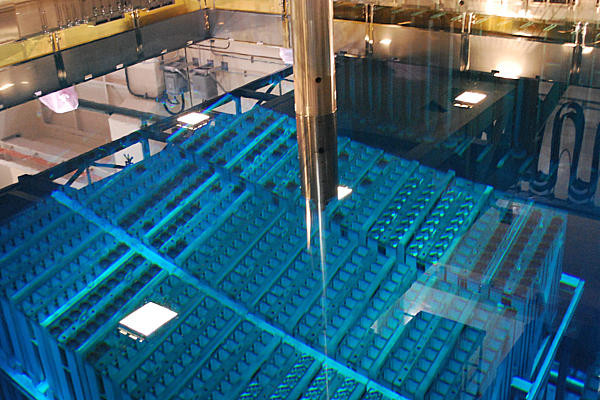
a visual tour of the fuel pools of fukushima...,

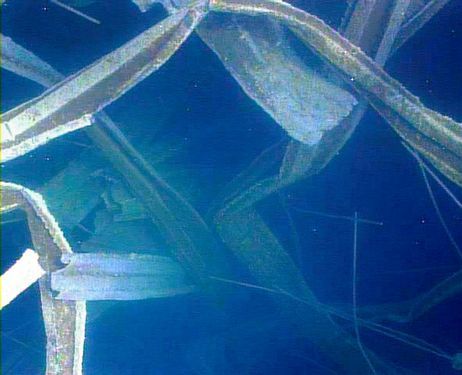
tangled wreckage inside the pool
ratical | You already know that Fukushima’s fuel pool number 4 may be the single greatest threat, but that pool number 3 is very dangerous as well.

You’ve heard that unit 3’s fuel pool contains less radioactive material than unit 4 . . . but still a tremendous amount of radiation. Scientific American reported last year:
The pools at each reactor are thought to have contained the following amounts of spent fuel, according to The Mainichi Daily News:
  • Reactor No. 1: 50 tons of nuclear fuel
  • Reactor No. 2: 81 tons
  • Reactor No. 3: 88 tons
  • Reactor No. 4: 135 tons
  • Reactor No. 5: 142 tons
  • Reactor No. 6: 151 tons
  • Also, a separate ground-level fuel pool contains 1,097 tons of fuel; and some 70 tons of nuclear materials are kept on the grounds in dry storage.
You’ve learned that unit 3’s reactor was the only one at Fukushima which burned plutonium. As Japan Times notes:
Reactor 3 . . . uses highly dangerous mixed oxide fuel, Tokyo Electric has reported.
***
No. 3 reactor is the only one at the crippled power station that was powered by the plutonium-uranium MOX
You’ve gotten the fact that – if the water drains out for any reason – it will cause a fire in the fuel rods, as the zirconium metal jacket on the outside of the fuel rods could very well catch fire within hours or days after being exposed to air. See this, this, this and this. (And that even a large solar flare could knock out the water-circulation systems for the pools.)

this and this – starting at 4 minutes into the video.
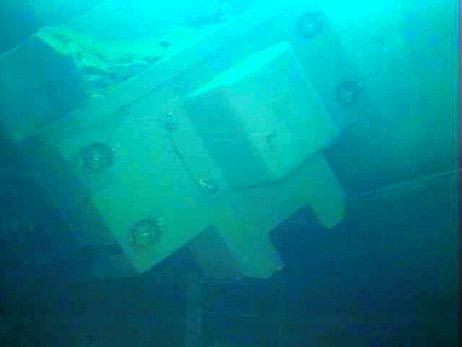
35 ton machine blocking the pool
You’ve listened to experts say that – unless the rods are removed from the fuel pools before a major earthquake strikes (using special equipment which keeps the rods submerged in water the whole time) – they will likely catch fire and release huge amounts of radioactivity. See

You’ve read that – after reviewing photos from several different angles – the Nuclear Regulatory Commission’s initial impressions were that spent fuel pool number 3 might not be there at all, and that nuclear engineer Arnie Gundersen said a couple of days ago:
Unit 3 is worse [than No. 4]. It’s mechanically, it’s rubble, the pool is rubble. It’s got less fuel in it. It faces the same problem. Structurally the pool has been dramatically weakened. And, god, nobody has even gotten near it yet.
And you may have caught the recent headline that a 35-ton machine fell into Unit Three's spent fuel pool. As Kyodo News reports:
The operator of the crippled Fukushima Daiichi nuclear power plant on Friday found that a 35-ton machine had dropped inside the spent fuel pool of the No. 3 unit, possibly because of a hydrogen explosion that occurred in the early stage of plant’s nuclear accident last year.

Tokyo Electric Power Co., commonly known as TEPCO, reported the finding after placing a camera inside the water-filled pool the same day to prepare for removing, as part of the decommissioning process, the nuclear fuel stored there.

One photo showed part of the machine, originally located above the pool and used to insert and remove fuel, appeared to have dropped onto the nuclear fuel storage racks.
But – until you see pictures – it is hard to get a sense of what all this means.

Sunday, November 17, 2013

dubya picking up an honorarium from the messianic jews...,


guardian | Bush himself famously described the war in Iraq as a "crusade" once, before it was pointed out to him that such language had unfortunate resonances in the Middle East. But the links between Zionism and Christianity go much further and deeper than that. The conversion of the Jews, and their restoration to Jerusalem, was a great enthusiasm among English evangelicals in Victorian times. 

Barbara Tuchman's marvellous book Bible And Sword chronicles some of the consequences. It's fair to say that without the belief of Victorian upper class evangelical Englishmen – almost exactly the equivalents of George W Bush – there never would have been a Balfour Declaration. And without that declaration, there could not have been the Jewish immigration to Palestine that laid the foundations for the state of Israel.

Some people will see this as an example of the destructive craziness of religion, and perhaps it is, but it is also an example of the way in which theology is only powerful and important when it is wrapped up in identity. Because if there is one group that has suffered as a result of the establishment of the state of Israel and its support by Western Christian countries, it is the historic Christians of the Middle East – who are now the victims of persecution throughout the region and scapegoats of an angry nationalism. This is one reason why the churches with historic links to Palestinian Christians are much less pro-Israel than those which don't, like the majority of American Baptists.

In the end, what matters is not so much what you believe about God, as who you think you are. The upper classes of any global empire feel certain that God is on their side. The Bushes feel that now as surely as the Balfours did a hundred years ago – and two thousand years ago the Caesars believed that gods were actually among their family members. None of them were good news for the inhabitants of Palestine, and I can't help feeling that Bush and his Texan Zionists are not so close to Jesus as they are to the Romans who crucified him.

a child-rape assembly-line

vice | Rabbi Nuchem Rosenberg—who is 63 with a long, graying beard—recently sat down with me to explain what he described as a “child-rape assembly line” among sects of fundamentalist Jews. He cleared his throat. “I’m going to be graphic,” he said.

A member of Brooklyn’s Satmar Hasidim fundamentalist branch of Orthodox Judaism, Nuchem designs and repairs mikvahs in compliance with Torah Law. The mikvah is a ritual Jewish bathhouse used for purification. Devout Jews are required to cleanse themselves in the mikvah on a variety of occasions: women must visit following menstruation, and men have to make an appearance before the High Holidays such as Rosh Hashanah and Yom Kippur. Many of the devout also purify themselves before and after the act of sex, and before the Sabbath.

On a visit to Jerusalem in 2005, Rabbi Rosenberg entered into a mikvah in one of the holiest neighborhoods in the city, Mea She’arim. “I opened a door that entered into a schvitz,” he told me. “Vapors everywhere, I can barely see. My eyes adjust, and I see an old man, my age, long white beard, a holy-looking man, sitting in the vapors. On his lap, facing away from him, is a boy, maybe seven years old. And the old man is having anal sex with this boy.”

Rabbi Rosenberg paused, gathered himself, and went on: “This boy was speared on the man like an animal, like a pig, and the boy was saying nothing. But on his face—fear. The old man [looked at me] without any fear, as if this was common practice. He didn’t stop. I was so angry, I confronted him. He removed the boy from his penis, and I took the boy aside. I told this man, ‘It’s a sin before God, a mishkovzucher. What are you doing to this boy’s soul? You’re destroying this boy!’ He had a sponge on a stick to clean his back, and he hit me across the face with it. ‘How dare you interrupt me!’ he said. I had heard of these things for a long time, but now I had seen.”

The child sex abuse crisis in ultra-Orthodox Judaism, like that in the Catholic Church, has produced its share of shocking headlines in recent years. In New York, and in the prominent Orthodox communities of Israel and London, allegations of child molestation and rape have been rampant. The alleged abusers are schoolteachers, rabbis, fathers, uncles—figures of male authority. The victims, like those of Catholic priests, are mostly boys. Rabbi Rosenberg believes around half of young males in Brooklyn’s Hasidic community—the largest in the United States and one of the largest in the world—have been victims of sexual assault perpetrated by their elders. Ben Hirsch, director of Survivors for Justice, a Brooklyn organization that advocates for Orthodox sex abuse victims, thinks the real number is higher. “From anecdotal evidence, we’re looking at over 50 percent. It has almost become a rite of passage.” Fist tap Dale.

Saturday, November 16, 2013

google map reveals the devastating rate of deforestation across the globe..,


dailymail | The destruction caused by deforestation, wildfires and storms on our planet have been revealed in unprecedented detail. High-resolution maps released by Google show how global forests experienced an overall loss of 1.5 million sq km during 2000-2012. For comparison, that’s a loss of forested land equal in size to the entire state of Alaska.

seen in the scene from the anthropocene in the philipines....,


Humans devised the technological means to use natural resources to construct a vast array of infrastructure (cities, roads, cars, ships, power stations, computers etc. etc). The operations of society are now very dependent on the services of this infrastructure. When it is abruptly destroyed as has happened in the Philipines, and as it irrevocably ages - which we witness all around ourselves - the decisions made by people (and their survivability) in the future will be greatly affected by the declining availability of these services.

paul chefurka | Denial wears many faces. Whether it’s average people who are too busy with their lives to take on board the more extreme reports of environmental degradation; bloggers and politicians who believe that it’s all a hoax cooked up by evil scientists to get grant money for bogus studies; or, perhaps surprisingly, the green activists who believe that more political or technological change will improve or even fix the situation – these are common techniques we use to avoid confronting the horror of global collapse face-to-face.

We are all familiar with the face of climate change denial. The Koch brothers, James Inhofe, Anthony Watts and a host of bloggers and politicians work tirelessly to derail any efforts to address humanity’s greatest existential crisis since the Toba super-volcano 75,000 years ago. They are a resilient species, their fact-resistance bolstered by inoculations of status and cash.

But this form of denial is easy to spot. There is a more subtle form, one that is endemic among the white hats of the green movement. They are the ones who tirelessly work from the moral high ground – to change policies, to develop and promote green technology, to encourage sustainability. They resolutely refuse to countenance any thoughts of our predicament being inextricable. Tireless work, even in a lost cause, tends to keep one insulated from the deeper, darker realizations, and lets one keep fighting the good fight. Heroism has always been an intrinsic part of our story: “Quitters never win and winners never quit!”

Is it unfair to characterize (at least some) green activists as being (at least somewhat) in denial? Possibly. But it’s true far more often than you might expect.

I have no idea if we’re facing “the end of the world”, whatever that hackneyed phrase might mean. However the big picture that most green activists, including the Transition folks and most Permaculturists I’ve met, fail to take on board includes some very simple, very stark facts: the entire planetary biosphere is collapsing, including the oceans, rivers, lakes and land; we are going to break the 2C degree “safe” threshold (which was never safe to begin with) within a couple of decades even with our best efforts (which we’re not giving); we will break 4C and possibly 6C with BAU; the agricultural systems of the world are destabilizing before our eyes due to extreme weather; methane feedbacks may have already begun; the world’s populations of human beings and their food animals are exploding while the world’s population of wild creatures is imploding; the bees and bats are dying; starfish are melting; sea turtles are dying on the beaches; the Eastern Cougar, the Western Black Rhino, the Japanese River Otter and the Formosan Clouded Leopard have all been declared extinct in the last year.

It looks a whole lot like the global life-support system is coming apart at the seams, and we are doing what we’ve always done: precisely nothing.

awareness required to handle climate change impossible...,

guymcpherson | Seems to me that all efforts to create awareness about climate change will be useless. Any effort to make the average individual understand the problem we are facing today, will be useless. “Limits to growth” is a good example of failed efforts. The message has been there for 40 years. The required awareness, at a global scale, a necessity to handle the current situation, is something that seems to me impossible, because we are, as specie, not smart enough to handle our own power. 

Based on my experience, average human has, let´s say, a six-dimensional perception of the world. Own body, family, house, job, grocery store (stores in general) and neighborhood. Anything beyond this limits, it is outside of a truly understanding (something happens out there, but nobody dares to find out what and how). Nation is a distant concept understood only because our job and family require some security provided by the concept of nation. Most people do not understand how the nation-system works. Water and electricity are there, always available. Food, at the grocery store. Job, a place to go and do something for what we receive some fiat money. Garbage, is taken by the garbage truck, to who knows where. Dirty water goes somewhere. Smoke vanishes into the air. Outside these limits, nobody knows what is really going on. Nobody knows how things happen.The mechanisms.We are unable to connect the dots. Concurrently, nobody knows their footprint and the effects of it to the rest of this world (present and future). Nobody cares.

But the world, the biosphere, mankind activity included, is a thousand times more complex (ten thousand dimensions?). Average people can handle only six …. We have not been able to model climate. We have not been able to model the behavior of the ocean (I work with it). We have not been able to make a robot like in “I robot” (the movie), that is still Sci-Fi, even though we have been trying for more than 50 years. We have not been even close to make an organic part of a human body. Our so respected medical doctors can just help to repair it. The truth is that the final repair is done by the body itself. We know that gravity exists, but we do not know what it is. And so on. There are so many things we do not know how they work. The reality of the average human is so basic.

Friday, November 15, 2013

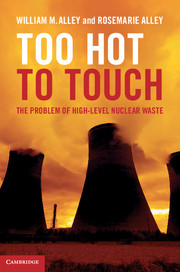
too hot to touch the problem of high-level nuclear waste

energyskeptic | After Yucca Mountain was thrown out as a nuclear waste site in 2009 after 25 years and $10 billion in studies — to help Senator Majority leader Harry Reid (D-NV) get re-elected in 2010 — there is nowhere to put nuclear waste.  Not much, if anything, is being done to find a new place, and there’s no chance an ideologically divided Congress would agree on a new site anyhow.

Meanwhile, 70,000 tons of spent nuclear reactor fuel and 20,000 giant canisters of defense-related high-level radioactive waste is sitting at 121 sites across 39 states, with another 70,000 tons on the way before nuclear power plants reach their end of life.  All of this waste is now, and for millions of years, exposing future generations and is vulnerable to terrorists, tsunamis, floods, rising sea levels, hurricanes, electric grid outages, earthquakes, tornadoes, and other disasters.

Spent fuel pools in America at 104 nuclear power plants, have an average of 10 times more radioactive fuel stored than what was at Fukushima, and almost no safety features such as a backup water-circulation systems and generators.

About 75% of spent fuel in America is being stored in pools, many of them so full they have four times the amount they were designed to hold.

The National Academy of Sciences published a report that stated terrorists could drain the water from spent fuel storage, causing the fuel rods to self-ignite and release large quantities of radioactivity, or they could steal nuclear waste to make a (dirty) bomb.

Not making a choice about where to store nuclear waste is a choice. We will expose future generations to millions of years of toxic radioactive wastes if we don’t clean them up now.
This book has a complete history of nuclear waste and what to do with it, the many issues, how we arrived at doing nothing, and has outstanding explanations of difficult topics across many fields (i.e. nuclear science, geology, hydrology, etc), as well as explaining the even more difficult political and human issues preventing us from disposing of nuclear wastes in a permanent geological repository.
The goal of anti-nuclear opponents has been to prevent a nuclear waste site from happening so that no new nuclear power plants would be built. Many states, such as California, have laws against building new nuclear plants until a waste depository exists.

The thing is, activists never needed to fear new reactors because the upfront costs are so high and the payback so delayed along with such high, uninsurable liabilities, that investors and utilities haven’t wanted to build nuclear power plants for decades.  Also, Uranium reserves are so low there’s only enough left to power existing nuclear plants for a few more decades (Tverberg), and perhaps less than that once the energy crisis hits and the energy to mine and crush millions of tons of ore is used for other purposes.

The only way new plants would ever get built is for the government to build them.  Not going to happen.  America has trillions in debt, hundreds of trillions of unfunded liabilities in the future (i.e. Medicare and other programs), the overall economic system is $600 trillion in debt, and the entire economic system is rotten and corrupt to the core with no reform in sight (see my amazon Fraud & Greed:  Wall Street, Banks, & Insurance book list  for details).  The final nail in the coffin is Fukushima — even if the government decided to nuclear power plants, public opposition would be too high.  Not to mention the most dysfunctional Congress in history.

Within the next few years (Hirsch), we will be on the exponentially declining oil curve of Hubbert’s Peak, and it will be too late to move the waste because our priorities will be rationing oil to agriculture to grow, harvest and distribute food, repair essential infrastructure, home heating and cooling, and emergency services.

Once the energy crisis hits, even if new nuclear plants are begun, which is not a given, since the crisis is oil — electricity doesn’t solve anything — building would probably stop because within the next ten years there are very good odds of another nuclear disaster: our plants are old and falling apart.
It’s really bad, much worse than most people realize. I highly recommend the 128 page report by Hirsch called “Nuclear Reactor Hazards Ongoing Dangers of Operating Nuclear Technology in the 21st Century”, or my summary of this paper at energyskeptic “Summary of Greenpeace Nuclear Reactor Hazards”.

visit sunny chernobyl


energyskeptic | After Chernobyl, Russia had workers hired people to be “liquidators”. They were exposed to a lot of radiation to clean up Chernobyl so radioactive waste wouldn’t be tracked out or blown into the air and spread further.  These workers are now entitled to benefits depending on how much radiation dosage they received.

It hadn’t occurred to me that every time there’s a forest fire, the fallout of Chernobyl continues, because trees take up radioactive particles, which are released by fire again.

After Chernobyl exploded, firemen rushed over and kept the fire from spreading to an adjacent reactor — most of them died, but their bravery kept Chernobyl from creating an 800 kilometer no man’s zone, instead of the 30 kilometer zone that exists today.

Russia is planning to put a concrete dome over Chernobyl that will last for 150 years.  Blackwell describes this as “The reactor building, though, will be dangerous for millennia. So maybe there will one day be a shelter for the shelter for the Shelter Object, and then a shelter for that, and we will continue down the generations, building–shell by shell– a nest of giant, radioactive Russian dolls.”

There are tours of Chernobyl, here’s a description from the book: “Dennis’s radiation meter topped out at 1300 micros, about 30 times the background radiation in New York City. He twisted around in his seat to face me. “Yesterday it was up to 2,000″. There was a hint of apology in his voice. Perhaps he was worried I might feel shortchanged for having received less than the maximum possible exposure …, as if I had come to Nepal to see Mount Everest, only to find it obscured by clouds”.

The Chernobyl core “was the size of a small building, a thick bucket standing several stories tall. It felt impossible to understand the power embodied in such a machine. A quarter ounce of nuclear fuel holds nearly as much energy as a ton of coal; the core had held more than a hundred thousand times that much”.

Thursday, November 14, 2013

unspeakable atomic plague inexorably spreading...,


Esquire, Nov. 12, 2013: Fukushima Radiation Arrives In Alaska – The Fukushima Crisis Comes To The States [...] The catastrophe at the Fukushima nuclear power plant — aka Yesterday’s Tragedy — appears to be ongoing, and Alaska now has become part of the story. “Some radiation has arrived in northern Alaska and along the west coast. That’s raised concern over contamination of fish and wildlife. More may be heading toward coastal communities” [...] It’s past time for the world to step in because this problem now is riding on the wind and the tides to places far from Fukushima. [...]

Hannah Spector, Ph.D., Assistant Professor of Education at Penn State (Harrisburg), Transnational Curriculum Inquiry, 2012: [...] One of the problems we face with radioactive fallout from Fukushima is the lack of information coming from “experts.” Indeed, there has been a global media blackout, a “deadly silence on Fukushima” (Norris, 2011) […] science still does not have the technological or methodological understanding to clean up the disaster (Magwood, 2012) which has leaked into the Pacific Ocean and spread throughout the northern hemisphere by way of wind and rain. This invisible truth is so incomprehensible that it is easier to pretend it doesn’t exist. [...] The novelty of Fukushima is worth noting. A new and improved version of the original atomic plague is spreading across the planet through earth, air, fire, and water – yet it cannot be seen, heard, tasted, smelled, or touched. It has become part of the atmosphere. [...] Where to run? Where to hide? What to do? At the same time, official reports have denied the extent of this boundary-transgressing catastrophe in both overt and covert ways. One year after Fukushima began, National Public Radio reported that “trauma, not radiation is [the] key concern in Japan” (Harris, 2012). [...] focusing upon trauma as being more worrisome than possible effects of radiation contamination deflects from the crime that created the trauma to begin with, a crime that will last days, decades, and millennia into the future depending on what type of radionuclide we are talking about. [...]

(In April 2013, Spector received the American Educational Research Association’s Critical Issues in Curriculum and Cultural Studies Award for this journal article  -Source)

highest-stakes pick-up sticks game of all time...,


enenews | Reuters, Nov. 12, 2013: The urgency to clear Reactor No. 4 of the fuel assemblies is because of the risk in having spent fuel stored at such a height – some 18 meters above ground level – in a building that has buckled and tilted and could collapse if another quake strikes. Also, if the pool housing the fuel assemblies is punctured and the water drains away, there could be a fire [...] threatening Tokyo […] As the water used to cool the rods has had to be pumped in from the ocean, there is a risk that some may have corroded from the seawater. […] [The fuel rods] contain plutonium, one of the most toxic substances known [...]

Bloomberg, Nov. 8, 2013: Engineers have been examining the stability of the reactor building to make sure no new vulnerabilities have developed that could lead to accidents during removal. Quarterly tests have also been conducted to ensure the building isn’t sinking because of soil subsidence, [Akira Ono, head of the Fukushima Daiichi plant] said.

Independent (UK), Nov. 8, 2013: Engineers must remove the fuel assemblies one by one, without incident, and each time deal with the risk of fire or the cooling water boiling dry. The building lists slightly but Tepco says it has been reinforced [...] Tepco had built an alarm system that would warn workers to evacuate if radiation climbed dangerously high. […]

Takashi Hara, head of the spent fuel removal operation at Unit 4, Nov. 12, 2013: “A lot of debris fell into the fuel pool as a result of the March 2011 hydrogen explosion. The large pieces of debris have been removed […] If, for some reason, the water levels drop, the fuel would quickly heat up.”

Ichiro Kazawa, 61, a former real estate manager from Hirono, nearby the plant, Nov. 12, 2013: “We are all worried … Every day we read news about the plant, and we are aware of their plans to remove the spent fuel rods […] Everybody’s concerned and just hoping there will be no major accidents. No one here trusts Tokyo Electric.”

scenes from the anthropocene...,


LATimes | As concerns grew about rampant looting and lawlessness, Philippine security forces sent reinforcements and imposed a nighttime curfew in Tacloban. Armed assailants have been holding up aid convoys headed to the city. On Tuesday, troops killed two suspected communist rebels who attacked one such convoy, the military said.

Local officials said bands of looters, having cleaned out shops in Tacloban, were beginning to break into the homes of people who had died or fled the city. But there were reports that newly arrived troops were restoring order.

Flights delivering aid from around the world are arriving at the airport in Cebu, which has been turned into a logistics hub for the relief effort. The many donations included a field hospital from Belgium and a portable purification plant from Germany, according to European officials.

By the end of the day Wednesday, the United States had delivered nearly 274,000 pounds of supplies to Tacloban, about 100 miles northeast of Cebu, said two senior Obama administration officials who briefed reporters in Washington on condition of anonymity. The shipments included plastic tarps, hygiene kits, blankets and medical supplies.

U.S. military personnel had also evacuated about 800 people from Tacloban to Manila for medical treatment.

Philippine welfare personnel loaded up packages of rice and canned food provided by the World Food Program and distributed them to nearly 50,000 Tacloban residents. But even there, where the bulk of assistance has been delivered, bodies still lined the streets because, authorities said, there were not enough hands to remove them.

Hundreds of additional Marines are expected to arrive in the Philippines by week's end to bolster the relief effort, which has struggled against logistical hurdles and the scale of the devastation.

Aid has yet to reach many victims of the typhoon, known by Filipinos as Yolanda, particularly on outlying islands.

"The major challenge is logistics," said Mathias Rick, a regional spokesman for the European Commission's humanitarian aid directorate. "With all this aid arriving and at the same time, the various Philippine authorities — military, civilian structures, the Philippine Red Cross — trying to distribute aid to so many communities ... obviously there are bottlenecks."

Some of the logistical problems eased Wednesday, as remote airstrips and major roads were cleared of debris. However, fuel shortages and lack of power remain problems in rural areas.

The longer the aid takes to arrive, the more people try to leave. Every day, desperate residents gather at Tacloban airport hoping for a spot on one of the departing supply planes.

pacific ocean warming faster...,


usatoday | "We're pumping heat into the ocean at a faster rate over the past 60 years," said study lead author Yair Rosenthal, a climate scientist at Rutgers University. "We may have underestimated the efficiency of the oceans as a storehouse for heat and energy," he added. "It may buy us some time — how much time, I don't really know. But it's not going to stop climate change."

"It's not so much the magnitude of the change, but the rate of change," noted study co-author Braddock Linsley, a Columbia University climate scientist. "We're experimenting by putting all this heat in the ocean without quite knowing how it's going to come back out and affect climate."

He said that in the past six decades the temperature of the Pacific Ocean water studied (from the surface to about 2,200 feet below) has increased by about one-third of a degree Fahrenheit. (The specific area studied was in the Pacific near Indonesia, chosen because that's a typical sample of Pacific Ocean water.) Researchers say that while the amount of warming might seem small in the scheme of things, it's the rate of warming that's so alarming, Linsley said.

The researchers found that Pacific Ocean water has generally been cooling over the past 10,000 years, until about 800 years ago, when temperatures started to slowly rise. (Then fell again, during the so-called Little Ice Age from the mid-1500s to mid-1800s). It's been only in the past few decades, though, that the rate has dramatically increased.

The Earth's atmosphere has been about the same temperature for the past 15 years or so, providing fuel for skeptics of man-made global warming. However, this study, along with other recent research, finds that heat absorbed by the planet's oceans has increased significantly.

Obviously, there were no thermometers taking measurements of ocean temperatures over the past few thousand years (instrument records from buoys go back only to the 1960s). So scientists had to use "proxy" sources to measure temperature. In this case, it was fossils of ancient marine life — little shelled animals known as foraminifera — that could be analyzed to reconstruct the climates in which they lived over millennia.

"This is a relatively new way of measuring past temperature data," Rosenthal noted.

Wednesday, November 13, 2013

kufi on too tight....,


quoth Bro. Makheru: If all language in the locker room or on the battlefield is fair game, why don’t we hear about Black players/soldiers using derogatory terms like “crackers,” “peckerwoods,” “honkies,” or “devils?” Why is that? White supremacy?

After 1978 or so, nobody outside the pathologically identified and the perpetually aggrieved use those terms of endearment - either in the heat of anger, or, in the throes of overwrought righteous indignation. The exception is of course "peckerwood", and the all-time classic conjugation of "redneck peckerwood" - which I haven't heard comically screeched since the last time I was at the Texas state fair. When that happened, I nearly had to have CPR I was laughing so hard hearing it inveighed by one loud and bumptious rednecked peckerwood against yet another only slightly less boisterous representative of the caste.

Now, the great Sam Peckinpah was intensely fond of this particular term of endearment, and he used it whenever and wherever possible in his westerns. It turns up in both Major Dundee and in the Wild Bunch.  So Bro. Makheru, in partial answer to your rhetorical kwestin, "why don't we hear black soldiers using these specific derogatory terms" - I'ma go with the answer "you better have been a very special brand of badass back in the day to have had the nerve and audacity to say it and live to tell of it", and, in consequence of this fact, it never caught on and became popular outside a small circle of intensely identified folk who LOVE to use these terms of endearment when they gather together to reminisce about the glory days of the early 70's.


quoth Bro. Makheru: “Where men are required to depend on one another, the spoken word doesn't even come from the same psychological spigot…” That is pure unadulterated, historically revisionist, bovine excrement!

Because I'm decidedly not a team player, you won't find me representing on behalf of either the Amerireich or the NBUF..., as a species-level guy, I find it preferable to observe and assess the antics of deuterostems in more universal and powerfully explanatory ethological terms, thus my preference for "killer-ape" on the small scale, "dopamine hegemony" on the largest scale, and global system of 1% supremacy to identify the controlling minority who rules it all.


quoth Bro. Makheru: The above mentioned derogatory words all come from the same psychological spigot--the spigot of white supremacy. Epithets don’t lose their meaning, particularly when a specific epithet is repeatedly used by the same group of people with violent intentions.

As the nominal and symbolic commander of the whole and entire machinery of global supremacy, the boss is not merely a figment of the imagination. The Hon.Bro.Preznit signifies where black Americans stand in the fourth and final quarter of this game. With nothing else left to prove. Everything else is - as they say - merely conversation.

world at the crossroads - free computer game


skepticalscience | One can write hundreds of articles and books, but still it will be just passive transfer of knowledge. If one could only sit behind the control panel of our civilization and steer it through history… It would help understand why in the XX th century our history happened this way, it would let us look into the future and understand how our various decisions will influence it. Then, if something would go wrong, we could draw conclusions and try again. And once again, until everything is fine…

Do you know "Limits to growth"? Forty years ago scientists of the Club of Rome prepared a computer model, showing that our exponentially growing economy, based on nonrenewable resources, is on a collision course with reality, heading for a crash. They also showed, that our deliberate intervention in the system’s dynamics can prevent the disaster.

Here comes "World at the Crossroads" – a highly playable Windows computer game, prepared by the Polish ASPO chapter together with European Regional Environmental Center. The game simulates the rise of the industrial civilization, from 1900 to 2200. It can be viewed as a model of The Limits to Growth, commissioned by the Club of Rome in 1972, converted into a strategy game that helps understand systems dynamics and complex interactions between Earth and human civilization.

Tuesday, November 12, 2013

the real danger will come from the government clampdown


activistpost | The Department of Homeland Security (DHS) spent $80M to fortify federal buildings in New York apparently in preparation for civil disturbances and possible food riots on November 1st. The DHS plans included armed private guards who would protect IRS and other buildings against attack by fellow Americans.

Other officials joined in ringing an alarm bell. Margarette Purvis, head of New York City's Food Bank – the largest one in the nation – also suggested that food riots were likely to break out in NYC. In a well-timed interview with Salon (10/29/13), Purvis hinted she might not even be averse to unrest. Salon reported, “Rather than 'trying to raise a dollar' to avert disaster privately, she [Purvis] said, a solution will require Americans to 'raise their voices', because 'the avenue has to be activism'.”

The proximate cause of the expected unrest was November 1st cuts to the food stamp program, which resulted from the expiration of a 2009 stimulus bill. The New York Times estimated that benefits for a family of four will fall $36 a month; for a single adult, it will fall $11. The most current data available (July) indicates that nearly 48 million Americans are on food stamps, or approximately one-seventh of the population. More reductions are expected over coming months as a result of Congressional renegotiations on a farm bill.

It is difficult to know how seriously to take the fact that the term “food riots” has entered the vocabulary of the American media and its bureaucrats. Both parties have a vested interest in creating panics. The media wants ratings and government wants an excuse for more social control. But a few aspects of the food riot talk seem clear enough.

The government seems to have been shaken by a glitch that occurred last month, bringing down part of the Electronic Benefits Transfer System (EBT); the system enables electronic food stamps. When recipients were not allowed to 'purchase' food, they flooded twitter with threats of rioting. When two Wal-Marts in Louisiana allowed purchases even though they could not verify the e-balance on the EBT cards, the stores were “legally looted”; that is, people with next to no balance stripped them of hundreds of dollars in goods. One woman with a balance of .49 cents tried to 'buy' $700 worth but was thwarted when EBT reconnected.

In short, a limited and temporary breakdown in EBT caused looting to break out and riots to be threatened. What would have emerged from a nationwide and permanent disruption?

But the real danger is more likely to come from a government clamp down rather than from rioting. The cut backs have not been severe. Heritage Foundation policy analyst Rachel Sheffield explained that food stamps is “one of 80 federal means-tested programs that provide food, housing, medical care to poor and low income Americans.” And the government certainly continues to promote the program. An October 16th, 2013 Cato study entitled “The Food Stamp Program Needs Reform” found that over $41.3 million was being spent annually to market food stamps to prospective recipients. Nevertheless, the government is not likely to waste a good crisis. Fist tap Dale.

learning how to die in the anthropocene


NYTimes | The human psyche naturally rebels against the idea of its end. Likewise, civilizations have throughout history marched blindly toward disaster, because humans are wired to believe that tomorrow will be much like today — it is unnatural for us to think that this way of life, this present moment, this order of things is not stable and permanent. Across the world today, our actions testify to our belief that we can go on like this forever, burning oil, poisoning the seas, killing off other species, pumping carbon into the air, ignoring the ominous silence of our coal mine canaries in favor of the unending robotic tweets of our new digital imaginarium. Yet the reality of global climate change is going to keep intruding on our fantasies of perpetual growth, permanent innovation and endless energy, just as the reality of mortality shocks our casual faith in permanence.

The biggest problem climate change poses isn’t how the Department of Defense should plan for resource wars, or how we should put up sea walls to protect Alphabet City, or when we should evacuate Hoboken. It won’t be addressed by buying a Prius, signing a treaty, or turning off the air-conditioning. The biggest problem we face is a philosophical one: understanding that this civilization is already dead. The sooner we confront this problem, and the sooner we realize there’s nothing we can do to save ourselves, the sooner we can get down to the hard work of adapting, with mortal humility, to our new reality.

The choice is a clear one. We can continue acting as if tomorrow will be just like yesterday, growing less and less prepared for each new disaster as it comes, and more and more desperately invested in a life we can’t sustain. Or we can learn to see each day as the death of what came before, freeing ourselves to deal with whatever problems the present offers without attachment or fear.

If we want to learn to live in the Anthropocene, we must first learn how to die. Fist tap Arnach.

the plot against france...,


NYTimes | By the numbers, then, it’s hard to see why France deserves any particular opprobrium. So again, what’s going on? 

Here’s a clue: Two months ago Olli Rehn, Europe’s commissioner for economic and monetary affairs — and one of the prime movers behind harsh austerity policies — dismissed France’s seemingly exemplary fiscal policy. Why? Because it was based on tax increases rather than spending cuts — and tax hikes, he declared, would “destroy growth and handicap the creation of jobs.” 

In other words, never mind what I said about fiscal discipline, you’re supposed to be dismantling the safety net. 

S.& P.’s explanation of its downgrade, though less clearly stated, amounted to the same thing: France was being downgraded because “the French government’s current approach to budgetary and structural reforms to taxation, as well as to product, services and labor markets, is unlikely to substantially raise France’s medium-term growth prospects.” Again, never mind the budget numbers, where are the tax cuts and deregulation? 

You might think that Mr. Rehn and S.& P. were basing their demands on solid evidence that spending cuts are in fact better for the economy than tax increases. But they weren’t. In fact, research at the I.M.F. suggests that when you’re trying to reduce deficits in a recession, the opposite is true: temporary tax hikes do much less damage than spending cuts. 

Oh, and when people start talking about the wonders of “structural reform,” take it with a large heaping of salt. It’s mainly a code phrase for deregulation — and the evidence on the virtues of deregulation is decidedly mixed. Remember, Ireland received high praise for its structural reforms in the 1990s and 2000s; in 2006 George Osborne, now Britain’s chancellor of the Exchequer, called it a “shining example.” How did that turn out? 

If all this sounds familiar to American readers, it should. U.S. fiscal scolds turn out, almost invariably, to be much more interested in slashing Medicare and Social Security than they are in actually cutting deficits. Europe’s austerians are now revealing themselves to be pretty much the same. France has committed the unforgivable sin of being fiscally responsible without inflicting pain on the poor and unlucky. And it must be punished. Fist tap Arnach.

Chipocalypse Now - I Love The Smell Of Deportations In The Morning

sky |   Donald Trump has signalled his intention to send troops to Chicago to ramp up the deportation of illegal immigrants - by posting a...