Wednesday, October 05, 2011

take a page from the teabagger playbook

'This is Revolution Not Reform' Occupy Wall Street Organizer from Naked Emperor News on Vimeo.

WaPo | A question was asked of me yesterday about the Occupy Wall Street movement that has been a presence in lower Manhattan since Sept. 17. Are there any parallels between it and the Tea Party movement? Yes. But if it doesn’t do four things — 1.) broaden its base of support to include those who share its values or goals; 2.) get specific about what the goals are; 3.) bring the protests to Washington; and 4.) get support from members of Congress — it could squander its momentum.

Both Occupy Wall Street and the Tea Party are organic movements. They rose up from everyday people who got tired of being pushed around or ignored by powers they believe are beyond their control. Both movements eschew having one or a crew of recognized leaders who speak for everyone. So far, it’s worked for the Tea Party. For the nascent movement centered in Lower Manhattan, there’s still time for it to get its act together.
Occupy Wall Street is already doing the first and second things I proposed. A look at the calendar on www.occupywallstreet.org shows rallies with organized labor. And it released a “Declaration of the Occupation of New York City,” detailing its beliefs and grievances.
They have taken our houses through an illegal foreclosure process, despite not having the original mortgage.
They have taken bailouts from taxpayers with impunity, and continue to give Executives exorbitant bonuses.
They have perpetuated inequality and discrimination in the workplace based on age, the color of one’s skin, sex, gender identity and sexual orientation.
They have poisoned the food supply through negligence, and undermined the farming system through monopolization.
They have profited off of the torture, confinement, and cruel treatment of countless animals, and actively hide these practices.
There’s more where this came from. But it’s still having trouble articulating specifically what it’s fighting for. A painful example of this was an interview Al Sharpton did last night with Harrison Schultz, an organizer for Occupy Wall Street. Sharpton asked him several times, “What are the goals?” Schultz just couldn’t articulate any.

po thangs...,


Video - Motorhead Eat the Rich

WaPo | The latest group to claim victim status is the rich. Actually the super-rich, whose wealth ordinarily exempts them from pity. While they are not yet subjected to airport profiling (except for early boarding and club access), they sense that the public is turning subtly against them — otherwise how could President Obama propose raising their taxes?

Admirers of the rich, led by pundits and politicians on the right — from Laura Ingraham to Larry Kudlow — have long derided the victimization claims of African Americans, women, gays and the unemployed, but now they’re raising their voices to defend the rich against what they see as an ugly tide of “demonization.”

At a time when poverty is soaring, unemployment hovers grimly above 9 percent and growing numbers of Americans suffer from “food insecurity” — the official euphemism for hunger — this concern may seem a tad esoteric. At a time when executive compensation is reaching dizzying new levels and the gap between the rich and everyone else is growing as fast as the federal deficit, it may even seem a little perverse.

But even beyond the taxes-and-deficits debate, in which wealthy Americans have been routinely characterized as yacht owners and corporate-jet fliers, the rich have indeed suffered a few blows to their self-esteem. Last year’s film “The Social Network” was unflattering to exemplars of both new and old wealth, and now two new television series are being hyped by some in the media as incitements to class warfare. In “2 Broke Girls,” a couple of young women struggle to survive — not as runway models or high-maintenance housewives but, shockingly enough, as waitresses. And Time magazine titillatingly describes ABC’s “Revenge,” set in the Hamptons, as “a target-rich environment of polo players and stock traders” in which a young woman stalks the singularly overprivileged people who, years earlier, ruined her father. No less a social commentator than “Revenge” star Madeleine Stowe has observed that “we’re dealing in a particular time right now in American history where I think the average American is going to want to see a takedown of the rich.”

You would never guess from all the talk of demonization that the rich enjoy perhaps the strongest PR machine on the planet, far beyond their entourages of agents, publicists and assorted image-makers. The mainstream media, for example, are not owned by collectives of busboys and taxi drivers, and even the “liberal” outlets among them are not pitched toward the impecunious. They may snicker when the occasional hedge fund manager is brought to justice, but they’ve been equally snarky about populist actions against the rich, such as the ongoing occupation of Wall Street, which is newsworthy if only for the levels of brutality it’s elicited from the NYPD. Or did you know that the Transportation Security Administration just won union representation this summer? Probably not, because that’s “labor news,” which has been all but supplanted by “business news.”

In fact, if you keep your ears open, you can hear the praises of the rich ringing out almost everywhere. Evangelical Christianity, for example, once harbored an ancient biblical bias in favor of the poor, but now, at least in its high-profile megachurch manifestations, it has abandoned the book of Matthew for a “prosperity gospel” that counts wealth as a mark of God’s favor.

Nor should we forget those secular evangelists in the motivation industry who have advocated selflessly for the rich for years, as in these instructions from the 2005 bestseller “Secrets of the Millionaire Mind”: “Place your hand on your heart and say . . . ‘I admire rich people!’ ‘I bless rich people!’ ‘I love rich people!’ ‘And I’m going to be one of those rich people too!’ ”

Tuesday, October 04, 2011

very well played...,


Video - NYPD backs off when Occupy protestors chant "The Whole World is Watching"

99% of service men and women are the 99%


Video - Veterans in uniform showing up at the Occupation?

In5D | The Occupy Wall Street movement may have just received an unexpected surprise – United States Army and Marine troops are reportedly on their way to various protest locations to support the movement and to protect the protesters.

Army serviceman Ward Reilly posted the following on Facebook:

“I'm heading up there tonight in my dress blues. So far, 15 of my fellow marine buddies are meeting me there, also in Uniform.

I want to send the following message to Wall St and Congress:

I didn't fight for Wall St. I fought for America. Now it's Congress' turn.

My true hope, though, is that we Veterans can act as first line of defense between the police and the protester. If they want to get to some protesters so they can mace them, they will have to get through the Fucking Marine Corps first. Let's see a cop mace a bunch of decorated war vets.

I apologize now for typos and errors. Typing this on iPhone whilst heading to NYC. We can organize once we're there. That's what we do best.If you see someone in uniform, gather together.

#OccupyWallStreet - "The Marines are Coming to Wall Street to PROTECT the Protestors' | in5d Alternative News | in5d.com |A formation will be held tonight at 10PM.

We all took an oath to uphold, protect and defend the constitution of this country. That's what we will be doing.

Hope to see you there!!”

Reilly added, “Please note...this is from another veteran, NOT ME. (I was Army, he's a Marine)...and I am on my way to DC, not NYC. :>) ....but this is fantastic, and he's not a VFP guy....just a soldier that is outraged by what we have become in this country, as it should be.

Occupy Washington, DC link

“A LOT of veterans get it,” Reilly stated. “Only one third of one percent of our citizens serve in the military, and we are the ones who sacrifice MUCH, and all we ask in return is that civilians control the people they elect. (miserable failure so far) But ...the image of police, or anyone else, pepper spraying veterans or even confronting them, is "priceless" as they say, and will help slap this country into seeing what we have become.(totally insane, politically and police-state-wise). And EXACTLY what I have requested from my brother and sister veterans in DC Oct.6.”

Reilly added an edited statement: "I'm no longer in active duty or in any way contractually indebted to the military. Nor are any of my friends that are joining me.

To the officers' of this thread: I'm aware of the potential, maybe inevitable trouble I can get in. So too are my friends.

I don't really care about the debate here, the upvotes, the downvotes or anything in here really. Mental masturbation is awesome and all. But fucking hell people get off reddit and do something about it. The decision is made. I just figured reddit to be a useful tool to get the attention of a good amount of veterans."

This tipping point could be the defining moment that sends the Occupy Wall Street movement into perpetual motion.

white shirts gettin they thug on....,

NYTimes | The New York Police Department puts an endless list of tasks on the shoulders of its so-called white shirts — the commanders atop an army of lesser-ranking officers in dark blue.

But the portfolio of the white shirt has now unexpectedly grown to include the role of enforcer.

As the Occupy Wall Street protests, which began on Sept. 17, lurch into their third week, it is often the white shirts who lay hands on protesters or initiate arrests. Video recordings of clashes have shown white shirts — lieutenants, captains or inspectors — leading underlings into the fray.

White shirts led the face-off with protesters on the Brooklyn Bridge on Saturday afternoon. The episode provided no viral YouTube moments, as the senior officers avoided confrontations with the demonstrators. Yet as hundreds of arrests were made, chants of “white shirts, white shirts” could be heard.

And a white shirt is the antagonist in the demonstrations’ defining image: Deputy Inspector Anthony Bologna’s dousing of some penned-in women with pepper spray on Sept. 24, which seemed to surprise at least one of the blue shirts standing near him on East 12th Street, near University Place. The department is investigating the spraying.

Martin R. Stolar, a member of the National Lawyers Guild who is representing protesters, said, “It appears that it is white shirts that are directing the rough arrests.” To him, their actions constitute a policy from on high. Even the chief of department, Joseph J. Esposito, the highest-ranking officer, was mixing with marchers last Saturday, briefly holding two people by the arm and directing their arrests.

Paul J. Browne, the department’s chief spokesman, did not return a call to discuss the department’s strategy, but in an e-mail he said most of the roughly 80 arrests made last Saturday “were made by police officers directed by supervisors.”

In everyday policing situations, the one-two punch of uniformed response usually goes like this: Blue shirts form the first wave, with white shirts following. But those roles seem reversed in the police response to the Wall Street protests.

is j.p. morgan getting a good return on its invesment?


Video - NYPD's infamous Brooklyn Bridge barrelfish tactic.

NakedCapitalism | No matter how you look at this development, it does not smell right. From JP Morgan’s website, hat tip Lisa Epstein:

JPMorgan Chase recently donated an unprecedented $4.6 million to the New York City Police Foundation. The gift was the largest in the history of the foundation and will enable the New York City Police Department to strengthen security in the Big Apple. The money will pay for 1,000 new patrol car laptops, as well as security monitoring software in the NYPD’s main data center.
New York City Police Commissioner Raymond Kelly sent CEO and Chairman Jamie Dimon a note expressing “profound gratitude” for the company’s donation.
“These officers put their lives on the line every day to keep us safe,” Dimon said. “We’re incredibly proud to help them build this program and let them know how much we value their hard work.”

Perhaps I remember too much of the scruffy and not exactly safe New York City of the 1980s, where getting your wallet pinched was a pretty regular occurrence. My perception has been that police-related charities have relied overmuch on the never-stated notion that if you didn’t donate, you might not get the speediest response if you needed help. As a mere apartment-dweller, I can’t imagine that anyone could scan incoming 911 calls against a priority list. But the flip side is if I owned a retail store and thought the beat police would keep an extra eye on it if I gave to a police charity, it would seem like an awfully cheap form of insurance.

But what, pray tell, is this about? The JPM money is going directly from the foundation to the NYPD proper, not to, say, cops injured in the course of duty or police widows and orphans. But that is how the NYPD Police Foundation works. From its website:

The New York City Police Foundation, Inc. was established in 1971 by business and civic leaders as an independent, non-profit organization to promote excellence in the NYPD and improve public safety in New York City.

The Police Foundation supports programs designed to help the NYPD keep pace with rapidly evolving technology, strategies and training.

The New York City Police Foundation:

Provides resources that are not readily available through other means – to date over $100 million has been invested in 400+ innovative NYPD programs;

Serves as a vehicle for tax-exempt gifts and grants from individuals, businesses, and philanthropies;

Is the first municipal foundation of its kind in the country, and serves as a model for similar organizations in other cities;

Is the only organization authorized to raise funds on behalf of the NYPD and;

Does not solicit by telephone or use telemarketers.

The Police Foundation works closely with the Police Commissioner to develop a strategic program agenda. The Foundation encourages and supports NYPD programs in two main areas:

Projects, research studies, and equipment to improve the effectiveness of police activities; and

Education, training and skill development to strengthen the partnership between the police and the public.
Given when the NYC Police Foundation was formed, it looked to have been a desperate move during New York City’s fiscal crisis (remember the infamous headline: “Ford to City: Drop Dead”?) When I moved to the city in 1981, pretty much everyone I knew who lived in a non-doorman building had suffered a break-in. Guiliani’s reputation was built on cleaning up a perceived-to-be unsafe city (which he did by hiring William Bratton). Even in the later 1980s, when I lived in a townhouse on 69th between Park and Madison (translation: good neighborhood), I’d be the first out of the building in the AM. The inner door to the townhouse was locked, the outer one was closed but unlocked. I’d always have to navigate my way out carefully so as not to waken the homeless person sleeping in the vestibule.

So while this effort to supplement taxpayer funding has a certain logic, it raises the nasty specter of favoritism, that if private funding were to become a significant part of the Police Department’s total budget, it would understandably give priority to its patrons.

And look at the magnitude of the JP Morgan “gift”. The Foundation has been in existence for 40 years. If you assume that the $100 million it has received over that time is likely to mean “not much over $100 million” this contribution could easily be 3-4% of the total the Foundation have ever received.

Now readers can point out that this gift is bupkis relative to the budget of the police department, which is close to $4 billion. But looking at it on a mathematical basis likely misses the incentives at work. Dimon is one of the most powerful and connected corporate leaders in Gotham City. If he thinks the police donation was worthwhile, he might encourage other bank and big company CEOs to make large donations.

And what sort of benefits might JPM get?
Fist tap Uncle John.

Monday, October 03, 2011

too late for the unemployed?

SeekingAlpha | The debate between cyclical and structural unemployment arose last year. At this point, it looks like Federal Reserve policymakers increasingly favor the structural side of the debate. Federal Reserve Chairman Ben Bernanke, speaking at Jackson Hole, suggested that cyclical unemployment remains the primary economic challenge:
Normally, monetary or fiscal policies aimed primarily at promoting a faster pace of economic recovery in the near term would not be expected to significantly affect the longer-term performance of the economy. However, current circumstances may be an exception to that standard view--the exception to which I alluded earlier. Our economy is suffering today from an extraordinarily high level of long-term unemployment, with nearly half of the unemployed having been out of work for more than six months. Under these unusual circumstances, policies that promote a stronger recovery in the near term may serve longer-term objectives as well. In the short term, putting people back to work reduces the hardships inflicted by difficult economic times and helps ensure that our economy is producing at its full potential rather than leaving productive resources fallow.
Note that he does not conclude the long-term unemployed are by definition structurally unemployed. Still, he continues to suggest that cyclical unemployment can turn structural:
In the longer term, minimizing the duration of unemployment supports a healthy economy by avoiding some of the erosion of skills and loss of attachment to the labor force that is often associated with long-term unemployment.

But, as is well known, he throughs the ball to the fiscal authorities:

Notwithstanding this observation, which adds urgency to the need to achieve a cyclical recovery in employment, most of the economic policies that support robust economic growth in the long run are outside the province of the central bank. We have heard a great deal lately about federal fiscal policy in the United States, so I will close with some thoughts on that topic, focusing on the role of fiscal policy in promoting stability and growth.

But is it already too late? Has the cyclical unemployment turned strutural? This week, serial-dissenter Philadelphia Federal Reserve President Charles Plosser embraced the structural view:

These numbers are troubling, especially when more than 40 percent of the unemployed, or some 6 million people, have been out of work for 27 weeks or longer. This underscores that we should not expect any easy solution. Millions of unemployed workers may take longer to find jobs because their skills have depreciated or they may need to seek employment in other sectors. These structural issues will take time to resolve. Jobs and workers will need to be reallocated across the economy, which is a long and slow process.

Plosser takes the rise in long-term unemployment as an indication of structural unemployment. He then extends the point to fight the last war:
We have provided a great deal of monetary accommodation to the economy, and given the stubbornness of the unemployment rate in responding to these efforts, we should be cautious and vigilant that our previous accommodative policies do not translate into a steady rise in inflation over the medium term even while the unemployment rate remains elevated. Creating an environment of stagflation, reminiscent of the 1970s, will not help businesses, the unemployed, or the consumer. It is an outcome we must carefully guard against.
Likewise, the centrist Atlanta Federal Reserve President Dennis Lockhart also speaks of structural factors with respect to the long-term unemployed, even invoking a comparison with Europe:

Sunday, October 02, 2011

the best among us

TruthDig | There are no excuses left. Either you join the revolt taking place on Wall Street and in the financial districts of other cities across the country or you stand on the wrong side of history. Either you obstruct, in the only form left to us, which is civil disobedience, the plundering by the criminal class on Wall Street and accelerated destruction of the ecosystem that sustains the human species, or become the passive enabler of a monstrous evil. Either you taste, feel and smell the intoxication of freedom and revolt or sink into the miasma of despair and apathy. Either you are a rebel or a slave.

To be declared innocent in a country where the rule of law means nothing, where we have undergone a corporate coup, where the poor and working men and women are reduced to joblessness and hunger, where war, financial speculation and internal surveillance are the only real business of the state, where even habeas corpus no longer exists, where you, as a citizen, are nothing more than a commodity to corporate systems of power, one to be used and discarded, is to be complicit in this radical evil. To stand on the sidelines and say “I am innocent” is to bear the mark of Cain; it is to do nothing to reach out and help the weak, the oppressed and the suffering, to save the planet. To be innocent in times like these is to be a criminal. Ask Tim DeChristopher.

Choose. But choose fast. The state and corporate forces are determined to crush this. They are not going to wait for you. They are terrified this will spread. They have their long phalanxes of police on motorcycles, their rows of white paddy wagons, their foot soldiers hunting for you on the streets with pepper spray and orange plastic nets. They have their metal barricades set up on every single street leading into the New York financial district, where the mandarins in Brooks Brothers suits use your money, money they stole from you, to gamble and speculate and gorge themselves while one in four children outside those barricades depend on food stamps to eat. Speculation in the 17th century was a crime. Speculators were hanged. Today they run the state and the financial markets. They disseminate the lies that pollute our airwaves. They know, even better than you, how pervasive the corruption and theft have become, how gamed the system is against you, how corporations have cemented into place a thin oligarchic class and an obsequious cadre of politicians, judges and journalists who live in their little gated Versailles while 6 million Americans are thrown out of their homes, a number soon to rise to 10 million, where a million people a year go bankrupt because they cannot pay their medical bills and 45,000 die from lack of proper care, where real joblessness is spiraling to over 20 percent, where the citizens, including students, spend lives toiling in debt peonage, working dead-end jobs, when they have jobs, a world devoid of hope, a world of masters and serfs.

it's overdue time to get money out of politics...,

Bailouts. War. Unemployment. Our government is bought, and we’re angry. Now, we’re turning our anger into positive action. By signing this petition, you are joining our campaign to get money out of politics. Our politicians won’t do this. But we will. We will become an unrelenting, organized wave advocating a Constitutional amendment to get money out of politics.

As the petition grows, the wave grows. Email, Facebook, Tweet -- GET MONEY OUT. We are using The Dylan Ratigan Show on MSNBC, and our ability to influence other media outlets as a platform to force this issue to the center of the 2012 elections. Join us.

From our former Washington Lobbyist, Jimmy Williams, here is a DRAFT of our Constitutional Amendment for public debate this fall:

"No person, corporation or business entity of any type, domestic or foreign, shall be allowed to contribute money, directly or indirectly, to any candidate for Federal office or to contribute money on behalf of or opposed to any type of campaign for Federal office. Notwithstanding any other provision of law, campaign contributions to candidates for Federal office shall not constitute speech of any kind as guaranteed by the U.S. Constitution or any amendment to the U.S. Constitution. Congress shall set forth a federal holiday for the purposes of voting for candidates for Federal office."

To double your impact, send GETMONEYOUT.com to one other person.

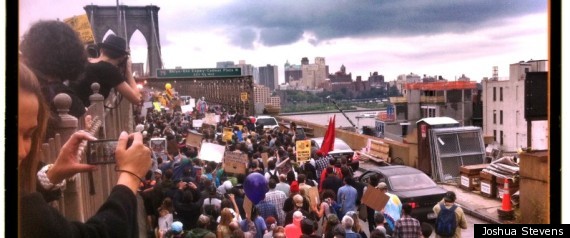
nypd barrelfish's protesters on the brooklyn bridge

HuffPo | Joshua Stephens, 33, had joined the protest march and had ended up on the Brooklyn Bridge. He managed to avoid being one of the 500 or so penned in by the NYPD and arrested. HuffPost reached him by phone, and he provided a first-hand narrative of just what happened on the bridge:

"The people who plotted the march did not give out the route in advance. There were people stationed throughout the march in the procession who were helping guide us when it was time to turn. They told people at the beginning 'we have a route, we're not announcing it.' I think that was a reaction to what happened before when the cops pepper-sprayed those women up in Union Square.

I was a little surprised when we got down to City Hall, and people started turning onto the Brooklyn Bridge. The Brooklyn Bridge is generally choked with tourists, just choked with tourists. If you are a cyclist, you just never take the Brooklyn Bridge...it's just a really frustrating experience...There's so many people on it all the time.

As we were turning to the entrance to the bridge, one of the protest people, the organizers, appeared to be cooperating with police. They were standing right there in front of cops. This march up until it went on the bridge was all on the sidewalk. The Troy Davis march which I was on, we took the street.

On this march, from basically Wall Street to the Brooklyn Bridge, if you stepped off the sidewalk to go around the signpost you would either be told nicely or as if you were at bootcamp to get back on the sidewalk. There was zero tolerance. If they successfully policed everybody to stay out of the streets up to the bridge, what prevented them from keeping us on the pedestrian walkway?

It just seemed odd to me, all of a sudden, people could go wherever they wanted [on the bridge]. People were splitting off.

The interesting thing is the cops could have stopped people from getting on the motorway at any point. You had thousands of people in that march--easily two or three thousand -- and the entrance to the Brooklyn Bridge is not wide. It's narrow. It's the width of a walkway. You can't just rush it. The march slowed to almost a stop. The police would have had plenty of opportunity to prevent people [from going] down to the motorway.

The police were just standing. I saw police standing there. It was all very chill. They were definitely at ease. It was almost like everything was as it should be. Then once we were on the bridge, all these cops came out of nowhere with flex ties and paddy wagons-- that seemed like a whole separate cadre of cops.

At the time, nothing about it seemed conspicuous. There was a protest organizer who was standing right in front of the cops who was directing people with disabilities up to the pathway. We were cracking jokes, we were all packed in there like sardines at the entrance. Wherever you happened to be you were forced to walk in a straight line. I just happened to be positioned to go up to the walkway.

As we started going up the pedestrian part of it, there were lots of middle-aged and retirement-aged people who ended up down at the motorway--and when the cops began to mobilize, they literally started climbing the fence. Six people at a time, hoisting up over these cast iron posts. People were risking being impaled on this fence to get off this motorway. As you get further on to the bridge, the motorway gets further below.

We didn't get far on the bridge before I saw cops mobilize behind us. There was a formation. I could see maybe 15 to 20 cops all with like reams of flex ties--a square formation standing and then marching towards Brooklyn. And they had paddy wagons going onto the bridge in reverse. They were backing up onto the bridge so they could go forward toward Manhattan. That started happening--I think that happened as soon as the last person got on the bridge.

They had cops coming from the other side and stop them from going any further. I couldn't hear anything. I was too far up. I saw the cops march up. At one point, they actually stopped again. And then they advanced forward again. I was just shocked, I looked down and saw all these people. How the fuck are they going to arrest all these people?

brooklyn bridge arrests on bbcnews cut off


Video - BBCNews interview about Occupy Wallstreet protests

BBCNews | More than 700 people from the Occupy Wall Street protest movement have been arrested on New York's City's Brooklyn Bridge, police say.

They were part of a larger group crossing the bridge from Manhattan, where they have been camped out near Wall Street for two weeks.

Some entered the bridge's roadway and were met by a large police presence and detained, most for disorderly conduct.

The loosely-organised group is protesting against corporate greed.

They say they are defending 99% of the US population against the wealthiest 1%.

Occupy Wall Street called for 20,000 people to "flood into lower Manhattan" on 17 September and remain there for "a few months".

Several hundred remain camped at Zuccotti Park, a privately owned area of land not far from Wall Street.

A police spokesman quoted by Reuters said the arrests came "after multiple warnings by police were given to protesters to stay on the pedestrian walkway".

"Some complied and took the walkway without being arrested. Others locked arms and proceeded on the Brooklyn-bound vehicular roadway. The latter were arrested," the spokesman said.

Many were released again shortly afterwards, police said.

Some of the protesters said police had allowed them on to the roadway and were escorting them across when they were surrounded and the arrests began.

"This was not a protest against the NYPD. This was a protest of the 99% against the disproportionate power of the 1%," protester Robert Cammiso told the BBC.

"We are not anarchists. We are not hooligans. I am a 48-year-old man. The top 1% control 50% of the wealth in the USA."

Another protester, Henry-James Ferry, said: "It is not fair that our government supports large corporations rather than the people.

"I only heard about the protest on day one when I came across it. I then decided to go back every day," he told the BBC.
March on police HQ

The protesters have had previous run-ins with New York's police.

On Friday, about 2,000 people marched under the Occupy Wall Street banner to New York's police headquarters to protest against arrests and police behaviour.

Some 80 people were arrested during a march on 25 September, mostly for disorderly conduct and blocking traffic, but one person was charged with assaulting a police officer.

A series of other small-scale protests have also sprung up in other US cities in sympathy with the aims of Occupy Wall Street.

good, the nytimes finally had to take notice...,


Video - Initial RT coverage of Occupy Wallstreet

NYTimes | Ever since the Arab Spring, many people here have been pining for an American Autumn. The closest we’ve gotten so far is Occupy Wall Street.

For two weeks, a “leaderless resistance movement” of a couple hundred people (depending on whom you ask) have camped out and sat-in at a tiny park in Lower Manhattan to protest greed and corruption, among other things. The protests were first called for in July by the magazine Adbusters, which calls itself “a global network of culture jammers and creatives.”

As New York Magazine reported the day before the protest began, protesters would first be meeting at Bowling Green Park for a program that included yoga, a pillow fight, and face-painting. The N.Y.P.D. thwarted those plans.

Still, it feels like a festival of frustrations, a collective venting session with little edge or urgency, highlighting just how far away downtown Manhattan is from Damascus — the hyper-aggressiveness of the police not withstanding.

It has, though, attracted institutional agitators such as Michael Moore and Cornel West, both who seem to ache for an uprising to fit the narratives of their personal discontent.

While it lacks the clarity and size — at least so far — of other protests we’ve seen in this country, let alone in other countries, it does highlight a growing sense of disillusionment among Americans and the failures and ineffectiveness they feel from the current government in addressing their concerns.

transit workers union wields formidable monkey wrench...,


Video - Why the TWU supports the Occupy Wall St. protest

Business Insider | According to Daily Kos, The New York Transit Workers Union (TWU) voted to support the Wall Street Protestors at their meeting last night.

A member of TWU Local 100 told a reporter that they would join the protest Friday at 4PM.

Here's more about them from their website:

The TWU has four main divisions: Railroad; Gaming; Airline; Transit; and Utility, University and Service. The Union has 114 autonomous locals representing over 200,000 members and retirees in 22 states around the country.
Occupy Wall Street has been picking up some decent support from unions in the past few days.

Saturday, October 01, 2011

specious application of game mechanics...,

TechnologyReview | The world is in the midst of a gamification revolution—a mad dash to incorporate points, levels, and achievement badges into nearly every online and mobile experience. According to the hype, these "game mechanics" are a magic potion that can motivate anyone to do anything—purchase brand-name clothing, publicly share location information, or adopt healthy behaviors. Yet like many Internet revolutions, this one is tinged with irrational exuberance. Truly understanding what game mechanics can do requires significantly more nuance.

The intuitive idea is simple and appealing. Games are engaging, so making anything more gamelike should make it more engaging too. The scientific justification seems equally straightforward. Game mechanics invoke reinforcement learning; like B. F. Skinner's rats, we are repeatedly rewarded to produce the desired behavior.

Although behaviorist psychology is sound science, however, it is insufficient to justify gamification. Skinner's rats pressed a lever to get a morsel of food, and there is little debate about whether that constituted a reward. For human beings, what counts as a reward is much less clear. Points, levels, or badges are not inherently rewarding. The reward, when there is one, comes from underlying psychological phenomena such as social status, reputation, and group identification. Very little quality research has been done to show how game mechanics invoke these phenomena, and what the effects may be when they do.

When we look at game mechanics this way, it also becomes clear that they are unlikely to affect everyone in the same way. Some people actively seek status in the eyes of others, for example; other people are actually status-averse. Offering one-size-fits-all rewards may motivate certain people while putting others off. We need to understand more about the types of people who are motivated by specific gamelike rewards.

Another risk is that the extrinsic motivations supplied by game dynamics could crowd out motivations that are intrinsic to an activity. The most active Wikipedia editors, for example, are motivated by a shared investment in activities, interests, and beliefs that form a genuine connection among community members. The same is true in many online systems. Game dynamics, on the other hand, offer rewards that can be comparatively superficial and short-term. We know little about how gamification can undermine or support deeper, long-term motivation.

juan crow?

Philly.com | Hispanic students have started vanishing from Alabama public schools after a court ruling that upheld the state's tough new law on illegal immigration.

Education officials say scores of immigrant families have withdrawn their children from classes or kept them home this week, afraid that sending the children to school would draw attention from authorities.

There are no precise statewide numbers. But several districts with large immigrant enrollments reported a sudden exodus of children of Hispanic parents, some of whom told officials they would leave the state to avoid trouble with the law, which requires schools to check students' immigration status.

The anxiety has become so great that the superintendent in one of the state's largest cities, Huntsville, appeared on a Spanish-language television show Thursday to try to calm widespread worries.

"In the case of this law, our students do not have anything to fear," Casey Wardynski said in halting Spanish. He urged families to send students to class and explained that the state was only trying to compile statistics. Police, he insisted, were not getting involved in schools.

In Montgomery County, more than 200 Hispanic students were absent the morning after the judge's Wednesday ruling. A handful withdrew.

Friday, September 30, 2011

fit'na do this on monday - any thoughts, suggestions?


Video - brainzooming building the gigabit city

brainzooming | The area’s most avid internet users and innovators will convene with business, education and civic leaders to brainstorm ways to capitalize on Google’s bestowment of ultra-high speed fiber internet network upon Kansas City.

After Google announced last spring that Kansas City, Kansas and Kansas City, Missouri are the two initial cities to benefit from “internet access more than 100 times faster than what most Americans have today,” the task falls to the community to determine the best ways this technological gift should be used.

In response, the Social Media Club of Kansas City (SMCKC) will host “Building the Gigabit City: Brainstorming a Google Fiber Roadmap” October 3rd at the Kansas City (MO) Public Library Central Branch, one of the event’s major sponsors.

SMCKC member Mike Brown, founder of The Brainzooming Group, will lead the invitation-only, daylong work session. Brown volunteered to fully donate the company’s innovation services and the Brainzooming Methodology to the session that will bring together more than 50 individuals from SMCKC as well as the broader community—a combination of visionary entrepreneurs, developers, business leaders and creators.

A public presentation of preliminary results from the Gigabit City session and a call for public input will be conducted from 6:30 to 8 p.m. at the Kansas City Public Library Central Branch Helzberg Auditorium at 14 W. 10th Street in Kansas City, MO.

google green the big picture

do moods on twitter follow biorhythms?

NYTimes | However grumpy people are when they wake up, and whether they stumble to their feet in Madrid, Mexico City or Minnetonka, Minn., they tend to brighten by breakfast time and feel their moods taper gradually to a low in the late afternoon, before rallying again near bedtime, a large-scale study of posts on the social media site Twitter found.

Drawing on messages posted by more than two million people in 84 countries, researchers discovered that the emotional tone of people’s messages followed a similar pattern not only through the day but also through the week and the changing seasons. The new analysis suggests that our moods are driven in part by a shared underlying biological rhythm that transcends culture and environment.

The report, by sociologists at Cornell University and appearing in the journal Science, is the first cross-cultural study of daily mood rhythms in the average person using such text analysis. Previous studies have also mined the mountains of data pouring into social media sites, chat rooms, blogs and elsewhere on the Internet, but looked at collective moods over broader periods of time, in different time zones or during holidays.

“There’s just a torrent of new digital data coming into the field, and it’s transforming the social sciences, creating new lenses to look at all sorts of behaviors,” said Peter Sheridan Dodds, a researcher at the University of Vermont who was not involved in the new research. He called the new study “very exciting, because it complements previous findings” and expands on what is known about how mood fluctuates.

He and other outside researchers also cautioned that drawing on Twitter had its hazards, like any other attempt to monitor the fleeting internal states labeled as moods. For starters, Twitter users are computer-savvy, skew young and affluent, and post for a variety of reasons.

“Tweets may tell us more about what the tweeter thinks the follower wants to hear than about what the tweeter is actually feeling,” said Dan Gilbert, a Harvard psychologist, in an e-mail. “In short, tweets are not a simple reflection of a person’s current affective state and should not be taken at face value.”

The study’s authors, Scott A. Golder and Michael W. Macy, acknowledge such limitations and worked to correct for them. In the study, they collected up to 400 messages from each of 2.4 million Twitter users writing in English, posted from February 2008 through January 2010.

They analyzed the text of each message, using a standard computer program that associates certain words, like “awesome” and “agree,” with positive moods and others, like “annoy” and “afraid,” with negative ones. They included so-called emoticons, the face symbols like “:)” that punctuate digital missives.

The researchers gained access to the messages through Twitter, using an interface that allows scientists as well as software developers to work with the data.

Thursday, September 29, 2011

ironies abound in the media reaction to the English riots that erupted between August 6-10.

Media Lens | It was widely reported that two young men acting independently - Jordan Blackshaw, 20, and Perry Sutcliffe-Keenan, 22 – had been sentenced to four years in prison for trying to incite riots via Facebook in the Manchester area. This ‘despite both being of previous good character’, and despite the fact that their Facebook entries - viewed by a few hundred people – failed to generate a single rioter. Farcically, the only people waiting for Blackshaw at his gathering point were the police.

The four-year jail sentences were harsh indeed, as the Guardian noted:

‘If the two Cheshire men had left home and actually taken part in a riot, it is likely they would have been charged with violent disorder. The average sentence passed on the 372 people convicted of violent disorder in 2010 was just over 18 months. The 1,434 people convicted of public order offences last year got, on average, two months inside.

‘Normally, to qualify for a four-year sentence, a convict would have to kidnap somebody (average sentence 47 months in 2010), kill someone while drink driving (45 months), or carry out a sexual assault (48 months).’
Clearly, judges felt that even failed attempts to incite disruption via social media were worse than actual participation in the riots.

Writing in the Daily Mail, columnist Melanie Phillips located the cause of the riots in ‘fatherless boys who are consumed by an existential rage and desperate emotional need, and who take out the damage done to them by lashing out from infancy at everyone around them’.

This vicious behaviour is fostered by ‘a world without any boundaries or rules. A world of emotional and physical chaos. A world where a child responds to the slightest setback or disagreement by resorting to violence.’

And who can doubt that compassion and restraint in the face of disagreement offer the best hopes for a peaceful world? The 11th century Buddhist poet Ksemendra recalled the wise counsel offered to one enraged king:
'Lord, do not talk like this. If you return anger for anger, anger increases. If you give hate in return for hatred, you will never be rid of your enemies. Would you put out a fire by covering it with wood? It will always rekindle... If you meditate on tolerance to overcome anger, all will become your friends.' (Leaves of the Heaven Tree, Dharma Publishing, 1997, p.333)
Earlier this month, Phillips commented on the tenth anniversary of the September 11 attacks:
‘The real problem with the US and UK reaction to 9/11 was that they did not follow through… we should have gone on to deal with Iran, Syria, Pakistan and Saudi as well.’
Did she mean ‘deal with’ their concerns and grievances in a just and even-handed way? Should the US and UK have recognised their own wrongdoing, their own responsibility for generating hatred? In clarification, Phillips quoted herself from September 2002:
‘The US hopes that sorting Saddam will deliver to these other states the simple message: unless you desist from terror, you're next.’
A world ‘without any boundaries or rules’, in other words, where unilaterally ‘resorting to violence’ and 'lashing out' is the natural response.

Journalists like Phillips, who use national media platforms like the Daily Mail (circulation 2 million) to agitate for war at a time when the decision lies in the balance, are typically garlanded with awards, not sent to the slammer.  After two years spent cold-selling Blair’s war on Iraq, David Aaronovitch, then of the Guardian, won the What the Papers Say Columnist of The Year Award for 2003. In the same year, following a similar pro-war performance, the Independent’s Johann Hari was made Young Journalist of the Year at the British Press Awards (to his credit, Hari has since recanted his support for the Iraq war). Phillips was awarded the Orwell Prize for Journalism in 1996.

Politicians do even better, of course. Last month, the Israeli newspaper Haaretz reported that Tony Blair, now the Middle East Quartet’s Special Envoy, was to receive an award ‘to express Israel’s appreciation for his efforts toward Middle East peace'. A decision worthy of a different kind of Orwell Prize. Meanwhile, Channel 4 reports:
‘Since resigning in June 2007 Tony Blair has financially enriched himself more than any ex-Prime Minister ever. Reporter Peter Oborne reveals some of the sources of his new-found wealth, much of which comes from the Middle East.’ 

the rat race for prestige

The Atlantic | Stephen Joel Trachtenberg understands the prestige war from the inside. When he became president of George Washington University in 1988, tuition was $14,000 -- below average for a private, four-year university, as Washington Monthly reported. When he left in 2007, tuition had skyrocketed to $39,000. During that time, undergraduate applications tripled, the endowment quintupled to $1 billion, SAT scores jumped by 200 points, and the university created five new schools. This essay is adapted from an interview with The Atlantic.

You can buy a pair of jeans at Wal-Mart for $29 and one from Ralph Lauren for $98. While both cover your backside, one comes with a label of status that appeals to some and not to others. Customers -- and lets not forget that students are customers of academic services -- like choices and they usually make selections based on more than one factor, price being only one.

When my son checked into his freshman dorm, there were no lights in his room - nothing on the ceiling, walls or desk. There were two outlets: if you wanted light, Yale required you to bring your own lamp. I thought this took the parable of Plato's Cave a bit too far.

Applicants to GW look for more than overhead lights: they want living and dining choices, places to study and swim, comfortable desks and chairs, and tennis and basketball courts. Yes, they are looking for great professors but they want more than classroom life. The only way to provide more books in the library, more theaters for performances, laboratories for experiments, coffee shops for study breaks is to have the dollars to build and maintain all these things - and dollars come from tuition.

At the same time as the demand for quality services increased, so too did the cost for basic utilities: electricity, water, security, oil, insurance, personnel health and other employee benefits have all risen over the past 40 years.

PERCEPTION IS REALITY: WHY TUITION KEEPS RISING
The only way to buy more books and build more labs is more money. And the money come from tuition. The top 50 universities are not a monolithic list. They can probably be divided into two parts: the top 15 and the next 35. Within the first group, there is little difference of quality - it is all cream with nuances of flavorings. For the next group - numbers 16-50, there is cream, buttermilk, latte, and lots of special tastes. There is also jockeying for position. The top ten always get a mention by the general press. Sometimes, the next 5 or 10 are in a paragraph lower down the column. No question that number 35 wants to move up.

Tuitions rise because costs rise. As the payroll grows, tuition goes up. As the expense of goods and services used by the institution inflate, or become more extended and expanded, tuition goes up. Universities really do get better faculty by providing better compensation and benefits. Professors, it turns out, are economic men and women: Prestige tends to be indexed to quality and quality tends to be measured by the attributes of an institution: the laboratories, libraries, studios, playing fields, recreational and residential facilities; the services for counseling. When one talks about a top 50 university, one is talking about both perception and reality. These are in significant measure indexed to the size of endowment, the fundraising and the tuition income available to the school to provide what the students seek.

Chipocalypse Now - I Love The Smell Of Deportations In The Morning

sky |   Donald Trump has signalled his intention to send troops to Chicago to ramp up the deportation of illegal immigrants - by posting a...