Thursday, September 29, 2011

the rise of the adult student

The Atlantic | The quintessential American college student leaves home at 18 to live on a college campus for four years. We've historically defined "nontraditional" students as those over the age of twenty-four, those enrolled part time, and those who are financially independent. But today, the "typical" student is the exception.

There are currently 17.6 million undergraduates enrolled in American higher education. The National Center for Education Statistics reports that just fifteen percent of them attend four-year colleges and live on campus. Forty-three percent of them attend two-year institutions. Thirty-seven percent of undergraduates are enrolled part-time and thirty-two percent work full-time. Of those students enrolled in four-year institutions, just thirty-six percent actually graduate in four years.

The most significant shift is probably the massive growth in the adult student population in higher education. Thirty-eight percent of those enrolled in higher education are over the age of 25 and one-fourth are over the age of 30. The share of all students who are over age 25 is projected to increase another twenty-three percent by 2019.

The demands for degrees reflect this changed population. Slightly over half of today's students are seeking a "subbacalaureate" credential (i.e. a certificate, credential, or associate's degree). In 2008-09, postsecondary institutions conferred 806,000 certificates and 787,000 associate's degrees, or a total of about 1.59 million, as compared to 1.6 million bachelor's degrees. In 2008, more than half a million students were enrolled in a health sciences certificate program, making it the largest certificate program area. Another 173,000 students sought a certificate in manufacturing, construction, repair, and transportation. While public discourse often focuses on four-year degrees, these other credentials matter, a lot.

There are plenty of good jobs that don't require a four-year degree. After all, the Bureau of Labor Statistics (BLS) reports that two-thirds of the labor force has less than a four-year degree, including nearly half of those in professional occupations and one-third of those in management roles. It pays for workers to earn these credentials; according to the BLS, that workers with an associate's degree earned $141 more per week, on average, than those whose highest degree is a high school diploma.

But subbacalaureate programs continue to be regarded as marginal in the press and the higher education mainstream. Universities turn their nose up at them. Policies and norms remain oriented towards "traditional" students. Rankings, awards, and honors go to institutions with great sports teams, prize-winning researchers, or elite student bodies--never to those that are helping nontraditional students master new skills and so that they can reenter the workforce, get promoted, or change careers.

Wednesday, September 28, 2011

why you should root for colleges to go online

The Atlantic | In early August, Apollo Group, parent company of the University of Phoenix, made an acquisition that is small compared to the billion-dollar deals common to high-tech industries. Apollo paid less than $100 million to acquire Carnegie Learning, a provider of computer-based math tutorials. Such technology acquisitions are rare in higher education, to say the least. Yet this seemingly small deal is a signal of disruptive revolution in higher education.

Carnegie Learning is the creation of computer and cognitive scientists from Carnegie Mellon University. Their math tutorials draw from cutting-edge research about the way students learn and what motivates them to succeed academically. These scientists have created adaptive computer tutorials that meet students at their individual level of understanding and help them advance via the kinds of exercises they personally find most engaging and effective. The personalization and sophistication is hard for even an expert human tutor to match. It is a powerful, affordable adjunct to classroom instruction, as manifest by Carnegie Learner's user base of more than 600,000 secondary students in over 3,000 schools nationwide.

Some of Apollo's potential uses of this software are immediately apparent. It will prove a boon to the hundreds of thousands of University of Phoenix students who take math courses in almost all of its programs of study. Also, the underlying learning and computer science technology are likely to be applied to math-related courses, such as those in economics, finance, and accounting that the University of Phoenix offers its undergraduate business and MBA students.

Then there are the strategic marketing possibilities. The secondary school students who have come to value and rely on Carnegie Learning's math tutorials are future college students. They might not think now of the University of Phoenix for college. But Sony discovered something interesting about the teenagers who bought its inexpensive pocket-size transistor radios and Walkman cassette tape players: they grew up to be faithful consumers of its larger stereos and television sets. Initially, Magnavox and RCA didn't worry about the low-profit-margin products for kids. In hindsight, they should have. Fist tap Bob.

exhausting our year's supply of earth resources

Fist tap Nana.

Monday, September 26, 2011

no surprise there's a very strong correlation...,

Medicalxpress | Intuition may lead people toward a belief in the divine and help explain why some people have more faith in God than others, according to research published by the American Psychological Association.

In a series of studies, researchers at Harvard University found that people with a more intuitive thinking style tend to have stronger beliefs in God than those with a more reflective style. Intuitive thinking means going with one's first instinct and reaching decisions quickly based on automatic cognitive processes. Reflective thinking involves the questioning of first instinct and consideration of other possibilities, thus allowing for counterintuitive decisions.

"We wanted to explain variations in belief in God in terms of more basic cognitive processes," researcher Amitai Shenhav said. "Some say we believe in God because our intuitions about how and why things happen lead us to see a divine purpose behind ordinary events that don't have obvious human causes. This led us to ask whether the strength of an individual's beliefs is influenced by how much they trust their natural intuitions versus stopping to reflect on those first instincts."

The research was published online in the Journal of Experimental Psychology: General. The study from the Harvard University Psychology Department was conducted by Shenhav, a doctoral student; post-doctoral fellow David Rand, PhD; and associate professor Joshua Greene, PhD.

In the first part of the study, 882 U.S. adults, with a mean age of 33 and consisting of 64 percent women, completed online surveys about their belief in God before taking a cognitive reflection test. The test had three math problems with incorrect answers that seemed intuitive. For example, one question stated: "A bat and a ball cost $1.10 in total. The bat costs $1 more than the ball. How much does the ball cost?" The automatic or intuitive answer is 10 cents, but the correct answer is 5 cents. Participants who had more incorrect answers showed a greater reliance on intuition than reflection in their thinking style.

harvest a few long-pig and see if that deters the crop-theft problem...,

Boston | William Anderson, like a growing number of urban farmers in Boston, doted on his small plot near Codman Square over the summer, sowing seeds, watering regularly, clearing weeds, and watching with pride as the sprouts slowly blossomed into turnips, bell peppers, and other hearty vegetables.

Then, as he prepared to harvest the broad leaves of his collard greens, he was dismayed to discover about 15 of his plants decapitated, all the tasty leaves pilfered.

“It was just depressing to see,’’ said Anderson, 69, who planned to share the fruits of his labor with friends. “I was hurt. I had nursed them, watched them grow, and someone took advantage.’’

It is an increasingly familiar lament across the city, where there are some 3,500 plots in about 150 community gardens. With everything from cucumbers to watermelons ripening in the open, the gardens are something like a supermarket without doors, effectively free for the picking.

“It’s a problem that has worsened with the economy,’’ said Paul Sutton, coordinator for open space and director of urban wilds at the Boston Parks and Recreation Department, which oversees five community gardens. “I hear about people picking tomatoes and squash in the middle of the night. It happens all the time.’’

Theft from urban gardens peaks at this time of year, as the fruit and vegetables reach their final stages, sizable prizes waiting to be harvested before the first frost.

Veteran urban gardeners learn what not to plant and how to veil what they do grow. Valerie Burns - president of the Boston Natural Areas Network, a nonprofit that oversees more community gardens than any other organization in the city - has found that the bounty of mature eggplants and butternut squash are like bait for vegetable thieves.

After hers were swiped at a garden along the Southwest Corridor, she stopped planting them.

“You have to be philosophical about it if you garden in the city,’’ she said, noting that a fellow urban farmer found six cabbages for sale at a bodega that he suspected were stolen from his plot. “You just have to hope that it’s going to be food for someone who might really need it.’’

Betsy Johnson, president of the South End/Lower Roxbury Open Space Land Trust and a board member of the American Community Gardening Association, said the bigger the fruit or vegetable, the more likely it is to be stolen. She said pumpkins and beefy tomatoes are more enticing than spinach or Swiss chard.

Her organization issues tips to urban gardeners that include avoiding growing the more tempting vegetables and fruits at the edge of gardens and veiling them in the thicker foliage of less popular plants. She and others counsel gardeners to harvest as soon as possible.

“It’s a fact of life, but if it was so serious a problem, community gardens would have died out a long time ago,’’ Johnson said. “Instead, they are thriving.’’

beans, bullets, band-aids, and bibles...,


Video - Strange bird scrying portents in Led Zep titles and lyrics.

Survivalblog | As preppers we have all heard of the Three B’s those would be beans, bullets and Band-Aids. An alliteration for food, protection/sufficiency and medical supplies. We should know their importance and for the most part practice it as part of our lifestyle. In our home we utilize a fourth B, the Bible. Let me explain why we feel the Bible is just that important.

I am a bi-vocational pastor serving in the Blue Ridge of the Appalachian Mountains. In case you don’t understand the meaning of bi-vocational I support my wife and I with a full time job while I pastor a full time church. Small rural churches utilize this type of pastorate very successfully. There is a stereo-type that is inappropriately applied to bi-vocational pastors, one that questions their qualifications. I have earned degrees in electrical/electronics technology and hold an earned Doctorate of Theology from an accredited seminary.

Why did I go through that seemingly self centered introduction? I feel it is important for you to know a little about me considering the subject I am writing about. “Faith when the world falls apart” you see it is easy for you and I to talk about our Christian beliefs when things are going well, but, when the world comes unraveled faster than a cheap sweater, our faith is subject to do the same. Just like you, I get up early, go to work every day, come home and take care of my homestead and family, plus I have the responsibility of pastor to a small group of Southern Baptists at a local church. In addition to this my wife and I are preppers.

Some see the pastor as a wimpy little man who is sickly, who preaches three times a week and is never heard from until he is called upon to do a wedding, funeral, baptism or similar activity. Unfortunately this all some people see of their pastor, but the pastorate is much more. It is about people. Likewise the Bible is about people and their faith in God along with His willingness to answer their prayers. Faith is arguably the most powerful force on the face of the earth. People put their faith in many things, each other, equipment, stores, weapons just to name a few. I want challenge you to think about these things a little differently, think of them as instruments of faith. If you are a person of faith (in God) then you know He can use anything or anyone to meet the needs of His people. For faith to be effective it must be understood and to understand it we need our Bible. Ideally a concordance and good Bible dictionary would make a wonderful trio but if you have a good study Bible handy and are willing to use it God can and will work miracles through it. As you read through my article think about the Bible as your fourth B.

We do approach prepping from a biblical world view, believing that at some time in the future the Lord will rapture the born again believers (the Church), removing us from the Great Tribulation spoken of in the book of Revelation. Furthermore we understand the Bible to teach prepping from both the old and new testaments. For example the book of Proverbs tells us in chapter 30 there are four things upon the earth that are little but extremely wise; the ant, the spider, the locust and the conies (small fury animals that live in the rocks of Sinai). Each of these are used to represent an aspect of prepping; the ants are not strong but they prepare their food in the summer when it is abundant, the conies make their homes in strong fortified places, the locusts have no leader but they work in groups to accomplish their work and survive and the spider is able to defend itself and establish itself in any area.

Sunday, September 25, 2011

the profit-seeking parasites must always fail you...,

those two tapeworms on top gotta go, gotta go, gotta go....,
WSJ | The crowd-sourced, wikinomic cloud is the new, new thing that all management consultants are now telling their clients to embrace. Yet the cloud is not a new thing at all. It has been the source of human invention all along. Human technological advancement depends not on individual intelligence but on collective idea sharing, and it has done so for tens of thousands of years. Human progress waxes and wanes according to how much people connect and exchange.

When the Mediterranean was socially networked by the trading ships of Phoenicians, Greeks, Arabs or Venetians, culture and prosperity advanced. When the network collapsed because of pirates at the end of the second millennium B.C., or in the Dark Ages, or in the 16th century under the Barbary and Ottoman corsairs, culture and prosperity stagnated. When Ming China, or Shogun Japan, or Nehru's India, or Albania or North Korea turned inward and cut themselves off from the world, the consequence was relative, even absolute decline.

Knowledge is dispersed and shared. Friedrich Hayek was the first to point out, in his famous 1945 essay "The Uses of Knowledge in Society," that central planning cannot work because it is trying to substitute an individual all-knowing intelligence for a distributed and fragmented system of localized but connected knowledge.

So dispersed is knowledge, that, as Leonard Reed famously observed in his 1958 essay "I, Pencil," nobody on the planet knows how to make a pencil. The knowledge is dispersed among many thousands of graphite miners, lumberjacks, assembly line workers, ferrule designers, salesmen and so on. This is true of everything that I use in my everyday life, from my laptop to my shirt to my city. Nobody knows how to make it or to run it. Only the cloud knows.

One of the things I have tried to do in my book "The Rational Optimist" is to take this insight as far back into the past as I can—to try to understand when it first began to be true. When did human beings start to use collective rather than individual intelligence?

In doing so, I find that the entire field of anthropology and archaeology needs Hayek badly. Their debates about what made human beings successful, and what caused the explosive take-off of human culture in the past 100,000 years, simply never include the insight of dispersed knowledge. They are still looking for a miracle gene, or change in brain organization, that explains, like a deus ex machina, the human revolution. They are still looking inside human heads rather than between them.

obsession with profit and control is the source of the error...,

NYTimes | Greg Lindsay is a visiting scholar at the Rudin Center for Transportation Policy and Management at New York University and the co-author of “Aerotropolis: The Way We’ll Live Next.”

THE Southwest is famously fertile territory for ghost towns. They didn’t start out depopulated, of course — which is what makes the latest addition to their rolls so strange. Starting next year, Pegasus Holdings, a Washington-based technology company, will build a medium-size town on 20 square miles of New Mexico desert, populated entirely by robots.

Scheduled to open in 2014, the Center for Innovation, Testing and Evaluation, as the town is officially known, will come complete with roads, buildings, water lines and power grids, enough to support 35,000 people — even though no one will ever live there. It will be a life-size laboratory for companies, universities and government agencies to test smart power grids, cyber security and intelligent traffic and surveillance systems — technologies commonly lumped together under the heading of “smart cities.”

The only humans present will be several hundred engineers and programmers huddled underground in a Disneyland-like warren of control rooms. They’ll be playing SimCity for real.

Since at least the 1960s, when New York’s Jane Jacobs took on the autocratic city planner Robert Moses, it’s been an article of faith that cities are immune to precisely this kind of objective, computation-driven analysis. Much like the weather, Ms. Jacobs said, cities are astoundingly complex systems, governed by feedback loops that are broadly understood yet impossible to replicate.

But Pegasus and others insist there’s now another way — that, armed with enough data and computing muscle, we can translate cities’ complexity into algorithms. Sensors automatically do the measuring for us, while software makes the complexity manageable.

“We think that sensor development has gotten to the point now where you can replicate human behavior,” said Robert H. Brumley, the managing director and co-founder of Pegasus. These days, he and others believe, even the unpredictable “human factor” is, given enough computing power, predictable. “You can build randomness in.”

Mr. Brumley isn’t alone in his faith that software can do a better job of replicating human behavior than the humans themselves. A start-up named Living PlanIT is busy building a smart city from scratch in Portugal, run by an “urban operating system” in which efficiency is all that matters: buildings are ruthlessly junked at the first signs of obsolescence, their architectural quality being beside the point.

To the folks at Living PlanIT and Pegasus, such programs are worth it because they let planners avoid the messiness of politics and human error. But that’s precisely why they are likely to fail. Fist tap Nana.

urbanized


Video - Urbanized - A documentary about the design of cities

Urbanized is currently screening at film festivals and special events in North America and Europe, ticket info here: http://urbanizedfilm.com/screenings More international events will be announced soon.

Gary Hustwit (Helvetica, Objectified) returns with the final documentary in his design film trilogy. Urbanized focuses on the design of cities, and features some of the world's foremost architects, planners, policymakers, and thinkers, including Sir Norman Foster, Rem Koolhaas, Jan Gehl, Oscar Niemeyer, Amanda Burden, Enrique Peñalosa, Yung Ho Chang, Alejandro Aravena, Eduardo Paes, Rahul Mehrotra, Ellen Dunham-Jones, Ricky Burdett, James Corner, Michael Sorkin, Bruce Katz, Candy Chang, Edgar Pieterse, and many more, including extraordinary citizens who have changed their cities.
-
Who is allowed to shape our cities, and how do they do it? And how does the design of our cities affect our lives? By exploring a diverse range of urban design projects in dozens of cities around the world, from massive infrastructure initiatives to temporary interventions, Urbanized frames a global discussion on the future of cities. Fist tap Dale.

does being on "the pipe" enhance cognition?


Video - wanker whining about call of duty hacks

Nature | Research showing that action video games have a beneficial effect on cognitive function is seriously flawed, according to a review published this week in Frontiers in Psychology1.

Numerous studies published over the past decade have found that training on fast-paced video games such as Medal of Honor and Grand Theft Auto that require a wide focus and quick responses has broad 'transfer effects' that enhance other cognitive functions, such as visual attention. Some of the studies have been highly cited and widely publicized: one, by cognitive scientists Daphne Bavelier and Shawn Green of the University of Rochester in New York, published in Nature in 20032, has been cited more than 650 times, and was widely reported by the media as showing that video games boost visual skills.

But, say the authors of the review, that paper and the vast majority of other such studies contain basic methodological flaws and do not meet the gold standard of a properly conducted clinical trial.

"Our main focus was recent work specifically examining the effects of modern action games on college-aged participants," says Walter Boot, a psychologist at Florida State University in Tallahassee, and lead author of the review. "To our knowledge, we've captured all of these papers in our review, and all of the literature suffers from the limitations we discuss."

Video - a shooter where you can flip gravity

the limits of design...,


Video - Dialogue with the Architect

Saturday, September 24, 2011

25 signs of a horrific global water crisis...,


Video - the coming global water crisis

economicollapseblog | Every single day, we are getting closer to a horrific global water crisis. This world was blessed with an awesome amount of fresh water, but because of our foolishness it is rapidly disappearing. Rivers, lakes and major underground aquifers all over the globe are drying up, and many of the fresh water sources that we still have available are so incredibly polluted that we simply cannot use them anymore. Without fresh water, we simply cannot function. Just imagine what would happen if the water got cut off in your house and you were not able to go out and buy any. Just think about it. How long would you be able to last? Well, as sources of fresh water all over the globe dry up, we are seeing drought conditions spread. We are starting to see massive "dust storms" in areas where we have never seem them before. Every single year, most of the major deserts around the world are getting bigger and the amount of usable agricultural land in most areas is becoming smaller. Whether you are aware of this or not, the truth is that we are rapidly approaching a breaking point.

If dramatic changes are not made soon, in the years ahead water shortages are going to force large groups of people to move to new areas. As the global water crisis intensifies, there will be political conflicts and potentially even wars over water. We like to think of ourselves as being so "advanced", but the reality is that we have not figured out how to live without water. When the water dries up in an area, most of the people are going to have to leave.

And yes, it will even happen in the United States too. For example, once Lake Mead dries up there is simply no way that so many people are going to be able to live in and around Las Vegas.

Right now, most of us take for granted that we will always have access to an unlimited amount of clean water.


But when you take a hard look at the data, it quickly becomes clear that everything that we have always taken for granted about water is about to dramatically change.

That following are 25 signs that a horrific global water crisis is coming. The first 12 facts are about the United States, and the last 13 are about the rest of the world.... Fist tap Big Don.

how energy drains water supplies

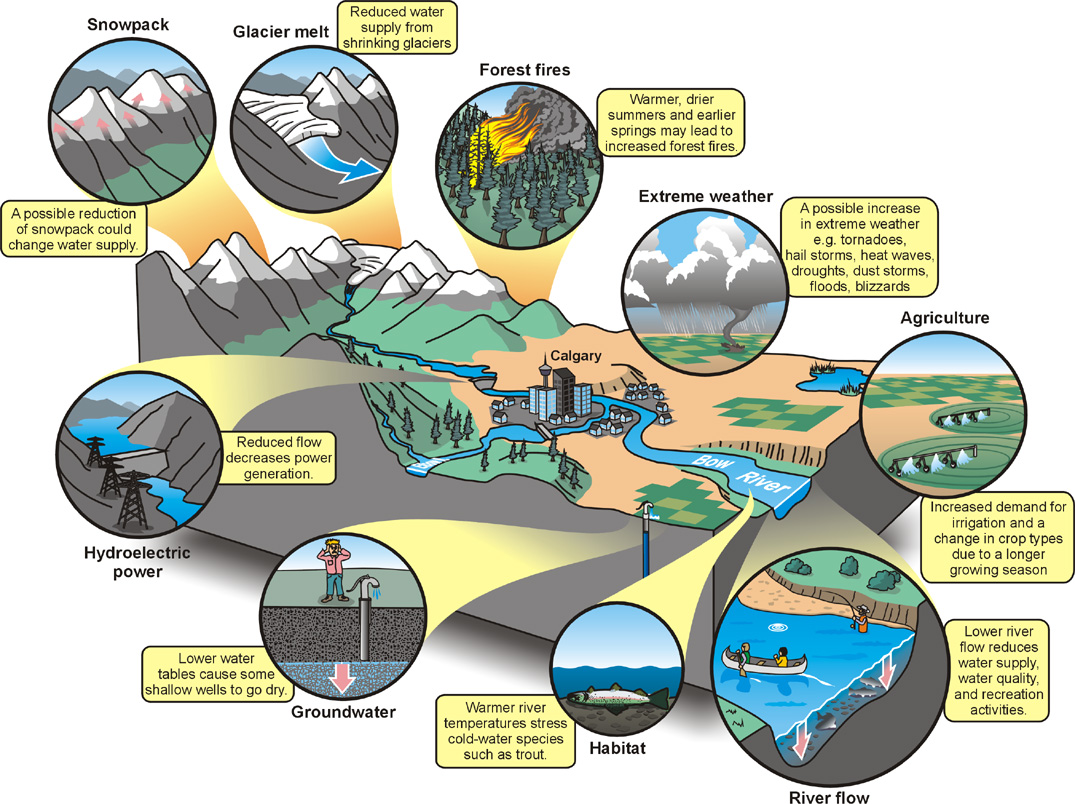
NYTimes | The worst single-year drought in the recorded history of Texas has caused cotton crops to wither and ranchers to sell off cattle. It may also hurt power plants, which need vast amounts of water to cool their equipment.

“We will be very concerned” if it does not rain by spring, said Kent Saathoff, an official with the Texas electric grid operator.

The worries in Texas bear out what an increasingly vocal group of researchers has been warning in recent years: that planners must pay more attention to how much water is needed in energy production.

“Water and energy are really linked,” said Henrik Larsen, a water policy expert with the DHI Group, a research and consulting firm based in Denmark. “If you save water, you save energy, and vice-versa.”

Experts call this the “water-energy nexus.” It takes huge quantities of water to produce electricity from a plant powered by nuclear energy or fossil fuels, and it also takes lots of energy to pump and process the water that irrigates fields and supplies cities.

In the United States, 4 percent of all fresh water is consumed in the energy sector, and 3 percent of all electricity used daily goes toward water and wastewater pumping, distribution, and treatment, according to Mike Hightower, a member of the technical staff at Sandia National Laboratories.

A big problem, experts say, is that water is often taken for granted.

“We simply don’t value water in the same way that we value energy,” said Mr. Larsen of DHI. He noted that whereas barrels of oil get shipped around the globe, nobody wants to ship water in the same way.

With needs for both water and energy growing worldwide and climate change threatening to roil rainfall patterns, the issue could grow more pressing.

Given the scarcity of water resources, stronger regional cooperation will be important in making sure power plants are located in the best places, according to Jakob Granit, director of the Stockholm International Water Institute, which has been trying to promote such cooperation among countries in southern Africa.

“We are not very mature on this type of cross-sector analysis,” Mr. Granit said.

The water needs of power plants are actually greater than the raw consumption numbers suggest. According to Mr. Hightower, more than 50 percent of the water withdrawn every day from rivers and lakes in the United States goes toward energy production.

Power plants discharge almost all of that water back into rivers or ponds after it has helped cool the plant (which explains the difference between 4 percent consumption and 50 percent withdrawals).

However, this means that in times of drought, when rivers or reservoirs are drying up, power plants may have trouble finding enough water, even if they end up discharging most of it.

“You don’t just pick these things up and move them,” Mr. Hightower said, referring to power plants.

The water the plants discharge is also warmer and can affect the environment downstream, Mr. Hightower said.

The water-saving technologies in power plants are improving, and there is a trend toward cooling systems in which more water is recycled, said Mr. Larsen of DHI. The potential for improvements is large: A recent paper by University of Texas academics in the journal Environmental Research Letters reports that changing the cooling technologies used by power plants in 11 Texas river basins could reduce the water they divert each year by an amount equivalent to the annual water use of at least 1.3 million people.

Hydroelectric facilities — which account for about 16 percent of global electricity production — are also vulnerable to drought, of course.

Power plants are not the only reason energy production depends on water. Extracting oil and natural gas from the ground with hydraulic fracturing techniques requires prodigious amounts of water. Fist tap Nana.

big pie in the big sky by-and-by...,

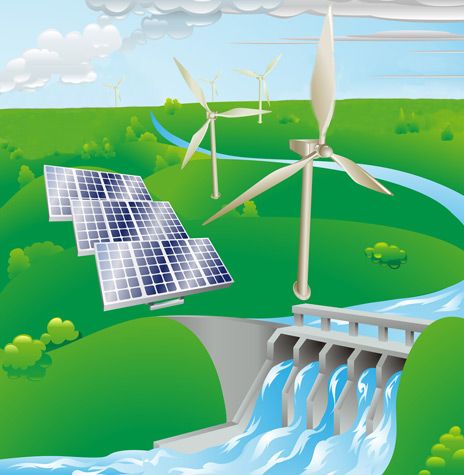
IEEE | We don’t need nuclear power, coal, or biofuels. We can get 100 percent of our energy from wind, water, and solar (WWS) power. And we can do it today—efficiently, reliably, safely, sustainably, and economically.

We can get to this WWS world by simply building a lot of new systems for the production, transmission, and use of energy. One scenario that Stanford engineering professor Mark Jacobson and I developed, projecting to 2030, includes:

  • 3.8 million wind turbines, 5 megawatts each, supplying 50 percent of the projected total global power demand
  • 49 000 solar thermal power plants, 300 MW each, supplying 20 percent
  • 40 000 solar photovoltaic (PV) power plants supplying 14 percent
  • 1.7 billion rooftop PV systems, 3 kilowatts each, supplying 6 percent
  • 5350 geothermal power plants, 100 MW each, supplying 4 percent
  • 900 hydroelectric power plants, 1300 MW each, of which 70 percent are already in place, supplying 4 percent
  • 720 000 ocean-wave devices, 0.75 MW each, supplying 1 percent
  • 490 000 tidal turbines, 1 MW each, supplying 1 percent.
We also need to greatly expand the transmission infrastructure in order to create the large supergrids that will span many regions and often several countries and even continents. And we need to expand production of battery-electric and hydrogen fuel cell vehicles, ships that run on hydrogen fuel cell and battery combinations, liquefied hydrogen aircraft, air- and ground-source heat pumps, electric resistance heating, and hydrogen for high-temperature processes.

To make a WWS world work, we also need to reduce demand. Reducing demand by improving the efficiency of devices that use power, or substituting low-energy activities and technologies for high-energy ones—for example, telecommuting instead of driving—directly reduces the pressure to produce energy.

Because a massive deployment of WWS technologies requires an upgraded and expanded transmission grid and the smart integration of the grid with battery-electric vehicles and hydrogen fuel cell vehicles—using both types of these vehicles for distributed electricity storage—governments need to carefully fund, plan, and manage a long-term, large-scale restructuring of the electricity transmission and distribution system. In much of the world, we’ll need international cooperation in planning and building supergrids that span across multiple countries, because many individual countries just aren’t big enough to permit enough geographic dispersion of generators to mitigate local variability in wind and solar intensity. The Desertec project proposes a supergrid to link Europe and North Africa, and 10 northern European countries are beginning to plan a North Sea supergrid for offshore wind power. Africa, Asia and Southeast Asia, Australia/Tasmania, China, the Middle East, North America, South America, and Russia will need supergrids as well.

Although this is an enormous undertaking, it does not need to be done overnight, and there are plenty of examples in recent history of successful large-scale infrastructure, industrial, and engineering projects. Fist tap Arnach.

Friday, September 23, 2011

much too expensive, but at least a token step in the right direction...,


Video - Energy efficient home-building decathalon

USAToday | The California house looks like a pillow but has an iPad app to control window shades and 3-D cameras to adjust lighting based on movement inside.

The University of Maryland's "WaterShed" has a waterfall designed to control humidity, and Purdue University's "InHome" has a self-watering biowall with vertically arranged plants.

For New Zealand's vacation-style house, or "Kiwi bach," students sheared sheep and "stuffed (wool) in the walls" for insulation, says team member Nick Officer.

Welcome to the 2011 Solar Decathlon, a showcase of state-of-the-art green building by 19 of the world's most innovative academic teams. The biennial competition, sponsored by the U.S. Department of Energy, opens to the public today for two weeks in Washington's West Potomac Park, near the National Mall.

The teams — 15 from the USA and one each from Canada, China, Belgium and New Zealand — are vying to see who built the most stylish, efficient and affordable solar-powered house.

Their prototypes, which the students designed and built during a two-year period, then reassembled within a week at the decathlon site, reflect rapid changes in technology.

Unlike the first decathlon in 2002 or even the last one in 2009, almost all of the houses now have smart meters or automation devices that track energy use in real time, plus triple-pane windows and LED (light emitting diode) fixtures.

"The shift has been pretty dramatic," says Fred Maxik, chief technology officer of Lighting Science Group, an LED manufacturer that donated lights to six of the homes. "Today, (LEDs) are ubiquitous."

The solar devices themselves have improved. They include a canopy of 42 bi-facial solar panels collecting sunlight from above and reflected light from below for Appalachian State University's house, and a rounded rooftop system for the University of Calgary entry.

Perhaps the biggest change this year is cost. DOE is emphasizing affordability and will subtract points for houses that cost more than $250,000. Each team accepted into the competition is given $100,000 in grants as start-up funding. DOE estimates each house's final price tag, based on a list of parts.

"It brings parity to the contest," says Richard King, decathlon director. "We don't want people buying it." In 2009, Team Germany won with an ultra-modern, cube-like house that King says cost about $800,000.

WW-III will have its own little gratifications...,

LATimes | Reporting from Beijing — At a glance, it is clear this is no run-of-the-mill farm: A 6-foot spiked fence hems the meticulously planted vegetables and security guards control a cantilevered gate that glides open only to select cars.

"It is for officials only. They produce organic vegetables, peppers, onions, beans, cauliflowers, but they don't sell to the public," said Li Xiuqin, 68, a lifelong Shunyi village resident who lives directly across the street from the farm but has never been inside. "Ordinary people can't go in there."

Until May, a sign inside the gate identified the property as the Beijing Customs Administration Vegetable Base and Country Club. The placard was removed after a Chinese reporter sneaked inside and published a story about the farm producing organic food so clean the cucumbers could be eaten directly from the vine.

Elsewhere in the world, this might be something to boast about. Not in China. Organic gardening here is a hush-hush affair in which the cleanest, safest products are largely channeled to the rich and politically connected.

Many of the nation's best food companies don't promote or advertise. They don't want the public to know that their limited supply is sent to Communist Party officials, dining halls reserved for top athletes, foreign diplomats, and others in the elite classes. The general public, meanwhile, dines on foods that are increasingly tainted or less than healthful — meats laced with steroids, fish from ponds spiked with hormones to increase growth, milk containing dangerous additives such as melamine, which allows watered-down milk to pass protein-content tests.

"The officials don't really care what the common people eat because they and their family are getting a special supply of food," said Gao Zhiyong, who worked for a state-run food company and wrote a book on the subject.

In China, the tegong, or special supply, is a holdover from the early years of Communist rule, when danwei, work units of state-owned enterprises, raised their own food and allocated it based on rank. "The leaders wanted to make sure they had enough to eat and that nobody poisoned their food," said Gao.

In the 1950s, Soviet advisors helped the Chinese set up a food procurement department under the security apparatus to supply and inspect food for the leadership, according to a biography of Mao Tse-tung written by his personal physician. Lower levels of officialdom were divided into 25 gradations of rank that determined the quantity and quality of rations.

In modern-day China, it is the degradation of the environment and a limited supply of healthful food that is fueling the parallel food system for the elite.

"We flash forward 50 years and we see the only elements of China society getting food that is reliable, safe and free of contaminants are those cadres who have access to the special food supply," said Phelim Kine of the Hong Kong office of Human Rights Watch.

Chipocalypse Now - I Love The Smell Of Deportations In The Morning

sky |   Donald Trump has signalled his intention to send troops to Chicago to ramp up the deportation of illegal immigrants - by posting a...