Sunday, May 08, 2011

usda's food desert locator map

Good | Yesterday, the United States Department of Agriculture unveiled its latest online tool: an eye-opening map of the nation's "food deserts."

These food deserts (marked in pink above) are places where there is "low income" and "low access"—or places where at least a fifth of the population lives at or below the poverty line and where there isn't a supermarket within a one-mile radius (or within a 10-mile radius in rural areas). All things told, about 13.5 million people nationwide have little or no access to stores selling healthful food.

The complete dataset is downloadable, so it should spawn mash-ups. The USDA has also created the Food Environment Atlas, which maps factors ranging from food taxes to farmers' markets (below). What correlations can we make about the absence of food deserts and farmers' markets?

The data's impressive and certainly opens up opportunities to map other connections: What's the impact of healthy corner stores, walkable school districts, or even McDonald's locations on food deserts? Could we put the "Wal-Mart as food desert solution" theory to the test? Fist tap ProfGeo.

u.s. squanders energy on food chain


Video - First McDonald's commercial featuring Ronald.

CNBC | Between 1997 and 2002, in fact, over 80 percent of the increase in annual U.S. energy consumption was food related.

And estimates for 2007 suggest the U.S. food system accounted for nearly 16 percent of the nation’s total energy budget, up from 14.4 percent in 2002, according to the report, which measured both the direct energy used to power machines and appliances (like trucks and microwave ovens) as well as the “embodied” energy used to manufacture, store and distribute food products.

“This is what they call a fossil fuel party,” says Kamyar Enshayan, director of the Center for Energy & Environmental Education at the University of Northern Iowa. “We’ve created a food system that relies heavily on fossil energy, and it’s become so globalized that there are literally grapes from South Africa in the grocery store in Cedar Falls, Iowa. It’s a long-distance shipping economy, which makes all of us vulnerable to disruptions in the supply chain and other unforeseen emergencies.”

That’s particularly troublesome, he notes, when so much of the U.S. — particularly the Midwest — has such potential for primary production.

“We have the best soils and a great climate and yet, most of what we eat is imported,” says Enshayan. “You have to step back and say, ‘Wait, why is a region like Iowa not feeding itself?”

The environmental consequence of relying so heavily on a national and international network of suppliers is even greater, he notes.

“It dulls our imagination and prevents us from paying attention to what sustains us,” says Enshayan. “The loss of water and soil quality is right in front of us, but since our food doesn’t come from it, why worry?”

And then, of course, there’s the impact on our climate.

“The production and distribution of food has long been known to be a major source of green house gas and other environmental emissions, and, for many reasons, it is seen by many environmental advocates as one of the major ways concerned consumers can reduce their carbon footprints,” writes Christopher Weber, an environmental engineering professor at Carnegie Mellon University, in a 2008 paper called “Food-Miles and the Relative Climate Impacts of Food Choices in the Unites States” that he co-authored with H. Scott Mathews.

According to the report, the average household’s climate impact related to food is estimated to be 8.1 t CO2/yr, or tonnes of CO2 equivalent a year, a common measure for determining how much global warming a type of greenhouse gas may cause.

To put that figure into perspective, driving a car that gets 25 miles per gallon roughly 12,000 miles produces 4.4 t CO2/yr.

Why So High
One of the reasons energy use in the food system is growing so rapidly is that there are more of us to feed.

The U.S. population grew by more than 9.7 percent to 308.7 million in 2010, according to the Census Bureau.

A second culprit is higher food expenditure for the amount of food marketed to U.S. consumers, which boosted food system energy use in America by 25 percent, the USDA report notes.

By far, though, the use of energy-intensive technologies as a substitute for manual labor is the biggest contributor.

energy use in the u.s. food system

USDA | Energy is an important input in growing, processing, packaging, distributing, storing, preparing, serving, and disposing of food. Analysis using the two most recent U.S. benchmark input-output accounts and a national energy data system shows that in the United States, use of energy along the food chain for food purchases by or for U.S. households increased between 1997 and 2002 at more than six times the rate of increase in total domestic energy use. This increase in food-related energy flows is over 80 percent of energy flow increases nationwide over the period. The use of more energy-intensive technologies throughout the U.S. food system accounted for half of this increase, with the remainder attributed to population growth and higher real (inflation-adjusted) per capita food expenditures. A projection of food-related energy use based on 2007 total U.S. energy consumption and food expenditure data and the benchmark 2002 input-output accounts suggests that food-related energy use as a share of the national energy budget grew from 14.4 percent in 2002 to an estimated 15.7 percent in 2007.

Summary and discussion of the paper. Keywords: Energy use, energy technologies, food expenditures, input-output analysis, population change, structural decomposition analysis, supply chain analysis, ERS, USDA

Saturday, May 07, 2011

radicals quiet as a church mouse...,

WaPo | As details and rumors about the killing of Osama bin Laden coursed this week through Pakistan’s streets, there was near-total quiet from an unexpected quarter.

In a nation that is home to an alphabet soup of militant organizations subscribing to the late al-Qaeda leader’s violent ideology, retaliatory bombs did not explode. The cities did not fill with banned organizations’ foot soldiers vowing revenge. A top religious party drummed up a few hundred demonstrators Friday afternoon, but their stated agenda — to protest the bin Laden killing — barely seemed to register, and instead they fell back on familiar anti-government, anti-American slogans.

The subdued reaction from Pakistan’s most radical groups — at least for now — may reflect the eroded resonance of bin Laden’s message and the disarray of Pakistani militant groups, whose attacks have slowed in recent months, analysts said.

In interviews, members of Pakistani extremist organizations also seemed to express confusion: Some said they did not believe bin Laden had died. More said they did, but that they were still in mourning — and calculating their response.

“Everybody in the organization is in a state of shock,” said one 27-year-old member of a banned militant group. “Nothing will be done in haste.”

Despite the muted response, security officials said it was hardly time to relax. An online posting attributed to al-Qaeda on Friday confirmed bin Laden’s death and vowed retaliation. It also called specifically upon Pakistanis to “rise up and revolt to cleanse this shame that has been attached to them by a clique of traitors and thieves.”

Several of Pakistan’s prominent militant groups, including the Pakistani Taliban and various sectarian organizations, have long-standing ties to al-Qaeda. Intelligence officials said the Pakistani army had pointedly distanced itself from the U.S. raid this week in part to discourage an insurgent backlash.

A senior police official in Lahore, the capital of a province that is the base of several banned jihadist outfits, said authorities expected strikes within two weeks.

“They are wise enough to just hold on,” the police official said. “Then they will respond, once all the security apparatus becomes complacent.”

That is what the groups have warned. The day of the killing, the Pakistani Taliban, which focuses its attacks on the Pakistani state, threatened that it would soon lash out.

A pro-Taliban weekly newspaper, published in the northwestern city of Peshawar on Friday, asserted that bin Laden’s followers had restricted their attacks to “protect” their leader, but that “now they are free with full revenge.”

“This is the beginning. We will take the revenge from both Pakistan and the United States,” one Taliban fighter said by telephone from North Waziristan, a mountainous border area where a stewpot of militant groups, including al-Qaeda, have bases. On Friday, a suspected CIA drone strike hit North Waziristan, killing 13, Pakistani media reported.

‘We are all Osama’

benazir bhutto: omar sheikh murdered osama bin-laden


Video - Benazir Bhutto states Osama bin Laden murdered by ISI.

LCL | In an interview with David Frost on November 2, 2007, Benazir Bhutto mentioned in passing that Omar Sheikh murdered Osama bin-Laden.

David, one of my readers, asked if this interview was broadcast outside of the Al-Jazeera network. The answer is yes - and no.

The BBC aired the interview, but edited out the sentence where Benazir Bhutto says Omar Sheikh murdered Osama bin-Laden. Fist tap Galactic-Nine.

lit his house with red dots like it had a rash...,


Video - Obama on the death of Osama spoof.

why the twilight zone puts todays sci-fi to shame


Video - Twilight Zone - To Serve Man Part 1 of 3

Guardian | "There is a fifth dimension, beyond that which is known to man. It is a dimension as vast as space and as timeless as infinity. It is the middle ground between light and shadow, between science and superstition and it lies between the pit of man's fears and summit of his knowledge. This is the dimension of imagination. It is an area we call … The Twilight Zone."

Now, that's how you start a television show. Those words were first heard coming out of TV sets across the USA on 2 October 1959. In the decades since, The Twilight Zone has become shorthand for anything offbeat, with that spooky four-note theme ("do-dee-do-do") an instant signal that something unusual is about to happen.

While the short story with a twist ending has always been a staple of storytelling, it was Rod Serling's The Twilight Zone that refined it to an artform. It deservedly casts a long shadow in popular culture: if you stick together The Time Element, where a man repeatedly "dreams" he's waking up in Pearl Harbor on the morning of the attack, with Where Is Everybody?, which contains images of a flight-suited army pilot in a capsule, you've pretty much got Source Code. Then there's An Occurrence At Owl Creek Bridge, based on Ambrose Bierce's classic short story where a man about to be hanged in the American civil war escapes the noose, ventures across country to rejoin his wife and child and realises this has all been a dream condensed into seconds as the noose breaks his neck. Expand on that "dreams with time distortion" routine and you'll eventually hit Inception. The Simpsons still riffs on TZ episodes, particularly in their Halloween Treehouse Of Horror specials, and there's not an episode of Futurama that passes without some reference. Donnie Darko director Richard Kelly's bizarre oddity The Box was based on Button, Button, a Twilight Zone episode from its 1980s revamp. Once you get into the Twilight Zone you'll see writers and directors such as M Night Shyamalan as less remarkable: what is The Sixth Sense if not a half-hour Zone episode stretched out to over an hour and a half?

Watching The Twilight Zone today, it's striking how complex, satirical and thought-provoking it all is. While the tales include such fantastical imagery as a stopwatch that can stop time, department store mannequins coming to life, or a child whose dreams take corporeal form, you can clearly see that they're really about the early-60s: an era of race riots, assassinations, crooked politicians and the Vietnam war, when communism and nuclear bombs were palpable fears. People were confused, scared and paranoid, yet so little of the television of the time reflected this mood. Sponsors, executives, salesmen and producers were in charge of the networks and they didn't want viewers distracted by big issues when they should have been thinking about what products to buy. It was in this climate that 34-year-old writer-producer Rod Serling devised The Twilight Zone. After having almost all the contemporary political references excised from an early drama about a crooked senator, he hit upon the idea of using science fiction and fantasy to smuggle in more controversial elements, in plain sight of the moneymen.

Our world is just as chaotic as the 1960s, but you'd never know it from our genre shows. Apart from Battlestar Galactica's space-war on terror, they're full of missed opportunities; flashy and entertaining, sure – but did Lost really have anything to say? Did the remake of V tell us anything other than they really shouldn't have remade V?

Friday, May 06, 2011

social activity signals what is authoritative and good?

Technology Review | This ambitious project gets much of its information from the simple "Like" button, a thumbs-up logo that adorns many Web pages and invites visitors to signal their appreciation for something—a news story, a recipe, a photo—with a click. Taylor created the concept in 2007 at FriendFeed, a social network that he cofounded, which was acquired by Facebook in 2009. Back then, the button was just a way to encourage people to express their interests, but in combination with Facebook's user base of nearly 600 million people, it is becoming a potent data-collecting tool. The code behind the Like button is available to any site that wants to add it to its pages. If a user is logged in to Facebook and clicks the Like button anywhere on the Web, the link is shared with that person's Facebook friends. Simultaneously, that thumbs-up vote is fed into Taylor's Web-wide index.

That's how the Wall Street Journal highlights articles that a person's friends enjoyed on its site. This is what lets Microsoft's Bing search engine promote pages liked by a person's friends. And it's how Pandora creates playlists based on songs or bands a person has appreciated on other sites.

This method of figuring out connections between pieces of content is fundamentally different from the one that has ruled for a decade. Google mathematically indexes the Web by scanning the hyperlinks between pages. Pages with many links from other sites rise to the top of search results on the assumption that such pages must be relatively useful or interesting. The social index isn't going to be a complete replacement for Google, but for many types of activity—such as finding products, entertainment, or things to read—the new system's personal touch could make it more useful.

Google itself acknowledges this: it recently rolled out a near-clone of the Like button, which it calls "+1." It lets people signify for their friends which search results or Web pages they've found useful. Google is also using Twitter activity to augment its index. If you have connected your Twitter and Google accounts, Web links that your friends have shared on Twitter may come up higher in Google search results.

Another advantage of a social index is that it could be less vulnerable to manipulation: inflating Google rankings by creating extra links to a site is big business, but buying enough Facebook likes to make a difference is nearly impossible, says Chris Dixon, cofounder of Hunch, a Web startup that combines its own recommendation technology with tools from Facebook and Twitter. "Social activity provides a really authentic signal of what is authoritative and good," says Dixon. That's why Hunch and other services, including an entertainment recommendation site called GetGlue, are building their own social indexes, asking people to record their positive feelings about content from all over the Web. If you're browsing for something on Amazon, a box from GetGlue can pop up to tell you which of your friends have liked that item.

A social index will be of less use to people who don't have many online connections. And even Facebook's map covers just a small fraction of the Web for now. But about 10,000 additional websites connect themselves to Facebook every day.

wall st. journal launches wikileaks "rival"

Physorg | The Wall Street Journal launched a WikiLeaks rival called "SafeHouse" on Thursday, calling for online submissions to help uncover fraud and abuse in business and politics.

"If you have newsworthy contracts, correspondence, emails, financial records or databases from companies, government agencies or non-profits, you can send them to us using the SafeHouse service," the Journal said at wsj.safehouse.com.

The newspaper said SafeHouse's security features include file encryption and the possibility for a contributor or whistleblower to remain anonymous.

It said the SafeHouse site was located on secure servers managed directly by Journal editors.

The Journal said SafeHouse's interests include "politics, government, banking, Wall Street, deals and finance, corporations, labor, law, national security and foreign affairs."

"SafeHouse will enable the collection of information and documents that could be used in the generation of trustworthy news stories," Journal managing editor Robert Thomson said in a statement.

"We're open to receiving information in nearly any format, from text files to audio recordings and photos," the newspaper said. "Help The Wall Street Journal uncover fraud, abuse and other wrongdoing."

The is the latest to launch a site similar to , which has released tens of thousands of US from the wars in Iraq and Afghanistan and secret diplomatic cables.

Bill Keller, the executive editor of The , told Yahoo! News in January that the newspaper was considering the creation of a site for leakers.

Pan-Arab television network Al Jazeera launched a "Transparency Unit" in January seeking documents, photos, audio and video clips as well as "story tips."

A former WikiLeaks spokesman, Daniel Domscheit-Berg, has also launched a WikiLeaks competitor, OpenLeaks.

pentagon takes steps to stop wikileaking...,

WaPo | The U.S. national security establishment drew fierce criticism after Sept. 11, 2001 because it hadn’t shared data that could have prevented the attacks that day – its so-called failure to “connect the dots.” In response, government officials sought to make it easier for agencies to share sensitive information. Then, as the United States went to war in Iraq and Afghanistan, efforts that began after the Persian Gulf War to push more timely intelligence to personnel on the front lines also were ramped up.

But “that aperture went too wide,” Secretary of Defense Robert M. Gates said after WikiLeaks began disclosing sensitive materials last year. So, Pentagon officials say they have begun to take steps aimed at preventing future breaches:

■ Disabling the “write” capability on most computers in SIPRNet, the military’s secret-level classified network. The 12 percent of computers that retain the capability are under strict controls, such as requiring two persons to be present when downloading information onto a CD-ROM or other removable media.

■ Issuing smart cards with special identity credentials required to log on to SIPRNet. The cards allow holders access to only those portions of the network that contain information relevant to their jobs. The goal is to “both deter bad behavior and require absolute identification of who is accessing data and managing that access,” said acting Pentagon Chief Information Officer Teresa Takai. The plan is to issue 500,000 cards by 2012.

■ Working with the Office of the National Counterintelligence Executive to create a formal insider threat program.

■Piloting insider threat detection technology developed by the National Security Agency.

■ Developing an information technology audit to identify suspicious behavior on all Department of Defense information systems.

“We’re very aware of the need to share information on behalf of the war-fighter,” said Col. Sean Broderick, senior analyst working for the Pentagon chief information officer. “Our goal is to deploy tools that ensure people have access to the data they need and appropriately restrict access to data they don’t need.”

Last November, after WikiLeaks announced it was releasing State Department cables that reflected diplomats’ candid views of foreign governments and their policies, the State Department suspended SIPRNet access to its database of cables, though access remains available via a more limited classified military network. Officials testifying before Congress said the department has updated policies that ban the downloading of classified information to removable media such as thumb drives and CDs. It also continues to deploy an automated tool that monitors the classified network to detect anomalies.

“Simply put, we must more consistently sort out what we share before determining how we share it,” Ambassador Patrick Kennedy, State Department undersecretary for management, said to Congress in March.

Thursday, May 05, 2011

rt interviews julian assange


Video - In an exclusive interview with RT, Julian Assange said it is only a matter of time before more damaging information becomes known.

Russia Times | One of the hopeful things that I’ve discovered is that nearly every war that has started in the past 50 years has been a result of media lies. The media could've stopped it if they had searched deep enough; if they hadn't reprinted government propaganda they could've stopped it. But what does that mean? Well, that means that basically populations don't like wars, and populations have to be fooled into wars. Populations don't willingly, with open eyes, go into a war. So if we have a good media environment, then we also have a peaceful environment.

how long had osama's whereabouts been known?


Video - Satellite pictures of Osama bin Laden's hideout in Abbottabad,

Counterpunch | And Osama? What about Osama bin Laden? Now we know that the US knew of his whereabouts; they knew of the trail, they asked Leigh and Keller to remove relevant references. Why didn’t they capture him or kill him earlier?

OBL’s organisation did what the US authorities wanted to be done. They fought the Russians and ruined Afghanistan. They conspired and fought against Hezbollah, slaughtered Shias in Iraq, undermined Qaddafi, hated Hamas and Iran. They supported ethnic cleansing of ‘infidels’ in Chechnya and in the Balkans. They never ever attacked Israel: they preserved their vigor for Sayyed Nasrallah. Like a dreadful beast nurtured in the CIA secret labs, only once they reportedly rebelled against their merciless creator - on 9/11. Osama was greater than, but similar to such American friends as Jonas Savimbi of Angola or Shamil Basayev of Chechnya, and hopefully after his death his organization will vanish like Unita and Basayev did.

The Guantanamo files reveal utter wretchedness of Osama’s unlucky followers. With exception of a few dozen close associates, the rest of the prisoners made a wrong choice ever listening to him. They (especially foreigners) were idealists, who wanted to establish the Kingdom of God upon the earth; they were encouraged by the US to flock to Afghanistan to fight the Commies. The majority of them never even had a chance to hold the gun. They, the foreigners in Afghanistan and Pakistan were sold for bounty to the Americans as fast as possible. They paid for this by years of torture. And now they are about to learn that their supreme chief was safeguarded by the same Americans who tortured them!

But in the mind of the Muslim masses OBL will be remembered (justly or not) as the architect of the only successful response of the oppressed to the Empire on its own soil. And that ensured him greatness of his own and a place in history.

assassination details...,

alarabiya | Senior Pakistani security officials said Osama bin Laden’s daughter had confirmed her father was captured alive and shot dead by the US Special Forces during the first few minutes of the operation carried out at the huge compound in Bilal Town, Abbottabad. 


Besides recovering four bullet-riddled bodies from the compound, Pakistani security agencies also arrested two women and six children, aged between 2 and 12 years, after American forces flew toward Afghanistan. Some reports suggest 16 people, including women and children, were arrested from the house, most of them Arab nationals.

A Pakistani security source told Al Arabiya that Bin Laden family members had been transported to Rawalpindi, which is near Islamabad. He added, “They are now under treatment in the military hospital of Rawalpindi, where they have been transported in an helicopter.” A source told Al Arabiya that Bin Laden’s wife had been injured either in her leg or her shoulder.

He added that the members of the household were children and Bin Laden’s wife, in addition to a Yemeni woman. He added that the woman might be the personal doctor of the family. Bin Laden was known to be afflicted with renal failure. He had reportedly received treatment in Hyderabad, India, before the 9/11 attacks.

Sources speculated that US Forces could not arrest these family members because there weren’t enough places for them in the helicopter, after they lost another chopper during the operation.

About the slain woman: officials said she could either be Bin Laden’s wife or a close family member since she offered to sacrifice her life for him. “As per our information, she shielded Bin Laden during the operation and was killed by American commandos,” an official said. 


The US Special Forces only took two bodies with them in the military chopper; one is said to be Bin Laden’s and the other his son’s. By the time Pakistani security agencies and soldiers arrived at the spot, the US commandos were flying over the mountains in the Pakistani tribal belt, well on their way to Afghanistan. 


Sources said one of the two women taken into custody from the compound by Pakistani forces was one of Osama bin Laden’s several wives.

“She is Yemeni and became unconscious during the operation,” said an official. Pleading anonymity, he said the woman was provided necessary medical aid till she became conscious. 


“During preliminary investigations, the lady said they moved to the Abbottabad house five to six months ago,” the Pakistani official said, adding that she did not provide further information about bin Laden or his shifting to the house. 


The official said a 12-year-old daughter of bin Laden was among the six children rescued from the three-storey compound.

The daughter has reportedly told her Pakistani investigators that the US forces captured her father alive but shot him dead in front of family members. 


According to sources, Bin Laden was staying on the ground floor of the house and was dragged on the floor to the helicopter after being shot dead by US commandos. 


Wednesday, May 04, 2011

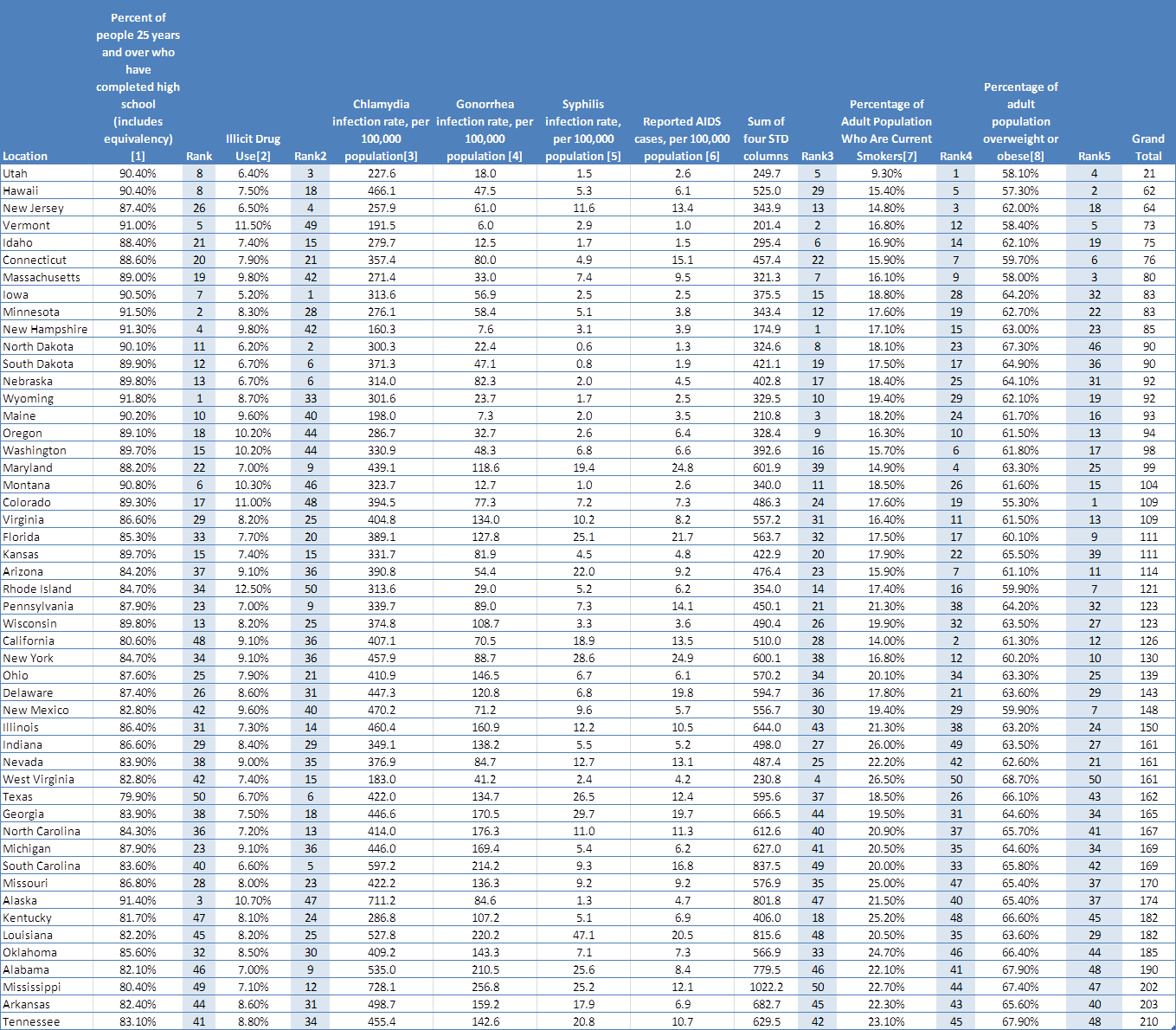
profile of states


Sources (all via States Perform ):
[1] U.S. Census Bureau, 2009 American Community Survey
[2] SAMHSA, Office of Applied Studies, National Survey on Drug Use and Health
Illicit drug use by those age 12+ in the past month. Illicit drugs include marijuana/hashish,
cocaine (including crack), heroin, hallucinogens, inhalants, or prescription-type psychotherapeutics used nonmedically. Based on the results from the 2007 National Survey on Drug Use and Health.
[3] Centers for Disease Control and Prevention, Division of STD Prevention, Sexually Transmitted Disease Surveillance 2008: November 2009
[4] Centers for Disease Control and Prevention, Division of STD Prevention, Sexually Transmitted Disease Surveillance 2008: November 2009
[5] Centers for Disease Control and Prevention, Division of STD Prevention, Sexually Transmitted Disease Surveillance 2008: November
[6] Centers for Disease Control and Prevention, Divisions of HIV/AIDS
prevention, Reported AIDS cases and annual rates (per 100,000 population), by area of residence, 2006, 2007 and cumulative United States and dependent areas: 2009
[7] Centers for Disease Control and Prevention, National Center for Chronic Disease Prevention and Health Promotion, Behavioral Risk Factor Surveillance System, Tobacco Use 2008: 2009
[8] Centers for Disease Control and Prevention, National Center for Chronic Disease Prevention and Health Promotion, Behavioral Risk Factor Surveillance System, 2008 Overweight and Obesity (BMI): 2009

are mexican oil politics keeping riches just out of reach?

NYTimes | To the Mexican people, one of the great achievements in their history was the day their president kicked out foreign oil companies in 1938. Thus, they celebrate March 18 as a civic holiday.

Yet today, that 72-year-old act has put Mexico in a straitjacket, one that threatens both the welfare of the country and the oil supply of the United States.

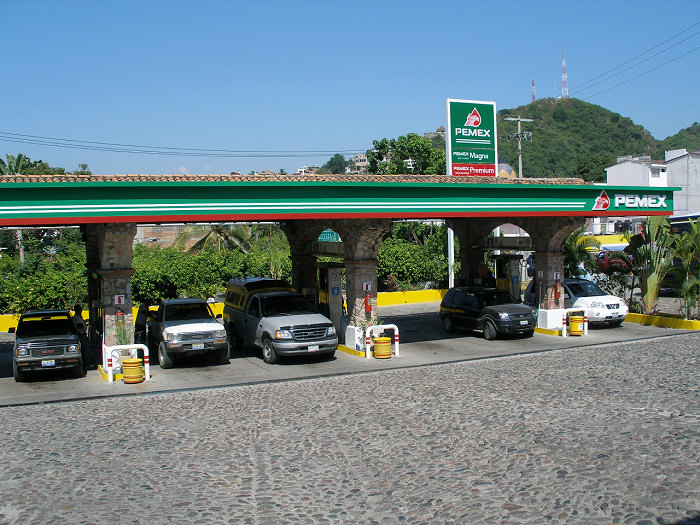
The national oil company created after the 1938 seizure, Pemex, is entering a period of turmoil. Oil production in its aging fields is sagging so rapidly that Mexico, long one of the world’s top oil-exporting countries, could begin importing oil within the decade.

Mexico is among the three leading foreign suppliers of oil to the United States, along with Canada and Saudi Arabia. Mexican barrels can be replaced, but at a cost. It means greater American dependence on unfriendly countries like Venezuela, unstable countries like Nigeria and Iraq, and on the oil sands of Canada, an environmentally destructive form of oil production.

“As you lose Mexican oil, you lose a critical supply,” said Jeremy M. Martin, director of the energy program at the Institute of the Americas at the University of California, San Diego. “It’s not just about energy security but national security, because our neighbor’s economic and political well-being is largely linked to its capacity to produce and export oil.”

Mexico probably still has plenty of oil, especially beneath the deep waters of the Gulf of Mexico, but Pemex lacks the technology and know-how to get it out. Inviting foreign companies into the country to help is one of the touchiest propositions in Mexican politics.

As the Mexican government struggles to find a way forward, production keeps falling.

The basic problem is simply that Mexico’s readily accessible oil is used up — pretty much the same thing that happened to the United States when production began falling in the 1970s. Output from Mexico’s giant Cantarell field, in shallow waters near the eastern shore, has plunged by 50 percent in recent years. Output at the country’s other large field is expected to begin falling in the next year or two.

Historically, oil has supplied 30 to 40 percent of the Mexican government’s revenue. Confronting a potential calamity, President Felipe Calderón has pushed through the strongest reforms he can defend politically, in hopes of attracting foreign investment. But he dare not do anything that would appear to reverse the 1938 nationalization. Even the modest reforms he has managed to pass are being challenged in court.

Officially, the government is optimistic that Mexico can reverse its decline as an oil-producing nation. But its efforts so far have yielded more rhetoric than oil.

Last year, on the day celebrating the 1938 seizure, the president’s helicopter landed in a hilly oil field outside this farming town. He announced that a new era of Mexican gushers would dawn soon.

“Under this soil,” Mr. Calderón told thousands of oil workers, lay “the richness that could propel development in our country and help Mexico accelerate our path to progress and well-being.” He promised that 20 wells would be spurting crude “very soon” from the ground on which he stood.

Almost a year later, only three wells were pumping on a recent afternoon. Eleven had been shut after producing little or no oil. In fact, the effort to develop the geologically challenging Chicontepec field here, near the gulf coast, is deteriorating into an embarrassing disaster for Pemex, the latest in a string of them.

In all, Mexican oil output has dropped from just short of 3.5 million barrels a day in 2004 to a projected average of 2.5 million barrels this year. Mexican oil exports to the United States, now 1.1 million barrels a day, have fallen by nearly a third in the last six years.

The United States Energy Department projects that Mexican production will decline by an additional 600,000 barrels a day by 2020; combined with growing domestic demand, that would probably make the country an oil importer.

In the last two years, Mexico provided about 12 percent of all crude oil imports to the United States, supplying about 8 percent of the total oil used by American refineries, according to the Energy Department.

Pemex — officially Petróleos Mexicanos — is the most important company in Mexico, employing 140,000 people. Oil money is used for everything from building schools to fighting the war against drug cartels.

“The fact that Mexico’s production is rapidly declining could potentially cause a financial crisis not only for Pemex but for the government,” said Enrique Sira, the Mexico director of IHS Cera, an energy consulting firm.

complaining about mosquitos while a crocodile bites your leg

Post Carbon Institute | Last week, in a repeat of 2008, reports of fat earnings from the oil majors were met with blame and outrage from American consumers, who are stressed from $4+ gas prices and strapped finances. Exxon Mobil, the 18th-largest oil company in the world, with about 3% of world production (~4million barrels of oil equivalent per day), reported quarterly earnings of $10.7 billion dollars. Americans are upset because they envision such hefty profits as direct transfers from their thin pocketbooks to Exxon, itself the recipient of government oil and gas subsidies to boot.

I am not an oil industry apologist, but recognize that I live in an oil-centric world, own a car, enjoy air travel and partake in the daily smorgasbord of food, services, and novelty made possible in the cheap energy age. To me, given the problems our country and government face, blaming Exxon for high gasoline prices and excessive tax subsidies is akin to complaining about a mosquito bite on your arm when a crocodile has your leg in its mouth.

First, it is a stretch to say that Exxon is under-taxed; last year Exxon's worldwide total taxes amounted to $86 billion, or 23% of its revenue (by comparison, at this country's second-largest corporation — Apple, Inc. — taxes were 6.9% of revenue. Yet Exxon understandably is a lightning rod, because the ~3 cents per gallon it makes as the world's largest refiner add up to very large numbers. And yes they make large sums on their oil production when commodity prices rise more than costs. But these are two sides of the wrong argument, and are not the real story.

Under a lens of ecology and biophysical economics, the vitriol being expressed at the Exxon is misplaced at best and counterproductive at worst. Though our culture perceives dollars and digits in the bank as wealth, in reality they are only markers. Our real wealth comes from the sun, including its direct daily insolation, its role in photosynthesis (which creates biomass, including fossil fuels), and its pushing natural and hydrological cycles that perform vital services to our species and others.

Our primary wealth is our finite endowment of resources, like oil and gas, timber, water, and minerals. We extract resources from this natural "bank account" and combine them with human ingenuity and technology to produce things we can use, such as tractors, houses, and clothing. Our socio-political system then overlays monetary tokens: stocks, bonds, bank deposits and cash that function as markers of our real wealth, markers that are increasingly disconnected from the reality of our natural resource balance sheet.

But energy is different from iPads or Doritos in its impact on our lives. The laws of economics (more like guidelines) state that energy, capital and labor are all substitutable. This turns out not to be true; there is no substitution for energy in our economy — every single economic product created requires first an expenditure of energy.

The amount of human labor that oil and other fossil fuels have been able to replace or allocate to other pursuits is gargantuan. The average human can generate only about 0.6 kilowatt-hours per day from physical effort, which, based on median U.S. salaries, equates to more than $300 per kWh generated by human labor. Oil, even at $110 per barrel, costs us just 6 cents per kWh, or 500 times cheaper than human labor. This replacement of human effort with fossil fuels has been the single primary driver of economic riches of the past couple of generations. For all intents and purposes, on human time scales, oil in our lives is indistinguishable from magic.

And it is depleting. U.S. oil production has been in steady decline since its peak in 1970. World production has been stagnant since 2005, despite a tripling in price last decade. The marginal barrel of oil now costs $85, as we are drilling deeper and in harsher environments, and now having to include fuels with lower net BTUs like tar sands, natural gas liquids and ethanol into the oil category just to stay even.

So when Exxon reports $10.7 billion in earnings, this is the monetary accounting of the chemical and kinetic energy it contributed to society in the form of oil and gas sales. This oil and gas then went on to perform myriad other activities in our economy — and 4 million barrels per day is the equivalent of over 2 billion human-days of useable energy. About equal to the working population of the world. Quite a deal actually, for us.

Tuesday, May 03, 2011

Double "O"

the destruction of economic facts

Businessweek | During the second half of the 19th century, the world's biggest economies endured a series of brutal recessions. At the time, most forms of reliable economic knowledge were organized within feudal, patrimonial, and tribal relationships. If you wanted to know who owned land or owed a debt, it was a fact recorded locally—and most likely shielded from outsiders. At the same time, the world was expanding. Travel between cities and countries became more common and global trade increased. The result was a huge rift between the old, fragmented social order and the needs of a rising, globalizing market economy.

To prevent the breakdown of industrial and commercial progress, hundreds of creative reformers concluded that the world needed a shared set of facts. Knowledge had to be gathered, organized, standardized, recorded, continually updated, and easily accessible—so that all players in the world's widening markets could, in the words of France's free-banking champion Charles Coquelin, "pick up the thousands of filaments that businesses are creating between themselves."

The result was the invention of the first massive "public memory systems" to record and classify—in rule-bound, certified, and publicly accessible registries, titles, balance sheets, and statements of account—all the relevant knowledge available, whether intangible (stocks, commercial paper, deeds, ledgers, contracts, patents, companies, and promissory notes), or tangible (land, buildings, boats, machines, etc.). Knowing who owned and owed, and fixing that information in public records, made it possible for investors to infer value, take risks, and track results. The final product was a revolutionary form of knowledge: "economic facts."

Over the past 20 years, Americans and Europeans have quietly gone about destroying these facts. The very systems that could have provided markets and governments with the means to understand the global financial crisis—and to prevent another one—are being eroded. Governments have allowed shadow markets to develop and reach a size beyond comprehension. Mortgages have been granted and recorded with such inattention that homeowners and banks often don't know and can't prove who owns their homes. In a few short decades the West undercut 150 years of legal reforms that made the global economy possible.

The results are hardly surprising. In the U.S., trust has broken down between banks and subprime mortgage holders; between foreclosing agents and courts; between banks and their investors—even between banks and other banks. Overall, credit (from the Latin for "trust") continues to flow steadily, but closer examination shows that nongovernment credit has contracted. Private lending has dropped 21 percent since 2007. Outstanding loans to small businesses dropped more than 6 percent over the past year, while lending to large businesses, measured in commercial loans of more than $1 million, fell nearly 9 percent.

The importance of economic facts may not be obvious to Americans. "What does the fish know about the water in which it swims?" asked Albert Einstein. But it's easy to grasp from the perspective of the developing and former communist countries where I live and work. In these countries, most of our assets and relationships are in the informal sector, outside the legal economy. Because they're not recorded in public memory systems, they cannot be written up as facts and are, in effect, invisible. All we have are shadow markets.

Without standardization, the values of assets and relationships are so variable that they can't be used to guarantee credit, to generate mortgages and bundle them into securities, to represent them in shares to raise capital. Nor do they fit the standard slots required to enter global markets. That's why credit crunches and massive unemployment are chronic conditions for most people forced to operate in the informal economy. These are the ones you see protesting in the streets of Arab countries or living in tents surrounding Port-au-Prince. We know only too well that facts don't speak for themselves: They have to be constructed through legal processes and kept transparent. They have to be defended, too.

all hail the PUBLIC library..,

Onthecommons | "The word 'public' has been removed from the name of the Fort Worth Library. Why? Simply put, to keep up with the times." From the Media release on the rebranding of the Fort Worth Library

Fort Worth, you leave me speechless. You’re certainly correct about one thing. The public library is indeed an institution that has not kept up with the times. But given what has happened to our times, why do you see that as unhealthy? In an age of greed and selfishness, the public library stands as an enduring monument to the values of cooperation and sharing. In an age where global corporations stride the earth, the public library remains firmly rooted in the local community. In an age of widespread cynicism and distrust of government, the 100 percent tax supported public library has virtually unanimous and enthusiastic support.

This is not the time to take the word “public” out of the public library. It is time to put it in capitals.

The public library is a singularly American invention. Europeans had subscription libraries for 100 years before the United States was born. But on a chilly day in April 1833 the good citizens of Peterborough, New Hampshire created a radical new concept—a truly PUBLIC library. All town residents, regardless of income, had the right to freely share the community’s stored knowledge. Their only obligation was to return the information on time and in good condition, allowing others to exercise that same right.

By the 1870s 11 states boasted 188 public libraries. By 1910 all states had them. Today 9,000 central buildings plus about 7500 branches have made public libraries one of the most ubiquitous of all American institutions, exceeding Starbucks and McDonalds.

Almost two thirds of us carry library cards. At least once a year, about half of us visit a public library, many more than once. Library use varies by class and race and by age and educational level. But the majority of blacks and Latinos as well as whites, old as well as young, poor as well as rich, high school dropouts as well as university graduates, use the public library.

neighborhood tool-sharing


Video - Portland's neighborhood tool sharing libraries.

PeakMoment | Need a tool for a few days? Don’t have it? Neighbor doesn’t have it? Borrow it from your neighborhood tool library! No tool library? Check out Portland, where several neighborhoods have started successful tool libraries just in the last few years. Organizers Tom Thompson, Karen Tarnow and Stephen Couche discuss how they got started, stories of community generosity, and the enthusiastic response of all who stop by. In these neighborhoods, there’s no reason not to grab the tools you need and do that project!

Chipocalypse Now - I Love The Smell Of Deportations In The Morning

sky |   Donald Trump has signalled his intention to send troops to Chicago to ramp up the deportation of illegal immigrants - by posting a...