Wednesday, March 23, 2011

evidence of extrajudicial death squads emerging in mexico


Video - Gen. Bibiano Villa - like a Robert Rodriquez character

narconews | Leaked State Department Cable Claims Juárez Business Leaders Hired Former Zetas for “Protection”

The drug war in Mexico has been depicted in the mainstream media, for the most part, as a conflict between brutal, rival “drug cartels” that are in a pitched battle over territory and for survival as the Mexican military seeks to restore order under the leadership of the brave and resolute President Felipe Calderón.

A U.S. State Department cable released last week through WikiLeaks pokes yet another hole in that bogus narrative, however. Given that fact, it is no surprise that the cable has been essentially ignored by the mainstream media, save one small daily, the El Paso Times — located in a U.S. border city across from Ciudad Juárez, Mexico, which registered more than 3,100 drug-war murders last year alone.

Diana Washington Valdez, a veteran drug-war reporter for the El Paso Times, in a March 16 story about the WikiLeaks cable, reported that a syndicate of Juárez businessmen hired a group of former Zetas (a paramilitary narco-trafficking group) to “protect themselves against kidnappings and extortions.”

The acknowledgement in an official U.S. document of the existence of this vigilante paramilitary group, which is funded by wealthy Juárez businessmen and has close ties to the Mexican military (the Zetas were founded by former Mexican special forces operatives), provides us with an important insight into the dynamics of the violence of the drug war in Mexico.

A similar alliance of former soldiers and wealthy business leaders (landowners) was the genesis for Colombia’s ruthless, right-wing paramilitary force known as the Autodefensas Unidas de Colombia (AUC) [United Self-Defense Forces of Colombia]. The AUC grew out of a smaller vigilante death squad called Los Pepes, which was established in the early 1990s to battle narco-trafficking as well — in particular, the notorious Colombian bandito Pablo Escobar. The AUC, however, itself eventually became a major player in the narco-trafficking business and spread terror across Colombia by murdering thousands of Colombians — particularly those deemed to have leftist leanings, such as labor organizers and human rights activists.

The WikiLeaks cable, drafted by the U.S. consulate in Juárez in late January 2009, provides the following description of the Pepes-like paramilitary group established in Juárez:
There have been indications that local businesses are taking a different approach to self-protection, that of vigilantism. In October, the press carried stories of business people forming paramilitary groups to protect themselves from extortionists and kidnappers. On November 28 [2008], seven men were shot dead outside a school a few blocks from the Consulate, and placards were hung over their bodies (a fact not reported to the public) claiming that the executions were carried out by the `Yonkeros Unidos (United Junkyard Owners of Juárez)'.

In another notorious incident, a burned body was left outside a Juárez police station with its amputated hands each holding a gas fire starter, and with a sign saying that this would be the penalty paid by arsonists. During the week of January 11 [2009] an email circulated through Juárez, claiming that a new locally funded group called the `Comando Ciudadano por Juárez (Juárez Citizen Command, or CCJ)' was going to "clean (the) city of these criminals" and "end the life of a criminal every 24 hours."

City and state government officials have argued that there exists no evidence of a vigilante movement in Ciudad Juárez, and that the messages by the CCJ are a hoax. A Consulate contact in the press, however, suggests that the CCJ is a real self-defense group comprised of eight former `Zetas' hired by four Juárez business owners (including 1998 PRI mayoral candidate Eleno Villalba). According to the contact, the former `Zetas' paid a visit on local military commanders when they arrived in Juárez in September 2008, and purchased previously seized weapons from the army garrison. According to the contact, the former `Zetas' pledged not to target the army, and made themselves available to the army for extrajudicial operations. [Emphasis added.]
In addition to illuminating the cozy relationship between the Mexican military and this vigilante paramilitary group empowered to carry out “extrajudicial [outside the law] operations,” the State Department cable reveals a concern that the Mexican army itself may well be taking sides in Juárez’ drug war.

“The view is widely held that the army is comfortable letting the Sinaloa and Juárez cartels diminish each other's strength as they fight for control of the "plaza" (with a corollary theory being that the army would like to see the Sinaloa cartel win),” the State Department cable states.

pentagon a source of mexican narco-firepower


Video - Unclear how cartels are getting military grade weapons.

narconews | Another series of leaked State Department cables made public this week by WikiLeaks lend credence to investigative reports on gun trafficking and the drug war published by Narco News as far back as 2009.

The big battles in the drug war in Mexico are “not being fought with Saturday night specials, hobby rifles and hunting shotguns,” Narco News reported in March 2009, against the grain, at a time when the mainstream media was pushing a narrative that assigned the blame for the rising tide of weapons flowing into Mexico to U.S. gun stores and gun shows.

Rather, we reported at the time, “the drug trafficking organizations are now in possession of high-powered munitions in vast quantities that can’t be explained by the gun-show loophole.”

Those weapons, found in stashes seized by Mexican law enforcers and military over the past several years, include U.S.-military issued rifles, machine guns, grenade launchers and explosives.

The State Department cables released recently by WikiLeaks support Narco News’ reporting and also confirm that our government is very aware of the fact that U.S military munitions are finding their way into Mexico, and into the hands of narco-trafficking organizations, via a multi-billion dollar stream of private-sector and Pentagon arms exports.

Narco News, in a report in December 2008 [“Juarez murders shine a light on an emerging Military Cartel”] examined the increasing militarization of narco-trafficking groups in Mexico and pointed out that U.S. military-issued ammunition popped up in an arms cache seized in Reynosa, Mexico, in November 2008 that was linked to the Zetas, a mercenary group that provides enforcement services to Mexican narco-trafficking organizations.

Tosh Plumlee, a former CIA asset who still has deep connections in the covert world, told Narco News recently that a special-operations task force under Pentagon command, which has provided training to Mexican troops south of the border, has previously “… found [in Mexico] hundreds of [U.S.-made] M-67s [grenades] as well as thousands of rounds of machine gun-type ammo, .50 [and] .30 [caliber] and the famous [U.S.-made] M-16 — most later confirmed as being shipped from Guatemala into Mexico as well as from USA vendors. …”

koch brothers exposed video series


Video - The Koch Brothers exposed

Tuesday, March 22, 2011

an odd rumination

Kunstler | I have a peculiar fantasy about Japan. It burbled up in my mind even before the earthquake-tsunami-reactor disaster, and I conceived it in rumination upon Japan's weird twenty-year-long economic malaise, as the nation's population shrank, and its debt climbed to astronomical heights, and its young people lost heart, and it seemed just to go through the motions of whatever modernity required of them - ship the cars, package the robot parts, show up at the salaryman drinking contest, get stuffed into another late-night commuter train. I don't claim to be a Japan expert, but I think all this was getting to them in a deep, major way. I think they perhaps secretly longed to get back to something like an older traditional Japanese society - the one before car assembly plants, big steel ships, chain reactions, and fluorescently-lighted pachinko parlors, back to the society that blossomed and fruited in cycles of centuries on those beautiful rocky, sea-washed islands into a culture saturated in artistry - unencumbered by idiot religions or the bothersome neediness of other nations.

I can't shake the odd feeling that Japan was looking for a way to get back to the 19th century, and perhaps even deeper beyond that - to the dream-time before they made the fateful decision to industrialize. The earthquake-tsunami-reactor moment is their chance now to begin that journey. Frankly, I don't know what else they can do. Japan imports over 95 percent of the fossil fuels it uses (that would be oil, coal, and natural gas). Does anyone think they'll be able to continue that indefinitely? Sorry, I just don't see it under any circumstances. And, anyway, the geographic region where the bulk of the world's oil comes from is in the process of blowing up. The Middle East and North Africa (MENA) are like some kind of mansion where fire has broken out simultaneously in the kitchen, the conservatory, the media room, the master bathroom, the chauffeur's apartment over the garage, and the pool house, and whenever the flames are doused in one spot, they break out in another. Yesterday it was Syria and Yemen. Bahrain is under lockdown. The Egyptians are having second thoughts about the loss of a grinding stability, trouble is stirring up in Kuwait, Iraq is like a crazy person in the rubber room of history, and who knows what kind of spells the vizeer Mahmoud Ahmadinejad is laying out in his Kevlar sanctum. There is just too much tension in the world and it is demanding release in the most vexing ways.

So, I can see the Japanese people - a deeply homogenous society - veering toward an as yet un-articulated consensus: let's just get out of the modern world. Let's go back home. Let's don the kimono and the hakama, get us some horses, sharpen the katana, and kick back in the chaniwa garden with a bowl of green tea - and forget about all that dirty, disgusting, dangerous, heavy manufacturing-for-export (to an insane world) nonsense. History may record their industrial adventure as a weird blip of activity in a much longer timeline. As it will for us and everybody else, I believe. In fact, this fantasy about the Japanese shrugging off the toils of modernity is exactly what all the other so-called advanced nations of the world will find themselves doing sooner rather than later as we all take the road back to a world made by hand. The Japanese may just be the pioneering exemplars of the universal process. Fist tap Dale.

A Review of Joe Bageant's Rainbow Pie: A Redneck Memoir

JoeBaegent | Q: How do you know if you are rich, middle class or poor in America?

A: When you go to work, if your name is on the building -- you’re rich; if your name is on an office door -- you’re middle class; if your name is on your shirt -- you're poor…and, if someone else’s name is on your hand-me-down work shirt.

You always hear about natural-born musicians, artists, teachers, nurses, even businessmen. But what happened to the natural-born farmer and extended farm family when the rural-to-urban migration saw us go from 92% of Americans making their living (and dying) on the land in 1900 to around 2% today? What happened to the natural sense of community that engendered -- that "we're all in it together," culture we now long for? And, what about America's supposedly classless society? How's that working out for ya?

Joe’s memoir begins in 1951 at grandparents Maw and Pap’s small farm along Shanghai (it’s an Irish term) Road in Morgan County, West Virginia. Like many a homestead along the Blue Ridge Mountains, it was a multi-generational subsistence farm (“the farm was not a business”) that had been the norm in America before the great corporate-driven rural-to-urban shift that coincided with the end of World War Two.

Joe’s childhood days “Over Home” were whiled away on the usual attendant chores, hand-picking bugs off garden crops, watching Pap plow fields behind his draught horse or hand-harvest the large cornfield, sweating away with the adults during the all-hands-on-deck haying and wood cutting, helping with the late Autumn hog butchering, dodging the ever-present snakes and bullying older cousins and hunting with the adults or developing future hunting skills plinking holes in a broken metal bucket set on a fencepost.

A Multi-faceted American Tragedy
For the Christian teetotaler Pap -- who likely never brought in more than $1000 in any given year -- freedom “resided in yeoman property rights” -- the Jeffersonian ideal of an Agrarian Democracy. No one in Maw and Pap's hard-working extended family ever went hungry or homeless. As Joe notes, this rural system of subsistence farming and barter right up the great rural-to-urban migration was “an economy whose currency was the human calorie.”

And, that’s what this book is all about: the post WWII shift from Maw and Pap’s agrarian democracy to the urban-dominated/techno/bureaucratic/military/security/consumer Empire of today. He writes how that shift and the resulting class stratification has led us to the brink of economic and ecological collapse.

Joe notes: “Damn few of us grasp how the loss of traditional aesthetic and foundational values, the yeoman tradition, are connected with so much modern American tragedy.”

The rush to “agri-business;” the obesity/diabetes health crisis; the out-migration to teeming cities; the resulting army of disposable laborers; the meth epidemic devastating the “white working-class’s futureless young”… all are tragedies personal and political. It’s also the root of our ecological crisis. You just can’t have “ten thousand years of agriculture synthesized into money” without it. Joe posits, “In all likelihood, there is no solution for environmental destruction that does not first require a healing of the damage done to the human community.”

equilibrium and an invisible ideology

DebunkingEconomics | Economics as a discipline arose at a time when English society was in the final stages of removing the controls of the feudal system from its mercantile/capitalist economy. In this climate, economic theory had a definite (and beneficial) political role: it provided a counter to the religious ideology that once supported the feudal order, and which still influenced how people thought about society. In the feudal system the pre-ordained hierarchy of king, lord, servant and serf was justified on the basis of the ‘divine right of Kings’. The King was God’s representative on earth, and the social structure which flowed down from him was a reflection of God’s wishes.

This structure was nothing if not ordered, but this order imposed severe restrictions on the now dominant classes of merchants and industrialists. At virtually every step, merchants were met with government controls and tariffs. When they railed against these imposts, the reply came back that they were needed to ensure social order.

Economic theory–then rightly called political economy–provided the merchants with a crucial ideological rejoinder. A system of government was not needed to ensure order: instead, social order would arise naturally in a market system in which each individual followed his own self-interest. Smith’s phrase ‘the invisible hand’ came along rather late in the process, but the notion played a key role in the political and social transformations of the late 18th and early 19th centuries.

An essential aspect of this market social order was equilibrium.

From the outset, economists presumed that the market system would achieve equilibrium. Indeed, the achievement of equilibrium was often touted as an advantage of the free market over any system where prices were set by fiat. Equilibrium was therefore an essential notion of the economic defence of capitalism: the equilibrium of the capitalist market would replace the legislative order of the now defunct feudal hierarchy.

More importantly, whereas the feudal order endowed only the well-born with welfare, the equilibrium of the market would guarantee the best possible welfare for all members of society. The level of individual welfare would reflect the individual’s contribution to society: people would enjoy the lifestyle they deserved, rather than the lifestyle into which they had been born.

If, instead of equilibrium, economists had promised that capitalism would deliver chaos; if, instead of meritocracy, economists had said that the market could concentrate inequality, then economists could have hindered rather than helped the transition to capitalism (though they more likely would have been ignored).

By the middle of the 19th century, the transition to capitalism was complete: what was left of feudalism was a mere vestige. But rather than the promised equilibrium, 19th century capitalism was wracked by cycles and enormous disparities of wealth. A major depression occurred roughly every 20 years, workers’ conditions would improve and then rapidly deteriorate, prices rise and then fall, banks expand and then collapse. New ‘robber barons’ replaced the barons of old. It appeared that, while promising a meritocratic equilibrium, capitalism had instead delivered unbalanced chaos. A new political challenge arose: that of socialism.

Once again, economics rose to the challenge, and once again equilibrium was a central tenet. This time the defence was mounted by what we today call neoclassical economics, since classical economics had been turned into a weapon against capitalism by the last great classical economist, Karl Marx.

In contrast to the hand-waving of Smith, the neoclassical economists of the late 19th century provided a substantive mathematical analysis of how equilibrium could be achieved by an idealised market economy, and how this equilibrium could be fair to all. However, unlike the earlier classical championing of capitalism, this technical edifice provided very little in the way of libertarian slogans for the battle against the ideology of socialism. Instead of arming capitalism’s defenders with rhetoric to deploy against socialists, it gave birth to the academic discipline of economics.

Capitalism eventually transcended the challenge of socialism, with little real assistance from economic theory. But while the economics had little impact upon capitalism, the need to defend capitalism had a profound impact upon the nature of economic theory. The defensive imperative, and the role of equilibrium in that defence, cemented equilibrium’s role as a core belief of economic theory.

At the beginning of the 3rd millennium, there is no competing social system against which capitalism must prove its superiority. Feudalism is long dead, and those socialist societies which remain are either socialist in name only, or bit players on the world stage.

Today, most economists imperiously dismiss the notion that ideology plays any part in their thinking. The profession has in fact devised the term ‘positive economics’ to signify economic theory without any value judgments, while describing economics with value judgments as ‘normative economics’–and the positive is exalted far above the normative.

Yet ideology innately lurks within ‘positive economics’ in the form of the core belief in equilibrium.[3] As previous chapters have shown, economic theory has contorted itself to ensure that it reaches the conclusion that a market economy will achieve equilibrium.[4] The defence of this core belief is what has made economics so resistant to change, since virtually every challenge to economic theory has called upon it to abandon the concept of equilibrium. It has refused to do so, and thus each challenge–Sraffa’s critique, the calamity of the Great Depression, Keynes’s challenge, the modern science of complexity–has been repulsed, ignored, or belittled.

This core belief explains why economists tend to be extreme conservatives on major policy debates, while simultaneously believing that they are non-ideological, and are in fact motivated by knowledge rather than bias.

If you believe that a free market system will naturally tend towards equilibrium–and also that equilibrium embodies the highest possible welfare for the highest number–then ipso facto, any system other than a complete free market will produce disequilibrium and reduce welfare. You will therefore oppose minimum wage legislation and social security payments–because they will lead to disequilibrium in the labour market. You will oppose price controls–because they will cause disequilibrium in product markets. You will argue for private provision of services–such as education, health, welfare, perhaps even police–because governments, untrammelled by the discipline of supply and demand, will either under or oversupply the market (and charge too much or too little for the service).

the human costs of different types of energy

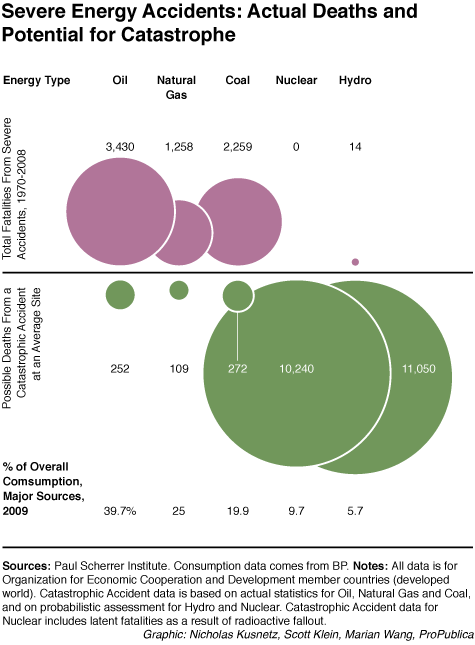
Propublica | Since this time last year, we’ve seen a deadly mine disaster [1], the worst oil spill in U.S. history [2], and now a nuclear crisis in Japan [3]. That got us wondering—how does one compare or quantify the human cost of different sources of energy?

As it turns out, a Swiss research organization, the Paul Sherrer Institute, has been doing just that. Using data from the institute, we pulled together a few visualizations.

The top part of the graph shows the actual number of deaths from severe accidents in developed countries [4] from 1970 through 2008. The bottom part of the graph shows the number of deaths that might result [5] from a catastrophic event at an average site in the developed world. This does not show the worst case scenario for any situation, but it gives a sense of the relative risks associated with different sources of energy.

These numbers represent deaths in the developed world from severe accidents only, where at least five people were killed. The accidents have occurred at many stages of the energy supply chain, from coal mining to shipping oil to accidents at actual power plants.

It’s important to note that every-day energy use from fossil fuels kills far more people than accidents. By one estimate from 2000, pollution from power plants results in at least 30,000 premature deaths every year [6] in the United States alone.

the amount of fuel at fukushima DWARFS chernobyl


The Daiichi complex in Fukushima, Japan ... had a total of 1760 metric tons of fresh and used nuclear fuel on site last year, according to a presentation by its owners, the Tokyo Electric Power Company (Tepco). The most damaged Daiichi reactor, number 3, contains about 90 tons of fuel, and the storage pool above reactor 4, which the Nuclear Regulatory Commission's (NRC's) Gregory Jaczko reported yesterday had lost its cooling water, contains 135 tons of spent fuel. The amount of fuel lost in the core melt at Three Mile Island in 1979 was about 30 tons; the Chernobyl reactors had about 180 tons when the accident occurred in 1986.

And see this.

That means that Fukushima has nearly 10 times more nuclear fuel than Chernobyl.

It also means that a single spent fuel pool - at reactor 4, which has lost all of its water and thus faces a release of its radioactive material - has 75% as much nuclear fuel as at all of Chernobyl.

However, the real numbers are even worse.

Specifically, Tepco very recently transferred many more radioactive spent fuel rods into the storage pools. According to Associated Press, there were - at the time of the earthquake and tsunami - 3,400 tons of fuel in seven spent fuel pools plus 877 tons of active fuel in the cores of the reactors.

That totals 4,277 tons of nuclear fuel at Fukushima.

Which means that there is almost 24 times more nuclear fuel at Fukushima than Chernobyl.

Monday, March 21, 2011

global energy crunch: how different parts of the world would react to a peak oil scenario

Global Energy Crunch | Peak oil theory predicts that oil production will soon start a terminal decline. Most authors imply that no adequate alternate resource and technology will be available to replace oil as the backbone resource of industrial society. This article uses historical cases from countries that have gone through a similar experience as the best available analytical strategy to understand what will happen if the predictions of peak oil theorists are right. The author is not committed to a particular version of peak oil theory, but deems the issue important enough to explore how various parts of the world should be expected to react. From the historical record he is able to identify predatory militarism, totalitarian retrenchment, and socioeconomic adaptation as three possible trajectories.

why so little looting in japan?

Slate | If your home was hit by a 9.0-magnitude earthquake, a tsunami, and radiation from a nuclear power plant, you'd be forgiven for not remaining calm. Yet that's what many Japanese quake victims appear to be doing. People are forming lines outside supermarkets. Life is "particularly orderly," according to PBS. "Japanese discipline rules despite disaster," says a columnist for The Philippine Star.

Anyone who has seen Big Bird in Japan knows the shorthand for Japanese culture: They're so honest and disciplined! They're a collective society! They value the group over the individual! Of course they're not going to steal anything after the most devastating natural disaster of their lifetimes—unlike those undisciplined thieves in post-Katrina New Orleans and post-earthquake Haiti. Even if they're desperate for food, the Japanese will still wait in line for groceries.

There's a circularity to these cultural explanations, says Mark D. West, a professor at University of Michigan Law School: "Why don't Japanese loot? Because it's not in their culture. How is that culture defined? An absence of looting." A better explanation may be structural factors: a robust system of laws that reinforce honesty, a strong police presence, and, ironically, active crime organizations.

Honesty, with incentives. Japanese people may well be more honest than most. But the Japanese legal structure rewards honesty more than most. In a 2003 study on Japan's famous policy for recovering lost property, West argues that the high rates of recovery have less to do with altruism than with the system of carrots and sticks that incentivizes people to return property they find rather than keep it. For example, if you find an umbrella and turn it in to the cops, you get a finder's fee of 5 to 20 percent of its value if the owner picks it up. If they don't pick it up within six months, the finder gets to keep the umbrella. Japanese learn about this system from a young age, and a child's first trip to the nearest police station after finding a small coin, say, is a rite of passage that both children and police officers take seriously. At the same time, police enforce small crimes like petty theft, which contributes to an overall sense of security and order, along the lines of the "broken windows" policy implemented in New York City in the 1990s. Failure to return a found wallet can result in hours of interrogation at best, and up to 10 years in prison at worst.

Police presence. Japan has an active and visible police force of nearly 300,000 officers across the country. Cops walk their beats and chat up local residents and shopkeepers. Police are posted at ubiquitous kobans, police boxes manned by one or two officers, and in cities there's almost always a koban within walking distance of another koban. A survey in 1992 found that 95 percent of residents knew where the nearest koban was, and 14 percent knew the name of an officer who worked there. Cops are paid well—the force attracts many college graduates—and can live in cheap government housing. They also care a lot about public relations: The Tokyo Metropolitan Police even has a mascot, Pipo-kun, whose name means "people + police." They're good at their jobs, too: The clearance rate for murder in 2010 was an unbelievable 98.2 percent, according to West—so unbelievable that some attribute it to underreporting.* Fist tap Dale.

how much competition do we need in a civilized society?

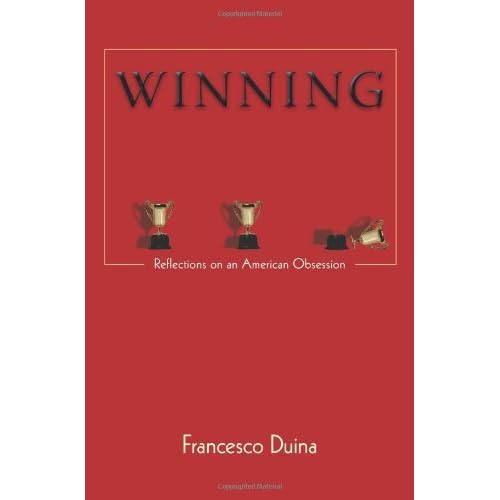
Springerlink | Francesco Duina is an American associate professor and chair of the Sociology Department at Bates College, in Maine, USA, and visiting professor at the International Center for Business and Politics in Copenhagen, Denmark. His latest book ‘‘Winning’’ is about the American love for competition; a love not shared by all Americans, but dominant enough to shape how many Americans live. In the rest of the world, and certainly in more egalitarian nations like Denmark and the Netherlands, people have more reservations about competition (Data World Values Surveys). Duina describes the ‘‘American obsession’’ with competition and winning and losing very vividly. The bulk of the book is descriptive but in the last chapter Duina makes some critical normative remarks and proposes an alternative mind-set for the USA. This book is important because it poses the question how much competition we really need in rich nations, with high levels of economic and cultural productivity. The answer to this question is relevant in discussions about the role of governments and about the optimal levels of liberalization or regulation of markets. Duina’s suggestions to moderate and redirect competition by changing the American mind-set are valuable. His suggestions might have been more adequate, however, if he would have made a distinction between ‘competition for fun’ and ‘competition to survive’, and if he would have paid more attention to their different effects on happiness.

i call'em knuckledraggers for a reason...,

Physorg | The tendency to perceive others as "us versus them" isn't exclusively human but appears to be shared by our primate cousins, a new study led by Yale researchers has found.

In a series of ingenious experiments, Yale researchers led by psychologist Laurie Santos showed that monkeys treat individuals from outside their groups with the same suspicion and dislike as their human cousins tend to treat outsiders, suggesting that the roots of human intergroup conflict may be evolutionarily quite ancient.

The findings are reported in the March issue of the Journal of Personality and Social Psychology.

"One of the more troubling aspects of human nature is that we evaluate people differently depending on whether they're a member of our 'ingroup' or 'outgroup,'" Santos said. "Pretty much every conflict in human history has involved people making distinctions on the basis of who is a member of their own race, religion, social class, and so on. The question we were interested in is: Where do these types of group distinctions come from?"

The answer, she adds, is that such biases have apparently been shaped by 25 million years of evolution and not just by human culture.

why inequality matters


Richard Wilkinson has played a formative role in international research on the social determinants of health and on the societal effects of income inequality; his work has been published in many languages. He studied economic history at the London School of Economics before training in epidemiology. He is Professor Emeritus of Social Epidemiology at the University of Nottingham Medical School, Honorary Professor at University College London and a Visiting Professor at the University of York. Richard co-wrote The Spirit Level and is a co-founder of The Equality Trust.

Sunday, March 20, 2011

the method is transparency, the goal is justice

Technology Review | Perhaps the best way to conceive of WikiLeaks is like this: it is a stateless, distributed intelligence network, a reverse image of the U.S. National Security Agency, dedicated to publicizing secrets rather than acquiring them, unconstrained and answerable to a single man.

The future of WikiLeaks
If WikiLeaks is not a media organization, is it another example of the Internet overthrowing our settled habits? That question is more interesting. By this formulation, WikiLeaks is to the state and corporations what Napster was to music or Google is to media as a business.

Shakespeare, Lord Annan recalled in his war memoirs, gave to Ulysses in Troilus and Cressida the haunting phrase "There is a mystery ... in the soul of the state." "That mystery is the intelligence services," Annan explained. He was thinking of his service on the United Kingdom's Joint Intelligence Staff 70 years ago. But the modern state has many allied organizations besides the intelligence services, including the management of large corporations and banks, who partake in its mystery. Julian Assange, the disordered soul of WikiLeaks, wants to explode the soul of the state.

The modern state, with its monopoly on violence, is not like the music industry or the media. It is properly jealous of its secrets, and more powerful and able than Assange understands. It will bitterly resent an attack by a crypto-utopian on its ability to "think." Assange has declared himself the state's enemy, and he will, in all likelihood, be comprehensively destroyed. WikiLeaks will vanish.

Once imagined, however, the technology of WikiLeaks cannot be forgotten and can easily be imitated. Other organizations, less radically activist, will create secure drop boxes for anonymous leaking. Already, the disgruntled former WikiLeaks volunteer, Daniel Domscheit-Berg, has said he will create a less threatening platform called OpenLeaks. It will, he says, publish nothing but, instead, function as a pipeline where sources designate the media organization to which they wish to leak: "We want to be a neutral conduit. That's what's most politically sustainable." Still more leak platforms are sprouting, including GreenLeaks, which will publish "information of environmental significance"; Brussels Leaks, which will expose the European Union; and Rospil, which will uncover Russia's secrets.

Predictably, media organizations want to replicate WikiLeaks's secure drop box, too. Recently, Al Jazeera launched a "Transparency Unit," which encourages its audience to submit "all forms of content" for "editorial review and, if merited, online broadcast and transmission on our English and Arabic-language broadcasts." The first product came in January, when Al Jazeera published the "Palestine Papers," 11 years' worth of secret documents created by the Palestinian Authority, describing negotiations with the Israeli government. The impression that emerges from them is that the Israeli government is no longer interested in securing a Palestinian state: it is a scoop that could not have existed without the Transparency Unit's drop box. Now other publications are considering their own. Bill Keller, the executive editor of the New York Times, is pondering how he can make it easier for sources to leak to his journalists.

WikiLeaks may not be with us for the long haul, but others will imitate its innovations, and they are likely to be more constrained and more responsible.

nuclear boy "explains" fukushima daiichi for kids...,


Video - Nuclear Boy explains Fukushima Daiichi Fist tap LongdeShizi.

science vs. money

From: "THE LEADING EDGE" Feb. 1983 M. King Hubbert: Science's Don Quixote ... (Published By: Society of Exploration Geophysicists (Pg.22)):

Hubbert first joined SEG in 1945 and quickly became an active member. He has served on the standing committee geophysical education, the standing committee on publications, and as editor of Geophysics (1947-49).

Hubbert has had serious health problems for several years... But, neither his ailments nor the recent adulation have eroded his zest for intellectual combat. In recent years, he has assaulted a target which he labels the culture of money that is gigantic event by Hubbert standards. His thesis is that society is seriously handi-capped because its two most important intellectual underpinnings, the science of matter-energy and the historic system of finance, are incompatible. A reasonable co-existence is possible when both are growing at approximately the same rate. That, Hubbert says, has been happening since the start of the industrial revolution but it is soon going to end because the amount the matter-energy system can grow is limited while money's growth is not.

"I was in New York in the 30's. I had a box seat at the depression," Hubbert says. "I can assure you it was a very educational experience. We shut the country down because of monetary reasons. We had manpower and abundant raw materials. Yet we shut the country down. We're doing the same kind of thing now but with a different material outlook. We are not in the position we were in 1929-30 with regard to the future. Then the physical system was ready to roll. This time it's not. We are in a crisis in the evolution of human society. It's unique to both human and geologic history. It has never happened before and it can't possibly happen again. You can only use oil once. You can only use metals once. Soon all the oil is going to be burned and all the metals mined and scattered."... That is obviously a scenario of catastrophe, a possibility Hubert concedes. But it is not one he forecasts. The man known a pessimist is, in this case, quite hopeful. In fact, he could be the ultimate utopian. We have, he says, the necessary technology. All we have to do is completely overhaul our culture and find an alternative to money. We are not starting from zero, he emphasizes. We have an enormous amount of existing technical knowledge. It's just a matter of putting it all together. We still have great flexibility but our maneuverability will diminish with time.

A non-catastrophic solution is impossible, Hubbert feels, unless society is made stable. This means abandoning two axioms of our culture the work ethic and the idea that growth is the normal state of affairs. Hubbert challenges the latter mathematically and concludes the exponential growth of the last two centuries is the opposite of the normal situation "It is an aberration. For most of human history, the population doubled only once every 32,000 years. Now it's down to 35 years. That is dangerous. No biologic population can double more than a few times without getting seriously out of bounds. I think the world is seriously overpopulated right now. There can be no possible solutions to the world's problems that do not involve stabilization of the world's population."

Hubbert's ideas about work are even more heretical. Work is becoming, he says, increasingly unimportant. He thinks it is conceivable that the future work week might be on the order of 10 hours. Indeed, because production will have to be limited by increasingly limited mineral resources that might be inevitable. And that, Hubbert stresses, could be the foundation of an earthly paradise...Most employment now is merely pushing paper around, He says. The actual work needed to keep a stable society running is a very small fraction of available manpower.

The key to making this cultural alteration is to come up with limitless supply of cheap energy. Hubbert feels the answer is obvious solar power and he does not feel more technological breakthroughs are needed before it can be made universally available. His faith is not that of a kneejerk trendy but that of a doubter who did much studying before his conversion. Fifteen years ago I thought solar power was impractical because I thought nuclear power was the answer. But I spent some time on an advisory committee on waste disposal to the Atomic Energy Commission. After that, I began to be very, very sceptical because of the hazards. That's when I began to study solar Power. I'm convinced we have the technology to handle it right now. We could make the transition in a matter of decades if we begin now.

Solar power is limited by astronomic time but not in human time frame. It's been there for billions of years and it will be going on for billions of years after we're gone. It also has another great advantage over conventional sources -- once the system is in place it is permanent. All that's required to keep it going is routine maintenance.

Harnessing an infinite supply of cheap energy is the key to Hubbert's technate, because of the leisure time it would generate. Look at the people who did remarkable things in the past. The Greeks. The English of a century ago. What did they have in common? They were highly educated and had a lot of leisure time. Of course not everyone with that combination did remarkable things, but the people who did do remarkable things generally had that combination.

In both cases, though, the opportunities for intellectual greatness were limited to a very few. The intellectual life of Greece was made possible because it was a slave society. England's was supported by great masses that lived in terrible poverty. But if the sun is conquered, education and leisure could be universal. It could result in the greatest intellectual renaissance of all time, Hubbert says.

His nominees for the leadership role in making this cultural change? His earth science peers... Intellectual leadership is, he says, their natural function.

A handful of men like Hutton, Lyell, and Darwin (1780-1880) changed the world. They gave us a geologic view of history instead of a Biblical view.

In the second stage, from 1880 until now, earth scientists became utilitarian and concentrated mostly on the search for ores, metals and fossil fuels. They did very little thinking about the broader subjects.

Now is the start of the third phase when the world is heading into intellectual turmoil... It needs guidance. The knowledge essential to competent intellectual leadership in this situation is pre-eminently geological "a knowledge of the earth's mineral and energy resources." The importance of any science, socially, is its effect on what people think and what they do. It is time earth scientists again become a major force in how people think rather than in how they live.

If Hubbert is right about man being on the brink of an unparalleled crisis, then men are going to have to make fantastic decisions “species-wide decisions" imminently.

This ability to make people, particularly the right people think, will be of inestimable worth. It may be Hubbert's greatest legacy.

technical information on fukushima daiichi

In the aftermath of Japan's earthquake and tsunami, reliable technical information about the crisis affecting the nuclear power plants at Fukushima has been difficult to discern from the media coverage. The demand to know what is happening, however, is very great. The Department of Nuclear Science and Engineering held an information session for the MIT community about the current situation at Fukushima on March 14, 2011. Topics discussed include: the characteristics of the boiling water reactors at Fukushima; the possible causes of the accidents; the current status of the reactors; the technical options that may now be available to the reactor operators; and the possible future implications. NSE students, with support from our faculty, are maintaining a technical information blog at mitnse.com to continue to provide non-sensationalized, factual data from engineers in a manner that can be understood by the general public.


archaic superpowers in the age of superorganismic explosion (redux)


Video - J. Robert Oppenheimer we knew the world would not be the same.

Originally posted 1/30/11
America had made the bomb, and it could not escape the decisions that the possession of the bomb entailed. We had it. No one else did. Having it, what should we do with it? Should we share our knowledge or seek some international custodian of the "secret" we had discovered by prodigious wartime effort and the expenditure of some $2 Billion? Or, should we husband it, should we keep it all to ourselves? These were the fateful questions, and on the answers to them depended in large degree the climate of the postwar world and the direction that world would take.

The answers lay in the realm of science, which alone could gauge the validity of our secret and estimate the degree of our true choice; and because these answers, like the questions, involved entire new worlds of techniques and knowledge, it could not be expected that they would be widely and clearly understood. Inevitably, the issue of the bomb, the most momentous issue of our time, would be debated and settled in the inner councils of government; and, inevitably, under these circumstances, with knowledge largely confined to the high-circle inner club, it was foreordained that the Military, which already dominated this club, would define the argument in its own terms and dictate the decision. For this was clearly the Military's province, was it not? Who else could possibly know with their certainty?

The simplicity of this logic, viewed in the perspective of the years, now seems to have been the great delusion of our times. For anyone studying the record is forced to the conclusion that the Military, preoccupied with their own narrow professional interests, simply did not know best. Trained always to seek out the more powerful weapon, drilled to the point of instinct to protect such weapons by the tightest of secrecy, the military mentality was precisely the worst possible type of mentality with which to meet the special challenges of the new and infinitely complicated age of nuclear science. Great vision would be needed to recognize and deal with the unimaginable host of problems that we had willed ourselves in the birth of our horrible brain child.

But the military mind, by its very nature, would fall prey to the obsession that it possessed a great and final "secret" when in reality it had no secret at all, or at best only one of fleeting duration. This first delusion of the military mind would lead directly to a second. Convinced we alone held the "secret" of this supreme power, we would soon envision ourselves as the guardian of the world, the policeman of its security and its peace - a decision that ignored the elemental fact other nations almost certainly would not desire a guardian and one of them, Russia, would not trust or countenance our policing. Along such paths were we to be driven into the ever-mounting tensions of the Cold War that sane men can hardly be expected to continue and remain forever cold.

The tragedy is that we need not have walked so often to so many precarious brinks. There were men who saw the issues clear and whole. But these men were not of the Military. They were civilian scientists whose only claim was that they had created the atomic monster. They knew its terrible power. They knew that the scientific knowledge on which it was based was world-wide, not the exclusive province of any single country. They could glimpse the still more horrifying potentials that lay in the nuclear future now that the door was open, and they clearly saw that an arms race to achieve these higher horrors would escalate into the most desperate competition the world had ever seen. The views of the scientists were reflected in the eleoquent voice of one far-visioned statesman in the top-level councils of government, Secretary of War Henry L. Stimson. The scientists raised their voices in protest. Stimson tried to bring to the issue the power of prophetic vision and common sense and high ideals. But the scientists and Stimson lost. Inevitably, because the Military was against them. This is the story of that defeat - a defeat that led directly to all our future points of no return.

Video - FDR warns of a fifth column.

Saturday, March 19, 2011

you made the rain black and shoved your values down our throat...,


Video - You made the rain black, and shoved your values down our throat.

Yale | The chaotic events unfolding at the damaged Fukushima-Daiichi reactors along Japan’s northeast coast have inspired intense new scrutiny of the country’s nuclear policies. While Japan excels in some anti-pollution measures, the lack of a vigorously independent press and a strong judiciary has enabled Japanese industry to resist legislation to safeguard the environment and human health. The nuclear power industry, a powerful player in Japan’s politically dominant construction industry, has pressed ahead with its plans — endorsed in 2006 by the Ministry of Economics, Trade and Industry’s “New National Energy Policy” — to mold the country into a “nuclear state.” In addition to 54 existing nuclear power plants that until last week supplied 30 percent of the country’s electricity, a dozen new nuclear plants are planned or under construction.

One in particular has exposed a deep public divide. The proposed Kaminoseki nuclear plant is to be built on landfill in a national park in the country’s well-known Inland Sea, hailed as Japan’s Galapagos. For three decades, local residents, fishermen, and environmental activists have opposed the plant, saying it should not be built in the picturesque sea, with its rich marine life and fishing culture dating back millennia. The Inland Sea has also been the site of intense seismic activity, including the epicenter of the 1995 Kobe earthquake that killed 6,400 people.

But in a sign of the immense clout of the nuclear power industry, a utility has barreled ahead with plans to build the Kaminoseki plant, despite what may be the most intense opposition yet to a Japanese nuclear project. In 2009, the utility began clearing forests for the project — located just 50 miles from Hiroshima — and reclaiming land from the sea. Nothing, not even intensifying protests, seemed able to stop the plant’s construction — until, that is, last week’s earthquake and tsunami set off the crisis at the Fukushima-Daiichi nuclear power plant. Now, for the time being at least, work has halted on the Kaminoseki project.

“We have to stop it,” Masae Yuasa, a professor of International Studies at Hiroshima City University and a leading opponent of the plant, told me when I visited Japan last fall. In words that have a chilling resonance now, she continued, “Once an accident happens, there is no border. I want to be more polite, but we have to stop it. I am a person from Hiroshima. I cannot be quiet about it.”

Video - Fallout came in the form of thick black rain.

fallout fear returns...,


Video - Excerpt from "White Light/Black Rain: The Destruction of Hiroshima and Nagasaki".

CNN | The cities flattened by last week's earthquake look eerily similar to the decimated buildings Shigeko Sasamori saw after an atomic bomb was dropped on her hometown in 1945.

The floodwaters from the tsunami -- the waves of debris and bodies -- remind her of the rivers in Hiroshima, Japan, swamped with corpses.

And the struggle to contain radioactive emissions at the Fukushima Daiichi nuclear plant makes Sasamori, 78, wonder if the crisis there will plague a new generation in Japan.

"Radiation is the most horrible thing, and it's more horrible to me because humans make it," she said from her home near Los Angeles. "We don't have to make that."

Sasamori is a hibakusha, or heat radiation survivor -- a name given to those who lived through the atomic bombs dropped on Hiroshima and Nagasaki by the United States at the end of World War II.

For them, radiation is an invisible enemy that has haunted them, claimed their loved ones, altered their bodies and threatened their lives.
WWII survivors' second nuclear crisis

The parallels between the devastation from the 1945 atomic bombs and that of the earthquake, tsunami and nuclear crisis have reopened old scars.

Sasamori wakes up at night and watches Japanese TV coverage of the disasters from her living room. A slender woman, dignified and gray-haired, Sasamori is shaken. Her body is sleepless, and her heart feels heavy, she said.

And she waits for news, because her daughter-in-law's extended family has yet to be located in the oceanside prefecture of Iwate.

As a nervous world watches the situation at Fukushima, some hibakusha worry that more Japanese people may have to endure the ordeal of radiation exposure than they did after World War II.

"This is like déjà vu," said Dr. Ritsuko Komaki, another Japanese American who grew up in Hiroshima after the bomb fell when she was 2.

Japan's modern history has now been haunted by two major nuclear events: the atomic bombs and the struggle to contain the Fukushima Daiichi nuclear plant, which the Japanese prime minister described Friday as "very grave."

Chipocalypse Now - I Love The Smell Of Deportations In The Morning

sky |   Donald Trump has signalled his intention to send troops to Chicago to ramp up the deportation of illegal immigrants - by posting a...