Thursday, March 10, 2011

testing a central tenet of epigenetic regulation

The Scientist | A fundamental problem in biology concerns how the genomic information present in fertilized eggs can give rise to the full spectrum of stably differentiated cell types required to form vertebrates and invertebrates. In the 1930s, C.H. Waddington’s largely observational mammalian embryology studies, which defined this problem, were central to establishing the field of epigenetics. It is now well known that there are master regulatory genes that must be kept on to specify a given cell lineage and off in the many other cell lineages that make up the body.

The problem of keeping these genes in the off state when required has received considerable attention, in large part due to the landmark genetic studies initiated by Pam and Ed Lewis in the 1940s that identified a set of genes required for this repression. This family of genes is called the Polycomb Group (PcG) because the visual phenotype of a heterozygous null allele in these genes is duplication on the second and third legs of the sex combs that wild-type male Drosophila flies have on their front legs. It turns out that PcG proteins repress key developmental master regulatory genes in organisms from plants to humans. The PcG is responsible for a diversity of important biological events, from why plants flower only in the spring (and not in a December warm spell) to how mammals form the correct body tissues in the correct locations.

epigenetics: a primer

The Scientist | What makes the ~200 cell types in our body remember their identity? What prevents them from becoming cancer cells? Why do we inherit some traits from our father, others from our mother? How do our experiences and environment influence our thinking? Why do plants bloom in spring but not in winter? These important and quite different questions are all addressed by the field of epigenetics, which studies heritable changes in a phenotype arising in the absence of alterations in the DNA sequence. The idea of transgenerational inheritance of acquired characteristics goes back to Lamarck in the early 19th century, but still only correlative evidence exists in humans. In contrast, many cellular epigenetic phenomena are now well understood on the molecular level. In humans, they include the parent-of-origin specific expression of genes (imprinting) and the shutting-down of almost all genes on one of the two X chromosomes in females (X-chromosome inactivation).

All these epigenetic phenomena are characterized by chemical modifications to DNA itself (DNA methylation) or to histones, the proteins around which DNA is wound. These modifications change during development as stem cells give rise to liver cells and neurons, but also in response to environmental signals—in plants, for example, during the cold of winter or in humans when immune cells are activated after an infection. One of the biggest controversies in the field is whether histone modifications are inherited through cell division (called the “histone code hypothesis”) or whether they only form transient indicators of transcriptional states (“signaling model”).

earliest evidence for magic mushroom use in europe

NewScientist | EUROPEANS may have used magic mushrooms to liven up religious rituals 6000 years ago. So suggests a cave mural in Spain, which may depict fungi with hallucinogenic properties - the oldest evidence of their use in Europe.

The Selva Pascuala mural, in a cave near the town of Villar del Humo, is dominated by a bull. But it is a row of 13 small mushroom-like objects that interests Brian Akers at Pasco-Hernando Community College in New Port Richey, Florida, and Gaston Guzman at the Ecological Institute of Xalapa in Mexico. They believe that the objects are the fungi Psilocybe hispanica, a local species with hallucinogenic properties.

Like the objects depicted in the mural, P. hispanica has a bell-shaped cap topped with a dome, and lacks an annulus - a ring around the stalk. "Its stalks also vary from straight to sinuous, as they do in the mural," says Akers (Economic Botany, DOI: 10.1007/s12231-011-9152-5).

This isn't the oldest prehistoric painting thought to depict magic mushrooms, though. An Algerian mural that may show the species Psilocybe mairei is 7000 to 9000 years old.

multicellular evolution not linear

The Scientist | Multicellular blue-green algae made the transition from single-celled to multi-celled not once, but several times over the course of history, according to a study published last week (February 14) in BMC Evolutionary Biology, giving support to the idea that the evolution of multicellularity may not have been as big of an evolutionary leap as scientists once believed.

"Simple multicellularity has evolved a number of times within the bacteria and as many as two dozen times within the eukaryotes," paleobiologist Andrew Knoll of Harvard University, who was not involved in the research, said in an email, but relatively little is known about how that transition occurs. This paper provides an "explicit phylogenetic reconstruction" of one group that has evolved multicellular forms, and shows that it's not a simple linear progression of complexity.

In cyanobacteria, "multicellularity is easy to lose and regain," agreed Bettina Schirrmeister of the University of Zurich, who co-authored the study. "It's not this classical transition from unicellular to multicellular to more complex forms as we might have expected in the past."

Blue-green algae, photosynthetic prokaryotes also known as cyanobacteria, first appeared in the fossil record almost 2.5 billion years ago, and have since populated most of the world in a variety of unicellular and multicellular forms. Using gene sequences from 1,254 species of modern cyanobacteria, a team of researchers led by Bettina Schirrmeister of the University of Zurich
created over 11,000 different phylogenetic trees that helped pinpoint when multicellularity evolved in this lineage.

Wednesday, March 09, 2011

how the swedes set up julian assange...,


Video - Claes Borgstrom explains how a Swedish politician became involved in the Julian Assange case.

CounterPunch | Our hero has found himself in quite a mess. And meanwhile, in order to create more confusion and undermine Julian’s unflagging popularity, the Guardian team has cooked up a new charge: this time it is anti-Semitism. It is much easier to shout “Anti-Semite!” than to defend The Guardian against these very real accusations: falsification of cables, plagiarism, manipulation, deliberate smearing of Julian Assange…

tyranny, rebellion, and corporate media monopolies

MediaLens | Julian Assange recently said of the Guardian, formerly one of WikiLeaks’ media partners:
‘There’s a point I want to make about perceived moral institutions such as the Guardian and the New York Times. The Guardian has good people in it. It also has a coterie of people at the top who have other interests…

What drives a paper like the Guardian or the New York Times is not their inner moral values; it is simply that they have a market. In the United Kingdom, there is a market called "educated liberals". "Educated liberals" want to buy a newspaper, they buy the Guardian, and therefore an institution arises to fulfil that market, and that institution needs to be managed. And those people at the top of that institution simply manage the institution that fulfils that market.

‘What is in the newspaper is not a reflection of the values of the people in that institution. It is a reflection of the market demand for particular material. Not a reflection of good values.’
The world really does need to take the golden opportunity offered by the internet to break from corporate media driven by market demands. Just as Obama and Cameron are selling themselves as passionate supporters of revolution in the Middle East, so the liberal media are selling themselves as enthusiastic partners in the social media revolution.

But we need an authentic people’s media rooted, not in profit, not even in revenue, not in power, status or phoney establishment respectability. We need media driven by an uncompromised commitment to investigating the true causes of the problems afflicting our world. Many of these problems are rooted precisely in corporate greed.

welcome to the abyss

Guardian | In the history of painting one can sometimes find strange prophecies: prophecies that were not intended as such by the painter. It is almost as if the visible by itself can have its own nightmares. For example, in Breughel's Triumph of Death, painted in the 1560s and now in the Prado museum, there is already a terrible prophecy of the Nazi extermination camps.

Most specific prophecies are bound to be bad, for, throughout history, there are always new terrors. Even if some of the terrors disappear, there are no new happinesses - happiness is always the old one. It is the modes of struggle for this happiness that change.

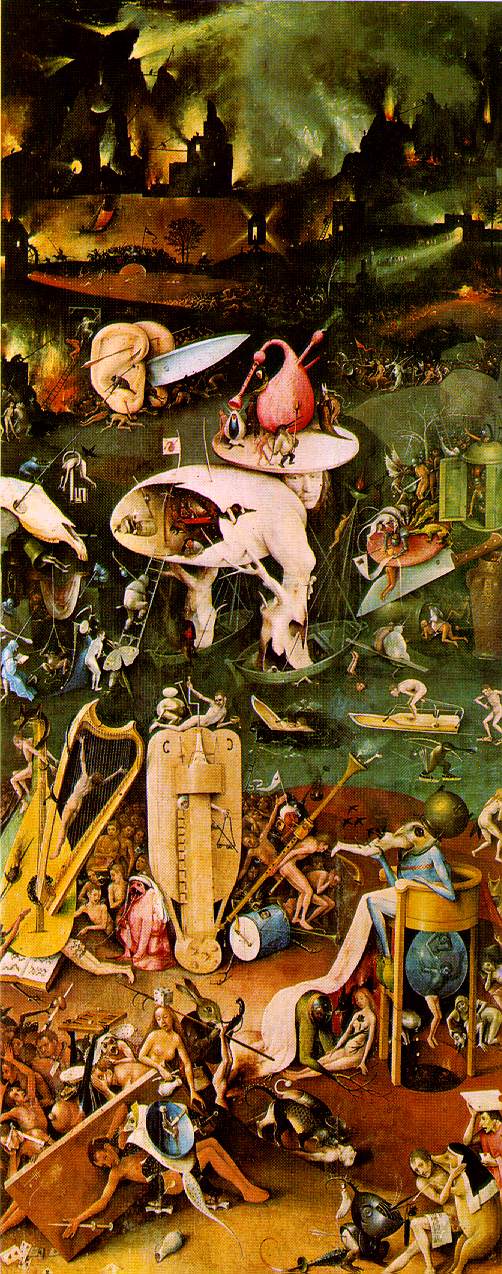
Half a century before Breughel, Hieronymus Bosch painted his Millennium Triptych. The left-hand panel shows Adam and Eve in Paradise, the large central panel describes the Garden of Earthly Delights, and the right-hand panel depicts hell. And this hell has become a strange prophecy of the mental climate imposed on the world, at the end of our century, by globalisation and the new economic order.

Let me try to explain how. It has little to do with the symbolism employed in the painting. Bosch's symbols probably came from the secret, proverbial, heretical language of certain 15th-century millennial sects, who believed that, if evil could be overcome, it was possible to build heaven on earth. Many essays have been written about the allegories to be found in his work. Yet if Bosch's vision of hell is prophetic, the prophecy is not so much in the details - haunting and grotesque as they are - as in the whole. Or, to put it another way, in what constitutes the space of hell.

There is no horizon there. There is no continuity between actions, there are no pauses, no paths, no pattern, no past and no future. There is only the clamour of the disparate, fragmentary present. Everywhere there are surprises and sensations, yet nowhere is there any outcome. Nothing flows through: everything interrupts. There is a kind of spatial delirium.

Compare this space to what one sees in the average publicity slot, or in a typical CNN news bulletin, or any mass-media commentary. There is a comparable incoherence, a comparable wilderness of separate excitements, a similar frenzy.

Bosch's prophecy was of the world-picture that is communicated to us today by the media under the impact of globalisation, with its delinquent need to sell incessantly. Both are like a puzzle whose wretched pieces do not fit together.

And this was precisely the phrase that the Zapatista leader Subcomandante Marcos used in an open letter about the new world order. He was writing from the Chiapas, southeast Mexico, where he leads insurgents fighting for liberation from the Mexican state. He sees the planet today as the battlefield of a fourth world war. (The third was the so-called cold war.) The aim of the belligerents is the conquest of the entire world through the market. The arsenals are financial; there are nevertheless millions of people being maimed or killed every moment.

The aim of those waging the war is to rule the world from new, abstract power centres - megapoles of the market, which will be subject to no control except that of the logic of investment. "Thanks to computers and the technological revolution," he writes, "the financial markets, operating from their offices and answerable to nobody but themselves, have been imposing their laws and world-view on the planet as whole. Globalisation is merely the totalitarian extension of the logic of the finance markets to all aspects of life." Meanwhile, nine-tenths of the women and men on the planet live with the jagged pieces which do not fit.

how the end begins: the road to nuclear ww-III

NYTimes | When Rosenbaum turns to the Middle East as a hot center of nuclear danger, however, he hits his stride. He’s already explored the question of the morality of deterrence, of threatening to kill millions of people in a retaliatory nuclear attack if the United States were struck with nuclear weapons. He’s noted that the World Court in 1996 adjudged “that the entire system of nuclear deterrence was a war crime.” That may be so, Rosenbaum acknowledges, but what is Israel, in particular, to do?

Surrounded by enemies who call for its destruction, Rosenbaum writes, Israel has assembled a substantial if unacknowledged nuclear arsenal. An attack by a ­nuclear-armed regional enemy — perhaps Iran at some future date when it has acquired nuclear weapons and the missiles with which to deliver them — could materialize without effective warning, and only a few nuclear weapons would be enough to destroy the country. Israel has therefore deployed nuclear cruise missiles on a small fleet of German-made submarines that reportedly patrol the Iranian coast. The submarines give Israel a secure second-strike capability, which deterrence theory predicts should be adequate to prevent a rational enemy from attacking. But what if deterrence fails?

The Jews would then be visited with a second Holocaust, Rosenbaum observes. He calls this possibility “Hitler’s chain reaction,” noting that the United States had raced to develop the atomic bomb in the first place because it feared that Nazi Germany was working on such a weapon. “The contemporary Middle East is a Hitler dream come true,” he writes sardonically. “The Jews have been compelled by the Holocaust and history to, in effect, round themselves up and may feel compelled by history to inflict an attack with genocidal consequences on others that could well precede a second one for them.” That is, either Israel would attack first with nuclear weapons, pre-emptively, and then be attacked in turn, or its submarines would retaliate after Israel was destroyed. Either way, a second Holocaust would result.

why no defence of saudi "right to protest"?

ActivistPost | Secretary of State Hillary Clinton had been exhaustively in front of cameras promoting the right for people to protest in Egypt, Bahrain, Iran, and Libya. She's been touting the freedom to use social networking sites as a way for Arab people to organize against their oppressive regimes. Now, the Administration is even considering arming the opposition in Libya.

Clinton's perpetual propaganda efforts exposed her blatant hypocrisy when a silent peaceful protester was violently removed from one of her recent speeches on the very subject. However, the hypocrisy now seems to go much deeper in her deafening silence over the prospect for protests in Saudi Arabia.

After Human Rights Watch revealed that a nationwide "Day of Rage" protest had been planned in Saudi Arabia for this week, March 11th, Bloomberg reported that the Saudi government claims that demonstrations and marches are "strictly" prohibited by law. A Saudi Interior Ministry official said protests "contradict Islamic values" and "They harm public interest, infringe on the rights of others, spread chaos and lead to bloodshed."

This prohibition of popular dissent proves beyond a shadow of doubt that Saudi Arabia is indeed the most tyrannical authoritarian regime in the Arab world. Yet, U.S. Administration officials have been strangely silent about supporting the people's uprising there.

Tuesday, March 08, 2011

The Story of Citizens United v. FEC (2011)


Video - The Story of Citizens United v. FEC (2011)

aljazeera has won the information war...,


AL-JAZEERA 1 OF 3
Uploaded by Top-Notch112. - News videos from around the world.

CounterPunch | None other than the US Secretary of State herself, Hillary Clinton, paid fulsome tribute to Al Jazeera last Wednesday, March 2. Appearing before a US Foreign Policy Priorities committee, she was asked by Senator Richard Lugar to impart her views on how well the US was promoting its message across the world.

Clinton promptly volunteered that America is in an "information war and we are losing the war," and furthermore, that "Al Jazeera is winning".

"Let’s talk straight realpolitik," Clinton went on. "We are in a huge competition" for global influence and global markets. China and Russia have started multi-language television networks, even as the US cuts back in this area. "We are paying a big price" for dismantling international communications networks after the end of the Cold War. "Our private media cannot fill that gap."

As noted here across the past couple of weeks, there’s been a flourishing little internet industry claiming that the overthrow of Mubarak came courtesy of US Twitter-Facebook Command. The New York Times runs numerous articles about the role of Twitter and Facebook while simultaneously ignoring or reviling Julian Assange and WikiLeaks.

Of course, in any discussion of the role of the internet in fuelling the upsurges across the Middle East, WikiLeaks should be given major credit. But WikiLeaks, along with Twitter and Facebook, all pale into insignificance next to the role of Al Jazeera,

Millions of Arabs can’t tweet. Facebook is unfamiliar to them. But most watch TV, which means they all watch Al Jazeera. And of course it was Al Jazeera which detonated the IED exploding under the Palestinian Authority, namely the cache of documents known as the Palestine Papers.

There were huge ironies in Clinton’s confession to Senator Lugar and his colleagues. In the late 1970s, radicals in the United Nations were eagerly promoting the need for a 'New World Information Order' (NWIO) to counter the lock on world communications and hence propaganda by the advanced industrial countries, preeminently the United States.

distorting the essence of the arab revolutions

Counterpunch | “Orientalism is fundamentally a political doctrine willed over the Orient because the Orient was weaker than the West. . . As a cultural apparatus Orientalism is all aggression.” ~ Edward Said

In his book “Manufacturing Consent,” Noam Chomsky discusses the role of the mainstream, corporate media in conditioning the public to conform to the views and policies of society’s powerful ruling elite.

Regarding these media outlets- as supposed to independent ones- he argues that “their role is quite different, it's diversion.” He describes those who distort facts to suit the interests of the powerful as living “in a world of comforting illusion.” They present a narrative that is more fiction than fact, one of fantasy rather than analysis. It’s actually “a form of propaganda, which is to a democracy what the bludgeon is to a totalitarian state,” Chomsky argues.

One such enabler is New York Times columnist Thomas Friedman. His frequently shallow and eccentric analysis of events in the Middle East has been noted for many years, whether it is his deliberate misrepresentation of the Camp David negotiations in July 2000, or his hyped columns regarding alleged – and as it turned out non-existent- weapons of mass destruction in Iraq on behalf of the Bush administration in the prelude to the 2003 war.

And now he’s at it again, with his incredible contention that the revolutions sweeping the Arab World, from Tunisia Egypt, and Libya, to Yemen, Bahrain, and beyond are due to external factors. In Friedman’s delusional world, the presence of decades-long repression, police state, corruption, poverty, economic strangulation, lack of infrastructure, or, in short, the collapse of the modern civil state in the Arab World for the benefit of thugs, thieves and Western underlings were not the real factors in the uprisings and revolutions of millions of Arabs from the Atlantic Ocean to the Persian Gulf.

In his column on March 2, 2011, Friedman gives five reasons for these great revolutions, none of which is true. He starts by ridiculously claiming that it was President Barack Obama who inspired the Youth in the streets of Tunisia, Egypt, and other countries because of his race, middle name, and his 2009 Cairo speech. Clearly such opinion is an ethnocentric and distorted view of the Arab Middle East. Obama may inspire minorities in the West, but why would his skin color or the religion of his forefathers inspire people in the Middle East?

Former Secretaries of State Colin Powell and Condoleezza Rice did not inspire the Arab masses although they were also African Americans occupying high positions in government. On the contrary these Secretaries attained the Arabs’ scorn because they represented a U.S. administration that invaded two Muslim countries, killing tens of thousands of Arabs and Muslims, with millions more suffering. Their administration used torture, carried out unjust prosecutions, and abused its power against Arabs and Muslims not only in Guantanamo Bay and other prisons around the world, but also inside the U.S. against many Muslim leaders and charitable organizations. Arabs are not so naïve as to be inspired by the symbolism of skin color or middle name. It is a government’s policies and principles that inspire the oppressed whether in the U.S. or the Arab World.

Undoubtedly people around the world had hoped that the election of Obama would bring a new dawn of American foreign policy that would not only reverse much of the previous administration’s atrocious policies with regard to the Muslim World, but also institute pro-people policies against their dictators.

But Obama has broken nearly every meaningful promise he made in his June 2009 Cairo speech (see my article Promises Made.. Promises Unkept). If anything, Obama is perceived as a big disappointment across the Arab World. He exhibits the image of a weak and ineffective leader, as in the case of closing Guantanamo, as well as an unprincipled and hypocritical politician with regard to the illegal Jewish settlements on occupied Palestinian lands.

How could Obama inspire a small child, much less revolutionaries, when he has just vetoed in the U.N. Security Council his own declared policy that the Israeli settlements are illegal and must stop? During the 28 and 18 revolutionary days of continuous demonstrations in Tunisia and Egypt respectively, not a single statement by any opposition figure had mentioned Obama in a positive light.

Monday, March 07, 2011

the high cost of oil..,


Video - Matt Damon "I no longer hope for audacity".

LATimes | The spread of popular revolt in the Middle East to Libya has exacerbated a spike in oil prices and gasoline costs at the pump. In turn, this has stimulated widespread complaints about the lack of a coherent U.S. foreign policy toward despots in the region. This is not the first time this has happened.

More than four decades ago, a military coup, led by a 27-year-old Moammar Kadafi, overthrew Libya's ineffectual King Idris and expelled all American and British troops from their large Libyan airbases. The new regime demanded a substantial increase in the price of Libyan oil — at a time when Libya supplied about 30% of Europe's oil.

Following Kadafi's lead, Abu Dhabi, Iran, Iraq, Kuwait, Qatar and Saudi Arabia soon sought higher prices for their oil. But the price increases didn't satisfy Kadafi or the Organization of the Petroleum Exporting Countries for long. The nations of OPEC demanded "equity participation" in the oil companies. This was a turning point as the oil-producing nations established control over the oil in their lands. The Arab embargo of October 1973 soon thereafter made it unmistakable that control over Middle East oil production had shifted from U.S. and European oil companies — which for decades had controlled both output and prices — to the nations in whose lands the oil was located.

President Nixon had a clear foreign policy response to this. The United States turned to our Cold War allies Saudi Arabia and Iran for support, in spite of their autocratic nature. Washington provided them with military aid and encouraged economic interdependence, hoping that in exchange the countries would serve as the Middle East's "two pillars" of anti-Soviet stability and free-flowing oil. Needless to say, that plan failed miserably.

The Iranian "pillar" collapsed a few years later in an anti-American Islamic revolution. And even though Saudi Arabia and the other Arab states of the Persian Gulf have nominally remained U.S. allies, they, not we, hold the key strings in the relationship. The United States continues to support and aid these regimes despite their authoritarianism. If the sheiks of the Persian Gulf decide to put down popular unrest with the same fervor Libya has, the hands of U.S. foreign policy almost certainly will be tied.

The problem, however, is not that the United States has had the wrong foreign policy. The problem lies in the failures of U.S. domestic policies. For 40 years, we have had no effective response to what eight presidents — from Nixon to Barack Obama — have called our addiction to oil. The fundamental problem, of course, is that notwithstanding all the laws Congress has enacted since the oil embargo of 1973, we have still not solved the nation's energy problems.

The fundamental difficulties that brought energy into the policy forefront then remain unabated. The United States has 4% of the world's population, but we consume 25% of the world's oil. Today, we import more than 50% of our oil, compared with 35% in 1973, the year the Arab oil embargo shocked consumers at the pump.

tap the strategic petroleum reserve? why?

CNN | This isn't like the last time the U.S. tapped the SPR back in 2005. That followed a huge surge in oil and gas prices in the wake of Hurricane Katrina, which did actually wreak havoc on production in the Gulf of Mexico.

Despite all the worries about supply disruption, the U.S. still is not facing any shortage. In fact, it's the exact opposite.

"If you really look at the inventories in the U.S., frankly we're oversupplied," said Blake Fernandez, an analyst who covers shares of integrated oil companies and independent refiners for energy research firm Howard Weil in New Orleans.

According to the most recent figures from the Department of Energy, the stockpile of oil is 1.4% above levels from last year. Fernandez added that according to his firm's estimates, inventories are 4% above their 5-year average.

Tapping the SPR is short-sighted, said David Pursell, managing director with Tudor, Pickering, Holt & Co., a Houston-based investment bank focusing on the energy industry.
CNN iReport: How much is gas where you live?

Pursell said he recognizes that lawmakers must be getting angry calls from anxious constituents about gas prices. But that's not an excuse to do something without fully thinking about the consequences

"Outside of Washington, this plan doesn't make sense," Pursell said. "But we don't have a shortage of crude, just a fear of a shortage. So where would you put the oil you release from the SPR?"

moore on monopoly's endgame...,


Video - Speech delivered at Wisconsin Capitol in Madison, March 5, 2011

HuffPo | America is not broke.

Contrary to what those in power would like you to believe so that you'll give up your pension, cut your wages, and settle for the life your great-grandparents had, America is not broke. Not by a long shot. The country is awash in wealth and cash. It's just that it's not in your hands. It has been transferred, in the greatest heist in history, from the workers and consumers to the banks and the portfolios of the uber-rich.

Today just 400 Americans have more wealth than half of all Americans combined.

Let me say that again. 400 obscenely rich people, most of whom benefited in some way from the multi-trillion dollar taxpayer "bailout" of 2008, now have more loot, stock and property than the assets of 155 million Americans combined. If you can't bring yourself to call that a financial coup d'état, then you are simply not being honest about what you know in your heart to be true.

And I can see why. For us to admit that we have let a small group of men abscond with and hoard the bulk of the wealth that runs our economy, would mean that we'd have to accept the humiliating acknowledgment that we have indeed surrendered our precious Democracy to the moneyed elite. Wall Street, the banks and the Fortune 500 now run this Republic -- and, until this past month, the rest of us have felt completely helpless, unable to find a way to do anything about it.

singin those $4.00/gallon blues already...,


Fox4News | AAA reports gas prices rose by four cents on Saturday night. The new national average is $3.47. People is Kansas City say they're feeling the pain at the pump as prices continue to soar.

FOX 4 visited Poco's Mexican Restaurant on Sunday morning. Customers say they eat there because the food's good and the prices are good too. Still, the owner admits sometimes people keep a watchful eye as the gas prices change across the street from the restaurant. Poco's also pays attention to the price of gas because delivery is a part of their business.

"It's really tough for us because we also do catering and we're always on the road," said Claudia Gutierrez with Poco's. "We had to up our prices a little bit and the customers aren't really happy about that."

Raymond and Gina Munoz say they take their kids to Poco's twice a month. On Sunday, their bill was about $50.

"That's a tank of gas for one of our vehicles," said customer Gina Munoz.

The Munoz family says they may have to cut back on eating out.

"You've gotta have gas to go places, so it's like, what do you do?" said Raymond Munoz. "You've got to find ways to compensate I guess."

The Munoz family say they may end up walking to the restaurant next time. Other customers say they'll keep a bright outlook even though it doesn't look so bright at the gas station across the street.

The owner of Poco's says they shop around for the best gas prices in both Kansas and Missouri before they head out on a food delivery.

Sunday, March 06, 2011

is you is or is you ain't fit'na tap?!?!?!

Reuters | White House Chief of Staff Bill Daley said on Sunday the Obama administration is considering tapping into the U.S. strategic oil reserve as one way to help ease soaring oil prices.

Speaking on NBC television's "Meet the Press," Daley said: "We are looking at the options. The issue of the reserves is one we are considering. ... All matters have to be on the table."

There has been support among Senate Democrats for tapping the reserves. Senator Jay Rockefeller on Thursday became the third Democrat to ask President Barack Obama to tap America's emergency oil supply to cool prices that have risen past $100 a barrel on the strife in Libya.

In a letter to Obama, Rockefeller said a "limited draw-down" from the nation's 727-million-barrel Strategic Petroleum Reserve "can protect our national security by preventing or reducing the adverse impact of an oil shortage."

On Wednesday, U.S. Energy Secretary Steven Chu ruled out releasing oil from the reserve, saying ramped up oil production in Saudi Arabia should lower the crude price.

"That's going to mitigate the price increase," he told reporters on Wednesday. "We're hoping market forces will take care of this."

Treasury Secretary Timothy Geithner said on Thursday the United States and other major economies could tap strategic reserves to keep oil prices from derailing a global recovery.

Geithner said high food and oil prices were causing hardships in many parts of the world. But he said Americans were feeling less impact.

the top vs the food-powered make-work multitude

The L-Curve | The red line represents a graph of family income across the population. The height of the curve at any point is the height of a stack of $100 bills equalling that income. Unless you have a very old browser you will be able to zoom. Be sure to zoom both in and out.

The US population is represented along the length of the football field, arranged in order of income.

Median US family income (the family at the 50 yard line) is ~$40,000 (a stack of $100 bills 1.6 inches high.)

--The family on the 95 yard line earns about $100,000 per year, a stack of $100 bills about 4 inches high.

--At the 99 yard line the income is about $300,000, a stack of $100 bills about a foot high.

--The curve reaches $1 million (a 40 inch high stack of $100 bills) one foot from the goal line.

--From there it keeps going up...it goes up 50 km (~30 miles) on this scale!

What are the implications of this picture?

I am not an economist, but then again, most likely you aren't either. On the other hand, the economy affects you and me, so we need to come to grips with these issues to participate intelligently in the political process. There needs to be a genuine national dialog on these issues at all levels. The L-Curve graph represents income, not wealth. The distribution of wealth is even more skewed.

how will america handle the fall of its middle-east empire?

Telegraph | Empires can collapse in the course of a generation. At the end of the 16th century, the Spanish looked dominant. Twenty-five years later, they were on their knees, over-extended, bankrupt, and incapable of coping with the emergent maritime powers of Britain and Holland. The British empire reached its fullest extent in 1930. Twenty years later, it was all over.

Today, it is reasonable to ask whether the United States, seemingly invincible a decade ago, will follow the same trajectory. America has suffered two convulsive blows in the last three years. The first was the financial crisis of 2008, whose consequences are yet to be properly felt. Although the immediate cause was the debacle in the mortgage market, the underlying problem was chronic imbalance in the economy.

For a number of years, America has been incapable of funding its domestic programmes and overseas commitments without resorting to massive help from China, its global rival. China has a pressing motive to assist: it needs to sustain US demand in order to provide a market for its exports and thus avert an economic crisis of its own. This situation is the contemporary equivalent of Mutually Assured Destruction (MAD), the doctrine which prevented nuclear war breaking out between America and Russia.

Unlike MAD, this pact is unsustainable. But Barack Obama has not sought to address the problem. Instead, he responded to the crisis with the same failed policies that caused the trouble in the first place: easy credit and yet more debt. It is certain that America will, in due course, be forced into a massive adjustment both to its living standards at home and its commitments abroad.

This matters because, following the second convulsive blow, America’s global interests are under threat on a scale never before seen. Since 1956, when Secretary of State John Foster Dulles pulled the plug on Britain and France over Suez, the Arab world has been a US domain. At first, there were promises that it would tolerate independence and self-determination. But this did not last long; America chose to govern through brutal and corrupt dictators, supplied with arms, military training and advice from Washington.

The momentous importance of the last few weeks is that this profitable, though morally bankrupt, arrangement appears to be coming to an end. One of the choicest ironies of the bloody and macabre death throes of the regime in Libya is that Colonel Gaddafi would have been wiser to have stayed out of the US sphere of influence. When he joined forces with George Bush and Tony Blair five years ago, the ageing dictator was leaping on to a bandwagon that was about to grind to a halt.

In Washington, President Obama has not been stressing this aspect of affairs. Instead, after hesitation, he has presented the recent uprisings as democratic and even pro-American, indeed a triumph for the latest methods of Western communication such as Twitter and Facebook. Many sympathetic commentators have therefore claimed that the Arab revolutions bear comparison with the 1989 uprising of the peoples of Eastern Europe against Soviet tyranny.

I would guess that the analogy is apt. Just as 1989 saw the collapse of the Russian empire in Eastern Europe, so it now looks as if 2011 will mark the removal of many of America’s client regimes in the Arab world. It is highly unlikely, however, that events will thereafter take the tidy path the White House would prefer. Far from being inspired by Twitter, a great many of Arab people who have driven the sensational events of recent weeks are illiterate. They have been impelled into action by mass poverty and unemployment, allied to a sense of disgust at vast divergences of wealth and grotesque corruption. It is too early to chart the future course of events with confidence, but it seems unlikely that these liberated peoples will look to Washington and New York as their political or economic model.

Saturday, March 05, 2011

the collapse of the old oil order: how the petroleum age will end

TomDispatch | Whatever the outcome of the protests, uprisings, and rebellions now sweeping the Middle East, one thing is guaranteed: the world of oil will be permanently transformed. Consider everything that’s now happening as just the first tremor of an oilquake that will shake our world to its core.

For a century stretching back to the discovery of oil in southwestern Persia before World War I, Western powers have repeatedly intervened in the Middle East to ensure the survival of authoritarian governments devoted to producing petroleum. Without such interventions, the expansion of Western economies after World War II and the current affluence of industrialized societies would be inconceivable.

Here, however, is the news that should be on the front pages of newspapers everywhere: That old oil order is dying, and with its demise we will see the end of cheap and readily accessible petroleum -- forever.

Ending the Petroleum Age
Let’s try to take the measure of what exactly is at risk in the current tumult. As a start, there is almost no way to give full justice to the critical role played by Middle Eastern oil in the world’s energy equation. Although cheap coal fueled the original Industrial Revolution, powering railroads, steamships, and factories, cheap oil has made possible the automobile, the aviation industry, suburbia, mechanized agriculture, and an explosion of economic globalization. And while a handful of major oil-producing areas launched the Petroleum Age -- the United States, Mexico, Venezuela, Romania, the area around Baku (in what was then the Czarist Russian empire), and the Dutch East Indies -- it’s been the Middle East that has quenched the world’s thirst for oil since World War II.

In 2009, the most recent year for which such data is available, BP reported that suppliers in the Middle East and North Africa jointly produced 29 million barrels per day, or 36% of the world’s total oil supply -- and even this doesn’t begin to suggest the region’s importance to the petroleum economy. More than any other area, the Middle East has funneled its production into export markets to satisfy the energy cravings of oil-importing powers like the United States, China, Japan, and the European Union (EU). We’re talking 20 million barrels funneled into export markets every day. Compare that to Russia, the world’s top individual producer, at seven million barrels in exportable oil, the continent of Africa at six million, and South America at a mere one million.

As it happens, Middle Eastern producers will be even more important in the years to come because they possess an estimated two-thirds of remaining untapped petroleum reserves. According to recent projections by the U.S. Department of Energy, the Middle East and North Africa will jointly provide approximately 43% of the world’s crude petroleum supply by 2035 (up from 37% in 2007), and will produce an even greater share of the world’s exportable oil.

To put the matter baldly: The world economy requires an increasing supply of affordable petroleum. The Middle East alone can provide that supply. That’s why Western governments have long supported “stable” authoritarian regimes throughout the region, regularly supplying and training their security forces. Now, this stultifying, petrified order, whose greatest success was producing oil for the world economy, is disintegrating. Don’t count on any new order (or disorder) to deliver enough cheap oil to preserve the Petroleum Age.

To appreciate why this will be so, a little history lesson is in order.

Chipocalypse Now - I Love The Smell Of Deportations In The Morning

sky |   Donald Trump has signalled his intention to send troops to Chicago to ramp up the deportation of illegal immigrants - by posting a...