Monday, February 28, 2011

how IS the dopamine hegemony at gunpoint project going?

antiwar | Remember those heady days of the neocons’ triumphalism, when Glenn Reynolds and his fellow laptop bombardiers were proclaiming the victory of "Democracy, whiskey, sexy" in Iraq? Today the society that is emerging from the bloodstained rubble of Iraq’s cities is far from democratic, in the liberal sense, and as for whiskey and "sexy" – well, you can just forget it.

Neither democracy, nor a culture that respects human rights, can be exported at gunpoint: that is one of the lessons of the Iraq war. The neoconservative ideologues who told us otherwise weren’t just wrong: they were lying, as usual.

Their goal wasn’t democracy, or anything remotely resembling it: their strategy was simply to smash up the existing Iraqi state, and atomize the region into small, squabbling splinter-states, all the better to dominate them and make the world safe for Israel. Now that their job is done in Iraq, they’re moving on to the next victims: Iran, Syria, and on into Central Asia. Or so they think.

The great Arab Awakening, however, may very well short-circuit their plans: if and when this powerful populist movement takes down the Iranian mullahs and the Ba’athist gerontocracy in Damascus, Washington may find it harder to pursue its Israel-centric policy with impunity.

Sunday, February 27, 2011

hon.bro.preznit declared a national state of emergency on friday...,


Video - nolinknews recap of the President's quiet declaration of a national state of emergency.

LATimes | The Libyan government’s continued violation of human rights, brutalization of its people, and outrageous threats have rightly drawn the strong and broad condemnation of the international community.

By any measure, Muammar el-Qaddafi’s government has violated international norms and common decency and must be held accountable. These sanctions therefore target the Qaddafi government, while protecting the assets that belong to the people of Libya.

Going forward, the United States will continue to closely coordinate our actions with the international community, including our friends and allies, and the United Nations.

We will stand steadfastly with the Libyan people in their demand for universal rights, and a government that is responsive to their aspirations. Their human dignity cannot be denied. ####

EXECUTIVE ORDER BLOCKING PROPERTY AND PROHIBITING CERTAIN TRANSACTIONS RELATED TO LIBYA

By the authority vested in me as President by the Constitution and the laws of the

...United States of America, including the International Emergency Economic Powers Act (50 U.S.C. 1701 et seq.) (IEEPA), the National Emergencies Act (50 U.S.C. 1601 et seq.) (NEA), and section 301 of title 3, United States Code,

I, BARACK OBAMA, President of the United States of America, find that Colonel Muammar Qadhafi, his government, and close associates have taken extreme measures against the people of Libya, including by using weapons of war, mercenaries, and wanton violence against unarmed civilians.

I further find that there is a serious risk that Libyan state assets will be misappropriated by Qadhafi, members of his government, members of his family, or his close associates if those assets are not protected.

The foregoing circumstances, the prolonged attacks, and the increased numbers of Libyans seeking refuge in other countries from the attacks, have caused a deterioration in the security of Libya and pose a serious risk to its stability, thereby constituting an unusual and extraordinary threat to the national security and foreign policy of the United States, and I hereby declare a national emergency to deal with that threat.

economic theory for scientists and engineers

jayhanson | POLITICS:
n 1: social relations involving authority or powerThe members of the American economics profession, as Arnold contended, performed a vital practical role in maintaining this unique system of corporate socialism American style. It was their role to prevent the American public from achieving a correct understanding of the actual workings of the American economic system. Economists instead were assigned the task to dispense priestly blessings that would allow business to operate independent of damaging political manipulation. They accomplished this task by means of their message of “laissez faire religion, based on a conception of a society composed of competing individuals.” However false as a description of the actual U.S. economy, this vision in the mind of the American public was in practice “transferred automatically to industrial organizations with nation-wide power and dictatorial forms of government.” Even though the arguments of economists were misleading and largely fictional, the practical — and beneficial — result of their deception was to throw a “mantle of protection ... over corporate government” from various forms of outside interference. Admittedly, as the economic “symbolism got farther and farther from reality, it required more and more ceremony to keep it up.” But as long as this arrangement worked and there could be maintained “the little pictures in the back of the head of the ordinary man,” the effect was salutary — “the great [corporate] organization was secure in its freedom and independence.” It was this very freedom and independence of business professionals to pursue the correct scientific answer — the efficient answer — on which the economic progress of the United States depended. — Robert H. Nelson, REACHING FOR HEAVEN ON EARTH
The problem is, of course, that not only is economics bankrupt but it has always been nothing more than politics in disguise ... economics is a form of brain damage. Hazel Henderson

Henderson is certainly correct; universities teach politics in disguise. I can cut through the jargon, math, and explain economics in just one sentence: economics is the publishing of political propaganda with agendas hidden in assumptions.

I attribute the absolutely brilliant tactic of using assumptions to further political agendas to one man: Milton Friedman. Friedman lied on the Allais paradox in 1952 and then told his students to lie as he did:
“To be important, therefore, a hypothesis must be descriptively false in its assumptions... ” Milton Friedman, 1953
Friedman is correct: economic propaganda must lie to be effective. Friedman’s efforts hid the true nature of economics from the public for 50 years! Four important aspects of economics prevent it from becoming a true science:

Aspect #1. Economists select known-to-be-wrong-hypothetical assumptions so they can mislead the public into supporting their political agendas (e.g., Homo economicus, advertising, money). You may call it what you wish. I call it “lying.”

Aspect #2. The economic method is “correlation” (this happened before that happened, and thus, must have caused it). Correlation is also called “magical thinking” for the obvious reasons.

Aspect #3. The economic unit of measure is “price” — which is a “transitory effect” — not a “cause.” For example, a dollar’s worth of oil today will not be a dollar’s worth of oil tomorrow. Thus, today’s economic Nobel-Prize-winning discovery (correlation) may be worthless tomorrow.

Aspect #4. Economic articles and texts are always “political” (they always imply how we should behave). Every economic theory claims to know what is best for us. Economists always publish to support specific political agendas.

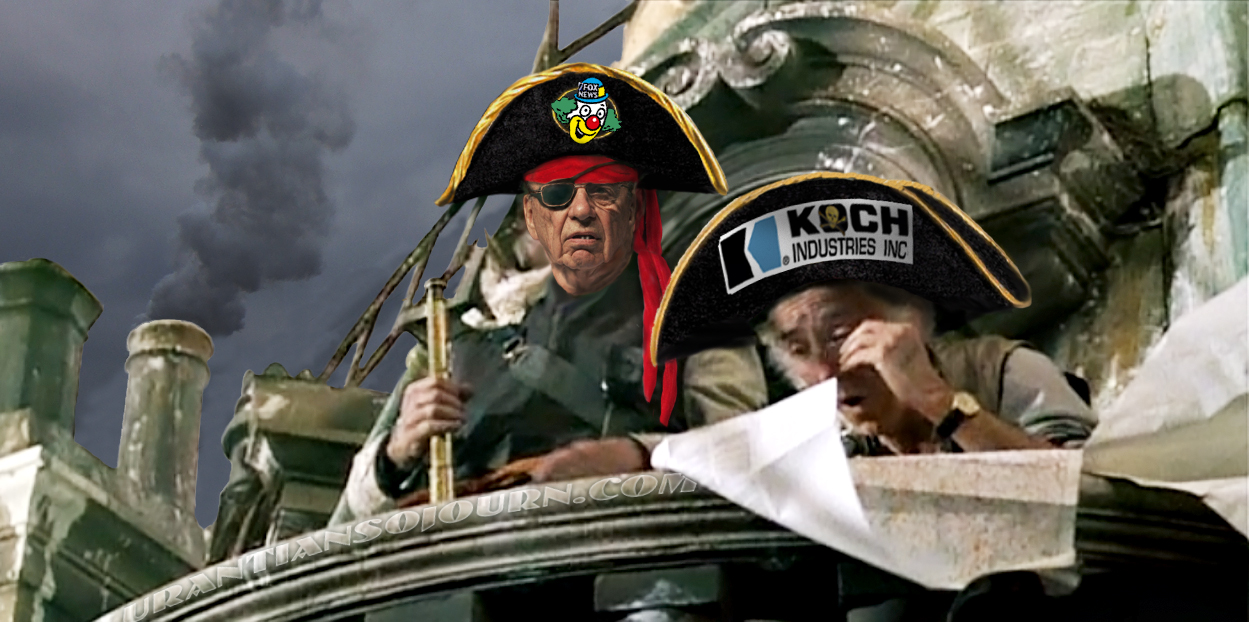
koch and murdoch's wisconsin collusion

Alternet | In the week-long battle taking place in Wisconsin over Gov. Scott Walker's attempt to strip state workers of their collective bargaining rights, you'd expect Fox News to be doing what it's done: misreporting the story, mistakenly characterizing a poll supporting public workers to mean its opposite, featuring Glenn Beck painting the protests of union workers as something cooked up by Stalinists. And you might be tempted to think, well, that's just Fox playing to its base of frightened Tea Partiers who prefer a fact-free zone to the more challenging territory of actual news, where the answers are never pat, and the world is a bit more complicated than it seems in the realm of Fox Nation.

You might think it's all about what brings in the advertising dollars for Rupert Murdoch, CEO of Fox's parent company, News Corporation. But it runs much deeper than that, involving key players at the Wall Street Journal, News Corp.'s crown jewel. The informal partnership between billionaire David Koch, whose campaign dollars and astroturf group, Americans for Prosperity, have fomented the Wisconsin crisis, and billionaire Rupert Murdoch, is profoundly ideological -- the ideology being the exponential enrichment of the two men's heirs, all dressed up in the language of libertarianism and free enterprise. Together with his brother, Charles -- also a big donor to right-wing causes --David Koch runs Koch Industries, the conglomerate that sprang from the oil and gas company founded by his father.

King of the World and Lord of His Majesty's Media

Ginning up the right-wing rabble is a Fox News specialty. Glenn Beck is more than a talk-show host; he's Rupert Murdoch's community organizer. Like Koch, Murdoch embraces a completely deregulatory agenda: one that would leave giant corporations such as News Corp., the second largest entertainment company in the world, according to Fortune magazine, with nary a single regulation to stand in the way of profit-taking. Like Koch, Murdoch has no use for unions, having famously broken the unions of the newspapers he runs in the U.K. Like Koch, Murdoch gave $1 million to the Republican Governors Association least year, the only difference being that Koch wrote a personal check for his contribution, while Murdoch's check was written on a News Corp. account.

In AlterNet's coverage of the Kochs and Murdoch over the last two years, we reported how Koch's Americans for Prosperity Foundation synced an annual conference with Glenn Beck's rally last summer at the Lincoln Memorial, offering discounted hotel rooms and bus travel to attendees, as well as day-long shuttle service between the conference hotel and the rally. Perhaps you remember the collusion we reported between Americans for Prosperity and Fox News in creating the furor that pushed Van Jones from the White House. You may recall our report on a 2009 Americans for Prosperity Foundation conference at which one-third of the speakers on a 15-speaker plenary agenda were on the payroll of a Murdoch entity. Two of those speakers, John Fund and Stephen Moore, hail from the Wall Street Journal; Moore sits on the newspaper's editorial board. So it should come as no surprise to find both Fund and Moore carrying Koch's water in this fight.

Together, Fund and Moore play a very particular role in the war to make David Koch king of the world, and Rupert Murdoch his favorite lord. (Murdoch is the lesser of the two billionaires, worth a mere $6 or $7 billion, to Koch's $20-plus billion.) While Fund and Moore talk to those regular folks who find their thrills watching Fox News, they also speak to the elite readers of WSJ, the investors to whom the two sell the notion that what's good for David Koch is good for everybody's bottom line.

water project shortfall leaves towns high and dry

USAToday | When President Barack Obama's budget came out earlier this month, one thing was clear to Madison Mayor Gene Hexom: His town's wait for high-quality water probably will grow a lot longer.

The president's fiscal 2012 budget included just $493,000 for the Lewis & Clark Regional Water System, a paltry sum that officials say casts serious doubt on the timeframe for completing the project.

Considering the earmark moratorium that prevents Congress from steering more money toward the project — and the fact that all future construction costs are the responsibility of the federal government — it's a bitter development for officials in towns such as Madison that are scheduled to hook into the pipeline last.

"We realize that we're on the end of the line and it's going to take a few years," Hexom said. "But at this level of funding I'm very pessimistic."

Lewis & Clark will tap wells in the Missouri-Elk Point aquifer, process the water at a plant near Vermillion and pump it through 377 miles of pipe to wholesale customers in South Dakota, Iowa and Minnesota.

Of the 20 communities that are part of the project, nine will still be waiting when the treatment plant begins pumping water next summer — a scenario that assumes the project's backers can surmount a $6 million shortfall in this year's budget.

Madison would be the only South Dakota subscriber left out. The others are Sheldon, Sioux Center, Sibley and Hull in Iowa; and Worthington, Luverne, Lincoln-Pipestone Rural Water System and Rock County Rural Water in Minnesota.

These towns already have paid their share of the project's cost, but when they'll get a taste of the water is anybody's guess.

Troy Larson, the executive director of the Lewis & Clark project, said that even for a project as routinely underfunded as Lewis & Clark has been, the 2012 budget figure is absurdly low. If it stands, it would represent less than half of the organization's administrative budget — to say nothing about construction — and will mean further delays on a half-finished project that already is four years behind schedule.

"It's extremely frustrating for all the members, but particularly those in the outlying areas," Larson said.

"Once we have haves and have-nots, the have-nots are going to want their water as quickly as possible."

Madison will be the second-to-last town to hook into the system. And though Hexom said the town's water needs are basically flat, the city has been cautious with water use, for instance imposing year-round watering restrictions. At current rates of use, the city is in good shape, city engineer Chad Comes said. Still, the lack of additional capacity is keeping industry away.

"Can we take on economic development contracts that need lots of water?" Hexom said. "Probably not."

Another reason Madison chose to tap into the Lewis & Clark pipeline is the city's water quality issues. Madison has hard water, and treatment plant forewoman Connie Silva said she has been looking forward to getting Lewis & Clark water. Not that the city's water is necessarily bad, she said, "but as an operator you always want to do better."

Scott Wynja, the city manager in Sheldon, Iowa, said the shallow aquifer wells from which his town draws its water aren't adequate for a customer base that's growing 1% to 2% annually.

"We're quite concerned," he said. "I don't think people realize what a precious commodity water is."

Saturday, February 26, 2011

federal employees don't have collective bargaining rights...,


Video - Barack Obama in Spartanburg, SC. Nov. 3rd, 2007.

"And understand this: If American workers are being denied their right to organize and collectively bargain when I'm in the White House, I'll put on a comfortable pair of shoes myself, I'll will walk on that picket line with you as President of the United States of America. Because workers deserve to know that somebody is standing in their corner."

what wisconsin is really about

MotherJones | IN 2008, A LIBERAL Democrat was elected president. Landslide votes gave Democrats huge congressional majorities. Eight years of war and scandal and George W. Bush had stigmatized the Republican Party almost beyond redemption. A global financial crisis had discredited the disciples of free-market fundamentalism, and Americans were ready for serious change.

Or so it seemed. But two years later, Wall Street is back to earning record profits, and conservatives are triumphant. To understand why this happened, it's not enough to examine polls and tea parties and the makeup of Barack Obama's economic team. You have to understand how we fell so short, and what we rightfully should have expected from Obama's election. And you have to understand two crucial things about American politics.

The first is this: Income inequality has grown dramatically since the mid-'70s—far more in the US than in most advanced countries—and the gap is only partly related to college grads outperforming high-school grads. Rather, the bulk of our growing inequality has been a product of skyrocketing incomes among the richest 1 percent and—even more dramatically—among the top 0.1 percent. It has, in other words, been CEOs and Wall Street traders at the very tippy-top who are hoovering up vast sums of money from everyone, even those who by ordinary standards are pretty well off.

Second, American politicians don't care much about voters with moderate incomes. Princeton political scientist Larry Bartels studied the voting behavior of US senators in the early '90s and discovered that they respond far more to the desires of high-income groups than to anyone else. By itself, that's not a surprise. He also found that Republicans don't respond at all to the desires of voters with modest incomes. Maybe that's not a surprise, either. But this should be: Bartels found that Democratic senators don't respond to the desires of these voters, either. At all.

Unions, for better or worse, are history. Even union leaders don't believe they'll ever regain the power of their glory days. If private-sector union density increased from 7 percent to 10 percent, that would be considered a huge victory. But it wouldn't be anywhere near enough to restore the power of the working and middle classes.

And yet: The heart and soul of liberalism is economic egalitarianism. Without it, Wall Street will continue to extract ever vaster sums from the American economy, the middle class will continue to stagnate, and the left will continue to lack the powerful political and cultural energy necessary for a sustained period of liberal reform. For this to change, America needs a countervailing power as big, crude, and uncompromising as organized labor used to be.

But what?

Over the past 40 years, the American left has built an enormous institutional infrastructure dedicated to mobilizing money, votes, and public opinion on social issues, and this has paid off with huge strides in civil rights, feminism, gay rights, environmental policy, and more. But the past two years have demonstrated that that isn't enough. If the left ever wants to regain the vigor that powered earlier eras of liberal reform, it needs to rebuild the infrastructure of economic populism that we've ignored for too long. Figuring out how to do that is the central task of the new decade.

wisconsin lie exposed: taxpayers don't directly fund public employee pensions

Forbes | Pulitzer Prize winning tax reporter, David Cay Johnston, has written a brilliant piece for tax.com exposing the truth about who really pays for the pension and benefits for public employees in Wisconsin.
Gov. Scott Walker says he wants state workers covered by collective bargaining agreements to “contribute more” to their pension and health insurance plans. Accepting Gov. Walker’ s assertions as fact, and failing to check, creates the impression that somehow the workers are getting something extra, a gift from taxpayers. They are not. Out of every dollar that funds Wisconsin’ s pension and health insurance plans for state workers, 100 cents comes from the state workers.
Via tax.com

How can this be possible?

Simple. The pension plan is the direct result of deferred compensation- money that employees would have been paid as cash salary but choose, instead, to have placed in the state operated pension fund where the money can be professionally invested (at a lower cost of management) for the future.

Many of us are familiar with the concept of deferred compensation from reading about the latest multi-million dollar deal with some professional athlete. As a means of allowing their ball club to have enough money to operate, lowering their own tax obligations and for other benefits, ball players often defer payment of money they are to be paid to a later date. In the meantime, that money is invested for the ball player’s benefit and then paid over at the time and in the manner agreed to in the contract between the parties.

Does anyone believe that, in the case of the ball player, the deferred money belongs to the club owner rather than the ball player? Is the owner simply providing this money to the athlete as some sort of gift? Of course not. The money is salary to be paid to the ball player, deferred for receipt at a later date.

A review of the state’s collective bargaining agreements – many of which are available for review at the Wisconsin Office of State Employees web site - bears out that it is no different for state employees. The numbers are just lower.

public sector unions: some real welfare queens?

NYTimes | Like a stand-up comedian working out-of-the-way clubs, Chris Christie travels the townships and boroughs of New Jersey­, places like Hackettstown and Raritan and Scotch Plains, sharpening his riffs about the state’s public employees, whom he largely blames for plunging New Jersey into a fiscal death spiral. In one well-worn routine, for instance, the governor reminds his audiences that, until he passed a recent law that changed the system, most teachers in the state didn’t pay a dime for their health care coverage, the cost of which was borne by taxpayers.

And so, Christie goes on, forced to cut more than $1 billion in local aid in order to balance the budget, he asked the teachers not only to accept a pay freeze for a year but also to begin contributing 1.5 percent of their salaries toward health care. The dominant teachers’ union in the state responded by spending millions of dollars in television and radio ads to attack him.

“The argument you heard most vociferously from the teachers’ union,” Christie says, “was that this was the greatest assault on public education in the history of New Jersey.” Here the fleshy governor lumbers a few steps toward the audience and lowers his voice for effect. “Now, do you really think that your child is now stressed out and unable to learn because they know that their poor teacher has to pay 1½ percent of their salary for their health care benefits? Have any of your children come home — any of them — and said, ‘Mom.’ ” Pause. “ ‘Dad.’ ” Another pause. “ ‘Please. Stop the madness.’ ”

By this point the audience is starting to titter, but Christie remains steadfastly somber in his role as the beseeching student. “ ‘Just pay for my teacher’s health benefits,’ ” he pleads, “ ‘and I’ll get A’s, I swear. But I just cannot take the stress that’s being presented by a 1½ percent contribution to health benefits.’ ” As the crowd breaks into appreciative guffaws, Christie waits a theatrical moment, then slams his point home. “Now, you’re all laughing, right?” he says. “But this is the crap I have to hear.”

Friday, February 25, 2011

cereal revolutions

DailyReckoning | That will bring to three the number of regime changes in the last few weeks. Which leads us to ask: what’s up?

The answer comes from our old friend, Jim Davidson. He pins the revolutions on Ben Bernanke. Behind the popular discontent is neither the desire for liberty nor the appeal of elections. It’s food. And behind soaring food prices is Ben Bernanke.

The Arab world is a model Malthusian disaster, says Davidson. Populations have ballooned. Food production has not. Which makes Arab countries the biggest importers of cereals in the world. And when the price of food goes up, the masses rise up too.

From Jim’s latest newsletter, Strategic Investment:

Food prices hit an all-time high in January. According to the UN’s Food and Agricultural Organization (FAO) “the FAO Food Price Index (FFPI) rose for the seventh consecutive month, averaging 231 points in January 2011, up 3.4 percent from December 2010 and the highest in both real and nominal terms” since records began. Note that prices have now exceeded the previously record levels of 2008 that sparked food riots in more than 30 countries. “Famine-style” prices for food and energy that prevailed early in 2008 may also have helped precipitate the credit crisis that Federal Reserve Chairman Ben Bernanke described in closed-door testimony “as the worst in financial history, even exceeding the Great Depression.”

This time around, the turmoil surrounding commodity inflation has taken center stage with more serious riots and even revolutions across the globe. Popular discontent is not just confined to “basket case” countries like Haiti and Bangladesh as in 2008. High food prices have roiled Arab kleptocracies with young populations and US backed dictators such as Tunisia, Egypt, Bahrain and Yemen. Even dynamic economies have been affected. Indeed, all of the BRIC countries, except Brazil, have witnessed food rioting.

Well, how do you like that, Dear Reader? All those billions of dollars spent propping up dictators – $70 billion was the cost of supporting Hosni Mubarak in Egypt alone – and then the Fed comes along and knocks them down.

The Fed lowers the cost of money so speculators can borrow below the rate of inflation. And then it prints up trillions more – just to top up the worlds’ money supply.

Is it any wonder food prices rise? Imagine you’re a farmer…or a speculator. You can sell food. Or you can hold it in storage. You know the food is valuable. You know the world has more and more mouths to feed everyday. You know food production is limited. And you know Ben Bernanke can print up an unlimited number of dollars. What do you do?

Do you sell immediately? Or drag your feet…holding onto your valuable grain as the price hits new highs?

is the fed a causal actor in MENA destabilization?


50 million 'environmental refugees' by 2020?

Physorg | Fifty million "environmental refugees" will flood into the global north by 2020, fleeing food shortages sparked by climate change, experts warned at a major science conference that ended here Monday.

"In 2020, the UN has projected that we will have 50 million environmental refugees," University of California, Los Angeles professor Cristina Tirado said at the annual meeting of the American Association for the Advancement of Science (AAAS).

"When people are not living in sustainable conditions, they migrate," she continued, outlining with the other speakers how climate change is impacting both food security and food safety, or the amount of food available and the healthfulness of that food.

Southern Europe is already seeing a sharp increase in what has long been a slow but steady flow of migrants from Africa, many of whom risk their lives to cross the Strait of Gibraltar into Spain from Morocco or sail in makeshift vessels to Italy from Libya and Tunisia.

The flow recently grew to a flood after a month of protests in Tunisia, set off by food shortages and widespread unemployment and poverty, brought down the government of longtime ruler Zine El Abidine Ben Ali, said Michigan State University professor Ewen Todd, who predicted there will be more of the same.

"What we saw in Tunisia -- a change in government and suddenly there are a whole lot of people going to Italy -- this is going to be the pattern," Todd told AFP.

"Already, Africans are going in small droves up to Spain, Germany and wherever from different countries in the Mediterranean region, but we're going to see many, many more trying to go north when food stress comes in. And it was food shortages that put the people of Tunisia and Egypt over the top.

"In many Middle Eastern and North African countries," he continued, "you have a cocktail of politics, religion and other things, but often it's just poor people saying 'I've got to survive, I've got to eat, I've got to feed my family' that ignites things."

iran is the big winner here?


Video - Duke Ellington Isfahan

NYTimes | The popular revolts shaking the Arab world have begun to shift the balance of power in the region, bolstering Iran’s position while weakening and unnerving its rival, Saudi Arabia, regional experts said.

While it is far too soon to write the final chapter on the uprisings’ impact, Iran has already benefited from the ouster or undermining of Arab leaders who were its strong adversaries and has begun to project its growing influence, the analysts said. This week Iran sent two warships through the Suez Canal for the first time since its revolution in 1979, and Egypt’s new military leaders allowed them to pass.

Saudi Arabia, an American ally and a Sunni nation that jousts with Shiite Iran for regional influence, has been shaken. King Abdullah on Wednesday signaled his concern by announcing a $10 billion increase in welfare spending to help young people marry, buy homes and open businesses, a gesture seen as trying to head off the kind of unrest that fueled protests around the region.

King Abdullah then met with the king of Bahrain, Hamad bin Isa al-Khalifa, to discuss ways to contain the political uprising by the Shiite majority there. The Sunni leaders in Saudi Arabia and Bahrain accuse their Shiite populations of loyalty to Iran, a charge rejected by Shiites who say it is intended to stoke sectarian tensions and justify opposition to democracy.

The uprisings are driven by domestic concerns. But they have already shredded a regional paradigm in which a trio of states aligned with the West supported engaging Israel and containing Israel’s enemies, including Hamas and Hezbollah, experts said. The pro-engagement camp of Egypt, Jordan and Saudi Arabia is now in tatters. Hosni Mubarak of Egypt has been forced to resign, King Abdullah of Jordan is struggling to control discontent in his kingdom and Saudi Arabia has been left alone to face a rising challenge to its regional role.

“I think the Saudis are worried that they’re encircled — Iraq, Syria, Lebanon; Yemen is unstable; Bahrain is very uncertain,” said Alireza Nader, an expert in international affairs with the RAND Corporation. “They worry that the region is ripe for Iranian exploitation. Iran has shown that it is very capable of taking advantage of regional instability.”

“Iran is the big winner here,” said a regional adviser to the United States government who spoke on the condition of anonymity because he was not authorized to speak to reporters.

saudi probably wont fall, but if it does?!?!?


Video - Oil emperor of Dune.

The Independent | Unlike the striking poverty in Tunisia, Egypt and other places, Saudis are relatively well off. Although there is poverty in Saudi Arabia, the government has invested billions of dollars in welfare.

It is no surprise that King Abdullah's return to the Kingdom on Wednesday coincided with the announcement that the government is set to inject an additional $36bn into public spending projects – it is the result of nervousness for sure, but it is also a tried and tested method of keeping dissent at bay.

The structure of society in the Kingdom also makes it less vulnerable. The state's main organs, the government and the ultra-conservative Sunni religious leaders, are largely at one. A social contract between these two competing powers exists to the benefit of both.

The elites in each camp have enforced this social contract at times of instability, with King Abdullah – who is a viewed as a reformer – winning the trust of the conservatives by refusing to make radical changes to Saudi society in return for the religious leadership eschewing the extremists of the al-Qa'ida type. That does not mean there are no risks for the establishment. The Arab uprising has largely been made possible by the "Al Jazeera effect", with ordinary people becoming aware of corruption and injustice in their own societies through new media outlets, and the Kingdom is not immune.

The rest of the world should be taking a careful look at the situation. If Saudi Arabia were to fall, an unlikely scenario, there would be an earthquake across the world economy. The two major spikes in Western inflation in recent memory were caused by Opec limiting supply in 1973 in protest at the US arming Israel, and later by the revolution in Iran. Saudi Arabia is a huge economy that oils the wheels of the rest of the world. Most of us believe Saudi is too big to fall. If we are wrong, the effect on the world will be devastating.

NOW we see the folly of our faustian bargain on oil...,


Video - Corny movieline Dune trailer.

The Independent | Commodities markets are telling our leaders something they should have grasped long ago. The price of oil is surging. At one point yesterday, the price of a barrel of crude touched $120 – its highest level since 2008. The commodities trading markets are telling the world something it should have grasped long ago: that the global economy is disastrously over-reliant on energy from the most unstable of regions.

The violent chaos in Libya is the proximate cause of the market jitters. The revolutions in Tunisia and Egypt did not alarm oil traders, but Libya is a significant oil exporter. As Colonel Muammar Gaddafi's regime has imploded, the pumps have stopped. Output has fallen by three-quarters. And when the supply of any commodity suddenly falls, its price generally rises.

The markets are also casting wary eyes in the direction of Saudi Arabia, the world's biggest oil exporter. This week, King Abdullah promised a £22bn financial relief package for his subjects. This is plainly an attempt to pre-empt the outbreak of popular protests occurring in his country of the sort that have been witnessed across the region. The Saudi Arabian oil minister is also suggesting that his country could increase production to make up for the shortfall from Libya.

But the situation is not under the Saudi regime's control. A month ago, Hosni Mubarak in Egypt and Muammar Gaddafi in Libya looked entirely secure. Now the first has been forced to resign and the sun has almost set on the regime of the second (although there is no telling how much damage Gaddafi could do on the way out). Anyone who asserts that the same could not happen in Saudi Arabia has few grounds for their confidence. King Abdullah certainly has more resources with which to buy off discontent, but it is impossible to say how effective this will be. When people have the scent of freedom in their nostrils, they can be impossible to deter. The markets certainly understand this.

The knock-on effects of a spike in oil prices threaten to be painful. The sudden jump in energy costs could derail the recovery from the economic crash of three years ago. Britain's inflation is already double the Bank of England's 2 per cent target. If the oil price remains at these levels, it will feed through to prices and the Bank will feel no alternative but to raise interest rates, pushing up the cost of borrowing and undermining consumer confidence. But other countries would be just as badly damaged by an oil price shock. Even the likes of China and India would struggle.

The world is reaping the consequences of bad geopolitical decisions going back decades. After the Second World War, the West entered into a Faustian bargain with autocratic Middle Eastern regimes. We would buy their oil exports and turn a blind eye to the repression of their populations. In return, they would buy Western-manufactured weapons and luxury goods. China has made a similar bargain with repressive regimes more recently. But the Arab revolutions are upsetting those deals.

Thursday, February 24, 2011

shell future energy scenarios: "zone of uncertainty" ahead


Video - Shell examines how the global financial crisis has affected energy outlooks

Shell | 1. We believe that the world is entering an era of volatile transitions and intensified economic cycles. The recession interrupted the oil and commodity price boom but it may return. Emerging nations like China and India are going through materially intensive development and a tighter market will continue to put pressure on prices and generate volatility. Improvements in policy-making and strong gains in productivity have helped economies to grow without inflation in the last two decades. We do not believe the moderating effect of this combination of good policies, good practices, and good luck will continue into the future..

2. We are seeing a step change in energy use. Developing nations, including population giants China and India, are entering their most energy-intensive phase of economic growth as they industrialise, urbanise, build infrastructure, and increase their use of transportation. Demand pressures will stimulate alternative supply and more efficiency in energy use — but these alone may not be enough to offset growing demand tensions completely. Underlying global demand for energy by 2050 could triple from its 2000 level if emerging economies follow historical patterns of development.

3. In broad-brush terms, natural innovation and competition could spur improvements in energy efficiency to moderate underlying demand by about 20% over this time. Ordinary rates of supply growth – taking into account technological, geological, competitive, financial and political realities – could naturally boost energy production by about 50%. But this still leaves a gap between business-as-usual supply and business-as-usual demand of around 400 EJ/a – the size of the whole industry in 2000. This gap – this zone of uncertainty – will have to be bridged by some combination of extraordinary demand moderation and extraordinary production acceleration.

4. Supply will struggle to keep pace with demand. By the end of the coming decade, growth in the production of easily accessible oil and gas will not match the projected rate of demand growth. While abundant coal exists in many parts of the world, transportation difficulties and environmental degradation ultimately pose limits to its growth. Meanwhile, alternative energy sources such as biofuels may become a much more significant part of the energy mix — but there is no “silver bullet” that will completely resolve supply-demand tensions.

5. Smart urban development, sustained policy encouragement and commercial and technological innovation can all result in some demand moderation. But so can price-shocks, knee-jerk policies and frustrated aspirations. Timescales are a key factor. Buildings, infrastructure and power stations last several decades. The stock of vehicles can last 20 years. New energy technologies must be demonstrated at commercial scale and require 30 years of sustained double-digit growth to build industrial capacity and grow sufficiently to feature at even 1–2% of the energy system. The policies in place in the next five years shape investment for the next 10 years, which largely shape the global energy picture out to 2050.

6. The global economic crisis has coincided with a shift in geopolitical and economic power from west to east. This decisive shift is transforming the global economic and political system. The change is gradual, but its potential consequences are profound. The economic crisis in the west may accelerate this trend. Future generations may see 2008 as the turning point. The world faces a period of uncertain global politics. Strategic fault lines are emerging. Rising powers are increasingly and confidently asserting what they see as their national interests. This is undermining global mechanisms for ensuring collective security.

7. Environmental stresses are increasing. Even if it were possible for fossil fuels to maintain their current share of the energy mix and respond to increased demand, CO2 emissions would then be on a pathway that could severely threaten human well-being. Even with the moderation of fossil fuel use and effective CO2 management, the path forward is still highly challenging. Remaining within desirable levels of CO2 concentration in the atmosphere will become increasingly difficult.

sale of the century

Newsweek | In my favorite spaghetti Western, The Good, the Bad and the Ugly, there is a memorable scene that sums up the world economy today. Blondie (Clint Eastwood) and Tuco (Eli Wallach) have finally found the cemetery where they know the gold is buried. Trouble is, they’re in a vast Civil War graveyard, and they don’t know where to find the loot. Eastwood looks at his gun, looks at Wallach, and utters the immortal line: “In this world, there are two kinds of people, my friend. Those with loaded guns … and those who dig.”

In the post-crisis economic order, there are likewise two kinds of economies. Those with vast accumulations of assets, including sovereign wealth funds (currently in excess of $4 trillion) and hard-currency reserves ($5.5 trillion for emerging markets alone), are the ones with loaded guns. The economies with huge public debts, by contrast, are the ones that have to dig. The question is, just how will they dig their way out?

The conventional wisdom holds that, aside from resorting to inflation or default, debts can be reduced only through belt-tightening austerity measures—some mixture of higher taxes and spending cuts. And yet politicians are notoriously leery of proposing hikes or cuts big enough to make a real dent in the debt. President Obama’s latest budget proposal includes a five-year freeze on nondefense discretionary spending and tax increases on higher earners. But even if all goes according to plan, the gross debt will still rise above 105 percent of gross domestic product—and stay there.

The root of the problem is, of course, a lack of political will, extending down from the president himself to the lowliest Tea Party activist living on Social Security and Medicare. But a convenient excuse for ongoing borrowing is also provided by Keynesian economic theory, which states that a fiscal squeeze will tend to reduce economic growth, thereby widening the gap between revenues and expenditures. Fiscal hawks respond that a bond-market panic induced by excessive borrowing could be even nastier.

Yet there is another fiscal option that neither party seems to be considering. The U.S. needs to do exactly what it would if it were a severely indebted company: sell off assets to balance its books.

why america's teachers are enraged


Video - Rachel Maddow explains what's going on in Madison Wisconsin.

CNN | Thousands of teachers, nurses, firefighters and other public sector workers have camped out at the Wisconsin Capitol, protesting Republican Gov. Scott Walker's efforts to reduce their take-home pay -- by increasing their contribution to their pension plans and health care benefits -- and restrict their collective bargaining rights.

Republicans control the state Legislature, and initially it seemed certain that Walker's proposal would pass easily. But then the Democrats in the Legislature went into hiding, leaving that body one vote shy of a quorum. As of this writing, the Legislature was at a standstill as state police searched high and low for the missing lawmakers.
Advertisement

Like other conservative Republican governors, including Chris Christie of New Jersey, John Kasich of Ohio, Mitch Daniels of Indiana and Rick Scott of Florida, the Wisconsin governor wants to sap the power of public employee unions, especially the teachers' union, since public education is the single biggest expenditure for every state.

Public schools in Madison and a dozen other districts in Wisconsin closed as teachers joined the protest. Although Walker claims he was forced to impose cutbacks because the state is broke, teachers noticed that he offered generous tax breaks to businesses that were equivalent to the value of their givebacks.

The uprising in Madison is symptomatic of a simmering rage among the nation's teachers. They have grown angry and demoralized over the past two years as attacks on their profession escalated.

The much-publicized film "Waiting for Superman" made the specious claim that "bad teachers" caused low student test scores. A Newsweek cover last year proposed that the key to saving American education was firing bad teachers.

Teachers across the nation reacted with alarm when the leaders of the Central Falls district in Rhode Island threatened to fire the entire staff of the small town's only high school. What got their attention was that Secretary of Education Arne Duncan and President Obama thought this was a fine idea, even though no one at the high school had been evaluated.

The Obama administration's Race to the Top program intensified the demonizing of teachers, because it encouraged states to evaluate teachers in relation to student scores. There are many reasons why students do well or poorly on tests, and teachers felt they were being unfairly blamed when students got low scores, while the crucial role of families and the students themselves was overlooked.

census: near record level of U.S. counties dying..,

AP | In America's once-thriving coal country, 87-year-old Ed Shepard laments a prosperous era gone by, when shoppers lined the streets and government lent a helping hand. Now, here as in one-fourth of all U.S. counties, West Virginia's graying residents are slowly dying off.

Hit by an aging population and a poor economy, a near-record number of U.S. counties are experiencing more deaths than births in their communities, a phenomenon demographers call "natural decrease."

Years in the making, the problem is spreading amid a prolonged job slump and a push by Republicans in Congress to downsize government and federal spending.

"You're the anchors of our Main Streets," President Barack Obama told small business leaders in Cleveland on Tuesday. "We want your stories — your successes, your failures, what barriers you're seeing out there to expand. .How can America help you succeed so that you can help America succeed?"

Local businesses in Welch began to shutter after U.S. Steel departed McDowell County, which sits near Interstate 77, once referred to as the "Hillbilly Highway" because it promised a way to jobs in the South. Young adults who manage to attend college — the high-school dropout rate is 28 percent, compared with about 8 percent nationwide — can't wait to leave. For some reason, the fish in nearby Elkhorn Creek left too.

"There's no reason for you to come to Welch," says Shepard, wearing a Union 76 cap at a makeshift auto shop he still runs after six decades. "This is nothing but a damn ghost town in a welfare county." Fist tap Nana.

mentally ill increasing strain on US prison system

BBCNews | Treating mental illness is always a challenge, but in the US, after decades of declining funding for mental health care, the burden is increasingly falling on the prison system. The BBC was granted access to a local jail in the state of Virginia to see first-hand how staff and inmates are coping.

In Virginia Beach, a city on America's east coast, 260 of the roughly 1,400 inmates in the county jail are being treated for mental illnesses.

The local sheriff, Ken Stolle, told the BBC that most weeks, he has more inmates in his jail suffering from mental illnesses than the state's system has beds.

That leaves Mr Stolle feeling as though he's in charge of the default mental institution for the area.

"Most sheriffs that I know feel like this is a problem that needs to be addressed by the state and that we shouldn't be the provider of last resort. That's what we feel like we are right now, " he says.

"If the system fails to catch these people in a safety net, they end up in the jails."

The jail has its fair share of rowdy, unruly criminals. But it's the mentally ill inmates who Mr Stolle loses sleep over.

"Ninety percent of my assaults on deputies last year were committed by mentally ill inmates," Mr Stolle told the BBC.

"I've got a problem there in the security and the safety for my deputies."

Some inmates have thrown excrement and urine at staff, others rush the doors when they are opened, injuring staff in the process.

But Mr Stolle also worries about the harm these inmates do to themselves. The jail's small medical centre sees a shocking array of conditions. Fist tap Nana.

Chipocalypse Now - I Love The Smell Of Deportations In The Morning

sky |   Donald Trump has signalled his intention to send troops to Chicago to ramp up the deportation of illegal immigrants - by posting a...