Thursday, February 17, 2011

world bank warns of soaring food prices

Guardian | The World Bank has given a stark warning of the impact of the rising cost of food, saying an estimated 44 million people had been pushed into poverty since last summer by soaring commodity prices.

Robert Zoellick, the Bank's president, said food prices had risen by almost 30% in the past year and were within striking distance of the record levels reached during 2008.

"Global food prices are rising to dangerous levels and threaten tens of millions of poor people around the world," Zoellick said. "The price hike is already pushing millions of people into poverty, and putting stress on the most vulnerable, who spend more than half of their income on food."

According to the latest edition of Food Price Watch, the World Bank's food price index was up by 15% between October 2010 and January 2011, is 29% above its level a year earlier, and only 3% below its 2008 peak.

Wheat prices have seen the most pronounced increases, doubling between June last year and January 2011, while maize prices were up 73%.

The bank said that fewer people had fallen into poverty than in 2008 because of two factors – good harvests in many African countries had kept prices stable, and the increases in rice prices – a key part of the diet for many of the world's poor – had been moderate.

Wednesday, February 16, 2011

freedom to interdict your freedom to connect


Video - Anonymous response to Twitter subpoena.

Guardian | The US secretary of state, Hillary Clinton, praised the role of social networks such as Twitter in promoting freedom – at the same time as the US government was in court seeking to invade the privacy of Twitter users.

Lawyers for civil rights organisations appeared before a judge in Alexandria, Virginia, battling against a US government order to disclose the details of private Twitter accounts in the WikiLeaks row, including that of the Icelandic MP Birgitta Jonsdottir, below.

The move against Twitter has turned into a constitutional clash over the protection of individual rights to privacy in the digital age.

Clinton, in a speech in Washington, cited the positive role that Twitter, Facebook and other social networks played in uprisings in Tunisia and Egypt. In a stirring defence of the internet, she spoke of the "freedom to connect".

The irony of the Clinton speech coming on the day of the court case was not lost on the constitutional lawyers battling against the government in Alexandria. The lawyers also cited the Tunisian and Egyptian examples. Aden Fine, who represents the American Civil Liberties Union, one of the leading civil rights groups in the country, said: "It is very alarming that the government is trying to get this information about individuals' communications. But, also, above all, they should not be able to do this in secret."

still m.s.m.


Video - Still D.R.E.

HuffPo | It's not necessarily those who tweet the most, or have the most followers that help determine Twitter's trending topics, but the mainstream media, says new research from HP.

"You might expect the most prolific tweeters or those with most followers would be most responsible for creating such trends," said Bernardo Huberman, HP Senior Fellow and director of HP Labs' Social Computing Research Group, in a statement. "We found that mainstream media play a role in most trending topics and actually act as feeders of these trends. Twitter users then seem to be acting more as filter and amplifier of traditional media in most cases."

The subject of the tweet is the major determinant of whether the tweet's topic trends--largely as a result of retweeting. Thirty-one percent of trending topics are retweets, according to the HP research. Using data from Twitter's search function over 40 days, the researchers used 16.32 million tweets to identify the top 22 users that were generating the most retweets for trending topics. "Of those 22, 72% were Twitter streams run by mainstream media outfits such as CNN, the New York Times, El Pais and the BBC," HP wrote. "Although popular, most of these sites have millions of followers fewer than highly-followed tweeters such as Ashton Kutcher, Barack Obama or Lady Gaga."

While they also found that most trending topics don't survive beyond 40 minutes or so, the most dominant, longer-lasting trends were those that took hold over diverse audience members.

The researchers hinted that it remains to be seen whether social media can alter the public agenda.

how we use social media in an emergency

Mashable | The use of social media during national and international crises, both natural and political, is something that Mashable has followed with great interest over the past few years.

As a culture, we started becoming more aware of the power of social media during times of crisis, like when the Iran election in 2009 caused a furor, both on the ground and on Twitter. More recently, the Internet and social media played an important role in spreading news about the earthquake in Haiti and political revolution in Egypt.

But what about other kinds of natural disasters or crime? Can social media be used to good effect then?

In 2009, two girls trapped in a storm water drain used Facebook to ask for help rather than calling emergency services from their mobile phones. At the time, authorities were concerned about the girls’ seemingly counterintuitive action.

However, according to new research from the American Red Cross, the Congressional Management Foundation and other organizations, social media could stand to play a larger and more formal role in emergency response. In fact, almost half the respondents in a recent survey said they would use social media in the event of a disaster to let relatives and friends know they were safe.

future soldier - world-wide mind

NYTimes | Imagine, Michael Chorost proposes, that four police officers on a drug raid are connected mentally in a way that allows them to sense what their colleagues are seeing and feeling. Tony Vittorio, the captain, is in the center room of the three-room drug den.

He can sense that his partner Wilson, in the room on his left, is not feeling danger or arousal and thus has encountered no one. But suddenly Vittorio feels a distant thump on his chest. Sarsen, in the room on the right, has been hit with something, possibly a bullet fired from a gun with a silencer.

Vittorio glimpses a flickering image of a metallic barrel pointed at Sarsen, who is projecting overwhelming shock and alarm. By deducing how far Sarsen might have gone into the room and where the gunman is likely to be standing, Vittorio fires shots into the wall that will, at the very least, distract the gunman and allow Sarsen to shoot back. Sarsen is saved; the gunman is dead.

That scene, from his new book, “World Wide Mind,” is an example of what Mr. Chorost sees as “the coming integration of humanity, machines, and the Internet.” The prediction is conceptually feasible, he tells us, something that technology does not yet permit but that breaks no known physical laws.

Mr. Chorost also wrote “Rebuilt,” about his experience with deafness and his decision to get a cochlear implant in 2001. In that eloquent and thoughtful book, he refers to himself as a cyborg: He has a computer in his skull, which, along with a second implant three years ago, artificially restores his hearing. In “World Wide Mind,” he writes, “My two implants make me irreversibly computational, a living example of the integration of humans and computers.”

He takes off from his own implanted computer to imagine a world where people are connected by them. The implanted computer would work something like his BlackBerry, he explains, in that it would let people “be effortlessly aware of what their friends and colleagues are doing.” It would let each person know what the others “are seeing and feeling, thus enabling much richer forms of communication.”

Cool. Maybe. But beginning with privacy issues, the hazards are almost countless.

In discussing one of them, he cites the work of Dr. John Ratey, a professor of psychiatry at Harvard who believes people can be physically addicted to e-mail. “Each e-mail you open gives you a little hit of dopamine,” Mr. Chorost writes, “which you associate with satiety. But it’s just a little hit. The effect wears off quickly, leaving you wanting another hit.” Fist tap Nana.

Tuesday, February 15, 2011

the man who knew too little...,

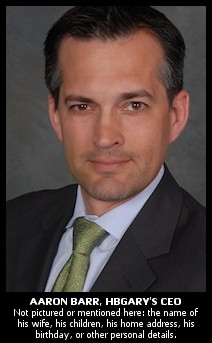
Wired | How did Barr, a man with long experience in security and intelligence, come to spend his days as a CEO e-stalking clients and their wives on Facebook? Why did he start performing “reconnaissance” on the largest nuclear power company in the United States? Why did he suggest pressuring corporate critics to shut up, even as he privately insisted that corporations “suck the lifeblood out of humanity”? And why did he launch his ill-fated investigation into Anonymous, one which may well have destroyed his company and damaged his career?

Thanks to his leaked e-mails, the downward spiral is easy enough to retrace. Barr was under tremendous pressure to bring in cash, pressure which began on Nov. 23, 2009.

“A” players attract “A” players
That’s when Barr started the CEO job at HBGary Federal. Its parent company, the security firm HBGary, wanted a separate firm to handle government work and the clearances that went with it, and Barr was brought in from Northrup Grumman to launch the operation.

In an e-mail announcing Barr’s move, HBGary CEO Greg Hoglund told his company that “these two are A+ players in the DoD contracting space and are able to ‘walk the halls’ in customer spaces. Some very big players made offers to Ted and Aaron last week, and instead they chose HBGary. This reflects extremely well on our company. ‘A’ players attract ‘A’ players.”

Barr at first loved the job. In December, he sent an e-mail at 1:30am; it was the “3rd night in a row I have woken up in the middle of the night and can’t sleep because my mind is racing. It’s nice to be excited about work, but I need some sleep.”Barr had a huge list of contacts, but turning those contacts into contracts for government work with a fledgling company proved challenging. Less than a year into the job, HBGary Federal looked like it might go bust.

On Oct. 3, 2010, HBGary CEO Greg Hoglund told Aaron that “we should have a pow-wow about the future of HBGary Federal. [HBGary President] Penny and I both agree that it hasn’t really been a success… You guys are basically out of money and none of the work you had planned has come in.”

Aaron agreed. “This has not worked out as any of us have planned to date and we are nearly out of money,” he said.While he worked on government contracts, Barr drummed up a little business doing social media training for corporations using, in one of his slides, a bit of research into one Steven Paul Jobs.

what a tangled web they weave...,

Independent | The computer hackers' collective Anonymous has uncovered a proposal by a consortium of private contractors to attack and discredit WikiLeaks.

Last week Anonymous volunteers broke into the servers of HB Gary Federal, a security company that sells investigative services to companies, and posted thousands of the firm's emails on to the internet.

The attack was in revenge for claims by the company's chief executive Aaron Barr that he had successfully infiltrated the shadowy cyber protest network and discovered details of its leadership and structure.

Hacktivists, journalists and bloggers have since pored over the emails and discovered what appears to be a proposal that was intended to be pitched to the Bank of America to sabotage WikiLeaks and discredit journalists who are sympathetic to the whistle-blowing website.

The PowerPoint presentation claims that a trio of internet security companies – HB Gary Federal, Palantir Technologies and Berico Technologies – are already prepared to attack WikiLeaks which is rumoured to be getting ready to release a cache of potentially embarrassing information on the Bank of America.

The presentation, which has been seen by The Independent, recommends a multi-pronged assault on WikiLeaks including deliberately submitting false documents to the website to undermine its credibility, pioneering cyber attacks to expose who the leakers to WikiLeaks are and going after sympathetic journalists.

One of those mentioned is Glenn Greenwald, a pro-WikiLeaks reporter in the US. Writing on Salon.com Greenwald stated that his initial reaction to was "to scoff at its absurdity".

"But after learning a lot more over the last couple of days," he added, "I now take this more seriously – not in terms of my involvement but the broader implications this story highlights. For one thing, it turns out that the firms involved are large, legitimate and serious, and do substantial amounts of work for both the US government and the nation's largest private corporations."

A separate email written by Mr Barr to a Palantir employee suggests that security companies should track and intimidate people who donate to WikiLeaks. Security firms, Mr Barr wrote, "need to get people to understand that if they support the organisation we will come after them. Transaction records are easily identifiable."

The Bank of America does not seem to have directly solicited the services of HB Gary Federal. Instead it pitched the idea to Hunton and Williams, a law firm that represents the bank.

A Bank of America spokesman denied any knowledge of the proposals: "We've never seen the presentation, never evaluated it, and have no interest in it." A spokesman for Hunton and Williams declined to comment. HB Gary Federal has acknowledged in a statement that it was hit by a cyber attack but has suggested the documents online could be falsified.

However, the two other security firms named on the presentation have not denied the authenticity of the documents. Instead, both Berico and Palantir issued angry statements distancing themselves from HB Gary Federal and severing ties with the firm.

But a statement from Anonymous claimed the presentation showed how sections of corporate America were "entangled in highly dubious and most likely illegal activities, including a smear campaign against WikiLeaks, its supportive journalists, and adversaries of the US Chamber of Commerce and Bank of America".

tool-user

WaPo | A feud between a security contracting firm and a group of guerrilla computer hackers has spilled over onto K Street, as stolen e-mails reveal plans for a dirty-tricks-style campaign against critics of the U.S. Chamber of Commerce.

The tale began this month when a global hackers collective known as Anonymous broke into the computers of HBGary Federal, a California security firm, and dumped tens of thousands of internal company e-mails onto the Internet.

The move was in retaliation for assertions by HBGary Federal chief executive Aaron Barr that he had identified leaders of the hackers' group, which has actively supported the efforts of anti-secrecy Web site WikiLeaks to obtain and disclose classified documents.

The e-mails revealed, among other things, a series of often-dubious counterintelligence proposals aimed at enemies of Bank of America and the chamber. The proposals included distributing fake documents and launching cyber-attacks.

The chamber has adamantly denied any knowledge of the "abhorrent" proposals, including some contained in a sample blueprint outlined for Hunton & Williams, a law and lobbying firm that works for the chamber. The business group said in a statement Monday that the proposal "was not requested by the Chamber, it was not delivered to the Chamber and it was never discussed with anyone at the Chamber."

Two other security firms named in the e-mails, Berico Technologies and Palantir Technologies, also have issued statements distancing themselves from the plans. HBGary Federal and Hunton & Williams declined to comment.

The hacked e-mails suggest that the three security firms worked with Hunton & Williams in hopes of landing a $2 million contract to assist the chamber. Some of the e-mails, which were highlighted by the liberal Web site ThinkProgress on Monday, seem to suggest that the chamber had been apprised of the efforts. The chamber denied any such knowledge.

On Nov. 16, for example, Barr suggests in an e-mail to Berico that his company had spoken "directly" to the chamber despite the lack of a signed contract.

Other e-mails describe Hunton & Williams lawyer Bob Quackenboss as the "key client contact operationally" with the chamber and make references to a demonstration session that had "sold the Chamber in the first place."

On Dec. 1, a Palantir engineer summarized a meeting with Hunton & Williams, saying the law firm "was looking forward to briefing the results to the Chamber to get them to pony up the cash for Phase II." The proposed meeting was set to take place this past Monday, according to the e-mail.

"While many questions remain in the unfolding ChamberLeaks controversy, what's clear is that this multitude of emails clearly contradicts the Chamber's claim that they were 'not aware of these proposals until HBGary's e-mails leaked,' " ThinkProgress reporter Scott Keyes wrote in a blog post.

One Nov. 29 e-mail contains presentations and memos outlining how a potential counterintelligence program against chamber critics might work. The documents are written under the logo of Team Themis, which was the joint project name adopted by the three technology firms.

tool...,

Switched | Based on e-mails he sent before beginning his mission, it's clear that Barr's motives, from the very beginning, were profit-driven. A social media fanatic, Barr firmly believed that he could use data from sites like Facebook and LinkedIn to identify any hacker in the world, including members of Anonymous. "Hackers may not list the data, but hackers are people too so they associate with friends and family," Barr wrote in an e-mail to a colleague at HBGary Federal. "Those friends and family can provide key indicators on the hacker without them releasing it...." He even wanted to give a talk at this year's Bside security conference, titled "Who Needs NSA when we have Social Media?" But, long-term security implications aside, Barr knew exactly what he would do once he obtained data on Anonymous' members. "I will sell it," he wrote.

Using several aliases, Barr began regularly dropping in on Anonymous' instant relay chat (IRC) forums, and, after setting up fake Facebook and Twitter accounts, attempted to unearth the members' true identities via social media. Putting real names to screennames, however, wasn't easy. Barr's techniques included matching timecodes; when someone shared something in the Anonymous IRC, he would check a suspected Twitter handle for any follow-up activity in the next few seconds. More matches lessened the likelihood of coincidence. By the time he concluded his research, he believed he had successfully identified 80 to 90-percent of Anonymous' leaders -- all thanks to information that was publicly available.

Some of his colleagues at HBGary, however, soon became uneasy with the direction that Barr was taking his investigation. In exchanges with his coder, he insisted that he was not aiming to get anyone arrested, but simply wanted to prove the efficacy of his statistical analysis. In an e-mail to another colleague, though, the coder complained that Barr made many of his claims based not on statistics, but on his "best gut feeling." Others, meanwhile, feared retribution from Anonymous, and with good reason.

Though Barr insisted that he wouldn't reveal the names of Anonymous' leaders at a meeting with the FBI, the group didn't take any chances, and launched a devastating counter-offensive against both Barr and his company. Barr's e-mails were leaked, his Twitter account hijacked, and his iPad, apparently, wiped clean. HBGary, meanwhile, suffered a DDoS attack that crippled its site.

The attack on the company was so bad that at one point, HBGary President Penny Leavy dove into Anonymous' IRC, in an attempt to reason with them. The members asked her why Barr was meeting with the FBI. She insisted he just wanted their business, and had no interest in toppling Anonymous. She, in turn, asked what they demanded. "Simple: fire Aaron, have him admit defeat in a public statement," a member responded. "We won't bother you further after this, but what we've done can't be taken back. Realize that, and for the company's sake, dispose of Aaron." The group later hacked an e-mail account belonging to Leavy's husband, and is threatening to post it online.

Anderson concludes his piece by examining what the saga says about Anonymous, whose members he describes as "young, technically sophisticated, brash, and crassly juvenile." After what happened to HBGary and Barr, he writes, it's become difficult to write off Anonymous' attacks "as the harmless result of a few mask-wearing buffoons."

But perhaps the most intriguing character in this drama is Barr, himself. His e-mails shed some light on the inner workings of a company man who seems philosophically divided. Like Anonymous, he once supported WikiLeaks, until the organization began leaking diplomatic cables, last fall. The document dump led Barr to conclude that "they [WikiLeaks] are a menace," and fueled his antipathy toward Anonymous, which he saw as a group driven not by principle, but by power.

In another message, he declared that corporations "suck the lifeblood out of humanity," but acknowledged that they serve a purpose, and affirmed his belief that some secrets are better left unexposed. "Its [sic] all about power," Barr wrote. "The Wikileaks and Anonymous guys think they are doing the people justice by without much investigation or education exposing information or targeting organizations? BS. Its about trying to take power from others and give it to themeselves [sic]. I follow one law. Mine."

Monday, February 14, 2011

why do we sleep?


Video - Jay Electronica Dimethyltryptamine

Physorg | While we can more or less abstain from some basic biological urges—for food, drink, and sex—we can’t do the same for sleep. At some point, no matter how much espresso we drink, we just crash. And every animal that’s been studied, from the fruit fly to the frog, also exhibits some sort of sleep-like behavior. (Paul Sternberg, Morgan Professor of Biology, was one of the first to show that even a millimeter-long worm called a nematode falls into some sort of somnolent state.) But why do we—and the rest of the animal kingdom—sleep in the first place?

“We spend so much of our time sleeping that it must be doing something important,” says David Prober, assistant professor of biology and an expert on how genes and neurons regulate sleep. Yes, we snooze in order to rest and recuperate, but what that means at the molecular, genetic, or even cellular level remains a mystery. “Saying that we sleep because we’re tired is like saying we eat because we’re hungry,” Prober says. “That doesn’t explain why it’s better to eat some foods rather than others and what those different kinds of foods do for us.”

No one knows exactly why we slumber, Prober says, but there are four main hypotheses. The first is that sleeping allows the body to repair cells damaged by metabolic byproducts called free radicals. The production of these highly reactive substances increases during the day, when metabolism is faster. Indeed, scientists have found that the expression of genes involved in fixing cells gets kicked up a notch during sleep. This hypothesis is consistent with the fact that smaller animals, which tend to have higher metabolic rates (and therefore produce more free radicals), tend to sleep more. For example, some mice sleep for 20 hours a day, while giraffes and elephants only need two- to three-hour power naps.

Another idea is that sleep helps replenish fuel, which is burned while awake. One possible fuel is ATP, the all-purpose energy-carrying molecule, which creates an end product called adenosine when burned. So when ATP is low, adenosine is high, which tells the body that it’s time to sleep. While a postdoc at Harvard, Prober helped lead some experiments in which zebrafish were given drugs that prevented adenosine from latching onto receptor molecules, causing the fish to sleep less. But when given drugs with the opposite effect, they slept more. He has since expanded on these studies at Caltech.

Sleep might also be a time for your brain to do a little housekeeping. As you learn and absorb information throughout the day, you’re constantly generating new synapses, the junctions between neurons through which brain signals travel. But your skull has limited space, so bedtime might be when superfluous synapses are cleaned out.

And finally, during your daily slumber, your brain might be replaying the events of the day, reinforcing memory and learning. Thanos Siapas, associate professor of computation and neural systems, is one of several scientists who have done experiments that suggest this explanation for sleep. He and his colleagues looked at the brain activity of rats while the rodents ran through a maze and then again while they slept. The patterns were similar, suggesting the rats were reliving their day while asleep.

what is reality?


Video - BBC Horizon Documentary What is Reality?

There is a strange and mysterious world that surrounds us, a world largely hidden from our senses. The quest to explain the true nature of reality is one of the great scientific detective stories.

It starts with Jacobo Konisberg talking about the discovery of the Top quark at Fermilab. Frank Wilceck then featured to explain some particle physics theory at his country shack using bits of fruit. Anton Zeilinger showed us the double slit experiment and then Seth Lloyd showed us the worlds most powerful quantum computer, which has some problems. Lloyd has some interesting ideas about the universe being like a quantum computer.

Lenny Susskind then made an appearance to tell us about how he had discovered the holographic principle after passing an interesting hologram in the corridor. The holgraphic principle was illustated by projecting an image of Lenny onto himself. Max Tegmark then draws some of his favourite equations onto a window and tell us that reality is maths before he himself dissolved into equations.

The most interesting part of the program was a feature about an experiment to construct a holometer at Fermilab described by one of the project leaders Craig Hogan. The holometer is a laser inteferometer inspired by the noise produced at the gravitational wave detectors such as LIGO. It is hoped that if the holographic principle is correct this experiment will detect its effects.

Clues have been pieced together from deep within the atom, from the event horizon of black holes, and from the far reaches of the cosmos. It may be that that we are part of a cosmic hologram, projected from the edge of the universe. Or that we exist in an infinity of parallel worlds. Your reality may never look quite the same again.

the illusion of reality


Video - BBC Atom Documentary The Illusion of Reality

BBC Atom | Al-Khalili discovers that there might be parallel universes in which different versions of us exist, and finds out that empty space isn't empty at all, but seething with activity.

Sunday, February 13, 2011

ua experts determine age of book nobody can read

UANews | While enthusiasts across the world pored over the Voynich manuscript, one of the most mysterious writings ever found – penned by an unknown author in a language no one understands – a research team at the UA solved one of its biggest mysteries: When was the book made?

University of Arizona researchers have cracked one of the puzzles surrounding what has been called "the world's most mysterious manuscript" – the Voynich manuscript, a book filled with drawings and writings nobody has been able to make sense of to this day.

Using radiocarbon dating, a team led by Greg Hodgins in the UA's department of physics has found the manuscript's parchment pages date back to the early 15th century, making the book a century older than scholars had previously thought.

This tome makes the "DaVinci Code" look downright lackluster: Rows of text scrawled on visibly aged parchment, flowing around intricately drawn illustrations depicting plants, astronomical charts and human figures bathing in – perhaps – the fountain of youth. At first glance, the "Voynich manuscript" appears to be not unlike any other antique work of writing and drawing.

An alien language

But a second, closer look reveals that nothing here is what it seems. Alien characters, some resembling Latin letters, others unlike anything used in any known language, are arranged into what appear to be words and sentences, except they don't resemble anything written – or read – by human beings.

Hodgins, an assistant research scientist and assistant professor in the UA's department of physics with a joint appointment at the UA's School of Anthropology, is fascinated with the manuscript.

"Is it a code, a cipher of some kind? People are doing statistical analysis of letter use and word use – the tools that have been used for code breaking. But they still haven't figured it out."

A chemist and archaeological scientist by training, Hodgins works for the NSF Arizona Accelerator Mass Spectrometry, or AMS, Laboratory, which is shared between physics and geosciences. His team was able to nail down the time when the Voynich manuscript was made.

Currently owned by the Beinecke Rare Book and Manuscript Library of Yale University, the manuscript was discovered in the Villa Mondragone near Rome in 1912 by antique book dealer Wilfrid Voynich while sifting through a chest of books offered for sale by the Society of Jesus. Voynich dedicated the remainder of his life to unveiling the mystery of the book's origin and deciphering its meanings. He died 18 years later, without having wrestled any its secrets from the book.

pseudoscience infects litigation and the law

Law&Biosciences | If you’ve been following along, you know already that in some cases defense counsel choose not to introduce evidence of cognitive neuroscience or genetic defects because of its double-edged potential. Convincing a judge or a jury that the defendant is predisposed to act the way that he did may backfire against, rather than help, a criminal defendant.

In some cases, the state is already using cognitive neuroscience and behavioral genetics to substantiate predictions of future dangerousness. Whether for death penalty aggravators or the diagnosis of psychopathy, neurological and biological predisposition evidence is being used by prosecutors and not just criminal defendants.

The first case today is representative of that trend. In civil commitment hearings, neuropsychological testing has been used by the state as evidence to bolster a “sexually violent predator” (“SVP” or a sexually dangerous individual) diagnosis to justify confinement. By all indications, this use of cognitive neuroscience is on the rise.

The second case is a bit of GINA bummer, since the pro se litigant botched the case. The Genetic Information Nondiscrimination Act went into effect on November 21, 2009. It largely tracks to Title VII, but has an interesting additional feature that has proven a bit thorny. It makes illegal the mere acquisition (although not inadvertent) of genetic information by an employer. Already over 200 cases are pending with the Equal Opportunity Employment Commission (EEOC), largely based on improper acquisition. While none of these cases have yet to come to trial, and it’s unclear what the damages will be in these cases, this will be an interesting area to watch nonetheless.

As a side note, although we aren’t there yet, I suspect that as more information becomes available linking genetic variation to behavioral variation, there will be greater interest in acquiring and potentially discriminating between individuals based on their genetic information. So despite the botched claim below, the case raises an interesting substantive point: While discrimination is always difficult to prove, discrimination based on genetic information may be even more so. Fist tap Big Don.

mind vs. machine

The Atlantic | In the race to build computers that can think like humans, the proving ground is the Turing Test—an annual battle between the world’s most advanced artificial-intelligence programs and ordinary people. The objective? To find out whether a computer can act “more human” than a person. In his own quest to beat the machines, the author discovers that the march of technology isn’t just changing how we live, it’s raising new questions about what it means to be human.

Each year for the past two decades, the artificial-intelligence community has convened for the field’s most anticipated and controversial event—a meeting to confer the Loebner Prize on the winner of a competition called the Turing Test. The test is named for the British mathematician Alan Turing, one of the founders of computer science, who in 1950 attempted to answer one of the field’s earliest questions: can machines think? That is, would it ever be possible to construct a computer so sophisticated that it could actually be said to be thinking, to be intelligent, to have a mind? And if indeed there were, someday, such a machine: how would we know?

Instead of debating this question on purely theoretical grounds, Turing proposed an experiment. Several judges each pose questions, via computer terminal, to several pairs of unseen correspondents, one a human “confederate,” the other a computer program, and attempt to discern which is which. The dialogue can range from small talk to trivia questions, from celebrity gossip to heavy-duty philosophy—the whole gamut of human conversation. Turing predicted that by the year 2000, computers would be able to fool 30 percent of human judges after five minutes of conversation, and that as a result, one would “be able to speak of machines thinking without expecting to be contradicted.”

Turing’s prediction has not come to pass; however, at the 2008 contest, the top-scoring computer program missed that mark by just a single vote. When I read the news, I realized instantly that the 2009 test in Brighton could be the decisive one. I’d never attended the event, but I felt I had to go—and not just as a spectator, but as part of the human defense. A steely voice had risen up inside me, seemingly out of nowhere: Not on my watch. I determined to become a confederate.

The thought of going head-to-head (head-to-motherboard?) against some of the world’s top AI programs filled me with a romantic notion that, as a confederate, I would be defending the human race, à la Garry Kasparov’s chess match against Deep Blue.

During the competition, each of four judges will type a conversation with one of us for five minutes, then the other, and then will have 10 minutes to reflect and decide which one is the human. Judges will also rank all the contestants—this is used in part as a tiebreaking measure. The computer program receiving the most votes and highest ranking from the judges (regardless of whether it passes the Turing Test by fooling 30 percent of them) is awarded the title of the Most Human Computer. It is this title that the research teams are all gunning for, the one with the cash prize (usually $3,000), the one with which most everyone involved in the contest is principally concerned. But there is also, intriguingly, another title, one given to the confederate who is most convincing: the Most Human Human award.

One of the first winners, in 1994, was the journalist and science-fiction writer Charles Platt. How’d he do it? By “being moody, irritable, and obnoxious,” as he explained in Wired magazine—which strikes me as not only hilarious and bleak, but, in some deeper sense, a call to arms: how, in fact, do we be the most human we can be—not only under the constraints of the test, but in life? Fist tap Nana.

2045 the year man becomes immortal

Time | Of course, a lot of people think the Singularity is nonsense — a fantasy, wishful thinking, a Silicon Valley version of the Evangelical story of the Rapture, spun by a man who earns his living making outrageous claims and backing them up with pseudoscience. Most of the serious critics focus on the question of whether a computer can truly become intelligent.

The entire field of artificial intelligence, or AI, is devoted to this question. But AI doesn't currently produce the kind of intelligence we associate with humans or even with talking computers in movies — HAL or C3PO or Data. Actual AIs tend to be able to master only one highly specific domain, like interpreting search queries or playing chess. They operate within an extremely specific frame of reference. They don't make conversation at parties. They're intelligent, but only if you define intelligence in a vanishingly narrow way. The kind of intelligence Kurzweil is talking about, which is called strong AI or artificial general intelligence, doesn't exist yet.

Why not? Obviously we're still waiting on all that exponentially growing computing power to get here. But it's also possible that there are things going on in our brains that can't be duplicated electronically no matter how many MIPS you throw at them. The neurochemical architecture that generates the ephemeral chaos we know as human consciousness may just be too complex and analog to replicate in digital silicon. The biologist Dennis Bray was one of the few voices of dissent at last summer's Singularity Summit. "Although biological components act in ways that are comparable to those in electronic circuits," he argued, in a talk titled "What Cells Can Do That Robots Can't," "they are set apart by the huge number of different states they can adopt. Multiple biochemical processes create chemical modifications of protein molecules, further diversified by association with distinct structures at defined locations of a cell. The resulting combinatorial explosion of states endows living systems with an almost infinite capacity to store information regarding past and present conditions and a unique capacity to prepare for future events." That makes the ones and zeros that computers trade in look pretty crude. (See how to live 100 years.)

Underlying the practical challenges are a host of philosophical ones. Suppose we did create a computer that talked and acted in a way that was indistinguishable from a human being — in other words, a computer that could pass the Turing test. (Very loosely speaking, such a computer would be able to pass as human in a blind test.) Would that mean that the computer was sentient, the way a human being is? Or would it just be an extremely sophisticated but essentially mechanical automaton without the mysterious spark of consciousness — a machine with no ghost in it? And how would we know?

Even if you grant that the Singularity is plausible, you're still staring at a thicket of unanswerable questions. If I can scan my consciousness into a computer, am I still me? What are the geopolitics and the socioeconomics of the Singularity? Who decides who gets to be immortal? Who draws the line between sentient and nonsentient? And as we approach immortality, omniscience and omnipotence, will our lives still have meaning? By beating death, will we have lost our essential humanity?

Saturday, February 12, 2011

people


Video - Men in Black; People

Decline of the Empire | To those in the peak oil business, Sadad al-Husseini's views on Saudi reserves and production are Old News. Many people, including ASPO-USA co-founders Steve Andrews and Randy Udall, interviewed al-Husseini, wrote about al-Husseini, and tried to convince policy-makers to take his well-informed assessment seriously. I often mentioned al-Husseini's views during the time I was writing a weekly column for the ASPO-USA website.

What is news is that American diplomats urged those in the government to do the same thing—take al-Husseini's assessment seriously. Needless to say, that didn't happen. Do you remember this exchange between Will Smith (Edwards) and Tommy Lee Jones (Kay) in Men In Black?
Edwards — Why the big secret? People are smart. They can handle it.

Kay — A person is smart. People are dumb, panicky dangerous animals and you know it. Fifteen hundred years ago everybody knew the Earth was the center of the universe. Five hundred years ago, everybody knew the Earth was flat, and fifteen minutes ago, you knew that humans were alone on this planet. Imagine what you'll know tomorrow.
I laughed outloud the first time I heard that because it was so true! And if people (in groups) are dumb, panicky dangerous animals, what does that make CNBC market shills, Republicans, Democrats and Government Institutions? And aside from Governments in general being dumber than dumb, other terms come to mind as well, words or phrases like corruption, malfeasance, dereliction of duty, dishonesty, criminal negligence and impervious (as in "impervious to reason").
It's all Saudi lies and American stupidity. I covered the OPEC (and Saudi) reserves issues in OPEC Will Never Run Out Of Oil. I recommend you read it if you care about the our oil future.
There was simply no way that big shots in our Government were going to listen to the diplomats sending these now leaked cables, let alone listen to Steve Andrews, Randy Udall—who actually has two close family members in the Senate—or a nobody like Dave Cohen about the very probable correctness of Sadad al-Husseini's analysis.

Now, people like Andrews, Udall and I are mostly out of the peak oil business. Speaking for myself, I simply gave up, and oil certainly wasn't the only insurmountable problem we were facing. Folks like Mother Jones' Kevin Drum have now taken up the peak oil cause. Others who I know, like Tom Whipple or the folks at the The Oil Drum, keep plugging away. Kevin Drum recently alluded to an important article that appeared some years ago in Business Week called Saudi Oil: A Crude Awakening On Supply?

Way back In July, 2008, when the oil price was over $140 per barrel, I wrote an ASPO-USA column called Peak Oil Is A Done Deal, and took this (slightly marked up) graph from that Business Week article.

future Saudi capacityGhawar is the world's biggest oil field, producing about 5 million barrels per day. The data above hint at the beginning of it's inevitable decline in a relatively short time-frame.

The data in this table, which looks plausible based on what we know and knew back in 2008, comes from a leaked internal Saudi document, and purports to show their own estimates of their actual production capacity through 2013. If you knew anything about Saudi oil production this was (and still is) a scary graphic.

And now we find out courtesy of Julian Assange that American diplomats thought the Saudis may be lying about exaggerating their recoverable reserves! This is shocking to say the least. I don't know about you, but I am sitting on the edge of my seat waiting for future revelations about this latest oil scandal. As Kay said in Men In Black, just imagine what we'll know tomorrow.

galloping growth and hunger in india

NYTimes | The 50-year-old farmer knew from experience that his onion crop was doomed when torrential rains pounded his fields throughout September, a month when the Indian monsoon normally peters out.

For lack of modern agricultural systems in this part of rural India, his land does not have adequate drainage trenches, and he has no safe, dry place to store onions. The farmer, Arun Namder Talele, said he lost 70 percent of his onion crop on his five-acre farm here, about 70 miles north of the western city of Aurangabad.

“There are no limits to my losses,” Mr. Talele said.

Mr. Talele’s misfortune, and that of many other farmers here, is a grim reminder of a persistent fact: India, despite its ambitions as an emerging economic giant, still struggles to feed its 1.1 billion people.

Four decades after the Green Revolution seemed to be solving India’s food problems, nearly half of Indian children age 5 or younger are malnourished. And soaring food prices, a problem around the world, are especially acute in India.

Globally, floods in Australia and drought in China have helped send food prices everywhere soaring — on fears the world will see a repeat of shortages in 2007 and 2008 that caused food riots in some poor countries, including Egypt.

While India’s agricultural problems are part of this bigger global puzzle, in many ways India’s food challenges are more entrenched and systemic than those faced elsewhere.

vandana shiva: the future of food

Video Part 1; This 3-part series of interviews with Dr. Vandana Shiva about the future of food is one of the most contentious, revolutionary, profound, and important discussions of any, we have had to date on Food News. This is more than about the safety of biotechnology; it?s about the ability of all of us to have a choice of the foods that we eat, and for our farmers to be able to freely use their own seeds, and grow food in the manner that they choose. In developing countries like India, biotechnology introduces higher costs of production to the farmers, and makes them highly dependent upon a small number of companies to purchase their seeds, and required chemical inputs.

Video Part 2; Vandana Shiva explains the science of biotechnology (genetic engineering), and the dangers it poses to the worlds food supplies. Dr. Shiva is a scientist, an environmental activist, and an internationally recognized leader in the sustainable food movement.

Video Part 3; Dr. Vandana Shiva founded the Research for Science, Technology, and Ecology, (RFSTE) organization, inspired by her earlier involvement with the Chipko movement. In 1973, in a mountainous region in the Himalayas, women villagers, in heroic and desperate fashion, clung to the body of trees to protest against their forest being decimated by contractors for the State?s Forest Department. The entire ecology of the region, and thus the local economy of these villagers, depended upon preserving the integrity of their forest. The eventual success of this self-organized environmental movement to protect their own natural resources from exploitation, became a (non-violent) model for future environmental activism throughout the world.

Chipocalypse Now - I Love The Smell Of Deportations In The Morning

sky |   Donald Trump has signalled his intention to send troops to Chicago to ramp up the deportation of illegal immigrants - by posting a...