Monday, January 03, 2011

allstate goes in on BoA

Video - Allstate Haysbert Nothing to Fear commercial

LATimes | But a lawsuit filed last week provides a pointed reminder that the bubble would never have happened had it not been for irresponsible lenders and the feckless investors who kept them awash in cash.

The case pits insurer Allstate against Bank of America and Countrywide, the giant mortgage lender that Bank of America bought in 2008. The suit claims that Countrywide misrepresented the risks posed by the bundles of mortgages it sold to investors such as Allstate, which sank $700 million into the securities from 2005 to 2007. After the housing bubble burst, the mortgages in those securities started defaulting at a torrid pace, causing the value of the securities to plummet.

The complaint presents only one side of the dispute, of course. A Bank of America spokesman suggested that Allstate was "a sophisticated investor … looking for someone to blame." But Allstate's examination of a sample of the mortgages in each bundle found that Countrywide's disclosures consistently understated such important indicators as the percentage of mortgages with low down payments or with no proof of the borrower's income (so-called liar loans). And by Allstate's analysis, Countrywide's disclosures weren't off by a little bit. For example, in 11 securities that were supposedly free of "underwater" mortgages, up to 14% of the loans turned out to be larger than the value of the house.

Get the best in Southern California opinion journalism delivered to your inbox with our Opinion L.A. newsletter. Sign up »

It's true that lenders across the industry threw caution to the winds during the housing boom — how else to explain the existence of liar loans and mortgages that went belly up as soon as housing prices turned down? But that was just part of the problem. As Bank of America observed, Allstate and other buyers of mortgage-backed securities were often sophisticated investors. Yet they don't seem to have bothered with a rigorous risk analysis until after they lost their shirts.

Instead, they relied on credit rating agencies — which were paid by the sellers of the securities, not the buyers — to protect them from bad investments. Given that most of the securities Allstate bought were given pristine AAA ratings, it's clear that the rating agencies involved also failed to do the research needed to spot the discrepancies between Countrywide's claims and the actual risks.

neighbor goes in on neighbor...,

WSJ | Few things agitate Sid Schulman, who often shoots the breeze with other retirees and flirts with women friends at their condominium complex here.

But it galls him when neighbors stop paying their mortgages and maintenance fees, and leave the cost of community upkeep to others. "I am paying for these guys," said the 75-year-old sitting poolside, a diamond stud in his left ear.

Last year, he took matters into his own hands. Near the mailbox of each condo building he posted a list of residents delinquent on their maintenance fees, with the message "Pay up or move out" and the same in Spanish, Pague O Mudese. He also tried, unsuccessfully, to get the cable company to cut off service to nonpayers.

The public shaming angered some of those named. "You know where I live—come and tell me that to me face," said Lorena Garcia, 36, who lost her job and ability to pay.

The storm that struck the housing market has strewn many casualties—lenders, builders, real-estate agents, mortgage-bond investors.

Add to the list the comity of certain communities where residents live close together, some of them paying their mortgages and homeowner-association fees, and some not.

As banks slow foreclosures amid concerns about sloppy record keeping, some delinquent homeowners get to stay put even longer without paying. The delays are further inflaming some neighbors who consider that unfair.

6 "myths" about oil

FoxNews | Every American consumes an average of three gallons of oil a day. Republicans and Democrats call this reliance on oil an “addiction”—an irrational, self-destructive habit that must be broken as soon as possible. This year's BP oil spill disaster is only making the chorus to “end our addiction to oil” louder. But if we examine the most common arguments for this idea, we see that they are myths. Oil is a vital, viable, and desirable part of our energy future.

Economic freedom, not climate, is the fundamental determiner of human well-being. Left free to discover and harness energy, human beings can adapt to any change in weather. But there is no adapting to a mass, government-created drought of energy. There are already 1.5 billion people in the world who live without electricity. What they need is not a stagnant average global temperature; they need capitalism, including cheap, affordable fossil fuels.

The 6 myths about oil all count on the fact that we have not been taught to truly value or understand oil, the oil industry, and the capitalist system that have made them so prominent.

How often do we hear that oil is a source of incredible value to human life, past, present, and future? How often do we hear about of the forward-looking ingenuity of the oil industry and other energy industries to keep finding new and better ways to harness raw materials from the earth. How often do we hear about the great benefits of international trade in energy? Almost never.

It’s time to start talking about these positives and talk about liberating, not restricting, oil production. Otherwise, in the name of being “clean” and “green” we will adopt policies that will sentence ourselves and our children to energy poverty.

Sunday, January 02, 2011

gasoline fuels myth that spending is on the rise

NYPost | My question is simple: When you and your children opened presents on Christmas morning, was gasoline among the loot? Raise your hands if you got a gallon or two.

I suspect there isn't a single hand raised. Santa may give out coal to bad boys and girls, but he doesn't give out petroleum-based products. (Too heavy, I suppose, for the sleigh.)

There's a reason for this preposterous question.

Research firms attempting to track the amount of money consumers spent this Christmas don't bother to distinguish between the iPad you bought for your brother Luke and the gas that Luke purchased on Dec. 23 to fill his truck.

Both the gas and the iPad are retail sales. They are equal in most surveys of Christmas shopping. Yet, the iPad means someone intentionally increased his hoard of gadgets. It's what economists call a discretionary purchase, which people make mostly when they are feeling good.

This would be good news for the economy.

The gasoline? Not only is it a necessity of life, but any increase in the dollar amount of gasoline sales was caused by rising prices and not because a driver -- caught up in the holiday spirit -- purposely bought, say, 1.1 gallons instead of just a gallon.

Worse, the rising price of gasoline likely caused people to cut back on their holiday purchases, or go deeper into debt than they would have to buy those gifts.

So we don't know how much of Christmas sales were really wasted on the inflated prices of products that would have been purchased anyway -- gasoline but also food and especially clothing, which has been jumping in price along with the price of cotton.

But it's clear that energy costs chugged higher in December, so the impact is likely to be substantial. The Energy Department says gas prices went from a nationwide average of $2.91 a gallon in mid-November to $3.05 a gallon around Christmas time.

That's a 4.8-percent increase and indicates that a lot of this holiday's spending wasn't for the purpose of joyful gift- giving but rather went toward filling Luke's pickup.

You've probably heard that consumer spending makes up 70 percent of the US economy. So what people did during Christmas is terribly important, not only for the economy but also for the stock market and the general mood of our country.

Washington has been wildly unsuccessful in creating jobs, as the steady-as-you-go 9.8 percent unemployment rate proves. Without job growth, the experts are re ally hoping for some mira cle pickup in consumer spending -- a spontane ous combustion of the urge to own that over whelmed fear and lack of cash.

Can this miracle hap pen?

whatever became of this?


Video - World Without Oil Game Project

WWO | It was the world's first serious alternate reality game, a cooperative pre-imagining of a global oil crisis. Over 1900 players collaborated in May 2007 to chronicle the oil crisis with their own personal blog posts, videos, images and voicemails. The game ended after simulating the first 32 weeks of the oil shock, but its effects continue, as game designers analyze its unique gameplay and we all watch the continuing drama with global oil prices and supply.

food in a world without oil...,


Video - Royal Society Panel Discussion of Food in a World Without Oil

Friday, December 31, 2010

"The Flower Duet (Lakmé)" - Léo Delibes.


Audio - "The Flower Duet (Lakmé)" - Léo Delibes.

gurdjieff's mission


Video - Gurdjieff's Mission.


Video - Gurdjieff Chants Hymns and Dances.

in search of the miraculous


Video - In Search of the Miraculous Part 1.

Video - In Search of the Miraculous Part 2.

Video - In Search of the Miraculous Part 3.

Video - In Search of the Miraculous Part 4.

Video - In Search of the Miraculous Part 5.

A film directed by Zivko Nicolic, script adaptation by Milan Peters based on the 1949 book by P.D.Ouspensky. Sidney:Fairway Films in association with Znak Productions Belgrade, 1998, 42 min. black & white. Thoughtfully telescopes Ouspensky's book and glimpses of the teaching he received from Gurdjieff, interspersed with archival footage of the Russia Revolution.

glimpses of a fragment


Video - As above so below..a fusion of impressions celebrating great natures design from the sub atomic to the Galactic.

2011 will bring more decriminalization of elite financial fraud

HuffPo | The role of the criminal justice system with regard to financial fraud by elite bankers in 2011 is likely to reprise its role last decade -- de facto decriminalization. The Galleon investigation of insider trading at hedge funds will take much of the FBI's and the Department of Justice's (DOJ) focus.

The state attorneys general investigations of foreclosure fraud do focus on the major players such as the Bank of America (BoA), but they are unlikely to lead to criminal liability for any senior bank officials. It is most likely that they will lead to financial settlements that include new funding for loan modifications.

The FBI and the DOJ remain unlikely to prosecute the elite bank officers that ran the enormous "accounting control frauds" that drove the financial crisis. While over 1000 elites were convicted of felonies arising from the savings and loan (S&L) debacle, there are no convictions of controlling officers of the large nonprime lenders. The only indictment of controlling officers of a far smaller nonprime lender arose not from an investigation of the nonprime loans but rather from the lender's alleged efforts to defraud the federal government's TARP bailout program.

What has gone so catastrophically wrong with DOJ, and why has it continued so long? The fundamental flaw is that DOJ's senior leadership cannot conceive of elite bankers as criminals.

As the Huffington Post Investigative Fund's David Heath reports:
Benjamin Wagner, a U.S. Attorney who is actively prosecuting mortgage fraud cases in Sacramento, Calif., points out that banks lose money when a loan turns out to be fraudulent. An investor in loans who documents fraud can force a bank to buy the loan back. But convincing a jury that executives intended to make fraudulent loans, and thus should be held criminally responsible, may be too difficult of a hurdle for prosecutors. 'It doesn't make any sense to me that they would be deliberately defrauding themselves,' Wagner said."
Mr. Wagner is confused by his own pronouns: "It doesn't make any sense to me that they would be deliberately defrauding themselves." This direct quotation needs to be read in conjunction with the author's description of his position: "banks lose money" when loans "turn out to be fraudulent." Wagner was responding to a question about control fraud -- frauds led by the person controlling the seemingly legitimate entity who uses it as a "weapon." The relevant "they" is the person looting the bank -- the CEO. The word "themselves" refers not to the CEO, but rather to the bank. The CEO is not looting the CEO; he is looting the bank's creditors and shareholders. Two titles capture this well known fraud dynamic. The Nobel laureate in economics, George Akerlof, and Paul Romer co-authored >Looting: the Economic Underworld of Bankruptcy for Profit in 1993 and I wrote The Best Way to Rob a Bank is to Own One (2005). The CEO becomes wealthy by looting the bank. He uses accounting as his ammunition because, to quote Akerlof & Romer, it is "a sure thing." The firm fails (or in the modern era, is bailed out), but the CEO walks away wealthy.

Here is the four-part recipe for maximizing fraudulent accounting income in the short-term:

1. Grow extremely rapidly
2. By making bad loans at high yields
3. While employing extreme leverage, and
4. Providing only minimal loss reserves

A bank that follows this recipe is mathematically guaranteed to report record income in the near term. The first two ingredients in the recipe are linked. A bank in a reasonably competitive, mature market such as home mortgage lending cannot decide to grow extremely rapidly by making good loans. A bank can, however, guarantee its ability to grow rapidly -- and charge a premium yield -- if it lends to the tens of millions of people who cannot afford to own a home. Equally importantly, if many lenders follow the same recipe they will cause a financial bubble to hyper-inflate. Financial bubbles extend the lives of accounting control frauds by making it simple to refinance loans to those who cannot afford to purchase the asset. The longer that delinquencies and defaults can be delayed the more the CEO can loot the bank.

Note that the same recipe that maximizes short-term fictional income in the near term maximizes real losses in the longer term. Mr. Wagner is unable to understand that accounting control fraud represents the ultimate "agency" problem -- the unfaithful agent (the CEO) enriches himself at the expense of the principals he is supposed to serve and the firm's creditors. Agency problems are well known to white-collar criminologists, economists, lawyers that practice corporate, securities, or criminal law, and financial regulators. Yes, accounting control fraud causes the bank to suffer huge losses. The loans don't "turn out to be fraudulent" -- they are fraudulent when made. The recognition of the losses is delayed when an epidemic of accounting control fraud hyper-inflates a bubble, but the bubble will increase the ultimate losses. Sacramento, California is one of the epicenters of the mortgage fraud that drove the financial crisis, so Mr. Wagner's lack of understanding of fraud mechanisms is particularly harmful.

what, me care?

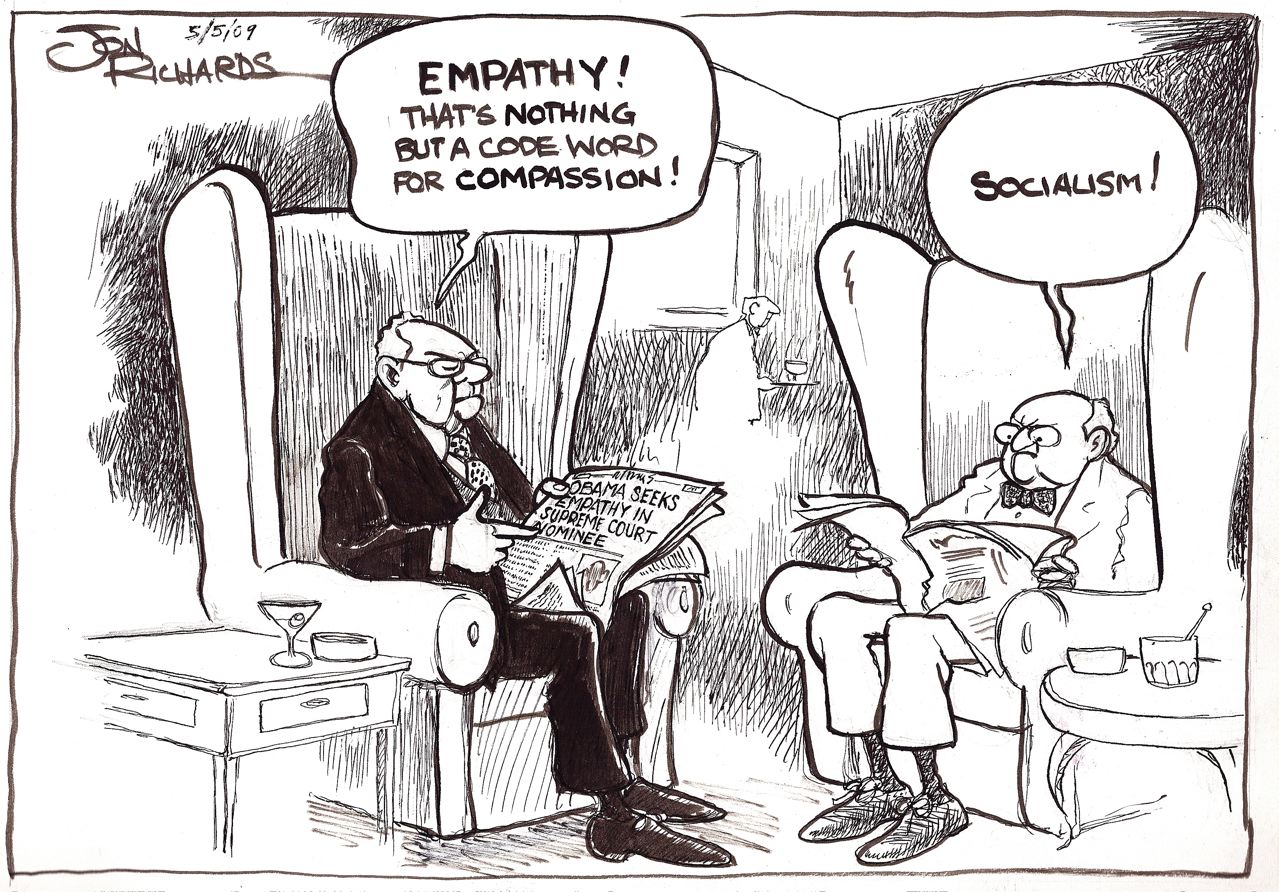
Scientific American | Humans are unlikely to win the animal kingdom’s prize for fastest, strongest or largest, but we are world champions at understanding one another. This interpersonal prowess is fueled, at least in part, by empathy: our tendency to care about and share other people’s emotional experiences. Empathy is a cornerstone of human behavior and has long been considered innate. A forthcoming study, however, challenges this assumption by demonstrating that empathy levels have been declining over the past 30 years.

The research, led by Sara H. Konrath of the University of Michigan at Ann Arbor and published online in August in Personality and Social Psychology Review, found that college students’ self-reported empathy has declined since 1980, with an especially steep drop in the past 10 years. To make matters worse, during this same period students’ self-reported narcissism has reached new heights, according to research by Jean M. Twenge, a psychologist at San Diego State University.

An individual’s empathy can be assessed in many ways, but one of the most popular is simply asking people what they think of themselves. The Interpersonal Reactivity Index, a well-known questionnaire, taps empathy by asking whether responders agree to statements such as “I often have tender, concerned feelings for people less fortunate than me” and “I try to look at everybody’s side of a disagreement before I make a decision.” People vary a great deal in how empathic they consider themselves. Moreover, research confirms that the people who say they are empathic actually demonstrate empathy in discernible ways, ranging from mimicking others’ postures to helping people in need (for example, offering to take notes for a sick fellow student).

Since the creation of the Interpersonal Reactivity Index in 1979, tens of thousands of students have filled out this questionnaire while participating in studies examining everything from neural responses to others’ pain to levels of social conservatism. Konrath and her colleagues took advantage of this wealth of data by collating self-reported empathy scores of nearly 14,000 students. She then used a technique known as cross-temporal meta-analysis to measure whether scores have changed over the years. The results were startling: almost 75 percent of students today rate themselves as less empathic than the average student 30 years ago. Fist tap Dale.

america in decline: why germans think we're insane

Alternet | The European Union has a larger economy and more people than America does. Though it spends less -- right around 9 percent of GNP on medical, whereas we in the U.S. spend close to between 15 to 16 percent of GNP on medical -- the EU pretty much insures 100 percent of its population.

The U.S. has 59 million people medically uninsured; 132 million without dental insurance; 60 million without paid sick leave; 40 million on food stamps. Everybody in the European Union has cradle-to-grave access to universal medical and a dental plan by law. The law also requires paid sick leave; paid annual leave; paid maternity leave. When you realize all of that, it becomes easy to understand why many Europeans think America has gone insane.

Der Spiegel has run an interesting feature called "A Superpower in Decline," which attempts to explain to a German audience such odd phenomena as the rise of the Tea Party, without the hedging or attempts at "balance" found in mainstream U.S. media. On the Tea Parties:

Full of Hatred: "The Tea Party, that group of white, older voters who claim that they want their country back, is angry. Fox News host Glenn Beck, a recovering alcoholic who likens Obama to Adolf Hitler, is angry. Beck doesn't quite know what he wants to be -- maybe a politician, maybe president, maybe a preacher -- and he doesn't know what he wants to do, either, or least he hasn't come up with any specific ideas or plans. But he is full of hatred."

The piece continues with the sobering assessment that America’s actual unemployment rate isn’t really 10 percent, but close to 20 percent when we factor in the number of people who have stopped looking for work.

Some social scientists think that making sure large-scale crime or fascism never takes root in Europe again requires a taxpayer investment in a strong social safety net. Can we learn from Europe? Isn't it better to invest in a social safety net than in a large criminal justice system? (In America over 2 million people are incarcerated.)

Jobless Benefits That Never Run Out
Unlike here, in Germany jobless benefits never run out. Not only that -- as part of their social safety net, all job seekers continue to be medically insured, as are their families.

veterans confront grim employment landscape

WaPo | During the seven months that he was stationed in Iraq, Joe Janssen served as an assaultman, a job that involved manning the turret gun in a Humvee and using shoulder-fired rockets and other explosives to support his fellow Marines.

Those skills were invaluable in war. But they are of little use now that he is back home in Hauppauge, N.Y., a Long Island hamlet. He has applied for job after job since leaving active duty well over a year ago, but his efforts have proved futile.

The Marine reservist used his veterans benefits to finish his bachelor's degree in criminal justice. Now he is scouring for a job in law enforcement while he waits for his name to rise to the top of the New York state police hiring list - which is unlikely to be anytime soon, given the state's severe budget problems.

"I have a passion to be a cop," said Janssen, 23, a fitness buff who dabbles in mixed martial arts. "But no one is hiring."

Janssen's experience is common among the 2 million veterans of the long-running wars in Iraq and Afghanistan. As they return home to the worst labor market in generations, the veterans who are publicly venerated for their patriotism and service are also having a harder time than most finding work, federal data show.

Thursday, December 30, 2010

the imminent collapse of industrial society - redux


Video - Fossil fuels have powered human growth and ingenuity for centuries.

CounterCurrents | The collapse of modern industrial society has 14 parts, each with a somewhat causal relationship to the next. (1) Fossil fuels, (2) metals, and (3) electricity are a tightly-knit group, and no industrial civilization can have one without the others. The decline in fossil-fuel production is the most critical aspect of the collapse, and most of the following text will be devoted to that topic. As those three disappear, (4) food and (5) fresh water become scarce; grain and wild fish supplies per capita have been declining for years, water tables are falling everywhere, rivers are not reaching the sea. Matters of infrastructure then follow: (6) transportation and (7) communication - no paved roads, no telephones, no computers. After that, the social structure begins to fail: (8) government, (9) education, and (10) the large-scale division of labor that makes complex technology possible.

After these 10 parts, however, there are four others that form a separate layer, in some respects more psychological or sociological. We might call these “the four Cs.” The first three are (11) crime, (12) cults, and (13) craziness - the breakdown of traditional law; the ascendance of dogmas based on superstition, ignorance, cruelty, and intolerance; the overall tendency toward anti-intellectualism; and the inability to distinguish mental health from mental illness. There is also a final and more general part that is (14) chaos, resulting in the pervasive sense that “nothing works any more.”

These are cascading dominoes; all parts of the collapse have more to do with causality than with chronology, although there is no great distinction to be made between the two. If we look at matters from a more purely chronological viewpoint, however, we can say that there is a clear division into two time periods, two phases. The first phase will be merely economic hardship, and the second will be entropy. In the first phase the major issues will be inflation, unemployment, and the stock market. The second phase will be characterized by the disappearance of money, law, and government. In more pragmatic terms, we can say that the second phase will begin when money is no longer accepted as a means of exchange. (We last took note of Peter Goodchild at the very end of 2007 writing about Dunbar's Number)

kutcher keepin it real...,


Video - Ashton Kutcher Killers trailer.

TorontoSun | Ashton Kutcher is getting toned and tough - so he can fend for himself and look after his family following an Armageddon-type crisis.

The movie star and producer, who is married to health nut Demi Moore, fears a major U.S. energy meltdown is nigh and he's trying to get superfit so he can deal with the chaos that will follow a blackout or worse.

Kutcher discovered combat training Krav Maga last year as he prepared to tone up for his role in Killers and now he's obsessed with running, Bikram yoga and Muay Thai fighting with the French national champion - and he insists he's committed to his extreme workouts, so he can dominate in desperate times.

The 32 year old tells Men's Fitness magazine, "It will not take much for people to hit the panic button. The amount of convenience that people rely on based on electricity alone. You start taking out electricity and satellites, and people are going to lose their noodle.

"And people are going to go, 'That land's not yours, prove that it's yours,' and the only thing you have to prove it's yours is on an electronic file... People's alarm systems at their homes will no longer work, Neither will our heating, our garbage disposals, hot-water heaters that run on gas but depend on electricity.

"What happens when all our modern conveniences fail? I'm going to be ready to take myself and my family to a safe place where they don't have to worry... All of my physical fitness regimen is completely tailored around the end... I stay fit for no other reason than to save the people I care about."

And he admits he tasted what life could be like after a major national or international calamity when he, Moore and her kids were left without power for 14 hours at their mountain cabin last Christmas.

He adds, "I got my guns out. We made a fire. We went to the grocery store... People were rolling in and out, clearing out all the shelves... It was like a preview."

american cities that are running out of people

24/7WallSt. | The population of the United States has increased steadily by roughly 2.5 million people every year since World War II. Throughout prosperity and hard times, Americans continue to have families. Many of the country’s regions have expanded to accommodate this population increase. Some cities have grown faster than others as the result of being at the center of some important new technology or job market. Others have lost residents because of failing industries and migration. Nevertheless, some of these cities have continued to grow slowly, or at least remain relatively stagnant, buoyed by the rising tide of the national population.

There are some cities, however, which have experienced such severe hardship and decline that their populations have actually decreased significantly. New Orleans has lost more than a quarter of its population in the past ten years as the result of Hurricane Katrina. The rest of the cities that have lost major parts of their population have seen their flagship industries which include coal, steel, oil, and auto-related manufacturing fall off or completely collapse. America moved away from its status as an industrial superpower in the second half of the 20th century as the services sector rose to replace it. Millions of US manufacturing jobs have moved overseas. Cities such as Rochester, Cleveland and Buffalo declined in population because they were trade hubs, and new modes of transportation removed their geographical dominance. Cities like Flint, Michigan have economies based on a single major industry. In Flint’s case, that industry is auto manufacturing. When that industry began to decline, Flint was unable to diversify to prevent a population exodus.

All of the cities on this list experienced at least one of these devastating problems which have caused tens of thousands, and in some cases, hundreds of thousands of its residents to leave the region for other jobs and other homes. While it has been the primary focus of these cities to create new sources of employment for their residents, it may be years before people return, if they do at all.

Unfortunately, the populations of most of the cities on this list continue to decline and the situation could get worse for years. This loss of residents has caused severe drops in the social services that many of these cities can provide. Property and other taxes have fallen so much that the support that residents of other cities take for granted is at risk in the municipalities on this list. There is no longer any guarantee that they can maintain police and fire departments at reasonable levels. Some of these cities cannot continue to manage large neighborhoods which have become almost deserted as residents have left unoccupied homes behind. Home vacancy rates tell a great deal about how much a city’s population has dropped.

24/7 obtained its population data from the U.S. Census Bureau’s Population Division. Housing Vacancy came from the Census Bureau’s American Community Survey. This is a list of the seven American cities that have lost the most people in the past decade.

systemic collapse


Video - Preparing and survival in the city.

Countercurrents | Systemic collapse, societal collapse, the coming dark age, the great transformation, the coming crash, the post-industrial age, the long emergency, socioeconomic collapse, the die-off, the tribulation, the coming anarchy, perhaps even resource wars (to the extent that this is not an oxymoron, since wars themselves require resources) ― there are many names, and they do not all correspond to exactly the same thing, but there is a widespread belief that something immense and ominous is happening. Unlike those of the Aquarian Age, the heralds of this new era often have impressive academic credentials: they include scientists, engineers, and historians. The serious beginnings of the concept can be found in Paul and Anne Ehrlich, Population, Resources, Environment (1970); Donella H. Meadows et al., The Limits to Growth (1972); and William R. Catton, Jr., Overshoot (1980). What all the overlapping theories have in common can be seen in the titles of those three books.

Oil depletion is the most critical aspect in the systemic collapse of modern civilization, but altogether this collapse has about 10 principal parts, each with a vaguely causal relationship to the next. Oil, metals, and electricity are a tightly-knit group, as we shall see, and no industrial civilization can have one without the others. As those 3 disappear, food and fresh water become scarce (fish and grain supplies per capita have been declining for years, water tables are falling everywhere, rivers are not reaching the sea). These 5 can largely be considered as resource depletion, and the converse of resource depletion is environmental destruction. Disruption of ecosystems in turn leads to epidemics. Matters of infrastructure then follow: transportation and communication. Social structure is next to fail: without roads and telephones, there can be no government, no education, no large-scale division of labor. After the above 10 aspects of systemic collapse, there is another layer, in some respects more psychological or sociological, that we might call “the 4 Cs.” The first 3 are crime (war and crime will be indistinguishable, as Robert D. Kaplan explains), cults, and craziness — the breakdown of traditional law, the tendency toward anti-intellectualism, the inability to distinguish mental health from mental illness. After that there is a more general one that is simple chaos, which results in the pervasive sense that “nothing works any more.”

Systemic collapse, in turn, has one overwhelming cause: world overpopulation. All of the flash-in-the-pan ideas that are presented as solutions to the modern dilemma — solar power, ethanol, hybrid cars, desalination, permaculture — have value only as desperate attempts to solve an underlying problem that has never been addressed in a more direct manner. American foreign aid, however, has always included only trivial amounts for family planning; the most powerful country in the world has done very little to solve the biggest problem in the world.

Chipocalypse Now - I Love The Smell Of Deportations In The Morning

sky |   Donald Trump has signalled his intention to send troops to Chicago to ramp up the deportation of illegal immigrants - by posting a...