Saturday, October 23, 2010

a renegade history of the united states

HuffPo | I was raised by pot-smoking, nudist, socialist revolutionaries as an egghead white boy in black neighborhoods in Berkeley and Oakland. I nearly flunked eighth grade and finished high school with a C average. Then I went to the anarchist, ultra-hippy Antioch College in Ohio, which accepted all their applicants, didn't give grades, and didn't have a history department.

So even though I managed to pull myself out of that background and into and through Columbia for a PhD, then onto a job at an elite college, I was highly uncomfortable moving from the world of weed to the world of tweed. I hated being "Professor." I cursed in class. I talked about sex. I used politically incorrect terms. My students said they had never heard the things I was teaching them in class. They called me "Bad Thad."

I showed them that during the American Revolution drunkards, laggards, prostitutes, and pirates pioneered many of the freedoms and pleasures we now cherish -- including non-marital sex, interracial socializing, dancing, shopping, divorce, and the weekend -- and that the Founding Fathers, in the name of democracy, opposed them. I argued not only that many white Americans envied slaves but also that they did so for good reason, since slave culture offered many liberating alternatives to the highly repressive, work-obsessed, anti-sex culture of the early United States. I demonstrated that prostitutes, not feminists, won virtually all the freedoms that were denied to women but are now taken for granted. By tracing the path of immigrants from arrival as "primitives" to assimilation as "civilized" citizens, I explained that white people lost their rhythm by becoming good Americans. I presented evidence that without organized crime, we might not have jazz, Hollywood, Las Vegas, legal alcohol, birth control, or gay rights, since only gangsters were willing to support those projects when respectable America shunned them.

This was not the standard left-liberal perspective my students had heard, and it certainly wasn't a conservative one, either. It was informed by an unlikely mix of influences, including the hippies and other cultural radicals I had encountered in my early life, black and gay cultures that showed me a way out of the self-imposed limitations of being white and straight, and libertarians who caused me to question the commitment to freedom among the left that I had been born into and which employed me as a professor.

I gave my students a history that was structured around the oldest issue in political philosophy but which professional historians often neglect - the conflict between the individual and community, or what Freud called the eternal struggle between civilization and its discontents. College students are normally taught a history that is the story of struggles between capitalists and workers, whites and blacks, men and women. But history is also driven by clashes between those interested in preserving social order and those more interested in pursuing their own desires -- the "respectable" versus the "degenerate," the moral versus the immoral, "good citizens" versus the "bad." I wanted to show that the more that "bad" people existed, resisted, and won, the greater was what I called "the margin of freedom" for all of us.

My students were most troubled by the evidence that the "good" enemies of "bad" freedoms were not just traditional icons like presidents and business leaders, but that many of the most revered abolitionists, progressives, and leaders of the feminist, labor, civil rights, and gay rights movements worked to suppress the cultures of working-class women, immigrants, African Americans, and the flamboyant gays who brought homosexuality out of the closet.

I had developed these ideas largely on my own, in my study and in classrooms, knowing all the while that I was engaged in an Oedipal struggle to overthrow the generation of historians who came of age during the 1960s and 1970s, controlled academic history, and had trained me. They were so eager to make the masses into heroes that they did not see that it was precisely the non-heroic and unseemly characteristics of ordinary folks that changed American culture for the better.

standing up to the corporate bully

RagBlog | Big corporations charge citizens extra for making mistakes and penalize them unjustly for being the suckers who fall for their sales pitch.

There has been an increasing amount of talk taking place around the issue of bullying. Several young children and college students have recently committed suicide as a result of what many feel was bullying.

On Oct. 1 a 13-year-old boy committed suicide at his home in Houston after being bullied at the Cypress Fairbanks Independent School District. Asher Brown’s parents blamed the school for their son’s death, saying that he shot himself in the head after being tormented by classmates for being gay.

Tyler Clementi, a first year student at Rutgers University in New Jersey, jumped off a bridge to his death after his roommate and another student secretly filmed him engaging in a sexual act with another male student.

Kevin Morrissey committed suicide near the University of Virginia campus after being tormented on the job. At least two co-workers said they warned university officials about his growing despair over alleged workplace bullying at the award-winning Virginia Quarterly Review.

On July 30, Morrissey, the Review's 52-year-old managing editor, walked to the old coal tower near campus and shot himself in the head.

Bullying can take many forms, but one of the most lethal and least recognized is corporate bullying. Corporations treat citizens like commodities and charge them for services they don’t even render.

confusing ritual and superstition


Video - The Samurai of Soma Noma Oi.

Scientific American | Ray Allen’s pregame routine never changes. A nap from 11:30am to 1:00pm, chicken and white rice for lunch at 2:30, a stretch in the gym at 3:45, a quick head shave, then practice shots at 4:30. The same amount of shots must be made from the same spots every day – the baselines and elbows of the court, ending with the top of the key. [Ray Allen is a samurai] Similar examples of peculiar rituals and regimented routines in athletics abound. Jason Giambi would wear a golden thong if he found himself in a slump at the plate, and Moises Alou, concerned about losing his dexterous touch with the bat, would frequently urinate on his hands. [Jason Giambi and Moises Alou are nasty, superstitious ass-clowns] This type of superstitious behavior can veer from the eccentric to the pathological, and though many coaches, teammates and fans snicker and shake their heads, a new study headed by Lysann Damisch at the University of Cologne and recently published in the journal Psychological Science suggests that we should all stop smirking and start rubbing our rabbit’s foot.

When it comes to superstitions, social scientists have generally agreed on one thing: they are fundamentally irrational. “Magical thinking” (as it has been called) is defined as the belief that an object, action or circumstance not logically related to a course of events can influence its outcome. In other words, stepping on a crack cannot, given what we know about the principles of causal relations, have any direct effect on the probability of your mother breaking her back. Those who live in fear of such a tragedy are engaging in magical thought and behaving irrationally.

Yet in their study, Damisch and colleagues challenge the conclusion that superstitious thoughts bear no causal influence on future outcomes. Of course, they were not hypothesizing that the trillions of tiny cracks upon which we tread every day are imbued with some sort of sinister spine-crushing malevolence. Instead, they were interested in the types of superstitions that people think bring them good luck. The lucky hats, the favorite socks, the ritualized warmup routines, the childhood blankies. Can belief in such charms actually have an influence over one’s ability to, say, perform better on a test or in an athletic competition? In other words, is Ray Allen’s performance on the basketball court in some ways dependent on eating chicken and rice at exactly 2:30? Did Jason Giambi’s golden thong actually have a hand in stopping a hitless streak?

Friday, October 22, 2010

show me the note!!!

GonzaloLira | So the week before last, I wrote about Brian and Ilsa, a retired couple in their mid-to-late sixties, living in a house in the Southwest that had—unremarkably—gone underwater.

They had tried to refinance their home mortgage, under the auspices of the HAMP, the Home Affordable Modification Program. HAMP was part of the Financial Stability Act of 2009—the famed “Stimulus Package”.

The point of my piece was, if and when solid upstanding middle-class people such as Brian and Ilsa ever do throw in the towel and let out a collective Fuckit, then it’s curtains for the American Republic: You cannot have a viable society where the backbone of the country thinks that following the rules and the law is for suckers and chumps.

Life goes on. Between when I last spoke to Brian and Ilsa, and when the reactions to my post started rolling in, Brian and Ilsa’s story continued, of course—

—and it took quite the amazing turn over the last couple of weeks.

“And we have you to thank,” Ilsa told me.

“Oh?” I said.

“Yes indeed,” said Brian—and then he explained: Fist tap Dale.

where poverty is rising in america

hemp is the far bigger economic issue


Video - speeded up version of 1942 gubmint documentary "Hemp for Victory".

AlterNet | Prop 19 will open up California to hemp, a multi-billion-dollar crop that has been a staple of human agriculture for thousands of years.

Hemp is the far bigger economic issue hiding behind legal marijuana.

If the upcoming pot legalization ballot in California were decided by hemp farmers like George Washington and Thomas Jefferson, it would be no contest. For purely economic reasons, if you told the Constitutional Convention in 1787 that the nation they were founding would someday make hemp illegal, they would have laughed you out of the room.

If California legalizes pot, it will save the state millions in avoided legal and imprisonment costs, while raising it millions in taxes.

But with legal marijuana will come legal hemp. That will open up the Golden State to a multi-billion-dollar crop that has been a staple of human agriculture for thousands of years, and that could save the farms of thousands of American families.

Hemp is currently legal in Canada, Germany, Holland, Rumania, Japan and China, among many other countries. It is illegal here largely because of marijuana prohibition. Ask any sane person why HEMP is illegal and you will get a blank stare.

For paper, clothing, textiles, rope, sails, fuel and food, hemp has been a core crop since the founding of ancient China, India and Arabia. Easy to plant, grow and harvest, farmers---including Washington and Jefferson---have sung its praises throughout history. It was the number one or two cash crop on virtually all American family farms from the colonial era on.

If the American Farm Bureaus and Farmers Unions were truly serving their constituents, they would be pushing hard for legal pot so that its far more profitable (but essentially unsmokable) cousin could again bring prosperity to American farmers.

Hemp may be the real reason marijuana is illegal. In the 1930s, the Hearst family set out to protect their vast timber holdings, much of which were being used to make paper.

But hemp produces five times as much paper per acre as do trees. Hemp paper is stronger and easier to make. The Declaration of Independence was written on hemp paper, and one of Benjamin Franklin’s primary paper mills ran on it.

But the Hearsts used their newspapers to incite enough reefer madness to get marijuana banned in 1937. With that ban came complex laws that killed off the growing of hemp. The ecological devastation that’s followed with continued use of trees for paper has been epic.

Thursday, October 21, 2010

what if we ran universities like wikipedia?

ChronicleofHigherEd | A silly question? Maybe. But the analogy, made by a speaker at the Educause conference here today, reflects a recurring theme at this year’s event: Do our university bureaucracies still make sense in the era of networks?

In a session called “The University as an Agile Organization,” David J. Staley laid out the findings of a focus group he conducted asking educators what a college would look like if it ran like Wikipedia.

First, it wouldn’t have formal admissions, said Mr. Staley, director of the Harvey Goldberg Center for Excellence in Teaching at Ohio State University. People could enter and exit as they wished. It would consist of voluntary and self-organizing associations of teachers and students “not unlike the original idea for the university, in the Middle Ages,” he said. Its curriculum would be intellectually fluid.

And instead of tenure, it would have professors “whose longevity would be determined by the community,” Mr. Staley said, and who would move back and forth between the “real world” and the university.

Universities “seem to be becoming more top-down and hierarchical at a time when more and more organizations are looking more like networks,” said Mr. Staley, who expanded on the Wikipedia theme last year in Educause Review. Fist tap Dale.

culture of poverty makes a comeback

NYTimes | “Culture is back on the poverty research agenda,” the introduction declares, acknowledging that it should never have been removed.

The topic has generated interest on Capitol Hill because so much of the research intersects with policy debates. Views of the cultural roots of poverty “play important roles in shaping how lawmakers choose to address poverty issues,” Representative Lynn Woolsey, Democrat of California, noted at the briefing.

This surge of academic research also comes as the percentage of Americans living in poverty hit a 15-year high: one in seven, or 44 million.

With these studies come many new and varied definitions of culture, but they all differ from the ’60s-era model in these crucial respects: Today, social scientists are rejecting the notion of a monolithic and unchanging culture of poverty. And they attribute destructive attitudes and behavior not to inherent moral character but to sustained racism and isolation.

To Robert J. Sampson, a sociologist at Harvard, culture is best understood as “shared understandings.”

“I study inequality, and the dominant focus is on structures of poverty,” he said. But he added that the reason a neighborhood turns into a “poverty trap” is also related to a common perception of the way people in a community act and think. When people see graffiti and garbage, do they find it acceptable or see serious disorder? Do they respect the legal system or have a high level of “moral cynicism,” believing that “laws were made to be broken”?

Wednesday, October 20, 2010

changing education paradigms


Video - Changing Education Paradigms

the limits of social media

Shareable | Blogs have been a twitter about Malcolm Gladwell’s New Yorker article last week slamming those who believe social media can revolutionize activism. The article compares the high risk activism of the civil rights movement with Twitter’s role in the Iranian elections concluding that, “the revolution will not be tweeted.”

First of all, taking aim at those who are love drunk for social media is like shooting fish in a barrel. Secondly, it’s no revelation that a tweet is less effective than putting your life on the line for a cause.

Moreover, Gladwell gets the role of the online activism wrong. As someone who worked with professional online activists on a daily basis for two years while at Care2.com, I can tell you that none of my clients believed online activism had much value by itself. It was always part of a larger strategy and, as Mashable pointed out, serves a very specific role in activism – it offers citizens a no risk first step on the path to higher risk engagement. But this is no reinvention as Mashable argues. It’s mostly optimization.

From my perspective as publisher of Shareable, Gladwell's article and the resulting hubbub misses the larger points:

1.) activism by itself can’t achieve its stated aims no matter what medium is used. A new social order requires a new economy.

2.) social media is primarily creative – its true power is not as a tool for resistance but as a coordinating medium for an emerging peer-economy which promises to obsolete state capitalism.

The reason I co-founded Shareable is that having been a lobbyist and a capitalist, and now a nonprofit activist, I’ve come to believe that activism by itself is no match for state capitalism. I remember vividly the time ten years ago when I naively asked a peer at the FCC, who I interfaced with as a representative of a large telecom trade association, where the FCC got their market research. They said, “from you.” I was shocked. The FCC didn’t do their own research. They relied mainly on industry for that. Of course the public could way in too, but the presence of public interest advocacy seemed minimal. We, on the other hand, never missed a beat. The association membership was unified and funded our lobbying efforts well.

This story points to a systemic issue - activists face a classic collective action problem that has no resolution: the nonprofit sector is composed of many entities with many agendas; the corporate sector is composed of a smaller number of vastly more powerful entities with only one agenda – profit. This means that it’s significantly easier for corporations to act collectively and achieve their goals than it is for nonprofits. This is partly why corporations have become so powerful.

Bottom line, the nonprofit sector is structurally fucked and social media doesn’t change this one byte, because after all it’s available to both sides in the game. The failure of the COP15 climate negotiations is a good example of activism’s limits. And then there’s this brave letter from Bill McKibben admitting that the environmental movement is failing to get action on climate change. This is despite having public opinion on its side and a legion of activist across the globe. Fist tap Dale.

economics memewar

Adbusters | In anticipation of November’s Carnivalesque Rebellion, a memewar salvo has been opened on the University of California – Berkeley’s prestigious Economics department. The first act was a defiant challenge. The Kick It Over Manifesto was boldly pinned to the door of Daniel McFadden, a Nobel Prize winner in economics, along with bulletin boards throughout the department. [The Kick It Over Manifesto was pinned to McFadden's office door.]

Printed on bright pink paper, the manifesto declares in part: “You hide in your offices, protected by your mathematical jargon, while in the real world, forests vanish, species perish and human lives are callously destroyed. We accuse you of gross negligence in the management of our planetary household.”

The goal was to disrupt the obliviousness of students and teachers who preach the self-destructive consumerist lie that societies should pursue economic growth. It worked: the manifesto hit a nerve.

Within three hours, an adjunct professor emailed Adbusters to justify his approach to teaching economic theory. But he concluded with a defiant flare: “I have a fairly strong hunch that you are mistaken about the system crumbling, or the imminent loss of relevance of mainstream economics. In all likelihood my students will continue to have considerable influence on the body politic for many years to come.”

We, jammers and activists, vow to make the econ department a key location in the coming insurrection of ideas. To the students of economics in universities across the world, we say that it is time to challenge the flawed economic theories of your professors. As Kalle Lasn wrote in his Preface to the Student, before you is a decision moment: “You can ignore all of the screaming inconsistencies and accept the status quo. You can cross your fingers and hope the old paradigm has a generation or two left in it, enough for you to carve out a career. Or you can align yourself from the get-go with the mavericks. You can be an agitator, a provocateur, one of the students on campus who posts heterodox messages up on notice boards and openly challenges professors in class. You can bet your future career on a paradigm shift.”

The economics department at Berkeley will be jammed again… and again. Join us by spreading the memewar to your campus. Remember, the Carnivalesque Rebellion is November 22 to 28!

tea party parasites

RollingStone | Quelle surprise! So it turns out that one after another of the Tea Party candidates is in one way or another mooching off the government. The latest series of hilarious disclosures center around Alaska’s GI-Joe-bearded windbag Senatorial candidate, Joe Miller, who appears to have run virtually the entire gamut of government aid en route to becoming a staunch, fist-shaking opponent of the welfare state.

Miller’s pomposity and piety with regard to government aid programs has all along been in line with the usual screechingly hysterical self-righteousness Tea Party candidates bring to such matters, railing against Obamacare and other “entitlement” programs and promising to end the “welfare state.” That makes it all the more delicious now that he and his family have been exposed for taking state medical aid, unemployment insurance, farm subsidies, hell, even for using state equipment to run a private political campaign.

Back in June, Miller was saying this about his Republican primary opponent Lisa Murkowski, blasting her for supporting a state health care program:

As you are aware, just last week the Anchorage Daily News reported that the Denali KidCare Program funded 662 abortions last year. Senator Murkowski has been a champion of this program, voting against the majority of her Republican colleagues for CHIPRA (HR 2) in January of 2009.

Of course it now turns out that back in the Nineties, Miller himself and his three children (with one on the way; he now has eight) were at one point receiving assistance via a program almost exactly like the Denali KidCare program, which is only for low-income earners. Various reports note that Miller received this assistance after he’d bought a house and been hired by a prestigious law firm; he also got low-income hunting and fishing licenses during that time. It’s also come out that he received some $7,000 in farm subsidies and that his wife received unemployment insurance benefits.

So now of course Miller, who said he and his family “absolutely” used Alaska’s state medical program, is backtracking and saying that he’s not against the modern Denali Kidcare program, only against the “expansion” of it. But even more telling was his longer answer about the program, as reported in the Anchorage Daily News:

Miller said what he's advocating is complete state control of the programs. "That doesn't mean we cut off the programs. That is ultimately a state decision. And I think there is a use; in fact the most effective use is probably those programs that help transition the populations from more of a situation of dependency" to one where they can be economically independent, Miller said.

You see, when a nice white lawyer with a GI Joe beard uses state aid to help him through tough times and get over the hump – so that he can go from having three little future Medicare-collecting Republican children to eight little future Medicare-collecting Republican children – that’s a good solid use of government aid, because what we’re doing is helping someone “transition” from dependency to economic independence.

This of course is different from the way other, less GI-Joe-looking people use government aid, i.e. as a permanent crutch that helps genetically lazy and ambitionless parasites mooch off of rich white taxpayers instead of getting real jobs.

I can’t even tell you how many people I interviewed at Tea Party events who came up with one version or another of the Joe Miller defense. Yes, I’m on Medicare, but… I needed it! It’s those other people who don’t need it who are the problem!

Or: Yes, it’s true, I retired from the police/military/DPW at 54 and am on a fat government pension that you and your kids are going to be paying for for the next forty years, while I sit in my plywood-paneled living room in Florida watching Fox News, gobbling Medicare-funded prescription medications, and railing against welfare queens. But I worked hard for those bennies! Not like those other people!

Tuesday, October 19, 2010

hitler exhibit explores nazi empowerment

NYTimes | As artifacts go, they are mere trinkets — an old purse, playing cards, a lantern. Even the display that caused the crowds to stop and stare is a simple embroidered tapestry, stitched by village women.

But the exhibits that opened Friday at the German Historical Museum are intentionally prosaic: they emphasize the everyday way that ordinary Germans once accepted, and often celebrated, Hitler.

The household items had Nazi logos and colors. The tapestry, a tribute to the union of church, state and party, was woven by a church congregation at the behest of their priest.

“This is what we call self-mobilization of society,” said Hans-Ulrich Thamer, one of three curators to assemble the exhibit at the German Historical Museum. “As a person, Hitler was a very ordinary man. He was nothing without the people.”

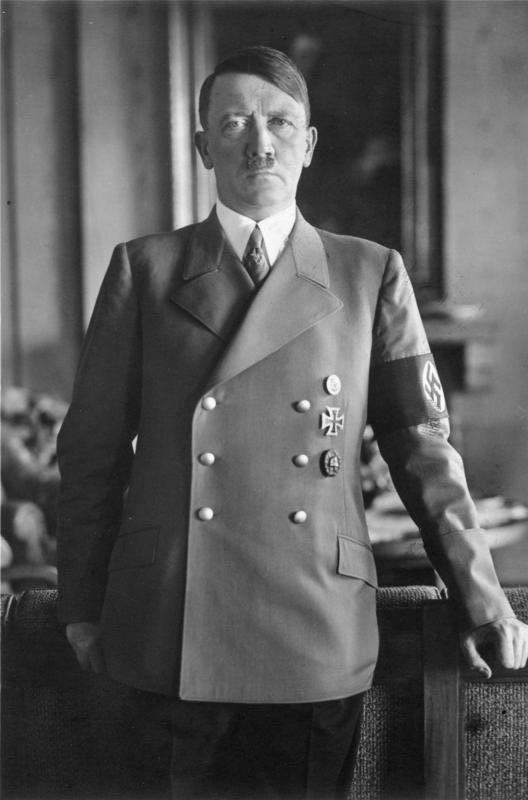
This show, “Hitler and the Germans: Nation and Crime,” opened Friday. It was billed as the first in Germany since the end of World War II to focus exclusively on Adolf Hitler. Germany outlaws public displays of some Nazi symbols, and the curators took care to avoid showing items that appeared to glorify Hitler. His uniforms, for example, remained in storage.

Instead, the show focuses on the society that nurtured and empowered him. It is not the first time historians have argued that Hitler did not corral the Germans as much as the Germans elevated Hitler. But one curator said the message was arguably more vital for Germany now than at any time in the past six decades, as rising nationalism, more open hostility to immigrants and a generational disconnect from the events of the Nazi era have older Germans concerned about repeating the past.

“The only hope for stopping extremists is to isolate them from society so that they are separated, so they do not have a relationship with the bourgeoisie and the other classes,” Mr. Thamer said. “The Nazis were members of high society. This was the dangerous moment.

“This we have to avoid from happening.”

why 13 percent of germans would welcome a 'Führer'

CSM | A new survey signals that Germany, where the term 'Führer,' or leader, is explicitly linked to Adolf Hitler, is not immune from the far-right sentiments that are spreading across Europe.

A new survey in Germany shows that 13 percent of its citizens would welcome a “Führer” – a German word for leader that is explicitly associated with Adolf Hitler – to run the country “with a firm hand.”

The findings signal that Europe’s largest nation, freed from cold-war strictures, is not immune from the extreme and often right-wing politics on the rise around the Continent.

The study, released Oct. 13 by the Friedrich Ebert Foundation, affiliated with the center-left Social Democratic Party, revealed among other things that more than a third of Germans feel the country is “overrun by foreigners,” some 60 percent would “restrict the practice of Islam,” and 17 percent think Jews have “too much influence.”

The study's overall snapshot of German society shows new forms of extremism and hate are no longer the province of far-right cohorts who shave their heads or wear leather jackets adorned with silver skulls – but register in the tweedy political center, on the right and the left. Indeed, the study found, extremism in Germany isn’t a fringe phenomenon but is found in the political center, "in all social groups and in all age groups, regardless of employment status, educational level or gender." Fist tap Nana.

how hitler won over germans

Bloomberg | In their neatest handwriting, hundreds of children wrote to Adolf Hitler congratulating him on his 43rd birthday in 1932. One letter is on Mickey Mouse writing paper; others enclose photos of their diminutive authors posing in “Heil Hitler” salutes or waving swastikas.

“I hope that you will save Germany in the election on April 24!” writes 12-year-old Elga. “Here in Liebenburg, 90 percent of the people are Nazis and voted for you!”

More than 65 years after Hitler’s death and the collapse of the Third Reich, the German Historical Museum is seeking answers to a question that each generation asks anew: How did Germany, known as a nation of poets and thinkers, fall under Hitler’s spell and let him commit some of the worst crimes in history?

The new exhibition, called “Hitler and the Germans, Nation and Crime,” is the first in Berlin to focus exclusively on the dictator and his influence over the people. That is not to say that Hitler is still a taboo topic in Germany, as some of the international coverage of the exhibition would have it.

Far from it. Hitler sells. Television news channels such as N-TV and N-24 broadcast Hitler documentaries back-to-back in non-peak hours. Der Spiegel news magazine has put him on its cover no fewer than 40 times since 1947. The first academic biography of Eva Braun, published this year, became a bestseller. The fascination extends beyond Germany: the English- language film rights to the book have already been snapped up. Fist tap Nana.

Monday, October 18, 2010

scenes from life in a drug war

NYTimes | Incidences of drug-related violence in Mexico and on the border continue to make news. We tend to hear about the crimes that touch American lives — like the reported killing of a man riding a Jet Ski on the Rio Grande. What we don’t hear as much about is how drugs and violence shape the everyday lives of Mexicans. So here are dispatches from four writers on how drug trafficking has changed their parts of the country. They were translated by Kristina Cordero from the Spanish.

The Walls of Puebla
The drug lords like this city for the same reason I do: it’s safe.

Tijuana Reclaimed
Drug-related violence has driven away the tourists, but now locals are reclaiming their city.

Ground Zero in Sinaloa
In the state where Mexico’s drug trade started, narcotics have seeped into the social D.N.A.

Monterrey’s Habit
In Mexico, we have a drug problem — but it’s not the one you think.

mexico under siege

Sunday, October 17, 2010

integrieren Sie oder sonst!


Video - RT synopsis of Angela Merkel statement on multiculturalism in Germany.

Guardian | Chancellor Angela Merkel has declared the death of multiculturalism in Germany, saying that it had "failed utterly" , in what has been interpreted as a startling shift from her previous views. The German leader said it had been an illusion to think that Germans and foreign workers could "live happily side by side".

"We kidded ourselves for a while that they wouldn't stay, but that's not the reality," she said at a conference of the youth wing of her Christian Democratic Union party at the weekend, referring to the gastarbeiters, or guest workers, who arrived in Germany to fill a labour shortage during the economic boom of the 1960s.

"Of course the tendency had been to say, 'let's adopt the multicultural concept and live happily side by side, and be happy to be living with each other'. But this concept has failed, and failed utterly," she said, without elaborating on the nature and causes of this failure.

Merkel's verdict marks a shift in her previously liberal line on immigration which had always put her at odds with the more conservative wing of the party.

While she stressed in the same speech that immigrants were welcome in Germany and that Islam was a part of the nation's modern-day culture, her remarks positioned her closer to Horst Seehofer, the Bavarian state premier of the Christian Social Union, who last week called for an end to immigration from Turkey and Arab countries.

They also align her with Thilo Sarrazin, the former Bundesbank member whose book on how the failure of many of Germany's 16 million immigrants to integrate was contributing to Germany's decline led to his dismissal.

Sharing the same podium as Merkel in Potsdam, Seehofer also said "multiculturalism is dead" and that both the rightwing parties were committed to a "dominant German culture". If Germany did not revise its immigration policies, he said, it was in danger of becoming "the world's welfare office".

the new oil?

Newsweek | Sitka, Alaska, is home to one of the world’s most spectacular lakes. Nestled into a U-shaped valley of dense forests and majestic peaks, and fed by snowpack and glaciers, the reservoir, named Blue Lake for its deep blue hues, holds trillions of gallons of water so pure it requires no treatment. The city’s tiny population—fewer than 10,000 people spread across 5,000 square miles—makes this an embarrassment of riches. Every year, as countries around the world struggle to meet the water needs of their citizens, 6.2 billion gallons of Sitka’s reserves go unused. That could soon change. In a few months, if all goes according to plan, 80 million gallons of Blue Lake water will be siphoned into the kind of tankers normally reserved for oil—and shipped to a bulk bottling facility near Mumbai. From there it will be dispersed among several drought-plagued cities throughout the Middle East. The project is the brainchild of two American companies. One, True Alaska Bottling, has purchased the rights to transfer 3 billion gallons of water a year from Sitka’s bountiful reserves. The other, S2C Global, is building the water-processing facility in India. If the companies succeed, they will have brought what Sitka hopes will be a $90 million industry to their city, not to mention a solution to one of the world’s most pressing climate conundrums. They will also have turned life’s most essential molecule into a global commodity.

Saturday, October 16, 2010

can mushrooms rescue the gulf?

Justify FullYesMagazine | For more than a decade, mycologist and inventor Paul Stamets has known that mushrooms eat oil. There were still a few kinks to work out; bringing the technology to scale and winning the acceptance of government agencies were two of the most challenging. Yet the basic science was solid and had been replicated many times by other scientists.

Then Stamets heard about the Deepwater Horizon oil spill in the Gulf of Mexico. While his first reaction was horror and regret, he also knew that he might be able to offer practical solutions, while at the same time giving his oil-eating mushrooms a chance to show their stuff.

He wasn’t the only one who thought mushrooms might be part of the solution. In the days after the explosion in the Gulf, the EPA contacted him several times to request a proposal. They wanted to understand how mycoremediation—the reduction of toxic compounds into harmless ones by fungi—could work as a component of their cleanup strategy for the spill.

Stamets drafted a three-page proposal and sent it off. Then he ramped up the pace of his research and shifted his focus to finding oil-eating mushrooms that could tolerate the Gulf of Mexico’s salt water and powerful sun.

Chipocalypse Now - I Love The Smell Of Deportations In The Morning

sky |   Donald Trump has signalled his intention to send troops to Chicago to ramp up the deportation of illegal immigrants - by posting a...