Friday, July 30, 2010

identical cells? not so much..,

The Scientist | Genetically identical cells may be far more different than previously believed. Published this week in Science, researchers find striking variation in levels of gene expression among individual, genetically identical E. coli, seemingly the result of simple chance.

"The paper is quite rich," said Sanjay Tyagi, a molecular biologist at New Jersey Medical School who was not involved in the research. "People think that if an organism has a particular genotype, it determines its phenotype -- that there's a one-to-one relationship," said Tyagi. "But as it turns out, [differences in gene expression] can arise just from chance."

In traditional gene expression studies, researchers grind up a population of cells, then identify overall amounts of gene products from the resulting mixture. Researchers at Harvard University instead studied cells one by one, still calculating averages but also capturing variation in the population with single molecule sensitivity -- and found cells expressing genes at wildly different levels. "It's single molecules meet systems biology," said Sunney Xie, senior author on the paper and a chemical biologist at Harvard University.

oceans in manmade peril

YahooLiveScience | One hundred days ago Thursday, the oil rig Deepwater Horizon began spewing oil into the Gulf of Mexico. As profoundly as the leak of millions of barrels of oil is injuring the Gulf ecosystem, it is only one of many threats to the Earth's oceans that, many experts say, could change the makeup of the oceans as we know them and wipe out a large portion of marine life.

The waters of the Gulf were already heavily fished, and the Gulf has been home to an oxygen-depleted dead zone generated by agricultural runoff rich in nutrients.

The Gulf and the rest of the world's waters also face the uncertain and potentially devastating effects of climate change. Warming ocean temperatures reduce the water's oxygen content, and rising atmospheric carbon dioxide is altering the basic chemistry of the ocean, making it more acidic. There is no shortage of evidence that both of these effects have begun to wreak havoc on certain important creatures.

Human beings created these problems, largely in the two centuries since the Industrial Revolution, but for some researchers, they bring to mind the ancient past. The Earth has seen several mass extinctions, including five that annihilated more than half the planet's species. Experts now believe Earth is in the midst of a sixth event, the first one caused by humans.

"Today the synergistic effects of human impacts are laying the groundwork for a comparably great Anthropocene mass extinction in the oceans, with unknown ecological and evolutionary consequences," Jeremy Jackson of the Scripps Institution of Oceanography at the University of California, San Diego, wrote in a 2008 article published in the journal Proceedings of the National Academy of Sciences.

ocean life support dwindling

The Scientist | Phytoplankton, which are responsible for half of the world's primary production and are the basis of all marine ecosystems, have been declining for more than 100 years, perhaps the result of rising sea temperatures, according to a study published in this week's Nature -- a cause for concern about the health of the Earth's oceans.

"It is troubling," said marine scientist David Siegel of the University of California, Santa Barbara, who was not involved in the research. With data dating back to the late 1800s, "this paper finds a long-term trend that's huge," he said. "The phytoplankton community has undoubtedly been changing."

Phytoplankton productivity lies at the base of the marine food web, supporting all ocean life and contributing to global geochemical processes, including the carbon cycle. Through photosynthetic activities, phytoplankton reduce atmospheric carbon dioxide. Satellite data from the last few decades has suggested that phytoplankton might be on the decline.

Thursday, July 29, 2010

organizing for anti-capitalist transition


Video - David Harvey the crisis today.

davidharvey | The historical geography of capitalist development is at a key inflexion point in which the geographical configurations of power are rapidly shifting at the very moment when the temporal dynamic is facing very serious constraints. Three percent compound growth (generally considered the minimum satisfactory growth rate for a healthy capitalist economy) is becoming less and less feasible to sustain without resort to all manner of fictions (such as those that have characterized asset markets and financial affairs over the last two decades). There are good reasons to believe that there is no alternative to a new global order of governance that will eventually have to manage the transition to a zero growth economy. If that is to be done in an equitable way, then there is no alternative to socialism or communism. Since the late 1990s, the World Social Forum became the center for articulating the theme “another world is possible.” It must now take up the task of defining how another socialism or communism is possible and how the transition to these alternatives are to be accomplished. The current crisis offers a window of opportunity to reflect on what might be involved.

The current crisis originated in the steps taken to resolve the crisis of the 1970s. These steps included:

(a) the successful assault upon organized labor and its political institutions while mobilizing global labor surpluses, instituting labor-saving technological changes and heightening competition. The result has been global wage repressions (a declining share of wages in total GDP almost everywhere) and the creation of an even vaster disposable labor reserve living under marginal conditions.

(b) undermining previous structures of monopoly power and displacing the previous stage of (nation state) monopoly capitalism by opening up capitalism to far fiercer international competition. Intensifying global competition translated into lower non-financial corporate profits. Uneven geographical development and inter-territorial competition became key features in capitalist development, opening the way towards the beginnings of a hegemonic shift of power particularly but not exclusively towards East Asia.

(c) utilizing and empowering the most fluid and highly mobile form of capital – money capital – to reallocate capital resources globally (eventually through electronic markets) thus sparking deindustrialization in traditional core regions and new forms of (ultra-oppressive) industrialization and natural resource and agricultural raw material extractions in emergent markets. The corollary was to enhance the profitability of financial corporations and to find new ways to globalize and supposedly absorb risks through the creation of fictitious capital markets.

(d) At the other end of the social scale, this meant heightened reliance on “accumulation by dispossession” as a means to augment capitalist class power. The new rounds of primitive accumulation against indigenous and peasant populations were augmented by asset losses of the lower classes in the core economies (as witnessed by the sub-prime housing market in the US which foisted a huge asset loss particularly upon African American populations).

(e) The augmentation of otherwise sagging effective demand by pushing the debt economy (governmental, corporate and household) to its limits (particularly in the USA and the UK but also in many other countries from Latvia to Dubai).

(f) Compensating for anemic rates of return in production by the construction of whole series of asset market bubbles, all of which had a Ponzi character, culminating in the property bubble that burst in 2007-8. These asset bubbles drew upon finance capital and were facilitated by extensive financial innovations such as derivatives and collateralized debt obligations.

The political forces that coalesced and mobilized behind these transitions had a distinctive class character and clothed themselves in the vestments of a distinctive ideology called neoliberal. The ideology rested upon the idea that free markets, free trade, personal initiative and entrepreneurialism were the best guarantors of individual liberty and freedom and that the “nanny state” should be dismantled for the benefit of all. But the practice entailed that the state must stand behind the integrity of financial institutions, thus introducing (beginning with the Mexican and developing countries debt crisis of 1982) “moral hazard” big time into the financial system. The state (local and national) also became increasingly committed to providing a “good business climate” to attract investments in a highly competitive environment. The interests of the people were secondary to the interests of capital and in the event of a conflict between them, the interests of the people had to be sacrificed (as became standard practice in IMF structural adjustments programs from the early 1980s onwards). The system that has been created amounts to a veritable form of communism for the capitalist class.

These conditions varied considerably, of course, depending upon what part of the world one inhabited, the class relations prevailing there, the political and cultural traditions and how the balance of political-economic power was shifting.

So how can the left negotiate the dynamics of this crisis? At times of crisis, the irrationality of capitalism becomes plain for all to see. Surplus capital and surplus labor exist side-by side with seemingly no way to put them back together in the midst of immense human suffering and unmet needs. In midsummer of 2009, one third of the capital equipment in the United States stood idle, while some 17 per cent of the workforce were either unemployed, enforced part-timers or “discouraged” workers. What could be more irrational than that!

Can capitalism survive the present trauma? Yes. But at what cost? This question masks another. Can the capitalist class reproduce its power in the face of the raft of economic, social, political and geopolitical and environmental difficulties? Again, the answer is a resounding “yes.” But the mass of the people will have to surrender the fruits of their labour to those in power, to surrender many of their rights and their hard-won asset values (in everything from housing to pension rights), and to suffer environmental degradations galore to say nothing of serial reductions in their living standards which means starvation for many of those already struggling to survive at rock bottom. Class inequalities will increase (as we already see happening). All of that may require more than a little political repression, police violence and militarized state control to stifle unrest.

Since much of this is unpredictable and since the spaces of the global economy are so variable, then uncertainties as to outcomes are heightened at times of crisis. All manner of localized possibilities arise for either nascent capitalists in some new space to seize opportunities to challenge older class and territorial hegemonies (as when Silicon Valley replaced Detroit from the mid-1970s onwards in the United States) or for radical movements to challenge the reproduction of an already destabilized class power. To say that the capitalist class and capitalism can survive is not to say that they are predestined to do so nor does it say that their future character is given. Crises are moments of paradox and possibilities.

So what will happen this time around? If we are to get back to three percent growth, then this means finding new and profitable global investment opportunities for $1.6 trillion in 2010 rising to closer to $3 trillion by 2030. This contrasts with the $0.15 trillion new investment needed in 1950 and the $0.42 trillion needed in 1973 (the dollar figures are inflation adjusted). Real problems of finding adequate outlets for surplus capital began to emerge after 1980, even with the opening up of China and the collapse of the Soviet Bloc. The difficulties were in part resolved by creation of fictitious markets where speculation in asset values could take off unhindered. Where will all this investment go now?

f**k you buddy redux


Video - Adam Curtis BBC Documentary The Trap - Fuck You Buddy.

Wikipedia | In this episode, Curtis examines the rise of game theory during the Cold War and the way in which its mathematical models of human behaviour filtered into economic thought. The programme traces the development of game theory with particular reference to the work of John Nash, who believed that all humans were inherently suspicious and selfish creatures that strategised constantly. Using this as his first premise, Nash constructed logically consistent and mathematically verifiable models, for which he won the Bank of Sweden Prize in Economic Sciences, commonly referred to as the Nobel Prize in Economics. He invented system games reflecting his beliefs about human behaviour, including one he called "Fuck You Buddy" (later published as "So Long Sucker"), in which the only way to win was to betray your playing partner, and it is from this game that the episode's title is taken. These games were internally coherent and worked correctly as long as the players obeyed the ground rules that they should behave selfishly and try to outwit their opponents, but when RAND's analysts tried the games on their own secretaries, they instead chose not to betray each other, but to cooperate every time. This did not, in the eyes of the analysts, discredit the models, but instead proved that the secretaries were unfit subjects.

What was not known at the time was that Nash was suffering from paranoid schizophrenia, and, as a result, was deeply suspicious of everyone around him—including his colleagues—and was convinced that many were involved in conspiracies against him. It was this mistaken belief that led to his view of people as a whole that formed the basis for his theories. Footage of an older and wiser Nash was shown in which he acknowledges that his paranoid views of other people at the time were false.

Curtis examines how game theory was used to create the USA's nuclear strategy during the Cold War. Because no nuclear war occurred, it was believed that game theory had been correct in dictating the creation and maintenance of a massive American nuclear arsenal—because the Soviet Union had not attacked America with its nuclear weapons, the supposed deterrent must have worked. Game theory during the Cold War is a subject Curtis examined in more detail in the To The Brink of Eternity part of his first series, Pandora's Box, and he reuses much of the same archive material in doing so.

A separate strand in the documentary is the work of R.D. Laing, whose work in psychiatry led him to model familial interactions using game theory. His conclusion was that humans are inherently selfish, shrewd, and spontaneously generate strategems during everyday interactions. Laing's theories became more developed when he concluded that some forms of mental illness were merely artificial labels, used by the state to suppress individual suffering. This belief became a staple tenet of counterculture during the 1960s. Reference is made to the Rosenhan experiment, in which bogus patients, surreptitiously self-presenting at a number of American psychiatric institutions, were falsely diagnosed as having mental disorders, while institutions, informed that they were to receive bogus patients, "identified" numerous supposed imposters who were actually genuine patients. The results of the experiment were a disaster for American psychiatry, because they destroyed the idea that psychiatrists were a privileged elite able to genuinely diagnose, and therefore treat, mental illness.

All these theories tended to support the beliefs of what were then fringe economists such as Friedrich von Hayek, whose economic models left no room for altruism, but depended purely on self-interest, leading to the formation of public choice theory. In an interview, the economist James M. Buchanan decries the notion of the "public interest", asking what it is and suggesting that it consists purely of the self-interest of the governing bureaucrats. Buchanan also proposes that organisations should employ managers who are motivated only by money. He describes those who are motivated by other factors—such as job satisfaction or a sense of public duty—as "zealots".

As the 1960s became the 1970s, the theories of Laing and the models of Nash began to converge, producing a widespread popular belief that the state (a surrogate family) was purely and simply a mechanism of social control which calculatedly kept power out of the hands of the public. Curtis shows that it was this belief that allowed the theories of Hayek to look credible, and underpinned the free-market beliefs of Margaret Thatcher, who sincerely believed that by dismantling as much of the British state as possible—and placing former national institutions into the hands of public shareholders—a form of social equilibrium would be reached. This was a return to Nash's work, in which he proved mathematically that if everyone was pursuing their own interests, a stable, yet perpetually dynamic, society could result.

The episode ends with the suggestion that this mathematically modelled society is run on data—performance targets, quotas, statistics—and that it is these figures combined with the exaggerated belief in human selfishness that has created "a cage" for Western humans. The precise nature of the "cage" is to be discussed in the next episode.

Wednesday, July 28, 2010

unsustainable culture's "undesirable" fitness


Video - Ice Cube My Summer Vacation

NewScientist | FROM feckless fathers and teenaged mothers to so-called feral kids, the media seems to take a voyeuristic pleasure in documenting the lives of the "underclass". Whether they are inclined to condemn or sympathise, commentators regularly ask how society got to be this way. There is seldom agreement, but one explanation you are unlikely to hear is that this kind of "delinquent" behaviour is a sensible response to the circumstances of a life constrained by poverty. Yet that is exactly what some evolutionary biologists are now proposing.

There is no reason to view the poor as stupid or in any way different from anyone else, says Daniel Nettle of the University of Newcastle in the UK. All of us are simply human beings, making the best of the hand life has dealt us. If we understand this, it won't just change the way we view the lives of the poorest in society, it will also show how misguided many current efforts to tackle society's problems are - and it will suggest better solutions.

Evolutionary theory predicts that if you are a mammal growing up in a harsh, unpredictable environment where you are susceptible to disease and might die young, then you should follow a "fast" reproductive strategy - grow up quickly, and have offspring early and close together so you can ensure leaving some viable progeny before you become ill or die. For a range of animal species there is evidence that this does happen. Now research suggests that humans are no exception. Fist tap Chauncey deVega

Video - Johnny Cash General Lee Dukes of Hazard moonshine mobile.

the arctic and shell

royaldutchshellplc | Back in the early mid-1980’s Shell Oil began to take a serious look at the hydrocarbon production potential of the Chukchi Sea. They formed an operating division and staffed it with management, albeit with no staff, except secretarial support for the managers. (These guys were referred to ‘managers without portfolio’).

Shell’s exploration and production research division began to investigate the regions of the Chukchi Sea where potential lease sales were likely to occur. Of interest were the basic oceanographic parameters; water depths, under topography, sea floor surface geology, ice pack characteristics, etc. The basic surveys revealed some interesting results. The sea flow was basically covered fairly deeply with soft sediment (marine mud) but the topography was highly unusual. Acoustic mapping revealed an ocean bottom that was scarred by all sorts of crisscrossing trenches from a meter or so in depth, to almost 20 meters in depth.

At first these surface trenches were thought to be remnant features from the last ice age. But they appeared to relatively young. Arguments about their age and origin could not be settled with then available data. So, Shell obtained the cooperation of the US Coast Guard and ‘borrowed’ one of their icebreakers for a summer to do some detailed ocean bottom surveys and surface mapping. In addition a pattern of acoustic buoys were left upon the ocean bottom.

The next year the icebreaker with its compliment of Shell ‘boffins’ remapped the ocean bottom surface and set about looking for the acoustic buoys. They found some, many were never found. Those that were found had been displaced. And the topography of the ocean bottom had change completely. The old ocean bottom topography was gone, replaced by a new topography that had been sculpted by the dragging of the previous winter’s pressure ridges across the ocean bottom by surface winds and ocean currents. Some of the new trenches were almost 20 meters deep.

This news came as a very rude surprise to Shell’s leaders. Shell’s head office management turned to its talent pool at its research labs for an answer. Surely there must be an answer. Shell management wanted an engineering solution to the problem posed to development of oil and gas reserves by the Arctic ice.

After some degree of consideration it was recognized that the ice sheet itself posed problems, but those problems could probably be handled with creative design features to platforms or man-made islands. The pressure ridges however, were a whole different problem. Their size and extent made them a force of nature that could not be defeated. In shallow waters it might be possible to build rock and gravel production ‘islands’ that could be repaired after each winter’s battering by the ice. However, in deeper waters construction of these islands this was not a feasible solution. Man-made platforms of some sort would be required.

Short of the use of small nuclear weapons to ‘vaporize’ the problem posed by pressure ridges there was no ‘rational or practical’ engineering solution.

retailers pay more to get cargo (no guarantees)

NYTimes | The grills shaped like kegs and toolboxes, ordered for a Father’s Day promotion at Cost Plus World Market, arrived too late for the holiday. At the Container Store, platinum-color hangers, advertised in a summer sale catalog, were delivered days after the sale began. At True Value Hardware, the latecomers were fans and portable chairs.

Fighting for freight, retailers are outbidding each other to score scarce cargo space on ships, paying two to three times last year’s freight rates — in some cases, the highest rates in five years. And still, many are getting merchandise weeks late.

The problems stem from 2009, when stores slashed inventory. With little demand for shipping, ocean carriers took ships out of service: more than 11 percent of the global shipping fleet was idle in spring 2009, according to AXS-Alphaliner, an industry consultant.

Carriers also moved to “slow steaming,” traveling at slower and more fuel-efficient speeds, while the companies producing containers, the typically 20- or 40-foot boxes in which most consumer companies ship goods, essentially stopped making them.

“All my customers, they’re having a terrible time,” said Steven L. Horton, principal at Horton Global Strategies, which negotiates freight contracts for companies. “With the increased cost and them not knowing if they’re even going to get the space or equipment, it’s a weekly battle.”

served with no regard....,


Video - Bell California outrageous municipal gangsterism...,

Tuesday, July 27, 2010

crises of capitalism


homesteads for future tax income?

NYTimes | Give away land to make money?

It hardly sounds like a prudent scheme. But in a bit of déjà vu, that is exactly what this small Nebraska city aims to do.

Beatrice was a starting point for the Homestead Act of 1862, the federal law that handed land to pioneering farmers. Back then, the goal was to settle the West. The goal of Beatrice’s “Homestead Act of 2010,” is, in part, to replenish city coffers.

The calculus is simple, if counterintuitive: hand out city land now to ensure property tax revenues in the future.

“There are only so many ball fields a place can build,” Tobias J. Tempelmeyer, the city attorney, said the other day as he stared out at grassy lots, planted with lonely mailboxes, that the city is working to get rid of. “It really hurts having all this stuff off the tax rolls.”

Around the nation, cities and towns facing grim budget circumstances are grasping at unlikely — some would say desperate — means to bolster their shrunken tax bases. Like Beatrice, places like Dayton, Ohio, and Grafton, Ill., are giving away land for nominal fees or for nothing in the hope that it will boost the tax rolls and cut the lawn-mowing bills.

Analysts say that this year and next, city budgets will reach their most dismal points of the recession, largely because of lag time inherent in the way taxes are collected and distributed.

Despite signs of a recovery, if a slow one, in other elements of the economy, it may be years away for many municipalities. Between now and 2012, America’s cities are likely to experience shortfalls totaling $55 billion to $85 billion, according to a survey by the National League of Cities, because of slumping revenues from property taxes and sales taxes and reduced support from state governments.

bringing in the sheaves

Visit msnbc.com for breaking news, world news, and news about the economy

Fist tap Dale.

modern cargo ships slow to the speed of clippers

Guardian | The world's largest cargo ships are travelling at lower speeds today than sailing Justify Fullclippers such as the Cutty Sark did more than 130 years ago.

A combination of the recession and growing awareness in the shipping industry about climate change emissions encouraged many ship owners to adopt "slow steaming" to save fuel two years ago. This lowered speeds from the standard 25 knots to 20 knots, but many major companies have now taken this a stage further by adopting "super-slow steaming" at speeds of 12 knots (about 14mph).

Travel times between the US and China, or between Australia and Europe, are now comparable to those of the great age of sail in the 19th century. American clippers reached 14 to 17 knots in the 1850s, with the fastest recording speeds of 22 knots or more.

Maersk, the world's largest shipping line, with more than 600 ships, has adapted its giant marine diesel engines to travel at super-slow speeds without suffering damage. This reduces fuel consumption and greenhouse gas emissions by 30%. It is believed that the company has saved more than £65m on fuel since it began its go-slow.

Monday, July 26, 2010

julian assange on the afghanistan war logs


Video - Julian Assange on the Wikileaks Afghanistan War Logs.

wikileaks afghanistan war logs

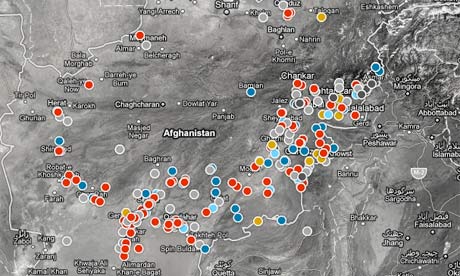
Guardian | It must be one of the biggest leaks in intelligence history. An archive of almost 90,000 files has come to light thanks to Wikileaks, logging the history of the war in Afghanistan, practically blow-by-blow. We've trawled through these incidents to help you make sense of the key events.

We have reproduced full military logs behind more than 200 of the key events from the database – you can navigate around them. But if you want to download this data to play with it yourself, this is the place to come.

These detailed reports show coalition forces' attacks on civilians, friendly fire incidents and Afghan forces attacking each other – so-called green on green.

wikileaks takes a new approach

WaPo | Wikileaks founder Julian Assange called the release of nearly 92,000 individual reports portraying a sputtering Afghan war effort "the nearest analogue to the Pentagon Papers." He was referring to the secret military documents that helped shift public opinion about the Vietnam War after they became public in 1971.

"It provides a whole map, if you like, through time, of what has happened during this war," said Assange, a native of Australia, in a television interview broadcast Sunday on Britain's public-service Channel 4.

He acknowledged that some will judge harshly the Web site's airing of classified documents, but he insisted that Wikileaks was not breaking the law or putting troops at risk. For the first time, Wikileaks decided unilaterally to delay the release of some documents because of the possibility that putting them out immediately could cause harm, he said.

"We believe that the way to justice is transparency, and we are clear that the end goal is to expose injustices in the world and try to rectify them," Assange said.

The publication of the documents also feeds an appetite for greater disclosure about the war, now in its ninth year.

"People want more details," said Steven Aftergood, director of the Federation for American Scientists' Project on Government Secrecy. "They want greater clarity and greater candor than they have gotten up to this point. Wikileaks, in this case, has filled a void left by the Pentagon."

The White House responded critically to the documents' release. "The United States strongly condemns the disclosure of classified information by individuals and organizations which could put the lives of Americans and our partners at risk, and threaten our national security," national security adviser James Jones said in a statement.Justify Full
Jones called the leaks "irresponsible" and said the White House only learned from news organizations that the documents would be posted online. A senior administration official said officials are reviewing the documents to decide whether to take legal action against the site.

Sunday, July 25, 2010

raw food raid - fight over what people put in their mouths


Video - LA Times reporter discussing raw food raid. (click story link to see guns drawn absurdity of one-time conducting the raid)

LATimes | With no warning one weekday morning, investigators entered an organic grocery with a search warrant and ordered the hemp-clad workers to put down their buckets of mashed coconut cream and to step away from the nuts.

Then, guns drawn, four officers fanned out across Rawesome Foods in Venice. Skirting past the arugula and peering under crates of zucchini, they found the raid's target inside a walk-in refrigerator: unmarked jugs of raw milk.

"I still can't believe they took our yogurt," said Rawesome volunteer Sea J. Jones, a few days after the raid. "There's a medical marijuana shop a couple miles away, and they're raiding us because we're selling raw dairy products?"

Cartons of raw goat and cow milk and blocks of unpasteurized goat cheese were among the groceries seized in the June 30 raid by federal, state and local authorities — the latest salvo in the heated food fight over what people can put in their mouths.

systemic fear, modern finance and the future of capitalism

B&N | Existing theories of political economy, liberal as well as Marxist, see capital as a dual entity. According to these theories, the "real" essence of capital consists of material/productive commodities, while the "financial" appearance of capital either accurately mirrors or fictitiously distorts this underlying reality. We reject this duality. Capital, we argue, is finance, and only finance. In its modern incarnation, capital exists as forward-looking capitalization, a universal financial ritual that discounts expected future earnings to a singular present value.

The universality of this reduction makes capitalization the most supple power instrument ever known to humanity. Previously, distributive power was associated with clear socio-ecological distinctions -- differences between king and subject, owner and slave, tiller and landlord, field and citadel, village and town. Capitalization flattens these qualitative features to the point of irrelevance. In principle, anyone can be a capitalist, and what distinguishes one capitalist from another is the quantity of their capitalization: the most powerful are those with the greatest capitalization (dominant capital), and those that hold that power achieve and augment it by increasing their capitalization faster than others (differential accumulation). In this way, capitalization crystallizes the power of capitalists to shape their world, as well as the resistance of those that oppose this power. It gauges the capitalists' success in directing production and consumption, in shaping ideology and culture, in affecting the law, public policy, conflict, war and even the environment. It is the all-encompassing algorithm that creorders -- or creates the order -- of the capitalist mode of power.

The purpose of our paper is to examine the breakdown of this algorithm. To be sure, this type of inquiry is hardly novel. Marxists have long searched for objective signs of capitalist collapse, preliminary omens that would foretell the system’s imminent disintegration. However, because of their dual conception of capital, they've tended to look for such signs in the so-called real sphere of production and consumption, while paying far less attention to finance, which, in their view, is merely a distorted mirror of that reality. But finance isn’t a mirror of real capital; it is real capital – and indeed the only real capital. So if we want to look for signs of systemic crisis and possible disintegration, our search should begin here, in the very ritual of capitalization.

The specific focus of the article is two historical ruptures of modern finance – the periods of 1929-1939 and 2000-2010. During both periods, capitalists abandoned the conventional forward-looking ritual of capitalization, resorting instead to the backward-looking posture of pre-modern finance. In our view, these rare episodes are of great importance for understanding the nature of capitalist confidence and the capitalists’ ability to rule – as well as the possibility that this system of rule will collapse. Our inquiry seeks, first, to characterize key features of these episodes; second, to speculate on their causes; and third, to assess, however speculatively, what they might imply for the future of capitalism.

the new science of morality


Video - BloggingHeads Paul Bloom breaks it down for Michael Murray.

Edge | Something radically new is in the air: new ways of understanding physical systems, new ways of thinking about thinking that call into question many of our basic assumptions. A realistic biology of the mind, advances in evolutionary biology, physics, information technology, genetics, neurobiology, psychology, engineering, the chemistry of materials: all are questions of critical importance with respect to what it means to be human. For the first time, we have the tools and the will to undertake the scientific study of human nature.

This began in the early seventies, when, as a graduate student at Harvard, evolutionary biologist Robert Trivers wrote five papers that set forth an agenda for a new field: the scientific study of human nature. In the past thirty-five years this work has spawned thousands of scientific experiments, new and important evidence, and exciting new ideas about who and what we are presented in books by scientists such as Richard Dawkins, Daniel C. Dennett, Steven Pinker, and Edward O. Wilson among many others.

In 1975, Wilson, a colleague of Trivers at Harvard, predicted that ethics would someday be taken out of the hands of philosophers and incorporated into the "new synthesis" of evolutionary and biological thinking. He was right.

Scientists engaged in the scientific study of human nature are gaining sway over the scientists and others in disciplines that rely on studying social actions and human cultures independent from their biological foundation.

No where is this more apparent than in the field of moral psychology. Using babies, psychopaths, chimpanzees, fMRI scanners, web surveys, agent-based modeling, and ultimatum games, moral psychology has become a major convergence zone for research in the behavioral sciences.

So what do we have to say? Are we moving toward consensus on some points? What are the most pressing questions for the next five years? And what do we have to offer a world in which so many global and national crises are caused or exacerbated by moral failures and moral conflicts? It seems like everyone is studying morality these days, reaching findings that complement each other more often than they clash.

Saturday, July 24, 2010

status as a valued resource?

HPLabs | While the striving for status has long been recognized in animals and in humans, the role of status in their utility calculations has not been clarified. Specifically, the debate has not been settled whether people pursue status as a means to achieve power and resources or as an (emotional) goal in itself. We present results of a rent seeking experiment with human subjects from four different national cultures. Our results show that people regard status as a valued resource in itself, rather than a means to an end. Participants in the experiment played a two-stage game in which they tried to win a risky all-or-none rent. An analysis of the data established that the subjects valued status independently of any monetary consequence and were willing to trade-off some material gain in order to obtain it. This result was stable across the four cultures from Hong Kong, Turkey, the US, and Germany. Moreover, the amount of money that participants were willing to trade off against status corresponded to the Hofstede's power distance index of the respective culture. The power distance index of a culture has been shown to be correlated with the importance and acceptance of status symbols in that culture. Finally, the amount of status seeking observed was different among men and women, an intriguing observation that deserves further work.

Chipocalypse Now - I Love The Smell Of Deportations In The Morning

sky |   Donald Trump has signalled his intention to send troops to Chicago to ramp up the deportation of illegal immigrants - by posting a...