Tuesday, April 06, 2010

priest charged in u.s. still serving in india

NYTimes | A Catholic priest who has been criminally charged with sexually assaulting a 14-year-old girl in Minnesota six years ago is still working in his home diocese in India despite warnings to the Vatican from an American bishop that the priest continued to pose a risk to children, according to church documents made public on Monday.

The documents show that the American bishop warned the Vatican that the priest was accused of molesting two teenage girls whose trust he gained by promising to discuss their interest in becoming nuns.

A county attorney in Minnesota is seeking to extradite the priest from India in a criminal case that involves one of the girls, who said the priest had forced her to perform oral sex and had threatened her and her family.

The case took place during the papacy of Pope Benedict XVI, who has recently come under fire for his role in cases of sexually abusive priests in Germany and Wisconsin.

The case was handled after the Vatican clarified and streamlined its procedures in 2001 to respond to accusations of sexual abuse by priests. In the midst of a growing scandal, the Vatican has sought to defend the pope by pointing out that he was both an architect and a promoter of these procedures.

But the Vatican also says it defers to local bishops to decide how to treat accused priests, leaving it exposed to criticism that the church is not doing enough to rein in sexually abusive priests.

In 2006, the Vatican recommended that the priest simply be monitored, a document shows. A lawyer for the Holy See said in a statement that the Vatican had recommended that the priest be defrocked, but that canon law specifies that the decision rests with the local bishop. The bishop in India sentenced the priest to a year of prayer in a monastery rather than seeking his removal from the priesthood, according to documents and interviews. Roman Catholic Church Sex Abuse Cases - Times Topic.

ireland child sex abuse scandal


SkyNews | An investigation into decades of alleged abuse at schools and orphanages run by the Catholic Church in Ireland has described how children were "terrorised" by nuns and priests. Around 2,500 men and women who were abused in schools and institutions across the Republic gave evidence to the government-backed Commission, led by Justice Sean Ryan at a total cost of £65m.

Victims had hoped the publication of its 2,500 pages would finally reveal the truth about the hidden torture they suffered as children. The Child Abuse Commission detailed a catalogue of disturbing and chronic sexual, physical and emotional abuse inflicted on thousands of disadvantaged, neglected and abandoned children over the last 70 years.

The church was aware long-term sex offenders were repeatedly abusing children, the damning report revealed. The inquiry found that paedophiles were moved from school to school each time their behaviour was uncovered.

"Sexual abuse was endemic in boys' institutions," said the long-awaited official report. It was known to religious authorities to be a "persistent problem in male religious oganisations", it went on. Nevertheless, each instance of sexual abuse was treated in isolation and in secrecy by the authorities and there was no attempt to address the underlying systemic nature of the problem."

The leader of the Catholic Church in Ireland, Cardinal Sean Brady, apologised for the abuse and said he was ashamed by what the report had found. "It documents a shameful catalogue of cruelty, neglect, physical, sexual and emotional abuse, perpetrated against children," he said.

"I am profoundly sorry and deeply ashamed that children suffered in such awful ways in these institutions." Fist tap BTx3.

Monday, April 05, 2010

retrofuturism

the drone wars....,

NYTimes | By all reports, the bombardment of North Waziristan, and to a lesser extent South Waziristan, has become fast and furious since a combined Taliban and Qaeda suicide attack on a C.I.A. base in Khost, in southern Afghanistan, in late December.

In the first six weeks of this year, more than a dozen strikes killed up to 90 people suspected of being militants, according to Pakistani and American accounts. There are now multiple strikes on some days, and in some weeks the strikes occur every other day, the people from North Waziristan said.

The strikes have become so ferocious, “It seems they really want to kill everyone, not just the leaders,” said the militant, who is a mid-ranking fighter associated with the insurgent network headed by Jalaluddin and Sirajuddin Haqqani. By “everyone” he meant rank-and-file fighters, though civilians are being killed, too.

Tactics used just a year ago to avoid the drones could not be relied on, he said. It is, for instance, no longer feasible to sleep under the trees as a way of avoiding the drones. “We can’t lead a jungle existence for 24 hours every day,” he said.

Militants now sneak into villages two at a time to sleep, he said. Some homeowners were refusing to rent space to Arabs, who are associated with Al Qaeda, for fear of their families’ being killed by the drones, he said.

The militants have abandoned all-terrain vehicles in favor of humdrum public transportation, one of the government supporters said.

The Arabs, who have always preferred to keep at a distance from the locals, have now gone further underground, resorting to hide-outs in tunnels dug into the mountainside in the Datta Khel area adjacent to Miram Shah, he said.

“Definitely Haqqani is under a lot of pressure,” the militant said. “He has lost commanders, a brother and other family members.”

While unpopular among the Pakistani public, the drone strikes have become a weapon of choice for the Obama administration after the Pakistani Army rebuffed pleas to mount a ground offensive in North Waziristan to take on the militants who use the area to strike at American and NATO forces in Afghanistan.

karzai threatening to go native...,

NYTimes | At the meeting, Mr. Karzai stepped up his anti-Western statements, according to a Parliament member who attended but spoke on condition of anonymity.

“If you and the international community pressure me more, I swear that I am going to join the Taliban,” Mr. Karzai said, according to the Parliament member.

A spokesman for Mr. Karzai, Waheed Omar, could not be reached for comment on Sunday.

In a speech in Kandahar on Sunday, Mr. Karzai promised local tribal elders that coalition military operations planned for the area this summer would not proceed without their approval.

“I know you are worried about this operation,” he said, adding: “There will be no operation until you are happy.”

Given his tone in the last few days, it was unclear whether he was literally extending the elders veto power over the offensive, or merely trying to quell their fears and bring them on board.

Interviews with diplomats, Afghan analysts and ordinary Afghans suggest that the United States and other Western countries have three options: threaten to withdraw troops or actually withdraw them; use diplomacy, which so far has had little result; and find ways to expand citizen participation in the government, which now has hardly any elected positions at the provincial and district levels.

Threatening to withdraw, which Stephen Biddle, a senior fellow at the Council on Foreign Relations, called the “nuclear deterrent” option, would put the United States and other Western countries in the position of potentially having to make good on the promise, risking their strategic interest in a stable Afghanistan. Few experts think the country would remain peaceful without a significant foreign force here. Moreover, withdrawal could open the way for the country to again become a terrorist haven.

Some Western critics of Mr. Karzai believe that the West has no choice but to threaten to leave.

calling afghanistan what it is - a drug war

Salon | In the late 1990s, the Taliban, which had taken power in most of the country, lost any chance for international legitimacy by protecting and profiting from opium -- and then, ironically, fell from power only months after reversing course and banning the crop. Since the U.S. military intervened in 2001, a rising tide of opium has corrupted the government in Kabul while empowering a resurgent Taliban whose guerrillas have taken control of ever larger parts of the Afghan countryside.

These three eras of almost constant warfare fueled a relentless rise in Afghanistan's opium harvest -- from just 250 tons in 1979 to 8,200 tons in 2007. For the past five years, the Afghan opium harvest has accounted for as much as 50 percent of the country's gross domestic product (GDP) and provided the prime ingredient for over 90 percent of the world's heroin supply.

The ecological devastation and societal dislocation from these three war-torn decades has woven opium so deeply into the Afghan grain that it defies solution by Washington's best and brightest (as well as its most inept and least competent). Caroming between ignoring the opium crop and demanding its total eradication, the Bush administration dithered for seven years while heroin boomed, and in doing so helped create a drug economy that corrupted and crippled the government of its ally, President Karzai. In recent years, opium farming has supported 500,000 Afghan families, nearly 20 percent of the country's estimated population, and funds a Taliban insurgency that has, since 2006, spread across the countryside.

To understand the Afghan War, one basic point must be grasped: In poor nations with weak state services, agriculture is the foundation for all politics, binding villagers to the government or warlords or rebels. The ultimate aim of counterinsurgency strategy is always to establish the state's authority. When the economy is illicit and by definition beyond government control, this task becomes monumental. If the insurgents capture that illicit economy, as the Taliban have done, then the task becomes little short of insurmountable.

Opium is an illegal drug, but Afghanistan's poppy crop is still grounded in networks of social trust that tie people together at each step in the chain of production. Crop loans are necessary for planting, labor exchange for harvesting, stability for marketing, and security for shipment. So dominant and problematic is the opium economy in Afghanistan today that a question Washington has avoided for the past nine years must be asked: Can anyone pacify a full-blown narco-state?

Saturday, April 03, 2010

how come?

what?

why?


Vatican - Niche of the Pinecone

teabonics


the new language of the tea party movement

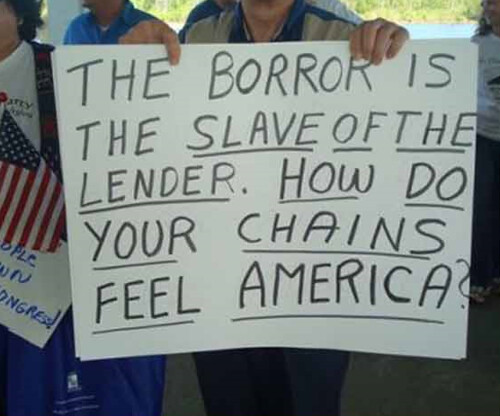
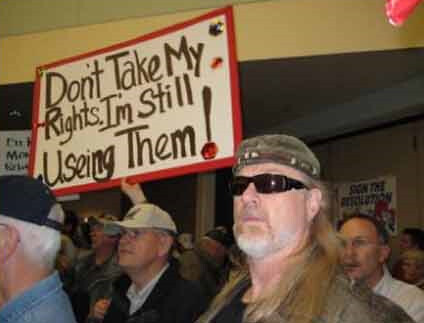
Guardian | Along with the Tea Party has risen not only an incoherent political movement but exciting and refreshing variations on the English language. Now Flickr user Pargon has collected together many fine examples of "Teabonics", the curious pidgin that has emerged on the simple signs and crude posters handcrafted by the modern-day Poujadists:
These are signs seen primarily at Tea Party Protests. They all feature "creative" spelling or grammar. This new dialect of the English language shall be known as "Teabonics."
This being the Guardian, we take a liberal view of the uses and abuses of English, and we'd be fools to pretend otherwise. There but for the grace of god, and so on. Obviously, signs like the one above – "Don't mortage my childs future" – are amusing enough for the mis-spelling. But signs such as these below, with one saying "Honk for English" and another next to it saying "No Amnety" – something to do with immigration – are even more delightful:

Friday, April 02, 2010

elite agenda for social transformation

RKMoore | In a non-growth economy, the mechanisms of production will become relatively static. Instead of corporations competing to innovate, we’ll have production bureaucracies. They’ll be semi-state, semi-private bureaucracies, concerned about budgets and quotas rather than growth, somewhat along the lines of the Soviet model. Such an environment is not driven by a need for growth capital, and it does not enable a profitable game of Monopoly.

We can already see steps being taken to shift the corporate model towards the bureaucratic model, through increased government intervention in economic affairs. With the Wall Street bailouts, the forced restructuring of General Motors, the call for centralized micromanagement of banking and industry, and the mandating of health insurance coverage, the government is saying that the market is to superseded by government directives. Not that we should bemoan the demise of exploitive capitalism, but before celebrating we need to understand what it is being replaced with.

In an era of capitalism and growth, the focus of the game has been on the production side of the economy. The game was aimed at controlling the means of growth: access to capital. The growth-engine of capitalism created the demand for capital; the bankers controlled the supply. Taxes were mostly based on income, again related to the production side of the economy.

In an era of non-growth, the focus of the game will be on the consumption side of the economy. The game will be aimed at controlling the necessities of life: access to food and energy. Population creates the demand for the necessities of life; the bankers intend to control the supply. Taxes will be mostly based on consumption, particularly of energy. That’s why they’re pushing for carbon taxes and carbon credits.

Already in Britain there is talk of carbon quotas, like gasoline rationing in wartime. It’s not just that you’ll pay taxes on energy, but the amount of energy you can consume will be determined by government directive. Carbon credits will be issued to you, which you can use for driving, for heating, or on rare occasions for air travel. Also in Britain, the highways are being wired so that they can track how many miles you drive, tax you accordingly, and penalize you if you travel over your limit. We can expect these kinds of things to spread throughout the West, as it’s the same international bankers who are in charge everywhere.

In terms of propaganda, this carbon-credit regime is being sold as a solution to global warming and peak oil. The propaganda campaign has been very successful, and the whole environmental movement has been captured by it. In Copenhagen, demonstrators confronted the police, carrying signs in support of carbon taxes and carbon credits. But in fact the carbon regime has nothing to do with climate or with sustainability. It is all about micromanaging every aspect of our lives, as well as every aspect of the economy.

the first exploitive hierarchies

RKMoore | In a hierarchal society there are a few at the top, who make the big decisions — and everyone else, who are obliged to abide by those decisions. If the interests of those at the top are aligned with the interests of the general population, hierarchy can be a somewhat reasonable mode of organization. The few are able to reach coherent decisions efficiently, and the many can get on with the business of society.

In our very first hierarchical societies — herding bands ruled by a warrior chief — we had such an alignment of interests. The chief and the band shared the goals of obtaining the best pastures for their herds, and protecting their territory from competing bands. A strong chief improved their combat prowess, and the system worked well for the chief and band alike.

The chief enjoyed many privileges, compared to the rest of the band, yet his role was essentially beneficial to the band, not exploitive. He got the biggest slice of the pie, and his lieutenants did well too, but overall the pie was divided reasonably equitably.

Our second generation of hierarchical societies emerged when herding bands conquered and enslaved early agricultural societies. The few at the top were now exploiting the majority of the population, and most of the pie was now being shared by the new upper class, the members of the conquering tribe. The slaves did all the hard work and grew the food, and subsisted on crumbs from the pie that their labor created.

From our modern perspective, this was a radically different kind of society than either of its ancestor societies, the herders and the agriculturalists. We can appreciate that this was the beginning of exploitive hierarchy, something that has cursed us ever since. This is a perspective that would have made sense to the slaves of that time as well. They had become slaves on the very lands they had once proudly called their own. For the first time, the interests of those at the top were no longer in alignment with the interests of the general population of the society.

From the perspective of the conquering tribe, however, the new societies were in many ways very similar to the original herding societies. The chief — now king — was still the undisputed ruler, and he still shared the pie more or less equitably with his fellows, the members of the conquering tribe. The difference was that the slaves had now taken the place of the herds.

Throughout history, slaves have always been looked on as subhuman by their masters. To the conquering tribe, this first generation of slaves was simply a better source of food than the herds had been. A greater supply of food could be obtained, and without the need to stay on the move looking for green pastures. Slaves were property, just like the herd animals had been, and they could perform many other kinds of labor as well, besides just food production. The slaves were not people: they were multi-purpose beasts of burden.

From the perspective of the conquerors, the internal structure of society had not changed radically — because the slaves were not part of society. Such was the nature of the early city-states that arose in Mesopotamia. Historians consider these slave-based societies to be the beginning of Western civilization.

the grand story of humanity

RKMoore | Because of language, we are involved in two different complex worlds, the world outside our heads, and the world inside our heads. The outside world is the real world, and I call the inside world the story world. I call it that because it seems to be organized in terms of stories.

Every sentence is a story, where some subject does some action to some object, and every paragraph is a slightly longer story. With Chinese ideograms, each symbol tells a little story. When we have conversations we tell stories to one another. Our dreams come as stories. We learn through stories. When we want to know the truth of current events, we tune in to our favorite channel to get the real story. Even a mathematical proof follows the story form, with a beginning, a middle, and an end, marked by QED, just like amen, the end, or that’s all folks.

Indeed, our very concept of understanding something is being able to tell its story coherently. And our concept of what is true is closely related to the concept of coherent story. A mathematical proof is valid if it tells a coherent story. A suspect appears guilty if he cannot give a coherent story as an alibi. Witnesses are trusted if their story is coherent. Even our concept of being sane is closely linked to being able to speak coherently, which is the same as being able to tell coherent stories.

Because story-processing skills are so central to our understanding, and to our functioning in society, it is not surprising that we get pleasure out of practicing those skills by listening to stories. In general, pleasure is an adaptive mechanism that draws us to what we need. Baby lions love to wrestle, thus learning the moves they will need as adult hunters.

Language and stories are not just about words. The same cognitive machinery supports other modalities. Music is a language, and a tune is a story. Art is a language and a painting is a story. Physics is a language and a theory is a story. Food preparation is a language, and a meal is a story. Each language must be learned before its stories can be told or appreciated.

I suppose all of this can be summed up by saying that we think, understand, create, and communicate in terms of stories, in one mode of language or another. As I write, my concern always is to be telling a coherent story in a coherent sequence. Coherence in a story is like digestibility in a meal.

Because we have specialized in the story way-of-knowing, we don’t feel we understand anything until we know its story. From a very early age we begin asking questions, wanting to hear stories that explain our experience to us. As our experience of the world expands, our need for stories expands. Eventually, we all get to the big questions: What is the meaning of life? and Where did we come from?

Wednesday, March 31, 2010

my man....,


dunning-kruger effect

Five to One - The Doors.

Wikipedia | The Dunning–Kruger effect is a cognitive bias in which "people reach erroneous conclusions and make unfortunate choices but their incompetence robs them of the metacognitive ability to realize it". The unskilled therefore suffer from illusory superiority, rating their own ability as above average, much higher than in actuality; by contrast the highly skilled underrate their abilities, suffering from illusory inferiority. This leads to a perverse result where less competent people will rate their own ability higher than more competent people. It also explains why actual competence may weaken self-confidence because competent individuals falsely assume that others have an equivalent understanding. "Thus, the miscalibration of the incompetent stems from an error about the self, whereas the miscalibration of the highly competent stems from an error about others."
The trouble with the world is that the stupid are cocksure and the intelligent are full of doubt. — Bertrand Russell
When the Music's Over - The Doors.

pale horse's million armed man march

hutaree nutter on larouche front talk show

Chipocalypse Now - I Love The Smell Of Deportations In The Morning

sky |   Donald Trump has signalled his intention to send troops to Chicago to ramp up the deportation of illegal immigrants - by posting a...