Monday, April 05, 2010

calling afghanistan what it is - a drug war

Salon | In the late 1990s, the Taliban, which had taken power in most of the country, lost any chance for international legitimacy by protecting and profiting from opium -- and then, ironically, fell from power only months after reversing course and banning the crop. Since the U.S. military intervened in 2001, a rising tide of opium has corrupted the government in Kabul while empowering a resurgent Taliban whose guerrillas have taken control of ever larger parts of the Afghan countryside.

These three eras of almost constant warfare fueled a relentless rise in Afghanistan's opium harvest -- from just 250 tons in 1979 to 8,200 tons in 2007. For the past five years, the Afghan opium harvest has accounted for as much as 50 percent of the country's gross domestic product (GDP) and provided the prime ingredient for over 90 percent of the world's heroin supply.

The ecological devastation and societal dislocation from these three war-torn decades has woven opium so deeply into the Afghan grain that it defies solution by Washington's best and brightest (as well as its most inept and least competent). Caroming between ignoring the opium crop and demanding its total eradication, the Bush administration dithered for seven years while heroin boomed, and in doing so helped create a drug economy that corrupted and crippled the government of its ally, President Karzai. In recent years, opium farming has supported 500,000 Afghan families, nearly 20 percent of the country's estimated population, and funds a Taliban insurgency that has, since 2006, spread across the countryside.

To understand the Afghan War, one basic point must be grasped: In poor nations with weak state services, agriculture is the foundation for all politics, binding villagers to the government or warlords or rebels. The ultimate aim of counterinsurgency strategy is always to establish the state's authority. When the economy is illicit and by definition beyond government control, this task becomes monumental. If the insurgents capture that illicit economy, as the Taliban have done, then the task becomes little short of insurmountable.

Opium is an illegal drug, but Afghanistan's poppy crop is still grounded in networks of social trust that tie people together at each step in the chain of production. Crop loans are necessary for planting, labor exchange for harvesting, stability for marketing, and security for shipment. So dominant and problematic is the opium economy in Afghanistan today that a question Washington has avoided for the past nine years must be asked: Can anyone pacify a full-blown narco-state?

Saturday, April 03, 2010

how come?

what?

why?


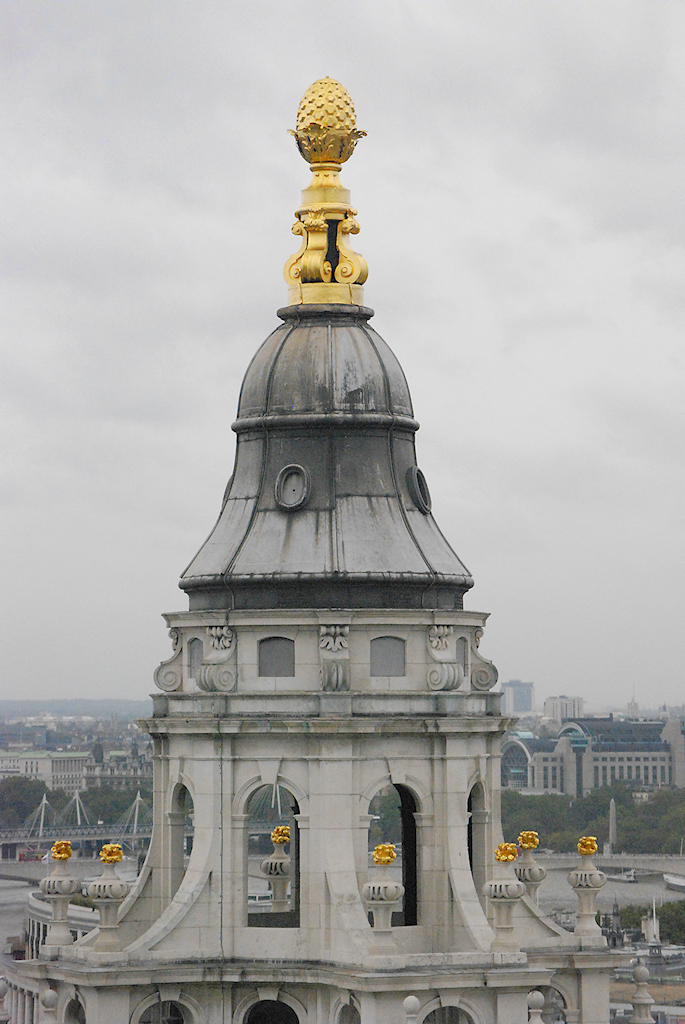
Vatican - Niche of the Pinecone

teabonics


the new language of the tea party movement

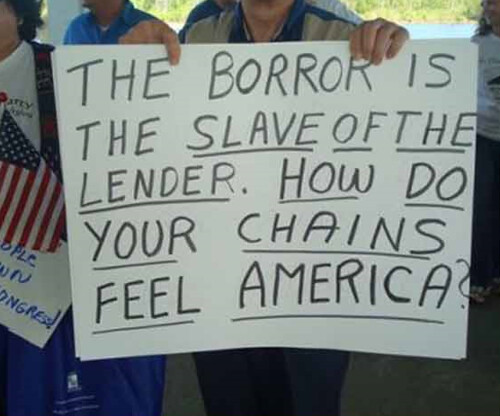
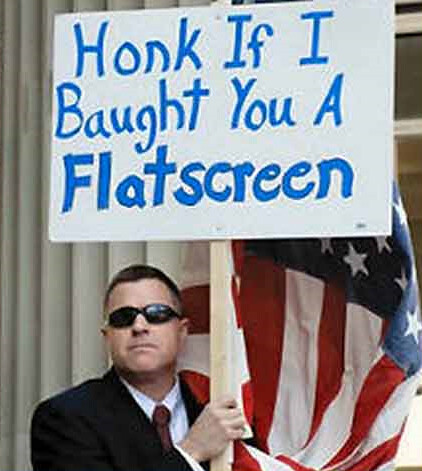
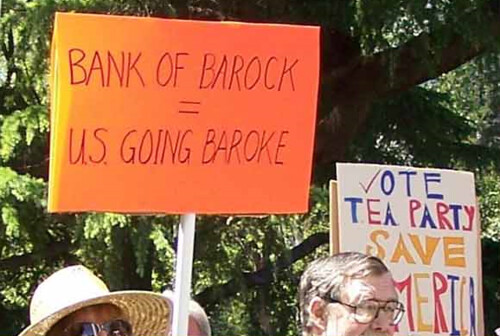
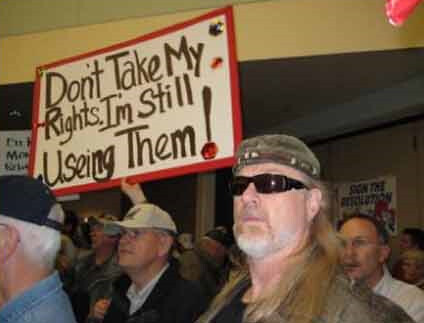
Guardian | Along with the Tea Party has risen not only an incoherent political movement but exciting and refreshing variations on the English language. Now Flickr user Pargon has collected together many fine examples of "Teabonics", the curious pidgin that has emerged on the simple signs and crude posters handcrafted by the modern-day Poujadists:
These are signs seen primarily at Tea Party Protests. They all feature "creative" spelling or grammar. This new dialect of the English language shall be known as "Teabonics."
This being the Guardian, we take a liberal view of the uses and abuses of English, and we'd be fools to pretend otherwise. There but for the grace of god, and so on. Obviously, signs like the one above – "Don't mortage my childs future" – are amusing enough for the mis-spelling. But signs such as these below, with one saying "Honk for English" and another next to it saying "No Amnety" – something to do with immigration – are even more delightful:

Friday, April 02, 2010

elite agenda for social transformation

RKMoore | In a non-growth economy, the mechanisms of production will become relatively static. Instead of corporations competing to innovate, we’ll have production bureaucracies. They’ll be semi-state, semi-private bureaucracies, concerned about budgets and quotas rather than growth, somewhat along the lines of the Soviet model. Such an environment is not driven by a need for growth capital, and it does not enable a profitable game of Monopoly.

We can already see steps being taken to shift the corporate model towards the bureaucratic model, through increased government intervention in economic affairs. With the Wall Street bailouts, the forced restructuring of General Motors, the call for centralized micromanagement of banking and industry, and the mandating of health insurance coverage, the government is saying that the market is to superseded by government directives. Not that we should bemoan the demise of exploitive capitalism, but before celebrating we need to understand what it is being replaced with.

In an era of capitalism and growth, the focus of the game has been on the production side of the economy. The game was aimed at controlling the means of growth: access to capital. The growth-engine of capitalism created the demand for capital; the bankers controlled the supply. Taxes were mostly based on income, again related to the production side of the economy.

In an era of non-growth, the focus of the game will be on the consumption side of the economy. The game will be aimed at controlling the necessities of life: access to food and energy. Population creates the demand for the necessities of life; the bankers intend to control the supply. Taxes will be mostly based on consumption, particularly of energy. That’s why they’re pushing for carbon taxes and carbon credits.

Already in Britain there is talk of carbon quotas, like gasoline rationing in wartime. It’s not just that you’ll pay taxes on energy, but the amount of energy you can consume will be determined by government directive. Carbon credits will be issued to you, which you can use for driving, for heating, or on rare occasions for air travel. Also in Britain, the highways are being wired so that they can track how many miles you drive, tax you accordingly, and penalize you if you travel over your limit. We can expect these kinds of things to spread throughout the West, as it’s the same international bankers who are in charge everywhere.

In terms of propaganda, this carbon-credit regime is being sold as a solution to global warming and peak oil. The propaganda campaign has been very successful, and the whole environmental movement has been captured by it. In Copenhagen, demonstrators confronted the police, carrying signs in support of carbon taxes and carbon credits. But in fact the carbon regime has nothing to do with climate or with sustainability. It is all about micromanaging every aspect of our lives, as well as every aspect of the economy.

the first exploitive hierarchies

RKMoore | In a hierarchal society there are a few at the top, who make the big decisions — and everyone else, who are obliged to abide by those decisions. If the interests of those at the top are aligned with the interests of the general population, hierarchy can be a somewhat reasonable mode of organization. The few are able to reach coherent decisions efficiently, and the many can get on with the business of society.

In our very first hierarchical societies — herding bands ruled by a warrior chief — we had such an alignment of interests. The chief and the band shared the goals of obtaining the best pastures for their herds, and protecting their territory from competing bands. A strong chief improved their combat prowess, and the system worked well for the chief and band alike.

The chief enjoyed many privileges, compared to the rest of the band, yet his role was essentially beneficial to the band, not exploitive. He got the biggest slice of the pie, and his lieutenants did well too, but overall the pie was divided reasonably equitably.

Our second generation of hierarchical societies emerged when herding bands conquered and enslaved early agricultural societies. The few at the top were now exploiting the majority of the population, and most of the pie was now being shared by the new upper class, the members of the conquering tribe. The slaves did all the hard work and grew the food, and subsisted on crumbs from the pie that their labor created.

From our modern perspective, this was a radically different kind of society than either of its ancestor societies, the herders and the agriculturalists. We can appreciate that this was the beginning of exploitive hierarchy, something that has cursed us ever since. This is a perspective that would have made sense to the slaves of that time as well. They had become slaves on the very lands they had once proudly called their own. For the first time, the interests of those at the top were no longer in alignment with the interests of the general population of the society.

From the perspective of the conquering tribe, however, the new societies were in many ways very similar to the original herding societies. The chief — now king — was still the undisputed ruler, and he still shared the pie more or less equitably with his fellows, the members of the conquering tribe. The difference was that the slaves had now taken the place of the herds.

Throughout history, slaves have always been looked on as subhuman by their masters. To the conquering tribe, this first generation of slaves was simply a better source of food than the herds had been. A greater supply of food could be obtained, and without the need to stay on the move looking for green pastures. Slaves were property, just like the herd animals had been, and they could perform many other kinds of labor as well, besides just food production. The slaves were not people: they were multi-purpose beasts of burden.

From the perspective of the conquerors, the internal structure of society had not changed radically — because the slaves were not part of society. Such was the nature of the early city-states that arose in Mesopotamia. Historians consider these slave-based societies to be the beginning of Western civilization.

the grand story of humanity

RKMoore | Because of language, we are involved in two different complex worlds, the world outside our heads, and the world inside our heads. The outside world is the real world, and I call the inside world the story world. I call it that because it seems to be organized in terms of stories.

Every sentence is a story, where some subject does some action to some object, and every paragraph is a slightly longer story. With Chinese ideograms, each symbol tells a little story. When we have conversations we tell stories to one another. Our dreams come as stories. We learn through stories. When we want to know the truth of current events, we tune in to our favorite channel to get the real story. Even a mathematical proof follows the story form, with a beginning, a middle, and an end, marked by QED, just like amen, the end, or that’s all folks.

Indeed, our very concept of understanding something is being able to tell its story coherently. And our concept of what is true is closely related to the concept of coherent story. A mathematical proof is valid if it tells a coherent story. A suspect appears guilty if he cannot give a coherent story as an alibi. Witnesses are trusted if their story is coherent. Even our concept of being sane is closely linked to being able to speak coherently, which is the same as being able to tell coherent stories.

Because story-processing skills are so central to our understanding, and to our functioning in society, it is not surprising that we get pleasure out of practicing those skills by listening to stories. In general, pleasure is an adaptive mechanism that draws us to what we need. Baby lions love to wrestle, thus learning the moves they will need as adult hunters.

Language and stories are not just about words. The same cognitive machinery supports other modalities. Music is a language, and a tune is a story. Art is a language and a painting is a story. Physics is a language and a theory is a story. Food preparation is a language, and a meal is a story. Each language must be learned before its stories can be told or appreciated.

I suppose all of this can be summed up by saying that we think, understand, create, and communicate in terms of stories, in one mode of language or another. As I write, my concern always is to be telling a coherent story in a coherent sequence. Coherence in a story is like digestibility in a meal.

Because we have specialized in the story way-of-knowing, we don’t feel we understand anything until we know its story. From a very early age we begin asking questions, wanting to hear stories that explain our experience to us. As our experience of the world expands, our need for stories expands. Eventually, we all get to the big questions: What is the meaning of life? and Where did we come from?

Wednesday, March 31, 2010

my man....,


dunning-kruger effect

Five to One - The Doors.

Wikipedia | The Dunning–Kruger effect is a cognitive bias in which "people reach erroneous conclusions and make unfortunate choices but their incompetence robs them of the metacognitive ability to realize it". The unskilled therefore suffer from illusory superiority, rating their own ability as above average, much higher than in actuality; by contrast the highly skilled underrate their abilities, suffering from illusory inferiority. This leads to a perverse result where less competent people will rate their own ability higher than more competent people. It also explains why actual competence may weaken self-confidence because competent individuals falsely assume that others have an equivalent understanding. "Thus, the miscalibration of the incompetent stems from an error about the self, whereas the miscalibration of the highly competent stems from an error about others."
The trouble with the world is that the stupid are cocksure and the intelligent are full of doubt. — Bertrand Russell
When the Music's Over - The Doors.

pale horse's million armed man march

hutaree nutter on larouche front talk show

Tuesday, March 30, 2010

traveling wave reactors

the rage is not about healthcare

NYTimes | To find a prototype for the overheated reaction to the health care bill, you have to look a year before Medicare, to the Civil Rights Act of 1964. Both laws passed by similar majorities in Congress; the Civil Rights Act received even more votes in the Senate (73) than Medicare (70). But it was only the civil rights bill that made some Americans run off the rails. That’s because it was the one that signaled an inexorable and immutable change in the very identity of America, not just its governance.

The apocalyptic predictions then, like those about health care now, were all framed in constitutional pieties, of course. Barry Goldwater, running for president in ’64, drew on the counsel of two young legal allies, William Rehnquist and Robert Bork, to characterize the bill as a “threat to the very essence of our basic system” and a “usurpation” of states’ rights that “would force you to admit drunks, a known murderer or an insane person into your place of business.” Richard Russell, the segregationist Democratic senator from Georgia, said the bill “would destroy the free enterprise system.” David Lawrence, a widely syndicated conservative columnist, bemoaned the establishment of “a federal dictatorship.” Meanwhile, three civil rights workers were murdered in Philadelphia, Miss.

That a tsunami of anger is gathering today is illogical, given that what the right calls “Obamacare” is less provocative than either the Civil Rights Act of 1964 or Medicare, an epic entitlement that actually did precipitate a government takeover of a sizable chunk of American health care. But the explanation is plain: the health care bill is not the main source of this anger and never has been. It’s merely a handy excuse. The real source of the over-the-top rage of 2010 is the same kind of national existential reordering that roiled America in 1964.

In fact, the current surge of anger — and the accompanying rise in right-wing extremism — predates the entire health care debate. The first signs were the shrieks of “traitor” and “off with his head” at Palin rallies as Obama’s election became more likely in October 2008. Those passions have spiraled ever since — from Gov. Rick Perry’s kowtowing to secessionists at a Tea Party rally in Texas to the gratuitous brandishing of assault weapons at Obama health care rallies last summer to “You lie!” piercing the president’s address to Congress last fall like an ominous shot.

If Obama’s first legislative priority had been immigration or financial reform or climate change, we would have seen the same trajectory. The conjunction of a black president and a female speaker of the House — topped off by a wise Latina on the Supreme Court and a powerful gay Congressional committee chairman — would sow fears of disenfranchisement among a dwindling and threatened minority in the country no matter what policies were in play. It’s not happenstance that Frank, Lewis and Cleaver — none of them major Democratic players in the health care push — received a major share of last weekend’s abuse. When you hear demonstrators chant the slogan “Take our country back!,” these are the people they want to take the country back from.

the tea party allstars...,

Freep | Six Michigan residents, two Ohio residents and an Indiana resident have been indicted on charges of attempted use of weapons of mass destruction in connection with their membership in a Lenawee County Christian militia group.

Members of the Hutaree -- including a Michigan couple and their two sons -- conspired to oppose by force the authority of the U.S. government, according to a release by the U.S. Attorney’s Office in Detroit.

The indictment unsealed in U.S. District Court today claims that the Hutaree planned to kill an unidentified member of local law enforcement and then attack the law enforcement officers who gather in Michigan for the funeral. According to the plan, the Hutaree would attack law enforcement vehicles during the funeral procession with improvised explosive devices rigged with projectiles, which constitute weapons of mass destruction, according to the announcement by U.S. Attorney Barbara L. McQuade.

“Because the Hutaree had planned a covert reconnaissance operation for April which had the potential of placing an unsuspecting member of the public at risk, the safety of the public and of the law enforcement community demanded intervention at this time," McQuade said in the announcement. “Hutaree members view local, state, and federal law enforcement as the ‘brotherhood,’ their enemy, and have been preparing to engage them in armed conflict.”

Alleged Hutaree members indicted are David Brian Stone, 45; his wife, Tina Stone, 44; his son, Joshua Matthew Stone, 21, of Clayton, Mich.; and his other son, David Brian Stone Jr., 19, of Adrian; Joshua Clough, 28, of Blissfield; Michael Meeks, 40 of Manchester; Thomas Piatek, 46, of Whiting, Ind.; Kristopher Sickles, 27, of Sandusky, Ohio, and Jacob Ward, 33, of Huron, Ohio.

Joshua Stone is the only alleged Hutaree not in custody. Anyone with information about Stone should contact the Federal Bureau of Investigation at 313- 965-2323.

under shadow of 1957, arkansas sits this one out...,

WaPo | As 14 states move forward with a lawsuit to block President Obama's new health-care law, calling it an unconstitutional infringement on state sovereignty, Arkansas is nowhere to be found.

"They tried it here in Arkansas in '57 and it didn't work," Gov. Mike Beebe (D) told reporters recently. "I think you got to tell people the truth. And if I understand the law, the truth is the federal government can't just be defied by the state governments."

There are memorials here to the events of 1957, when a previous Arkansas governor rejected federal authority and tried to prevent nine black students from attending all-white Little Rock Central High School. It took U.S. soldiers to protect the students, who made history during an epic struggle over racism and federal power.

To Beebe and Attorney General Dustin McDaniel (D), the lawsuits filed last week and a states'-rights measure proposed for the November ballot are unwelcome echoes. In the face of an implicit request from 33 Republican state legislators to enlist in the court fight, McDaniel remains unmoved.

"I would be abusing my office to bring a suit that I believe to be constitutionally frivolous," McDaniel said in a telephone interview. "State budgets are tight enough right now without bringing actions that are entirely driven by political motivation rather than sound legal justification."

The Arkansas experience in the 1950s rubbed the state raw and delivered a resounding defeat to segregationists, who made arguments similar to the ones launched by opponents of the Democratic-led health-care overhaul.

The central issues, according to many "tea party" protesters and Republican lawmakers, are personal freedom and state sovereignty and the role of the federal government in both spheres.

As Virginia legislators debated a law making it illegal for Congress to require the purchase of health insurance, Attorney General Ken Cuccinelli II (R) called Obama's proposals an "onslaught on our liberty."

"In seeking to protect the liberties guaranteed by the Constitution," Cuccinelli wrote in this month's American Spectator, "we are vigorously pursuing freedom for our citizens in the face of a government that, no matter how well intentioned, seeks to expand its power at citizens' expense."

In 1956, two years after the Supreme Court ruling in Brown v. Board of Education overturned the concept of separate but equal, every member of the Arkansas congressional delegation signed "The Southern Manifesto." It declared that the court had abused its power and encroached "on rights reserved to the states and the people."

Parents, the manifesto said, "should not be deprived by government of the rights to direct the lives and education of their own children." The changes were happening "without regard to the consent of the governed" -- a mantra of tea party protesters and Republican members of Congress who voted against the Democrats' health-care bills.

Also in 1956, Gov. Orval E. Faubus (D) was quoted as saying that "neither the state of Arkansas nor its people delegated to the federal government . . . the power to regulate or control the operation of the domestic institutions of Arkansas."

gop makin it rain on'em hizzoes...,

Guardian | Some in the Republican party have been trying to force Steele out on the grounds of his poor performance. Now they have more ammunition in the form of published returns showing that the RNC has spent lavishly during trips around the country – including nearly $2,000 on a high-end strip club in West Hollywood.

The Daily Caller website posted the details from Federal Election Commission filings that the party is obliged to report. It noted:
A February RNC trip to California, for example, included a $9,099 stop at the Beverly Hills Hotel, $6,596 dropped at the nearby Four Seasons, and $1,620.71 spent [update: the amount is actually $1,946.25] at Voyeur West Hollywood, a bondage-themed nightclub featuring topless women dancers imitating lesbian sex.

RNC trips to other cities produced bills from a long list of chic and costly hotels such as the Venetian and the M Resort in Las Vegas, and the W (for a total of $19,443) in Washington. A midwinter trip to Hawaii cost the RNC $43,828, not including airfare.
FEC filing by Republican National Committee The RNC's declaration of spending at West Hollywood strip club Voyeur. Under "purpose of disbursement," Republican officials put: "Meals".
Voyeur West Hollywood is, according to the Los Angeles Times, modelled on sex scenes in the awful Stanley Kubrick/Tom Cruise/Nicole Kidman porn film Eyes Wide Shut. It describes the scene:
The dark, leather-heavy interior is reminiscent of the masked orgy scene from the movie. The reference is taken a step further with impromptu bondage and S&M "scenes" being played out on an elevated platform by scantily clad performers throughout the night – not presented as "shows," like they are in clubs such as Playhouse Hollywood. There is also a heavy net suspended above the club's lounge area where performers writhe above the heads of clubgoers. Even more provocative scenes are played out in an enclosed glass booth area adjacent to the club's dance floor area.

"It's pretty ... intense," clubgoer Lee Stone admitted on opening night as one female performer with a horse's bit in her mouth was being strapped to the wall by another just behind the booth he was sharing with friends. His friend was more intrigued by the action. "I wonder if I would get in trouble for joining them?" she joked.
A recent reviewer on the Yelp website wrote: "There are topless 'dancers' acting out S&M scenes throughout the night on one of the side stages, there's a half-naked girl hanging from a net across the ceiling and at one point I walked to the bathroom and pretty much just stopped dead in my tracks to watch two girls simulating oral sex in a glass case. Really understated elegance here."

Classy. According to the Daily Caller's piece: "Steele himself declined numerous interview requests, though his defenders point out that luxurious accommodations are sometimes necessary to attract big-time donors, especially since Republicans remain in the minority in Washington."

Monday, March 29, 2010

patriot dress-up hobby enthusiasts get raided...,

Hutaree members playing dress-up to weird German music.

Freep | Federal agents conducted raids over the weekend in Lenawee and Wastenaw counties that reports say may be related to some members of Hutaree, a Christian-militia group in Michigan.

"We can confirm that there were law enforcement activities in the Lenawee/Washtenaw County area," said Detroit FBI Special Agent Sandra Berchtold. But she added that "the federal warrants are sealed and we can not comment at this time."

The website for Hutaree says that it is "preparing for the end time battles to keep the testimony of Jesus Christ alive." The group's logo is a cross with the initials CCR, Colonial Christian Republic. In one of its videos, a group of men in military gear take down a burning United Nations flag and replace it with their flag, which has a cross.

Other militia groups said they have nothing to do with the federal raids.

"Neither MICHIGANMILITIA.COM nor the SMVM (Southeast Michigan Volunteer Militia) have been raided by the FBI. We do nothing illegal." reads a statement on michiganmilitia.com

On the Hutaree website, it warns of an anti-Christ. "As christians we all are a part of the Souls of the Body of Christ, the one true church of Christ. Not any specific man made building or any man controlled organization. This is the belief of the Hutaree soldier, as should the belief of all followers in Christ be. We believe that one day, as prophecy says, there will be an Anti-Christ. All christians must know this and prepare, just as Christ commanded."

The group's message boards contained messages expressing concern about the raids.

A member of Hutaree could not be immediately reached for comment.

Chipocalypse Now - I Love The Smell Of Deportations In The Morning

sky |   Donald Trump has signalled his intention to send troops to Chicago to ramp up the deportation of illegal immigrants - by posting a...