Monday, March 15, 2010

a lesson from the great depression

Hotchalk | During the Depression, along with restoring a collapsed economy, the United States government recognized the need for a "national unity". The government viewed the economically devastated public as "a people without a unifying central culture". Back then, it was as important to the government to cultivate a unified American society as it was to return the country to economic stability. Eleanor Roosevelt brilliantly understood the need to develop a national sense of esteem and identity, and pressured her husband to take action. Between 1933 and 1934, the Public Works of Art Project One was initiated by the government to create murals on public buildings. It employed 3700 artists and resulted in over 15,000 works of art. The Federal Art Project, a division of the Works Progress Administration- or WPA- was created in 1935. It employed over 5000 artists and produced 225,000 works of art for the American public. Artists such as Jackson Pollock, Mark Rothko, Willim de Kooning and Diego Rivera were among those employed as muralists during the depression. Regionalism, art that depicted specific national regions, became popular through artists such as Grant Wood and Edward Hopper. Artists, writers and musicians were paid to create. Visual artists had complete freedom over their subject matter and medium unless they were being commissioned to create a mural. Divisions within the Project One included a teaching project which employed artists to teach classes at neighborhood houses or community centers. Over two million students attended W.P.A. art classes during the eight years of the program.

As important as it was to support the arts during the worst financial crisis in American history, it is equally as important to do so now. One of the major factors in the development of creating a "national unity" during the Depression was to prevent a sense of disenfranchisement and despair in the youth during that time. It was essential to instill a sense of hope in the upcoming generation, so that they would believe they could attain a quality life. It is for this very same reason that we need to keep the arts alive and healthy today in classrooms, community centers, businesses and industry. It is the arts that provides our youth and our people with a venue for creative contribution; a way to make sense of a world that has become increasingly complex and difficult. Our art is our way. Technology and innovation have their place, but they are not what esteems us as a society. It is the arts that have been our cultural heritage and will serve as our legacy to the generations of tomorrow.

church in our times - common security clubs

EnergyBulletin | The Reverend Cecilia Kingman, of Cascade Unitarian Universalist Fellowship in East Wenatchee, Washington, feels the church has a unique role to play in this moment of crisis: “All of the old stories are failing us, and we need new stories. Religion is the only institution that creates new stories, and a new theology.”

Cecilia has served several congregations in the past decade, and has observed a heightening amount of anxiety and depression in her congregations over that time. “People are overwhelmed by grief and anxiety...part of my job is to put grief work before them on a regular basis. I try to be deft about it--one upcoming service is about “how to keep moving forward in times of despair”, dealing with climate change, the economy, and so on. Rather than provide the congregation with false assurances, I’m approaching it through the story of Jonah (in the belly of the whale): we have to feel the loss and despair first. If we are clinging to trying not to feel bad, then there’s no possibility of real transformation.”

I work for the Institute for Policy Studies as an organizer, and my main project is the Common Security Club (CSC). CSCs are groups of about 20 people who come together to face the economic crisis in community. A facilitator takes them through a 5-session curriculum with three intents: learning together about the economy, fostering mutual aid and cooperation among group members, and moving into taking larger actions to create a livable economy. The Clubs create an intimate environment in which people are honest about their finances, their troubles, and their fears about the future. Slowly and cautiously, a space is formed in which people can face the reality that we are not going back to a growth economy, that our earth is truly imperiled, and that we must create the new world now.

We have found the Common Security Club a particularly effective tool for strengthening congregations in this time of economic and ecological crisis. These groups may seem unique, but really they help recreate the role that churches have always played in communities. The crisis we face is too big for us to hold alone. It’s imperative that we find communities in which to share our grief, pledge our support, and receive the aid and generosity of others.

Jim Antal is the conference Minister and President of the United Church of Christ in Massachusetts. Jim preaches in a different congregation every Sunday, and 90% of his sermons focus on climate change. Jim believes that “the unit of survival going forward is the local town--and guess what? There’s a church in every town! The circumstances of the planet require that churches embrace a new vocation--for all faiths. We must realize that “our “neighbor is all of creation, not just human beings, and we must think of unborn generations as our neighbors too. This idea has theological purchase, it grabs people, and then they can begin to change their lives, to do the things we can and should do for the earth, things which are in fact spiritual practices.”

our energy supply - some basics

The Oil Drum | If a person were to listen to Energy Secretary Steven Chu or National Geographic's Aftermath: World Without Oil, one might think that our energy problems are fairly minor and distant. We can easily add sufficiently renewable energy to substitute for fossil fuels in a fairly short time frame. All we need to do is put our minds (and pocketbooks) to it.

But if one looks at the situation more closely, one discovers that the situation is quite different. Our energy problems are close at hand, and solutions using what are optimistically called "renewables" are distant and may very well sink the country further into recession.

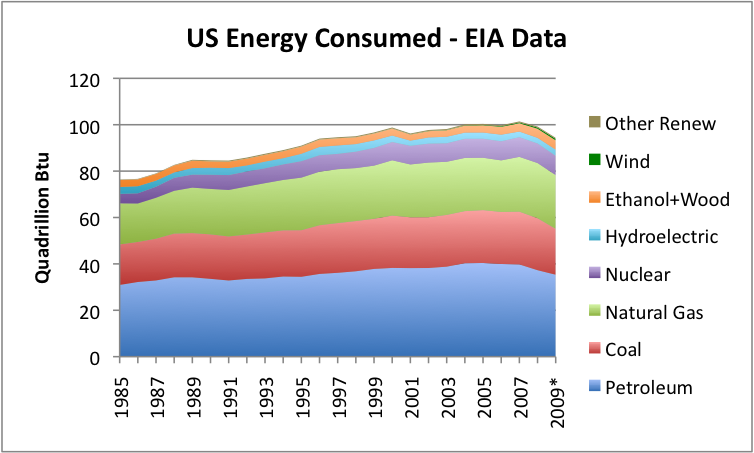
Figure 1- US energy consumption by source, based Energy Information Administration (EIA) Monthly Energy Review Table 1.3.
*Year 2009 estimated based on data through November.
US energy consumption is already down quite a bit--some might say due to recession, but it seems even more likely that the result is the other way around--high energy prices squeezed the financial system. This in turn caused credit availability to drop and demand for oil, gas, and coal to drop. We have put a huge amount of effort and subsidies into wind and solar, but they hardly show up on the chart. Ethanol isn't shown separately in the chart this data was taken from--instead it is combined with wood and with other biofuels in a category called "biomass" in the EIA data. The biomass line has thickened a bit, but it is still pretty insignificant.

Saturday, March 13, 2010

brand obama - conspicuous consumption collides with collapse

NYTimes | Long before the State Dinner party crashers and the tension with her White House colleagues and the strain in her relationship with the first lady, Desirée Rogers began to understand she was in trouble when David Axelrod summoned her to his office last spring to scold her.

Ms. Rogers had appeared in another glossy magazine, posing in a White House garden in a borrowed $3,495 silk pleated dress and $110,000 diamond earrings. But if the image was jarring in a time of recession, Mr. Axelrod was as bothered by the words and her discussion of “the Obama brand” and her role in promoting it, according to people informed about the conversation.

“The president is a person, not a product,” he was said to tell her. “We shouldn’t be referring to him as a brand.”

The confrontation that day between Ms. Rogers, the White House social secretary, and Mr. Axelrod, the senior adviser to President Obama, put at odds two longtime Chicago friends of the first family. And it foreshadowed a deeper, wrenching conflict that would eventually cost Ms. Rogers her job and tear at the fabric of the close-knit inner circle around Mr. Obama.

peak oil demand - yes, but not the nice kind!

EnergyandCapital | As we enter the post-peak phase of global oil supply sometime around 2012-2014, the price that heavily import-dependent countries like the U.S. would have to pay for that marginal barrel will become increasingly intolerable. In a weakened economy, $100 a barrel (or less) could be the new $120.

The true import of peak oil, therefore, may not be sustained high prices, but economic shrinkage. Demand will be destroyed long before oil gets to $200 a barrel, but it will not be destroyed by improved efficiency.

From where we stand today, it's hard to make an argument for economic recovery. Persistently high unemployment rates, broken state and federal balance sheets, and an inflationary depression will continue to cut into petroleum demand.

We spent the last several decades offshoring the fundamental value-adding sectors like energy production and manufacturing, and now our FIRE economy — finance, insurance, and real estate — rests entirely on real value created elsewhere.

The reason is simple: Energy is the only real currency.

Every dollar of fiat currency or GDP was ultimately derived from cheap energy. Trying to print your way out of energy decline is like prescribing ever-higher doses of aspirin for a headache caused by a brain tumor. Yet those at the levers of monetary policy are, by all appearances, completely ignorant (or in willful denial) of this fundamental fact.

The vogue prescription for the sovereign debtors at greatest risk of default (see a Top 10 list) is "austerity measures." The theory is that a period of belt-tightening will stanch the fiscal bleeding until economic recovery puts everyone into the black again.

Yet, if primary energy supply is declining, and the rising star of developing economies is inexorably cutting into the supply available to developed and indebted economies, then there can be no recovery.

I have joked on Twitter that I'm expecting an "M-shaped recovery," where we're now on the second hump. A more accurate image is slow strangulation.

conventional crude production to peak in 2014

Green Car | Scientists from Kuwait University and Kuwait Oil Company are forecasting that world conventional crude oil production will peak in 2014—almost a decade earlier than some other predictions. Their study is in published the ACS journal Energy & Fuels.

Ibrahim Nashawi and colleagues point out that rapid growth in global oil consumption has sparked a growing interest in predicting “peak oil”—the point at which oil production reaches a maximum and then declines. Scientists have developed several models to forecast this point, and some put the date at 2020 or later. The Hubbert forecast model—one of the most famous—accurately predicted that oil production would peak in the United States in 1970. The model has since gained in popularity and has been used to forecast oil production worldwide. However, recent studies show that the model is insufficient to account for more complex oil production cycles of some countries. Those cycles can be heavily influenced by technology changes, politics, and other factors, the scientists say.

The new study describes the development of a new version of the Hubbert model that accounts for these individual production trends to provide a more realistic and accurate oil production forecast.

Friday, March 12, 2010

optogenetic neurophysiology

SciAm | as our understanding of the brain grows, our desire to intervene, to help ameliorate the many pathologies to which the mind is prey, grows commensurately. Yet today’s tools (drugs and deep-brain stimulations) are comparatively crude, with undesirable side effects.

To the rescue rides an amazing technology, a fusion of molecular biology with optical stimulation, dubbed optogenetics. It is based on some fundamental discoveries made by three German biophysicists—Peter Hegemann, Ernst Bamberg and Georg Nagel working on photoreceptors in ancient bacteria. These photoreceptors directly (rather than indirectly, like the ones in your eyes) convert incoming light in the blue part of the spectrum into an excitatory, positive electrical signal. The trio also isolated the gene for this protein, called channelrhodopsin-2 (ChR2). Bamberg and Nagel subsequently engaged in a fruitful collaboration with Karl Deisseroth, a professor of psychiatry and bioengineering at Stanford University, and Edward S. Boyden, now at the Massachusetts Institute of Technology.

The group took the ChR2 gene, inserted it into a small virus, and infected neurons with this virus. Many of the neurons took up the foreign instructions, synthesized ChR2 protein and inserted the photoreceptors in their membrane. In the dark, the receptors quietly sit there, with no discernible effect on their host cells. But illumination of the network with a brief flash (10 milliseconds) of blue light causes each of these bacterial photoreceptors to jolt their host cell a bit. Collectively, they reliably and repeatedly produce a spike in the membrane voltage. Spikes are the universal all-or-none pulses used by all but the tiniest nervous systems to communicate information among neurons. Each time the light is turned on, the cells spike reliably, exactly once. Thus, an entire population of neurons can be manipulated by precisely timed stabs of light.

The biophysicists added another photoreceptor to their tool kit. It derives from a different type of bacterium, one living in dry salt lakes in the Sahara Desert. Shining yellow light on it yields an inhibitory, negative signal. Through the same viral strategy, both photoreceptor types were then introduced into neurons. Once the neuron stably incorporates both types into its membrane, it can be excited by blue light and subdued by yellow. Each blue flash evokes a spike, like a note sounding when a piano key is pushed down. But a simultaneous flash of yellow light can block that spike. Consider the “musical score sheet” recorded from one such neuron as it is played with light. This ability to precisely control electrical activity in one or more neurons is unprecedented.

meta

optogenetic engineering

Wired | Flashes of light may one day be used to control the human brain, and that day just got a lot closer.

Using lasers, researchers at the MIT Media Lab were able to activate a specific set of neurons in a monkey’s brain. Though the technique has been used to control and explore neural circuits in fish, flies and rodents, this is the first time the much-hyped technology has ever been used in primates.

“It paves the way for new therapies that could target a number of psychiatric disorders,” said MIT neuroscientist Ed Boyden, who led the research with postdoctoral fellow Xue Han. “This is very exciting from a translational standpoint.”

The beauty of this optogenetic technique is its specificity. By using a combination of lasers and genetic engineering, scientists can control, to the millisecond, the firing of a specific class of neurons, allowing them to pinpoint problematic cells and circuits while leaving innocent bystanders alone, thus minimizing potential side effects.

Viruses are engineered to infect neurons with a special type of channel, originally discovered in algae, which is sensitive to blue light. Once a blue laser shines on the infected neurons, the channels snap open, ions rush into the cell, and the neuron fires.

Crucial to the technique is that the virus is only injected into a very small part of the brain, and only a certain class of neurons, once infected, actually turn the channel on. The sharp laser beam further zeros in on a small portion of the brain. This precise aim is in contrast to current techniques, such as drugs and electrodes, both of which have a much broader reach.

The optogenetic method was pioneered in 2005 by Boyden and Karl Deisseroth at Stanford University and has since been used to understand how circuits of neurons control various behaviors, such as learning in mice and predator escape in fish. But until now, scientists had never demonstrated the technique in primates — a move essential for developing therapeutic uses for the technology in humans.

Thursday, March 11, 2010

free enterprise and the economics of slavery

PAEcon | Of the many contradictions we witness between fact and fiction, few would rank more significant today than the contradiction between the small town image commonly used to represent the essence of free enterprise and the real context of early capitalism—the Atlantic trade among the peoples of Europe, Africa, and the Americas. Here is the fiction:
It is not from the benevolence of the butcher, the brewer, or the baker, that we expect our dinner, but from their regard to their own self-interest. We address ourselves, not to their humanity but to their self-love, and never talk to them of our own necessities but of their advantages.2
Such a context is not so difficult to imagine. Small shop owners provide different goods to each other, and the best way of doing this is for each to be guided by one’s self-interest, since in this intimate setting, it is certainly in one’s self-interest to provide a good product at a good price. How nice that we so easily do what is best for us and it turns out best for our neighbors.

The reality of commerce when Adam Smith was composing The Wealth of Nations was something else. The center of this trade was not the town square, but the Atlantic Ocean, which was used for the trafficking of millions of captive Africans to the Americas and the trafficking of American grown sugar and tobacco to the Europeans, as well as the Europeans sending other products and services—such as credit and weapons—that went along with the development of any empire. The “success” of early British economics, in other words, was not so much the result of small town exchanges as the result of the economic connections among Europe, Africa, and America.

why some countries are poor and some rich

PAEcon | This study has explored the relations between human body colours and levels of economic attainment. In so doing it offers an alternative and non-Eurocentric approach to the classical question of why some nations are rich and some poor. In this respect, the study has reached two original conclusions.
1. The poverty and wealth of nations are significantly and orderly correlated with the representative morphological trait of their citizens.

2. This correlation stems from colour-coded colonial practices, created from a spectrum where ethnic groups of light morphological traits where the colonizers – a group on top of the societal hierarchy, and where ethnic groups of dark morphological traits where the enslaved ones – a group on the bottom of the societal hierarchy.
The basis for the first conclusion lies on the empirical results of correlations between morphological traits, represented by four nuances of bodily colours, and sustained economic levels, represented by GDP per capita figures. Countries with the majority of their citizens with lighter morphological traits are in general richer than countries with the majority of their citizens with darker morphological traits. In other words, the systematic direction is that the lighter a country, the higher the probability of that country having a higher economic level. The importance of the results is also shown by the statistical showcase, which highlights the

magnitude of these inequalities. For instance, in current PPP US dollars, the darkest ethnic groups have only about nine percent of the GDP per capita level the lightest group enjoy, 14 percent of the second lightest group, and 51 percent of the third darkest group, while having only 21 per cent of the world average income of nearly 10 000 PPP US dollars.

The second main conclusion means that the above results are neither coincidental nor a simple reflection of geography. Colour-coded polarisations are a force in practically all societies around the world, and thus a harsh reality for countless people regardless of geographic location. In our context, a global histography provided an overview of processes and turns of events shaping and enhancing the ethnically biased economic levels. Adopting an original perspective and piecing together rather familiar facts from various disciplines brought an insight to the metaphysics of our colour-coded global economy.

In particular, the correlation between GDP levels and ethnicity at the international macro level exist primarily because it happened to be lighter ethnic groups of western Europe that were the colonisers, while it happened to be darker ethnic groups of Sub-Saharan Africa that where the enslaved ones. This social condition sparked and established colour-coded perceptions in colonial practices during nearly 500 years. Note that this does not mean colour-coded racism or other ethnic polarisations have not existed before. Here, the emphasis is on the creation of colour-coded polarisations relevant to contemporary global economy. Nor does it mean that ethnicity is the single shaper of economic inequalities. Here, the aim has been to highlight it as a variable that has determined international comparative development.

Wednesday, March 10, 2010

nocera got $4 million, bloom box got $400 million...,

Dan Nocera: Personalized Energy from PopTech on Vimeo.

living above our means...,

MarketSkeptics | If the economy was a person, then the producing sector (agriculture, manufacturing, mining, etc) would be its “income”. If the service sector is much smaller than the producing sector (like China today or the US one hundred years ago), then a country is living below its means (net saver). If the service sector is much larger than the producing sector (like China today or the US one hundred years ago), then a country is living above its means (depleting savings and going into debt).

gendercide

Justify FullThe Economist | Gendercide—to borrow the title of a 1985 book by Mary Anne Warren—is often seen as an unintended consequence of China’s one-child policy, or as a product of poverty or ignorance. But that cannot be the whole story. The surplus of bachelors—called in China guanggun, or “bare branches”— seems to have accelerated between 1990 and 2005, in ways not obviously linked to the one-child policy, which was introduced in 1979. And, as is becoming clear, the war against baby girls is not confined to China.

Parts of India have sex ratios as skewed as anything in its northern neighbour. Other East Asian countries—South Korea, Singapore and Taiwan—have peculiarly high numbers of male births. So, since the collapse of the Soviet Union, have former communist countries in the Caucasus and the western Balkans. Even subsets of America’s population are following suit, though not the population as a whole.

The real cause, argues Nick Eberstadt, a demographer at the American Enterprise Institute, a think-tank in Washington, DC, is not any country’s particular policy but “the fateful collision between overweening son preference, the use of rapidly spreading prenatal sex-determination technology and declining fertility.” These are global trends. And the selective destruction of baby girls is global, too. Fist tap Dale.

Tuesday, March 09, 2010

tea partiers as true believers

Early Warning | US manufacturing employment has only ever been about a fifth the size of Chinese manufacturing employment.

But, and perhaps more importantly, I want to address a reaction I suspect many readers might have - "Oh, we've been dealing with Asian competition for decades now, yeah it's not good, yeah unemployment in Michigan is bad, but the sky hasn't fallen."

Indeed, this is true. However, I suggest that the problem with China is an order of magnitude larger than the earlier problem with Japan and Korea. Firstly, those countries have population of about 130 million (Japan) and 50 million (Korea). China has a population of 1.3 billion - ten times larger than Japan - and is determinedly trying to bring them all into the twentieth century. Secondly, as the labor cost graph higher up shows, Japanese manufacturing wages, for example, are about 80% of those in the US, while Chinese manufacturing wages are about 3%. It's going to take a very long while, or an unthinkably large correction in exchange rates, for Chinese wages to get anywhere close to those in the US.

You can see the effects of this in the data for US manufacturing employment. It peaked in 1980 and then gradually descended to the 2000 recession. But since then, as Chinese exports have ramped up, it's gone into a much more serious decline. It goes off a cliff in each recession, and it doesn't recover at all in between - in fact it continues to decline, only more slowly.

If we continue with our existing policies, it's very hard to see how this is going to change in the next decade or so (absent some internal collapse in China). As the Chinese figure out how to make cars, computers, furniture, etc, etc, to western quality standards, the entire industrial production capacity of the United States is going to get hollowed out. Manufacturing employment in the United States would appear to be headed towards zero, give or take some noise.

Let's not put too fine a point on this: guys like Errol are fucked.

In fact, the entire working class of the United States is fucked. Without manufacturing jobs, they are reduced to the small number of jobs installing and fixing the stuff that comes from China, and then low paying unskilled retail and service jobs. With large numbers of chronically unemployed, the folks who are employed will have no leverage whatsoever on pay and conditions.

And with a minority of exceptions, this is not something that can be fixed with education. To a rough approximation, the working class consists of the kids who didn't do well in school after they grew up. Remember the kids in your high school who didn't do well. Are they now going to turn around and become electronic engineers or CGI movie animators after some community college classes? A small fraction, sure (and more power to them). The vast majority, no way.

And at some level, Errol is beginning to understand his situation:
“As far as my job position,” he said, “I really don’t know what I want to do yet. I’m not sure.” When he was little, he wanted to be a mechanic, and he did enjoy the machine trade. But now there was hardly any work to be had, and what there was paid about the same as Walmart. “I don’t think there’s any way that you can have a job that you can think you can retire off of,” he said. “I think everyone’s going to have to transfer to another job.” He said the only future he could really imagine for himself now was just moving from job to job, with no career to speak of. “That’s what I think,” he said. “I don’t want to.”
Let's think about the political implications of this situation.

bloom box breakdown

CNET | Fuel cell apps in action. Fuel cell technology was most recently on the tech media's radar last year when the Department of Energy proposed cutting research for fuel-cell vehicles, which have been touted for many years as the ultimate green car solution. Mobile fuel cells have formidable technical challenges, notably storing enough hydrogen for a long driving range, and the lack of a hydrogen distribution infrastructure. Bloom Energy CEO KR Sridar told reporters at least twice during last week's press conference that the technology was not developed for cars, an indication of how much people associate fuel cells with vehicles.

Bloom Energy is using fuel cells for stationary power, which is arguably a better application for the technology. For starters, stationary fuel cells can use the natural gas lines already in place for fuel. The Bloom Energy Server can run on different fuel sources, including biogas, a gas made from organic materials. And they can be strung together, much the way servers are clustered to boost processing muscle. An initial customer, eBay, for example, is using a five 100 kilowatt boxes--each about the size of a parking space, to power 15 percent of its headquarters in San Jose, California.

For companies that need on-site power, fuel cells are already in use because they are very reliable. Fuel cells could power data centers, for example, because of their reliability and the potential to supply DC power directly to electronic equipment. Since they are relatively clean sources of power, fuel cells can receive state subsidies, as they do in California.

Bloom is not alone. In getting so much media attention, Bloom Energy certainly benefited from its connections to high-profile investors, such as John Doerr of famed venture capital company Kleiner, Perkins, Caulfied & Byers. Kleiner's connections probably helped line up initial customers for Bloom, including Google, Walmart, Staples, FedEx--all companies which have invested in alternative energy sources for financial and environmental reasons. But Bloom Energy is not the only company making fuel cells for stationary power.

FuelCell Energy, which is based in Danbury, Connecticut, is already selling fuel cell power systems for commercial customers, which fuel cells that can run range from 300 kilowatts to 2.8 megawatts. Another is start-up ClearEdge Power, which recently introduced a smaller fuel cell for homes or small businesses to make electricity and heat. Panasonic is developing fuel cells for homes, which also use natural gas to make both electricity and hot water.

Where Bloom Energy stands out is the design and materials it's using in its fuel cells, which offers the potential to lower costs with higher manufacturing volume. The core of Bloom Energy's technology is a solid oxide fuel cell, which takes fuels and oxygen from the air to make an electrical current.

One technical challenge with this type of fuel cell is that they operate at very high temperatures. That allows for greater efficiency in energy conversion but also requires engineers to deal with high heat. Bloom has designed the system to recycle the heat generated from the energy conversion in the process of mixing incoming natural gas with steam, which is needed with this type of fuel cell. So instead of using the heat to make hot water, for example, the heat is fed back into make electricity, according to the company.

Another significant technical achievement is that Bloom Energy's system doesn't use expensive materials, notably platinum which is used as a catalyst in many types of fuel cells. Bloom Energy is cagey on exactly what it uses but says that the fuel cells use a ceramic made from sand and inks. Researchers have been trying to make fuel cells without platinum for years. Another company trying to make a low-cost fuel cell catalyst is SunCatalytix, a spin-off from the Massachusetts Institute of Technology, although it's a very different technical approach.

Cost. So why all the fuss over a well understood technology? Because Bloom Energy has said that it can deliver its electricity at between 8 cents and 10 cents per kilowatt-hour, including the cost of ongoing maintenance. In many parts of the country, that's cheaper that the grid rate. Because fuel cells are their own source of juice, they also offer back up power in the case that there is a grid outage.

According to Bloom Energy's data, companies which purchase this sort of system can earn back the initial outlay of between $700,000 and $800,000 for a 100 kilowatt system in three to five years. A 100-kilowatt system could be enough to power 10 U.S. homes or a small business, such as a Starbucks, according to the company. But keep in mind, that its stated cost per kilowatt assumes subsidies as high as 50 percent of the initial cost and natural gas prices of $7 per million BTUs, according to an interview. Still, Sridhar claims it can drive down the cost steadily and that it can compete without subsidies in the future.

Chipocalypse Now - I Love The Smell Of Deportations In The Morning

sky |   Donald Trump has signalled his intention to send troops to Chicago to ramp up the deportation of illegal immigrants - by posting a...