Saturday, February 27, 2010

mit on intelligence at davos


MITNews | At the annual meeting of the World Economic Forum in Davos, Switzerland, MIT professors discussed their efforts to better understand the human mind, the nature of intelligence and the ways in which human and artificial intelligence can be brought together.

Tim Berners-Lee, Tom Malone, Rebecca Saxe, Sebastian Seung and Josh Tenenbaum were among the speakers at the forum’s IdeasLab, in which some of the world’s leading intellectuals and entrepreneurs discussed trends in business, technology and society. MIT President Susan Hockfield introduced the speakers.

digital nation roundtable


Frontline | Get ready for the second Digital Nation roundtable - which will look beyond the original Frontline documentary to some of the many ideas and issues this inquiry has spawned and suggested.

For the month of March, we'll be discussing "the crowd" - particularly the way group activity, creativity, and awareness are both enhanced and exacerbated by our digital networks. Open Source, Crowd-sourcing, The Mob, The fate of the Individual, and the rise of the Folk.

Friday, February 26, 2010

more on the post job world

robert paterson | From replaceable human resources to dynamic social groups

The manner in which we prepare people for work is based on the Taylorist perspective that there is only one way to do a job and that the person doing the work needs to conform to job requirements [F.W. Taylor, The Principles of Scientific Management, 1911]. Individual training, the core of corporate learning and development, is based on the premise that jobs are constant and those who fill them are interchangeable.

However, when you look at the modern organization, it is moving to a model of constant change, whether through mergers and acquisitions or as quick-start web-enabled networks. For the human resources department, the question becomes one of preparing people for jobs that don’t even exist. For example, the role of online community manager, a fast-growing field today, barely existed five years ago. Individual training for job preparation requires a stable work environment, a luxury no one has any more.

A collective, social learning approach, on the other hand, takes the perspective that learning and work happen as groups and how the group is connected (the network) is more important than any individual node within it. Here ends Dale's subrealist trifecta for the day.

time for the lies to be exposed and for "it" to die

robert paterson | We all worry about getting or losing a job. When we meet people, they ask us what we do and we give them a job description. When we apply for jobs, we get all fussed about the “skills” we need. When we have a job, we have to be managed and so have bosses. Politicians all talk about getting more jobs. School is all about getting jobs.

But the “Job” as we know it is a 19th century idea. In America very few people as a percentage of the population had job before 1905.

Here is a core idea, especially as we all fuss about skills etc. The whole purpose of a Job is to DESKILL people. What do I mean?

This picture is the key. Before Henry Ford, making a car was an artisanal activity. Really skilled people created each car. With the production line, tools and algorithms were used to enable the owner to use unskilled people. Yes each person could get good at assembly but that is like saying that, because I am good at putting Ikea furniture together, I am a cabinet maker. The men who made the Stanley Steamer could make anything. They had the metal working and engineering skills to be artisans.

This process of DESKILLING has taken place in all parts of our lives. Fist tap Dale Numero Dos.

round midnight: tortillas and the corporate state

joebageant | Near midnight and I am making tortillas on an iron skillet over a gas flame. Some three thousand miles to the north, my wife and dog nestle in sleep in the wake of a 34-inch snowstorm, while the dogs of Ajijic are barking at the witching hour and roosters crow all too early for the dawn. While my good Mexican neighbors along Zaragoza Street sleep.

Yet here I am awake and patting out tortillas, haunted by the empire that I have called home most of my life.

I like to think that, for the most part, I no longer live up there in the U.S., but southward of its ticking social, political and economic bombs. Because the US debt bomb has not yet gone off, Social Security still exists, and the occasional royalty check or book advance still comes in, allowing me to remain here. And so long as America's perverse commodities economy keeps stumbling along and making lifelike noises, so long as the American people accept permanent debt subjugation -- I can drink, think and burn tortillas. Believe me, I take no smugness in this irony.

There is a terrible science fiction-like awe in the autonomous American economic monolith, in the way that it provides for us, feeds on us and keeps us as its both its lavish pets and slaves. The commodity economy long ago enslaved Americans and other "developed" capitalist societies. But Americans in particular. The most profound slavery must be that in which the slaves can conceive of no other possible or better world than their bondage. Inescapable, global, all permeating, the commodities economy rules so thoroughly most cannot imagine any other possible kind of economy. Fist tap Dale Numero Uno.

becky phi becky got robbed!!!


Sprite | After the competition, we conducted a post-competition review and discovered a scoring discrepancy. There is no conclusive interpretation, nor definitive resolution for the discrepancy.

Sprite is committed to upholding the honesty and integrity of the competition. Because the scoring discrepancy cannot be resolved and due to the extremely narrow margin between the first and second place winning sororities, we believe that the appropriate course of action is to name both Alpha Kappa Alpha Sorority, Inc., Tau Chapter and Zeta Tau Alpha, Epsilon Chapter, co-first place winners of the Sprite Step Off. Accordingly, we will increase Alpha Kappa Alpha Sorority, Inc., Tau Chapter's scholarship prize to $100,000, consistent with first prize winnings.

Sprite Step Off was created for the primary purpose of awarding scholarships and supporting talented college students in their quest for higher education.

Thursday, February 25, 2010

casino royale

NYTimes | Bets by some of the same banks that helped Greece shroud its mounting debts may actually now be pushing the nation closer to the brink of financial ruin.

Echoing the kind of trades that nearly toppled the American International Group, the increasingly popular insurance against the risk of a Greek default is making it harder for Athens to raise the money it needs to pay its bills, according to traders and money managers.

These contracts, known as credit-default swaps, effectively let banks and hedge funds wager on the financial equivalent of a four-alarm fire: a default by a company or, in the case of Greece, an entire country. If Greece reneges on its debts, traders who own these swaps stand to profit.

“It’s like buying fire insurance on your neighbor’s house — you create an incentive to burn down the house,” said Philip Gisdakis, head of credit strategy at UniCredit in Munich.

As Greece’s financial condition has worsened, undermining the euro, the role of Goldman Sachs and other major banks in masking the true extent of the country’s problems has drawn criticism from European leaders. But even before that issue became apparent, a little-known company backed by Goldman, JP Morgan Chase and about a dozen other banks had created an index that enabled market players to bet on whether Greece and other European nations would go bust.

Last September, the company, the Markit Group of London, introduced the iTraxx SovX Western Europe index, which is based on such swaps and let traders gamble on Greece shortly before the crisis. Such derivatives have assumed an outsize role in Europe’s debt crisis, as traders focus on their daily gyrations.

A result, some traders say, is a vicious circle. As banks and others rush into these swaps, the cost of insuring Greece’s debt rises. Alarmed by that bearish signal, bond investors then shun Greek bonds, making it harder for the country to borrow. That, in turn, adds to the anxiety — and the whole thing starts over again.

testicular fortitude wanes...,

WaPo | The Obama administration is no longer insisting on the creation of a stand-alone consumer protection agency as a central element of the plan to remake regulation of the financial system.

In hopes of quick congressional approval of a reform bill, White House officials are opening the door to compromise with lawmakers concerned about creating a new bureaucracy, according to congressional and some administration sources.

President Obama's economic team is now open to housing the consumer regulator inside another agency, such as the Treasury Department, though they still prefer a stand-alone agency. In either case, they are insisting on a regulator with political autonomy and real teeth so it can effectively enforce rules designed to protect consumers of mortgages, credit cards and other financial products.

The administration may also have to compromise on Obama's recent proposal for a rule to limit risky activities at banks by prohibiting them from engaging in many kinds of speculative investments.

Treasury officials are preparing to send Capitol Hill a toughly worded measure that would bar banks from making certain investments that benefit only the firms' bottom line rather than their customers. But there is little support among either Democratic or Republican lawmakers for this proposal, known as the "Volcker rule," and Senate leaders are now closing ranks around legislation that would leave it to banking regulators, rather than the law, to decide which activities to ban.

From the start of the Obama presidency, administration officials have made far-reaching financial reform one of their highest priorities, along with overhauling the nation's health-care system. Officials have vowed to put in place new rules and regulators to prevent a repeat of the abuses that precipitated the financial crisis.

consumer agency essential in regulatory overhaul

Businessweek | The Consumer Financial Protection Agency sought by President Barack Obama is an essential part of the regulatory overhaul being negotiated in Congress, House Financial Services Committee Chairman Barney Frank said.

The standalone agency, opposed by Republicans and banks including JPMorgan Chase & Co., is “very important to us” because existing regulators view consumer protection “as a second thought,” Frank said yesterday in a Bloomberg Television interview.

“The agency that has by far the most power assigned to it to protect consumers is the Federal Reserve, and they don’t do it very well,” said Frank, a Massachusetts Democrat who put the consumer agency in legislation the House approved in December.

Obama’s proposed watchdog to guard against abuses in mortgage and credit-card lending is the biggest sticking point in Senate negotiations over new rules to govern U.S. financial firms. Republicans say the standalone agency would create a new bureaucracy; Democrats say it’s needed to prohibit business practices that contributed to the financial crisis.

Congress is drafting the legislation to strengthen oversight of Wall Street after largely unregulated bets tied to the subprime mortgage market led to the failures of Lehman Brothers Holdings Inc. and Bear Stearns Cos. and $182.3 billion in U.S. bailouts for American International Group Inc.

Senate Banking Committee Chairman Christopher Dodd, a Connecticut Democrat, will unveil his version of the bill next week, his spokeswoman Kirstin Brost said yesterday in an e-mail. His committee will begin considering amendments to the proposal in the first week of March, she said.

Alabama Senator Richard Shelby, the Banking Committee’s top Republican, is developing a competing bill that will likely put consumer protection authority in a new bank regulator instead of the standalone agency sought by Dodd and Obama, two Shelby aides said on Feb. 17. Shelby’s plan would shield taxpayers from the costs of unwinding failed systemically important financial firms, said the aides, who requested anonymity because the talks are private.

Wednesday, February 24, 2010

cigarettes may cause infection

Wired | The tobacco in cigarettes hosts a bacterial bonanza — literally hundreds of different germs, including those responsible for many human illnesses, a new study finds.

“Nearly every paper that you pick up discussing the health effects of cigarettes starts out with something to the effect that smokers and people exposed to secondhand smoke experience high rates of respiratory infections,” notes Amy Sapkota of the University of Maryland, College Park. The presumption has been that smoking renders people vulnerable to disease by impairing lung function or immunity. And it may well do both.

“But nobody talks about cigarettes as a source of those infections,” she says. Her new data now suggest that’s distinctly possible.

If these germs are alive, something she has not yet confirmed, just handling cigarettes or putting an unlit one to the mouth could be enough to cause an infection.

The idea that tobacco might contain viable germs isn’t just idle conjecture. Several research teams have isolated bacteria from tobacco that they could grow out in petri dishes. Those earlier investigations tended to hunt for — and, when found, attempted to grow — only one or two species of interest, Sapkota says.

What’s novel in her study: She and her colleagues probed for genetic material from any and every bacterium in a cigarette’s tobacco. Under sterile conditions, the researchers opened up cigarettes and then performed a series of tests on the leafy bits. For instance, they isolated all of the ribosomal material and then homed in on its long, species-specific stretches known as 16S regions. These genetic segments were then compared to 16S patches characteristic of known bacterial species.

Sapkota’s team had 16S probes for close to 800 different bacteria and found matches to many hundreds in the four brands of cigarettes screened: Marlboro Red, Camel, Kool Filter Kings and Lucky Strike Original Red. These cigarettes are “among the most commonly smoked brands in Westernized countries and represent three major tobacco companies,” Sapkota notes. All were purchased in Lyon, France, where she was completing her postdoctoral studies.

Among the large number of germs whose DNA laced these cigarettes were: Campylobacter, which can cause food poisoning and Guillain-Barre Syndrome; Clostridium, which causes food poisoning and pneumonias; Corynebacterium, also associated with pneumonias and other diseases; E. coli; Klebsiella, Pseudomonas aeruginosa and Stenotrophomonas maltophilia, all of which are associated not only with pneumonia but also with urinary tract infections; and a number of Staphylococcus species that underlie the most common and serious hospital-associated infections.

Sapkota’s team lists many of these — including the most prevalent bacteria in the tobacco they studied — in a paper published early, online in Environmental Health Perspectives. Fist tap Dale.

'god gap' impedes U.S. foreign policy

WaPo | American foreign policy is handicapped by a narrow, ill-informed and "uncompromising Western secularism" that feeds religious extremism, threatens traditional cultures and fails to encourage religious groups that promote peace and human rights, according to a two-year study by the Chicago Council on Global Affairs.

The council's 32-member task force, which included former government officials and scholars representing all major faiths, delivered its report to the White House on Tuesday. The report warns of a serious "capabilities gap" and recommends that President Obama make religion "an integral part of our foreign policy."

Thomas Wright, the council's executive director of studies, said task force members met Tuesday with Joshua DuBois, head of the White House Office of Faith-Based and Neighborhood Partnerships, and State Department officials. "They were very receptive, and they said that there is a lot of overlap between the task force's report and the work they have been doing on this same issue," Wright said.

DuBois declined to comment on the report but wrote on his White House blog Tuesday: "The Office of Faith-based and Neighborhood Partnership and the National Security Staff are working with agencies across government to analyze the ways the U.S. government engages key non-governmental actors, including religious institutions, around the globe."

The Chicago Council isn't as influential as the Council on Foreign Relations or some other Washington-based think tanks, but it does have a long-standing relationship with the president. Obama spoke to the council once as a state senator and twice as a U.S. senator, including his first major foreign policy speech as a presidential candidate in April 2007. Michelle Obama is on the council's board.

American foreign policy's "God gap" has been noted in recent years by others, including former secretary of state Madeleine K. Albright.

"It's a hot topic," said Chris Seiple, president of the Institute for Global Engagement in Arlington County and a Council on Foreign Relations member. "It's the elephant in the room. You're taught not to talk about religion and politics, but the bummer is that it's at the nexus of national security. The truth is the academy has been run by secular fundamentalists for a long time, people who believe religion is not a legitimate component of realpolitik."

wall st. banking on republicans...,

WaPo | Commercial banks and high-flying investment firms have shifted their political contributions toward Republicans in recent months amid harsh rhetoric from Democrats about fat bank profits, generous bonuses and stingy lending policies on Wall Street.

The wealthy securities and investment industry, for example, went from giving 2 to 1 to Democrats at the start of 2009 to providing almost half of its donations to Republicans by the end of the year, according to new data compiled for The Washington Post by the Center for Responsive Politics.

Commercial banks and their employees also returned to their traditional tilt in favor of the GOP after a brief dalliance with Democrats, giving nearly twice as much to Republicans during the last three months of 2009, the data show. At the same time, total political donations by the major banks and investment houses alike dropped in the waning months of that year.

The nascent shift came even before the White House announced proposals for a new tax on banks and a curb on some of their riskiest trading activities.

The proposals, offered last month, particularly alarmed Wall Street and have triggered renewed industry efforts to work with Democrats as well as Republicans on regulatory reform legislation that the bankers can live with, according to industry and government officials. Wall Street executives would prefer to engage with Democratic leaders now rather than face prolonged uncertainty about the rules to govern the industry, the sources said.

The new campaign contributions data underscore the political quandary facing Democrats, who want Wall Street donations to help fend off a GOP resurgence in congressional elections this fall but hope to distance themselves from an industry vilified by the public as greedy and ungrateful. President Obama has sought to strike a balance, calling outsize Wall Street bonuses "shameful" and "obscene" while also assuring business executives that he does not "begrudge people success or wealth."

god's in charge

just after the 2:00 minute mark....,

republicans vs. secular america

Guardian | With blatant disregard for the first amendment, Republicans' intolerance of US secularism means things are turning ugly. If you're part of secular America – that is, if you're an atheist, an agnostic, a religious liberal or even a mainstream believer who thinks religion should be kept out of politics and vice-versa – then you should be very afraid of what the Republican party has in store for you in 2012.

No news there, you might say. The Republicans, as we all know, have been in thrall to the Christian right since the Reagan era. But there's something new, something more intolerant, something truly ugly in the works. And if you don't believe me, let's start with Tim Pawlenty, unassuming governor of Minnesota in his day job, fire-breathing Christian warrior and aspiring presidential candidate in his spare time.

"I want to share with you four ideas that I think should carry us forward," Pawlenty said on Friday at the annual gathering of the Conservative Political Action Committee, or CPAC. After invoking "basic constitutional principle and basic common sense," he continued:

"The first one is this: God's in charge. God is in charge ... In the Declaration of Independence it says we are endowed by our creator with certain unalienable rights. It doesn't say we're endowed by Washington, DC, or endowed by the bureaucrats or endowed by state government. It's by our creator that we are given these rights."

Never mind Pawlenty's fundamental and no doubt deliberate misreading of the founders' intent. (Thomas Jefferson, the primary author of the Declaration of Independence, is well-known for having cut up a Bible to remove all supernatural references to Jesus.) How, in practice, does Pawlenty envision "God's in charge" as a governing principle?

Pawlenty didn't say. But he oozed mild-mannered hatred for anyone who doesn't share his beliefs. In a bizarre closing in which he invoked the civil war general (and future president) Ulysses S Grant as some sort of rough-around-the-edges, proto-Tea Party role model, Pawlenty trashed anyone who attended "Ivy League schools" or who go to "chablis-drinking, brie-eating parties in San Francisco". (You can watch Pawlenty's address at CSPAN.org, starting at the 1:38:30 mark.) It sounded like a parody of Pat Buchanan's famous 1992 "culture war" speech. Except that Pawlenty is one of the Republicans' two most plausible candidates for president in 2012.

Tuesday, February 23, 2010

terrorism and free speech

NYTimes | Congress has made it illegal to provide “material support” to foreign terrorist groups — a sensible means of combating terrorism but one that carries the risk of being applied in ways that infringe on Americans’ freedom of expression. The Supreme Court has a chance to draw the line where it should be between banning aid to terrorists and undermining civil liberties.

NYTimes | NOTWITHSTANDING the finger-pointing (and judicial head-shaking) since the Supreme Court’s decision last month on corporate speech, that ruling may not be the most consequential of this term. The court is also considering several cases whose implications reach back centuries, to the most fundamental underpinnings of Anglo-American criminal and constitutional law.

Earlier this term, the court heard three challenges to the 1988 federal criminal statute outlawing “theft of honest services,” a tool widely used by the George W. Bush administration Justice Department to prosecute political and corporate corruption. Today, the court will hear a challenge to the so-called material support statute, passed in the wake of the first World Trade Center and Oklahoma City bombings and amended repeatedly after 9/11, that makes it a felony to provide “material support” to a terrorist organization.

Although the crimes that the statutes are intended to prohibit — corruption and terrorism — are very different, both laws resulted from Congress’s attempt to push the boundaries of criminality in order to control the harder-to-define aspects of deplorable conduct. Both statutes reflect the recognition that a prohibition based on a “bright line” standard, like the exchange of money for a political favor or for the purchase of terrorist weapons, would be too easily evaded by sophisticated politicians, businessmen or terrorists.

The appeal of such a broad approach is easy to see. Do we really want potentially corrupt politicians or violent terrorist sympathizers to be able to avoid prosecution by having a clear idea of what they can and cannot do?

they mean terrorism in that capital T way

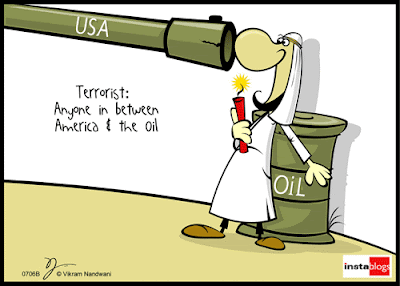
Salon | In sum: a Muslim who attacks military targets, including in war zones or even in their own countries that have been invaded by a foreign army, are Terrorists. A non-Muslim who flies an airplane into a government building in pursuit of a political agenda is not, or at least is not a Real Terrorist with a capital T -- not the kind who should be tortured and thrown in a cage with no charges and assassinated with no due process. Nor are Christians who stand outside abortion clinics and murder doctors and clinic workers. Nor are acts undertaken by us or our favored allies designed to kill large numbers of civilians or which will recklessly cause such deaths as a means of terrorizing the population into desired behavioral change -- the Glorious Shock and Awe campaign and the pummeling of Gaza. Except as a means for demonizing Muslims, the word is used so inconsistently and manipulatively that it is impoverished of any discernible meaning.

All of this would be an interesting though not terribly important semantic matter if not for the fact that the term Terrorist plays a central role in our political debates. It is the all-justifying term for anything the U.S. Government does. Invasions, torture, due-process-free detentions, military commissions, drone attacks, warrantless surveillance, obsessive secrecy, and even assassinations of American citizens are all justified by the claim that it's only being done to "Terrorists," who, by definition, have no rights. Even worse, one becomes a "Terrorist" not through any judicial adjudication or other formal process, but solely by virtue of the untested, unchecked say-so of the Executive Branch. The President decrees someone to be a Terrorist and that's the end of that: uncritical followers of both political parties immediately justify anything done to the person on the ground that he's a Terrorist (by which they actually mean: he's been accused of being one, though that distinction -- between presidential accusations and proof -- is not one they recognize).

If we're really going to vest virtually unlimited power in the Government to do anything it wants to people they call "Terrorists," we ought at least to have a common understanding of what the term means. But there is none. It's just become a malleable, all-justifying term to allow the U.S. Government carte blanche to do whatever it wants to Muslims it does not like or who do not like it (i.e., The Terrorists). It's really more of a hypnotic mantra than an actual word: its mere utterance causes the nation blindly to cheer on whatever is done against the Muslims who are so labeled.

UPDATE: I want to add one point: the immediate official and media reaction was to avoid, even deny, the term "terrorist" because the perpetrator of the violence wasn't Muslim. But if Stack's manifesto begins to attract serious attention, I think it's likely the term Terrorist will be decisively applied to him in order to discredit what he wrote. His message is a sharply anti-establishment and populist grievance of the type that transcends ideological and partisan divisions -- the complaints which Stack passionately voices are found as common threads in the tea party movement and among citizens on both the Left and on the Right -- and thus tend to be the type which the establishment (which benefits from high levels of partisan distractions and divisions) finds most threatening and in need of demonization. Nothing is more effective at demonizing something than slapping the Terrorist label onto it.

did stack jack "little eichmans"?

WaPo | Mark Potok, a director at the Southern Poverty Law Center, which tracks white supremacists and other hate groups, said the attack on the IRS has been endorsed by extremists even more enthusiastically than the shooting rampage last June at the U.S. Holocaust Memorial Museum in Washington that left a security guard dead.

"I think Joseph Stack has tapped into a very deep vein of rage against the government," he said.

On one Internet thread full of praise for Stack, one person wrote that he must "suppress the urge to take flying lessons."

Pensacola, Fla., pastor and radio host Chuck Baldwin wrote on his Web site that he wished Stack had not died "because we need each other." He added: "My heart goes out to Joe Stack! The sentiments expressed above are shared by millions of Americans who are also fed up with Big Brother."

Larken Rose, a 41-year-old Pennsylvania man who served a year in prison for willful failure to file an income tax return, said he does not consider the IRS employee killed in the attack and the man's injured co-workers to be innocent victims.

"I don't know how many people they harassed or how many houses they had stolen or how many bank accounts they had swiped," he told the AP. Stack's letter "shows quite obviously he was not crazy. He was frustrated. He had been wronged over and over."

The IRS kept a master list of tax protesters until 1998, when a change in the law prevented the agency from tracking them. MacNab estimated there are more than 500,000 tax protesters today, the vast majority of whom do not file tax returns.

"There are people who sympathize with this crime and turn the criminal into a hero," said Fathali Moghaddam, a psychology professor at Georgetown University. "At tax time, what better authority figure to hit than the tax man?"

what's wrong with texas?


DMN | East Texas church arson suspect Jason Robert Bourque (right) calls himself "Mr. Brightside" on his MySpace page, lists his religion as "Christian -- other" and prominently displays this quote from the 19th century anti-Christian philosopher Friedrich Nietzsche:

"Never give way to remorse, but immediately say to yourself: that would merely mean adding a second stupidity to the first. -- If you have done harm, see how you can do good. -- If you are punished for your actions, bear the punishment with the feeling that you ARE doing good -- by deterring others from falling prey to the same folly. Every evildoer who is punished may feel that he is a benefactor of humanity."

On his Facebook page, Bourque says he's a fan of bonfires. A couple of clicks takes you to hundreds of photos of blazes.

Bourque was arrested Sunday with Daniel George McAllister (lower right). The Bureau of Alcohol, Tobacco, Firearms and Explosives blames the two for a string of 10 recent church fires in East Texas.

The two men used to attend a Baptist church in the East Texas town of Ben Wheeler that was not torched, says Dallas Morning News reporter Richard Abshire.

Monday, February 22, 2010

environmental ills? it's consumerism stupid!

Scientific American | Two typical German shepherds kept as pets in Europe or the U.S. consume more in a year than the average person living in Bangladesh, according to research by sustainability experts Brenda and Robert Vale of Victoria University in Wellington, New Zealand. So are the world's environmental ills really a result of the burgeoning number of humans on the planet—predicted to reach at least nine billion people by 2050? Or is it more due to the fact that although the human population has doubled in the past 50 years, we have increased our use of resources fourfold?

After all, the roughly 40,000 attendees of the recent climate conference in Copenhagen produced more greenhouse gas emissions in just two weeks than 600,000 Ethiopians produce in a year. In fact, the world's richest 500 million people produce 50 percent of global carbon dioxide emissions compared to the 6 percent produced by the world's poorest 3 billion—Americans alone use up 88 kilograms of stuff (such as food and water but also plastics, metals and other things) per day, or roughly one me, day in and day out.

As simply put by the United Nations Millennium Ecosystem Assessment in 2005: "Human activity is putting such strain on the natural functions of Earth that the ability of the planet's ecosystems to sustain future generations can no longer be taken for granted."

And consumerism isn't even delivering on its own promise—a better life. "Not only is consumer culture causing unprecedented environmental havoc, it is in many cases not delivering the well-being for human beings it is supposed to," argued Christopher Flavin, president of the Worldwatch Institute during a press conference last week to release its new State of the World report, "Transforming Cultures: From Consumerism to Sustainability." "The kinds of changes in policy discussed at Copenhagen are also critical and, in fact, will go hand in hand with a cultural shift [from consumerism to sustainability.]" Fist tap Arnach.

out of the abyss of individualism

Guardian | We shouldn't leave politics to managers and economics to brokers – or be afraid to reintroduce 'virtue' to public discourse.

Human beings begin their lives in a state of dependence. They need to learn how to speak, to trust, to negotiate a world that isn't always friendly, and involves unavoidable limitations. They need an environment secure enough for them to take the necessary risks of learning – where they know there are some relationships that don't depend on getting things right, but are unconditional. The family is the indispensable foundation for all this.

We are also beings who take in more than we can easily process from the world around us; we know more than we realise, and that helps us to become self-questioning persons who are always aware things could be different. We learn this as children through fantasy and play, we keep it alive as adults through all sorts of "unproductive" activity, from sport to poetry. It is the extra things that make us human.

This is closely connected with understanding and sympathy for others. If you live in a world where everything encourages you to struggle for your own individual interest and success, you are encouraged to ignore the reality of other points of view – ultimately, to ignore the cost, or the pain of others. The result may be a world where people are articulate about their own feelings and pretty illiterate about those of others. An economic climate based on nothing but calculations of self-interest, fed by a distorted version of Darwinism, doesn't build a habitat for human beings; at best it builds a sort of fortified box room for paranoiacs.

What is encouraging is how few people seem to want a society composed of people like this. We have, to some extent, looked into the abyss where individualism is concerned and we know that it won't do. This is a moment when every possible agency in civil society needs to reinforce its commitment to a world where thoughtful empathy is a normal aspect of the mature man or woman. And of course without that, there will be no imaginative life, no thinking what might be different.

For myself, the roots of this view are deep in religious vision and commitment. From this viewpoint, the importance of the family isn't a sen­timental idealising of domestic life; it is about understanding that you grow in emotional intelligence and maturity because of a reality that is unconditionally faithful. In religious terms the unconditionality of family love is a faint mirror of God's unconditional commitment to be there for us. Similarly, the importance of imaginative life is not a vague belief that we should all have our creative side encouraged but comes out of the notion that the world we live in is rooted in an infinite life, whose dimensions we shall never get hold of. As for the essential character of human mutuality, this connects for me with the Christian belief that if someone else is damaged, frustrated, offended or oppressed, everyone's humanity is diminished.

Chipocalypse Now - I Love The Smell Of Deportations In The Morning

sky |   Donald Trump has signalled his intention to send troops to Chicago to ramp up the deportation of illegal immigrants - by posting a...