Wednesday, February 17, 2010

scientists recent crime blotter

The Scientist | Last Friday, biology professor Amy Bishop shocked the country when she allegedly shot and killed three of her colleagues at the University of Alabama in Huntsville, purportedly motivated by the university's recent decision to deny her tenure. Although certainly one of the most heinous crimes in recent memory, it is by no means the first criminal offense to disturb the scientific community. Here is a timeline of some disquieting events from the last few years:

September 27, 2009: University of Maryland pharmacologist Clinton McCracken admitted to having bought a narcotic known as buprenorphine from an online company in the Philippines after his live-in fiancé, University of Maryland School of Medicine postdoc Carrie Elisabeth John, died of what was initially believed to be an overdose on the drug. Although John's autopsy later revealed that she had no drugs in her system -- instead, cause of death was attributed to an allergic reaction made worse by her asthma -- McCracken was charged with multiple drug offenses, to which he pled not guilty at a hearing last December. His trial is set for March 25 in Baltimore Circuit Court.

September 13, 2009: The body of 24-year-old Annie Le, a doctoral student at Yale School of Medicine's Department of Pharmacology, was found inside a wall in the laboratory building where she was last seen. Four days later, police arrested Yale lab tech Raymond J. Clark, III, who pled not guilty for her murder at his January 26 hearing. His pretrial hearing is scheduled for March 3, 2010 in New Haven.

August 26, 2009: Six Harvard University Medical School researchers found themselves in the emergency room after drinking coffee that turned out to be contaminated with sodium azide, a toxic preservative commonly used in scientific laboratories. Last month, Harvard police closed the active phase of their investigation without conclusion, leaving open the question of whether the poisoning was intentional or a result of poor lab safety. (plenty more at source)

separate justice system thwarts background checks

AP | In the days since Friday's shooting, revelations about Amy Bishop's past have raised questions about whether much of the violence could have been prevented. In the latest twist, police said Tuesday that Bishop had also been charged with assaulting a woman in 2002 during a tirade over a child's booster seat at a restaurant.

On Tuesday, the 44-year-old Bishop was under extra guard at an Alabama jail. Students and victims' relatives want to know how someone with such a tortured past could ever have been hired at a state university.

"Do they not do background checks on teachers? How did all this slip through the cracks?" nursing student Caitlin Phillips asked.

University President David B. Williams defended the decision to hire Bishop. He said a review of her personnel file and her hiring file raised no red flags.

Police ran a criminal background check Monday, after she was charged with one count of capital murder and three counts of attempted murder.

"Even now, nothing came up," Williams said.

Tuesday, February 16, 2010

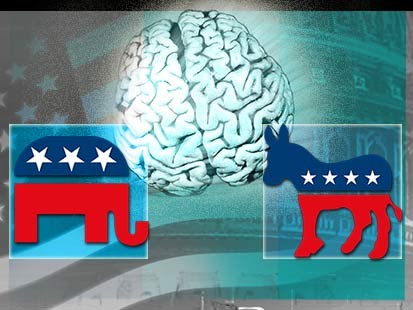
disgust sensitivity as a predictor of political attitudes

allacademic | Traditional explanations of individual-level variation in political attitudes have emphasized events occurring in the immediate political environment but recent research has started to include baseline dispositional variations in biological traits. In this paper, we continue this trend by analyzing the relationship between political issue preferences and physiological responses to disgusting images. Previously published research reports a connection between disgust sensitivity and certain political orientations, such as those pertaining specifically to homosexuality as well as broader collections of left-right issues, but has relied only on self-reports of disgust sensitivity. Given that self-reports are often inaccurate, we instead record and analyze involuntary measures of disgust sensitivity; particularly, skin conductance and startle blink EMG response. These long-accepted psycho-physiological measures permit a richer and more meaningful test of the possibility that some issue preferences are at least partially shaped by bedrock physiological orientations to generic rather than overtly political stimuli.

tea party rebellion on the right

NYTimes | Pam Stout has not always lived in fear of her government. She remembers her years working in federal housing programs, watching government lift struggling families with job training and education. She beams at the memory of helping a Vietnamese woman get into junior college.

But all that was before the Great Recession and the bank bailouts, before Barack Obama took the White House by promising sweeping change on multiple fronts, before her son lost his job and his house. Mrs. Stout said she awoke to see Washington as a threat, a place where crisis is manipulated — even manufactured — by both parties to grab power.

She was happily retired, and had never been active politically. But last April, she went to her first Tea Party rally, then to a meeting of the Sandpoint Tea Party Patriots. She did not know a soul, yet when they began electing board members, she stood up, swallowed hard, and nominated herself for president. “I was like, ‘Did I really just do that?’ ” she recalled.

Then she went even further.

Worried about hyperinflation, social unrest or even martial law, she and her Tea Party members joined a coalition, Friends for Liberty, that includes representatives from Glenn Beck’s 9/12 Project, the John Birch Society, and Oath Keepers, a new player in a resurgent militia movement.

When Friends for Liberty held its first public event, Mrs. Stout listened as Richard Mack, a former Arizona sheriff, brought 1,400 people to their feet with a speech about confronting a despotic federal government. Mrs. Stout said she felt as if she had been handed a road map to rebellion. Members of her family, she said, think she has disappeared down a rabbit hole of conspiracy theories. But Mrs. Stout said she has never felt so engaged.

“I can’t go on being the shy, quiet me,” she said. “I need to stand up.”

The Tea Party movement has become a platform for conservative populist discontent, a force in Republican politics for revival, as it was in the Massachusetts Senate election, or for division. But it is also about the profound private transformation of people like Mrs. Stout, people who not long ago were not especially interested in politics, yet now say they are bracing for tyranny.

These people are part of a significant undercurrent within the Tea Party movement that has less in common with the Republican Party than with the Patriot movement, a brand of politics historically associated with libertarians, militia groups, anti-immigration advocates and those who argue for the abolition of the Federal Reserve.

tea partiers at the big tent

WaPo | About 50 leaders of the grass-roots "tea party" movement will meet in Washington on Tuesday with Republican National Committee Chairman Michael S. Steele and other top GOP operatives to discuss campaign strategies and conservative principles.

The afternoon meeting on Capitol Hill will mark the first time that a broad coalition of tea party organizers -- who have railed against both the Democratic and the Republican establishments -- will sit down with GOP leaders. Top Republican leaders have been openly courting the organizers, looking to marshal grass-roots energy heading into November's midterm elections.

Karin Hoffman, founder of DC Works For Us, a tea party group in South Florida, said she initiated the meeting by approaching Steele last month and asking him to sit down with a range of tea party organizers. She said her goal is to open a civil dialogue with the GOP leadership, but she dismissed any suggestion that tea party groups might merge with the Republican Party.

"From the get-go, the grass-roots movement emerged from people desiring to be heard and not feeling like their voices are being heard in Washington," Hoffman said in an interview. "This is the beginning of a formal discussion with the political establishment."

RNC spokeswoman Katie Wright said Steele plans to listen to concerns of tea party leaders and hopes to discuss such issues as lower taxes and smaller government. "The chairman believes it is extremely important to listen to this significant grass-roots movement and work to find common ground in order to elect officials that will protect these principles," she said.

NYTimes | When after many months of careful tending, Sarah Cseke reached a milestone in her graduate student research, she went straight to the office of the busy chairman of the biology department at the University of Alabama in Huntsville, Gopi Podila, to share the triumphal moment.

“I knocked on his door with a petri dish full of hairy roots, and he actually came to the door and took the time to look at it,” she said. “He was just as happy as I was.”

On Friday, the biology department at the university lost Dr. Podila, 52, and two other faculty members in a hail of gunfire at an afternoon faculty meeting. A colleague with a Harvard Ph.D., Amy Bishop, is charged with capital murder. Another professor and the department administrator are still in the hospital in critical condition.

The deaths have left a small, close-knit department trying to pick up the pieces without either its leader, Dr. Podila, or the person colleagues described as its “glue,” Stephanie Monticciolo, 62, the administrator, who doles out hugs and birthday reminders. Ms. Monticciolo is in the hospital with a gunshot wound to the head.

The two other people killed were Maria Ragland Davis, 50, and Adriel Johnson, 52, described as professors who spent hours of extra time helping students. A colleague, Joseph Leahy, 50, a microbiology professor known for his zesty lectures, remained hospitalized with a head wound.

“They will leave a large hole in our department,” said Debra Moriarity, a biology professor and the dean of the university’s graduate program.

the making of a euromess


NYTimes | Lately, financial news has been dominated by reports from Greece and other nations on the European periphery. And rightly so.

But I’ve been troubled by reporting that focuses almost exclusively on European debts and deficits, conveying the impression that it’s all about government profligacy — and feeding into the narrative of our own deficit hawks, who want to slash spending even in the face of mass unemployment, and hold Greece up as an object lesson of what will happen if we don’t.

For the truth is that lack of fiscal discipline isn’t the whole, or even the main, source of Europe’s troubles — not even in Greece, whose government was indeed irresponsible (and hid its irresponsibility with creative accounting).

No, the real story behind the euromess lies not in the profligacy of politicians but in the arrogance of elites — specifically, the policy elites who pushed Europe into adopting a single currency well before the continent was ready for such an experiment.

Consider the case of Spain, which on the eve of the crisis appeared to be a model fiscal citizen. Its debts were low — 43 percent of G.D.P. in 2007, compared with 66 percent in Germany. It was running budget surpluses. And it had exemplary bank regulation.

But with its warm weather and beaches, Spain was also the Florida of Europe — and like Florida, it experienced a huge housing boom. The financing for this boom came largely from outside the country: there were giant inflows of capital from the rest of Europe, Germany in particular.

Monday, February 15, 2010

how christian were the founders?

NYTimes | The cultural roots of the Texas showdown may be said to date to the late 1980s, when, in the wake of his failed presidential effort, the Rev. Pat Robertson founded the Christian Coalition partly on the logic that conservative Christians should focus their energies at the grass-roots level. One strategy was to put candidates forward for state and local school-board elections — Robertson’s protégé, Ralph Reed, once said, “I would rather have a thousand school-board members than one president and no school-board members” — and Texas was a beachhead. Since the election of two Christian conservatives in 2006, there are now seven on the Texas state board who are quite open about the fact that they vote in concert to advance a Christian agenda. “They do vote as a bloc,” Pat Hardy, a board member who considers herself a conservative Republican but who stands apart from the Christian faction, told me. “They work consciously to pull one more vote in with them on an issue so they’ll have a majority.”

This year’s social-studies review has drawn the most attention for the battles over what names should be included in the roll call of history. But while ignoring Kennedy and upgrading Gingrich are significant moves, something more fundamental is on the agenda. The one thing that underlies the entire program of the nation’s Christian conservative activists is, naturally, religion. But it isn’t merely the case that their Christian orientation shapes their opinions on gay marriage, abortion and government spending. More elementally, they hold that the United States was founded by devout Christians and according to biblical precepts. This belief provides what they consider not only a theological but also, ultimately, a judicial grounding to their positions on social questions. When they proclaim that the United States is a “Christian nation,” they are not referring to the percentage of the population that ticks a certain box in a survey or census but to the country’s roots and the intent of the founders.

The Christian “truth” about America’s founding has long been taught in Christian schools, but not beyond. Recently, however — perhaps out of ire at what they see as an aggressive, secular, liberal agenda in Washington and perhaps also because they sense an opening in the battle, a sudden weakness in the lines of the secularists — some activists decided that the time was right to try to reshape the history that children in public schools study. Succeeding at this would help them toward their ultimate goal of reshaping American society. As Cynthia Dunbar, another Christian activist on the Texas board, put it, “The philosophy of the classroom in one generation will be the philosophy of the government in the next.”

Sunday, February 14, 2010

yes you are - so deal with it sissies!

WaPo | It's not often that one of the creators of our new digital culture comes forward to say: I made a mistake; this is not what I intended.

But Jaron Lanier, a pioneer in the invention of virtual reality, has done just that. Breaking with the ideas of technology-boosting friends and colleagues, such as Kevin Kelly, former executive editor of Wired magazine, and Chris Anderson, Wired's current editor, he goes so far as to call them "digital Maoists."

A self-confessed "humanistic softie," Lanier is fighting to wrest control of technology from the "ascendant tribe" of technologists who believe that wisdom emerges from vast crowds, rather than from distinct, individual human beings. According to Lanier, the Internet designs made by that "winning subculture" degrade the very definition of humanness. The saddest example comes from young people who brag of their thousands of friends on Facebook. To them, Lanier replies that this "can only be true if the idea of friendship is reduced."

Anyone who has followed technology and for years has resented the adoration heaped upon the ascendant tribe will positively swoon as Lanier throws into one great dustbin such sacred concepts as Web 2.0, singularity, hive mind, wikis, the long tail, the noosphere, the cloud, snippets, crowds, social networking and the Creative Commons -- dismissing them all as "cybernetic totalism" and, more fun yet, as potential "fascism."

The "cybernetic totalists" base their thinking on decades-old ideas known as "chaos" or "complexity" theory, which began with a question about ants: How does something as complex as a colony arise from the interactions of dumb ants? This approach can be useful if one is studying mass phenomena such as traffic jams. The problem comes when we try to apply ant-derived thinking to people who are trying to lead creative, expressive lives.

why are liberals so condescending?

WaPo | It's an odd time for liberals to feel smug. But even with Democratic fortunes on the wane, leading liberals insist that they have almost nothing to learn from conservatives. Many Democrats describe their troubles simply as a PR challenge, a combination of conservative misinformation -- as when Obama charges that critics of health-care reform are peddling fake fears of a "Bolshevik plot" -- and the country's failure to grasp great liberal accomplishments. "We were so busy just getting stuff done . . . that I think we lost some of that sense of speaking directly to the American people about what their core values are," the president told ABC's George Stephanopoulos in a recent interview. The benighted public is either uncomprehending or deliberately misinformed (by conservatives).

This condescension is part of a liberal tradition that for generations has impoverished American debates over the economy, society and the functions of government -- and threatens to do so again today, when dialogue would be more valuable than ever.

Liberals have dismissed conservative thinking for decades, a tendency encapsulated by Lionel Trilling's 1950 remark that conservatives do not "express themselves in ideas but only in action or in irritable mental gestures which seek to resemble ideas." During the 1950s and '60s, liberals trivialized the nascent conservative movement. Prominent studies and journalistic accounts of right-wing politics at the time stressed paranoia, intolerance and insecurity, rendering conservative thought more a psychiatric disorder than a rival. In 1962, Richard Hofstadter referred to "the Manichaean style of thought, the apocalyptic tendencies, the love of mystification, the intolerance of compromise that are observable in the right-wing mind."

This sense of liberal intellectual superiority dropped off during the economic woes of the 1970s and the Reagan boom of the 1980s. (Jimmy Carter's presidency, buffeted by economic and national security challenges, generated perhaps the clearest episode of liberal self-doubt.) But these days, liberal confidence and its companion disdain for conservative thinking are back with a vengeance, finding energetic expression in politicians' speeches, top-selling books, historical works and the blogosphere. This attitude comes in the form of four major narratives about who conservatives are and how they think and function.

u.k. industry task force on peak oil


PeakOilTaskForce | On 10 February 2010 at the Royal Society, six UK companies - Arup, Foster + Partners, Scottish and Southern Energy, Solarcentury, Stagecoach Group and Virgin - joined together to launch the second report of the UK Industry Task-Force on Peak Oil and Energy Security (ITPOES).

The report, titled “The Oil Crunch - a wake-up call for the UK economy”, finds that oil shortages, insecurity of supply and price volatility will destabilise economic, political and social activity within five years.

The Task-Force warns that the UK must not be caught out by the oil crunch in the same way it was with the credit crunch and states that policies to address Peak Oil must be a priority for the new government formed after the 2010 election.

Saturday, February 13, 2010

a disadvantaged class?

Essential Lists | One of the most astounding passages in the Supreme Court's mind-boggling decision in Citizens United v. Federal Election Commission -- the January decision holding that corporations have a First Amendment right to spend as much as they choose from their treasuries to support or oppose candidates for elected office -- is this:

"[T]he Government may commit a constitutional wrong when by law it identifies certain preferred speakers. By taking the right to speak from some and giving it to others, the Government deprives the disadvantaged person or class of the right to use speech to strive to establish worth, standing, and respect for the speakers voice. The First Amendment protects speech and speaker, and the ideas that flow from each."

This ode to the First Amendment is inspiring, until you recognize that the "disadvantaged class" reference is to corporations.

When it comes to speech protections, there are surely many rational ways to distinguish corporations from real, live persons. One is that corporations are not real, live persons! Another is that for-profit corporations exist for the purpose of making money, and that this monomaniacal focus distinguishes them in very important ways from humans, who care not only about making money, but building community, expressing themselves, fairness, equality, justice, protecting future generations, stewarding the planet and much more. And other consequential difference, compounding these other points of difference, is that large and even not-so-large corporations have a lot more money, and can easily mobilize resources on a scale that vastly outdistances anything that real people can do.

Thus the rather obvious conclusion that corporate money can distort elections and the political process. This is hardly speculative: large corporations dominated the political process even before Citizens United, a fact widely understood. Eighty-five percent of people in the United States believe big business has too much power in Washington.

What may not be quite so obvious is how extraordinary are the resources that corporations can mobilize as against what is now spent on elections.

Consider these juxtapositions -- (the list is impressive and footnoted w/links)

political science..,

NYTimes | Three faculty members at the University of Alabama in Huntsville were shot to death, and three other people were seriously wounded at a biology faculty meeting on Friday afternoon, university officials said.

The Associated Press reported that a biology professor, identified as Amy Bishop, was charged with murder.

According to a faculty member, the professor had applied for tenure, been turned down, and appealed the decision. She learned on Friday that she had been denied once again.

The newspaper identified Dr. Bishop as a Harvard-educated neuroscientist. According to a 2006 profile in the newspaper, Dr. Bishop invented a portable cell growth incubator with her husband, Jim Anderson. Police officials said that Mr. Anderson was being detained, but they did not call him a suspect.

Photographs of a suspect being led from the scene by the police appeared to match images of Dr. Bishop on academic and technology Web sites.

Dr. Bishop had told acquaintances recently that she was worried about getting tenure, said a business associate who met her at a business technology open house at the end of January and asked not to be named because of the close-knit nature of the science community in Huntsville.

at 500% net liability to GDP - G7 collapse inevitable

Zerohedge | For Greece, with on and off balance sheet liabilities at over 800%, it's game over. For the Eurozone, with the same ratio at about 500%, it is also game over. For the US, at 500%+, it is, you guessed it (sorry Joseph Stiglitz), game over, but since we have the printers, it will simply take a little longer. Please don't read this if you want to keep believing there is any hope left for the (developed) world.

As noted earlier on Zero Hedge, in Europe the population is a little less brainwashed by the moronic happenings on prime time TV, so while in America the destruction of the economic system, as trillions are transferred to the kleptocracy which knows fully well the end game is nigh, results in some sighs of desperation at best, in Europe the outcome will be somewhat more violent.

And in case you were wondering why all European leaders are powerless to provide a bailout proposal that actually has a snowball's chance in hell of doing something/anything to help Greece, read on. Alternatively, if you want to find out why any plan suggested on Monday will be thoroughly useless and once digested by the market will cause another major crash, read on as well.
The pressure to tighten fiscal policy from current nose-bleed levels of deficits is not just an issue for crisis hit Greece. It is an issue for virtually all economies. It is a particular issue for the US and UK with structural (cyclically adjusted) general government deficits of almost 10% of GDP (according to the OECD)! There is a ferocious debate ongoing between those who believe there needs to be a rapid reduction in these deficits to avoid some combination of insolvency/default/rapid inflation and those who believe that there should be even more fiscal stimulus. The debate is loud and opinions are tending to be polarised.

My own view on this is that obviously we should never have got into this wholly avoidable mess in the first place. But having got here, there really is no way out that does not trigger a major market-moving upheaval. Ultimately economic prosperity over the past decade has been a sham: a totally unsustainable Ponzi scheme built on a mountain of private sector debt.GDP has simply been brought forward from the future and now it's payback time. The trouble is that, as the private sector debt unwinds, there is no political appetite to allow GDP to decline to its "correct" level as this would involve a depression. So burgeoning public sector deficits and Quantitative Easing are required to maintain the fig-leaf of continued prosperity.
And here is the topic that will dominate over all pundit round table discussions in the next weeks: the entire world is insolvent, although some are more insolvent than others. Greek total net liabilities (on and off balance sheet) to GDP are 800%! EU: at 470%, the US, at over 500%. There is no way out but default.

Friday, February 12, 2010

cap ain't lied.....,


Yahoonews | Since 1941, Captain America has been one of the most popular comic book characters around. The fictional super-patriot fought Nazis during World War II, took on those who burned the American flag during the Vietnam era, and raked in hundreds of millions of dollars for Marvel Comics along the way. Now, the appearance that he is taking on the Tea Party Movement in a storyline about investigating white supremacists has forced Marvel to apologize for the comic hero.

Issue 602 of the comic features Captain America investigating a right-wing anti-government militia group called "the Watchdogs". Hoping to infiltrate the group, Captain America and his African-American sidekick The Falcon observe an anti-tax protest from a rooftop. The protestors depicted are all white and carry signs adorned with slogans almost identical to those seen today in Tea Party rallies like "tea bag libs before they tea bag you" and "stop the socialists."

The Falcon mentions that the gathering appears to be "some kind of anti-tax protest" and notes that "this whole 'hate the government' vibe isn't limited to the Watchdogs." He then tells Captain America that he doesn't think their plan will work because "I don't exactly see a black man from Harlem fitting in with a bunch of angry white folks." Captain America then explains that his plan entails sending The Falcon in among the group posing as an IRS agent under the thinking that a black government official will most certainly spark their anger.

The clear implicit attack on the Tea Party Movement was first noticed by Publius' Forum's Warner Todd Huston. When a minor uproar ensued, Marvel Comics editor-in-chief Joe Quesada spoke to Comic Book Resources and defended the issue while apologizing for the panel that seemed to tie real-life Tea Party protesters to the fictional group depicted in the book.

obamaman can..,

Fist tap Dale.

NYTimes | At a time of deepening political disaffection and intensified distress about the economy, President Obama enjoys an edge over Republicans in the battle for public support, according to the latest New York Times/CBS News poll.

While the president is showing signs of vulnerability on his handling of the economy — a majority of respondents say he has yet to offer a clear plan for creating jobs — Americans blame former President George W. Bush, Wall Street and Congress much more than they do Mr. Obama for the nation’s economic problems and the budget deficit, the poll found.

They credit Mr. Obama more than Republicans with making an effort at bipartisanship, and they back the White House’s policies on a variety of disputed issues, including allowing gay men and lesbians to serve openly in the military and repealing the Bush tax cuts for the wealthy.

The poll suggests that both parties face a toxic environment as they prepare for the elections in November. Public disapproval of Congress is at a historic high, and huge numbers of Americans think Congress is beholden to special interests. Fewer than 1 in 10 Americans say members of Congress deserve re-election.

As the party in power, Democrats face a particular risk from any wave of voter discontent; unfavorable views of the Democratic Party are as high as they have been since the Republican takeover of Congress in 1994, though Republicans continue to register an even worse showing. The percentage of Americans who approve of Mr. Obama’s job performance, 46 percent, is as low as it has been since he took office.

Still, the poll suggests that Mr. Obama and his party have an opportunity to deflect the anger and anxiety if they can frame the election not as a referendum on the president and his party, but as a choice between them and a Republican approach that yielded results under Mr. Bush that much of the nation still blames for the country’s woes. That is what the White House has been trying to do since the beginning of the year.

the tea party people are the corn pone nazis..,

Kunstler | Future historians who try to chart the unraveling of the USA's political tapestry might point to two events of the past week. The obvious first one was the Tea Party convention at Nashville. It was held not accidentally at the ridiculous Opryland Hotel and resort in the city's outer suburban asteroid belt, right next to the circumferential freeway, and next door to the defunct (1997) Opryland USA theme park, an attraction based on the cute idea that Tennessee rubes were too dumb to spell the word opera -- so the symbolism was perfect.

Behind the incoherent cargo of conflicting complaints that makes up Tea Party doctrine -- like "keeping the government's hands off our medicare!" -- stands the more basic dissolution of the Sunbelt's miracle economy, along with the pain and bewilderment of the southern peckerwood political nexus that rose out of the dust after World War Two to build the suburban nirvana of universal air-conditioning, happy motoring, Jesus tub-thumping, over-eating, and Friday night football that defined Sunbelt culture. They sense now that history is about to thrust them back into the okra patch, with the hookworms and the chiggers, as the economy whirls down the drain, and the car dealerships close up, and the idle production homebuilders succumb to methedrine addiction, and the price of Reba McEntire tickets exceeds their dwindling resources, and they are none too happy about any of that.

Of course this Sunbelt political culture has tentacles and outposts all over the USA, wherever a few generations of laboring folk enjoyed debt-fueled parabolic rises in living standards during the cheap oil decades, and now find themselves in foreclosure hell, indentured to the very WalMarts that they welcomed with open arms (and allowed to destroy their local businesses) -- and, of course, it's yet another paradox that these are the same folk who will still defend the big box masters to their deaths. The America they stand for is a weird contradictory mish-mash of Confederate nostalgia, hyper-individualism that really owes allegiance to nothing, racial enmity, religious paranoia, and potemkin patriotism -- especially involving anything in the constitution that allows them to wriggle out of obligations to the public interest at the same time that they get to push other groups of people around.

hoodwinked and bamboozled...,

the hardline..,

Thursday, February 11, 2010

the world is a ghetto....,

NYTimes | A decade ago, New York City officials were so reluctant to give out food stamps, they made people register one day and return the next just to get an application. The welfare commissioner said the program caused dependency and the poor were “better off” without it.

Now the city urges the needy to seek aid (in languages from Albanian to Yiddish). Neighborhood groups recruit clients at churches and grocery stores, with materials that all but proclaim a civic duty to apply — to “help New York farmers, grocers, and businesses.” There is even a program on Rikers Island to enroll inmates leaving the jail.

“Applying for food stamps is easier than ever,” city posters say.

The same is true nationwide. After a U-turn in the politics of poverty, food stamps, a program once scorned as “welfare,” enjoys broad new support. Following deep cuts in the 1990s, Congress reversed course to expand eligibility, cut red tape and burnish the program’s image, with a special effort to enroll the working poor. These changes, combined with soaring unemployment, have pushed enrollment to record highs, with one in eight Americans now getting aid.

“I’ve seen a remarkable shift,” said Senator Richard G. Lugar, an Indiana Republican and prominent food stamp supporter. “People now see that it’s necessary to have a strong food stamp program.”

The revival began a decade ago, after tough welfare laws chased millions of people from the cash rolls, many into low-wage jobs as fast-food workers, maids, and nursing aides. Newly sympathetic officials saw food stamps as a way to help them. For states, the program had another appeal: the benefits are federally paid.

But support also turned on chance developments, including natural disasters (which showed the program’s value in emergencies) and the rise of plastic benefit cards (which eased stigma and fraud). The program has commercial allies, in farmers and grocery stores, and it got an unexpected boost from President George W. Bush, whose food stamp administrator, Eric Bost, proved an ardent supporter.

“I assure you, food stamps is not welfare,” Mr. Bost said in a recent interview.

Chipocalypse Now - I Love The Smell Of Deportations In The Morning

sky |   Donald Trump has signalled his intention to send troops to Chicago to ramp up the deportation of illegal immigrants - by posting a...