Sunday, February 07, 2010
Saturday, February 06, 2010
the psychology of power
The Economist | REPORTS of politicians who have extramarital affairs while complaining about the death of family values, or who use public funding for private gain despite condemning government waste, have become so common in recent years that they hardly seem surprising anymore. Anecdotally, at least, the connection between power and hypocrisy looks obvious.Anecdote is not science, though. And, more subtly, even if anecdote is correct, it does not answer the question of whether power tends to corrupt, as Lord Acton’s dictum has it, or whether it merely attracts the corruptible. To investigate this question Joris Lammers at Tilburg University, in the Netherlands, and Adam Galinsky at Northwestern University, in Illinois, have conducted a series of experiments which attempted to elicit states of powerfulness and powerlessness in the minds of volunteers. Having done so, as they report in Psychological Science, they tested those volunteers’ moral pliability. Lord Acton, they found, was right.
An intriguing characteristic emerged among participants in high-power states who felt they did not deserve their elevated positions. These people showed a similar tendency to that found in low-power individuals—to be harsh on themselves and less harsh on others—but the effect was considerably more dramatic. They felt that others warranted a lenient 6.0 on the morality scale when stealing a bike but assigned a highly immoral 3.9 if they took it themselves. Dr Lammers and Dr Galinsky call this reversal “hypercrisy”.
They argue, therefore, that people with power that they think is justified break rules not only because they can get away with it, but also because they feel at some intuitive level that they are entitled to take what they want. This sense of entitlement is crucial to understanding why people misbehave in high office. In its absence, abuses will be less likely. The word “privilege” translates as “private law”. If Dr Lammers and Dr Galinsky are right, the sense which some powerful people seem to have that different rules apply to them is not just a convenient smoke screen. They genuinely believe it.
What explains hypercrisy is less obvious. It is known, though, from experiments on other species that if those at the bottom of a dominance hierarchy show signs of getting uppity, those at the top react both quickly and aggressively. Hypercrisy might thus be a signal of submissiveness—one that is exaggerated in creatures that feel themselves to be in the wrong place in the hierarchy. By applying reverse privileges to themselves, they hope to escape punishment from the real dominants. Perhaps the lesson, then, is that corruption and hypocrisy are the price that societies pay for being led by alpha males (and, in some cases, alpha females). The alternative, though cleaner, is leadership by wimps.
By
CNu
at
February 06, 2010
0
comments
Labels: ethics , People Centric Leadership , truth
hunger - a global justice problem?
The Atlantic | A year ago I sat in a room at the Earth Institute at Columbia surrounded by executives from big food companies. One of them, I believe from Unilever, clicked to a slide that read "The solution to global hunger is to turn malnutrition into a market opportunity." The audience—global development practitioners and academics and other executives—nodded and dutifully wrote it down in their notebooks; I shuddered. The experience stayed with me and I haven't gotten over it. Last month, I had a flashback.On a Tuesday evening I sat in a room on the 44th floor of a building in the financial district of lower Manhattan with representatives from General Mills, Monsanto, Dean Foods, Deutsche Bank, and the Rainforest Alliance. We were there to speak to institutional investors—the hedge fund managers, bankers, and others who invest in big food companies—about sustainability and food. In particular, we were there to talk about how sustainability and hunger issues may give these companies both exposure to risk and access to opportunity.
It was not your average sustainable food panel discussion. Reflecting back on it, three things jump out at me. The first was a false premise that is taken for fact. The false premise:
Both Deutsche Bank and Monsanto made it clear that they are basing their business strategy on answering a simple question: How will we feed the world in 2050, when the population reaches over 9 billion and global warming puts massive strains on our resources? The answer for Deutsche Bank: increase yields by investing in industrial agriculture in the developing world, with an emphasis on technology; put lots of capital into rural land to shift subsistence and local market agricultures to commodity export agriculture. The answer for Monsanto: increase yields by decreasing resource dependence using genetically modified crops.
At first glance, these answers make both Monsanto and Deutsche Bank look virtuous. But they rest on a false premise: "There will be over 9 billion people by 2050. We have less than 7 billion today, and people go hungry. We need to increase food production if we are going to feed them." Indeed, there will be over 9 billion people by 2050, and indeed, with less than 7 billion today, people still go hungry. But we don't need to increase crop yields to feed these people. In 2008, globally, we grew enough food to feed over 11 billion people. We grew 4,000 calories per day per person—roughly twice what people need to eat.
By
CNu
at
February 06, 2010
0
comments
Labels: Farmer Brown , food supply , Livestock Management
obama levy and volcker rule
FT | Paul Volcker and Barack Obama have either thrown the world into chaos or given the cause of global bank regulation new impetus – it depends on your point of view. But one thing is for certain: the twin US initiatives to derisk banks and tax them according to their size – the Volcker rule and the Obama levy as they have been dubbed – have seized the attention of bankers and regulators around the world.
The US last month first made clear that it wanted to exact a levy of 0.15 per cent on any bank balance sheet over $50bn. Then it said that banks should no longer engage in what it felt were riskier practices – investing in hedge funds, private equity or proprietary trading, the archetypal casino-style betting of bank funds for a quick profit.
As part of that second crackdown, US officials said banks would not be able to grow beyond their current share of the market.
Underpinning both initiatives is a crackdown on institutions deemed “too big to fail” – an area regulators admit had not been settled via the international supervisory authorities, such as the Financial Stability Board and the Basel Committee on Banking Supervision, until the US political intervention.
There are at least four competing ideas under discussion among regulators, politicians and bankers. These include the extension of existing regulatory initiatives; the introduction of contingency capital planning; the rewriting of rules around different capital instruments, such as bank bonds; and a full-scale adoption at the level of the Group of 20 countries of a form of the Obama levy.
By
CNu
at
February 06, 2010
0
comments
Labels: Obamamandian Imperative
Friday, February 05, 2010
dopamine receptor density correlates with social status
Physorg | People have typically viewed the benefits that accrue with social status primarily from the perspective of external rewards. A new paper in the February 1st issue of Biological Psychiatry suggests that there are internal rewards as well.Dr. Martinez and colleagues found that increased social status and increased social support correlated with the density of dopamine D2/D3 receptors in the striatum, a region of the brain that plays a central role in reward and motivation, where dopamine plays a critical role in both of these behavioral processes.
The researchers looked at social status and social support in normal healthy volunteers who were scanned using positron emission tomography (PET), a technology that allowed them to image dopamine type 2 receptors in the brain.
This data suggests that people who achieve greater social status are more likely to be able to experience life as rewarding and stimulating because they have more targets for dopamine to act upon within the striatum.
Dr. Martinez explains their findings: "We showed that low levels of dopamine receptors were associated with low social status and that high levels of dopamine receptors were associated with higher social status. The same type of association was seen with the volunteer's reports of social support they experience from their friends, family, or significant other."
Dr. John Krystal, Editor of Biological Psychiatry commented, "These data shed interesting light into the drive to achieve social status, a basic social process. It would make sense that people who had higher levels of D2 receptors, i.e., were more highly motivated and engaged by social situations, would be high achievers and would have higher levels of social support."
These data also may have implications for understanding the vulnerability to alcohol and substance abuse, as the work of Dr. Nora Volkow, the Director of the National Institute on Drug Abuse, and colleagues suggests that low levels of D2/D3 receptors may contribute to the risk for alcoholism among individuals who have family members who abuse alcohol. The current data suggest that vulnerable individuals with low D2/D3 receptors may be vulnerable to lower social status and social supports, and these social factors have previously been suggested as contributors to the risk for alcohol and substance use.
These findings are particularly exciting because they put human neurobiology into a social context, and we humans are fundamentally social creatures. It is in these social contexts that the biological effects on behavior obtain their real meaning.
By
CNu
at
February 05, 2010
0
comments
Labels: common sense , neuromancy , truth , What IT DO Shawty...
endgame
LATOC | From the early days of the industrial revolution into the early 1970s, the United States possessed the immense economic advantage of sizeable reserves of whatever the cutting-edge energy source happened to be. During what Lewis Mumford called the eotechnic era, when waterwheels were the prime mover for industry and canals were the core transportation technology, the United States prospered because it had an abundance of mill sites and internal waterways. During Mumford’s paleotechnic era, when coal and railways replaced water and canal boats, the United States once again found itself blessed with huge coal reserves, and the arrival of the neotechnic era, when petroleum and highways became the new foundation of power, the United States found that nature had supplied it with so much oil that in 1950, it produced more petroleum than all other countries combined.That trajectory came to an abrupt end in the 1970s, when nuclear power – expected by nearly everyone to be the next step in the sequence – turned out to be hopelessly uneconomical, and renewables proved unable to take up the slack. The neotechnic age, in effect, turned out to have no successor. Since then, for most of the last thirty years, the United States has been trying to stave off the inevitable – the sharp downward readjustment of our national standard of living and international importance following the peak and decline of our petroleum production and the depletion of most of the other natural resources that once undergirded American economic and political power. We’ve tried accelerating drawdown of natural resources; we’ve tried abandoning our national infrastructure, our industries, and our agricultural hinterlands; we’ve tried building ever more baroque systems of financial gimmickry to prop up our decaying economy with wealth from overseas; over the last decade and a half, we’ve resorted to systematically inflating speculative bubbles – and now, with our backs to the wall, we’re printing money as though there’s no tomorrow.
Now it’s possible that the current US administration will be able to pull one more rabbit out of its hat, and find a new gimmick to keep things going for a while longer. I have to confess that this does not look likely to me. Monetizing the national debt, as economists call the attempt to pay a nation’s bills by means of a hyperactive printing press, is a desperation move; it’s hard to imagine any reason that it would have been chosen if there were any other option in sight.
What this means, if I’m right, is that we may have just moved into the endgame of America’s losing battle with the consequences of its own history. For many years now, people in the peak oil scene – and the wider community of those concerned about the future, to be sure – have had, or thought they had, the luxury of ample time to make plans and take action. Every so often books would be written and speeches made claiming that something had to be done right away, while there was still time, but most people took that as the rhetorical flourish it usually was, and went on with their lives in the confident expectation that the crisis was still a long ways off.
We may no longer have that option. If I read the signs correctly, America has finally reached the point where its economy is so deep into overshoot that catabolic collapse is beginning in earnest. If so, a great many of the things most of us in this country have treated as permanent fixtures are likely to go away over the years immediately before us, as the United States transforms itself into a Third World country. The changes involved won’t be sudden, and it seems unlikely that most of them will get much play in the domestic mass media; a decade from now, let’s say, when half the American workforce has no steady work, decaying suburbs have mutated into squalid shantytowns, and domestic insurgencies flare across the south and the mountain West, those who still have access to cable television will no doubt be able to watch talking heads explain how we’re all better off than we were in 2000. Fist tap Big Don.
By
CNu
at
February 05, 2010
0
comments
Labels: Collapse Casualties , reality casualties
moody's says u.s. credit rating's in the crapper
In a move that follows intensifying concern among investors over the US deficit, Moody’s said the country faced a trajectory of debt growth that was “clearly continuously upward”.
Steven Hess, senior credit officer at Moody’s, said the deficits projected in the budget outlook presented by the Obama administration outlook this week did not stabilise debt levels in relation to gross domestic product.
“Unless further measures are taken to reduce the budget deficit further or the economy rebounds more vigorously than expected, the federal financial picture as presented in the projections for the next decade will at some point put pressure on the triple A government bond rating,” the rating agency added in an issuer note.
This week, the White House forecast a $1,565bn budget deficit for 2010, which represents 10.6 per cent of gross domestic product and is the highest such ratio of debt to GDP since the second world war. Fist Tap Dale.
By
CNu
at
February 05, 2010
0
comments
Labels: Peak Capitalism , The Hardline
quantum photosynthesis
The Scientist | Biologists have traditionally left quantum theory to physicists. But the complicated interactions between matter and energy predicted by quantum mechanics appears to play a role in photosynthesis, according to a study published this week in Nature -- affecting how energy from the sun makes its way to a cell's reaction centers before being converted to chemical energy that powers cellular functions."The main surprise was that you could actually see" these quantum effects influencing real world biology, said biophysicist Rienk van Grondelle of VU University in Amsterdam, who did not participate in the work, and "that you could observe this phenomenon underlying how [photosynthesis] was working."
Quantum mechanics is a theory that describes the behavior of subatomic particles such as photons and electrons. But scientists have long believed that predictions made by the theory would only be evident in an idealized world that lacks environmental noise of molecules moving around and bumping into one another. People thought that "at room temperature, the noisy environment would kill this kind of quantum interaction," said van Grondelle, who wrote an accompanying review in Nature.
But examining the light-harvesting systems of two species of photosynthetic algae, physical chemist Gregory Scholes of the University of Toronto and his colleagues observed that energy introduced to the system acted in a distinctly quantum manner, even at ambient temperatures.
By
CNu
at
February 05, 2010
0
comments
Thursday, February 04, 2010
the target is now iran
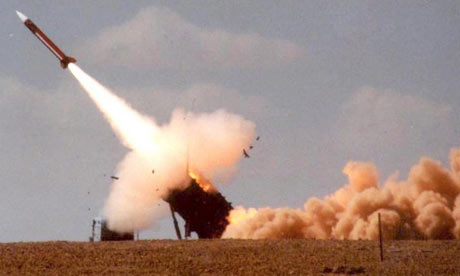
Guardian | We were supposed to have learned the lessons of the Iraq war. That's what Britain's Chilcot inquiry is meant to be all about. But the signs from the Middle East are that it could be happening all over again. The US is escalating the military build-up in the Gulf, officials revealed this week, boosting its naval presence and supplying tens of billions of dollars' worth of new weapons systems to allied Arab states.The target is of course Iran. Kuwait, the United Arab Emirates, Qatar and Bahrain are all taking deliveries of Patriot missile batteries. In Saudi Arabia, Washington is sponsoring a 30,000-strong force to protect oil installations and ports. The UAE alone has bought 80 F16 fighters, and General Petraeus, the US commander, claims it could now "take out the entire Iranian airforce".
The US insists the growing militarisation is defensive, aimed at deterring Iran, calming Israel and reassuring its allies. But the shift of policy is clear enough. Last week Barack Obama warned that Iran would face "growing consequences" for failing to halt its nuclear programme, while linking it with North Korea – as George Bush did, in his "axis of evil" speech in 2002.
When Iran's president, Mahmoud Ahmadinejad this week renewed Iran's earlier agreement to ship most of its enriched uranium abroad to be reprocessed, the US was dismissive. Obama's "outstretched hand", always combined with the threat of sanctions or worse, appears to have been all but withdrawn.
The US vice-president, Joe Biden, underlined that by insisting Iran's leaders were "sowing the seeds of their own destruction". And in Israel, which has vowed to take whatever action is necessary to prevent Iran acquiring nuclear weapons, threats of war against its allies, Lebanon's Hezbollah and the Palestinian Hamas, are growing. "We must recruit the whole world to fight Ahmadinejad," Israeli president Shimon Peres declared on Tuesday.
The echoes of the run-up to the invasion of Iraq are unmistakable. Just as in 2002-3, we are told that a dictatorial Middle Eastern state is secretly developing weapons of mass destruction, defying UN resolutions, obstructing inspections, threatening its neighbours and supporting terrorism.
By
CNu
at
February 04, 2010
0
comments
Labels: The Great Game , The Hardline
u.s. raising the stakes on iran
Guardian | Tension between the US and Iran heightened dramatically today with the disclosure that Barack Obama is deploying a missile shield to protect American allies in the Gulf from attack by Tehran.The US is dispatching Patriot defensive missiles to four countries – Qatar, United Arab Emirates, Bahrain and Kuwait – and keeping two ships in the Gulf capable of shooting down Iranian missiles. Washington is also helping Saudi Arabia develop a force to protect its oil installations.
American officials said the move is aimed at deterring an attack by Iran and reassuring Gulf states fearful that Tehran might react to sanctions by striking at US allies in the region. Washington is also seeking to discourage Israel from a strike against Iran by demonstrating that the US is prepared to contain any threat.
By
CNu
at
February 04, 2010
0
comments
Labels: Obamamandian Imperative , The Great Game
am not! are so!
BusinessGreen | We're running out of oil, warns Total boss; no we're not, says Saudi chief execLeading figures within the oil industry have clashed this week at the World Economic Forum in Davos over the risk to energy security posed by the "peak oil " phenomenon.
Thierry Desmarest, chief executive at French oil giant Total, yesterday told a meeting on energy supplies at the annual summit that the world's oil supplies were approaching their peak, the point at which many experts fear energy prices will begin to rise exponentially.
He said the industry would struggle to go beyond 95 million barrels per day, about 10 per cent above current levels of supply. "The problem of peak oil remains," he added.
His comments will be seized on by oil industry whistleblowers and environmental groups, who have been warning for years that the world is approaching an energy supply crunch that threatens to cripple the global economy. Experts have argued that the global recession has served to delay oil shortages for several years, noting that prior to the economic downturn, oil prices were running at record levels.
However, the chief executive of the Saudi state oil firm Saudi Aramco, Khalid al-Falih, told the same meeting in Davos that fears over "peak oil" had been hugely exaggerated.
"The concern about peak oil is behind us," he said, adding that "of the four trillion (barrels) of oil the planet is endowed with, only one has been produced ".
He did, however, admit that "most of what remains is more difficult and complex" to extract, but insisted there was "no doubt" the world can produce more than the 95 million to 100 million barrels a day that are projected to be required in the next few decades.
The spat came on the same day as the chief economist of the International Energy Agency, Dr Fatih Birol, cast fresh doubt on the wisdom of many oil firms' long-term investment plans, warning that demand for oil from industrialised nations has already peaked.
By
CNu
at
February 04, 2010
0
comments
Labels: Peak Capitalism
new peak in oil production needed
Telegraph | At a meeting of oil leaders at the World Economic Forum at Davos, Tony Hayward, group chief executive of BP, said that there was a “supply challenge” for the industry which would have to increase output to 100mbd - a new peak for oil. Mr Hayward said that at present the world was producing between 83 and 84mbd.
He said he hoped Iraq would become a major oil player, producing up to 10mbd in the next decade if the political situation remains relatively stable.
A need for a new peak in oil production will dismay environmental campaigners who hoped that the West’s declining reliance on oil would mean less CO2 emissions. Instead, demand from the emerging economies, including India and the other BRIC countries, China, Russia and Brazil, will lead to new record levels of consumption.
Mr Hayward’s comments were supported by Peter Voser, the chief executive of Shell, who said that the industry would have to find up to $27trn of investment over the next 20 years to meet demand.
At the session new figures from PriceWaterhouseCoopers revealed that non-OECD countries will account for two-thirds of world consumption by 2030. Mr Hayward said that demand from non-OECD nations would increase by 40pc.
“The obvious thing in the mature markets of Europe and the United States is that demand for oil products is in structural decline,” Mr Hayward said. He argued that demand was now coming from the East, pointing out that China sold 13m cars last year.
“The challenge is how do we meet this growing demand for oil and keep a lid on price?” Hayward said.
By
CNu
at
February 04, 2010
0
comments
Labels: Hanson's Peak Capitalism
Wednesday, February 03, 2010
continuing brand management struggles...,
WaPo | President Obama's 165th flight on Air Force One required all the customary protocols of a presidential trip. He took a helicopter from the White House lawn to Andrews Air Force Base, where seven military officers waited at full attention. He entered his plane through a door decorated by the presidential seal and settled into a suite that includes an office and a conference room. After a short flight, he exited to cheers from a greeting party before disappearing into a limousine that cruised down the barricaded streets of this New Hampshire city.
When Obama arrived here Tuesday afternoon, he stopped at a suburban industrial park to visit a machinery company. Snipers surveyed from the roof. Secret Service agents monitored the warehouse. A 19-car motorcade idled outside. Obama, meanwhile, stood on the gray concrete floor with the company's employees, studying their manufacturing materials and trying to convey his new favorite message: He understands the problems of what he calls "everyday Americans."
It is a tough sell for any president who lives inside what Obama refers to as "the bubble," but tougher still for Obama. His first year in office was defined in part by a paradox. He is a rare president who comes from the middle class, yet people still perceive him as disconnected from it. As he arrived in Nashua, nearly two-thirds of Americans believed that his economic policies had hurt the country or made no difference at all; almost half thought he did not understand their problems.
Obama has made it his goal in the past 10 days to convince them otherwise. In Nashua, he hoped to connect with the unemployed despite holding the country's most prestigious job; to disparage Washington politics despite being a product of them; to have a self-described "direct conversation with the folks of New Hampshire" even as bomb squads, Secret Service officers, political dignitaries and television cameras occupied every corner of the room.
By
CNu
at
February 03, 2010
0
comments
Labels: Obamamandian Imperative
gates sets new global war
Daily Bell | Free-Market Analysis: Wow, this is news. Maybe Gates has said this before, but we're not aware of it, or not like this. His speech seems to be positioning nonstate terrorism as a definitive fulcrum of a new cold war. That's some budget request!
But let us begin at the beginning - especially as we have already analyzed the dominant social theme of terrorism in several recent articles. You can see Scott Smith's analysis here, at the end of the Simon interview, click here.
In fact it is a kind of twofer.
First there is the "uniqueness of state military protection" - one of the longest-lived and most pernicious dominant social themes in the arsenal of the powers-that-be. It makes use of humankind's instinct, millions of years old, to band together to defend against the "other." In fact, it is a tribal instinct that was most useful when there were fewer humans and more lions and tigers. Today, all over the world, especially in the West, power elites (in our opinion) do whatever it takes to frighten their OWN populations in order to provide the necessary military and policing services that then justify their services, privileges and powers.
Then there is the meme of nonstate terrorism - that "terrorism can strike from anywhere." Starting with the "anarchist" promotion of the early 20th century, Western elites have been busily inculcating the meme that terror is entirely unpredictable and that sustained campaigns of violence can be initiated and carried forth by a few dedicated individuals.
For a long time, Israel served as a good example of this promotion. Shadowy bands of terrorists were reported attacking Israeli citizens on a regular basis, yet one was never really given to understand how these terrorists banded together, where they came from or how they received their support. Israel seemed to be afflicted by modern terrorism - by a peculiar aspect of modernity, the "stateless terrorist."
And now here is Gates speaking of a ...
"CONTINUING THREAT OF TERRORISM FROM ‘NONSTATE GROUPS ... [THAT] "TRANSCENDS THE FAMILIAR CONTINGENCIES THAT DOMINATED U.S. PLANNING AFTER THE COLD WAR."'
Do you see? Here is the BIFURCATED meme in its all its glory being trotted out. This is a historical moment folks. You are in on the ground floor. You are looking at liftoff. Right now, just this minute, Gates has declared a NEW GLOBAL COLD WAR. That's right - he's saying that the DANGER posed by the stateless terrorist "transcends" the threats, and therefore the contingencies or solutions, generated by Pentagon Cold War planning. And that the danger of the stateless terrorist is even bigger than the threat of the Soviet Union (and to a lesser extent China), which spawned the last cold war.
From our point of view (humble as it is) this is THE MOTHER OF ALL PROMOTIONS. In fact, a terrorist without a state is as much of a danger, long term, as a toaster without power, a flashlight without a battery or an agenda of religious violence without state backing. We have come to believe this because we are students of free-market economics. Absent the coercion of the state, there is competition - and people are free to choose whether or not to support a "terrorist."
By
CNu
at
February 03, 2010
0
comments
Labels: common sense , Obamamandian Imperative , truth
DoD fy 2011 budget request
By
CNu
at
February 03, 2010
0
comments
Labels: Deep State , narrative , warsocialism
Tuesday, February 02, 2010
why are u.s. voters stupid?
The Daily Bell | Thomas Frank, the author of the best-selling book What's The Matter with Kansas, is an ... exasperated Democrat. He believes that the voters' preference for emotional engagement over reasonable argument has allowed the Republican Party to blind them to their own real interests.The Republicans have learnt how to stoke up resentment against the patronizing liberal elite, all those do-gooders who assume they know what poor people ought to be thinking.
Right-wing politics has become a vehicle for channeling this popular anger against intellectual snobs. The result is that many of America's poorest citizens have a deep emotional attachment to a party that serves the interests of its richest. Thomas Frank says that whatever disadvantaged Americans think they are voting for, they get something quite different: "You vote to strike a blow against elitism and you receive a social order in which wealth is more concentrated than ever before in our life times, workers have been stripped of power, and CEOs are rewarded in a manner that is beyond imagining.
Thomas Frank thinks that voters have become blinded to their real interests "It's like a French Revolution in reverse in which the workers come pouring down the street screaming more power to the aristocracy."
As Mr. Frank sees it, authenticity has replaced economics as the driving force of modern politics. The authentic politicians are the ones who sound like they are speaking from the gut, not the cerebral cortex. Of course, they might be faking it, but it is no joke to say that in contemporary politics, if you can fake sincerity, you have got it made.
And the ultimate sin in modern politics is appearing to take the voters for granted. This is a culture war but it is not simply being driven by differences over abortion, or religion, or patriotism. And it is not simply Red states vs. Blue states any more. It is a war on the entire political culture, on the arrogance of politicians, on their slipperiness and lack of principle, on their endless deal making and compromises.
The passage above, coming toward the end of the article is, in our opinion, the real reason the article was written. The BBC generally is not a great fan of the American Republican Party and of "right wing" politics in general. The article's real thesis, from our point of view, is that "Americans are once again being lied to by the fascist right wing - which has learned to adopt an "authentic tone."
Poor BBC. They have got it wrong again. This is important because in the Age of the Internet, such propagandistic handiwork has ramifications. In fact, what is going on in America, thanks in large part to information available on the Internet, is that literally millions of people, many of them youngsters, have rediscovered classical liberalism and real republican values. The Tea Parties are an outgrowth of this discovery, though also of general American voter rage with the continued decline of civil society and living standards.
To answer the BBC's question, American voters ARE NOT voting against their interests, nor are they voting for "authenticity." What American voters are voting for increasingly is more freedom, less government, fewer taxes and a political system that is seen as working for the people rather than against them. President Barack Obama has misread the will of the voters and the "change" he was elected to provide.
The biggest and most powerful movement in the United States, as we have long predicted, is the classical liberal message of Congressman Ron Paul (R-Tex). Eventually, maybe sooner rather than later, his movement (with some 250,000 members) will have signed up one million members, making it the most powerful force for freedom in America since before the Civil War. The British - the BBC and even the Telegraph - are blithely ignoring the convulsive changes that are taking place in American political life.
By
CNu
at
February 02, 2010
0
comments
Labels: elite , establishment , narrative
the okey doke...,
AlterNet | In the following interview Bill Moyers and Thomas Frank, author of "What's the Matter With Kansas" and "The Wrecking Crew," talk about why conservatives can get away with blaming Obama for the past decade of conservative failures.
Bill Moyers: There were hands in the air in Washington this week, but it wasn't a stickup. The new Financial Crisis Inquiry Commission, appointed by Congress to find out how America got rolled, began hearings this week. These four are not the victims of one of the greatest bank heists in history - they're the perpetrators, bankers so sleek and crafty they got off with the loot in broad daylight, and then sweet talked the government into taxing us to pay it back.
Watching that scene on the opening day of the hearings, it was hard enough to believe that almost a year has passed since Barack Obama raised his hand, too -- taking the oath of office to become our 44th President. Even harder to remember what America looked like before Obama, because we've also been robbed of memory, assaulted by what the Nobel laureate Czeslaw Milosz described as a "fantastic proliferation of mass media." We live in a time "characterized by a refusal to remember." Inconvenient facts simply disappear down the memory hole, as in George Orwell's novel, "1984."
President Obama's made plenty of mistakes during his first year, and we've critiqued them frequently here on the JOURNAL, but hardly anyone talks any more about what happened in the years before. He inherited from George W. Bush the biggest financial debacle since the Great Depression, along with two unpopular and costly wars, and a dysfunctional and demoralized government.
It's important to remember those years, a time that has been characterized by the historian Thomas Frank, as "A Low, Dishonest Decade." He's here to talk about them with me. Thomas Frank is editor of the recently relaunched BAFFLER magazine, a literary journal; a contributing editor of HARPER'S; a weekly columnist for THE WALL STREET JOURNAL; and the author of ONE MARKET UNDER GOD, the bestselling WHAT'S THE MATTER WITH KANSAS? and his latest bestseller, THE WRECKING CREW, now out in paperback. Good to have you back.
By
CNu
at
February 02, 2010
0
comments
Labels: deceiver , ethics , Obamamandian Imperative
unapologetic conservative double-standards...,
WaPo | The nation owes a substantial debt to Justice Samuel Alito for his display of unhappiness over President Obama's criticisms of the Supreme Court's recent legislation -- excuse me, decision -- opening our electoral system to a new torrent of corporate money.
Alito's inability to restrain himself during the State of the Union address brought to wide attention a truth that too many have tried to ignore: The Supreme Court is now dominated by a highly politicized conservative majority intent on working its will, even if that means ignoring precedents and the wishes of the elected branches of government.
Obama called the court on this, and Alito shook his head and apparently mouthed "not true." His was the honest reaction of a judicial activist who believes he has the obligation to impose his version of right reason on the rest of us.
The controversy also exposed the impressive capacity of the conservative judicial revolutionaries to live by double standards without apology.
The movement's legal theorists and politicians have spent more than four decades attacking alleged judicial abuses by liberals, cheering on the presidents who joined them in their assaults. But now, they are terribly offended that Obama has straightforwardly challenged the handiwork of their judicial comrades.
There is ample precedent for Obama's firm but respectful rebuke of the court. I know of no one on the right who protested when President Ronald Reagan, in a 1983 article in the Human Life Review, took on the Supreme Court's Roe v. Wade decision of 10 years earlier.
"Make no mistake, abortion-on-demand is not a right granted by the Constitution," Reagan wrote. "No serious scholar, including one disposed to agree with the court's result, has argued that the framers of the Constitution intended to create such a right. . . . Nowhere do the plain words of the Constitution even hint at a 'right' so sweeping as to permit abortion up to the time the child is ready to be born." Reagan cited Justice Byron White's description of Roe as an act of "raw judicial power," which is actually an excellent description of the court's ruling on corporate money in Citizens United v. Federal Election Commission.
Reagan had every right to say what he did. But why do conservatives deny the same right to Obama? Alternatively, why do they think it's persuasive to argue, as Georgetown Law professor Randy Barnett did last week in the Wall Street Journal, that it's fine for a president to take issue with the court, except in a State of the Union speech? Isn't it more honorable to criticize the justices to their faces? Are these jurists so sensitive that they can't take it? Do they expect everyone to submit quietly to whatever they do?
By
CNu
at
February 02, 2010
1 comments
Labels: corporatism , theoconservatism
Chipocalypse Now - I Love The Smell Of Deportations In The Morning
sky | Donald Trump has signalled his intention to send troops to Chicago to ramp up the deportation of illegal immigrants - by posting a...
-
theatlantic | The Ku Klux Klan, Ronald Reagan, and, for most of its history, the NRA all worked to control guns. The Founding Fathers...
-
NYTimes | The United States attorney in Manhattan is merging the two units in his office that prosecute terrorism and international narcot...
-
Wired Magazine sez - Biologists on the Verge of Creating New Form of Life ; What most researchers agree on is that the very first functionin...
