Sunday, January 24, 2010

right-wing flame war (ditching racists and fascists is hard to do)


NYTimes | By virtue of his willingness to do and share research, his personal embrace of a hawkish, populist anger and his extraordinary Web savvy, Johnson quickly turned Little Green Footballs (or L.G.F., as it is commonly known) into one of the most popular personal sites on the Web, and himself — the very model of a Los Angeles bohemian — into an avatar of the American right wing. With a daily audience in the hundreds of thousands, the career sideman had moved to the center of the stage.

Now it is eight years later, and Johnson, who is 56, sits in the ashes of an epic flame war that has destroyed his relationships with nearly every one of his old right-wing allies. People who have pledged their lives to fighting Islamic extremism, when asked about Charles Johnson now, unsheathe a word they do not throw around lightly: “evil.” Glenn Beck has taken the time to denounce him on air and at length. Johnson himself (Mad King Charles is one of his most frequent, and most printable, Web nicknames) has used his technical know-how to block thousands of his former readers not just from commenting on his site but even, in many cases, from viewing its home page. He recently moved into a gated community, partly out of fear, he said, that the venom directed at him in cyberspace might jump its boundaries and lead someone to do him physical harm. He has turned forcefully against Fox News, Rush Limbaugh, Sarah Palin, nearly every conservative icon you can name. And answering the question of what, or who, got to Charles Johnson has itself become a kind of boom genre on the Internet.

“It’s just so illogical,” Geller told me heatedly not long ago. “I loved him. I respected him. But the way he went after people was like a mental illness. There’s an evil to that, a maliciousness. He’s a traitor, a turncoat, a plant. We may not know for years what actually happened. You think he changed his mind?”

uganda anti-gay bill backers in newark

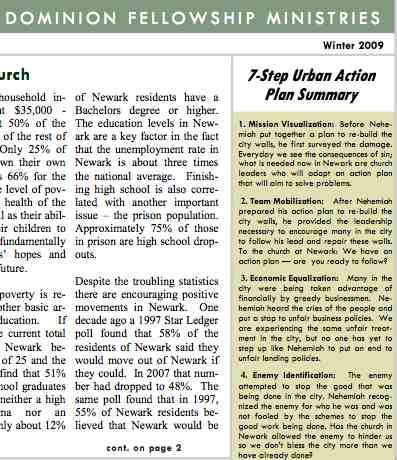
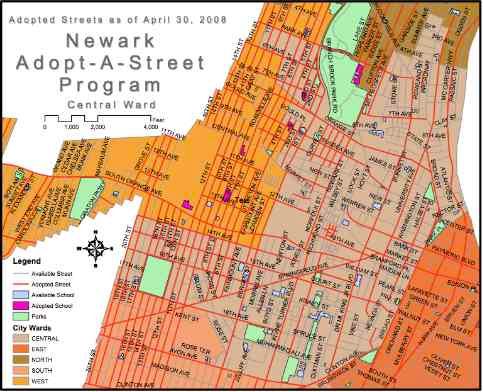
TalktoAction | Street by street, block by block, organized by city ward, PrayforNewark's squads of church members are walking their city, praying for residents and businesses. Launched on Martin Luther King Day in 2008, its leaders claim their effort now fields enough volunteers to pray for almost every street in the New Jersey city. Endorsed by Newark's liberal mayor, PrayforNewark would seem a blessing for any city. What could be wrong with prayer ? But the effort is directly tied to an international movement that, as detailed in my new video documentary Transforming Uganda, played a significant role in organizing and inspiring Ugandan politicians who have backed the internationally notorious "kill the gays" bill, the Anti-Homosexuality Bill currently before Uganda's parliament.

The ecumenical coalition behind PrayforNewark is led by Rev. Bernard Wilks, whose Dominion Fellowship Ministries newsletters for PrayforNewark have repeatedly called for "enemy identification" and a document on the official PrayforNewark web site touts the "Seven Mountains" program which calls upon born-again, charismatic Christians to take dominion over key societal sectors such as business, government, media and education.

Given the benign-seeming exterior of PrayforNewark, it is likely that many Newark citizens involved in the effort are not fully aware of the ideological roots of PrayforNewark, or of its links to international entities tied to the Uganda bill.

PrayforNewark was founded by Newark suburb resident Lloyd Turner, who in October 2008 spoke at an Argentina conference of the International Transformation Network (ITN), whose CEO Ed Silvoso wrote, in his 2007 book, Transformation: Change the Marketplace and You Change the World, that homosexuality is caused by demon possession and that HIV and AIDS can be cured through faith healing and prayer. According to Silvoso, the entire national police force of the Philippines is being indoctrinated in this ideology.

bob hunter on fellowship foundation and uganda

Visit msnbc.com for breaking news, world news, and news about the economy


Visit msnbc.com for breaking news, world news, and news about the economy

museveni and bahati on anti-gay bill

americans role seen in uganda anti-gay push


NYTimes | Last March, three American evangelical Christians, whose teachings about “curing” homosexuals have been widely discredited in the United States, arrived here in Uganda’s capital to give a series of talks.

The theme of the event, according to Stephen Langa, its Ugandan organizer, was “the gay agenda — that whole hidden and dark agenda” — and the threat homosexuals posed to Bible-based values and the traditional African family.

For three days, according to participants and audio recordings, thousands of Ugandans, including police officers, teachers and national politicians, listened raptly to the Americans, who were presented as experts on homosexuality. The visitors discussed how to make gay people straight, how gay men often sodomized teenage boys and how “the gay movement is an evil institution” whose goal is “to defeat the marriage-based society and replace it with a culture of sexual promiscuity.”

Now the three Americans are finding themselves on the defensive, saying they had no intention of helping stoke the kind of anger that could lead to what came next: a bill to impose a death sentence for homosexual behavior.

One month after the conference, a previously unknown Ugandan politician, who boasts of having evangelical friends in the American government, introduced the Anti-Homosexuality Bill of 2009, which threatens to hang homosexuals, and, as a result, has put Uganda on a collision course with Western nations.

Donor countries, including the United States, are demanding that Uganda’s government drop the proposed law, saying it violates human rights, though Uganda’s minister of ethics and integrity (who previously tried to ban miniskirts) recently said, “Homosexuals can forget about human rights.”

The Ugandan government, facing the prospect of losing millions in foreign aid, is now indicating that it will back down, slightly, and change the death penalty provision to life in prison for some homosexuals. But the battle is far from over.

Instead, Uganda seems to have become a far-flung front line in the American culture wars, with American groups on both sides, the Christian right and gay activists, pouring in support and money as they get involved in the broader debate over homosexuality in Africa.

Saturday, January 23, 2010

how corporate law inhibits social responsibility

MediaLens | I believe the battle against corporate abuse should be conducted in a more holistic way. We must inquire why corporations behave as they do, and look for a way to change these underlying motives. Once we have arrived at a viable systemic solution, we should then dictate the terms of engagement to corporations, not let them dictate terms to us. We must remember that corporations were invented to serve mankind. Mankind was not invented to serve corporations. Corporations in many ways have the rights of citizens, and those rights should be balanced by obligations to the public.

Many activists cast the fundamental issue as one of "corporate greed," but that's off the mark. Corporations are incapable of a human emotion like greed. They are artificial beings created by law. The real question is why corporations behave as if they are greedy. The answer is the design of corporate law.

We can change that design. We can make corporations more responsible to the public good by amending the law that says the pursuit of profit takes precedence over the public interest. I believe this can best be achieved by changing corporate law to make directors personally responsible for harms done.

Let me give you a sense of how director responsibility works in the current system. Under federal securities laws, directors are held personally liable for false and misleading statements made in prospectuses used to sell securities. If a corporate prospectus contains a material falsehood and investors suffer damage as a result, investors can sue each director personally to recover the damage. Believe me, this provision grabs the attention of company directors. They spend hours reviewing drafts of a prospectus to ensure it complies with the law. Similarly, everyone who works on the prospectus knows that directors' personal wealth is at stake, so they too take great care with accuracy.

That's an example of how corporate behavior changes when directors are held personally responsible. Everyone in the corporation improves their game to meet the challenge. The law has what we call an in terrorem effect. Since the potential penalties are so severe, directors err on the side of caution. While this has not eliminated securities fraud, it has over the years reduced it to an infinitesimal percentage of the total capital raised. I propose that corporate law be changed in a similar manner--to make individuals responsible for seeing that the pursuit of profit does not damage the public interest.

To pave the way for such a change, we must challenge the myth that making profits and protecting the public interest are mutually exclusive goals. The same was once said about profits and product quality, before Japanese manufacturers taught us otherwise. If we force companies to respect the public interest while they make money, business people will figure out how to do both. The specific change I suggest is simple: add 26 words to corporate law and thus create what I call the "Code for Corporate Citizenship." In Maine, this would mean amending section 716 to add the following clause. Directors and officers would still have a duty to make money for shareholders, ... but not at the expense of the environment, human rights, the public safety, the communities in which the corporation operates or the dignity of its employees.

This simple amendment would effect a dramatic change in the underlying mechanism that drives corporate malfeasance. It would make individuals responsible for the damage companies cause to the public interest, and would be enforced much the same way as securities laws are now. Negligent failure to abide by the code would result in the corporation, its directors, and its officers being liable for the full amount of the damage they cause. In addition to civil liability, the attorney general would have the right to criminally prosecute intentional acts. Injunctive relief-which stops specific behaviors while the legal process proceeds-would also be available.

terror of the situation

economic cyborgs

Warsocialism | In The Absence of the Sacred, advertising executive and economist Jerry Mander uncovers the true nature of corporations:
The corporation is not as subject to human control as most people believe it is; rather, it is an autonomous technical structure that behaves by a system of logic uniquely well suited to its primary function: to give birth and impetus to profitable new technological forms, and to spread techno-logic around the globe.

We usually become aware of corporate behavior only when a flagrant transgression is reported in the news: the dumping of toxic wastes, the releasing of pollutants, the suppression of research regarding health effects of various products, the tragic mechanical breakdowns such as at Three Mile Island, in Bhopal, or in Prince William Sound, Alaska. Sometimes we become concerned about a large corporation closing a factory, putting 5,000 people out of work, and moving to another country.

Even when we hear such news, our tendency is to respond as if the behaviors described stem from the people within the corporate structure – people who are irresponsible, dishonest, greedy, or overly ambitious. Or else we attribute the problem to the moral decline of the times we live in, or to the failure of the regulatory process.

Seeing corporate behavior as rooted in the people who work within them is like believing that the problems of television are attributable solely to its program content. With corporations, as with television, the basic problems are actually structural. They are problems inherent in the forms and rules by which these entities are compelled to operate. If the problems could be traced to the personnel involved, they could be solved by changing the personnel. Unfortunately, however, all employees are obligated to act in concert, to behave in accordance with corporate form and corporate law. If someone attempted to revolt against these tenets, it would only result in the corporation throwing the person out, and replacing that person with another who would act according to the rules. Form determines content. Corporations are machines.
Corporations – by their very structure – are forced to exhibit Mander’s eleven inherent rules of behavior: The Profit Imperative, The Growth Imperative, Competition and Aggression, Amorality, Hierarchy, Quantification, Linearity and Segmentation, Dehumanization, Exploitation, Ephemerality, Opposition to Nature, and Homogenization. Form determines content. Corporations are machines.

Corporations do not “need” such things as clean air, justice, truth, beauty or love to survive. The only thing that large for-profit corporations “need” to survive is PROFIT. It is impossible for these corporations to forego significant monetary profits for moral reasons. If managers sacrifice significant profits to save important natural ecosystems or a community’s quality of life, they may be fired and/or subject to stockholder litigation. Management must bend itself to the corporate will and that will is to enrich the rich. Today, the richest 1 percent of America’s families controls 28 percent of the nation’s wealth and 60 percent of the nation’s corporate stock. (one-dollar, one-vote)

Thus, a large corporation may be seen as a man-made life form, a beast with a will of its own: an “economic cyborg.” Visualize a powerful creature that has humans for talons, a bank vault for a heart, computers for eyes and an insatiable need for PROFIT. The economic cyborg – a “terminator” – a machine in human disguise!

Economic cyborgs ingest natural materials (including people) in one end, and excrete un-natural products and waste (including worn-out people) out the other. Cyborgs have no innate morals to keep them from seducing our politicians, subverting our democratic processes or lying in order to achieve their own selfish objectives. Moreover, cyborgs are only nominally controlled by laws, because the people who make our laws are in turn controlled by these same cyborgs. Today in America, we live under the de facto plutocracy of the economic cyborgs. (one-dollar, one-vote)

Friday, January 22, 2010

the mixed signal of bourgeois brand management

WSJ | Summing up what she does for a living, Rogers says she plans events that “promote the Obama presidency” and make sure “the White House asset is reflective of who they [the Obamas] are.” In keeping with her corporate background and her Harvard M.B.A., Rogers uses words like “strategic plan” and “brand” when she describes how a constant string of lunches, parties and concerts can help her mission. “You have to think about it [the social secretary job], in my mind, almost like a business. Otherwise, you never get there. You get caught in linen hell and flower hell, list hell,” Rogers says as she reflects on the first series of high-profile events.

“We have the best brand on earth: the Obama brand,” Rogers says. “Our possibilities are endless.” Like all brands, the Obama brand has a “crown jewel,” she explains, and that crown jewel is the White House. Think of it like Unilever’s Dove, a consumer brand Rogers says she admires. Having started with a simple bar of soap, the utilitarian Dove brand now boasts such grooming products as shampoo, body wash and deodorant. In 2004, its “Campaign for Real Beauty” featuring plus-size and older models generated a flood of publicity, boosted sales and made the brand seem approachable and public-service-oriented. “You basically need to understand what your customers want and need,” Rogers says.

Brand Obama is a marketer’s dream, says Michael Sitrick, chairman of Sitrick and Company, a public-relations firm that specializes in handling sensitive situations and has worked with billionaire Ron Burkle and socialite Paris Hilton. Rogers and the rest of the Obama team have an idyllic American family to work with “straight out of a 1950s sitcom,” Sitrick says. They “really get it from a public-relations perspective.” Not since Jacqueline Kennedy redecorated the White House and used it as a showcase for arts and culture, which helped create the Camelot mystique, has a first family so captured popular fascination, first-lady historian Myra Gutin says. Dale hit the stacks and get's big dap for this one.

lobbyists get potent campaign weapon


NYTimes | WASHINGTON — The Supreme Court has handed a new weapon to lobbyists. If you vote wrong, a lobbyist can now tell any elected official that my company, labor union or interest group will spend unlimited sums explicitly advertising against your re-election.

“We have got a million we can spend advertising for you or against you — whichever one you want,’ ” a lobbyist can tell lawmakers, said Lawrence M. Noble, a lawyer at Skadden Arps in Washington and former general counsel of the Federal Election Commission.

The decision seeks to let voters choose for themselves among a multitude of voices and ideas when they go to the polls, but it will also increase the power of organized interest groups at the expense of candidates and political parties.

It is expected to unleash a torrent of attack advertisements from outside groups aiming to sway voters, without any candidate having to take the criticism for dirty campaigning. The biggest beneficiaries might be well-placed incumbents whose favor companies and interests groups are eager to court. It could also have a big impact on state and local governments, where a few million dollars can have more influence on elections.

The ruling comes at a time when influence-seekers of all kinds have special incentives to open their wallets. Amid the economic crisis, the Obama administration and Congressional Democrats are trying to rewrite the rules for broad swaths of the economy, from Detroit to Wall Street. Republicans, meanwhile, see a chance for major gains in November.

Democrats predicted that Republicans would benefit most from the decision, because they are the traditional allies of big corporations, who have more money to spend than unions.

In a statement shortly after the decision, President Obama called it “a green light to a new stampede of special interest money in our politics.”

not even a very wise latina could save the day...,

WaPo | FOR MORE THAN a century, Congress has recognized the danger of letting corporations use their wealth to wield undue influence in political campaigns. The Supreme Court had upheld these efforts. But Thursday, making a mockery of some justices' pretensions to judicial restraint, the Supreme Court unnecessarily and wrongly ruled 5 to 4 that the constitutional guarantee of free speech means that corporations can spend unlimited sums to help elect favored candidates or defeat those they oppose. This, as the dissenting justices wrote, "threatens to undermine the integrity of elected institutions across the nation."

This result was unnecessary because the court's conservative majority -- including supposed exemplars of judicial modesty -- lunged to make a broad constitutional ruling when narrower grounds were available. It was wrong because nothing in the First Amendment dictates that corporations must be treated identically to people. And it was dangerous because corporate money, never lacking in the American political process, may now overwhelm both the contributions of individuals and the faith they may harbor in their democracy.

The majority found its pretext in the documentary "Hillary: The Movie," produced by a conservative group called Citizens United and released during the 2008 primaries. Citizens United wanted to make the movie -- "a feature-length negative advertisement," the court termed it -- available as a video-on-demand accessible through cable television. That brought into play a provision, part of the McCain-Feingold campaign finance law, that bars corporate and union political advertising close to the time of an election. That provision applied to Citizens United because the group is organized as a nonprofit corporation and because it takes a small amount of corporate donations. In our view, Citizens United should have been free to distribute the anti-Clinton documentary. The relevant McCain-Feingold provision could have been interpreted to permit such speech by a clearly ideological, as opposed to commercial, for-profit corporation.

Instead, the court's five-member majority went much further. It overruled a 1990 decision that upheld a state law prohibiting independent corporate expenditures in political campaigns. It overruled its own 2003 decision upholding the same provision of McCain-Feingold that it struck down Thursday -- so much for respect for precedent.

"We find no basis for the proposition that, in the context of political speech, the Government may impose restrictions on certain disfavored speakers," the court said in an opinion by Justice Anthony M. Kennedy. Rules against direct corporate contributions to candidates still stand, but corporations are now free to engage in unlimited independent expenditures, something that Congress has banned since 1947. Fist tap Nana who called it first in yesterday's comments.

Thursday, January 21, 2010

copenhagen and economic growth?

EnergyBulletin | As noted here routinely in my writings and in the Crash Course, we have an exponential monetary system. One mandatory feature of our current exponential monetary system is the need for perpetual growth. Not just any kind of growth; exponential growth. That's the price for paying interest on money loaned into existence. Without that growth, our monetary system shudders to a halt and shifts into reverse, operating especially poorly and threatening to melt down the entire economic edifice.

This is so well understood, explicitly or implicitly, throughout all the layers of society and in our various institutions, that you will only ever hear politicians and bankers talking about the "need" for growth.

In fact, they are correct; our system does need growth. All debt-based money systems require growth. That is the resulting feature of loaning one's money into existence. That's the long and the short of the entire story. The growth may seem modest, perhaps a few percent per year ('That's all, honest!'), but therein lies the rub. Any continuous percentage growth is still exponential growth.

Exponential growth means not just a little bit more each year, but a constantly growing amount each year. It is a story of more. Every year needs slightly more than the prior year - that's the requirement.

The Gap
Nobody has yet reconciled the vast intellectual and practical gap that exists between our addiction to exponential growth and the carbon reduction rhetoric coming out of Copenhagen. I've yet to see any credible plan that illustrates how we can grow our economy without using more energy.

Is it somehow possible to grow an economy without using more energy? Let's explore that concept for a bit.

What does it mean to "grow an economy?" Essentially, it means more jobs for more people producing and consuming more things. That's it. An economy, as we measure it, consists of delivering the needs and wants of people in ever-larger quantities. It's those last three words - ever-larger quantities - that defines the whole problem.

a desert mirage

WaPo | Every home builder in the country would probably describe 2009 as an "annus horribilis." But Las Vegas builders Adam Knecht and Ernie Domanico had a particularly horrible year.

Last January, their construction company, Domanico Custom Homes, was breaking ground for the New American Home, which was supposed to be a spectacular show house and a centerpiece of the International Builders Show, scheduled to open in Las Vegas next week.

Instead, the New American Home all too accurately reflects the state of luxury home building -- and the ravaged Las Vegas market. Unable to secure financing, the builders lost the unfinished home to foreclosure in December.

Rob Williams, the architect who designed the home, said he could have incorporated most of the showcased products in a house half as big, but the project was intended to be a "dream house" that demanded extravagance.

Its sprawling footprint is bookended by a capacious master suite at one end of the first floor and a grandparent suite at the other. The second floor includes three large bedrooms, each with its own bath, and a "man cave," a large room intended to be a hangout for Dad and his pals to play cards, shoot pool -- and watch six televisions simultaneously.

Despite this year's fiasco, the NCHI remains enthusiastic about its New American Home program, Bernard said. The builder for next year's 8,500-square-foot house in Orlando just got building permits and is going full speed ahead to meet the September deadline.

Knecht has left the family business and is moving into an emerging niche in the Las Vegas market, buying partially built foreclosures, finishing construction and selling them. He said Domanico remains in business, though the phone number was not in service when a reporter called.

system failure

The Nation | There is a widespread consensus that the decade we've just brought to a close was singularly disastrous for the country: the list of scandals, crises and crimes is so long that events that in another context would stand out as genuine lowlights--Enron and Arthur Andersen's collapse, the 2003 Northeast blackout, the unsolved(!) anthrax attacks--are mere afterthoughts. We still don't have a definitive name for this era, though Paul Krugman's 2003 book The Great Unraveling captures well the sense of slow, inexorable dissolution; and the final crisis of the era, what we call the Great Recession, similarly expresses the sense that even our disasters aren't quite epic enough to be cataclysmic. But as a character in Tracy Letts's 2007 Pulitzer Prize-winning play, August: Osage County, says, "Dissipation is actually much worse than cataclysm."

American progressives were the first to identify that something was deeply wrong with the direction the country was heading in and the first to provide a working hypothesis for the cause: George W. Bush. During the initial wave of antiwar mobilization, in 2002, much of the ire focused on Bush himself. But as the decade stretched on, the causal account of the country's problems grew outward in concentric circles: from Bush to his administration (most significantly, Cheney) to the Republican Party to--finally (and not inaccurately)--the entire project of conservative governance.

As much of the country came to share some version of this view (tenuously, but share it they did), the result was a series of Democratic electoral sweeps and a generation of Americans, the Millennials, with more liberal views than any of their elder cohorts. But it always seemed possible that the sheer reactionary insanity of the Bush administration would have a conservatizing effect on the American polity. Because things had gone so wrong, it was a more than natural reaction to long for the good old days; the Clinton years, characterized by deregulation and bubbles, seemed tantalizingly placid and prosperous in retrospect. The atavistic imperialism of the Bush administration had a way of making the pre-Bush foreign policy of soft imperialism and subtle bullying look positively saintly.

Toward the end of the decade, as the establishment definitively rebuked Bush and sought to distance itself from his failures, the big-tent center-left coalition took on an influential constituency--the Colin Powells and Warren Buffetts--who didn't want reform so much as they wanted restoration. This was reflected in a strange internal tension in the Obama campaign rhetoric that simultaneously promised both: change you can believe in and, as Obama said at a March 2008 appearance in Pennsylvania, a foreign policy that is "actually a return to the traditional bipartisan realistic policy of George Bush's father."

If the working hypothesis that bound this unwieldy coalition together--independents, most liberals and the Washington establishment--was that the nation's troubles were chiefly caused by the occupants of the White House, then this past year has served as a kind of natural experiment. We changed the independent variable (the party and people in power) and can observe the results. It is hard, I think, to come to any conclusion but that the former hypothesis was insufficient.

So what, exactly, is it that ails us?

the rule of law has been lost

Creator's Syndicate | As Lawrence Stratton and I show in our book, "The Tyranny of Good Intentions" (2000), the protective features of law in the U.S. were eroded in the twentieth century by prosecutorial abuse and by setting aside law in order to better pursue criminals. By the time of our second edition (2008), law as a shield of the people no longer existed. Respect for the Constitution and rule of law had given way to executive branch claims that during time of war government is not constrained by law or Constitution.

Government lawyers told President Bush that he did not have to obey the Foreign Intelligence Surveillance Act, which prohibits the government from spying on citizens without a warrant, thus destroying the right to privacy. The U.S. Department of Justice ruled that the President did not have to obey U.S. law prohibiting torture or the Geneva Conventions. Habeas corpus protection, a Constitutional right, was stripped from U.S. citizens. Medieval dungeons, torture, and the windowless cells of Stalin's Lubyanka Prison reappeared under American government auspices.

The American people's elected representatives in Congress endorsed the executive branch's overthrow of the Constitution and the Bill of Rights. Law schools and bar associations were essentially silent in the face of this overthrow of mankind's greatest achievement. Some parts of the federal judiciary voted with the executive branch; other parts made a feeble resistance. Today in the name of "the war on terror," the executive branch does whatever it wants. There is no accountability.

The First Amendment has been abridged and may soon be criminalized. Protests against, and criticisms of, the U.S. government's illegal invasions of Muslim countries and war crimes against civilian populations have been construed by executive branch officials as "giving aid and comfort to the enemy." As American citizens have been imprisoned for giving aid to Muslim charities that the executive branch has decreed, without proof in a court of law, to be under the control of "terrorists," any form of opposition to the government's wars and criminal actions can also be construed as aiding terrorists and be cause for arrest and indefinite detention.

One Obama appointee, Harvard law professor Cass Sunstein, advocates that the U.S. government create a cadre of covert agents to infiltrate anti-war groups and groups opposed to U.S. government policies in order to provoke them into actions or statements for which they can be discredited and even arrested.

Sunstein defines those who criticize the government's increasingly lawless behavior as "extremists," which, to the general public, sounds much like "terrorists." In essence, Sunstein wants to generalize the F.B.I.'s practice of infiltrating dissidents and organizing them around a "terrorist plot" in order to arrest them. That this proposal comes from a Harvard Law School professor demonstrates the collapse of respect for law among American law professors themselves, ranging from John Yoo at Berkeley, the advocate of torture, to Sunstein at Harvard, a totalitarian who advocates war on the First Amendment.

tea-bagger brown triumphs

The Phoenix | Brown’s election is in a category of its own. There is no escaping the fact that, in electing a right-wing Republican to take Kennedy’s place, Massachusetts is sending America a message: the nation’s middle-of-the road independents have been radicalized.

Congressional Democrats and Obama enjoy their majority at the sufferance of independents. But every indicator now screams that independents have lost faith in Democrats, just as a little more than a year ago they lost faith in Republicans.

Though public-opinion polls show that a majority of independents may still like and even admire Obama, their tolerance for his political performance is shrinking fast. Obama’s noble and necessary experiment with bipartisanship has failed. Republicans — hard-pressed by the Tea Party movement — are dedicated to little more than his destruction.

Obama and the Democrats may have stopped the economic decline, but they have failed to reverse it. People fear for their jobs, and for their families.

This worry is tangible and visceral. Independents want jobs more than health-care reform; they want bank loans for their small businesses, mortgages for their houses, and colleges they can afford for their kids. It is all about economics.

The paradox is that, at the moment, the federal government must intervene to bring these conditions about. But neither Democrats nor Republicans have given independent voters sufficient reason to trust Washington.

Obama’s challenge is to find a way to cut through the special interests that hold the Democrats hostage. The Republicans are a lost cause. Lose independents and he loses the nation.Justify Full

Wednesday, January 20, 2010

subtext

TimesOnline | The US army is training a crack unit to seal off and snatch back Pakistani nuclear weapons in the event that militants, possibly from inside the country’s security apparatus, get their hands on a nuclear device or materials that could make one.

The specialised unit would be charged with recovering the nuclear materials and securing them.

The move follows growing anti-Americanism in Pakistan’s military, a series of attacks on sensitive installations over the past two years, several of which housed nuclear facilities, and rising tension that has seen a series of official complaints by US authorities to Islamabad in the past fortnight.

“What you have in Pakistan is nuclear weapons mixed with the highest density of extremists in the world, so we have a right to be concerned,” said Rolf Mowatt-Larssen, a former CIA officer who used to run the US energy department’s intelligence unit. “There have been attacks on army bases which stored nuclear weapons and there have been breaches and infiltrations by terrorists into military facilities.”

Professor Shaun Gregory, director of the Pakistan security research unit at Bradford University, has tracked a number of attempted security breaches since 2007. “The terrorists are at the gates,” he warned.

In a counterterrorism journal, published by America’s West Point military academy, he documented three incidents. The first was an attack in November 2007 at Sargodha in Punjab, where nuclearcapable F-16 jet aircraft are thought to be stationed. The following month a suicide bomber struck at Pakistan’s nuclear airbase at Kamra in Attock district. In August 2008 a group of suicide bombers blew up the gates to a weapons complex at the Wah cantonment in Punjab, believed to be one of Pakistan’s nuclear warhead assembly plants. The attack left 63 people dead.

A further attack followed at Kamra last October. Pakistan denies that the base still has a nuclear role, but Gregory believes it does. A six-man suicide team was arrested in Sargodha last August.

Fears that militants could penetrate a nuclear facility intensified after a brazen attack on army headquarters in Rawalpindi in October when 10 gunmen wearing army uniforms got inside and laid siege for 22 hours. Last month there was an attack on the naval command centre in Islamabad.

never before campaign

the way, the truth, and the light....,

gummint run roads

The Beast | As the debate continues to rage on over whether or not the U.S. should include a public, government-funded plan in its healthcare reform, many citizens abruptly noticed that the federal government funds and regulates all Interstate Highways in the nation, and has done so for over 50 years.

Now, many are up in arms over the largest public works project in history, which has somehow gone unnoticed since the mid-20th century.

"I can't believe I didn't think of this before," said conservative analyst Paul Dobson, slapping his forehead in disbelief. "We were all so focused on the idea of the government ruining healthcare forever that we forgot how President Eisenhower -- who was obviously tricked by President Barack Hussein Obama -- already ruined our highways by building and then socializing them in the 1950s."

Dobson further clarified that Obama is not a U.S. citizen, but rather a time-traveling fiend who was born in the strange, alien fields of Mars.

Republican Senator Jim DeMint agreed, saying that like public healthcare, the government-funded Interstate is unconstitutional.

Chipocalypse Now - I Love The Smell Of Deportations In The Morning

sky |   Donald Trump has signalled his intention to send troops to Chicago to ramp up the deportation of illegal immigrants - by posting a...