Saturday, January 09, 2010

hubbert on the nature of growth

EnergyBulletin | Testimony to Hearing on the National Energy Conservation Policy Act of 1974, hearings before the Subcommittee on the Environment of the committee on Interior and Insular Affairs House of Representatives. June 6, 1974.

It is my understanding that the present hearings pertain primarily to the bill H.R. 11343, ``A bill to provide for the establishment of a comprehensive energy conservation program in order to regulate the national rate of growth of energy use, to establish a Council on Energy Policy, and for other purposes.'' In Sec. 7(a) of this bill it is stipulated that one of the duties of such a Council shall be ``to develop and transmit to the President and to the Congress ... a comprehensive report setting forth the proposed legislation it deems necessary to achieve a maximum rate of growth in energy consumption of 2 per centum per year'' [Italics added].

Instead of discussing the merits or demerits of this proposed legislation, I think that it may be more helpful if I discuss some of the aspects of growth in general in an effort to see the bearing which these relationships may have upon our evolving social system.

The earth and its biological inhabitants comprise an evolving system in which various of its components change in magnitude with time. To describe these changes we may use the term ``growth'' in a generic sense as being synonymous with change. Thus a given quantity may be said to exhibit positive growth if its magnitude increases with time, negative growth if it decreases with time, and zero growth if it remains constant.

Two terms applicable to an evolving system are of fundamental importance. These are steady (or stationary) state and transient state. A system is said to be in a steady state when its various components either do not change with time, or else vary cyclically with the repetitive cycles not changing with time. A system in a transient state is one whose various components are undergoing noncyclical changes in magnitude, either of increase or decrease.

In distinguishing these two states the time scale needs also to be taken into account. Actually, an ideal steady state on the earth is impossible. For example, a pendulum clock driven by a weight or a spring is an almost perfect example of a cyclical steady state, with one exception: the weight falls or the spring unwinds. This latter characteristic is a transient phenomenon. Similarly on the earth many quantities vary cyclically on a diurnal or annual scale and yet change very slowly over periods of thousands of years. However, even these quantities which approximate a steady state over intermediate periods of time become transient phenomena on a longer time scale. On a time scale of the solar system even the sun's radiation is a transient phenomenon due to the fact that the sun is slowly exhausting the supply of hydrogen upon which its radiation of energy depends.

Friday, January 08, 2010

bankruptcy or WW-III?


Forbes | "at all levels, federal, state, local and GSEs, the total public debt is now at 141% of GDP. That puts the United States in some elite company--only Japan, Lebanon and Zimbabwe are higher. That's only the start. Add household debt (highest in the world at 99% of GDP) and corporate debt (highest in the world at 317% of GDP, not even counting off-balance-sheet swaps and derivatives) and our total debt is 557% of GDP. Less than three years ago our total indebtedness crossed 500% of GDP for the first time."

Add the unfunded portion of entitlement programs and we're at 840% of GDP.

The world has not seen such debt levels in modern history. This debt is not serviceable. Imagine that total debt is 557% of GDP, without considering entitlements. The interest on the debt will consume all the tax revenues of the country in the not-too-distant future. Then there will be no way out but to create more debt in order to finance the old debt.

target yemen


RussiaToday | What's at stake? At most, Yemen has four billion proved barrels of oil reserves and modest amounts of natural gas, hardly a reason for war. More important is its strategic location near the Horn of Africa on Saudi Arabia's southern border, the Red Sea, its Bab el- Mandeb strait (a key chokepoint separating Yemen from Eritrea through which three million barrels of oil pass daily), and the Gulf of Aden connection to the Indian Ocean.

Washington is playing Iran against Saudi Arabia so as to weaken both the pro-Moscow Ahmadinejad government in Iran, and also those Saudi forces that are fed up with their status as a US protectorate. The US is openly now sponsoring a regroupment of Al Qaeda in Yemen, including by sending fighters direct from Guantanamo. The new CIA-promoted synthetic entity is Al Qaeda on the Arabian Peninsule (AQAP), a gaggle of US patsies, dupes, and fanatics which is claiming credit for the (Abdulmutallab) incident."

Washington's usual tactics are at work:

-- create a false flag incident;

-- heighten fear through the complicit media;

-- ride to the rescue with popular support;

-- keep oil prices high;

-- boost market opportunities for security equipment manufacturers;

-- weaken civil liberties through new police state measures;

-- erode Iranian and Russian influence; and

-- gain greater control over the region's southern portion, the entire Middle East and all of Eurasia.

Coming next may be another enlisted or unwitting stooge to take down an airliner, blame it on Iran, Yemeni rebels, or Al Qaeda and provide an excuse for greater intervention, mass slaughter and destruction in another country, then on to the next one as part of an offensive to expand regional war and destabilization toward the ultimate goal of global "full spectrum dominance.

At Washington's behest, the Saudis began bombing and using tanks against Yemen in early November. So far, hundreds have been killed or wounded and thousands displaced. In addition, a rebel group called the Young Believers claims US jets launched multiple attacks in Yemen's northwest Sa'ada Province. Britain's Daily Telegraph also reports that US Special Forces (meaning death squads like in Afghanistan) are training Yemen's army, and likely operating covertly on their own.

oil and politics south of the border

SeekingAlpha | This graph tracks Mexico's national deficit in billions of Mexican pesos. The figures are released monthly; the above graph shows the cumulative trailing 12-month total deficit.

It's not hard to see that since early 2008 Mexico's deficit has grown to unsustainable levels. There are two major reasons for this escalation: a severe contraction in the Mexican economy and plummeting oil revenues.

As to the first point, Mexico's economy declined at an annualized rate of more than 10 percent in the second quarter and at a rate of more than 6 percent in the quarter ended September 30. Analysts estimate that Mexico's economy shrank 7 percent in 2009.

And the nation's recovery doesn't look robust: Analysts expect the Mexican economy to grow 2.95 percent in 2010 and just 3.25 percent in 2011. The health of Mexico's economy depends heavily on what transpires in the US; unlike Brazil, China and India, there is little chance of the Mexican economy decoupling from the fortunes of its northern neighbor.

The second problem is just as insidious and has been building for some time. Mexico's crude production topped out at 3.4 million barrels per day in 2004, declined to 3 million barrels per day in 2007 and 2.8 million barrels per day in 2008.

According to PEMEX's estimates, production will total just 2.5 million barrels per day in 2010, and exports will be in the neighborhood of 1.1 million barrels per day--down over 40 percent from 2004.

This forecast has major implications for Mexico's fiscal health. State-owned PEMEX is the sole producer of crude oil and natural gas in Mexico; the company’s oil-related export revenues account for roughly 40 percent of Mexico's budget.

it's our desires that are in charge....,

big oil at sea

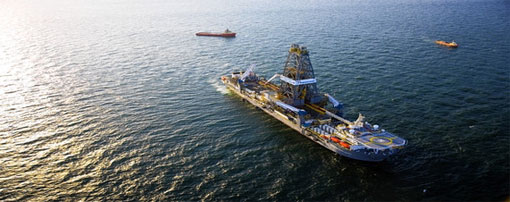
WSJ | Beyond the Gulf of Mexico, companies have announced big finds off the coasts of Brazil and Ghana, leading some experts to suggest the existence of a massive oil reservoir stretching across the Atlantic from Africa to South America. Production from deepwater projects -- those in water at least 1,000 feet deep -- grew by 67%, or by about 2.3 million barrels a day, between 2005 and 2008, according to PFC Energy, a Washington consulting firm.

The discoveries come as many of the giant oil fields of the past century are beginning to dry up, and as some experts are warning that global oil production could soon reach a peak and begin to decline. The new deepwater fields represent a huge and largely untapped source of oil, which could help ease fears that the world won't be able to meet demand for energy, which is expected to grow rapidly in coming years.

For oil companies, the discoveries mean something more: After a decade of retreat, large Western energy companies are taking back the lead in the quest to find oil. "A lot of people can get the very easy oil," says George Kirkland, Chevron's vice chairman. "There's just not a lot of it left."

There are challengers to Big Oil's deepwater dominance. Brazil recently has moved to give a larger share of its offshore oil to its state-run oil company, Petrobras. A handful of smaller companies, such as Anadarko Petroleum Corp. and Tullow Oil PLC, have had success offshore, particularly in Ghana, where giants like BP and Exxon Mobil Corp. are now playing catch-up.

The enormous investments of time and money required for such projects have made many experts skeptical that they can ease the long-term pressure on global oil supplies. The scale of the projects means that few smaller companies have the resources to take them on. Devon Energy Corp., an independent producer based in Oklahoma City, recently announced plans to abandon its deepwater-exploration business to focus on less-expensive onshore projects, which is says will produce a better return.

"This is technology capable of going to the moon," says Robin West, chairman of consulting firm PFC Energy, involving "extraordinary uncertainty, immense levels of information processing, staggering amounts of capital." Comments

Thursday, January 07, 2010

king of the north?

The Trumpet | Over the next few days, Russia will change the world. It has completed a new oil pipeline and port complex that sets Russia up to become a more powerful oil exporter than Saudi Arabia. The ramifications for Europe and Asia are profound: The shape of the global economy—and the global balance of power—will be altered forever.

December 28 was a big day of ceremony in Russia. Prime Minister Vladimir Putin pushed a button that transformed global oil dynamics—especially for Asia and Europe. The button released thousands of barrels of Siberian crude into a waiting Russian supertanker and heralded the opening of Russia’s first modern Pacific-based oil export facilities.

The multibillion-dollar, state-of-the-art oil terminal was a “great New Year present for Russia,” Putin said during the inauguration. The strategic terminal, located in the city of Kozmino on the coast of the Sea of Japan, is one of the “biggest projects in contemporary Russia” he said, not only in “modern Russia,” but “the former Soviet Union too.”

Putin has every right to be enthusiastic about his new port. Kozmino will unlock a two-way gate through which Russia’s vast Siberian oilfields will gush into Asia’s energy-hungry economies—and Chinese, Korean and Japanese currency will flow into Russia.

If just the seven ships currently waiting to berth are all filled during January, the port of Kozmino will instantly become Russia’s third-most important oil outlet.

According to Reuters, the first oil transport loads on January 15. In a symbolic move highlighting Russia’s warming relationship with China, Hong Kong will receive the first shipment.

After that, Kozmino’s importance will exponentially grow over the next year. Currently, all Siberian oil shipments into Kozmino are delivered by train—but that will soon change. Phase one of the East Siberian-Pacific Ocean Pipeline (espo) was also completed during December. Phase two will soon connect the Siberian fields directly to the new port. When phase two is finished in 2014, total exports could jump from the current rate of 250,000 barrels per day to over 1 million. Kozmino will transform into one of the largest oil centers in the world—capable of handling 14 percent of total Russian oil exports. It will be one of the most strategic geopolitical assets in Russia’s arsenal.

project anubis

Wired | The Air Force Research Laboratory set out in 2008 to build the ultimate assassination robot: a tiny, armed drone for U.S. special forces to employ in terminating “high-value targets.” The military won’t say exactly what happened to this Project Anubis, named after a jackal-headed god of the dead in Egyptian mythology. But military budget documents note that Air Force engineers were successful in “develop[ing] a Micro-Air Vehicle (MAV) with innovative seeker/tracking sensor algorithms that can engage maneuvering high-value targets.”

We have seen in recent years increased strikes by larger Predator and Reaper drones using Hellfire missiles against terrorist-leadership targets in Afghanistan and Pakistan. But these have three significant drawbacks.

First, you can never be quite sure of what you hit. In 2002’s notorious “Tall Man incident,” CIA operatives unleashed a Hellfire at an individual near Zhawar Kili in Afghanistan’s Paktia province. His unusual height convinced the drone controllers that the man was Bin Laden (who stands 6 feet, 5 inches). In fact, he was merely an innocent (if overgrown) Afghan peasant.

A second problem is that the Hellfire isn’t exactly the right weapon for the mission. Originally designed as an anti-tank missile, it’s not especially agile, nor is it designed to cope with a target that might swerve or dodge at the last second (like cars and motorbikes).

And thirdly, such strikes tend to affect a number of others, as well as the intended target. It raises the risk of killing or injuring innocent bystanders.

This was the rationale for Project Anubis. Special Forces already make extensive use of the Wasp drone made by AeroVironment. This is the smallest drone in service, weighing less than a pound. It has an endurance of around 45 minutes, and line-of-sight control extends to 3 miles.

It might seem limited compared to larger craft, but the Wasp excels at close-in reconnaissance. Its quiet electric motor means it can get near to targets without their ever being aware of its presence.
Fist tap Nana.

twilight of the american newspaper

Harpers | Newspapers have become deadweight commodities linked to other media commodities in chains that are coupled or uncoupled by accountants and lawyers and executive vice presidents and boards of directors in offices thousands of miles from where the man bit the dog and drew ink. The San Francisco Chronicle is owned by the Hearst Corporation, once the Chronicle’s archrival. The Hearst Corporation has its headquarters in New York City. According to Hearst, the Chronicle has been losing a million dollars a week. In San Francisco there have been buyouts and firings of truck drivers, printers, reporters, artists, editors, critics. With a certain élan, the San Francisco Chronicle has taken to publishing letters from readers who remark the diminishing pleasure or usefulness of the San Francisco Chronicle.

When a newspaper dies in America, it is not simply that a commercial enterprise has failed; a sense of place has failed. If the San Francisco Chronicle is near death—and why else would the editors celebrate its 144th anniversary? and why else would the editors devote a week to feature articles on fog?—it is because San Francisco’s sense of itself as a city is perishing.

Most newspapers that are dying today were born in the nineteenth century. The Seattle Post–Intelligencer died 2009, born 1863. The Rocky Mountain News died 2009, born 1859. The Ann Arbor News died 2009, born 1835. It was the pride and the function of the American newspaper in the nineteenth century to declare the forming congregation of buildings and services a city—a place busy enough or populated enough to have news. Frontier American journalism preserved a vestige of the low-church impulse toward universal literacy whereby the new country imagined it could read and write itself into existence. We were the Gutenberg Nation.

Nineteenth-century newspapers draped bunting about their mastheads and brandished an inflated diction and a Gothic type to name themselves the Herald, the Eagle, the Tribune, the Mercury, the Globe, the Sun. With the passage of time, the name of the city was commonly attached to the name of the newspaper, not only to distinguish the Alexandria Gazette from the New York Gazette but because the paper described the city and the city described the paper.

pensioners burning books for warmth

MetroUK | Volunteers have reported that ‘a large number’ of elderly customers are snapping up hardbacks as cheap fuel for their fires and stoves.

Temperatures this week are forecast to plummet as low as -13ºC in the Scottish Highlands, with the mercury falling to -6ºC in London, -5ºC in Birmingham and -7ºC in Manchester as one of the coldest winters in years continues to bite.

Workers at one charity shop in Swansea, in south Wales, described how the most vulnerable shoppers were seeking out thick books such as encyclopaedias for a few pence because they were cheaper than coal.

One assistant said: ‘Book burning seems terribly wrong but we have to get rid of unsold stock for pennies and some of the pensioners say the books make ideal slow-burning fuel for fires and stoves.

A lot of them buy up large hardback volumes so they can stick them in the fire to last all night.’

A 500g book can sell for as little as 5p, while a 20kg bag of coal costs £5.

Since January 2008, gas bills have risen 40 per cent and electricity prices 20 per cent, although people over 60 are entitled to a winter fuel allowance of between £125 and £400.

Jonathan Stearn, energy expert for Consumer Focus, said: ‘If pensioners are taking such desperate measures to heat their homes it is shocking. With low wholesale prices and increasing profit margins, there is clearly room for energy companies to make price cuts immediately.’

Ruth Davison, of the National Housing Federation, said: ‘The spiralling cost of energy means heating homes has become a luxury rather than a necessity for many people – particularly the elderly, low paid and unemployed.’

Wednesday, January 06, 2010

america now faces its own "weimar moment."

MarketOracle | The failure of right wing policy and leadership over the past eight years, especially in matters economic, is comparable to Germany's right-wing failure in World War I. It is catastrophic, undeniable, and complete.

Consider: According to the World Economic Forum, forty percent of the entire world's wealth has been destroyed in the recent financial collapse. In the U.S. alone, between housing and the stock market, more than $18 trillion in wealth has already been destroyed.

The private mega-banks that anchor the financial systems of the western world are bankrupt. This makes it all but impossible to jump-start the western world's economies which are heavily dependent on bank-system credit to operate.

More than 10,000 homes go into foreclosure every day. More than 20,000 people lose their job every day. And the collapse is accelerating, developing its own self-reinforcing dynamic. Job losses breed foreclosures, reducing demand, leading to more job losses and further degradation of the financial system. None of the stopgaps designed to stanch the bleeding have yet worked. There is no bottom in sight.

Meanwhile, debt has risen to astronomical levels. Reagan and Bush I quadrupled the national debt in only twelve years. Bush II doubled it again in only eight. It is now ten times higher than it was in 1980 when Reagan was elected. Total public and private debt exceeds 300% of GDP, half again higher than it was in 1929.

The government's unfunded liabilities, promises it has made to the American people but for which no payment source can be identified, now exceed $60 trillion, a literally inconceivable sum that can never, will never, be paid. Federal Reserve economist Lawrence Kotlikoff has suggested that the U.S. government is "actuarially bankrupt."

The full measure of the nation's plight is revealed in Hillary Clinton's first trip as Secretary of State. It was to China, to beg them to fund Obama's new fiscal deficits. Without loans from China, the U.S. economy cannot be revived. The significance of this cannot be overstated: the U.S. no longer exercises sovereignty over its own economic affairs. That sovereignty now resides in the hands of China, the U.S.'s greatest long-term rival.

Thanks to Republican policies of massive debt and shipping jobs abroad, the U.S. has technically become a colony of China. It exports raw materials and imports finished goods, together with the capital to make up the difference. Should the Chinese decide not to lend the trillions of dollars the U.S. is begging for, the U.S. economy will implode, plummeting onto itself in a World Trade Center-like collapse that will leave dust clouds circling the planet for decades.

Notwithstanding the destruction inflicted on the economy by Republican policies, the most devastating breakdown is in the intellectual foundation on which right wing economic ideology itself is premised. Free market doctrine, the secular religion of right-wing America, is in utter, irretrievable shambles.

feeding insurgency

BBCNews | "The malnutrition problem in Afghanistan, and especially Parwan province, is very bad. That's because of the years of fighting, the damage to our infrastructure and rising unemployment.

"It's all helped to make things worse," he said.

Deep discontent
The statistics bear him out: officially, unemployment is about 40%, though it is probably far higher than that; of those who do have a job in Parwan, 45% earn less than $1 a day; chronic malnutrition for children under five across Afghanistan is 54%.

And perhaps most surprising of all, on a UN scale of human development indicators, Afghanistan has slipped from 117th in the world, to 181st - second from the bottom - since the Taliban were ousted.

Professor Sayed Massood, an economist from Kabul University, believes that backsliding is responsible for much of the deep discontent with the government, and growing support for the insurgency.
Vegetables for sale at a market
Even farm workers are suffering from malnutrition

He blames the crisis of public confidence on the policy of pouring billions of dollars in development aid into regions where the insurgency is strongest.

"Instead of the benefits [of aid] going to friends, they are going to enemies. We needed to spend money in the places where the people believe in democracy and work for the government.

"But instead only the enemies are getting rich," he said.

"We need to set examples of peaceful provinces that are also prosperous, but that's just not happening."

Prof Massood argues that the international community has adopted an aid policy that has been entirely counter-productive.

"They have politicised aid; they have tried to use their money to bring about political change in the frontline provinces - they have tried to bribe their enemies.

"But they don't understand that it works the other way around. If you improve the economics of the people, the politics will follow. If you don't, you will lose them."

That might explain why the insurgency appears to be spreading to parts of the country that until now have been relatively peaceful.

pakistan's acute energy crisis

TheNews | The country may plunge into the worst imaginable energy crisis as virtually all refineries are teetering on the verge of financial default and may close down operations by Jan 15.

All the oil refineries of the country, currently working on a negative gross revenue margin, and with their borrowing limits already exhausted, are likely to shut down within the next two weeks following their expected default to retire the existing L/Cs to import crude oil. The shutdown would mean no oil supplies for thermal power generation plants and the picture turns outright dark.

This harrowing scenario of the looming crisis was given to The News by a senior functionary of the Ministry of Petroleum and Natural Resources, speaking on condition of anonymity.

The functionary said that after generating over Rs 85 billion from banks by marketing TFCs (Terms Finance Certificates), the circular debt has again started to haunt all the players involved in the energy sector.

“Some players in the energy sector, including Oil Marketing Companies (OMCs) and refineries have termed the Pakistan Electric Power Company (Pepco) responsible for the monster of circular debt, which has surfaced again, saying this is the most disorganised company which failed to pay the dues of PSO which have amounted to Rs69.7 billion,” the source said, adding: “The refineries have also informed the government that they will not be able to get fresh loans to continue functioning, as their borrowing limits have already been exhausted.”

The functionary further said that the refineries faced with losses had not being paid Rs 60.1 billion by the government owned entity Pakistan State Oil and that the refineries have warned the government that in the event of the non-payment of their dues their operations will be closed down “because of the liquidity crisis and, moreover, their equity too would be wiped out.”

The ministry functionary told The News that officials of the Ministry of Finance have held three to four meetings with representatives of the refineries and PSO and hopefully their outstanding issues would be resolved within a week.

According to latest available figures, the Pakistan State Oil (PSO) needs to pay Rs 25.5 billion to the Pak-Arab Refinery Company (PARCO), Attock Refinery Limited (ARL), Rs 11.2 billion; Pakistan Refinery Limited (PRL), Rs 11.2 billion; National Refinery Limited (NRL) and Bosicar, Rs 4.1 billion. Currently all the refineries are only working at 50 per cent capacity.

Meanwhile, the PSO, itself suffering at the hands of others, has reportedly conveyed to Pepco, Hub Power Company (Hubco) and Kot Addu Power Company (Kapco) that their orders for fuel will not be entrained if they did not clear the huge dues of PSO which now amount to approximately Rs69.7 billion.

Tuesday, January 05, 2010

gwot about scaring people, not protecting them

Guardian | So there was no ticking time bomb. No urgent need ever arose to torture anybody who was withholding crucial details, so that civilisation as we know it could be saved in the nick of time. No wires had to be tapped, special prisons erected or international accords violated. No innocent people had to be grabbed off the street in their home country, transported across the globe and waterboarded. Drones, daisy-cutters, invasions, occupations were, it has transpired, not necessary.

Indeed, when it actually came down to it, to forestall a near-calamitous terrorist atrocity in the US the authorities didn't even have to go in search of information or informants. The alleged terrorist's father came to the US embassy in Nigeria of his own free will and warned them that his son, Umar Farouk Abdulmutallab, had disappeared and could be in the company of Yemeni terrorists.

Meanwhile the National Security Agency had heard that al-Qaida in Yemen was planning to use an unnamed Nigerian in an attack on the US. If that were not enough, then came Abdulmutallab himself, a 23-year-old Nigerian bound for Detroit who bought his ticket in cash, checked in no bags and left no contact information. For seven years the American state manipulated the public with its multicoloured terror alerts. But when all the warning lights were flashing red, it did nothing.

To brand this near miss a "systemic failure", as Barack Obama has done, is both true and inadequate. It reduces the moral vacuity, political malevolence and enduring strategic recklessness that has been the enduring response to the 9/11 attacks to a question of managerial competence.

"Terror is first of all the terror of the next attack," explains Arjun Appadurai in Fear of Small Numbers. During the Bush years that terror was routinely leveraged for the purposes of social control, military mobilisation and electoral advantage. Meanwhile, the administrative processes that might prevent the next attack were tragically lacking. In short, Bush's anti-terror strategy was not about protecting people but about scaring them.

To galvanise the nation for war abroad and sedate it for repression at home, the previous administration constructed a terror threat that was ubiquitous in character, apocalyptic in scale and imminent in nature. Only then could they counterpose human rights against security as though they were not only contradictory but mutually exclusive.

Al-Qaida was only too happy to oblige. In such a state of perpetual crisis both terrorists and reactionaries thrive. Terrorists successfully create a climate of fear; governments successfully exploit that fear to extend their own powers.

detonated double-agent details...,


AP | The suicide bomber who killed eight people inside a CIA base in Afghanistan was a Jordanian-born terrorist working as a double agent who had been invited to the base because he claimed to have information targeting Osama bin Laden's second-in-command, a former senior U.S. intelligence official and a foreign government official confirmed Monday.

The bombing killed seven CIA employees - four officers and three contracted security guards - and a Jordanian intelligence officer, Ali bin Zaid, according to a second former U.S. intelligence official. The officials spoke on condition of anonymity because they were not authorized to discuss the incident.

The former senior intelligence official and the foreign official said the bomber was Humam Khalil Abu-Mulal al-Balawi, a 36-year old doctor from Zarqa, Jordan, who had been recruited by Jordanian intelligence. Zarqa is the hometown of slain al-Qaida in Iraq leader Abu Musab al-Zarqawi. NBC News first reported the bomber's identity.

He was arrested more than a year ago by Jordanian intelligence and was thought to have been persuaded to support U.S. and Jordanian efforts against al-Qaida, according to the NBC report. He was invited to Camp Chapman, a tightly secured CIA forward base in Khost province on the fractious Afghan-Pakistan frontier, because he was offering urgent information to track down Ayman al-Zawahri, Osama bin Laden's right-hand man.

The CIA declined to comment on the report.

obama's serial catastrophes in afghanistan


JuanCole | on Thursday, all hell broke loose when a high-level Pashtun asset who had been informing to the CIA on the location of important al-Qaeda and Taliban operatives detonated a vest bomb at FOB Chapman in Khost province, a CIA forward base. The attacker killed 7 field officers and one Jordanian intelligence operative detailed to the base. Those experienced field officers were on the front lines in the fight against al-Qaeda and their loss is a big blow to counter-terrorism. It is true that they had been drawn in to a campaign of assassination, but it is the president who gave them that task--unwisely, in my view.

The use of a double agent not only to misinform but actually to kill the most experienced counter-terrorism officers in the region showed the sophistication of tactical thinking in the Afghan insurgency.

The CIA's dependence on a double agent who finally openly betrayed them raises troubling questions about US strategy and tactics in the region. Such informants essentially direct CIA drone missile strikes.

You could imagine Siraj Haqqani, leader of the Haqqani Network in Khost and over the border in Pakistan's North Waziristan, inserting such a double agent into FOB Chapman and then using the CIA. For instance, what if a middling member of the Haqqani network launched a challenge to Siraj's leadership and that of his ailing father, Jalaluddin (an old-time ally of Reagan who was warmly greeted in the White House in the 1980s)? Wouldn't it be easy enough just to have the double agent tell the CIA that the challenger is a really bad guy in cahoots with al-Qaeda? Boom. Drone strike kills Taliban leaders in North Waziristan. In this way, Siraj could have used the US to eliminate rivals and become more and more powerful. And how many double agents have given up a few Arab jihadis who had fallen out with the Haqqanis, but then deliberately followed this up with bad intel on some innocent village, making the name of the US mud among the Pashtuns?

The drone strikes shouldn't be run by the CIA, and probably shouldn't be run at all. It could well be that savvy old-time Mujahidin trained in CIA tradecraft in the 1980s are having our young wet behind the ears field officers for lunch.

In short, is the bombing at FOB Chapman the tip of an iceberg of misinformation, on which the Titanic of Obama's AfPak policy could well founder?

Fist tap my man Rembom for continuing laser-like focus.

Monday, January 04, 2010

the god gene

NYTimes | How is a church like a can opener? Among the pleasures of using evolutionary logic to think about matters nonbiological, one is getting to ask questions like that. The evolutionary take on a cultural fact like religion or warfare can cut through the fog of judgment and show how a social institution solves some mechanical problem of human co-existence. What function did intergroup violence serve? What are gods good for?

Nicholas Wade’s book “The Faith Instinct” is at its best when putting us through such exercises and sidelining the by-now tiresome debates about religion as a force for good or evil. According to Wade, a New York Times science writer, religions are machines for manufacturing social solidarity. They bind us into groups. Long ago, codes requiring altruistic behavior, and the gods who enforced them, helped human society expand from families to bands of people who were not necessarily related. We didn’t become religious creatures because we became social; we became social creatures because we became religious. Or, to put it in Darwinian terms, being willing to live and die for their coreligionists gave our ancestors an advantage in the struggle for resources.

Wade holds that natural selection can operate on groups, not just on individuals, a contentious position among evolutionary thinkers. He does not see religion as what Stephen Jay Gould and Richard Lewontin called a spandrel — a happy side effect of evolution (or, if you’re a dyspeptic atheist, an unhappy one). He does not agree with the cognitive anthropologist Pascal Boyer that religion is a byproduct of our overactive brains and their need to attribute meaning and intention to a random world. He doesn’t perceive religious ideas as memes — that is to say, the objects of a strictly cultural or mental process of evolution. He thinks we have a God gene.

So how did this God gene flourish? Wade’s counterintuitive answer repurposes an old social-scientific analysis of religion as a saga of biological survival. Rituals take time; sacrifices take money or its equivalent. Individuals willing to lavish time and money on a particular group signal their commitment to it, and a high level of commitment makes each coreligionist less loath to ignore short-term self-interest and to act for the benefit of the whole. What are gods for? They’re the enforcers. Supernatural beings scare away cheaters and freeloaders and cow everyone into loyal, unselfish, dutiful and, when appropriate, warlike behavior.

burj dubai opens today

WaPo | The government hopes the unveiling of the 160-plus-story structure, Burj Dubai, will pierce the cloud that has lingered over Dubai since mid-December, when it received a second $10 billon bailout loan from Abu Dhabi, after unpaid bills prompted some creditors to abandon Dubai.

Sheik Mohammed bin Rashid al-Maktoum, after navigating the worst crisis in his four years as ruler of Dubai, will lead a day of celebrations for the unveiling of the residential, hotel and office building that on a clear day has views across the Persian Gulf to Iran.

About 90 percent of units have been sold in Burj Dubai, which will welcome the first occupants of the Giorgio Armani residences in February and will open the world's first Armani Hotel in March.

Prices in the skyscraper -- which formed the apex of the Dubai property market when the one-to-three-bedroom residences were launched in 2007 -- have held up amid the 50 percent crash across the rest of the city, including the surrounding developments of Downtown Burj Dubai.

For Dubai's defenders, Burj Dubai, developed by the partially government-owned Emaar Properties, is an engineering marvel representing the pinnacle of Dubai's evolution from fishing village to metropolis; for critics, it is a stark reminder of the commercial hub's excesses.

Roy Cherry, an analyst with Shuaa Capital in Dubai, says the truth lies somewhere in between. "It is a fantastic building and a great achievement for Emaar, but Dubai's dreams and challenges remain greater than any one building."

Sunday, January 03, 2010

seeking a cure for optimism

NYTimes | Recently, a number of writers and researchers have questioned the notion that looking on the bright side — often through conscious effort — makes much of a difference. One of the most prominent skeptics is Barbara Ehrenreich, whose best-selling book “Bright-Sided: How the Relentless Promotion of Positive Thinking Has Undermined America,” published in the fall, maintains that thinking positively does little good in the long run, and can, in fact, do harm.

“Happiness is great, joy is great, but positive thinking reduces the spontaneity of human interactions,” Ms. Ehrenreich said. “If everyone has that fixed social smile all the time, how do you know when anyone really likes you?”

A study published in the November-December issue of Australasian Science found that people in a negative mood are more critical of, and pay more attention to, their surroundings than happier people, who are more likely to believe anything they are told.

“Whereas positive mood seems to promote creativity, flexibility, cooperation and reliance on mental shortcuts, negative moods trigger more attentive, careful thinking, paying greater attention to the external world,” Joseph P. Forgas, a professor of social psychology at the University of New South Wales in Australia, wrote in the study.

brookings war scorecard

NYTimes | In 2009, Iraq, Pakistan and Afghanistan dominated American military and foreign policy. Which themes emerged over the last year?

Chipocalypse Now - I Love The Smell Of Deportations In The Morning

sky |   Donald Trump has signalled his intention to send troops to Chicago to ramp up the deportation of illegal immigrants - by posting a...