Tuesday, December 22, 2009

counterpoint on the web...,


This video exposes the eco-socialist Gaia conspiracy to portray people as a plague on the Earth and tax them into the poorhouse to fund nature trails and coffee cups for liberal bookstores. Combined with the Global Warming and Peak Oil hoaxes, this will bring our economy to a halt by 2022.

The only species that can be called overpopulated are the ones on the Endangered Species List, because their population should be zero since they couldn't cut it in this competitive world.

an actual course at the university of texas?


utexas.edu | Why are humans in such a state of total denial ("temporal blindness") about what we are doing to this planet?

People are becoming aware of some of the many consequences of overpopulation, but most still refuse to recognize the underlying causes: an economic system based on perpetual growth, and too many people. Just as the pharmaceutical industry targets symptomatic relief for man-made ailments rather than addressing underlying root causes, widespread attention to the many spin offs from growthmania and overpopulation diverts attention away from the real problems.

Monday, December 21, 2009

can obama stop america's gas-guzzling ways?

Spiegel | Never before has a US government been as serious in its warnings against the dangers of climate change as the Obama administration. But Americans are divided: Half of them regard climate protection policies as socialist, and half want to save the world. Can Obama make America go green?

There are two Americas that don't talk to each other. In fact, these two Americas -- Las Vegas on the one side, Berkeley on the other -- despise and ridicule each other.

"We have always been a sprawling country full of contradictions, but nowadays an issue like climate change has turned into something of a sport," says Kiser. "The one team is for climate protection and the other team is for industry. The fans root for their respective teams and hate the others."

In other words, when one side says that the Earth is getting warmer, the other side disagrees, purely out of principle. The same dynamic applies to all major issues in the United States. If one side seeks to promote healthcare reform and legislation to protect the climate, the other side equates both goals with socialism and characterizes a president who advocates both as a new Hitler. America has become a country paralyzed by self-loathing. The United States is now a republic of bloggers and talk radio, a country of shouting citizens and an eternal presidential election campaign, full of paranoid, spoiled and self-righteous people. They tend to become entrenched in their issues because the legislative branch is so complicated, with its two houses of Congress, in which it takes clear majorities to pass any legislation -- majorities that rarely materialize. Deep divisions within society have led to an American sluggishness in the last decade and are increasingly limiting the country's ability to act.

The question is: How can this be changed? Assuming that one side is indeed right this time -- not just because the existence of climate change has been proven without a doubt, but also because it is abundantly clear that the United States has played a bigger role in bringing about climate change than any other country -- how can politics and the way American society thinks and acts be changed? And how quickly?

Anyone in the country who pays attention to the issues surrounding climate change is familiar with the data. The average North American is responsible for more than 19 tons of carbon dioxide emissions a year, more than twice as much as the average European and four times as much as the average Chinese. If the global community intends to limit the warming of the planet to no more than 2 degrees Celsius (3.6 degrees Fahrenheit) by the year 2050, "America must lead," says President Barack Obama. "If we do nothing, the efforts of the rest of the world will never be sufficient," says environmental activist and former US Vice President Al Gore.

why are virtually all climate "sceptics" men?

BBCNews | The question first came to mind on the plane to Copenhagen last week while scanning The Guardian's feature on movers and shakers in the "sceptical" field.

Bjorn LomborgSo we go down their list... Bjorn Lomborg, Viscount Monckton, former TV presenter David Bellamy, British National Party leader Nick Griffin, Freakonomics authors Steven Levitt and Stephen Dubner, Lord Lawson, social anthropologist Benny Peiser, geologist Ian Plimer, US Senator James Inhofe, Czech President Vaclav Klaus... all men.

It's a marked contrast to the world of mainstream climate science, which boasts a number of eminent female practitioners including IPCC lead authors Susan Solomon and Cynthia Rosenzweig; and to the world of UN climate talks, where many delegations include, and are led by, women, including the UK's negotiating team.

The renowned environmental commentator Charles Clover noted the trend recently in The Times, writing of "... the born-again climate sceptic, the kind of man (always a man, almost invariably wearing a tweed jacket) who now materialises beside me at parties and confides that he has been having second thoughts about climate change".

So what's going on? Why is this issue such a gender-divider?

You might think it's a trite question; but I would argue it's not, for the following reason.

There are two distinct views of why climate scepticism exists in the way it does today.

One - promulgated by many sceptics themselves - speaks to a rigorous, analytical deconstruction of a deeply-flawed scientific edifice that is maintained by a self-interested cabal of tax-hungry politicians and careerist scientists.

The other is that climate scepticism has psychological roots; that it stems from a deep-seated inability or unwillingness to accept the overwhelming evidence that humanity has built with coal and lubricated with oil its own handcart whose destination board reads "climate hell".

As one ex-scientist and now climate action advocate put it to me rather caustically a while back: "I've been debating the science with them for years, but recently I realised we shouldn't be talking about the science but about something unpleasant that happened in their childhood".

Perhaps an answer to the gender issue will help illuminate this much bigger and politically significant question.

global warming's six americas

AmericanProgress | There are six unique segments of the American public that each engage with the issue of global warming in their own distinct way. Just over half of American adults (51 percent) are either Alarmed or Concerned about global warming, and these individuals are poised to vote on the issue with their pocket books and at the ballot box.

The Alarmed (18 percent of the U.S. adult population) are the segment most engaged in the issue of global warming. They are very convinced it is happening, human-caused, and a serious and urgent threat. The Alarmed are already making changes in their own lives and support an aggressive national response (see graphs below).

The Concerned (33 percent) are also convinced that global warming is a serious problem and support a vigorous national response. Members of this group have signaled their intention to at least engage in consumer action on global warming in the near term, but they are less personally involved in the issue and have taken fewer actions than the Alarmed.

The Cautious (19 percent) also believe that global warming is a problem, although they are less certain that it is happening than the Alarmed or the Concerned. They do not view it as a personal threat, and do not feel a sense of urgency to deal with it.

The Disengaged (12 percent) do not know and have not thought much about the issue at all and say that they could easily change their minds about global warming.

The Doubtful (11 percent) are evenly split among those who think global warming is happening, those who think it isn’t, and those who do not know. Many within this group believe that if global warming is happening, it is caused by natural changes in the environment. They believe that it won’t harm people for many decades, if at all, and they say that America is already doing enough to respond to the threat.

The Dismissive (7 percent), like the Alarmed, are actively engaged in the issue, but are on the opposite end of the spectrum. Most members of this group believe that global warming is not happening, is not a threat to either people or non-human nature, and strongly believe that it does not warrant a national response.

Sunday, December 20, 2009

are we recipients of our DNA, or caretakers of it?

WaPo | Two mice. One weighs 20 grams and has brown fur. The other is a hefty 60 grams with yellow fur and is prone to diabetes and cancer. They're identical twins, with identical DNA.

So what accounts for the differences?

It turns out that their varying traits are controlled by a mediator between nature and nurture known as epigenetics. A group of molecules that sit atop our DNA, the epigenome (which means "above the genome") tells genes when to turn on and off. Duke University's Randy Jirtle made one of the mice brown and one yellow by altering their epigenetics in utero through diet. The mother of the brown, thin mouse was given a dietary supplement of folic acid, vitamin B12 and other nutrients while pregnant, and the mother of the obese mouse was not. (Though the mice had different mothers, they're genetically identical as a result of inbreeding.) The supplement "turned off" the agouti gene, which gives mice yellow coats and insatiable appetites.

"If you look at these animals and realize they're genetically identical but at 100 days old some of them are yellow, obese and have diabetes and you don't appreciate the importance of epigenetics in disease, there's frankly no hope for you," Jirtle says.

He offers this analogy: The genome is a computer's hardware, and the epigenome is the software that tells it what to do.

Epigenomes vary greatly among species, Jirtle explains, so we cannot assume that obesity in humans is preventable with prenatal vitamins. But his experiment is part of a growing body of research that has some scientists rethinking humans' genetic destinies. Is our hereditary fate -- bipolar disorder or cancer at age 70, for example -- sealed upon the formation of our double helices, or are there things we can do to change it? Are we recipients of our DNA, or caretakers of it?

beliefs are structures in the brain...,

Salon | I was called to see an intensive care patient who believed his food was being poisoned. Say what you want about hospital food, but I don’t believe anyone is actually putting poison in it. Patients say goofy things in the ICU. Most of the time the nurses are fairly tolerant of it, but when a patient starts getting physically aggressive, I often get called.

What most upset the family, however, was that this was completely new behavior for this individual. Until recently, he had been a healthy, “normal” guy, with no history of psychiatric illness which might explain his paranoid thoughts. But his ordinary life recently had been interrupted when he fell from a ladder and struck the side of his head on concrete. Initially he refused medical attention. Who wouldn’t have a headache after knocking their noggin on the driveway? But when the headaches got worse, he agreed to be seen in the ER. A CT scan of the brain suggested blood was collecting between the lining of his skull, the dura, and his brain. With alarming rapidity, the patient slipped into unconsciousness. A neurosurgeon was quickly consulted.

In the operating room, a burr hole revealed a dark thundercloud of black blood building on the patient’s brain. But neurosurgeons are a cool-headed lot; the blood was quickly evacuated, and the patient just as quickly woke up. A short ICU stay and complete recovery were predicted. Then the problems with the food started.

Blood, like any other fluid, is incompressible, and the soufflĂ©-like tissue of the brain is no match for it when it is unleashed inside the skull. As the blood pooled, the patient’s right temporal lobe was pushed inward. Unfortunately, deep inside the skull the thick and tough dura forms a scimitar edge called the tentorium. This pushed against the patient’s compressed temporal lobe like a knife held against his throat, distorting his reality circuits, so to speak, and leading to his newly paranoid interpretation of reality.

Complex animals, if they hope to thrive, must possess the ability to extract reality from the deluge of sensory and memory information flooding their brains at any moment. Deep within the mammalian brain are large islands of neurons interconnected by bundles of nerve fibers, great reiterative loops which are responsible both for determining reality and then motivating some sort of behavior to act on that reality. No rational cortex is needed to make the immediate, essentially visceral decisions at life’s critical moments: is something safe or dangerous? Is that something I want and need, or something that I am better off to avoid?

Evolution is economical; once a solution evolves for a problem, there is little need for a completely separate solution to evolve in succeeding generations to solve the same problem. Humans possess a mammalian brain, one that solves problems in the same way as in other mammals. Our capacity for rational, imaginative thought is superimposed on our mammalian brain, but does not replace it. In other words, our capacity to determine reality and to make survival decisions is a product of that mammalian brain, and not of our uniquely human neocortex. Paul MacLean, the neuroscientist who pioneered our understanding of the emotion-generating structures of the brain, wrote that these structures are responsible for “a sense of self, of reality, and the memory of ongoing experience...” They alone are responsible for creating “a conviction as to what is true or false.”

Saturday, December 19, 2009

the "narcoterrorism" narrative

NYTimes | Federal prosecutors on Friday charged three West Africans with plotting to transport tons of cocaine across Africa in concert with Al Qaeda, using for the first time against that group a 2006 law aimed at drug trafficking that aids terrorism.

Federal officials say the case promises to peel back what they contend are increasing ties between drug traffickers and Al Qaeda as the terrorist group seeks to finance its operations in Africa and elsewhere. The case focused on a criminal organization in Ghana and elsewhere in West Africa that investigators believe worked with Al Qaeda, moving drugs to North Africa and on to Europe.

The case was based in some measure on the work of two informants, paid by the federal Drug Enforcement Administration, who posed as representatives of the Revolutionary Armed Forces of Colombia, or FARC, a Colombian rebel group that has taken advantage of lax enforcement and corruption to use Africa as a significant transshipment route to Europe. As part of the investigation, one of the informants approached the defendants, according to the complaint, saying he was seeking help in setting up a network to smuggle cocaine across the continent.

Over the course of the four-month investigation, federal drug agents secretly recorded and videotaped the three West African men, who said they were associated with Al Qaeda and had transported drugs and provided support to the group in the past. Federal law enforcement officials, however, said the inquiry had uncovered no independent evidence that corroborated their statements.

The three men believed that they were helping the informants set up the trafficking network to move what they thought was FARC’s cocaine from Ghana to the deserts of North Africa to Spain, the drugs’ ultimate destination, according to the complaint.

“Today’s allegations reflect the emergence of a worrisome alliance between Al Qaeda and transnational narcotics traffickers,” Preet Bharara, the United States attorney in Manhattan, said in a statement announcing the arrests. “As terrorists diversify into drugs, however, they provide us with more opportunities to incapacitate them and cut off the funding for future acts of terror.”

The three defendants, all from Mali and believed to be in their 30s, were taken into custody in Ghana on Wednesday and flown to the United States on Thursday night, officials said.

Identified as Oumar Issa, Harouna Touré and Idriss Abelrahman, they were charged with conspiracy to commit narcoterrorism and conspiracy to provide material support to terrorist groups: Al Qaeda, Al Qaeda in the Islamic Maghreb and the FARC.

teabagger high-command..,

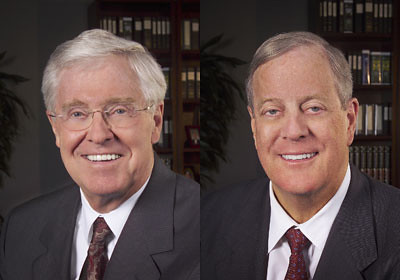
Boston | IN EARLY November, thousands of protesters descended on Capitol Hill to hear Representative Michele Bachmann decry House Speaker Nancy Pelosi’s “takeover’’ of health care. As they disembarked from their buses, they were greeted with doughnuts and coffee, and handed protest signs and talking points about socialized medicine. Few of the protesters were aware that a right-wing billionaire had paid for the meals, buses, or salaries of the helpful guides. On the same day, this rich proprietor was toasted by Manhattan’s fashionable socialites during the City Opera’s opening night, where he was lauded for his support.

David Koch, an oil and gas billionaire who is the ninth-richest person in the United States, according to Forbes magazine, was simultaneously responsible for a $100 million refurbished opera house and a protest that featured signs comparing health reform to the Holocaust. The two sides to Koch’s activism aren’t unique - they harken to a long tradition of conservative tycoons who were great philanthropists with one hand and ruthless powerbrokers with the other. But Koch’s hidden presence in the health care debate illustrates the extent to which the Old Right is creating - and then hiding behind - the grassroots fervor of middle-class opponents of health reform.

Across the New York social circuit, Koch is hailed for his donations to reputable causes, including the Metropolitan Museum of Art. But for years, Koch has also been funneling tens of millions of dollars to more subterranean efforts that reflect his conservative politics. His flagship group, Americans for Prosperity, sponsored Bachmann’s rally against health care reform. Although the Lincoln Center’s State Theater is now called the David H. Koch Theater, none of Koch’s right-wing fronts bear his name.

Americans for Prosperity is leading the way in channeling recession-era distress into anger at President Obama. This “grassroots’’ group has orchestrated many of the tea party protests, as well as steering activists into disrupting town hall meetings of Democratic members of Congress. Americans for Prosperity’s tactics are not new. Just as Koch inherited his oil business from his father, Americans for Prosperity borrows from the ultra-right group also founded in part by his dad, the John Birch Society.

Conceived by Robert Welch and a small group of conservative industrialists, including Fred Koch - David’s father and the namesake of the family firm of Koch Industries - the John Birch Society cloaked its pro-business, anti-civil rights agenda in the rhetoric of the Cold War.

The Birch Society battled communism by labeling President Kennedy a traitor who had to be impeached, denounced taxes as a creeping red menace, and attacked the forces of racial integration as being directed by the Kremlin.

Cushioned with large donations from Koch and others, the Birch Society helped propel Barry Goldwater to the Republican nomination in 1964 and helped Republicans make gains in the congressional midterms of 1966.

Like Americans for Prosperity, the John Birch Society rarely acknowledged its funding from the very rich. Instead, it depicted itself as a citizens group merely interested in American ideals of freedom. Rather than argue the policy nuances of entitlement programs or new regulations, the Birch Society marshaled opposition by depicting progressive reform as capitulation to the Soviet Union. In that polarized environment, the interests of millionaires suddenly became aligned with patriotic families who wanted to do their part against the communist threat.

Shortly after the Birch Society faded, David Koch founded Americans for Prosperity in 1984 (then known as Citizens for a Sound Economy). Americans for Prosperity still portrays itself as a defender of freedom and the average Joe. On the Americans for Prosperity website, financial regulations, health reform, net neutrality, and the estate tax are all assailed as forms of socialism.

While David Koch is celebrated as a patron of New York opera, his Americans for Prosperity donations have gone largely unsung. With his millions, he will not only have saved this year’s performance of the “Nutcracker,’’ but also contributed greatly to the obstruction of universal health care, the denial of climate change, and the derailment of much of President Obama’s domestic agenda.

His dad would be pleased.

the salesman fails again...,


Naomi Klein, author, acivist, and columnist for The Nation, tells The UpTake's Jacob Wheeler what she thinks of Obama's language of hope permeating the United Nations climate change conference in Copenhagen. In short: The action and funds it would take to make a real difference are not even on the table.

the beginning of the end...,

TCBH | Give credit to Howard Dean. This still practicing physician, former governor of Vermont, former chair of the Democratic Party and former Democratic presidential candidate has called for Justify Fullprogressive members of Congress in both houses to join their Republican colleagues in killing what he rightly says has become "an insurance company's dream."

Those namby-pamby, self-described "progressives" in the Democratic Party who claim that the health bill can still be saved with the inclusion of a fake, carefully circumscribed and thoroughly emasculated "public option" government insurance plan that at best would only be able to offer lousy coverage at high rates to a small number of self-employed poor people are wrong. This supposed attempt at reforming the US health care system--the costliest and least effective in the developed world--is simply past saving.

The only appropriate place for the bill at this point is a dumpster.

What could have been a transformational moment in American politics--an end to decades of corporate health care and the creation of a system in which all Americans were guaranteed affordable, quality care as a basic right of citizenship, the way people are in Canada, in all the countries of Europe, in Japan, in Taiwan, in Cuba and much of the rest of the world, has been squandered.

It has been squandered by President Obama, who was too gutless to take a leadership role, and left matters to Congress, and who then slithered up to the major players in the medical-industrial complex and cut secret deals with all of them--doctors, insurance companies, pharmaceutical companies and the hospital industry--in return for their "support."

Friday, December 18, 2009

the $200,000 customs agent

NYTimes | At first, Luis F. Alarid seemed well on his way to becoming a customs agency success story. He had risen from a childhood of poverty and foster homes, some of them abusive, earned praise and commendations while serving in the Army and the Marines, including two tours in Iraq, and returned to Southern California to fulfill a goal of serving in law enforcement.

But, early last year, after just a few months as a customs inspector, he was waving in trucks from Mexico carrying loads of marijuana and illegal immigrants. He pocketed some $200,000 in cash that paid for, as far as the government could tell, a $15,000 motorcycle, flat-screen televisions, a laptop computer and more.

Some investigators believe that Mr. Alarid, 32, who was paid off by a Mexican smuggling crew that included several members of his family, intended to work for smugglers all along. At one point, Mr. Alarid, who was sentenced to seven years in federal prison in February, told investigators that he had researched just how much prison time he might get for his crimes and believed, as investigators later reported, that he could do it “standing on his head.”

Mr. Alarid began working at the border in San Diego in October 2007. In his guilty plea, he admitted that he had started smuggling in February 2008. He was arrested three months later.

Mr. Alarid would wave in vehicles that should have raised suspicion, either because their license plates were partly covered or because the plates did not belong to the vehicle, something he would have seen on the computer screen in his inspection booth.

Before reporting to his lane, he would go out to the employee parking lot to use his cellphone, which federal agents believe was his way of telling the smugglers which lane to approach.

At his sentencing, all involved — the prosecutors, the judge, his lawyer — expressed bewilderment at the turn in Mr. Alarid’s life. But in an interview, a family member who was not part of the case said Mr. Alarid had mounting gambling debts and, despite it all, had always sought a bond with his biological mother.

Still, Judge Janis L. Sammartino accepted the government’s argument that a deterrent message needed to be sent.

“I do think that the public, for a while at least, needs to be assured that who we have at the border are 100 percent individuals of integrity,” she said. “I think you were at one time. I don’t know what went wrong for you, sir, and I hope that you attain that again.”

the $1,000,000 politician

NYTimes | First, Senator Joseph Lieberman — the former Democrat, current independent from Connecticut — rejected the so-called public health care option. Then he threatened to torpedo the entire health care reform bill if it allowed people over 55 to buy Medicare plans.

The aim of that idea, like the public option, is to provide more choice for consumers and more competition for the private insurance industry. And that industry, you will not be surprised to hear, has been very, very good to Mr. Lieberman.

What makes it all the more hypocritical is that Mr. Lieberman claims to want health care reform. And way back in September, the senator was publicly championing a Medicare buy-in.

In an interview with The Connecticut Post, he said he had been refining his views on health care for many years and was “very focused on a group post-50, or maybe more like post-55” whose members should be able to buy Medicare if they lacked insurance.

This week, when there actually seemed to be a compromise on health care that did not focus on Mr. Lieberman, he announced that he would block the package if the Democrats included a terrible idea — allowing people between 55 and 65 to buy Medicare.

He presented this as a principled effort to keep down federal debt, but when a Times reporter asked about his 180-degree turn, he said he had forgotten taking his earlier position until the Democratic leadership reminded him about it over the weekend.

Mr. Lieberman has taken more than $1 million from the industry over his Senate career. In his 2006 re-election campaign, he ranked second in the Senate in contributions from the industry. He doesn’t seem to have forgotten that.

The Senate bill was better with the public option, as weak as it was. The Medicare buy-in was an intriguing alternative. Still, even without either one, the Senate must pass this vital measure.

Now that Mr. Lieberman has gotten his way and everyone’s attention, he has a responsibility to move things forward. He can help persuade a wavering Democrat, Ben Nelson of Nebraska, and a hesitant Republican, Olympia Snowe of Maine, to vote for the bill. Or has he also forgotten his commitment to health care reform?

we are not iceland, we are not dubai!!!

NYTimes | Greece struggles to stay afloat as debts pile on. Ever since Greece’s credit rating was downgraded last week, its new Socialist government has fought back, saying it has the mettle to tackle the soaring deficit and structural woes that have earned the country a reputation as the weak link in the euro zone.

“We will reduce the deficit, we will control the debt and there will be no need for a bailout,” the Greek finance minister, George Papaconstantinou, said in an interview in his office here this week. “We are not Iceland; we are not Dubai.”

But Mr. Papaconstantinou may have good reason for the traditional Greek metal worry beads he fingered during the interview. Outside his office, garbage was piled high in Syntagma Square, a result of a two-week strike by trash collectors that ended Friday.

A student demonstration was advancing on the square a day after pensioners had taken to the streets. This week, protests for the first anniversary of the death of an Athenian teenager shot by the police turned violent, but did not cause as much damage as disturbances last year.

Common in Greece even during better times, such protests are expected to increase drastically once the government introduces austerity measures in its 2010 budget, including wage freezes and measures to scale back public sector hiring, steps it says are needed to bring Greece’s finances under control.

Thursday, December 17, 2009

are americans a broken people?

AlterNet | A psychologist asks: Have consumerism, suburbanization and a malevolent corporate-government partnership so beaten us down that we no longer have the will to save ourselves?

Can people become so broken that truths of how they are being screwed do not "set them free" but instead further demoralize them? Has such a demoralization happened in the United States?

Do some totalitarians actually want us to hear how we have been screwed because they know that humiliating passivity in the face of obvious oppression will demoralize us even further?

What forces have created a demoralized, passive, dis-couraged U.S. population?

Can anything be done to turn this around?

Can people become so broken that truths of how they are being screwed do not "set them free" but instead further demoralize them?

Yes. It is called the "abuse syndrome." How do abusive pimps, spouses, bosses, corporations, and governments stay in control? They shove lies, emotional and physical abuses, and injustices in their victims' faces, and when victims are afraid to exit from these relationships, they get weaker. So the abuser then makes their victims eat even more lies, abuses, and injustices, resulting in victims even weaker as they remain in these relationships.

Does knowing the truth of their abuse set people free when they are deep in these abuse syndromes?

No. For victims of the abuse syndrome, the truth of their passive submission to humiliating oppression is more than embarrassing; it can feel shameful -- and there is nothing more painful than shame. When one already feels beaten down and demoralized, the likely response to the pain of shame is not constructive action, but more attempts to shut down or divert oneself from this pain. It is not likely that the truth of one's humiliating oppression is going to energize one to constructive actions.

Has such a demoralization happened in the U.S.?

Yet another right on time topical collaboration from my man Dale.

james douglass redux

spain's second largest bank on peak oil

BBVA | The purpose of this paper is to provide an informed contribution to the existing debate on the topic of peak oil and the future sustainability of the prevailing dominant energy model. More specifically, the primary objective is to heighten general awareness of the high levels of uncertainty currently plaguing the future physical potential of global oil supply. The main sources of uncertainty pinpointed in this analysis are rooted, on the one hand, in the general shortage of verifiable information on the volume of existing reserves and, on the other, in our collective hazy knowledge regarding the current rate of decline of the world’s oil supply. The reliability of available estimates concerning these two variables has been clearly thrown into doubt by the poor quality and availability of the source data employed.

Global Trends: 'The potential of the oil supply: How long until the peak?'

Main sources of uncertainty in formulating potential growth scenarios for oil supply

Wednesday, December 16, 2009

biology (not religion) equals morality

Edge | For many, living a moral life is synonymous with living a religious life. Just as educated students of mathematics, chemistry and politics know that 1=1, water=H2O, and Barack Obama=US president, so, too, do religiously educated people know that religion=morality.

As simple and pleasing as this relationship may seem, it has at least three possible interpretations.

First, if religion represents the source of moral understanding, then those lacking a religious education are morally lost, adrift in a sea of sinful temptation. Those with a religious education not only chart a steady course, guided by the cliched moral compass but they know why some actions are morally virtuous and others are morally abhorrent.

Second, perhaps everyone has a standard engine for working out what is morally right or wrong but those with a religious background have extra accessories that refine our actions, fuelling altruism and fending off harms to others.

Third, while religion certainly does provide moral inspiration, not all of its recommendations are morally laudatory. Though we can all applaud those religions that teach compassion, forgiveness and genuine altruism, we can also express disgust and moral outrage at those religions that promote ethnic cleansing, often by praising those willing to commit suicide for the good of the religious "team".

None of my comments so far are meant to be divisive with respect to the meaning and sense of community that many derive from religion. Where I intend to be divisive is with respect to the argument that religion, and moral education more generally, represent the only — or perhaps even the ultimate — source of moral reasoning. If anything, moral education is often motivated by self-interest, to do what's best for those within a moral community, preaching singularity, not plurality. Blame nurture, not nature, for our moral atrocities against humanity. And blame educated partiality more generally, as this allows us to lump into one category all those who fail to acknowledge our shared humanity and fail to use secular reasoning to practise compassion.

If religion is not the source of our moral insights — and moral education has the demonstrated potential to teach partiality and, therefore, morally destructive behaviour — then what other sources of inspiration are on offer?

One answer to this question is emerging from an unsuspected corner of academia: the mind sciences. Recent discoveries suggest that all humans, young and old, male and female, conservative and liberal, living in Sydney, San Francisco and Seoul, growing up as atheists, Buddhists, Catholics and Jews, with high school, university or professional degrees, are endowed with a gift from nature, a biological code for living a moral life.

This code, a universal moral grammar, provides us with an unconscious suite of principles for judging what is morally right and wrong. It is an impartial, rational and unemotional capacity. It doesn't dictate who we should help or who we are licensed to harm. Rather, it provides an abstract set of rules for how to intuitively understand when helping another is obligatory and when harming another is forbidden. And it does so dispassionately and impartially. What's the evidence?

why these humans mutilate themselves?

WorldScience | Tat­toos and body pierc­ings—com­mon world­wide since an­cient times—may ex­ist be­cause they ef­fec­tively ad­ver­tise ro­bust health and good genes to po­ten­tial mates, a study pro­poses.

Bi­ol­o­gists the­o­rize that many risky, costly and ap­par­ently use­less be­hav­iors per­sist am­ong ani­mals be­cause of what they com­mu­ni­cate to po­ten­tial mates, ri­vals and oth­ers. For ex­am­ple, an ex­pen­sive Rolex watch may be no more use­ful or pret­ti­er than a Timex, but for some peo­ple it serves a func­tion by cre­at­ing an au­ra of wealth.

A field of ev­o­lu­tion­ary bi­ol­o­gy called sig­nal­ing the­o­ry ex­am­ines such be­hav­iors.

“Hon­est sig­nals” are de­fined as sig­nals that are hard to fake and thus make bet­ter ad­ver­tisements. For in­stance, the Rolex may not show true fi­nan­cial sol­id­ity; you might have just over­drawn your cred­it card or be run­ning a Ponzi scheme.

On the oth­er hand, if you stick a met­al pin through your cheek with­out suf­fer­ing any ill ef­fects, that may ac­tu­ally say some­thing about your im­mune sys­tem, es­pe­cially if dis­in­fec­tion has­n’t been in­vented yet. Thus, it could be an hon­est sig­nal of health, if per­haps not of the sharpest mind.

Sla­womir Koziel of the Pol­ish Acad­e­my of Sci­ences’ In­sti­tute of An­thro­po­l­ogy in Wro­claw, Po­land, and col­leagues de­cid­ed to ex­plore wheth­er body-de­cor­ated peo­ple ac­tu­ally do have bet­ter health than aver­age.

They meas­ured lev­els of bodily sym­me­try in 200 peo­ple with and with­out tat­tooes and un­con­ven­tion­al pierc­ings. Many sci­en­tists con­sid­er such sym­me­try as an in­di­ca­tor of healthy de­vel­op­ment.

Sym­me­try was sig­nif­i­cantly high­er in the tat­tooed-and-pierced group, es­pe­cially in men, the re­search­ers found.

number of cops fatally shot up 24% in 2009

CBSNews | A police officer is gunned down in his patrol car in Penn Hills, Pa., while waiting for backup. Near Seattle, four officers starting their day at a coffee shop are ambushed by an ex-con with a handgun. Another four officers are shot to death in Oakland, Calif., after a traffic stop gone awry.

Across the nation, 2009 was a particularly perilous year for officers involved in gun disputes.

The number of officers killed in the line of duty by gunfire increased 24 percent from 2008, according to preliminary statistics compiled by the National Law Enforcement Officers Memorial Fund, a national nonprofit organization that tracks officer-related deaths.

As of Saturday, 47 police officers have died nationwide this year after being shot while on duty, up from 38 for the same time in 2008, which was the lowest number of gunfire deaths since 1956, according to the data.

Over the past decade, small spikes in gunfire deaths have been common, but experts say they are surprised by the number of officers this year who have been specifically targeted by gunmen.

"There's an increasingly desperate population out there," said Eugene O'Donnell, a professor of police studies at the John Jay College of Criminal Justice in New York. "Other than in rare cases for ideological reasons, we really haven't seen people taking on the cops head-to-head. Something is amiss. It should be cause for grave concern."

Contributing to this year's spike are cases in which several officers were shot and killed in groups - the four officers last month outside Seattle; the four officers in Oakland, Calif. , in March; three officers in Pittsburgh in April; and two officers in Okaloosa County, Fla., in April. Fist tap Dale.

Chipocalypse Now - I Love The Smell Of Deportations In The Morning

sky |   Donald Trump has signalled his intention to send troops to Chicago to ramp up the deportation of illegal immigrants - by posting a...