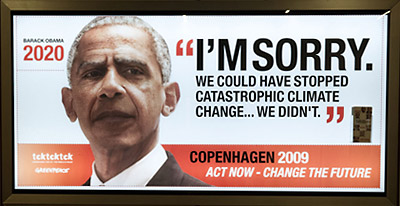
Thursday, December 10, 2009

we live in revolutionary times

Land Institute | Central to the problems we face is our reluctance to see them as anything more than temporary downturns in the usual up and down cycles of economics and climate. They are not. World production of oil in the past three years has remained steady—85 million barrels per day— while the price has more than doubled in that time, and in early July had reached as high as $145 per barrel. A human slave, on the other hand—of which there are now approximately 27 million in the world, more than at any other time in history—can be purchased for a mere $40. Add another 3 billion people to the planet in 40 years while simultaneously trying to cut carbon dioxide emissions by 80 percent. Find livelihoods, food, fresh water and shelter, as well as education, health care and stable governments for these numbers without causing species extinction, soil degradation, civil wars, nuclear wars and mass migrations. Try running any of the world’s major cities—their subways, waste water plants, transportation, lighting and heating—for even a few days on low density solar and wind power.

...We live in revolutionary times brought by substantial and sustained failures of current worldviews and global systems to provide everyday people with lives of health and freedom from want and fear, and with prospect of similar lives for their children. These failures are the self-evident truths of our time: that billions were promised improved lives only to see them degraded; mass extinctions of species; overheated climate; and unprecedented running down of the ecosphere on which all life depends.

The worldviews and systems responsible for these failures go by many names: individualism, capitalism, scientism, materialism, corporatism and globalism, to name a few. What they are called is not important. Important is that they share two bedrock beliefs that have become the intellectual DNA of our modern minds: first, that the natural world is without limit in energy and materials, and its sinks for wastes and pollution; and second, that the human intellect is sufficient to understand, control and operate Earth as a luxury-machine for the exclusive material happiness of human beings, again, without limit.

It is now necessary to overturn these false and dangerous beliefs, to limit the power of their many adherents, and to usher in a new way of thinking and living in the world. This is our revolutionary moment...

...To state unequivocally, “These are revolutionary times!” is recognition that the world is changing in ways that we would not necessarily choose; that it must change even if it goes against what we would otherwise choose; and that we can no longer choose to resist it.

It is so much easier to hope for a miracle. But our best and most realistic hope lies in embracing the revolution before us. With vigor and creativity we must help create the conceptual scaffolding necessary to build a new worldview—in the words of the American founder John Adams, “to start some new thinking that will surprise the world.” Every category of human thought needs reorientation to recognize the boundaries of our sun-powered ecosphere. We need ecospheric science, spirituality and economics, ecospheric politics, education and technology, ecospheric justice, history and architecture, ecospheric engineering, agriculture and philosophy, and ecospheric conceptions of rights, property and happiness.

Wednesday, December 09, 2009

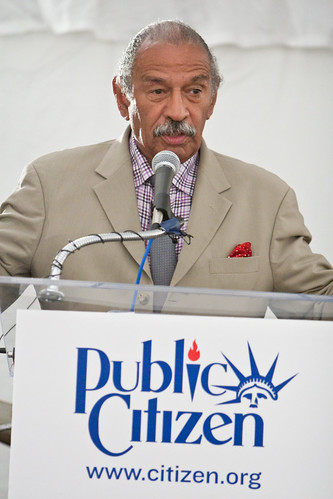
potus' lip poked out...,

The Hill | President Barack Obama recently called Rep. John Conyers Jr. to express his frustrations with the Judiciary Committee chairman’s criticism.

In an interview with The Hill, Conyers said his opinions of Obama’s policies on healthcare reform and the war in Afghanistan have not sat well with the president.

According to the lawmaker, the president picked up the phone several weeks ago to find out why Conyers was “demeaning” him.

Obama’s decision to challenge Conyers highlights a sensitivity to criticism the president has taken on the left. Conyers’s critical remarks, many of which have been reported on the liberal-leaning Huffington Post, appear to have irritated the president, known for his calm demeanor.

Conyers, the second-longest-serving member of the House, said, “[Obama] called me and told me that he heard that I was demeaning him and I had to explain to him that it wasn’t anything personal, it was an honest difference on the issues. And he said, ‘Well, let’s talk about it.’”

Sitting in the Judiciary Committee’s conference room two days after Obama delivered his speech on Afghanistan, the 23-term lawmaker said he wasn’t in the mood to “chat.”

Obama’s move to send in 30,000 troops to Afghanistan by the summer of 2010 has clearly disappointed Conyers.

He said he intends to press his case in writing soon.

“I want something so serious that he has to respond in writing, like I am responding in writing to him,” he said.

“Calling in generals and admirals to discuss troop strength is like me taking my youngest to McDonald’s to ask if he likes french fries,” Conyers said.

Many on the left have argued that military leaders routinely respond to crises by calling for more troops.

“I’ve been saying I don’t agree with him on Afghanistan, I think he screwed up on healthcare reform, on Guantánamo and kicking Greg off,” Conyers said, referring to the departure of former White House counsel Greg Craig.

Craig was a leading proponent in the White House of closing the terrorist detention center at Guantánamo Bay and releasing photos of detainees undergoing torture. Closing the military prison has proven to be politically difficult, and Obama reversed field on the photos, opting not to make them publicly available.

The White House did not respond to requests for comment for this article.

The liberal Conyers has been an outspoken proponent of a single-payer healthcare system and a critic of U.S. involvement in the wars in Afghanistan and Iraq.

He has also been at odds with White House policy on extending expiring provisions of the Patriot Act, crafting legislation that is to the left of the Senate’s version.

Obama and Conyers have a complicated and nuanced relationship.

time-lapse proof of extreme ice loss


TED | Photographer James Balog shares new image sequences from the Extreme Ice Survey, a network of time-lapse cameras recording glaciers receding at an alarming rate, some of the most vivid evidence yet of climate change.

why there's no sign of a climate conspiracy in hacked emails


NewScientist | The leaking of emails and other documents from the Climate Research Unit (CRU) at the University of East Anglia, UK, has led to a media and political storm. The affair is being portrayed as a scandal that undermines the science behind climate change. It is no such thing, and here's why.

We can be 100 per cent sure the world is getting warmer

Forget about the temperature records compiled by researchers such as those whose emails were hacked. Next spring, go out into your garden or the nearby countryside and note when the leaves unfold, when flowers bloom, when migrating birds arrive and so on. Compare your findings with historical records, where available, and you'll probably find spring is coming days, even weeks earlier than a few decades ago.

You can't fake spring coming earlier, or trees growing higher up on mountains, or glaciers retreating for kilometres up valleys, or shrinking ice cover in the Arctic, or birds changing their migration times, or permafrost melting in Alaska, or the tropics expanding, or ice shelves on the Antarctic peninsula breaking up, or peak river flow occurring earlier in summer because of earlier snowmelt, or sea level rising faster and faster, or any of the thousands of similar examples.

None of these observations by themselves prove the world is warming; they could simply be regional effects, for instance. But put all the data from around the world together, and you have overwhelming evidence of a long-term warming trend.

Tuesday, December 08, 2009

a beginners guide to evolutionary religious studies


Binghamton | Here are some quick answers to questions that are frequently asked about evolutionary theory in relation to religion and other aspects of human behavior.

Why is the field of evolutionary religious studies so new?
From the very beginning, Darwin and his colleagues were keenly interested in studying all aspects of humanity from an evolutionary perspective, including religion. However, this inquiry led in directions that can be recognized as false in retrospect. Cultural evolution was envisioned as a linear progression from “savagery” to “civilization,” with European societies most advanced. Herbert Spencer and others used evolution to justify a hierarchical society (“Social Darwinism”). Janet Browne’s magnificent 2-volume biography of Darwin and his times (Voyaging and The Power of Place) suggest that these views were inevitable against the background of Victorian culture. Instead of challenging the support that evolutionary theory lent to these views, the theory as a whole became off-limits for many human-related disciplines during most of the 20th century. The controversy surrounding the publication of E.O. Wilson’s Sociobiology in 1975 illustrates the tenor of the times. The modern study of humans from an evolutionary perspective represents a “fresh start” that is based on a much more sophisticated body of theory and knowledge from the biological sciences and bears almost no resemblance to earlier “evolutionary” theories. The field of evolutionary religious studies is part of this broader trend.

How can something as cultural as religion be studied from an evolutionary perspective?
It is typical to portray terms such as “culture” and “learning” as alternatives to terms such as “evolution” and “biology.” According to this formulation, evolutionary theory can explain other species and certain aspects of humans, such as our desire to eat and mate, but not other aspects, such as our rich cultural diversity. This formulation makes little sense from a modern evolutionary perspective. Culture and learning are manifestly important in our species, but they need to be understood from an evolutionary perspective rather than being regarded as an alternative. The capacities for learning and culture require an elaborate architecture that evolved by genetic evolution. Moreover, learning and cultural change can be regarded as fast-paced evolutionary processes in their own right. The bottom line is that evolutionary theory provides a framework for understanding cultural diversity in addition to biological diversity.

If cultural evolution refers to any kind of cultural change, doesn’t it explain nothing by explaining everything?
Consider an analogy with genetic evolution, which is defined as any kind of genetic change, whether by mutation, selection, drift, linkage disequilibrium, and so on. It is important for the definition to include everything to provide a complete accounting system for genetic change. The definition is not empty because specific categories of change are determined on a case-by-case. Thus, we might decide that guppy spots (and their associated genes) evolve primarily by selection, that mitochondrial genes evolve primarily by drift, and so on. Similarly, it is important for the definition of cultural evolution to be all-inclusive to provide a complete accounting system. What saves it from being empty is a number of meaningful sub-categories that can be determined on a case-by-case basis.

What is the relationship between evolutionary theory and other theoretical perspectives, such as Marxism, rational choice theory, or functionalism?
Most scholars and scientists who study religion are not young-earth creationists. They expect religion to be natural phenomenon that can be explained without invoking supernatural agents. They fully accept the theory of evolution, including humans as a product of evolution. Thus, they implicitly assume that their particular theoretical framework is consistent with evolutionary theory, without requiring much knowledge about evolutionary theory. For example, rational choice theory assumes that human behavior can be explained in terms of individual utility maximization. When pressed for an explanation, a rational choice theorist would presumably say that utility maximization evolved as a genetic or cultural adaptation—those who failed to maximize their utilities were not among our ancestors. In this fashion, when the axioms of any given naturalistic perspective are questioned, they involve assumptions about evolution. Unsurprisingly (at least in retrospect) these assumptions can be improved by a sophisticated knowledge of current evolutionary theory. In this fashion, other theoretical perspectives become integrated into evolutionary theory rather than providing an alternative. Virtually all naturalistic theories of religion that were developed without using the E-word can be given a formulation within evolutionary theory, enabling them to be compared with each other more productively than before.

epa says greenhouse gases imperil health

NYTimes | The Environmental Protection Agency on Monday issued a final ruling that greenhouse gases posed a danger to human health and the environment, paving the way for regulation of carbon dioxide emissions from vehicles, power plants, factories, refineries and other major sources.

The announcement was timed to coincide with the opening of the United Nations conference on climate change in Copenhagen, strengthening President Obama’s hand as more than 190 nations struggle to reach a global accord.

The E.P.A.’s administrator, Lisa P. Jackson, said that a 2007 decision by the Supreme Court required the agency to weigh whether carbon dioxide and five other climate-altering gases threatened human health and welfare and, if so, to take steps to regulate them.

She said Monday that the finding was driven by the weight of scientific evidence that the planet was warming and that human activity was largely responsible.

“There have and continue to be debates about how and how quickly climate change will happen if we fail to act,” Ms. Jackson said at a news conference at the E.P.A.’s headquarters. “But the overwhelming amounts of scientific study show that the threat is real.”

Industry groups quickly criticized the decision, saying that the regulation of carbon dioxide, a near-ubiquitous substance, would be legally and technically complex and would impose huge costs across the economy.

from the mind of apple daily....,

Monday, December 07, 2009

americans waste 40% of available food supply

LiveScience | U.S. residents are wasting food like never before. While many Americans feast on turkey and all the fixings, a new study finds food waste per person has shot up 50 percent since 1974. Some 1,400 calories worth of food is discarded per person each day, which adds up to 150 trillion calories a year.

The study finds that about 40 percent of all the food produced in the United States is tossed out.

Meanwhile, while some have plenty of food to spare, a recent report by the Department of Agriculture finds the number of U.S. homes lacking "food security," meaning their eating habits were disrupted for lack of money, rose from 4.7 million in 2007 to 6.7 million last year.

About 1 billion people worldwide don't have enough to eat, according to the World Food Program.

Growing problem
The new estimate of food waste, published in the journal PLoS ONE, is a relatively straightforward calculation: It's the difference between the U.S. food supply and what's actually eaten, which was estimated by using a model of human metabolism and known body weights.

The result, from Kevin Hall and colleagues at the National Institute of Diabetes and Digestive and Kidney Diseases, is about 25 percent higher than similar estimates made in recent years.

Last year, an international group estimated that up to 30 percent of food — worth about $48.3 billion — is wasted each year in the United States. That report concluded that despite food shortages in many countries, plenty of food is available to feed the world, it just doesn't get where it needs to go.

Previous calculations were typically based on interviews with people and inspections of garbage, which Hall's team figures underestimates the waste.

reserves are bunk

ResourceInsights |The claims that the United States has 100 years of recoverable natural gas as a result of the newly accessible shale basins has no meaning without attaching a price to it. The fact that major shale gas producers have trimmed their active drilling fleets to a fraction of what they were during the 2008 boom in natural gas prices proves that price is a critical factor in determining whether to drill. And, where there is no drilling, there are no additions to reserves. The natural gas market has shown itself to be highly volatile which has not surprisingly led to wide swings in natural gas drilling. The notion that somehow there will be a consistent accretion of natural gas reserves from year to year or that all discoveries from previous years will still be considered reserves in a low-price environment is pure bunkum. The same logic applies to oil discoveries. But these days no one is claiming the United States has enough oil left to supply the entire country for 100 years. And, so hype about oil reserves is less of an issue.

The upshot is that expected cash flow determines what areas will be drilled, not the size of potential reserves. Most companies won't drill a prospect unless they believe they can get their money back within two to three years, Doyle says. If it takes four or five years, the prospect is not very attractive. Cash flow is king.

It turns out that the NPV of the first three years of cash flow from my hypothetical well mentioned above is $1,556,112, only about half of the initial investment. Most companies would or should pass on such a prospect, and it would therefore never become part of anyone's reserves, he explains. Part of the hype over shale gas has to do with the claim that the wells may be very long-lived, he adds. Even if that turns out to be true--not a certainty as of now--the low flow rates expected after the initial burst of production and the distant payoffs would actually work against any decision to drill such wells. No wells, no reserves.

Doyle says that given modern technology, oil and natural gas are easier to find than ever before. But he doesn't believe that in North America at least, there is that much more to find. He thinks that shale gas in North America my indeed prove to be plentiful. But it will not be both plentiful and cheap.

And, of course, if we succeed at expanding natural gas production to meet the needs of a new natural gas-powered vehicle fleet--an idea advocated by one of the leading producers of shale gas--and expand other current uses such as the generation of electricity, we can expect that natural gas prices will soar. That may provide the necessary incentive (i.e. cash flow) to extract the shale gas that lies below the American landscape. But it will also certainly mean that the 100 years of supply that has been so frequently touted in the media will rapidly shrink to perhaps 30 or 40, and that the peak in production will come much sooner.

A peak in natural gas production in, say, 20 years would not exactly be a useful talking point for those advocating the wholesale conversion of key parts of the U. S. economy to run on natural gas. Just as we would be finishing such a conversion, we could find ourselves on the downslope of the natural gas production curve and faced with the urgent need to adapt our costly and newly completed natural gas infrastructure to run on some other energy source.

Sunday, December 06, 2009

police tapped sprint gps data 8 million times this year

TPM | Under a new system set up by Sprint, law enforcement agencies have gotten GPS data from the company about its wireless customers 8 million times in about a year, raising a host of questions about consumer privacy, transparency, and oversight of how police obtain location data.

What this means -- and what many wireless customers no doubt do not realize -- is that with a few keystrokes, police can determine in real time the location of a cell phone user through automated systems set up by the phone companies.

And while a Sprint spokesman told us customers can shield themselves from surveillance by simply switching off the GPS function of their phones, one expert told TPM that the company and other carriers almost certainly have the power to remotely switch the function back on.

To be clear, you can think of there being two types of GPS (global positioning system). One is the handy software on your mobile device that tells you where you are and helps give driving directions. But there's also GPS capability in all cell phones sold today, required by a federal regulation so if you dial 911 from an unknown location, authorities can find you.

Sprint says the 8 million requests represent "thousands" of individual customers -- it won't say how many exactly -- and that the company follows the law. It's not clear, however, if warrants are always needed, or whether they have been obtained by police for all the cases.

that climate change email


NYTimes | The theft of thousands of private e-mail messages and files from computer servers at a leading British climate research center has been a political windfall for skeptics who claim the documents prove that mainstream scientists have conspired to overstate the case for human influence on climate change.

They are using the e-mail to blast the Obama administration’s climate policies. And they clearly hope that the e-mail will undermine negotiations for a new climate change treaty that begin in Copenhagen this week.

No one should be misled by all the noise. The e-mail messages represent years’ worth of exchanges among prominent American and British climatologists. Some are mean-spirited, others intemperate. But they don’t change the underlying scientific facts about climate change.

One describes climate skeptics as “idiots,” another describes papers written by climate contrarians as “garbage” and “fraud.” Still another suggests that the United Nations’ Intergovernmental Panel on Climate Change, whose 2007 report concluded that humans were the dominant force behind global warming, should pay no attention to contrarian opinions.

Another quotes an exasperated Phil Jones — director of the climate center at the University of East Anglia, from which the e-mail was stolen — as expressing the hope that climate change would occur “regardless of the consequences” so “the science could be proved right.”

However, most of the e-mail messages — judging by those that have seen the light of day — appear to deal with the painstaking and difficult task of reconstructing historical temperatures, and the problems scientists encounter along the way. Despite what the skeptics say, they demonstrate just how rigorously scientists have worked to figure out whether global warming is real and the true role that human activities play.

The controversy isn’t over. James Inhofe, the Senate’s leading skeptic, has asked for an inquiry into what some are calling “Climategate.” And on Friday, Rajendra Pachauri, chairman of the United Nations’ intergovernmental panel, announced that he would conduct his own investigation.

It is important that scientists behave professionally and openly. It is also important not to let one set of purloined e-mail messages undermine the science and the clear case for action, in Washington and in Copenhagen.

jared diamond disappoints....,

NYTimes | THERE is a widespread view, particularly among environmentalists and liberals, that big businesses are environmentally destructive, greedy, evil and driven by short-term profits. I know — because I used to share that view.

But today I have more nuanced feelings. Over the years I’ve joined the boards of two environmental groups, the World Wildlife Fund and Conservation International, serving alongside many business executives.

As part of my board work, I have been asked to assess the environments in oil fields, and have had frank discussions with oil company employees at all levels. I’ve also worked with executives of mining, retail, logging and financial services companies. I’ve discovered that while some businesses are indeed as destructive as many suspect, others are among the world’s strongest positive forces for environmental sustainability.

The embrace of environmental concerns by chief executives has accelerated recently for several reasons. Lower consumption of environmental resources saves money in the short run. Maintaining sustainable resource levels and not polluting saves money in the long run. And a clean image — one attained by, say, avoiding oil spills and other environmental disasters — reduces criticism from employees, consumers and government.

What’s my evidence for this? Here are a few examples involving three corporations — Wal-Mart, Coca-Cola and Chevron — that many critics of business love to hate, in my opinion, unjustly.

the rise and fall of myspace

FT | To say MySpace was a hot property back in 2005 is something of an understatement. Its rapidly expanding tribe of users had attracted the attention of other potential buyers. Viacom, for one, a rival media conglomerate that owns companies such as Paramount Pictures and Comedy Central, was eyeing it as a vehicle to revive its flagging MTV channel, a similarly youth-oriented brand.

But Murdoch got there first and the resulting $580m deal transformed his image at a stroke. The curmudgeonly media baron, whose achievements included breaking the Fleet Street printing unions and launching the conservative Fox News cable channel, had re-invented himself as a 21st-century internet hipster. It took Wall Street a few months to appreciate the magnitude of the deal but the purchase slowly began to imbue News Corp with an almost priceless commodity it had lacked: cool.

Millions of teenagers across the world adored MySpace, spending hours every day connecting with each other online and fine-tuning ­personal profile pages that reflected their tastes and personalities. News Corp had new-found cultural cachet thanks to them – and to the popularity of MySpace with new filmmakers and musicians such as the Arctic Monkeys and Lily Allen, who became sensations on the site, releasing songs to fans before their first albums appeared.

Months after the acquisition, Murdoch had another reason to feel pleased: MySpace signed a three-year advertising contract with Google worth $900m – effectively paying for News Corp’s purchase. Google bought the right to become a fixture within the MySpace site, enabling it to display its text adverts to the network’s millions of users. This prize was highly contested, with Yahoo and Microsoft falling over themselves to win the business before Google triumphed. Larry Page and Sergey Brin, the ­founders of the search engine, flew in by helicopter to seal the deal at a starry News Corp retreat at Pebble Beach where the guests included Bono and Tony Blair.

"they" call it pollution, "we" call it life...,


RawStory | A group promoting skepticism over widely-accredited climate change science has a web of connections to influential oil giant Exxon-Mobil, Raw Story has found.

The organization is called the Nongovernmental International Panel on Climate Change (NIPCC), apparently named after the UN coalition International Panel on Climate Change (IPCC). An investigation into the group reveals its numerous links to Exxon-Mobil, a vehement opponent of climate legislation and notorious among scientists for funding global warming skeptics.

"Exxon-Mobil essentially funds people to lie," Joseph Romm, lauded climate expert and author of the blog Climate Progress, told Raw Story. "It's important for people to understand that they pay off the overwhelming majority of groups in the area of junk science."

The NIPCC's signature report, "Climate Change Reconsidered," disputes the notion that global warming is human-caused, insisting in its policy summary that "Nature, not human activity, rules the planet." Many of its assertions have been challenged by, among others, the scientists' blog RealClimate.

The report was released and promoted this summer by the Heartland Institute, a think tank that claims to support "common-sense environmentalism" as opposed to "more extreme environmental activism." It alleges that "Global warming is a prime example of the alarmism that characterizes much of the environmental movement."
--------------------------------------------------------------------------------------------------
One hopes that trial lawyers will finally penetrate big oil's vulnerabilities much as they managed to do with big tobacco......,

Saturday, December 05, 2009

the story of cap and trade


The Story of Cap & Trade is a fast-paced, fact-filled look at the leading climate solution being discussed at Copenhagen and on Capitol Hill. Host Annie Leonard introduces the energy traders and Wall Street financiers at the heart of this scheme and reveals the "devils in the details" in current cap and trade proposals: free permits to big polluters, fake offsets and distraction from whats really required to tackle the climate crisis. If youve heard about Cap & Trade, but arent sure how it works (or who benefits), this is the film is for you.

fossil fuel equivalence...,


BBC | How much electricity does the average British family of four use in a day?

To find out, BBC's Bang Goes the Theory attempts to power a house for an entire day solely through human pedal power, while an unsuspecting family inside go about their normal Sunday routine.

in e-mails, science of warming is hot debate


WaPo | It began with an anonymous Internet posting, and a link to a wonky set of e-mails and files. Stolen, apparently, from a research center in Britain, the files showed the leaders of climate-change science discussing flaws in their own data, and seemingly scheming to muzzle their critics.

Now it has mushroomed into what is being called "Climate-gate," a scandal that has done what many slide shows and public-service ads could not: focus public attention on the science of a warming planet.

Except now, much of that attention is focused on the science's flaws. Leaked just before international climate talks begin in Copenhagen -- the culmination of years of work by scientists to raise alarms about greenhouse-gas emissions -- the e-mails have cast those scientists in a political light and given new energy to others who think the issue of climate change is all overblown.

The e-mails don't say that: They don't provide proof that human-caused climate change is a lie or a swindle.

But they do raise hard questions. In an effort to control what the public hears, did prominent scientists who link climate change to human behavior try to squelch a back-and-forth that is central to the scientific method? Is the science of global warming messier than they have admitted?

The stolen electronic files include more than 1,000 e-mails and 3,000 documents, all taken from servers at the Climatic Research Unit, a world-famous center at the University of East Anglia in Britain.

Phil Jones, the unit's director, wrote a colleague that he would "hide" a problem with data from Siberian tree rings with more accurate local air temperature measurements. In another message, Jones talks about keeping research he disagrees with out of a U.N. report, "even if we have to redefine what the peer-review literature is!"

Since then, Jones has stepped down temporarily. And Pennsylvania State University is exploring whether the e-mails, some of which were written by one of its professors, Michael Mann, warrant an investigation. In an interview, Mann said he is confident that neither he nor any of the other researchers whose e-mails were pirated "did anything improper."

But recent debate -- some scientists say the Earth hasn't warmed as predicted over the past 10 years -- show that climate science is still science, with researchers drawing different lessons from the same data. The problem is that it plays out before an audience that won't wait for certainty.

Friday, December 04, 2009

cia authorized to expand use of drones in pakistan

NYTimes | Two weeks ago in Pakistan, Central Intelligence Agency sharpshooters killed eight people suspected of being militants of the Taliban and Al Qaeda, and wounded two others in a compound that was said to be used for terrorist training.

Then, the job in North Waziristan done, the C.I.A. officers could head home from the agency’s Langley, Va., headquarters, facing only the hazards of the area’s famously snarled suburban traffic.

It was only the latest strike by the agency’s covert program to kill operatives of Al Qaeda, the Taliban and their allies using Hellfire missiles fired from Predator aircraft controlled from half a world away.

The White House has authorized an expansion of the C.I.A.’s drone program in Pakistan’s lawless tribal areas, officials said this week, to parallel the president’s decision, announced Tuesday, to send 30,000 more troops to Afghanistan. American officials are talking with Pakistan about the possibility of striking in Baluchistan for the first time — a controversial move since it is outside the tribal areas — because that is where Afghan Taliban leaders are believed to hide.

By increasing covert pressure on Al Qaeda and its allies in Pakistan, while ground forces push back the Taliban’s advances in Afghanistan, American officials hope to eliminate any haven for militants in the region.

One of Washington’s worst-kept secrets, the drone program is quietly hailed by counterterrorism officials as a resounding success, eliminating key terrorists and throwing their operations into disarray. But despite close cooperation from Pakistani intelligence, the program has generated public anger in Pakistan, and some counterinsurgency experts wonder whether it does more harm than good.

hamid mir on the war in pakistan

are american drone attacks counterproductive?

Der Spiegel | SPIEGEL: Since you are already letting the US carry out its drone attacks against militants on Pakistani territory along the border with Afghanistan, why don't you let them help you with soldiers on Pakistani territory?

Part 2: We Need Huge Public Support to Combat Terrorism
Gilani: We haven't stopped them from helping us. In fact, we have a multi-dimensional cooperation with the United States, including defense and intelligence, but also economics, trade, development, health education and even in cultural affairs. But these drone attacks are counterproductive.

SPIEGEL: Really? The leader of the Pakistani Taliban, Baitullah Mehsud, was killed by an American drone. Don't you call this a success?

Gilani: The political and the military leadership have been very successful in isolating the militants from the local tribes. But once there is a drone attack in their home region, they get united again. This is a dangerous trend, and it is my concern and the concern of the army. It is also counterproductive in the sense that it is creating a lot of anti-American sentiment all over the country. But in order to fight the militants in Waziristan, we have to carry the public with us. One cannot go into any war without the support of the masses. We need huge public support to combat terrorism. But we do not get that if there is American interference, which we do not ask for.

SPIEGEL: But no matter what the Americans do, there will always be anti-American sentiment.

Gilani: Right now, the whole nation is supporting our military action because they feel that terrorism is a menace.

Chipocalypse Now - I Love The Smell Of Deportations In The Morning

sky |   Donald Trump has signalled his intention to send troops to Chicago to ramp up the deportation of illegal immigrants - by posting a...