Friday, November 27, 2009

h1n1 and pneumococcal lung infections?

WaPo | Federal health officials on Wednesday linked the H1N1 flu epidemic to a sharp rise in the number of severe bacterial infections.

Anne Schuchat, a physician at the Centers for Disease Control and Prevention, said the national trend was "worrisome" but not unexpected.

"In previous pandemics, there has been an increase in pneumococcal infections in younger people," she said.

The illnesses are caused by Streptococcus pneumoniae, a microbe often carried in the nose and throat. While often benign, the bacterium can cause bloodstream infections, fatal pneumonia and meningitis.

The clearest sign of the marked rise is coming from the Denver area, which usually records about 20 cases of "invasive pneumococcal disease" each October. This year, it has had 58, Schuchat said in a briefing for reporters.

Most invasive pneumococcal infections normally occur in the elderly, but in the Denver cases 62 percent were in people age 20 to 59, Schuchat said. Serious cases of influenza are also primarily hitting younger age groups.

When flu causes pneumonia, it can damage cells deep in the lungs, opening a portal for bacteria. In an analysis of about 75 fatal H1N1 cases earlier this year, autopsies showed that about one-third had bacterial pneumonia.

Pneumococcal infections are largely preventable with a vaccine that is given once or twice depending on a person's age. It is recommended for smokers and for people with asthma, kidney or liver problems, heart disease and other chronic ailments. Only about one-quarter of people with those conditions, however, have been vaccinated.

chinese garlic speculators cash in on swine flu fears

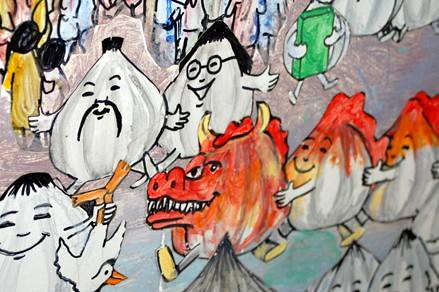
WaPo | Garlic prices are hitting record highs in China, the world's biggest producer of the pungent bulbs, amid reports of a speculative bubble in the market even as people rush to buy it as a putative cure for swine flu.

The China Daily reported last week that a high school in the eastern city of Hangzhou bought more than 400 pounds of garlic and made students eat it at lunch to stay healthy.

Wholesale garlic prices in Beijing are now 15 times as high as in March, and still rising.

Jerry Lou, a Morgan Stanley China strategist who has researched the opaque market here, said speculators -- fueled by the abundant liquidity sloshing around China -- have moved into the small market and strategically driven up prices.

"You need a warehouse, a lot of cash and a few trucks. That's how it works," Lou said, describing garlic speculators' tools of the trade. "Basically, what you do is try to arrest as much supply as possible, then you bid up the price. Moving garlic from one warehouse to the other, you make millions of dollars."

Lou said garlic wholesalers told him that gangs that had amassed cash and credit from dealing property and stocks in other parts of the country had chosen the garlic market as their latest ruse.

Thursday, November 26, 2009

simplest explanation

Bloomberg | Adrian Gibbs, the virologist who said in May that swine flu may have escaped from a laboratory, published his findings today, renewing discussion about the origins of the pandemic virus.

The new H1N1 strain, which was discovered in Mexico and the U.S. in April, may be the product of three strains from three continents that swapped genes in a lab or a vaccine-making plant, Gibbs, and fellow Australian scientists wrote in Virology Journal. The authors analyzed the genetic makeup of the virus and found its origin could be more simply explained by human involvement than a coincidence of nature.

Their study, published in a free, online journal reviewed by other scientists, follows debate among researchers six months ago, when Gibbs asked the World Health Organization to consider the hypothesis. After reviewing Gibbs’ initial three-page paper, WHO and other organizations concluded the pandemic strain was a naturally occurring virus and not laboratory-derived.

“It is important that the source of the new virus be found if we wish to avoid future pandemics rather than just trying to minimize the consequences after they have emerged,” Gibbs and colleagues John Armstrong and Jean Downie said in today’s eight- page study.

Gibbs and Armstrong are on the emeritus faculty at the Australian National University in Canberra and Downie is affiliated with the Centre for Infectious Diseases and Microbiology Laboratory Services at Sydney’s Westmead Hospital, according to the study.

While the exact source of the new H1N1 strain is a mystery, their research has “raised many new questions,” they said. The authors compared the genetic blueprints of flu strains stored in the free database Genbank and found the pandemic virus’s nearest ancestors circulate in pigs.

h1n1 and h5n1 pandemic mutation

Digital Journal | With H1N1 mutations seen in Norway and noted in several countries, a Chinese expert issues a warning on the potential for a superbug combination of bird flu and swine flu.

As mutating viruses go, influenza species are notorious for making sloppy copies of themselves - and this behavior presents a challenge to public health officials who are charged with containing more dangerous and widespread disease. On Wednesday, a Chinese disease expert spoke out on the possibility of a dangerous combination between a more dangerous H1N1 swine flu virus mutation and China's endemic H5N1 bird flu species.

A swap in genetic code between these two dangerous viruses could create a superbug pandemic with the potential to wipe out the majority of human populations worldwide.
"China, as you know, is different from other countries. Inside China, H5N1 has been existing for some time, so if there is really a reassortment between H1N1 and H5N1, it will be a disaster," Zhong Nanshan, director of the Guangzhou Institute of Respiratory Diseases in China's southern Guangdong province told Reuters.

Recently, Norwegian scientists discovered a more virulent mutation of the H1N1 swine flu virus. Their discovery was immediately followed by disclosures from the World Health Organization that this same mutation has been observed in several countries, including China. While experts believe that current vaccines are effective against the mutation, the WHO disclosures remained disconcerting.

China faces unique challenges with morphing influenza appearing somewhat regularly throughout their population. Late in 2002, China and the world were introduced to the SARS coronavirus - an event that nearly touched off a deadly pandemic. Since then, the H5N1 virus - known also as bird flu - has trumped SARS as the most likely China-based candidate to emerge as a global pandemic.

The H1N1 swine flu virus that emerged from Mexico earlier this year took many by surprise. And it quickly became the real thing - as pandemics go. Fist tap Big Don.

sure, on an individual basis - and I'll prove it


How otherwise could I offer you this guaranteed recipe for rolls easy enough for a child to make - and upon which you and yours are guaranteed to absolutely hurt yourself (in the best possible way of course). These go well with turkey and all the trimmings, or, standalone with jams, jellies, and preserves.

You'll need 3 packets of yeast,
1/3rd cup of lukewarm water
soften/dissolve yeast in the warm water

2/3rds cup of sugar,
1 tablespoon of salt
3 tablespoons of vegetable oil
3 cups of boiling water
mix these together and set them aside to cool

1 tablespoon of sugar
3 room temperature eggs
whisk these together in your largest mixing bowl

12 cups of sifted flour

Pour the dissolved yeast onto the egg and sugar mixture and gently whisk these together. (gotta jump start the yeasty proliferation) When the boiling salty, sugary, oily water is lukewarm, pour it into the jumpstarted egg/yeast/sugar mixture in the bowl and gently integrate it all with your whisk.

To this fragrant, active, yeasty brown egg broth - you will add your twelve cups of sifted flour. Up until the 8th cup or so, it's pretty easy, but from the 8th to the 12th cup, it becomes somewhat drier and more difficult to whisk and integrate additional flour.

Anyway, once you get all that biologically active mass of dough pulled together in your big mixing bowl, you'll probably want to break it up into a couple, possibly three smaller batches for overnight population explosion. (i.e., letting the dough rise, as the yeast devours the sugar and emits mass quantities of CO2 into the mass)

Be sure to cover each of your smaller rising bowls with a wet towel (cheesecloth) (so that as the dough rises overnight, it doesn't dry out on its surface) put the wet towel covered rising bowls in the refrigerator overnight (the cold will only moderate the yeasty population explosion) come late morning, you'll have big swollen. fragrant, yeasty dough balls trying to burst through the moist towels covering each bowl.

These will stay viable throughout the day into mid-afternoon. A couple of hours before you're ready to bake, melt a stick of butter in a bowl. Punch down a dough ball, roll it out on a floured board, use a juice glass to cut it out into ~3 inch circles.

Have a baking sheet ready.

Dip each circle (roll) into the melted butter and fold it in the middle onto the baking pan. Line these up row after row until the pan is full. Let the divided, conquered, buttered, and beaten rolls sit on that baking sheet to rise for at least 90 minutes (yes, the yeast is still very much alive even after all that abuse)

After that second rising, the baking sheet will be at overflow capacity with monstrous, swollen rolls a good three times larger than they were when you put them on the baking sheet.

Comes now the apocalypse.

Bake the rolls at 350 degrees until they're just a little golden brown 25-35 minutes.

Serve them immediately at the outset of your thanksgiving day feast. Trust me, once you've dropped these heavy, fresh, buttery hard rolls (not like bread at all) on a hungry gathering of friends and family, you will have ruined them for life on any possible alternative. From that point forward, as far as your guests are concerned, your holiday feasts will be all about the rolls. Accept no substitutes....,

what it do shawty...,


Carbon dioxide production is used to infer population growth in a colony of baker's yeast. We can monitor the population as it moves through the four phases of growth, ending with carrying capacity, in which the available nutrients are inadequate to support further expansion of the population.

Wednesday, November 25, 2009

the lauderdale paradox

Monthly Review | Today orthodox economics is reputedly being harnessed to an entirely new end: saving the planet from the ecological destruction wrought by capitalist expansion. It promises to accomplish this through the further expansion of capitalism itself, cleared of its excesses and excrescences. A growing army of self-styled “sustainable developers” argues that there is no contradiction between the unlimited accumulation of capital — the credo of economic liberalism from Adam Smith to the present — and the preservation of the earth. The system can continue to expand by creating a new “sustainable capitalism,” bringing the efficiency of the market to bear on nature and its reproduction. In reality, these visions amount to little more than a renewed strategy for profiting on planetary destruction.

Behind this tragedy-cum-farce is a distorted accounting deeply rooted in the workings of the system that sees wealth entirely in terms of value generated through exchange. In such a system, only commodities for sale on the market really count. External nature — water, air, living species — outside this system of exchange is viewed as a “free gift.” Once such blinders have been put on, it is possible to speak, as the leading U.S. climate economist William Nordhaus has, of the relatively unhindered growth of the economy a century or so from now, under conditions of business as usual — despite the fact that leading climate scientists see following the identical path over the same time span as absolutely catastrophic both for human civilization and life on the planet as a whole.1

Such widely disparate predictions from mainstream economists and natural scientists are due to the fact that, in the normal reckoning of the capitalist system, both nature’s contribution to wealth and the destruction of natural conditions are largely invisible. Insulated in their cocoon, orthodox economists either implicitly deny the existence of nature altogether or assume that it can be completely subordinated to narrow, acquisitive ends.

This fatal flaw of received economics can be traced back to its conceptual foundations. The rise of neoclassical economics in the late nineteenth and early twentieth centuries is commonly associated with the rejection of the labor theory of value of classical political economy and its replacement by notions of marginal utility/productivity. What is seldom recognized, however, is that another critical perspective was abandoned at the same time: the distinction between wealth and value (use value and exchange value). With this was lost the possibility of a broader ecological and social conception of wealth. These blinders of orthodox economics, shutting out the larger natural and human world, were challenged by figures inhabiting what John Maynard Keynes called the “underworlds” of economics. This included critics such as James Maitland (Earl of Lauderdale), Karl Marx, Henry George, Thorstein Veblen, and Frederick Soddy. Today, in a time of unlimited environmental destruction, such heterodox views are having a comeback.

courting convulsion

Kunstler | What's going on in the US economy is a slow-motion convulsion from which we will emerge as a very different nation with a different economy. The wild irresponsibility of the media in pretending otherwise is only going to make the convulsion worse, more painful, more socially and politically destructive. The convulsion can be described with precision as one of compressive contraction. Historic circumstances are requiring us to change our behavior, to make new arrangements for everyday life in all the major particulars: capital accumulation and deployment; food production; commerce; habitation; transport; education; and health care. These new arrangements must be organized at a smaller and finer scale, and on a much more local basis.

The main "historic circumstance" mandating these changes goes under the heading of "peak oil." We've come to the end of our ability in this world to increase energy inputs to the global economy. The routine "growth" in industrial activity and production that has been the basis of our financial arrangements for 200-odd years is no longer possible. Offsetting this decline in oil energy "input" with "alt.energy" is a dangerous fantasy because it distracts us from the urgent task of making new arrangements for trade, food production, et cetera - the very things that would provide jobs and social roles for our citizens in the future.

We are seeing a comprehensive failure of leadership in every sector and every level of American life - in politics, business, banking, education, news media, medicine, and the clergy. All are determined to pretend that we can somehow continue the habits and behaviors of the pre peak oil era. They are all unwilling to face reality, and are all engaged in mutually supporting each other's dangerous fantasies.

If we don't attend to the transformation of American life by downscaling our activities and changing the way they are carried out, and re-localizing them, we will see our society disintegrate - and I use the word "dis-integrate" with purposeful precision. Everything will come apart - our political arrangements, our households, our health and well-being.

At the moment, banking is disintegrating. It's happening because the end of regular, predictable, cyclical, industrial growth means the end of our ability to generate credit without limits, and in fact we passed this point by stealth some time ago leaving the banks in "Wile E. Coyote" suspension above an abyss, where they have lately been joined by government at all levels and the indebted citizens of the land. The profound nausea spreading through the offices of America is the somatic recognition of exactly where we are in all this: off the cliff.

imf - second bailout would threaten "democracy"

TimesOnline | The public will not bail out the financial services sector for a second time if another global crisis blows up in four or five years time, the managing-director of the International Monetary Fund warned this morning.

Dominique Strauss-Kahn told the CBI annual conference of business leaders that another huge call on public finances by the financial services sector would not be tolerated by the “man in the street” and could even threaten democracy.

"Most advanced economies will not accept any more [bailouts]...The political reaction will be very strong, putting some democracies at risk," he told delegates.

"I do believe that the financial sector needs to contribute both to the costs of the financial crisis and to reduce recourse to public funds in the future," he said.
Related Links

Mr Strauss-Kahn said that imposing high capital ratio requirements on banks was one price the financial services sector must pay to prevent the threat of further multi-billion dollar bailouts.

He pointed to the debate in the US over the Troubled Asset Relief Programme and said that in many countries, including France and Germany, he doubted that politicians would secure the mandate needed to secure any further bail-outs if banks got in to trouble again, in several years' time.

as sewers fill, waste poisons waterways


NYTimes | It was drizzling lightly in late October when the midnight shift started at the Owls Head Water Pollution Control Plant, where much of Brooklyn’s sewage is treated.

A few miles away, people were walking home without umbrellas from late dinners. But at Owls Head, a swimming pool’s worth of sewage and wastewater was soon rushing in every second. Warning horns began to blare. A little after 1 a.m., with a harder rain falling, Owls Head reached its capacity and workers started shutting the intake gates.

That caused a rising tide throughout Brooklyn’s sewers, and untreated feces and industrial waste started spilling from emergency relief valves into the Upper New York Bay and Gowanus Canal.

“It happens anytime you get a hard rainfall,” said Bob Connaughton, one the plant’s engineers. “Sometimes all it takes is 20 minutes of rain, and you’ve got overflows across Brooklyn.”

One goal of the Clean Water Act of 1972 was to upgrade the nation’s sewer systems, many of them built more than a century ago, to handle growing populations and increasing runoff of rainwater and waste. During the 1970s and 1980s, Congress distributed more than $60 billion to cities to make sure that what goes into toilets, industrial drains and street grates would not endanger human health.

But despite those upgrades, many sewer systems are still frequently overwhelmed, according to a New York Times analysis of environmental data. As a result, sewage is spilling into waterways.

In the last three years alone, more than 9,400 of the nation’s 25,000 sewage systems — including those in major cities — have reported violating the law by dumping untreated or partly treated human waste, chemicals and other hazardous materials into rivers and lakes and elsewhere, according to data from state environmental agencies and the Environmental Protection Agency.

But fewer than one in five sewage systems that broke the law were ever fined or otherwise sanctioned by state or federal regulators, the Times analysis shows.

feds pretending once more with airline industry

USAToday | For the third time in 16 years the federal government is forming a blue-ribbon panel to try to save the USA's troubled airline industry, which has racked up $58.5 billion in losses and shed 158,000 jobs this decade.

Transportation Secretary Ray LaHood, who has ordered up the panel, vows it won't be "just another advisory committee."

"I am not commissioning some report to fill space on my bookshelf," he wrote on his official blog on the department's website. "This committee will make a difference. Without a financially strong aviation industry we will be unable to compete in domestic and international commerce."

But a $20 billion price tag for fixing the industry's biggest problems and a failure to implement most of the suggestions from two previous commissions have many analysts and former government officials questioning whether anything will come from this latest effort.

Aviation economist Dan Kasper, a member of the panel convened by then-president Bill Clinton in 1993, says commissions can be used as a tool by politicians who don't want to make difficult and unpopular decisions.

"These commissions are a way for politicians to show that they're interested in these issues, that they're not ignoring them, but at the same time it does not necessarily require them to anything about it," says Kasper, a consultant at LECG.

Tuesday, November 24, 2009

wealthy nations outsource crops to african land


WaPo | "If these deals are negotiated well, I tell you, it will change the dynamics of the food economy in this country," said Mafa Chipeta, the FAO's representative in Ethiopia, dismissing the worst-case scenarios. "I can't believe Ethiopia or any other government would allow their country to be used like an empty womb. The human spirit would not allow it." Few countries have embraced the trend as zealously as Ethiopia, where hard-baked eastern deserts fade into spectacularly lush and green western valleys fed by the Blue Nile. Only a quarter of the country's estimated 175 million fertile acres is being farmed.

Desperate for foreign currency, the government of former Marxist rebels who once proclaimed "land to the tiller!" has set aside more than 6 million acres for agribusiness. Lured with 40-year leases and tax holidays, investors are going on farm shopping sprees, crisscrossing the country on chartered flights to pick out their swaths of Ethiopian soil.

"There's no crop that doesn't grow in Ethiopia," said Esayas Kebede, who works for a new government agency that promotes agribusiness, adding that too many requirements on investors might scare them off. "Everybody is coming."

Especially Indian companies, which have committed $4.2 billion so far.

Anand Seth, director general of the Federation of Indian Export Organizations, described Africa as "the next big thing" in investment opportunities and markets.

As he stood on a little hill overlooking 30,000 acres of rich, black soil, Hanumantha Rao, chief general manager of the Indian company Karuturi Agro Products, agreed.

So far, he said, the Ethiopian government has imposed few requirements on his company.

"From here," Rao said, "you can see the past and the future of Ethiopian agriculture."

From there -- a farm just west of Addis Ababa -- it was possible to see a river designated for irrigating cornfields and rice paddies; it is no longer open for locals to water their cows. Several shiny green tractors bounced across the six-mile-long field where teff, the local grain, once grew. Hundreds of Ethiopian workers, overseen by Indian supervisors, were bent over rows of corn stalks, cutting weeds tangled around them with small blades.

popular support for legalization gaining ground

WaPo | The same day they rejected a gay marriage ballot measure, residents of Maine voted overwhelmingly to allow the sale of medical marijuana over the counter at state-licensed dispensaries.

Later in the month, the American Medical Association reversed a longtime position and urged the federal government to remove marijuana from Schedule One of the Controlled Substances Act, which equates it with heroin.

A few days later, advocates for easing marijuana laws left their biannual strategy conference with plans to press ahead on all fronts -- state law, ballot measures, and court -- in a movement that for the first time in decades appeared to be gaining ground.

"This issue is breaking out in a remarkably rapid way now," said Ethan Nadelmann, executive director of the Drug Policy Alliance. "Public opinion is changing very, very rapidly."

The shift is widely described as generational. A Gallup poll in October found 44 percent of Americans favor full legalization of marijuana -- a rise of 13 points since 2000. Gallup said that if public support continues growing at a rate of 1 to 2 percent per year, "the majority of Americans could favor legalization of the drug in as little as four years."

A 53 percent majority already does so in the West, according to the survey. The finding heartens advocates collecting signatures to put the question of legalization before California voters in a 2010 initiative.

conservative christian leaders tell followers to disobey

WaPo | Conservative Christian leaders unveiled a declaration Friday calling on Christians not to comply with rules and laws forcing them to accept abortion, same-sex marriage and other ideals that go against their religious doctrines.

The declaration urges Christians to practice civil disobedience to defend their convictions, even though some signers of the document backed away from the strong language.

The Catholic Archbishop of Washington, Donald W. Wuerl, was among the first signers of the Manhattan Declaration. He appeared at a news conference in the District on Friday to announce it, even as the Church was considering a city-proposed compromise on its same-sex marriage measure. Church officials say the bill, as it stands, would require faith groups, such as the church-run Catholic Charities, to extend benefits to married same-sex partners, an example of what the declaration's authors see as a violation of religious liberty law.

"We are Orthodox, Catholic, and evangelical Christians who have united at this hour to reaffirm fundamental truths about justice and the common good, and to call upon our fellow citizens, believers and non-believers alike, to join us in defending them," the declaration says. It lists the "fundamental truths" as the "sanctity of human life, the dignity of marriage as the conjugal union of husband and wife, and the rights of conscience and religious liberty."

The declaration is signed by more than 125 Orthodox, Catholic and evangelical leaders. Other leaders at the news conference at the National Press Club included Cardinal Justin Rigali, outgoing chairman of the U.S. Catholic bishops' Committee for Pro-Life Activities; Pentecostal leader Harry Jackson, pastor of a Beltsville church; and evangelical activist Tony Perkins. Other signers include evangelical leader and Watergate-era figure Chuck Colson and academics Timothy George and Robert George.

The leaders are urging the public to sign the online document.

Monday, November 23, 2009

woodrow wilson - international, worldwide....?

Cyberjournal | The right-wing is being hyped up with all sorts of nonsense about Obama being a socialist, along with other disinformation, and so we have one segment of society that hates Obama, and opposes his programs, for all the wrong reasons. Simultaneously, we have what appears to be a strong conservative resistance in Congress to Obama's legislative agendas.

Meanwhile the left, those at whom the mainstream propaganda is aimed, are presented with an ongoing snow job regarding Obama, portraying him as a modern saint, a Nobel Peace Prize winner, spreading reconciliation and sober wisdom everywhere he goes. Those on the left look at the right, and they see a reactionary force, a popular constituency plus conservative representatives who are together preventing Obama from realizing his visions. They see a battle between good and evil, between wisdom and ignorance... Obama may not be perfect, and his agendas may be flawed, but he is clearly our standard bearer in this battle. Without him on the front lines, we'd be deluged by a conservative backlash.

Reality, on the other hand, is quite different than either of the propaganda lines. For example, there is no battle happening on Capital Hill over healthcare. The healthcare bill was finalized long ago by the insurance and pharmaceutical companies, and we're simply being presented with theater, whose final act will be the unveiling of that bill, and whose purpose is to make us think that is the best we could get.

More generally, the perceived battle between good and evil, a perception created by the effect of the psy-op campaigns aimed at left and right, is itself just theater, the final act of which will be outright fascism, and whose purpose is to distract us from the real course of events. To the extent those on the left blame the right, or those on the right blame the left, they are participating in that theater, and thereby being herded like sheep toward fascism.

Obama has been groomed over the years for one particular job, he has embraced that job, and he is carrying it out with enthusiasm and skill. That job is to be the point man for ushering in global fascism, to play a key role in the transition to a world government controlled by the global financial mafia, the same folks who funded Hitler and Mussolini. His role is to project a persona of global leadership, a wise, friendly face that can make the establishment of global tyranny appear to be the onset of global harmony and reconciliation. A bit like Woodrow Wilson, whose job was to usher in the Federal Reserve, and make it appear to be to be the onset of financial stability.

mandelbulb

national garage sale crashes....,

FT | Ebay became a victim of its own success at the weekend after a surge in the number of items for sale caused the world’s largest online auction site to crash.

Millions of shoppers were first unable to search for items on the website on Saturday, during the crucial run-up to Christmas, after a computer system failure.

Ebay said there had been a huge rise in the number of items listed for sale on its site in the run-up to the holiday season this year. It currently has more than 200m live listings, 33 per cent more than at this time last year.

On Sunday, the company’s website still said it was working to resolve the technical problems, which had first been noticed at about 11am Pacific Standard Time on Saturday.

It will be one of the worst outages suffered by the company in recent years. Ebay could be left with a hefty bill to compensate sellers for losses caused by the outage.

Sunday, November 22, 2009

if you don't agree...,

is there such a thing as agro-imperialism?

NYTimes | In a series of meetings, Saudi government officials, bankers and agribusiness executives told an institute delegation led by Zeigler that they intended to spend billions of dollars to establish plantations to produce rice and other staple crops in African nations like Mali, Senegal, Sudan and Ethiopia. “They laid out this incredible plan,” Zeigler recalled. He was flabbergasted, not only by the scale of the projects but also by the audacity of their setting. Africa, the world’s most famished continent, can’t currently feed itself, let alone foreign markets.

The American scientist was catching a glimpse of an emerging test of the world’s food resources, one that has begun to take shape over the last year, largely outside the bounds of international scrutiny. A variety of factors — some transitory, like the spike in food prices, and others intractable, like global population growth and water scarcity — have created a market for farmland, as rich but resource-deprived nations in the Middle East, Asia and elsewhere seek to outsource their food production to places where fields are cheap and abundant. Because much of the world’s arable land is already in use — almost 90 percent, according to one estimate, if you take out forests and fragile ecosystems — the search has led to the countries least touched by development, in Africa. According to a recent study by the World Bank and the United Nations Food and Agriculture Organization, one of the earth’s last large reserves of underused land is the billion-acre Guinea Savannah zone, a crescent-shaped swath that runs east across Africa all the way to Ethiopia, and southward to Congo and Angola.

Foreign investors — some of them representing governments, some of them private interests — are promising to construct infrastructure, bring new technologies, create jobs and boost the productivity of underused land so that it not only feeds overseas markets but also feeds more Africans. (More than a third of the continent’s population is malnourished.) They’ve found that impoverished governments are often only too welcoming, offering land at giveaway prices. A few transactions have received significant publicity, like Kenya’s deal to lease nearly 100,000 acres to the Qatari government in return for financing a new port, or South Korea’s agreement to develop almost 400 square miles in Tanzania. But many other land deals, of near-unprecedented size, have been sealed with little fanfare.

Investors who are taking part in the land rush say they are confronting a primal fear, a situation in which food is unavailable at any price. Over the 30 years between the mid-1970s and the middle of this decade, grain supplies soared and prices fell by about half, a steady trend that led many experts to believe that there was no limit to humanity’s capacity to feed itself. But in 2006, the situation reversed, in concert with a wider commodities boom. Food prices increased slightly that year, rose by a quarter in 2007 and skyrocketed in 2008. Surplus-producing countries like Argentina and Vietnam, worried about feeding their own populations, placed restrictions on exports. American consumers, if they noticed the food crisis at all, saw it in modestly inflated supermarket bills, especially for meat and dairy products. But to many countries — not just in the Middle East but also import-dependent nations like South Korea and Japan — the specter of hyperinflation and hoarding presented an existential threat.

“When some governments stop exporting rice or wheat, it becomes a real, serious problem for people that don’t have full self-sufficiency,” said Al Arabi Mohammed Hamdi, an economic adviser to the Arab Authority for Agricultural Investment and Development. Sitting in his office in Dubai, overlooking the cargo-laden wooden boats moored along the city’s creek, Hamdi told me his view, that the only way to assure food security is to control the means of production.

is humanity sustainable?

Royal Society | The principles and tenets of management require action to avoid sustained abnormal/pathological conditions. For the sustainability of interactive systems, each system should fall within its normal range of natural variation. This applies to individuals (as for fevers and hypertension, in medicine), populations (e.g. outbreaks of crop pests in agriculture), species (e.g. the rarity of endangerment in conservation) and ecosystems (e.g. abnormally low productivity or diversity in ‘ecosystem-based management’).

In this paper, we report tests of the hypothesis that the human species is ecologically normal. We reject the hypothesis for almost all of the cases we tested. Our species rarely falls within statistical confidence limits that envelop the central tendencies in variation among other species. For example, our population size, CO2 production, energy use, biomass consumption and geographical range size differ from those of other species by orders of magnitude. We argue that other measures should be tested in a similar fashion to assess the prevalence of such differences and their practical implications.

Keywords: pathology; sustainability; species; management; humans

Chipocalypse Now - I Love The Smell Of Deportations In The Morning

sky |   Donald Trump has signalled his intention to send troops to Chicago to ramp up the deportation of illegal immigrants - by posting a...