Sunday, October 18, 2009

blue-collar scholar spits game

Democracy Now | William Black, Former bank regulator at the Federal Savings and Loan Insurance Corporation. In the 1980s he helped expose the savings and loan scandal. He now teaches at the University of Missouri–Kansas City and is the author of the book The Best Way to Rob a Bank Is to Own One: How Corporate Executives and Politicians Looted the S&L Industry. Interview money shot;
WILLIAM BLACK: Well, I mean, Summers, for example—you talked about Geithner’s aides and how much money they had made, and, of course, it’s absurdly large, and they’re making it typically for not doing much of anything. But they’re taking their cue from Summers, who got $5 million, roughly, for working one day a week in areas he had no expertise. So, you know, once you leave the federal service, then these interests that you were very helpful to find a way to make you spectacularly rich, and they know that that’s what’s coming in their future. That’s part of the problem.

But the bigger part of the problem, in many ways, is that they have such an ideology about the market and its ability to deal with all problems that has no basis in reality, has been exposed in this crisis as completely fictional, and yet they can’t give it up. I mean, think of yourself as one of these professors who’s been trained in the Milton Friedmanish views, and you’re in your fifties, and you’ve been saying—you know, everything you’ve said in your career is wrong. Everything you’ve learned in your career is wrong. All of your areas of expertise are wrong. Are you going to admit that? “Hi, I’ve been misleading you, and I’m sorry I caused this disaster. And by the way, I have no meaningful skills or experience.
As Foreclosures Hit All-Time High, Wall Street on Pace to Hand Out Record $140B in Employee Bonuses - The Dow Jones Industrial Average has topped 10,000 for the first time in a year, as JPMorgan Chase reported massive profits in the third quarter. Meanwhile, the Wall Street Journal is reporting that major US banks and securities firms are on pace to pay their employees about $140 billion this year—a record high. But on Main Street, foreclosures are also at record levels, and the official unemployment rate is expected to top ten percent.

music, pattern, and the neurostructures of time

Noology | The term pattern has recently gained prominence as key term in understanding mankind's quest to make the universe intelligible, to fashion a Cosmos from the pure Chaos of the undiscriminate swarm of photons, electrons, air pressure changes, chemical and physical stimulants, that organisms are exposed to every instant of their living existence. On pattern are based not only the sciences, but also human society, and in the wider sense, life, and the lawfulness of the universe. The present contribution connects Gregory Bateson's work as a recent trailblazer in the recognition of the role of pattern with Goethe's earlier work on Morphology and Metamorphosis. It links this to current scientific understanding of the working of the brain, as neuronal activation patterns, consisting of oscillation fields and logical relation structures of neuronal assemblies, treated formally as coupled dynamic systems and neuronal attractors, which are characterized by their space-time-dynamics. These are called neuronal resonance patterns, and patterns of patterns: metapatterns. Thus, pattern is the "infrastructure" of neuronal processing happening in our brains, below, and a few miliseconds before our working consciousness experiences the "phainomena" and "noumena", of our discernible impressions and thoughts. This spatio-temporal neuronal infrastructure is then re-interpreted in a Neo-Pythagorean way, as the "inner music of the brain", which supports a new validation for the old Pythagorean world views.

time, anticipation, and pattern processors

Noology | Recent advances in the neurosciences are leading to an understanding of the structures and processes in neural networks as electric activation patterns, consisting of oscillation fields and logical relation structures of neuronal assemblies, treated formally as coupled dynamic systems and neuronal attractors. These are specifically characterized by their space-time-dynamics. In the present context, these phenomena are also called neuronal resonance patterns, and as higher-order hierarchical aggregates, patterns of patterns: metapatterns, as Gregory Bateson would have termed it. The term pattern is suited equally well for the spatial as for the temporal domain, and thus allows to formulate an abstract conceptual system of the neuronal computation processes of organisms. In re-formulation of Goethe's original ideas, such a systematics of metapatterns is called meta-morphology, in an effort to account especially for their dynamic, time-relevant aspects. The fundamental properties of such a system display a strong resemblance to a very ancient thought system that was known as Pythagoreanism in the Western tradition. The present contribution will show some of the parallels between the ancient system and the meta-morphology as outlined here.

Saturday, October 17, 2009

resources and anthropocentrism

NatureBatsLast | Considering the history of western thought, it's no surprise we view every element on Earth as feedstock for industrialization. The only question is when we exploit Earth's bounty, not if. The logical progression, then, is to exploitation of humans to further feed the industrial machine.

Within the last few years, personnel departments at major institutions became departments of human resources. Thus, whereas these departments formerly dealt with persons, they now deal with resources. There's a reason you feel like a cog in a grand imperial scheme: Not only are you are viewed as a cog by the machine, and also by those who run the machine, but any non-cog-like behavior on your part leads to rejection of you and your actions. Seems you're either a tool of empire or you're a saboteur (i.e., terrorist).

It's time to invest in wooden shoes.

As if fifteen people are even willing to poke a stick in the eye of the corporations that run and ruin our lives. Why is that? Probably because we think we depend upon them, when in fact they depend upon us. And, to a certain extent -- to the extent we allow -- we do depend upon industrial culture for our lives. But only in the short term, and only as self-absorbed, comfortable individuals unwilling to make changes in our lives (even ones that are necessary to our own survival). Taking the longer, broader view, it is evident industrial culture is killing the living planet, and our own species. The cultural problem we face is not that we're fish out of water. Rather, it's that we're fish in a river. We don't even know there's an ocean, much less a landbase.

Aye, there's the rub. Evolution demands short-term thinking focused on individual survival. Most attempts to overcome our evolutionarily hardwired absorption with self are selected against. The Overman is dead, killed by a high-fat diet and unwillingness to exercise. Reflexively, we follow him into the grave.

shale and our water

NYTimes | New York State’s environmental regulators have proposed rules to govern drilling in the Marcellus Shale — a subterranean layer of rock curving northward from West Virginia through Ohio and Pennsylvania to New York’s southern tier. The shale contains enormous deposits of natural gas that could add to the region’s energy supplies and lift New York’s upstate economy. If done carefully — and in carefully selected places — drilling should cause minimal environmental harm.

But regulators must amend the rules to bar drilling in the New York City watershed: a million acres of forests and farmlands whose streams supply the reservoirs that send drinking water to eight million people. Accidental leaks could threaten public health and require a filtration system the city can ill afford.

Natural gas is vital to the nation’s energy needs and can be an important bridge between dirty coal and renewable alternatives. The process of extracting it, however, is not risk-free. Known as hydraulic fracturing, it involves shooting a mix of water, sand and chemicals — many of them highly toxic — into the ground at very high pressure to break down the rock formations and free the gas.

The technique is used in 90 percent of the oil and gas operations in the United States. And while most drilling occurs without incident, “fracking” has been implicated in hundreds of cases of impaired or polluted drinking water supplies in states from Alabama to Wyoming.

The dangers are particularly acute in the Marcellus Shale, which, unlike the relatively shallow formations found elsewhere, lies miles underground. Getting the gas out will require far more water and heavy doses of chemicals. While the rules would require drillers to take special precautions in the watershed, there are too many points — from the delivery of the fluid to the drilling site to the removal of spent fluid after it surfaces — where poisoned water could escape into the water supplies.

Quarantining the watershed also makes economic sense. The shale contains only one-tenth of the gas in the southern tier. One big accident could undo everything the city and state have done — buying up property, creating buffer zones around the reservoirs — to protect the watershed from development and pollution.
-------------------------------------------------------------------------------------------------------------------

The hazards to fresh water posed by massive fracking are fairly well understood. Do we really have the luxury of poisoning this much of our freshwater supply in the name of natural gas development? The question needs to be asked again: What do we value more, energy to run our machines or water to sustain human life?

natural gas changes the energy map?


Technology Review | Vast amounts of the clean-burning fossil fuel have been discovered in shale deposits, setting off a gas rush. But how it will affect our energy use is still uncertain.

The first sign that there's something unusual about the flat black rocks strewn across the shore of Lake Erie comes when Gary Lash smashes two of them together. They break easily and fall into shards that give off the faint odor of hydrocarbons, similar to the smell of kerosene. But for Lash, a geologist and professor at nearby SUNY Fredonia, smashing the rocks is a simple trick designed to catch the attention of a visitor. The black outcroppings that protrude from the nearby bluff onto the narrow beach are what really interest him.

To Lash's expert eyes, the wide band of black shale, which runs roughly parallel to the beach, reveals hundreds of millions of years of geological history. The shale formed more than 350 million years ago when organic muck settled at the bottom of the shallow sea that covered much of what is now the eastern United States; it was once buried more than two kilometers underground but has gradually risen to the surface. Now, the exposed rock shows telltale patterns of breaks and splits. "We've demonstrated that these fractures could only have formed as a result of the generation of hydrocarbons," says Lash.

This formation is the edge of vast deposits of black shale that stretch under tens of millions of acres below western New York, much of western and northern Pennsylvania, and parts of Ohio, West Virginia, Maryland, and Kentucky. The oldest and deepest layer is called the Marcellus shale, and if geologists like Lash are correct, it holds enough natural gas to help change the way the United States uses energy for decades to come.

Experts now believe that the country has far more natural gas at its disposal than anyone thought three or four years ago. The revised estimates are largely due to advanced drilling techniques that make it economically feasible to extract the fuel from shale. And while the Marcellus is the most recently discovered and possibly the largest shale-gas deposit, others are scattered throughout the country. The U.S. consumes about 23 trillion cubic feet (TCF) of natural gas a year, according to the Department of Energy's Energy Information Agency (EIA). The Potential Gas Committee (PGC), an organization headquartered at the Colorado School of Mines, put the country's potential natural-gas resources at 1,836 TCF in a biennial assessment released in June. That's 39 percent higher than its estimate of two years earlier. Add to that the 238 TCF that the EIA has calculated in "proved reserves" (the gas that can be produced given existing economic conditions) and the PGC pegs the future supply at 2,074 TCF. In other words, there is enough natural gas to supply the country for 90 years at current consumption rates. Even if we used natural gas to totally replace coal in generating electricity, domestic supplies would last for 50 years.

Friday, October 16, 2009

naked politics at home....,

HuffPo | How the Servant Became a Predator: Finance's Five Fatal Flaws - What exactly is the function of the financial sector in our society? Simply this: Its sole function is supplying capital efficiently to aid the real economy. The financial sector is a tool to help those that make real tools, not an end in itself. But five fatal flaws in the financial sector's current structure have created a monster that drains the real economy, promotes fraud and corruption, threatens democracy, and causes recurrent, intensifying crises.

1. The financial sector harms the real economy.

2. The financial sector produces recurrent, intensifying economic crises here and abroad.

3. The financial sector's predation is so extraordinary that it now drives the upper one percent of our nation's income distribution and has driven much of the increase in our grotesque income inequality.

4. The financial sector's predation and its leading role in committing and aiding and abetting accounting control fraud combine to;

5. The CEOs of the largest financial firms are so powerful that they pose a critical risk to the financial sector, the real economy, and our democracy.

naked politics next door...,


Washington Post | Union members and their political allies filled the streets of the Mexican capital Thursday night to condemn President Felipe Calderón's recent liquidation of a state-run power utility, a surprise move seen by many as an assault on organized labor.

Declaring the state-owned company so poorly managed as to be "unsustainable," Calderón on Saturday night authorized the seizure of Central Light and Power. He also deployed about 1,000 federal police officers in riot gear to enforce his decree; workers from another state-run power company swept in to take over the electric grid and keep the lights on.

For Mexico, the takeover marked a pivotal moment. The government has long allowed state enterprises and their powerful unions to operate at a loss, in order to boost employment and keep the peace between haves and have-nots. But, at Central Light and Power, Calderón said the government could not continue to support staffing levels and salaries demanded by the powerful Mexican Electricians Union in the midst of a deep economic crisis. It did not help that the company has lost a third of its electricity to waste and theft.

Union members have reacted with outrage, sparking a widening political brawl over the new realities of the social contract in Mexico.

On Wednesday, Calderón, a member of the conservative, pro-business National Action Party, denied charges by the electricians and their political supporters that the liquidation of Light and Power was the first step in a coming campaign to dismantle other trade unions, such as guilds for teachers and oil workers, which play an outsize role in the economic and political life of Mexico.

But the president's promises did little to calm the roiling political fight, as both right and left, business leaders and union chiefs, quickly took up opposing sides.

coercive flu vaccination?

NYTimes | The New York Civil Liberties Union demanded on Tuesday that the state health commissioner withdraw a new regulation requiring hundreds of thousands of health care workers to get both seasonal and swine flu vaccinations.

In testimony before several State Assembly committees in Lower Manhattan, Donna Lieberman, executive director of the civil liberties union, said that the requirement violated the constitutional right of health care workers to control their bodies and their medical treatment.

Ms. Lieberman said that, while the civil liberties union supported voluntary flu vaccination, the “societal interest” being advanced by compulsory vaccination was dubious, since the state regulation conflicted with both international and national policy on the vaccination of health care workers.

Neither the World Health Organization nor the Centers for Disease Control and Prevention has called for mandatory vaccination, she pointed out.

Ms. Lieberman stopped short of saying that the civil liberties union would sue over the requirement, which was adopted by the state’s Health Department as an emergency regulation in August. State health officials said Tuesday that the regulation affected 500,000 health care workers and volunteers statewide.

Her testimony came a day before a judge in State Supreme Court in Manhattan was to hear a lawsuit filed by a nurse in Poughkeepsie, Suzanne Field, seeking to overturn the regulation.

In her lawsuit, filed a week ago, Ms. Field argues that the regulation is arbitrary and capricious because no other state is ordering mandatory vaccination despite concern about the H1N1 pandemic.

“It’s up to the Legislature to invoke such broad and sweeping police power,” Ms. Field’s lawyer, Patricia Finn, said Tuesday.

coercive insurance subscription?

ConsortiumNews | By demanding that the Baucus health-care bill toughen the coercive penalties to force young Americans to sign up for private insurance, industry lobbyists have inadvertently made the most dramatic argument to date for including a strong public option in any health reform law.

After all, the bill sponsored by Senate Finance Committee Chairman Max Baucus, D-Montana, already was widely regarded as industry friendly. It had scrapped the public option, a lower-cost government-run insurance alternative that the industry hated because it would create strong competitive pressures.

Plus, there appeared to be plenty of goodies for the industry. The Baucus bill, which is expected to clear the Finance Committee on Tuesday, would impose “an individual mandate” on Americans, requiring them to buy insurance or face a government fine. The bill also contained government subsidies to help modest-income citizens pay for their insurance.

So, the industry stood to gain an estimated 27 million new customers and get federal subsidies to boot.

But industry lobbyists began to send signals last week that they wanted more. They feared that the government fines would not be coercive enough to force many healthy young Americans to sign up for insurance, meaning that many new customers might be just the ones the industry doesn’t want – people who are sick and need medical attention.

Without more severe government penalties on young Americans, the lobbyists warned that the industry would jack up rates on everyone.

“Between 2010 and 2019 the cumulative increases in the cost of a typical family policy under this reform proposal will be approximately $20,700 more than it would be under the current system,” said Karen Ignagni, president and chief executive of America’s Health Insurance Plans, the industry’s lobbying arm which commissioned the price study by PriceWaterhouseCoopers. [Washington Post, Oct. 12, 2009]

In other words, the private health insurance industry is demanding more concessions in the reform bill – particularly stiffer fines on Americans who balk at signing up for health insurance – or the industry will make health insurance even more expensive for Americans.

Yet, while the industry may view its new hardball tactics as smart politics, its threats of sharply higher insurance premiums may backfire. The admission that the industry can’t control costs without greater government coercion on citizens may end up simply dramatizing the value of a strong public option.

Thursday, October 15, 2009

the pocket spy: will your smartphone rat you out?

New Scientist | THERE are certain things you do not want to share with strangers. In my case it was a stream of highly personal text messages from my husband, sent during the early days of our relationship. Etched on my phone's SIM card - but invisible on my current handset and thus forgotten - here they now are, displayed in all their brazen glory on a stranger's computer screen.

I've just walked into a windowless room on an industrial estate in Tamworth, UK, where three cellphone analysts in blue shirts sit at their terminals, scrutinising the contents of my phone and smirking. "If it's any consolation, we would have found them even if you had deleted them," says one.

Worse, it seems embarrassing text messages aren't the only thing I have to worry about: "Is this a photo of your office?" another asks (the answer is yes). "And did you enjoy your pizza on Monday night? And why did you divert from your normal route to work to visit this address in Camberwell, London, on Saturday?"

I'm at DiskLabs, a company that handles cellphone forensic analysis for UK police forces, but also for private companies and individuals snooping on suspect employees or wayward spouses. Armed with four cellphones, which I have begged, borrowed and bought off friends and strangers, I'm curious to know just how much personal information can be gleaned from our used handsets and SIM cards.

A decade ago, our phones' memories could just about handle text messages and a contacts book. These days, the latest smartphones incorporate GPS, Wi-Fi connectivity and motion sensors. They automatically download your emails and appointments from your office computer, and come with the ability to track other individuals in your immediate vicinity. And there's a lot more to come. Among other things, you could be using the next generation of phones to keep tabs on your health, store cash and make small transactions - something that's already happening in east Asia (see "Future phones").

Gone phishing
These changes could well be exploited in much the same way that email and the internet can be used to "phish" for personal information such as bank details. Indeed, some phone-related scams are already emerging, including one that uses reprogrammed cellphones to intercept passwords for other people's online bank accounts. "Mobile phones are becoming a bigger part of our lives," says Andy Jones, head of information security research at British Telecommunications. "We trust and rely on them more. And as we rely on them more, the potential for fraud has got to increase."

libraries wade into digital lending


NYTimes | Kate Lambert recalls using her library card just once or twice throughout her childhood. Now, she uses it several times a month.

The lure? Electronic books she can download to her laptop. Beginning earlier this year, Ms. Lambert, a 19-year-old community college student in New Port Richey, Fla., borrowed volumes in the “Hitchhiker’s Guide to the Galaxy” series, “The Lovely Bones” by Alice Sebold and a vampire novel by Laurell K. Hamilton, without ever visiting an actual branch.

“I can just go online and type my library card number in and look through all the books that they have,” said Ms. Lambert, who usually downloads from the comfort of her bedroom. And, she added, “It’s all for free.”

Eager to attract digitally savvy patrons and capitalize on the growing popularity of electronic readers, public libraries across the country are expanding collections of books that reside on servers rather than shelves.

The idea is to capture borrowers who might not otherwise use the library, as well as to give existing customers the opportunity to try new formats.

“People still think of libraries as old dusty books on shelves, and it’s a perception we’re always trying to fight,” said Michael Colford, director of information technology at the Boston Public Library. “If we don’t provide this material for them, they are just going to stop using the library altogether.”

About 5,400 public libraries now offer e-books, as well as digitally downloadable audio books. The collections are still tiny compared with print troves. The New York Public Library, for example, has about 18,300 e-book titles, compared with 860,500 in circulating print titles, and purchases of digital books represent less than 1 percent of the library’s overall acquisition budget.

But circulation is expanding quickly. The number of checkouts has grown to more than 1 million so far this year from 607,275 in all of 2007, according to OverDrive, a large provider of e-books to public libraries. NetLibrary, another provider of e-books to about 5,000 public libraries and a division of OCLC, a nonprofit library service organization, has seen circulation of e-books and digital audio books rise 21 percent over the past year.

Together with the Google books settlement — which the parties are modifying to satisfy the objections of the Department of Justice and others — the expansion of e-books into libraries heralds a future in which more reading will be done digitally.

riots rattled ancient french town

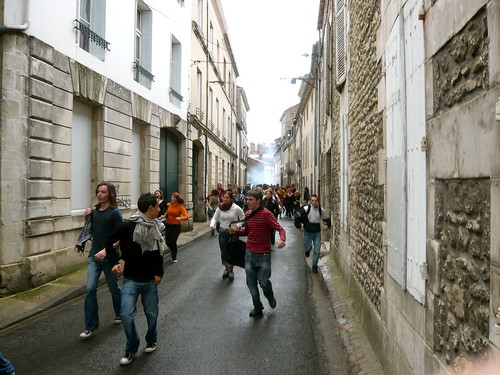
Washington Post | Under a bright autumn sun, the narrow lanes of ancient Poitiers teemed with families enjoying a lighthearted celebration of street theater. Suddenly, a knot of black-clad youths emerged from the crowd. They donned plastic masks, pulled up their hoods and started destroying everything in sight.

In what police described as an organized attack, the band shattered store windows, damaged the facades of several banks and spray-painted anarchist slogans on government buildings. Aiming even at the historical heritage of this comfortable provincial town 200 miles southwest of Paris, they fractured a plaque commemorating Joan of Arc's interrogation here in 1429 and -- in Latin -- scrawled "Everything belongs to everybody" on a stone baptistery that is one of the oldest monuments in Christendom.

The wanton destruction, which lasted for about 90 minutes early Saturday evening, was a dramatic reminder that France and other European nations, below their surface of stability and wealth, harbor tiny bands of ultra-leftist activists who still want to combat the market economies and parliamentary democracies on which the continent's well-being is founded.

"We will destroy your morbid world," one of the Poitiers protesters sprayed-painted on a wall near the city's landmark Notre Dame Cathedral.

Wednesday, October 14, 2009

not blind to emotion


Nature | Two patients, partially blind because of damage to one side of their brain, were able to sense, and respond to, emotions expressed by people in pictures presented to their blind sides.

A study by an international team of researchers found that the patients unconsciously twitched a facial muscle uniquely involved in smiling when a picture showed a happy person, and a muscle involved in frowning when the person depicted looked fearful1.

The patients, both from the United Kingdom, have the very rare condition known as partial cortical blindness. Their eyes are intact but they have damage to the visual cortex on one side of their brain. This means that they cannot process information from the visual field on the opposite side of their nose.

The scientists, who were led by Marco Tamietto and Beatrice de Gelder at Tilburg University in the Netherlands, say the results show that our spontaneous tendency to synchronize our facial expressions with those of other people in face-to-face situations - known as emotional contagion - occurs even if we cannot consciously see them.

"This is interesting evidence that we can recognize the emotions of others without needing to be visually aware of them," says neuroscientist Christian Keysers, an expert in the neurophysiology of emotion at the University of Groningen, the Netherlands, who was not involved in the study.

Mixed picture?
Much of the visual input from the retina goes directly to the visual cortex, which processes the information so that we consciously perceive the image we are looking at. But a small part goes directly to the midbrain, through an evolutionarily primitive subcortical pathway that processes emotion and other information central to survival - and that is intact in the two patients.

So it seems that emotional contagion can be implemented via evolutionarily ancient neural structures, says Tamietto, and does not necessarily require the involvement of higher brain regions, visual awareness or the mirror neurons that are active when we recognize the physical actions of others.

But Keysers cautions that it remains to be determined whether the subcortical and higher cortical pathways for recognizing emotions operate in parallel. Emotion recognition could use several types of available information, he says.

rags to riches in fairytales

Observer | In fairytales, as in dreams, things both are and are not what they seem to be. After Freud first lifted the curtain to reveal the unconscious mind seething and roiling with hidden desires and fears, and showed how dreams and stories were full of symbols that told quite a different tale from the one on the surface, we've become used to reading both literature and life in a double way; it feels quite natural now to look for – and find – sexual meanings, for example, in the most apparently non-sexual places. It was Bruno Bettelheim who blew the gaff as far as fairytales were concerned: his The Uses of Enchantment (1976) offered a reading of such innocent favourites as Hansel and Gretel, Little Red Riding Hood, and Cinderella that was Freudian enough to make your hair stand on end.

Bettelheim's a little discredited these days, and Freud's influence has retreated to the point where his great insight is no longer a climate of opinion, as Auden put it, but simply one theory among many. However, I'm still persuaded by the notion that it can be both interesting and enlightening to read as if X is not only X but also Y. Sometimes a cigar is only a cigar, but sometimes a frog can be a prince, and sometimes treasure can mean something other than wealth.

In the case of the Cinderella range of stories (one of the largest of all) the wealth she attains at the end is part of a larger acquisition, which is more fully symbolised by her wedding. Specifically, it's nubility: in the course of the story she leaves childhood behind, and becomes ready for marriage and the responsibilities of adulthood.

But not every growing-up story is a Cinderella tale. I once heard an American academic spend a whole lecture trying to show that Jane Eyre was a Cinderella story. She failed, because it isn't: Jane Eyre is a Beauty and the Beast story, in which the physically powerful, sexually potent, threateningly mature adult male, Mr Rochester, is gradually subdued and tamed (not to say shamed and maimed) by the small, weak, delicate, but implacable Jane, who does it all by herself.

And that's the reason it's not a Cinderella story. Cinderella, in every one of the hundreds of variations on the basic story, is not alone: she has a helper. A surrogate mother, in fact: the fairy godmother, a rose tree that grows from her mother's grave, a dove, a cow, the mossy coat in the version here – always, in principle, an older female who has herself safely negotiated the perils of the journey towards maturity and whose task is to help the girl make the same passage.

Bettelheim's point is that fairytales such as this symbolise genuine aspects of our psychological life – moments of transition from innocence to knowledge, and so on – and that they are invaluable aids to a contented and healthy growth. Children need such tales as much as they need food, warmth, shelter and love. I think I agree with that. But whether or not they're psychologically necessary, the greatest tales (and Cinderella is one of the greatest of all) derive their lasting power not only from the multitude of fascinating and unforgettable details that abound in them but from the emotionally satisfying shape they take up. In the Grimms' collection, for example, tale after tale begins enthrallingly and then collapses half way through: rather like most films, most novels, most plays, in fact. The hardest thing with a story of any kind is to bring it to a conclusion that works every time you read it. The best of the Grimm tales do that, and the ones that work best of all are clearly the work of some ancient and anonymous teller of genius, whose power of shape-creation has resisted generations of hamfisted clumsiness and mishandling. Pullman's retelling of the fairy tale of Mossycoat.

the ruins of detroit

Tuesday, October 13, 2009

economics uses the same circuits as religion

PhysOrg | Researchers have found that the process of believing or disbelieving a statement, whether religious or not, seems to be governed by the same areas in the brain.

When it comes to religion, believers and nonbelievers appear to think very differently. But at the level of the brain, is believing in God different from believing that the sun is a star or that 4 is an even number?

While religious faith remains one of the most significant features of human life, little is known about its relationship to ordinary belief. Nor is it known whether religious believers differ from nonbelievers in how they evaluate statements of fact.

In the first neuroimaging study to systematically compare religious faith with ordinary cognition, UCLA and University of Southern California researchers have found that while the human brain responds very differently to religious and nonreligious propositions, the process of believing or disbelieving a statement, whether religious or not, seems to be governed by the same areas in the brain.

The study also found that devout Christians and nonbelievers use the same brain regions to judge the truth of religious and nonreligious propositions. The results, the study authors say, represent a critical advance in the psychology of religion. The paper appears Sept. 30 in the journal PLoS ONE.

relentless promotion of positive thinking has undermined america

AlterNet | The author talks about how a plague of positive thinking is permeating our society, from medicine to business, and is even contributing to our financial crisis. When Barbara Ehrenreich went to be treated for breast cancer, she was exhorted to think positively; and when she expressed feelings of fear and anger, she was chided for being negative.

Ehrenreich, the author of 16 books, including Nickel and Dimed and Bait and Switch, which examine the blue- and white-collar job markets, took on what she sees as an epidemic of positive thinking in her new book: Bright-Sided: How the Relentless Promotion of Positive Thinking Has Undermined America.

Positive thinking is different, she says, from being cheerful or good-natured -- it's believing that the world is shaped by our wants and desires and that by focusing on the good, the bad ceases to exist.

Ehrenreich believes this has permeated our culture and that the refusal to acknowledge that bad things could happen is in some way responsible for the current financial crisis.

In her new book, Ehrenreich examines how the positive-thinking movement was started by Mary Baker Eddy, the founder of Christian Science, and an amateur metaphysician named Phineas Parkhurst Quimby in response to Calvinism; how being positive became mandatory in corporate culture; and how she thinks prosperity preachers, such as Joel Osteen of Lakewood Church in Houston encouraged a culture of debt by telling their congregations that God wants them to have a big house and a nice car.

Monday, October 12, 2009

top judge calls california government dysfunctional

NYTimes | In a rare public rebuke of state government and policies delivered by a sitting judge, the chief justice of the California Supreme Court scathingly criticized the state’s reliance on the referendum process, arguing that it has “rendered our state government dysfunctional.”

In a speech Saturday before the American Academy of Arts and Sciences in Cambridge, Mass., the chief justice, Ronald M. George, denounced the widespread use of the referendum process to change state laws and constitutions. And he derided California as out of control, with voters deciding on everything from how parts of the state budget are spent to how farm animals are managed.

The state is unusual, he said, because it prohibits its Legislature from amending or repealing many types of laws without voter approval, essentially hamstringing that body — and the executive branch.

Justice George’s remarks come at a time of severe budget crisis in California stemming from a variety of factors, including mandates from ballot initiatives. Several groups on the left and the right are clamoring for changes to the state’s Constitution, including reining in of the direct democracy that has defined much of how the state operates.

This week, hundreds of people will convene in Sacramento for a conference on constitutional reform. A spokesman for Gov. Arnold Schwarzenegger declined to comment on the justice’s speech.

Justice George said that perhaps the “most consequential” impact of the referendum process is that it limits “how elected officials may raise and spend revenue.” He added, “California’s lawmakers, and the state itself, have been placed in a fiscal straitjacket by a steep two-thirds-vote requirement — imposed at the ballot box — for raising taxes.”

He added: “Much of this constitutional and statutory structure has been brought about not by legislative fact-gathering and deliberation, but rather by the approval of voter initiative measures, often funded by special interests. These interests are allowed under the law to pay a bounty to signature-gatherers for each signer. Frequent amendments — coupled with the implicit threat of more in the future — have rendered our state government dysfunctional, at least in times of severe economic decline.”

simon johnson and rep. marcy kaptur


PBS | One year after the near-collapse of the U.S. financial system, the crisis seems to be over for the banks. No one expects any of the remaining huge banks to collapse, and a few large firms — JPMorgan Chase & Co., Goldman Sachs Group and Wells Fargo — are expected to post another quarter of billion dollar profits.

But according to guests on BILL MOYERS JOURNAL, ordinary Americans have little reason to celebrate the better fortunes on Wall Street. Simon Johnson, professor of Global Economics and Management at MIT's Sloan School of Management, and Representative Marcy Kaptur (D-OH), explain to Bill Moyers that the outlook for the rest of America isn't so rosy. Not only are many Americans still suffering the collapse of the housing market, they say, but Congress and the president haven't made the changes needed to prevent a much worse catastrophe sometime in the future.

To highlight the disparity between bailing out the banks and helping homeowners, Rep. Kaptur points to her district, where she sees one of the now-profitable banks not doing enough to help struggling borrowers:
Let me give you a reality from ground zero in Toledo, Ohio. Our foreclosures have gone up 94 percent. A few months ago, I met with our realtors. And I said, "What should I know?" They said, "Well, first of all, you should know the worst companies that are doing this to us." "Well, give me the top one." They said, "JPMorgan Chase."
Johnson adds that even bailed-out banks have little incentive to help homeowners:
I'm afraid that it's pretty obvious, and it's very tragic, that they have no interest in helping the homeowners. They make money with what they're doing. They expected a lot of these mortgages they made to default, okay? It was in their models. A high default rate. Now, they didn't expect house prices to come down so much. That's where they got their losses. But they absolutely made these loans expecting they would have to foreclose on people. And figuring they would make money on that.
Too late to reign in the banks?
The problem, Rep. Kaptur and Johnson agree, is that Congress and the Executive Branch didn't sufficiently reign in the banks because the banks have too much power in Washington. Responding to a recent ASSOCIATED PRESS report about Treasury Secretary Timothy Geithner's close ties to a few powerful bankers, Rep. Kaptur said, "Wall Street and Washington is a circuit. And because Mr. Geithner headed the New York Fed, that historic relationship, unfortunately, continues. And it gives them special access and special power to influence policy."

Johnson agrees, arguing that these links are especially beneficial in a time of crisis: "And in a crisis, when everything is up for grabs, you don't know what's going on, the people who will take your phone calls, right, in government and the people who are going to be standing in the oval office, making the key decisions — that's the heart of the system. That's the heart of how you get your agenda through, by changing their worldview."

Chipocalypse Now - I Love The Smell Of Deportations In The Morning

sky |   Donald Trump has signalled his intention to send troops to Chicago to ramp up the deportation of illegal immigrants - by posting a...