Monday, October 12, 2009

gas extraction method could greatly increase global supplies


NYTimes | A new technique that tapped previously inaccessible supplies of natural gas in the United States is spreading to the rest of the world, raising hopes of a huge expansion in global reserves of the cleanest fossil fuel.

Italian and Norwegian oil engineers and geologists have arrived in Texas, Oklahoma and Pennsylvania to learn how to extract gas from layers of a black rock called shale. Companies are leasing huge tracts of land across Europe for exploration. And oil executives are gathering rocks and scrutinizing Asian and North African geological maps in search of other fields.

The global drilling rush is still in its early stages. But energy analysts are already predicting that shale could reduce Europe’s dependence on Russian natural gas. They said they believed that gas reserves in many countries could increase over the next two decades, comparable with the 40 percent increase in the United States in recent years.

“It’s a breakout play that is going to identify gigantic resources around the world,” said Amy Myers Jaffe, an energy expert at Rice University. “That will change the geopolitics of natural gas.”

More extensive use of natural gas could aid in reducing global warming, because gas produces fewer emissions of greenhouse gases than either oil or coal. China and India, which have growing economies that rely heavily on coal for electricity, appear to have large potential for production of shale gas. Larger gas reserves would encourage developing countries to convert more of their transportation fleets to use natural gas rather than gasoline.

Shale is a sedimentary rock rich in organic material that is found in many parts of the world. It was of little use as a source of gas until about a decade ago, when American companies developed new techniques to fracture the rock and drill horizontally.

Because so little drilling has been done in shale fields outside of the United States and Canada, gas analysts have made a wide array of estimates for how much shale gas could be tapped globally. Even the most conservative estimates are enormous, projecting at least a 20 percent increase in the world’s known reserves of natural gas.

Sunday, October 11, 2009

fatimate truth and deception

Al-Gharb-Al-Andalus | Fatima (as) besides the name of the daughter of the Prophet (saw) and the wife of the gate to the Prophet-Ali (as) is the name of a small Portuguese town close to Ourem and Tomar. Since early christian times (or even before) the area was recognized as "spiritually special", this fact being proven by the presence of the Templar Knigths in the area (Tomar) as well as other religious-military orders.

But it seems that these were not the first to recognize the spirituality of the Place. Centuries before the Fatimid Moors who were the main part of the algharb moors (shia-ismaili) recognized this energy in those places and therefore the name of the town. What to Shia Moors looked like Fatima probably to Christian Knights looked like Mother Mary. The possibilities and speculations about what phenomena appears or appeared in that area are inumerous, but probably no one like the Professor Moisés Espírito Santo studied the issue in such depth.

In his book "As aparições de Fátima e os mouros Fatimidas"(the Fatima Apparitions and Fatimid Moors) - Moisés establishes links that no one ever dared to pronounce or write.

The initial theme of Moise's book were the islamic minorities (shia and ismaili) that advanced through the mediterranean and the iberian peninsula during the middle ages. Along the way the author sarted to understand the existence of elements of shia gnosis (irfan) of the IX-XII centuries in the reports of the modern visions (1917) of Mother Mary of Fatima in Cova da Iria.

A strange crossroad. The author decided therefore to research those elements. Using historical documents, Ethnology, ethnolinguistics and theological elements, the author breaks down the Shia (Fatimid) theological concepts of the IX-XII centuries along with the visions of 1917 at Fatima.

The author discovers a common identity at a historical, toponimical and other levels. We are therefore facing an incredible enigma taking in account the little we know about these Mother Mary/Fatima apparitions.

translating the bible into hebrew

IsraelShamir | Though the schism between the Eastern and the Western churches is usually connected with the filioque controversy, the true bifurcation point between the Christian East and the Christian West is located in their choice of the primary text (aside from the New Testament). Westerners (Catholics and Protestants) use the Old Testament they translated from the Jewish MT; Easterners use the Greek text as the original. This is an extremely important difference. When St Paul said that the opposites are united in Christ, he mentioned man and woman, Jew and Hellene (Galatians 3:28). Indeed, the ideal Jew and Hellene are as opposed to each other as the ideal man and woman, and the Jewish and Hellenic texts are equally opposed to each other. Moreover, translations from either of these texts carry the imprint of the original spirit with them. The Hellenic spirit found its expression in the Septuagint, while the Judaic spirit was expressed in the Masoretic Hebrew text, the MT. Christianity as a whole treads a narrow path between its Judaic and Hellenic tendencies, which are locked in an eternal fight like the Yin and the Yang. Their choice of primary text for the Old Testament caused the Eastern churches to favour the Hellenic, and the Western the Judaic tendency.

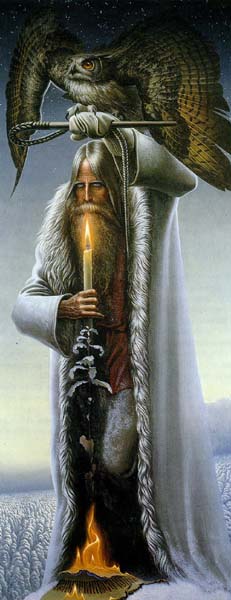
Before continuing, a full disclosure: until fairly recently, I was not aware of the problem, and like everybody else, I thought that the Old Testament in every language was a translation from the Hebrew MT original. A few months ago, I visited Moscow where I thoroughly enjoyed the fabulous hospitality of the Muscovites, who can turn every friendly meeting over a couple of vodkas into a Platonic symposium – a banquet of reason and a celebration of the soul. Once, my friend Michael, a Moscow University teacher, told me that a famous Starets wanted to receive me. “Starets,” the Russian equivalent of Greek gero-n, or “elder”, means, in Eastern Orthodoxy, a monastic spiritual leader – a charismatic spiritual guide who can aid others in attaining spiritual progress and success, as the Encyclopaedia Britannica tell us. The Starets is well known in Moscow as a confessor and heart-reader – a man who understands the human soul and its way to salvation. I was immensely touched and flattered by the invitation, for people normally wait months on end to see him and receive his blessing. Though I have met with princes of the Church – with bishops and cardinals, with the monks of Athos and Jerusalem – the elders are the hidden heart of the faith.

We drove out of Moscow to the monastery at four a.m. The road was empty, and there were only a few pilgrims in front of the monastery waiting for the heavy gates to open. This is neither the time nor the place to relate everything that happened at this meeting, but I’ll tell you the most important thing: the Starets told me of his desire to publish the Old Testament in Hebrew, corrected in accordance with the Queen Elizabeth Bible of the Russian Orthodox Church. At first, I was deeply shocked and confused. The Queen Elizabeth Bible (1751), or the QEB, is a translation, and a translation of the Greek translation into the Old Church Slavonic. Wasn’t this rather too daring a project, to correct the original according to a translation? Its scope would eclipse any post-modernist project!

Why will this bookish project influence the real world? Sacred matters influence our world far more than is acceptable to admit in polite society. The dummies believe that all things are done out of pecuniary considerations, but in truth, it is spiritual authority that decides. The world based on the Jewish Bible is not the same as would be a world based on the Greek Bible. Its priorities would be different. Even the texts themselves are different. The Hebrew text used today by Jews (and by tiny communities of Hebrew-speaking Christians), usually called MT (Masoretic text) is not the same text that was read by Christ and His apostles.

If you open the New Testament you’ll see that its references to the Old Testament do not fit. For instance, Matt. 12:21 quotes Isaiah: “in His name will the Gentiles trust”. But if you look up Isaiah 42:4, you’ll see something completely different: “the isles shall wait for his law”. Or (Acts 7:14) Stephen says "seventy-five" souls went down to Egypt with Jacob. But look up your Old Testament (Gen. 46:27; Deut. 10:22) – it says that only seventy people went to Egypt. This does not mean that the translators of King James, or any other translators of the Old Testament, made a mistake. They translated correctly, but from the wrong version, from the MT, while Jesus, His apostles and the New Testament writers in general had read and quoted the Septuagint (LXX) or its Hebrew Source (H70).

The transposition of the MT in place of the Septuagint (LXX) or its Hebrew Source (H70), making it the source for all subsequent Western translations, was the biggest coup the Jewish scholars ever pulled off, and this is the deep-lying cause of Judaisation of the West.

Saturday, October 10, 2009

fascism in america

Veterans Today | In recent days, there has been much confusion with terms like "Fascism" and "Socialism" being tossed around as one in the same, mostly in reference to President Obama and his war against the insurance monopoly in America. Years ago, Americans seemed to have gone into a state of confusion over poltical labels.

"Conservatives" wanted to borrow and cut taxes to the rich while creating massive goverrnment bureaucracies and "Liberals" are secret communists, wanting to tax the rich while making everyone move onto collective farms and grow turnips at gunpoint. Its almost as though an entire generation had lobotomized themselves.

A few things have to be made clear. Socialism is when workers own the means of production. If Karl Marx got a good look at Communist Russia, he would have been spinning in his grave. Marxs' "workers paradise" turned into a huge corporation run by Stalin that enslaved millions.

In the same way, Adam Smith in his Wealth of Nations, described capitalism as a totally free market, chaotic in many ways, but guided by an "invisible hand" where hard work and natural talent would build wealth and encourage a moral balance. Were he to see the current system of corruption, monopolies, government subsides and bail outs he too would be spinning like a top in his crypt.

Any competent political scientist will tell you that Fascism is everything bad about capitalism on steroids. Big business runs a Fascist state through a government with unlimited power to guarantee profits, enslave workers and even use military force for profit. The movie, Schindlers List does a good job of showing how this worked in Nazi Germany on a day to day basis.

In America today, we have political groups partnered in much the same way as in Germany in the 30s and 40s spending millions to convince folks without alot of formal education that the scary word "Fascist" describes someone working to stop monopolies from controlling government rather than supporting them. Maybe money can make up down and down up.

This is totally backwards. The folks spewing this curious and idiotic brew have a bit of histroy themselves and know Fascism better than anyone. Borrowed from the pages of The Nazi Hydra in America, the following snipit on our political history will help some of our confused friends gain a new perspective. Written by Glen Yeadon and John Hawkins and praised by noted historian Howard Zinn as a vital work, The Nazi Hydra in America is a must read for anyone wanting a clear understanding of how America got where it is today. Editors note: Read about how this book was suppressed.

ethologists weigh in on obama's nobel....,


Wired | When a warring termite colony loses its king and queen — the only members capable of reproduction — then its survivors merge with the victor colony, treating genetically unrelated former enemies as if they were siblings.

In the short term, this seems to make no sense. But in the long term, because replacement royalty is recruited from among worker bugs, it’s the losers’ best shot at eventually reproducing.

“You could go off and start your own colony, but that’s risky,” said Philip Johns, a Bard College evolutionary biologist. “This way, there’s a good chance a king or queen may die, and then you have a chance at taking over.”

The drama of termite succession, described Monday in the Proceedings of the National Academy of Sciences, is the latest addition to a long, rich history of research into insect altruism, which has fascinated and perplexed scientists since Darwin.

At its most extreme, insect altruism takes the form of eusociality, in which entire insect castes are unable to reproduce, and devote their lives to caring for other colony members. This is what makes giant insect colonies possible. But through a framework of classic evolutionary genetics, it doesn’t compute. Organisms are supposed to be driven to reproduce their genes.

The conundrum was solved for a while by Bill Hamilton, an evolutionary biologist who showed that eusociality could be explained by the relatedness of colony members. In some insect species, workers share more genes with their siblings than with their own hypothetical offspring.

But Hamilton’s position has become controversial, partly because of termites who aren’t so closely related to their siblings, but practice eusociality nonetheless. The cooperation described in the PNAS paper is especially striking: The colonies weren’t related to one another at all, yet came together like family. Fist tap Dale.

human variation revealed...,

The Scientist | Scientists have generated the most comprehensive map of the structural variation that exists among normal, healthy humans, according to a study published online today in Nature. Understanding normal variation between individuals is critical to identifying abnormal changes that may contribute to a wide variety of heritable diseases.

"I think it's considered to be a landmark paper," said geneticist Frank Speleman of the Center for Medical Genetics at Ghent University Hospital in Belgium, who was not involved in the work. "It's quite important in the complete context of genome wide association studies and genetic predisposition."

Using microarrays that contained more than 42 million probes, genome scientist Stephen Scherer of The Hospital for Sick Children in Toronto and the University of Toronto and his colleagues searched the genome of 40 healthy individuals for copy number variants (CNVs) -- areas of the genome that come in varying quantities as a result of deletions, insertions, or duplications. The researchers identified 11,700 CNVs 443 base pairs or greater in size, with an average of approximately 1,000 CNVs differing between any two individuals. "[That's] an important amount of normal variation that happens in the genome," Speleman said.

gov. muadib....,

LATimes | Gov. Arnold Schwarzenegger is threatening to kill hundreds of bills unless the Legislature delivers one bill on water. Is that heavy-handed? No question.

Is it bullying? Sure.

Hostage-taking? Political terrorism? Of course.

Misuse of power? Definitely not.

It is a proper use of power.

It's ugly. But it's an available political tool that the governor would be derelict not to use when an issue as critical as water is at stake.

This isn't about some narrow scheme important only to a narrow interest. Nor is it merely about a governor's pet project -- other than his legacy-building, which should be encouraged as long as it helps the state. It's about finally resolving an acute, decades-old problem that is worsening and affects practically all Californians.

The state water system is clogged and rusting. It's a matter of time before the California aqueduct, which funnels Sierra snow runoff from the Sacramento Valley into the San Joaquin Valley and Southern California, is shut off. The principal water tank, the Sacramento-San Joaquin River Delta, is threatened with potential levee collapses, earthquakes, floods and global warming. And the ecology already is crumbling.

The estuary's fishery is fast disappearing. The endangered delta smelt is a red herring -- a pet target of San Joaquin farmers and the governor who resent federal judges holding back water to save the tiny critter. The real economic tragedy is the decline of the once-abundant king salmon. Their plight has caused a two-year cancellation of commercial fishing for the popular fish, idling boats and shuttering processing plants all along the North Coast.

Nobody argues that the waterworks don't need major repairs and remodeling. But there is a delicate balance that Capitol negotiators have yet to find. It's the balance between investing in a reliable, environmentally friendly water supply and trying to achieve what really must be the state's No. 1 priority: living within its means.

Friday, October 09, 2009

the fall of the maya - they did it to themselves

Physorg | For 1200 years, the Maya dominated Central America. At their peak around 900 A.D., Maya cities teemed with more than 2,000 people per square mile -- comparable to modern Los Angeles County. Even in rural areas the Maya numbered 200 to 400 people per square mile. But suddenly, all was quiet. And the profound silence testified to one of the greatest demographic disasters in human prehistory -- the demise of the once vibrant Maya society.

What happened? Some NASA-funded researchers think they have a pretty good idea.

"They did it to themselves," says veteran archeologist Tom Sever.

"The Maya are often depicted as people who lived in complete harmony with their environment,' says PhD student Robert Griffin. "But like many other cultures before and after them, they ended up deforesting and destroying their landscape in efforts to eke out a living in hard times."

No single factor brings a civilization to its knees, but the deforestation that helped bring on drought could easily have exacerbated other problems such as civil unrest, war, starvation and disease.

Many of these insights are a result of space-based imaging, notes Sever. "By interpreting infrared satellite data, we've located hundreds of old and abandoned cities not previously known to exist. The Maya used lime plaster as foundations to build their great cities filled with ornate temples, observatories, and pyramids. Over hundreds of years, the lime seeped into the soil. As a result, the vegetation around the ruins looks distinctive in infrared to this day."

"Space technology is revolutionizing archeology," he concludes. "We're using it to learn about the plight of ancients in order to avoid a similar fate today."

why the peak oil debate is irrelevant

New Scientist | The debate over exactly when we will reach "peak oil" is irrelevant. No matter what new oil fields we discover, global oil production will start declining in 2030 at the very latest.

That's the conclusion of the most comprehensive report to date on global oil production, published on 7 October by the UK Energy Research Centre.

The report, which reviewed over 500 research studies, suggests that global oil production could peak any time from right now to as late as 2030.

"Either way, our research shows that the difference between even the most pessimistic and optimistic claims is just 15 to 20 years," says Steve Sorrell, the report's lead author, who is based at Sussex University in the UK.

This is a problem, says Sorrell, because 20 years isn't long enough for governments to prepare well-thought-out policies that would tackle the economic chaos likely to occur when oil production begins to decline. Research in 2005 by the US Department of Energy suggests that policies to reduce the demand for oil while developing large-scale alternatives will take at least two decades to bear fruit, he says.

saudis ask for aid if world cuts dependence on oil

Houston Chronicle | There are plenty of needy countries at the U.N. climate talks in Bangkok that make the case they need financial assistance to adapt to the impacts of global warming. Then there are the Saudis.

Saudi Arabia has led a quiet campaign during these and other negotiations — demanding behind closed doors that oil-producing nations get special financial assistance if a new climate pact calls for substantial reductions in the use of fossil fuels.

That campaign comes despite an International Energy Agency report released this week showing that OPEC revenues would still increase $23 trillion between 2008 and 2030 — a fourfold increase compared to the period from 1985 to 2007 — if countries agree to significantly slash emissions and thereby cut their use of oil. That is the limit most countries agree is needed to avoid the worst impacts of climate change.

The head of the Saudi delegation Mohammad S. Al Sabban dismissed the IEA figures as “biased” and said OPEC's own calculations showed that Saudi Arabia would lose $19 billion a year starting in 2012 under a new climate pact. The region would lose much more, he said.

“We are among the economically vulnerable countries,” Al Sabban told The Associated Press on the sidelines of the talks ahead of negotiations in Copenhagen in December for a treaty to replace the Kyoto Protocol, which expires in 2012.

“This is very serious for us,” he continued. “We are in the process of diversifying our economy but this will take a long time. We don't have too many resources.”

Saudi Arabia, which sits atop the world's largest proven oil reserves, is seeing economic growth slide because of fallout from the global meltdown, but experts still expect the country, flush with cash from oil's earlier price spike last year, to be better able than other nations to cope with the current crisis.

Thursday, October 08, 2009

america 2.0


Warsocialism | The “bad news” is that “peak oil” marks the beginning of the end of capitalism and market politics because many decades of declining “net energy”[1] will result in many decades of declining economic activity. And since capitalism can’t run backwards, a new method of distributing goods and services must be found. The “good news” is that our “market system” is fantastically inefficient!

In order to avoid anarchy, rebellion, civil war and global nuclear conflict, Americans must force a fundamental change in our political process. We can keep the same political structures and people, but must totally eliminate special interests from our political environment. A careful review of the progressive assault on laissez faire constitutionalism and neoclassical economics, from the 1880s through the 1930s, explains how this can be done legally and without violence. These early progressives showed how we can save our country. All that is lacking now is the political will. I call this adjustment of our political environment “America 2.0.”

To achieve America 2.0, we must first separate and isolate our political system from our economic system so that government can begin to actually address and solve societal problems rather than merely catering to corporate interests. The second step is to retire most working American citizens with an annuity sufficient for health and happiness, as government begins to eliminate the current enormous waste of vital resources by delivering goods and services directly. This would allow most adults to stay at home with their families but still receive the goods and services they need to enjoy life.

the demise of the dollar - continued....,

the failing u.s. government - the crisis of public management

Scientific American | The crisis of American governance goes much deeper than political divisions and ideology. The U.S. is in a crisis of policy implementation. Not only are Americans deeply divided on what to do about health care, budget deficits, financial markets, climate change and more, but government is also failing to execute settled policies effectively. Management systems linking government, business and civil society need urgent repair.

The recent systems failures are legion and notorious. The 9/11 attacks might well have been prevented if the FBI and the intelligence agencies had cooperated more effectively in early 2001 when they were receiving various signals of a possible terrorist attack. Hurricane Katrina caused mass devastation and loss of life because recommendations to bolster the levees shielding New Orleans and other protective measures were neglected for decades despite urgent expert warnings, and because the federal emergency relief effort failed completely after the storm. To this day, reconstruction efforts in New Orleans are paralyzed and many poor communities there have been abandoned. The U.S. occupation of Iraq was marked by massive and shocking corruption, incompetence, and implementation failures by U.S. agencies.

can boeing really build jets anymore?


Crikey | The ultimate Boeing 747, the 747-8, isn’t flying this year.

Barely a week after Boeing starting feeding nonsense into the ears of unquestioning reporters about how the 747-8 would exceed its specifications, it has announced it won’t fly until early next year, and has informed investors it will take a $US 1 billion hit because of problems with the project.

It is barely a month since the head of the 748 project, Mohammad “Mo” Yahyavi told reporters up to three of the initial freighter version of the jet could be flying by the end of this year, and that first flight was imminent.

He is either a fool or a liar. How can someone head a commercial jet program and not know the true situation when he opens his mouth?

The 748 looks every bit as shonky in its execution as the 787 Dreamliner project.

In its official statement to the markets, Boeing says ‘late maturity of engineering designs has caused greater than expected re-work and disruption in manufacturing.’

Please. Maturity? The 747 first flew in 1969. It has benefited from many enhancements down the years. It is a known quantity. The –8 freighter and passenger versions involve an adapted version of the new generation GE engines that will also, one day, fly on the 787 Dreamliner. The actual body of the 748 is stretched, making it the longest commercial jet even made.

The 748 has sold less than 100 jets, most of them in the freighter version, with Lufthansa the only carrier to order the airline version, originally for delivery next year, but not now expected until 2012.

Under the current management of the company Boeing has turned into a monstrous joke. Highlights of this dark comedy of spin and deception include deskilling the work force to the extent that it couldn’t even fit the right bolts into the right holes on the plastic fantastic 787, which wasn’t supposed to have so many bolts in the first place in its once seamless, super light weight carbon fibre laminated oven cooked shell.

Wednesday, October 07, 2009

capital gains

Senscot | Ask yourself this question: do you think most people can be trusted? Don’t dwell on it for too long – just offer a general sense. Would you say ‘yes’, or would you say ‘no, you can’t be too careful’? The chances are that, if you are from a professional background, relatively politically engaged and with a university degree – a typical RSA Fellow – you would answer ‘yes’. If so, you would be among a minority of Britons today.

This wasn’t always the case. In the late 1950s, about 60 percent of Britons said they thought most other people could be trusted. The figure had fallen to 43 percent by the early 1980s and to 29 percent by the mid- to late 1990s. This question helps measure what sociologists and political scientists call ‘social capital’. It gives a sense of the extent to which individuals and communities trust each other, reciprocate helpfully and are connected to other people.

Robert Putnam first brought this declining trend to wider public attention using US data in the mid-1990s and subsequently published his findings in Bowling Alone (2000). He found that Americans seemed to have become less engaged with one another from the late 1960s – as demonstrated by falling memberships in Parent-Teacher Associations, fewer family picnics, a decline in churchgoing, less political engagement and less social trust.

Yet Putnam – a friend and colleague with whom I have worked for more than a decade – got his initial account wrong in one important respect. The story he told so comprehensively using US data turned out not to be true for all countries. While a broadly similar decline occurred in the UK and some other Anglo-Saxon countries, as well as in France, subsequent analysis has shown that this was not the case in all countries. Evidence suggests that in the already high-trust Scandinavian nations, social trust has actually increased over the past two decades. The World Values Survey for 1981-2005 put it at 59 percent in Finland, 68 percent in Sweden and 74 percent in Norway.

Certain ‘traditional’ forms of social capital, such as church-going, Women’s Institutes, party membership and trade union memberships, have almost universally declined. But while in the US and the UK this seems to have been associated with a trend towards privatisation and disengagement, in other countries it was associated with the rise of ‘solidaristic individualism’, to use a phrase coined by Swedish sociologist Bo Rothstein.

In essence, we Anglo-Saxons have spent the past few decades using our growing personal wealth to escape from the inconvenience of other people. To use an everyday example, we buy several TVs so that even our own children don’t have to negotiate with each other about what to watch. We use our wealth to ensure that we can do what we want, when we want to. In contrast, our Scandinavian neighbours seem to have used their wealth to see more of one another – to go out with friends, to join more reading groups and so on.

It is not just a matter of idle curiosity that nations, regions and individuals have such different levels of social capital. National economic growth rates have been shown to be strongly affected by levels of social trust. Econometric models suggest that social trust has an effect on economic growth that is as significant as that of economic catch-up (the tendency of less developed countries to catch up economically with their more developed counterparts) and larger than that of human capital (levels of education and skills).

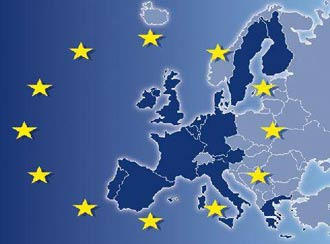
eu moves to unify science

The Scientist | Europe must invest more money and create better infrastructure to support science in order to remain globally competitive, said an independent panel of scientists advising the European Union in a report released today (October 6).

The group, called the European Research Area Board (ERAB), pointed out that Europe spends only 1% of its GDP on research, in comparison with 1.69% in the US and 2.62% in Japan. And although European researchers produce a third of all research papers world-wide, research published in the US is more highly cited. In today's report, the board proposed six strategies to unify and strengthen science in Europe -- from improving Justify Fullmobility of scientists to promoting scientific excellence over nationalism.

The ERA initiative was created in 2000 to provide a unified structure for science, but efforts to integrate research across nations soon stalled. Last year, the European Commission assembled 22 academic, non-profit, and industry scientists from different countries to advise the Commission on how to how to focus its efforts.

"Many of us have a very firm intention to realize [the recommendations] as fast as possible," Norbert Kroo, vice president of the Hungarian Academy of Sciences and a board member of the European Research Council, told The Scientist. He added, though, that the global economic crisis might slow the process.

Some of the ERAB's recommendations have already been promised by European leaders. Last month, upon being sworn in for his second term as president of the European Commission (EC), Jose Manuel Barroso said that he would promote the creation of a new position, a chief scientific officer of Europe, who would represent European science and advise the EC. The ERAB document, too, makes this suggestion; European science "should be represented by one single voice," said Kroo.

Broadly, the aim of the ERAB recommendations is to create "a more cohesive society from a research perspective," said John Wood, chair of the ERAB and a professor of engineering at Imperial College London -- to "use all the brains we've got." The report outlines 6 major themes to accomplish that goal: creating a unified research strategy; focusing research on societal needs such as sustainable energy and healthcare; increasing the interaction between science and policy, and between academia and industry; and promoting cohesion as well as excellence among European researchers.

gore vidal - united states of fury

The Independent | Gore Vidal is not only grieving for his own dead circle and his fading life, but for his country. At 83, he has lived through one third of the lifespan of the United States. If anyone incarnates the American century that has ended, it is him. He was America's greatest essayist, one of its best-selling novelists and the wit at every party. He holidayed with the Kennedys, cruised for men with Tennessee Williams, was urged to run for Congress by Eleanor Roosevelt, co-wrote some of the most iconic Hollywood films, damned US foreign policy from within, sued Truman Capote, got fellated by Jack Kerouac, watched his cousin Al Gore get elected President and still lose the White House, and – finally, bizarrely – befriended and championed the Oklahoma bomber, Timothy McVeigh.

Yet now, he says, it is clear the American experiment has been "a failure". It was all for nothing. Soon the country will be ranked "somewhere between Brazil and Argentina, where it belongs." The Empire will collapse militarily in Afghanistan; the nation will collapse internally when Obama is broken "by the madhouse" and the Chinese call in the country's debts. A ruined United States will then be "the Yellow Man's Burden", and "they'll have us running the coolie cars, or whatever it is they have in the way of transport".

A Scotch is fetched for him as he is wheeled into the corner of the bar. "I was like everyone else when Obama was elected – optimistic. Everything we had been saying about racial integration was vindicated," he says, "but he's incompetent. He will be defeated for re-election. It's a pity because he's the first intellectual president we've had in many years, but he can't hack it. He's not up to it. He's overwhelmed. And who wouldn't be? The United States is a madhouse. The country should be put away – and we're being told to go away. Nothing makes any sense." The President "wants to be liked by everybody, and he thought all he had to do was talk reason. But remember – the Republican Party is not a political party. It's a mindset, like Hitler Youth. It's full of hatred. You're not going to get them aboard. Don't even try. The only way to handle them is to terrify them. He's too delicate for that."

When he compares Obama to his old friend Jack Kennedy, he shakes his head. "He's twice the intellectual that Jack was, but Jack knew the great world. Remember he spent a long time in the navy, losing ships. This kid [Obama] has never heard a gun fired in anger. He's absolutely bowled over by generals, who tell him lies and he believes them. He hasn't done anything. If you were faced with great problems in chemistry – to find the perfect gas, to gas a population – you won't know for a long time whether it works. You have to go by what people tell you. He's like that. He's not ready for prime time and he's getting a lot of prime time on his plate at once."

Is there any hope? "Every sign I see is doom. But then people say" – he adopts a whiny, nasal voice – "'Oh Mr Vidal, you're so negative, can't you say something nice about America? It's a wonderful country, everybody wants to live here.' Oh yes? When was the last time you saw a Norwegian with a green card who wanted to come here because of the health service? I'll pay you if you can find one."

will california become america's first failed state?

Guardian | Los Angeles, 2009: California may be the eighth largest economy in the world, but its state government is issuing IOUs, unemployment is at its highest in 70 years, and teachers are on hunger strike. So what has gone so catastrophically wrong?

California has a special place in the American psyche. It is the Golden State: a playground of the rich and famous with perfect weather. It symbolises a lifestyle of sunshine, swimming pools and the Hollywood dream factory.

But the state that was once held up as the epitome of the boundless opportunities of America has collapsed. From its politics to its economy to its environment and way of life, California is like a patient on life support. At the start of summer the state government was so deeply in debt that it began to issue IOUs instead of wages. Its unemployment rate has soared to more than 12%, the highest figure in 70 years. Desperate to pay off a crippling budget deficit, California is slashing spending in education and healthcare, laying off vast numbers of workers and forcing others to take unpaid leave. In a state made up of sprawling suburbs the collapse of the housing bubble has impoverished millions and kicked tens of thousands of families out of their homes. Its political system is locked in paralysis and the two-term rule of former movie star Arnold Schwarzenegger is seen as a disaster – his approval ratings having sunk to levels that would make George W Bush blush. The crisis is so deep that Professor Kevin Starr, who has written an acclaimed history of the state, recently declared: "California is on the verge of becoming the first failed state in America."

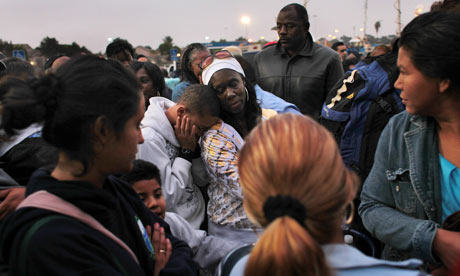
Outside the Forum in Inglewood, near downtown Los Angeles, California has already failed. The scene is reminiscent of the fallout from Hurricane Katrina, as crowds of impoverished citizens stand or lie aimlessly on the hot tarmac of the centre's car park. It is 10am, and most have already been here for hours. They have come for free healthcare: a travelling medical and dental clinic has set up shop in the Forum (which usually hosts rock concerts) and thousands of the poor, the uninsured and the down-on-their-luck have driven for miles to be here.

The queue began forming at 1am. By 4am, the 1,500 spaces were already full and people were being turned away. On the floor of the Forum, root-canal surgeries are taking place. People are ferried in on cushions, hauled out of decrepit cars. Sitting propped up against a lamp post, waiting for her number to be called, is Debbie Tuua, 33. It is her birthday, but she has taken a day off work to bring her elderly parents to the Forum, and they have driven through the night to get here. They wait in a car as the heat of the day begins to rise. "It is awful for them, but what choice do we have?" Tuua says. "I have no other way to get care to them."

office of the attending physician


Washington Monthly | From time to time, we're reminded of the fact that members of Congress -- many of whom are fighting to kill health care reform -- give themselves pretty good coverage. Several weeks ago, the LA Times reported on the taxpayer-subsidized insurance federal lawmakers currently enjoy.

The piece noted that, while most Americans have to go with whatever their employer offers, members have a choice of 10 plans that offer access to a national network of doctors. "Lawmakers also get special treatment at Washington's federal medical facilities and, for a few hundred dollars a month, access to their own pharmacy and doctors, nurses and medical technicians standing by in an office conveniently located between the House and Senate chambers," the article added.

ABC News explores this conveniently located facility in more detail today. It sounds like a pretty sweet deal for lawmakers.

Tuesday, October 06, 2009

the demise of the dollar

Independent | In a graphic illustration of the new world order, Arab states have launched secret moves with China, Russia and France to stop using the US currency for oil trading. In the most profound financial change in recent Middle East history, Gulf Arabs are planning – along with China, Russia, Japan and France – to end dollar dealings for oil, moving instead to a basket of currencies including the Japanese yen and Chinese yuan, the euro, gold and a new, unified currency planned for nations in the Gulf Co-operation Council, including Saudi Arabia, Abu Dhabi, Kuwait and Qatar.

Secret meetings have already been held by finance ministers and central bank governors in Russia, China, Japan and Brazil to work on the scheme, which will mean that oil will no longer be priced in dollars.

The plans, confirmed to The Independent by both Gulf Arab and Chinese banking sources in Hong Kong, may help to explain the sudden rise in gold prices, but it also augurs an extraordinary transition from dollar markets within nine years.

The Americans, who are aware the meetings have taken place – although they have not discovered the details – are sure to fight this international cabal which will include hitherto loyal allies Japan and the Gulf Arabs. Against the background to these currency meetings, Sun Bigan, China's former special envoy to the Middle East, has warned there is a risk of deepening divisions between China and the US over influence and oil in the Middle East. "Bilateral quarrels and clashes are unavoidable," he told the Asia and Africa Review. "We cannot lower vigilance against hostility in the Middle East over energy interests and security."

Chipocalypse Now - I Love The Smell Of Deportations In The Morning

sky |   Donald Trump has signalled his intention to send troops to Chicago to ramp up the deportation of illegal immigrants - by posting a...