Thursday, August 20, 2009

Is there any point in fighting to stave off industrial apocalypse?

Guardian | The collapse of civilisation will bring us a saner world, says Paul Kingsnorth. No, counters George Monbiot – we can't let billions perish.

The root cause of all these trends is the same: a rapacious human economy bringing the world swiftly to the brink of chaos. We know this; some of us even attempt to stop it happening. Yet all of these trends continue to get rapidly worse, and there is no sign of that changing soon. What these graphs make clear better than anything else is the cold reality: there is a serious crash on the way.

Yet very few of us are prepared to look honestly at the message this reality is screaming at us: that the civilisation we are a part of is hitting the buffers at full speed, and it is too late to stop it. Instead, most of us – and I include in this generalisation much of the mainstream environmental movement – are still wedded to a vision of the future as an upgraded version of the present. We still believe in "progress", as lazily defined by western liberalism. We still believe that we will be able to continue living more or less the same comfortable lives (albeit with more windfarms and better lightbulbs) if we can only embrace "sustainable development" rapidly enough; and that we can then extend it to the extra 3 billion people who will shortly join us on this already gasping planet.

I think this is simply denial. The writing is on the wall for industrial society, and no amount of ethical shopping or determined protesting is going to change that now. Take a civilisation built on the myth of human exceptionalism and a deeply embedded cultural attitude to "nature"; add a blind belief in technological and material progress; then fuel the whole thing with a power source that is discovered to be disastrously destructive only after we have used it to inflate our numbers and appetites beyond the point of no return. What do you get? We are starting to find out.

megacities

Physorg | Charles Kolb, Ph.D., reports that the concept of urban metabolism has existed for decades. It views large cities as living entities that consume energy, food, water, and other raw materials, and release wastes. The releases include carbon dioxide, the main greenhouse gas; air pollutants, sewage and other water pollutants; and even excess heat that collects in vast expanses of concrete pavement and stone buildings. Humans directly produce a significant share of this waste, but emissions from industrial, power generation and transportation systems respire the largest quantities of greenhouse gases and other air pollutants. Other urban metabolizers include sewage systems, landfills, domestic pets and pests like rats, which in some cities outnumber people.

During the last five years, this body of knowledge has drawn into sharper focus the hazards of poor air quality in megacities, not just on the large local populations but also on population centers, agricultural activities and natural ecosystems located downwind from these sprawling areas, Kolb said. He is with the Center for Atmospheric and Environmental Chemistry and the Center for Aerosol and Cloud Chemistry of Aerodyne Research Inc. in Billerica, Mass.

"Carbon dioxide and other pollutants in megacities make them immense drivers of climate change," he said. "They impact climate on both a regional and global level because these long-lived greenhouse gases are dispersed around the world."

More than half the world's population today lives in cities, and the world's largest urban areas are growing rapidly. The number of megacities — metropolitan areas with populations exceeding 10 million — has grown from just three in 1975 to about 20 today.

Kolb said that the most highly polluted megacities are in developing countries. They include Dhaka, Bangladesh; Cairo, Egypt; and Karachi, Pakistan. Some megacities in less developed regions have recently mounted air quality management campaigns that have resulted in lower levels of pollution; they include Mexico City, Mexico; Beijing, China; Sao Paulo, Brazil; and Buenos Aires, Argentina. Even the cleanest megacities like Tokyo/Osaka in Japan and New York City and Los Angeles in the United States — all in the developed world — still have serious problems, Kolb said.

Wednesday, August 19, 2009

what's really wrong with american healthcare?

The Atlantic | After the needless death of his father, the author, a business executive, began a personal exploration of a health-care industry that for years has delivered poor service and irregular quality at astonishingly high cost. It is a system, he argues, that is not worth preserving in anything like its current form. And the health-care reform now being contemplated will not fix it. Here’s a radical solution to an agonizing problem.

How does a nation that might close down a business for a single illness from a suspicious hamburger tolerate the carnage inflicted by our hospitals? And not just those 100,000 deaths. In April, a Wall Street Journal story suggested that blood clots following surgery or illness, the leading cause of preventable hospital deaths in the U.S., may kill nearly 200,000 patients per year. How did Americans learn to accept hundreds of thousands of deaths from minor medical mistakes as an inevitability?

My survivor’s grief has taken the form of an obsession with our health-care system. For more than a year, I’ve been reading as much as I can get my hands on, talking to doctors and patients, and asking a lot of questions.

Keeping Dad company in the hospital for five weeks had left me befuddled. How can a facility featuring state-of-the-art diagnostic equipment use less-sophisticated information technology than my local sushi bar? How can the ICU stress the importance of sterility when its trash is picked up once daily, and only after flowing onto the floor of a patient’s room? Considering the importance of a patient’s frame of mind to recovery, why are the rooms so cheerless and uncomfortable? In whose interest is the bizarre scheduling of hospital shifts, so that a five-week stay brings an endless string of new personnel assigned to a patient’s care? Why, in other words, has this technologically advanced hospital missed out on the revolution in quality control and customer service that has swept all other consumer-facing industries in the past two generations?

I’m a businessman, and in no sense a health-care expert. But the persistence of bad industry practices—from long lines at the doctor’s office to ever-rising prices to astonishing numbers of preventable deaths—seems beyond all normal logic, and must have an underlying cause. There needs to be a business reason why an industry, year in and year out, would be able to get away with poor customer service, unaffordable prices, and uneven results—a reason my father and so many others are unnecessarily killed.

Before exploring alternative policies, let’s reexamine our basic assumptions about health care—what it actually is, how it’s financed, its accountability to patients, and finally its relationship to the eternal laws of supply and demand. Everyone I know has at least one personal story about how screwed up our health-care system is; before spending (another) $1trillion or so on reform, we need a much clearer understanding of the causes of the problems we all experience.

supreme post crowley-gates symbolic hack...,


Fist tap P6 and Plantsmantx

Carefully orchestrated, but from a symbolic perspective, this strikes me as an exceptionally well crafted piece of libertarian agitprop. So I take back my initial "bookerrising surrealism" critique.

"We worked with the Phoenix police department. They came down to our studio on Friday. We've gone through this with them for 15 years."


"They have a squad - used to be called the confrontation prevention squad, now called community service. We told them that we're going to come down, I'm going to do the radio show live, we're going to be broadcasting it, and I'm going to have a firearm. I had a 9 millimeter on myself..."

"It was Thursday that I called and talked to Al Ramirez, the representative from the Phoenix police department, and we were discussing - we've been around this rhetoric that was building up around William Kostric, who did this in New Hampshire. We knew this from 15 years ago when Janet Napolitano was a U.S. Assistant Attorney and prosecuted the Viper Militia out of Arizona, and how that was generated into something it wasn't. We talked to Al and we were like, look, we know where this is going and we want to make sure, we come down, we're peaceful, and we demonstrate the right of the people to carry their firearms. And the police protected our right."

"They wanted to help - they assigned him [a police officer] to me. He was never more than 4-5 feet away from me. We had law enforcement around us to protect our rights to protect this firearm."

why the tea tastes like pee


Fist tap BTx3.

NHS drawn into u.s. healthcare reform debate

Pro:


Con:


Corporate Health Insurance is damning Obama's attempt to extend health care to the poor. As the process of demonizing the president's attempts grow, it has spawned an opportunistic attack on the British National Health Service (NHS), as well.

oil industry backs protests of emissions bill


NYTimes | Hard on the heels of the health care protests, another citizen movement seems to have sprung up, this one to oppose Washington’s attempts to tackle climate change. But behind the scenes, an industry with much at stake — Big Oil — is pulling the strings.

Hundreds of people packed a downtown theater here on Tuesday for a lunchtime rally that was as much a celebration of oil’s traditional role in the Texas way of life as it was a political protest against Washington’s energy policies, which many here fear will raise energy prices.

“Something we hold dear is in danger, and that’s our future,” said Bill Bailey, a rodeo announcer and local celebrity, who was the master of ceremonies at the hourlong rally.

The event on Tuesday was organized by a group called Energy Citizens, which is backed by the American Petroleum Institute, the oil industry’s main trade group. Many of the people attending the demonstration were employees of oil companies who work in Houston and were bused from their workplaces.

This was the first of a series of about 20 rallies planned for Southern and oil-producing states to organize resistance to proposed legislation that would set a limit on emissions of heat-trapping gases, requiring many companies to buy emission permits. Participants described the system as an energy tax that would undermine the economy of Houston, the nation’s energy capital.

Tuesday, August 18, 2009

when most powerful masquerade as grass roots...,

Washington Post | A petroleum industry trade group is asking oil companies to recruit employees and retirees to attend rallies attacking climate-change legislation, an approach to grass-roots politics that resembles strategies used recently by some opponents of health-care reform.

In a memo this month, American Petroleum Institute President Jack Gerard detailed plans for "Energy Citizen" rallies to be held in 20 states during the final two weeks of Congress's August recess. Gerard wrote that the intent was to put a "human face on the impacts of unsound energy policy," including a climate-change bill passed by the House in June.

"Please indicate to your company leadership your strong support for employee participation in the rallies," Gerard wrote in the memo, saying that contractors and suppliers should also be recruited.

Environmental groups on Saturday criticized the rallies, which they described as manufactured events intended to pass as organic assemblies of concerned citizens. Greenpeace activists said they saw parallels to the health-care debate, where opponents of reform -- including some organizations that receive heavy funding from industry groups and individuals -- have organized efforts to shout down lawmakers at "town hall" meetings.

"It's the most powerful among us, masquerading as grass-roots outrage to stifle debate on global warming," Michael Crocker, a spokesman for Greenpeace, said of the oil group's plans. "These are manufactured concerns, and the people who get involved in this are paid to put on this theater."

The memo, obtained by Greenpeace, was first reported on by the Financial Times Saturday.

cap and rage...,


Washington Post | The fight over health-care reform could hobble climate-change legislation. The rancorous debate over health reform has given voice to considerable uneasiness among Americans. Many are worried about how a new system will be paid for in an economy that has unraveled, and they are anxious about a kudzu-like expansion of an already unwieldy bureaucracy. Given the herculean effort it will take to get President Obama's vision of reform through Congress, we're not convinced that the Senate will have the stomach to tackle cap-and-trade legislation this fall. The growing agitation within the chamber over the creation of another complex system to buy, sell and trade pollution credits only adds to our doubts.

If Congress fails to pass cap-and-trade legislation, it will rapidly approach a fork in the road in addressing global warming. Members can sit back while unelected bureaucrats at the Environmental Protection Agency follow through on their moves toward regulating greenhouse gas emissions as a pollutant under the Clean Air Act. Or they can entertain a carbon-based tax designed to reduce emissions and give the money back to taxpayers in an equitable manner. A decision on which path to take is bearing down upon us. Not only are the global warming dangers facing the planet reaching the tipping point, but there will also be no climate agreement in Copenhagen without strong leadership in words and deeds from the United States. As the Senate forges ahead, nothing should be off the table.

the more things change.....,

Fist tap Denmark Vesey.

corporations co-opt craziness...,

Washington Post | Before the "black helicopters" of the 1990s, there were right-wingers claiming access to secret documents from the 1920s proving that the entire concept of a "civil rights movement" had been hatched in the Soviet Union; when the landmark 1964 Civil Rights Act was introduced, one frequently read in the South that it would "enslave" whites. And back before there were Bolsheviks to blame, paranoids didn't lack for subversives -- anti-Catholic conspiracy theorists even had their own powerful political party in the 1840s and '50s.

The instigation is always the familiar litany: expansion of the commonweal to empower new communities, accommodation to internationalism, the heightened influence of cosmopolitans and the persecution complex of conservatives who can't stand losing an argument. My personal favorite? The federal government expanded mental health services in the Kennedy era, and one bill provided for a new facility in Alaska. One of the most widely listened-to right-wing radio programs in the country, hosted by a former FBI agent, had millions of Americans believing it was being built to intern political dissidents, just like in the Soviet Union.

So, crazier then, or crazier now? Actually, the similarities across decades are uncanny. When Adlai Stevenson spoke at a 1963 United Nations Day observance in Dallas, the Indignation forces thronged the hall, sweating and furious, shrieking down the speaker for the television cameras. Then, when Stevenson was walked to his limousine, a grimacing and wild-eyed lady thwacked him with a picket sign. Stevenson was baffled. "What's the matter, madam?" he asked. "What can I do for you?" The woman responded with self-righteous fury: "Well, if you don't know I can't help you."

The various elements -- the liberal earnestly confused when rational dialogue won't hold sway; the anti-liberal rage at a world self-evidently out of joint; and, most of all, their mutual incomprehension -- sound as fresh as yesterday's news. (Internment camps for conservatives? That's the latest theory of tea party favorite Michael Savage.)
---------------------------------------------------
Rick Perlstein will be online today at 11:00am ET to discuss this article. Outlook: In America, Crazy Is a Pre-existing Condition
' ... the crazy tree blooms in every moment of liberal ascendancy ...'

forgery...,

American Prospect | Before the big House vote on the American Clean Energy and Security Act (ACES), Rep. Tom Perriello had a tough choice to make. Perriello won his seat by a small margin and worried about attacks from Republicans campaigning against the bill. Ultimately, he voted for it, in part because he believes a sustainable energy industry is the future of his district's economy.

But even as he was considering how to approach the legislation, he received at least five letters from local constituency groups opposing the bill, including a local Hispanic advocacy organization and the area branch of the NAACP. There was just one one small problem: The letters were forgeries; at least one came from Washington, D.C.-based lobbyists Bonner & Associates.

“They stole our name. They stole our logo. They created a position title and made up the name of someone to fill it. They forged a letter and sent it to our congressman without our authorization,” said Tim Freilich, who sits on the executive committee of Creciendo Juntos, a nonprofit network that tackles issues related to Charlottesville’s Hispanic community. “It’s this type of activity that undermines Americans’ faith in democracy.”

For all the reprehensible shenanigans that lobbying firms involve themselves in, forging letters from civil-rights groups to oppose this legislation is still pretty outrageous -- in fact, the NAACP even supports the legislation. Members of Congress are already very skeptical of constituent communications in this day of Internet-organized communications blitzes; the possibility that they may take these messages even less seriously due to fraud is a very disheartening one. Hopefully the reporting on this story will spur an investigation by legal authorities and some serious punishment for the perpetrators.

surreal bookerrising moment...,

Monday, August 17, 2009

game over - payer profits prevail

Washington Post | The president has said that creating a nonprofit, government-sponsored insurance plan -- competing alongside private insurers -- would provide a lower-cost alternative for consumers and keep the industry "honest." In Colorado on Saturday, the tone was more conciliatory.

"The public option, whether we have it or we don't have it, is not the entirety of health-care reform," Obama said. "This is just one sliver of it."

The proposal has become a lightning rod, particularly in the Senate, where Finance Committee members are seeking bipartisan consensus.

"The fact of the matter is there are not the votes in the United States Senate for the public option," said Conrad, one of six panel members involved in the talks. "There never have been. So to continue to chase that rabbit, I think, is just a wasted effort."

Sen. Orrin G. Hatch (R-Utah) said Democrats are moving toward a European-style, single-payer system. "And this public plan, this public government plan, don't think for a minute that that will not destroy the current insurance system," he said on ABC's "This Week."

Sebelius and other administration aides have said Obama is open to a nonprofit cooperative model as an alternative to the public option and the existing private plans. Finance Committee members have been studying utility co-ops as a possible model.

Liberal leaders reacted strongly to the idea that Obama would walk away from what they consider a central element of reform.

"I don't think this bill is worth passing without a public option," said Howard Dean, head of the grass-roots group Democracy for America.

mining the technosphere

Mining the Technosphere: a Solution for the Industrial Ecosystem? from Rembrandt Koppelaar on Vimeo.

world cement production

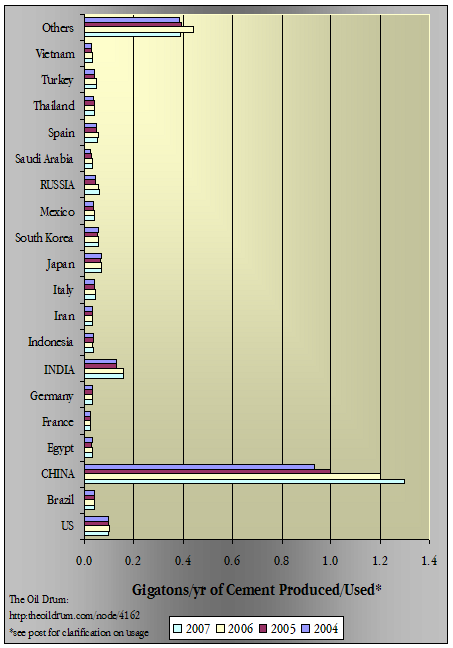
The Oil Drum | Cement is mainly used to make concrete, and is sort of the "active ingredient" in concrete - it is combined with sand and gravel in roughly fixed proportions. So cement production can be considered a rough proxy for the total amount of construction going on in a country.

The growth in China, from 1 GT to 1.3 GT in two years is mindboggling, even India and Russia are interesting...and there's more to think about under the fold. China's 2007 cement exports were only 33 million tons out of 1.3 billion tons produced. So, at least for China, production is a good proxy for demand/consumption.

Also interesting is the percentage of the world's production of cement that China took up in 2007 (50%) compared to 2004 (42.5%); some of this can no doubt be due to preparation for the Olympics, but that surely cannot not be all of that growth can it? Also note that other countries (perhaps the "developing world?") seems to be using less of the total proportion of cement used.

Some things we learned from the comment thread from Stuart's post a couple of years ago:

Remember, in China, oil isn't used in cement production. In the "clinker" stage, it's all coal. In the blending stage it's electricity (which is generated 80% from coal in China).

And cement production in China is inefficient. There are hundreds of small plants, both wet and dry processes, and the local environmental impact is severe.

Making a pound of cement releases a pound of CO2. And a Gigaton or two?

This also isn't a new phenomenon. This link shows data back to 1999 that illustrated that China has been at this for quite a while, but perhaps not to this extent.

To conclude, here is the percent change of production bar graph from 2005 to 2008. Think about what all that means in terms of energy. Also note the numbers from India, Russia, and the US.

Sunday, August 16, 2009

copeland "revival" - harvesting reality casualties

NYTimes | Onstage before thousands of believers weighed down by debt and economic insecurity, Kenneth and Gloria Copeland and their all-star lineup of “prosperity gospel” preachers delighted the crowd with anecdotes about the luxurious lives they had attained by following the Word of God.

Private airplanes and boats. A motorcycle sent by an anonymous supporter. Vacations in Hawaii and cruises in Alaska. Designer handbags. A ring of emeralds and diamonds.

“God knows where the money is, and he knows how to get the money to you,” preached Mrs. Copeland, dressed in a crisp pants ensemble like those worn by C.E.O.’s.

Even in an economic downturn, preachers in the “prosperity gospel” movement are drawing sizable, adoring audiences. Their message — that if you have sufficient faith in God and the Bible and donate generously, God will multiply your offerings a hundredfold — is reassuring to many in hard times.

The preachers barely acknowledged the recession, though they did say it was no excuse to curtail giving. “Fear will make you stingy,” Mr. Copeland said.

But the offering buckets came up emptier than in some previous years, said those who have attended before.

gop seeks its revival in healthcare revolt

LATimes | Conservatives are calling it their August Revolt -- a surprising upsurge of activism against President Obama's proposed healthcare overhaul.

Spurred on by the success of their efforts to dominate the news at Democratic town hall meetings, conservative groups are reporting increases in membership lists and are joining forces to plan at least one mass demonstration in Washington next month.

But the conservative mobilization has also created an unusual dilemma for Republican leaders, who want to turn the enthusiasm into election victories next year but find themselves the target of ire from many of the same activists.

Sen. John Cornyn (R-Texas), chairman of the GOP's Senate campaign committee, was booed at a "tea party" rally in July for supporting the government bailout of the financial services industry.

And one of the GOP's most reliable conservatives, Rep. Bob Inglis of South Carolina, was shouted down at a recent town hall meeting when he criticized a conservative broadcaster and tried to counter claims that children would soon be forced to receive swine flu vaccinations.

"You cannot build a movement on something that is not credible," said a frustrated Inglis, referring to the vaccine issue and other false rumors being spread by more aggressive critics of the health bill.

obamagenics

foxes out of the chicken coop

Washington Post | The Department of Health and Human Services is almost certain to take on responsibility for creating the criteria used to decide what health records technologies qualify for billions of dollars in reimbursements to medical offices under a new stimulus program, officials said Friday.

The decision represents a significant restriction of the role played by a private certification group, begun several years ago by the technology industry, which until recently had served as the government's gatekeeper for endorsing systems designed to improve the sharing of medical records.

The Certification Commission for Healthcare Information Technology, or CCHIT, came under sharp criticism in May after a Washington Post story showed that it has close ties to a trade group whose members stand to receive billions as a result of the stimulus legislation.

The trade group, called the Healthcare Information and Management Systems Society, was a key force behind the Obama administration's decision to include $36.5 billion in the stimulus package for development of electronic health records networks.

Under the stimulus legislation, doctors and medical organizations can be reimbursed for buying equipment that is certified as meeting certain mandates, including that the gear provides "meaningful use" to improve information sharing.

The nonprofit certification commission was started in 2004 with support from the trade association and two other industry groups. In recent years, it has received funding through HHS, but it is run by a former executive of the trade association and one of its current trustees also is president of the association. Several board members work for technology companies.

Critics of the certification group have complained that apparent conflicts of interest would undermine the group's credibility in judging deciding what technology merited stimulus funding.

"There was an apparent conflict. . . . We don't want to spend the next several years on a sideshow," said Paul Egerman, co-chairman of the advisory group that recommended that the HHS, instead of the private group, should set the criteria.

"Our energies need to be focused on the substantial challenges involved in getting physicians to use these systems effectively while, simultaneously, earning the public's trust in the privacy and integrity of these systems."

The recommendations of Egerman and several others were endorsed by a government health information technology advisory board Friday. That development virtually ensures the recommendations will be formally embraced, after a public comment period, by the National Coordinator for Health Information Technology at the HHS.

Chipocalypse Now - I Love The Smell Of Deportations In The Morning

sky |   Donald Trump has signalled his intention to send troops to Chicago to ramp up the deportation of illegal immigrants - by posting a...