Saturday, July 18, 2009
Global Banking Economist Warned of Coming Crisis
By
CNu
at
July 18, 2009
0
comments
Labels: elite , establishment , hegemony
interview: fusion in a cold climate
New Scientist | For most researchers, any mention of cold fusion brings back memories of a shameful period in modern science. Now, 20 years after Martin Fleischmann instigated this field, he tells Jon Cartwright that he could not have done anything differently, and that if we cannot get fusion of some sort to work on a large scale soon, we're doomedMARTIN FLEISCHMANN can still remember the morning he entered his lab and saw the terrific hole in the workbench. It was about the size of a dinner plate. Beneath, nestled in a shallow crater in the concrete floor, were the remains of a chemistry experiment that had been fizzing idly for several months without incident. "It had obliterated itself!" he recalls.
It happened overnight, so no one witnessed the meltdown that took place in a basement lab at the University of Utah, Salt Lake City, in 1985. But for Fleischmann and his longtime colleague Stanley Pons, there could be only one cause: room-temperature or "cold" fusion. If they were right, the chemists had made a reaction that nuclear physicists had thought next to impossible, one that potentially held the key to almost limitless clean energy. Yet four years later, and just weeks after they had announced their discovery at a now infamous press conference on 23 March 1989, their work was dismissed from mainstream science. Cold fusion became a pariah field, and Fleischmann and Pons fell under the shadow of disrepute.
At his home near Salisbury, UK, 82-year-old Fleischmann looks too beaten to entertain suggestions that, after two decades, cold fusion might actually be gaining acceptance. He has Parkinson's disease, and although he still speaks in his usual measured phrases and Czech accent, he is slow and often loses his train of thought. "All my activities are devoted to giving up," he laughs, glancing at his coffee cup performing another involuntary rattle on its saucer.
Even so, he regrets not having resolved his past dealings with the mainstream science community, who he thinks behaved in a "very unscientific" manner. "When we wrote this up I said [to Pons] we had to write exactly what we had done and how we analysed the results, which is what we did," he says. "Is it wrong? Where's the mistake? And that has never been answered really."
By
CNu
at
July 18, 2009
0
comments
Labels: Possibilities
Friday, July 17, 2009
scenario 12-d
By
CNu
at
July 17, 2009
0
comments
Labels: high strangeness
unspeakable truths
Paul Ehrlich, Professor of Biological Sciences, Bing Professor of Population Studies and president of the Center for Conservation Biology at Stanford, is an internationally prominent ecologist and evolutionist and the recipient of numerous national and international scientific awards.
By
CNu
at
July 17, 2009
0
comments
Thursday, July 16, 2009
cut population by a third say crowded britons
Dailymail | One in four Britons would like to see the population reduced by up to a third to ease overcrowding.A survey has revealed deep anxiety about pressure on the environment and the impact
of migrants on public services and social cohesion.
Nearly seven out of ten adults believe the best way to curb population growth is to cut immigration, the poll showed.
The findings, gathered in a YouGov survey for the environmental pressure group Optimum Population Trust, suggest there is widespread unhappiness over official projections that the population will rise to 70million in the next 20 years.
The number of British citizens has grown by around two million in the past decade.
The exact figure is unknown because of the difficulties in precisely measuring immigration. This has brought the population to around 61million.
Immigration minister Phil Woolas has promised that the Government will not allow numbers to reach 70million, a pledge that has provoked mockery from political opponents.
Yesterday’s poll showed that the greatest support for cutting population levels was found in regions where immigration has been the highest.
In London, where one in three of the population was born abroad, 54 per cent think there should be fewer people.
In the East of England, 49 per cent support a lower population and 48 per cent support it in the South.
The survey, which questioned 2,000 people, found that 24 per cent want the population to be between 40million and 50million, and 51 per cent would like numbers brought below 60million.
In Scotland, where recent levels of immigration have been minimal, only 22 per cent want the population reduced.
According to the poll, three quarters thought over-population was responsible for transport congestion and two thirds blamed it for lack of affordable housing or environmental degradation.
A total of 53 per cent thought that too many people meant a lower quality of life.
Reducing immigration was the most popular method of lowering numbers, and was supported by 69 per cent.
By
CNu
at
July 16, 2009
0
comments
Labels: The Hardline
washington's dilemma: this isn't a recession, it's a collapse
SeekingAlpha | Washington is bluffing that it will not bail out California, and every other state suffering from collapsed revenues and massive job losses. If cuts in police and schools don’t force DC off from its current position, then the math will. Because in many states the aggregate revenue losses and looming cuts to state payrolls will largely render the intended effects of federal stimulus as moot. Frankly, unless Washington prints money and bails out every state that needs capital, including California, federal power will decline amidst this severe economic recession, and the process of a soft American devolution will begin. If you think this idea is outrageous, then you’ve still not come to terms with a core reality of our current situation: the structure of this financial crisis is wholly different than any in our post-war era. This isn’t a recession. This is collapse.In Recession vs. Collapse
The internal composition of the US economic and financial system when it hit 2007/8 was very different than in previous recessions, even the severe recession of 1980/82. It’s this internal composition that’s now determinative, to the outcome. The sawdust of debt, and the monetization of assets rather than the production of goods, continually came to define the internal composition of the system. The economy cannot, therefore, express the same kind of resilience it has done so often, since WW2.
This is the core problem of this collapse and why the prospect for recovery is dim. Americans can’t actually rebuild the savings that the banking system needs to escape from the current mess. Individually, Americans are trapped by debt and cannot spend. In The Seigniorage Curse, I explain that one of the primary mechanisms for the hollowing out of the American economy over many years was the dollar advantage, which at first was earned. And then, came to be un-earned. By the time the US reached the 21st century, our primary manufactured product was debt, and dollars. Is it any wonder that once that system collapsed, that we quickly gave up 100% of the phantom job growth that had been sitting on top of the debt bubble? The current level of employment in the United States has now published in March, this blog explained that in a normal recession existing savings are used to support government debt issuance and that those who remain employed increase their savings to also support government debt issuance. Neither phenomenon is at work today. Yes, the savings rate has soared in the US. But this has not resulted in any actual accrued savings. Because private sector debt came to define the internal structure of the US system, savings currently is little more than debt service. Also, bank purchases of US Treasuries are really just a result of the circularity of monetization. It’s just money from the FED being recycled into Treasuries. There is no privately driven growth of bank deposits, in the aggregate. Americans as a class are broke. What the savings rate more accurately measures is a collapse of consumer spending.returned to the levels of June 2000. Enough said.
By
CNu
at
July 16, 2009
0
comments
Labels: Obamamandian Imperative , truth
Wednesday, July 15, 2009
boiling the frog
NYTimes | Now, it’s bad enough to be jobless for a few weeks; it’s much worse being unemployed for months or years. Yet that’s exactly what will happen to millions of Americans if the average forecast is right — which means that many of the unemployed will lose their savings, their homes and more.To head off this outcome — and remember, this isn’t what economic Cassandras are saying; it’s the forecasting consensus — we’d need to get another round of fiscal stimulus under way very soon. But neither Congress nor, alas, the Obama administration is showing any inclination to act. Now that the free fall is over, all sense of urgency seems to have vanished.
This will probably change once the reality of the jobless recovery becomes all too apparent. But by then it will be too late to avoid a slow-motion human and social disaster.
Still, the boiled-frog problem on the economy is nothing compared with the problem of getting action on climate change.
Put it this way: if the consensus of the economic experts is grim, the consensus of the climate experts is utterly terrifying. At this point, the central forecast of leading climate models — not the worst-case scenario but the most likely outcome — is utter catastrophe, a rise in temperatures that will totally disrupt life as we know it, if we continue along our present path. How to head off that catastrophe should be the dominant policy issue of our time.
But it isn’t, because climate change is a creeping threat rather than an attention-grabbing crisis. The full dimensions of the catastrophe won’t be apparent for decades, perhaps generations. In fact, it will probably be many years before the upward trend in temperatures is so obvious to casual observers that it silences the skeptics. Unfortunately, if we wait to act until the climate crisis is that obvious, catastrophe will already have become inevitable.
By
CNu
at
July 15, 2009
0
comments
Labels: weather report
goldman sachs earnings easily surpass expectations
The New York firm is only months removed from a federal rescue that included emergency approval to become a bank holding company, $10 billion in direct federal aid and help to borrow billions more to finance its operations. But Goldman's earnings of $4.93 a share, up from $4.58 during the comparable period last year, made clear that the company has emerged stronger than other survivors, allowing it to seize opportunities in the aftermath of the crisis.
The results may cheer investors, offering further evidence that the strongest financial companies can once again be trusted to generate massive profit. Goldman's stock closed basically flat yesterday at $149.66, but its share price has climbed 77 percent this year.
Goldman's success also risks a political backlash, as the company is now on track to pay record bonuses in the midst of a recession that many Americans -- including President Obama -- have blamed in part on Wall Street's lavish pay practices. Goldman said yesterday that it set aside 48 percent of its total revenue, or $6.65 billion, to reward employees for the company's performance. That share is the same as Goldman set aside in 2007, before the crisis.
By
CNu
at
July 15, 2009
0
comments
Labels: Collapse Crime
automated front-running on an unfathomable scale
GreenLight | For the past several years Street operators have assumed that the computer jockeys who were being employed by proprietary trading departments on The Street were developing algorithms that would find other algorithms that represented buyside orders so prop desks could trade against those orders.
Another trading prop that has been occurring for years is certain firms feed their electronic trading systems into prop desks so traders can see in real time money flows into and out of stocks and groups.
However recent revelations are forcing the Street to consider the possibility of automated front-running on an unfathomable scale. The two “front-running” issues are: 1) “queuing” [of orders] - finding orders loaded into a system, particularly limit orders, and trading against them; and 2) “latency” - discovering and then front-running electronic orders by a penny or more by exploiting the latency or lag in execution.
HFT (high frequency trading) is being done on every electronically traded item on a global basis. Ergo, firms could be making pennies a few billion times per day … It was imperative for the NYSE and other exchanges to price securities in pennies to disguise “HFT” and to provide ample trading opportunities.
By
CNu
at
July 15, 2009
0
comments
Labels: Collapse Crime , deceiver , elite , ethics
grabbing goldman's golden goose?
Another plus is if the bank tells the feds the security of the U.S. financial markets is at stake. This brings us to the strange tale of Goldman Sachs Group Inc. and Sergey Aleynikov.
Aleynikov, 39, is the former Goldman computer programmer who was arrested on theft charges July 3 as he stepped off a flight at Liberty International Airport in Newark, New Jersey. That was two days after Goldman told the government he had stolen its secret, rapid-fire, stock- and commodities-trading software in early June during his last week as a Goldman employee. Prosecutors say Aleynikov uploaded the program code to an unidentified Web site server in Germany.
It wasn’t just Goldman that faced imminent harm if Aleynikov were to be released, Assistant U.S. Attorney Joseph Facciponti told a federal magistrate judge at his July 4 bail hearing in New York. The 34-year-old prosecutor also dropped this bombshell: “The bank has raised the possibility that there is a danger that somebody who knew how to use this program could use it to manipulate markets in unfair ways.”
How could somebody do this? The precise answer isn’t obvious -- we’re talking about a black-box trading system here. And Facciponti didn’t elaborate. You don’t need a Goldman Sachs doomsday machine to manipulate markets, of course. A false rumor expertly planted using an ordinary telephone often will do just fine. In any event, the judge rejected Facciponti’s argument that Aleynikov posed a danger to the community, and ruled he could go free on $750,000 bail. He was released July 6.
Market Manipulation
All this leaves us to wonder: Did Goldman really tell the government its high-speed, high-volume, algorithmic-trading program can be used to manipulate markets in unfair ways, as Facciponti said? And shouldn’t Goldman’s bosses be worried this revelation may cause lots of people to start hypothesizing aloud about whether Goldman itself might misuse this program?
Here’s some of what we do know. Aleynikov, a citizen of the U.S. and Russia, left his $400,000-a-year salary at Goldman for a chance to triple his pay at a start-up firm in Chicago co- founded by Misha Malyshev, a former Citadel Investment Group LLC trader. Malyshev, who oversaw high-frequency trading at Citadel, said his firm, Teza Technologies LLC, first learned about the alleged theft July 5 and suspended Aleynikov without pay.
By
CNu
at
July 15, 2009
0
comments
frontrunning and tailgating
Wikipedia | Front running is the illegal practice of a stock broker executing orders on a security for its own account while taking advantage of advance knowledge of pending orders from its customers. When orders previously submitted by its customers will predictably affect the price of the security, purchasing first for its own account gives the broker an unfair advantage, since it can expect to close out its position at a profit based on the new price level. Front running may involve either buying (where the broker buys for their account, before filling customer buy orders that drive up the price) or selling (where the broker sells for its own account, before filling customer sell orders that drive down the price).Allegations of front running occasionally arise in stock and commodity exchanges, in scandals concerning floor brokers and exchange specialists.
For example, suppose a broker receives an order from a customer to buy a large block of 400,000 shares of some stock, but before placing the order for the customer the broker buys 20,000 shares of the same stock for his own account at $100 per share, then afterward places the customer's order for 400,000 shares, driving the price up to $102 per share and allowing the broker to immediately sell his shares for, say, $101.75, generating a significant profit of $35,000 in just a short time. This $35,000 is likely to be just a part of the additional cost to the customer's purchase caused by the broker's self-dealing.
This example uses unusually large numbers to get the point across. It is, however, highly uncommon for brokers to process buy orders totaling $40,800,000 in a single transaction. In practice, computer trading splits up large orders into many smaller ones, making front-running more difficult to detect. Moreover, the 2001 change to pricing stock in pennies rather than fractions of no less than 1/8 of a dollar facilitated front running by reducing the extra amount that must be offered to step in front of other orders.
By front-running, the broker has put his or her own financial interest above (or in front of) the customer's interest and is thus committing fraud. In the U.S. he or she might also be breaking laws on market manipulation or insider trading.
Tailgating
A practice similar to front running is called "tailgating". Tailgating means the action of a broker or adviser purchasing or selling a security for his or her client(s) and then immediately making the same transaction in his or her own account. This is not illegal like front running, but it is not looked upon favorably because the broker is most likely placing a trade for his or her own account based on what the client knows (like inside information).
By
CNu
at
July 15, 2009
0
comments
Labels: What IT DO Shawty...
Tuesday, July 14, 2009
climate change will cause civilization to collapse
Independent | An effort on the scale of the Apollo mission that sent men to the Moon is needed if humanity is to have a fighting chance of surviving the ravages of climate change. The stakes are high, as, without sustainable growth, "billions of people will be condemned to poverty and much of civilisation will collapse".This is the stark warning from the biggest single report to look at the future of the planet – obtained by The Independent on Sunday ahead of its official publication next month. Backed by a diverse range of leading organisations such as Unesco, the World Bank, the US army and the Rockefeller Foundation, the 2009 State of the Future report runs to 6,700 pages and draws on contributions from 2,700 experts around the globe. Its findings are described by Ban Ki-moon, Secretary-General of the UN, as providing "invaluable insights into the future for the United Nations, its member states, and civil society".
The impact of the global recession is a key theme, with researchers warning that global clean energy, food availability, poverty and the growth of democracy around the world are at "risk of getting worse due to the recession". The report adds: "Too many greedy and deceitful decisions led to a world recession and demonstrated the international interdependence of economics and ethics."
By
CNu
at
July 14, 2009
0
comments
Labels: weather report , What Now?
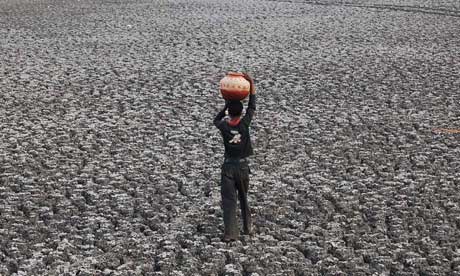
india prays for rain as water wars break out

Guardian | The monsoon is late, the wells are running dry and in the teeming city of Bhopal, water supply is now a deadly issue. It was a little after 8pm when the water started flowing through the pipe running beneath the dirt streets of Bhopal's Sanjay Nagar slum. After days without a drop of water, the Malviya family were the first to reach the hole they had drilled in the pipe, filling what containers they had as quickly as they could. Within minutes, three of them were dead, hacked to death by angry neighbours who accused them of stealing water.
In Bhopal, and across much of northern India, a late monsoon and the driest June for 83 years are exacerbating the effects of a widespread drought and setting neighbour against neighbour in a desperate fight for survival.
India's vast farming economy is on the verge of crisis. The lack of rain has hit northern areas most, but even in Mumbai, which has experienced heavy rainfall and flooding, authorities were forced to cut the water supply by 30% last week as levels in the lakes serving the city ran perilously low.
Across the country, from Gujarat to Hyderabad, in Andhra Pradesh, the state that claims to be "the rice bowl of India", special prayers have been held for more rain after cumulative monsoon season figures fell 43% below average.
On Friday, India's agriculture minister, Sharad Pawar, said the country was facing a drought-like situation that was a "matter for concern", with serious problems developing in states such as Punjab, Uttar Pradesh and Bihar.
In Bhopal, which bills itself as the City of Lakes, patience is already at breaking point. The largest lake, the 1,000-year-old, man-made Upper Lake, had reduced in size from 38 sq km to 5 sq km by the start of last week.
The population of 1.8 million has been rationed to 30 minutes of water supply every other day since October. That became one day in three as the monsoon failed to materialise. In nearby Indore the ration is half an hour's supply every seven days.
The UN has warned for many years that water shortages will become one of the most pressing problems on the planet over the coming decades, with one report estimating that four billion people will be affected by 2050. What is happening in India, which has too many people in places where there is not enough water, is a foretaste of what is to come.
By
CNu
at
July 14, 2009
0
comments
Labels: weather report

NYTimes | JUBAISH, Iraq — Throughout the marshes, the reed gatherers, standing on land they once floated over, cry out to visitors in a passing boat.
“Maaku mai!” they shout, holding up their rusty sickles. “There is no water!”
The Euphrates is drying up. Strangled by the water policies of Iraq’s neighbors, Turkey and Syria; a two-year drought; and years of misuse by Iraq and its farmers, the river is significantly smaller than it was just a few years ago. Some officials worry that it could soon be half of what it is now.
The shrinking of the Euphrates, a river so crucial to the birth of civilization that the Book of Revelation prophesied its drying up as a sign of the end times, has decimated farms along its banks, has left fishermen impoverished and has depleted riverside towns as farmers flee to the cities looking for work.
The poor suffer more acutely, but all strata of society are feeling the effects: sheiks, diplomats and even members of Parliament who retreat to their farms after weeks in Baghdad.
Along the river, rice and wheat fields have turned to baked dirt. Canals have dwindled to shallow streams, and fishing boats sit on dry land. Pumps meant to feed water treatment plants dangle pointlessly over brown puddles.
“The old men say it’s the worst they remember,” said Sayid Diyia, 34, a fisherman in Hindiya, sitting in a riverside cafe full of his idle colleagues. “I’m depending on God’s blessings.”
By
CNu
at
July 14, 2009
0
comments
Labels: weather report
Monday, July 13, 2009
metaphysical mistake

Guardian | Confusion by Christians between belief and reason has created bad science and inept religion
The question: Should we believe in belief?
The extraordinary and eccentric emphasis on "belief" in Christianity today is an accident of history that has distorted our understanding of religious truth. We call religious people "believers", as though acceptance of a set of doctrines was their principal activity, and before undertaking the religious life many feel obliged to satisfy themselves about the metaphysical claims of the church, which cannot be proven rationally since they lie beyond the reach of empirical sense data.
Most other traditions prize practice above creedal orthodoxy: Buddhists, Hindus, Confucians, Jews and Muslims would say religion is something you do, and that you cannot understand the truths of faith unless you are committed to a transformative way of life that takes you beyond the prism of selfishness. All good religious teaching – including such Christian doctrines as the Trinity or the Incarnation – is basically a summons to action. Yet instead of being taught to act creatively upon them, many modern Christians feel it is more important to "believe" them. Why?
In most pre-modern cultures, there were two recognised ways of attaining truth. The Greeks called them mythos and logos. Both were crucial and each had its particular sphere of competence. Logos ("reason; science") was the pragmatic mode of thought that enabled us to control our environment and function in the world. It had, therefore, to correspond accurately to external realities. But logos could not assuage human grief or give people intimations that their lives had meaning. For that they turned to mythos, an early form of psychology, which dealt with the more elusive aspects of human experience.
Stories of heroes descending to the underworld were not regarded as primarily factual but taught people how to negotiate the obscure regions of the psyche. In the same way, the purpose of a creation myth was therapeutic; before the modern period no sensible person ever thought it gave an accurate account of the origins of life. A cosmology was recited at times of crisis or sickness, when people needed a symbolic influx of the creative energy that had brought something out of nothing. Thus the Genesis myth, a gentle polemic against Babylonian religion, was balm to the bruised spirits of the Israelites who had been defeated and deported by the armies of Nebuchadnezzar during the sixth century BCE. Nobody was required to "believe" it; like most peoples, the Israelites had a number of other mutually-exclusive creation stories and as late as the 16th century, Jews thought nothing of making up a new creation myth that bore no relation to Genesis but spoke more directly to their tragic circumstances at that time.
Above all, myth was a programme of action. When a mythical narrative was symbolically re-enacted, it brought to light within the practitioner something "true" about human life and the way our humanity worked, even if its insights, like those of art, could not be proven rationally. If you did not act upon it, it would remain as incomprehensible and abstract – like the rules of a board game, which seem impossibly convoluted, dull and meaningless until you start to play.
Religious truth is, therefore, a species of practical knowledge. Like swimming, we cannot learn it in the abstract; we have to plunge into the pool and acquire the knack by dedicated practice. Religious doctrines are a product of ritual and ethical observance, and make no sense unless they are accompanied by such spiritual exercises as yoga, prayer, liturgy and a consistently compassionate lifestyle. Skilled practice in these disciplines can lead to intimations of the transcendence we call God, Nirvana, Brahman or Dao. Without such dedicated practice, these concepts remain incoherent, incredible and even absurd.
By
CNu
at
July 13, 2009
0
comments
Labels: History's Mysteries , truth
Sunday, July 12, 2009
a jes grew jack move...,
By
CNu
at
July 12, 2009
0
comments
Labels: History's Mysteries , What IT DO Shawty...
declassified the taliban
To the U.S. and the Soviets, Afghanistan has always been a pawn in a much bigger game. Both countries have used Afghanistan for their own gain since the late 1970’s.The Soviet Union invaded Afghanistan in December 1979. A peace agreement between the two countries wasn’t signed until February 1989, when Afghanistan defeated the Soviet Union.
The Taliban's rise to power was a project of Pakistan's secret service the ISI. The ISI was the arm through which the CIA managed its campaign in Afghanistan. The Bank of Commerce and Credit International served as the trellis on which these relational vines grew. Tensions rose as the Afghan government accused Pakistan of aiding the Taliban. The Taliban massacred thousands of innocent civilians.In 1998 the United States launched cruise missiles at Afghanistan, stating that its intent was to destroy the so called terrorist bases/training facilities used by Osama Bin Laden and his followers.
The Taliban banned the cultivation of drugs. In this movie, Ahmed Shah Massoud explains that. Massoud says the Taliban were just trying to corner the drug market. In 1999 and 2000 the UN Security Council Resolutions 1267 and 1333 were adopted. These resolutions used sanctions against the Taliban on grounds that they offered sanctuary to Osama Bin Ladin and for their continued support of terrorism and the cultivation of drugs. Check it out.
By
CNu
at
July 12, 2009
0
comments
Labels: Deep State , The Great Game
potato famine disease striking home gardens in U.S.
Reuters | CHICAGO - Late blight, which caused the Irish Potato Famine of the 1840s and 1850s, is killing potato and tomato plants in home gardens from Maine to Ohio and threatening commercial and organic farms, U.S. plant scientists said on Friday."Late blight has never occurred this early and this widespread in the United States," said Meg McGrath, a plant pathologist at Cornell University's extension center in Riverhead, New York.

She said the fungal disease, spread by spores carried in the air, has made its way into the garden centers of large retail chains in the Northeastern United States.
"Wal-mart, Home Depot, Sears, Kmart and Lowe's are some of the stores the plants have been seen in," McGrath said in a telephone interview.
The disease, known officially as Phytophthora infestans, causes large mold-ringed olive-green or brown spots on plant leaves, blackened stems, and can quickly wipe out weeks of tender care in a home garden.
McGrath said in her 21 years of research, she has only seen five outbreaks in the United States. The destructive disease can spread rapidly in cooler, moist weather, infecting an entire field within days."What's unique about it this year is we have never seen plants affected in garden centers being sold to home gardeners," she said.
This year's cool, wet weather created perfect conditions for the disease. "Hopefully, it will turn sunny," McGrath said. "If we get into our real summer hot dry weather, this disease is going to slow way down."
By
CNu
at
July 12, 2009
0
comments
Labels: food supply , weather report
victorian pop theosophy
Playing around with Google Books - vibrations occult octave - is even better and much less expensive than visiting a distant city and spending days wandering its flea markets and antiquarian bookstores..., gotta love those little swastikas around the seal of solomon.
By
CNu
at
July 12, 2009
0
comments
Labels: high strangeness
Saturday, July 11, 2009
domestic realpolitik
NYTimes | Vice President Joe Biden told us this week that the Obama administration “misread how bad the economy was” in the immediate aftermath of the inauguration.
Puh-leeze. Mr. Biden and President Obama won the election because the economy was cratering so badly there were fears we might be entering another depression. No one understood that better than the two of them. Mr. Obama tried to clean up the vice president’s remarks by saying his team hadn’t misread what was happening, but rather “we had incomplete information.”
That doesn’t hold water, either. The president has got the second coming of the best and the brightest working for him down there in Washington (think of Larry Summers as the latter-day Robert McNamara), and they’re crunching numbers every which way they can. They’ve got more than enough data. They understand the theories and the formulas as well as anyone. But they’re not coming up with the right answers because they’re missing the same thing that McNamara and his fellow technocrats were missing back in the 1960s: the human equation.
The crisis staring America in its face and threatening to bring it to its knees is unemployment. Joblessness. Why it is taking so long — seemingly forever — for our government officials to recognize the scope of this crisis and confront it directly is beyond me.
There are now five unemployed workers for every job opening in the U.S. The official unemployment rate is 9.5 percent, but that doesn’t begin to tell the true story of the economic suffering. The roof is caving in on struggling American families that have already seen the value of their homes and retirement accounts put to the torch.
At the present rate, upwards of seven million homes can be expected to fall into foreclosure this year and next. Welfare rolls are rising, according to a survey by The Wall Street Journal. The National Employment Law Project has pointed out that hundreds of thousands of unemployed workers will begin losing their jobless benefits, just about the only thing keeping them above water, by the end of the summer.
By
CNu
at
July 11, 2009
0
comments
Labels: Obamamandian Imperative
Chipocalypse Now - I Love The Smell Of Deportations In The Morning
sky | Donald Trump has signalled his intention to send troops to Chicago to ramp up the deportation of illegal immigrants - by posting a...
-
theatlantic | The Ku Klux Klan, Ronald Reagan, and, for most of its history, the NRA all worked to control guns. The Founding Fathers...
-
NYTimes | The United States attorney in Manhattan is merging the two units in his office that prosecute terrorism and international narcot...
-
Wired Magazine sez - Biologists on the Verge of Creating New Form of Life ; What most researchers agree on is that the very first functionin...