Thursday, October 23, 2008

World will tremble if Pakistan falls

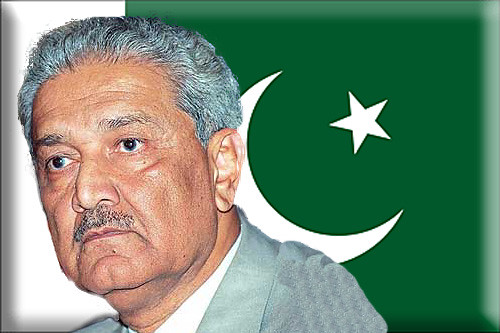
The stakes could not be higher: With a rapidly increasing population of more than 150 million -- larger than that of Russia -- Pakistan is also the world's only Muslim nuclear power. But since the fall of President Pervez Musharraf earlier this year, the bitter regional, social and religious disputes that have been building for decades have exploded in public. The current government of pro-American President Asif Ali Zardari is struggling to maintain any effective presence at all in the vast North-West Frontier Province, which covers one-quarter of the country.

If the government in Islamabad goes bankrupt, then the extreme Islamist forces spearheaded by the Taliban of Afghanistan, who already enjoy broad support among the Pashtun tribes of the NWFP, will have a far greater chance to turn the great cities of Pakistan, especially giant Karachi, into chaos.

As American military analyst and UPI columnist William S. Lind has warned, Fourth Generation war -- 4GW -- non-state forces like al-Qaida benefit from undermining the structures of established states and can metastasize rapidly if a state structure collapses, especially in a vast nation like Pakistan.

The Taliban and their fellow Islamists, aided by al-Qaida, already have stepped up their guerrilla operations against the Pakistani army and police.

Also, if Zardari fell, the impact on Pakistan's relations with the United States and on Washington's ability to effectively prosecute the war on terror could be dire. Currently, U.S. and NATO forces in Afghanistan -- around 50,000 in number overall -- are supplied by air along transport corridors over Pakistani territory. If a future Pakistani government should close those corridors, the already embattled U.S. and NATO forces in Afghanistan would find their situation deteriorating rapidly.

Pakistan's leaders are also understandably reluctant to put their political future and their country's fate in the hands of the International Monetary Fund, for they realize that IMF aid is usually tied to draconian conditions requiring the slashing of government spending. In a country like Pakistan, that means cutting social programs to support the poor, including subsidizing food prices.

Full-monty at Russodaily Space War.

Gird your loins...,

"Gird your loins," Biden told the crowd. "We're gonna win with your help, God willing, we're gonna win, but this is not gonna be an easy ride. This president, the next president, is gonna be left with the most significant task. It's like cleaning the Augean stables, man. This is more than just, this is more than – think about it, literally, think about it – this is more than just a capital crisis, this is more than just markets. This is a systemic problem we have with this economy."

Biden emphasized that the mountainous Afghanistan-Pakistan border is of particular concern, with Osama bin Laden "alive and well" and Pakistan "bristling with nuclear weapons."

"You literally can see what these kids are up against, our kids in that region," Biden said in recalling when his helicopter was forced down due to a snowstorm there. "The place is crawling with al Qaeda. And it's real."

"We do not have the military capacity, nor have we ever, quite frankly, in the last 20 years, to dictate outcomes," he cautioned. "It's so much more important than that. It's so much more complicated than that. And Barack gets it."

After speaking for just over a quarter of an hour, Biden noticed the media presence in the back of the small ballroom.

"I probably shouldn't have said all this because it dawned on me that the press is here," he joked.

"All kidding aside, these guys have left us in a God-awful place," he then said of the Bush regime, promptly wrapping up his remarks. "We have the ability to straighten it out. It's gonna take a little bit of time, so I ask you to stay with us. Stay with us." Full-monty at ABC News...,

Wednesday, October 22, 2008

M-Valued LETS

Sketch of the Most Likely Scenario for Implementing a Post-Bretton Woods Global Monetary System Utilizing m-Logically-Valued Exchange Units based on Quantum Principles of Self-Organization (circa Spring 1998, Saigon)

This site is devoted to all and everything associated with the notion of m-logically-valued monetary units and their applications to LETS, local exchange trading systems. Definitions of scope are broad and shall include: m-valued logic (e.g., fuzzy logic, Lukasiewicz logic); theory of monetary instruments; related quantum theoretical issues; applications technologies (hardware and software); research and development; the involved strategic planning issues; real politik of insinuating m-logically-valued exchange systems into the prevailing Newtonian institutionalization; quantum accounts of self-organization as they apply to questions of monetary theory; autopoiesis and its graphical representation systems; metaphors in theoretical biology, biometeorology, oceanography, and related sciences of multiscale dynamical systems; applicability of complexity theory to monetary systematics; history of any and all related subjects. Definitions of exclusion are narrow and shall be determined only by the propensity of any given contribution to elicit ennui.

Hypertext markup language is one very small step for mankind in the direction of employing m-valued logics. Free associations once were pristine logical accommodation schemata by virtue of animistic “identity transparency”. We are inspired by this fact and will embody that inspiration as complete disregard for conventions of binary logical thought -- though we will make no active effort in crass display of such unrespect.

Prehistoric Economics

Click the picture

The Idiots Who Rule America

Our oligarchic class is incompetent at governing, managing the economy, coping with natural disasters, educating our young, handling foreign affairs, providing basic services like health care and safeguarding individual rights. That it is still in power, and will remain in power after this election, is a testament to our inability to separate illusion from reality. We still believe in “the experts.” They still believe in themselves. They are clustered like flies swarming around John McCain and Barack Obama. It is only when these elites are exposed as incompetent parasites and dethroned that we will have any hope of restoring social, economic and political order.

“Their inability to see the human as anything more than interest driven made it impossible for them to imagine an actively organized pool of disinterest called the public good,” said the Canadian philosopher John Ralston Saul, whose books “The Unconscious Civilization” and “Voltaire’s Bastards” excoriates our oligarchic elites. “It is as if the Industrial Revolution had caused a severe mental trauma, one that still reaches out and extinguishes the memory of certain people. For them, modern history begins from a big explosion—the Industrial Revolution. This is a standard ideological approach: a star crosses the sky, a meteor explodes, and history begins anew.”

Our elites—the ones in Congress, the ones on Wall Street and the ones being produced at prestigious universities and business schools—do not have the capacity to fix our financial mess. Indeed, they will make it worse. They have no concept, thanks to the educations they have received, of the common good. They are stunted, timid and uncreative bureaucrats who are trained to carry out systems management. They see only piecemeal solutions which will satisfy the corporate structure. They are about numbers, profits and personal advancement. They are as able to deny gravely ill people medical coverage to increase company profits as they are able to use taxpayer dollars to peddle costly weapons systems to blood-soaked dictatorships. The human consequences never figure into their balance sheets. The democratic system, they think, is a secondary product of the free market. And they slavishly serve the market.

Chris Hedges brings the heat once again, full-monty at Truthdig.com

The United States, Europe and Bretton Woods II

French President Nicolas Sarkozy and U.S. President George W. Bush met Oct. 18 to discuss the possibility of a global financial summit. The meeting ended with an American offer to host a global summit in December modeled on the 1944 Bretton Woods system that founded the modern economic system.

The Bretton Woods framework is one of the more misunderstood developments in human history. The conventional wisdom is that Bretton Woods crafted the modern international economic architecture, lashing the trading and currency systems to the gold standard to achieve global stability. To a certain degree, that is true. But the form that Bretton Woods took in the public mind is only a veneer. The real implications and meaning of Bretton Woods are a different story altogether.

Excellent historical summary - full-monty at Stratfor.com

Tuesday, October 21, 2008

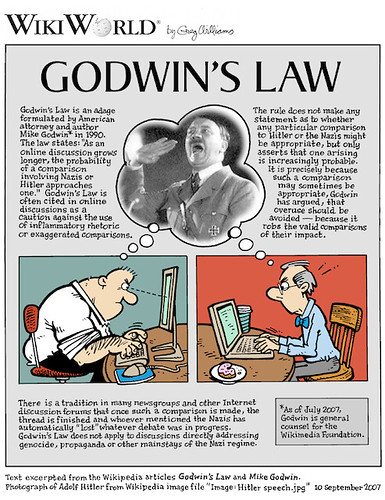
Godwin's Law

Godwin's Law (also known as Godwin's Rule of Nazi Analogies) is an adage formulated by Mike Godwin in 1990. The law states:

"As a Usenet discussion grows longer, the probability of a comparison involving Nazis or Hitler approaches one."

Godwin's Law is often cited in online discussions as a deterrent against the use of arguments in the reductio ad Hitlerum form.

The rule does not make any statement whether any particular reference or comparison to Hitler or the Nazis might be appropriate, but only asserts that one arising is increasingly probable. It is precisely because such a comparison or reference may sometimes be appropriate, Godwin has argued that overuse of Nazi and Hitler comparisons should be avoided, because it robs the valid comparisons of their impact. Although in one of its early forms Godwin's Law referred specifically to Usenet newsgroup discussions, the law is now applied to any threaded online discussion: electronic mailing lists, message boards, chat rooms, and more recently blog comment threads and wiki talk pages.

Gears Just Grinding.....,

In this 28th edition of the GEAB, LEAP/E2020 has decided to launch a new global systemic crisis alert. Indeed our researchers anticipate that, before next summer 2009, the US government will default and be prevented to pay back its creditors (holders of US Treasury Bonds, of Fanny May and Freddy Mac shares, etc.). Of course such a bankruptcy will provoke some very negative outcome for all USD-denominated asset holders. According to our team, the period that will then begin should be conducive to the setting up of a « new Dollar » to remedy the problem of default and of induced massive capital drain from the US. The process will result from the following five factors studied in detail further in this GEAB:

• The recent upward trend of the US Dollar is a direct and temporary consequence of the collapse of stock markets

• Thanks to its recent « political baptism », the Euro becomes a credible « safe haven » value and therefore provides a « crisis » alternative to the US dollar

• The US public debt is now swelling uncontrollably

• The ongoing collapse of US real economy prevents from finding an alternative solution to the country's defaulting

Strong inflation or hyper-inflation in the US in 2009?, that is the only question.

Studying the case of Iceland can give an idea of the upcoming stages of the crisis. That is what our team has been doing ever since the beginning of 2006. This country indeed provides a good illustration of what the US and the UK should be expecting. It can be considered – and that is what most Icelandic people do today – that the collapse of Iceland's financial system came from the fact that it was disproportionate to the size of the country's economy.

Financially speaking, Iceland thought of itself as UK, in the same way as, financially speaking, UK thought of itself as the US and the US thought of themselves as the entire world. It is therefore quite useful to study the case of Iceland in order to understand the course of events that London and Washington will follow in the next 12 months.

The Roots of the Crisis

The financial crisis finds its roots in the oil crisis and nobody seems to care about it. The current events that nobody saw coming, were already announced as early as 2006 by Dr. Colin Campbell, a geologist, former Vice-President of Fina Oil Company and founder of the nowadays respected ASPO (Association for the Study of Peak Oil).

Listen to what he says in this video:

Expansion becomes impossible without abundant cheap energy. So I think that the debt of the world is going bad. That speaks of a financial crisis, unseen, probably equalling the Great Depression of 1930; it’s probable we face the Second Great Depression. It would be a chain reaction, one bank would fail, and another one would fail, industries will close…

Monday, October 20, 2008

Crash Globally, Grow Locally

At noon eastern time, the Washington Post will host a live discussion of Joel Kotkin's thesis that the poor economy, high energy prices and technology are revitalizing american communities. Kotkin's original article is linked here, and I've included an excerpt:
But for all our nightmares of drowning in a sea of bad mortgages, foreclosed homes and shrunken retirement plans, the truth is that the effects of this meltdown won't be all bad in the long run. In one regard, it could offer our society a net positive: Forced into belt-tightening, Americans are likely to strengthen our family and community ties and to center our lives more closely on the places where we live.

This trend toward what I call "the new localism" has been underway for some years, driven by changing demographics, new technologies and rising energy prices. But the economic downturn will probably accelerate it as individuals and corporations look not to the global stage but closer to home, concentrating and congregating on the Main Streets where we choose to live – in the suburbs, in urban neighborhoods or in small towns.

In his 1972 bestseller, "A Nation of Strangers," social critic Vance Packard depicted the United States as "a society coming apart at the seams." He was only one in a long cavalcade of futurists who have envisioned an America of ever-increasing "spatial mobility" that would give rise to weaker families, childlessness and anonymous communities.
Should be interesting to see what kind of discussion jumps off in this most mainstream of media contexts.

Collapse Casualties Voting Their Interests...,

Washington Post | For all the emphasis on Sen. Barack Obama's chances with working-class voters in declining Rust Belt cities, the biggest swing vote in the presidential election is likely to be in outer suburban communities, where Democrats hope to capitalize on economic unease and demographic shifts to overturn traditional Republican strengths.

Across the country, the housing collapse has been most acute on the suburban fringe. In Prince William, sales are picking up again, but at severely reduced prices -- the median price for detached single-family houses plunged 41 percent in the past year, from $405,000 in September 2007 to $239,900 last month. There were 844 foreclosures last month, up from 256 a year before and 40 in September 2006. Exacerbating the real estate collapse was the spike in gasoline prices, which hit hardest in exurbs where 30-mile commutes are the norm.

It was the oil spike more than anything that led Gary Blake to strongly consider voting for Obama after voting for Bush in 2004. Blake, who lives in a McMansion community near the Potomac River, said fuel costs hurt his pest-control business, which inspects homes as far away as West Virginia. Even now that gas prices have dropped somewhat, Blake sees how things have gone amiss in the number of foreclosed homes on his inspection list.

"I've become more swayed to the left after the last eight years," he said. "In 2004, I was more swayed by the tax stance of the Republicans, and thought it would benefit us more. But I've concluded that was a mistake."

Robert Lang, a demographer at Virginia Tech's Metropolitan Institute in Alexandria, says it is a generalized discontent like Blake's that has increased the Democrats' share of the exurban vote.

Rich must apologise now

Madeleine Bunting brings it once again in this morning's Guardian|
Europe and the US have spent the weekend talking of reform of global capitalism and a Bretton Woods II, but they need to start with a grovelling apology. In recent decades, they have used their power through the IMF to write the rules and impose them across the world by ruthless manipulation and bullying. Belgium, Luxembourg and the Netherlands have together more votes in the IMF than China, India and Brazil.

In the past month, the US and Europe have been humiliated by the catastrophic failure of their own rules, and have been forced to rip them up. The double standards of western interests have been starkly exposed - their bail-outs are exactly what they have refused, repeatedly, to allow other countries to do in similar crises.

Those who will pay the heaviest price for the foolhardiness of deregulated financial capitalism are among those who are least responsible, as Brazil's President Lula angrily pointed out last week. The shockwaves of the west's banking crisis will shipwreck more vulnerable countries. In developing countries, people don't have the resources - welfare provision, savings, insurance - to tide them over a crisis. Instead, they go hungry, homeless - and they die. Across Africa and Asia, countries are bracing themselves for multiple hits, with falls in aid already threatened and a likely decline in the remittances that buoy up their economies - in the UK, the immigration minister Phil Woolas is already signalling a harder line on immigration. Fear of global recession is bringing commodity prices down and will reduce the demand for luxury products such as flowers, green beans and hot holidays. The anger among developing countries will spread. Our worries about jobs and pensions pale in comparison with the fallout on the billions who will not be able to feed or educate their children.

The Green New Deal

Taipan Publishing Group:

Time for a New Motor?


George Soros thinks the conclusion is foregone.

For the last 25 years, Soros observes, the “motor of the world economy” has been the American consumer. And not only has the American consumer been aggressively consuming, he “has been spending more than he has been saving.”

“So that motor is now switched off,” says Soros. “It’s finished. It’s run out of -- can’t continue. You need a new motor.”

The declines of that truly awful week when the Dow lost 18% were tied to the credit crisis. Before governments across the globe stepped up, there was a fear that nothing would be done.

The declines that followed Monday’s rally, however, were tied to a separate issue... rooted in fears that the U.S. consumer may, after many years and countless false alarms, be well and truly tapped out. If so, we don’t know what the new “motor of the world economy” is going to be.

Soros has a notion of what that new motor could be. Moral aspects aside, I think he is right. It’s an idea some readers will like and others will hate...

“We have [another] big problem,” Soros says. “Global warming. It requires big investment. And that could be the motor of the world economy for years to come... instead of consuming, building an electricity grid, saving on energy, rewiring the houses, adjusting your lifestyle where energy has got to cost more until you introduce those new things. So it will be painful. But at least we will survive and not cook.”

The Green New Deal

Concerns over global warming and the high cost of fossil fuels are closely aligned. Whether or not you embrace the concept of global warming -- and there is still real debate on the subject -- you no doubt remember the sky-high fuel prices the world had to deal with earlier this year.

Energy prices are falling now, mainly due to deflation fears and the phenomenon of “demand destruction.” But when global growth resumes, energy prices will go right back up again. And then there are the indirect costs, like the rampant pollution and quality-of-life issues that plague China and India.

Many top thinkers thus agree with Soros. There is a very strong feeling that the world needs a “Green New Deal”... an alternative-energy-focused motor that can get the global economy humming again.

Anna Schwartz - Bernanke Is Fighting the Last War

Wall Street Journal Weekend Interview| On Aug. 9, 2007, central banks around the world first intervened to stanch what has become a massive credit crunch.

Since then, the Federal Reserve and the Treasury have taken a series of increasingly drastic emergency actions to get lending flowing again. The central bank has lent out hundreds of billions of dollars, accepted collateral that in the past it would never have touched, and opened direct lending to institutions that have never had that privilege. The Treasury has deployed billions more. And yet, "Nothing," Anna Schwartz says, "seems to have quieted the fears of either the investors in the securities markets or the lenders and would-be borrowers in the credit market."

The credit markets remain frozen, the stock market continues to get hammered, and deep recession now seems a certainty -- if not a reality already.

Most people now living have never seen a credit crunch like the one we are currently enduring. Ms. Schwartz, 92 years old, is one of the exceptions. She's not only old enough to remember the period from 1929 to 1933, she may know more about monetary history and banking than anyone alive. She co-authored, with Milton Friedman, "A Monetary History of the United States" (1963). It's the definitive account of how misguided monetary policy turned the stock-market crash of 1929 into the Great Depression.

Since 1941, Ms. Schwartz has reported for work at the National Bureau of Economic Research in New York, where we met Thursday morning for an interview. She is currently using a wheelchair after a recent fall and laments her "many infirmities," but those are all physical; her mind is as sharp as ever. She speaks with passion and just a hint of resignation about the current financial situation. And looking at how the authorities have handled it so far, she doesn't like what she sees.

Sunday, October 19, 2008

China - Pakistan: Cash Money No

IHT - ISLAMABAD, Pakistan: Food prices have soared, making some basics, even flour, too expensive for the poorest to afford. No large-scale riots have occurred, but concern is mounting that such protests are not far off.

The new government has reduced subsidies on fuel and food, and the central bank moved on Friday to ease an intrabank liquidity crisis

President Asif Ali Zardari returned from China late Friday without a commitment for cash needed to shore up Pakistan's crumbling economy, leaving him with the politically unpopular prospect of having to ask the International Monetary Fund for help.

Pakistan was seeking the aid from China, an important ally, as it faces the possibility of defaulting on its current account payments.

With the United States and other nations preoccupied by a financial crisis, and Saudi Arabia, another traditional ally, refusing to offer concessions on oil, China was seen as the last port of call before the IMF

Accepting a rescue package from the fund would be seen as humiliating for Zardari's government, which took office this year.

An IMF-backed plan would require Pakistan's government to cut spending and raise taxes, among other measures, which could hurt the poor, officials said.

The Bush administration is concerned that Pakistan's economic meltdown will provide an opportunity for Islamic militants to capitalize on rising poverty and frustration.

The Pakistanis have not been shy about exploiting the terrorist threat to try to win financial support, a senior official at the IMF said.

But because of the dire global financial situation, and the reluctance of donor nations to provide money without strict economic reforms by Pakistan, the terrorist argument has not been fully persuasive, he said.

China - Pakistan: Nuclear Power Yes

CNN| Pakistan said Saturday that China will help it build two more nuclear power plants, offsetting Pakistani frustration over a recent nuclear deal between archrival India and the United States.

The agreement with China was among 12 accords signed during Pakistani President Asif Ali Zardari's recent visit to Beijing, said Foreign Minister Shah Mahmood Qureshi.

While Qureshi gave few details, the accord deepens Pakistan's long-standing ties with China at a time when its relations with Washington are strained over the war against terrorism.

U.S. officials including Assistant Secretary of State Richard Boucher, who arrived in Islamabad on Saturday for talks, have rejected Pakistani calls for equal treatment with India on nuclear power.

Chinese leaders "do recognize Pakistan's need, and China is one country that at international forums has clearly spoken against the discriminatory nature of that understanding" between Washington and New Delhi, Qureshi said.

Zardari met with China's top leaders during his first official trip to Beijing since replacing stalwart U.S. ally Pervez Musharraf as president in September.

China Wary of Islam

To be a practicing Muslim in the vast autonomous region of northwestern China called Xinjiang is to live under an intricate series of laws and regulations intended to control the spread and practice of Islam, the predominant religion among the Uighurs, a Turkic people uneasy with Chinese rule.

The edicts touch on every facet of a Muslim’s way of life. Official versions of the Koran are the only legal ones. Imams may not teach the Koran in private, and studying Arabic is allowed only at special government schools.

Two of Islam’s five pillars — the sacred fasting month of Ramadan and the pilgrimage to Mecca called the hajj — are also carefully controlled. Students and government workers are compelled to eat during Ramadan, and the passports of Uighurs have been confiscated across Xinjiang to force them to join government-run hajj tours rather than travel illegally to Mecca on their own.

Government workers are not permitted to practice Islam, which means the slightest sign of devotion, a head scarf on a woman, for example, could lead to a firing.

The Chinese government, which is officially atheist, recognizes five religions — Islam, Protestantism, Catholicism, Taoism and Buddhism — and tightly regulates their administration and practice. Its oversight in Xinjiang, though, is especially vigilant because it worries about separatist activity in the region.

In the NYTimes - Wary of Islam, China Tightens a Vise of Rules

Rachel Maddow: Jonathan Turley on Voter Suppression

My man Rembom hipped me to Rachel Maddow's coverage of organized GOP voter suppression and efforts on the part of the Obama campaign to seek legal recourse against it. Rachel has more on the voter fraud/suppression breaking news and the Obama campaign's request for a Special prosecutor. Constitutional law professor Jonathan Turley weighs in on how this is just more of the same thing GOP operatives have pulled in the last election with the same states targeted in an effort to keep people from voting.

Saturday, October 18, 2008

Blocking the Vote

In state after state, Republican operatives — the party's elite commandos of bare-knuckle politics — are wielding new federal legislation to systematically disenfranchise Democrats. If this year's race is as close as the past two elections, the GOP's nationwide campaign could be large enough to determine the presidency in November. "I don't think the Democrats get it," says John Boyd, a voting-rights attorney in Albuquerque who has taken on the Republican Party for impeding access to the ballot. "All these new rules and games are turning voting into an obstacle course that could flip the vote to the GOP in half a dozen states."

Suppressing the vote has long been a cornerstone of the GOP's electoral strategy. Shortly before the election of Ronald Reagan in 1980, Paul Weyrich — a principal architect of today's Republican Party — scolded evangelicals who believed in democracy. "Many of our Christians have what I call the 'goo goo' syndrome — good government," said Weyrich, who co-founded Moral Majority with Jerry Falwell. "They want everybody to vote. I don't want everybody to vote. . . . As a matter of fact, our leverage in the elections quite candidly goes up as the voting populace goes down."

Today, Weyrich's vision has become a national reality. Since 2003, according to the U.S. Election Assistance Commission, at least 2.7 million new voters have had their applications to register rejected. In addition, at least 1.6 million votes were never counted in the 2004 election — and the commission's own data suggests that the real number could be twice as high. To purge registration rolls and discard ballots, partisan election officials used a wide range of pretexts, from "unreadability" to changes in a voter's signature. And this year, thanks to new provisions of the Help America Vote Act, the number of discounted votes could surge even higher.

Full Monty in Rolling Stone.

Scientists pick their President

If scientists ruled the world, then the world would be extremely blue. Mind you not blue as in its mood, but blue as in its political party affiliation. The Scientist's recent mock election showed a clear trend towards Barack Obama, the Democratic presidential nominee. Barack Obama carried a staggering 56% of the total votes while his Republican counterpart, John McCain, only received 39% of the total votes. This is a margin of 17% which is statistically significant.


As most Americans know all too well, the popular vote doesn't determine the winner of the presidential election. Al Gore actually won the popular vote in 2000, but lost the election due to electoral votes. (For more details Google: +Florida +2000 +"hanging chads"). So if The Scientist wanted to determine a "true" presidential winner, then The Scientist would have to breakdown the voting by state in an attempt to calculate the electoral votes. Using Google Analytics to determine state locations of our voters, The Scientist found that Barack Obama would carry a whopping 464 electoral votes (the most since Ronald Reagan) and that's not even including the 45 votes still up for grabs.


Full Monty at The Scientist.

Chipocalypse Now - I Love The Smell Of Deportations In The Morning

sky |   Donald Trump has signalled his intention to send troops to Chicago to ramp up the deportation of illegal immigrants - by posting a...