Friday, October 17, 2008

The Evolutionary Roots of The Base

We have had a long-standing high regard for Paul Rosenberg's devastating account of modern *conservatism*.
It’s my main thesis in this series that conservatism is not fundamentally about ideology, but about the preservation of elite power, maintained as a form of identity politics.
But now we've happened upon a compact treatment referencing extensive sociobiological research with even more devastating explanatory power concerning the evolutionary underpinnings of that most alarming element comprising the broad demographic so ruthlessly exploited by cunning conservative manipulators, you know who - The Base.
Here's a question for you. Why hasn't natural selection driven the religious right to extinction?

You should forgive me for asking. After all, here is a group of people who base their lives on patently absurd superstitions that fly in the face of empirical evidence. It's as if I suddenly chose to believe that I could walk off the edges of cliffs with impunity; you would not expect me to live very long. You would expect me to leave few if any offspring. You would expect me to get weeded out.

And yet, this obnoxious coterie of retards — people openly and explicitly contemptuous of "intellectuals" and "evilutionists" and, you know, anyone who actually spends their time learning stuff — they not only refuse to die, they appear to rule the world. Some Alaskan airhead who can't even fake the name of a newspaper, who can't seem to say anything without getting it wrong, who bald-facedly states in a formal debate setting that she's not even going to try to answer questions she finds unpalatable (or she would state as much, if she could say "unpalatable" without tripping over her own tongue) — this person, this behavior, is regarded as successful even by her detractors. The primary reason for her popularity amongst the all-powerful "low-information voters"1? In-your-face religious fundamentalism and an eye tic that would make a Tourette's victim blush.
OH MY GAWD!!! This fellow is off to a rip-roaring good start.
Surely, any cancer that attacks the very intellect of a society would put the society itself at a competitive disadvantage. Surely, tribes founded on secular empiricism would develop better technology, better medicines, better hands-on understanding of The Way Things Work, than tribes gripped by primeval cloud-worshipping superstition. Why, then, are there so few social systems based on empiricism, and why are god-grovellers so powerful across the globe? Why do the Olympians keep getting their asses handed to them by a bunch of intellectual paraplegics?

The great thing about science is, it can even answer ugly questions like this. And a lot of pieces have been falling into place lately. Many of them have to do with the brain's fundamental role as a pattern-matcher.
Julian Jaynes explained all of this and far more nearly forty years ago in his dazzling exploration of the origins of human consciousness The Origins of Consciousness in the Breakdown of the Bicameral Mind. But these guys have whittled it down to its provable and repeatable dimensions and empirically demonstrated what Jaynes understood and described. Jaynes treatment of idols and idolatry as artifacts of precisely the type of surveillance community described by Watts is simply remarkable as a tour de force of deep psychopaleological insight. Understanding how these most primitive tribal formations are organized at a deep level provides no possibility of a cure of this persistent collective cognitive error, however, it informs you precisely how deep and intractable the problem is such that squander no valuable time, effort, or resources attempting to reason with it.

The Roots of Sovereignty

On monday we linked the major Michael Pollan piece in the NYTimes, Dear Farmer-in-Chief. Comes now Joe Windish at the Moderate Voice with a tight breakdown of the totality of what Pollan was talking about.
In a long and serious article on food policy in today’s NYTimes Magazine, Michael Pollan writes that the era of cheap and abundant food is coming to a close. He says the next American president, no matter which man is elected, is going to find that the health of our nation’s food system is a critical issue of national security.

His argument is that, unless we address the industrial food system, we will not be able to make significant progress resolving the three main issues of our day — health care, energy independence and climate change:
Food policy hasn't exactly been a hot-button issue in the presidential election. And it's not going to be. We're sure to hear more about Joe the plumber, drill, drill, drill, or whatever the sanctioned, theatrical nonsense du jour. That said, most of the problems our food system faces today are because of its reliance on fossil fuels, and to the extent that our policies wring the oil out of the system and replace it with the energy of the sun, those policies will simultaneously improve the state of our health, our environment and our security.

Pakistan's Bid for Chinese Cash

Washington Post | Pakistan's financial problems go back at least a year, with current and past administrations borrowing from the central bank to sustain generous state subsidies on gasoline and diesel. As global oil prices surged, the government of former President Pervez Musharraf curried favor with average Pakistanis by having the state absorb the shocks. Musharraf ousted a democratically elected government in 1999 and ruled until a civilian coalition was voted into office last spring, headed by Prime Minister Yousaf Raza Gillani. The government forced Musharraf from the presidency in August, electing Zardari as his replacement in September.

U.S. military and intelligence officials fear that Pakistan's increasingly precarious economy will compound an already unstable political situation and undermine military cooperation. Both al-Qaeda and the Taliban leadership are located in the rugged, economically depressed region along Pakistan's western border with Afghanistan. The Bush administration and Congress have been shaping a long-term economic and military assistance package for Pakistan, but there is no indication the United States is able to step in with a short-term financial lifeline.

Pakistan is going to the Chinese now "because you go to the guys with the money," a senior International Monetary Fund official said. "And right now, the Chinese are the ones with the money."

Securing as much as $6 billion would buy the government the breathing room it needs, analysts say, to begin a desperately needed overhaul of its budget to sustain Pakistan's battered economy in the longer term.

Pakistan's bid for Chinese cash underscores the potential of Beijing's $1.9 trillion in foreign reserves, the largest in the world, to boost its global influence. The government is now seeking as much as $3 billion in emergency assistance from China, as well as assistance from oil-rich Gulf countries including Saudi Arabia and the United Arab Emirates, according to a senior Pakistani official. Pakistan's central bank governor, Shashad Akhtar, is in Washington this week to review a draft plan for overhauling the country's finances with the International Monetary Fund, potentially paving the way for future aid.

Should the Kremlin bail out the billionaires?

Washington Post| With stock markets here down more than two-thirds from their May highs and continuing to fall, almost all of Russia's billionaires -- men and women who made their fortunes in the transition to capitalism after the Soviet Union's fall -- are hurting. According to one analysis, the wealth of the top 25 on the Forbes Russia list has plunged nearly $240 billion in the past five months.
ad_icon

These losses have been felt across the Russian economy, as the tycoons' businesses trim jobs, cut salaries and suspend projects, and have presented Prime Minister Vladimir Putin with a delicate political question: Should the Kremlin bail out the billionaires?

Putin has already reached into the nation's huge reserve funds, the third-largest in the world, and announced one emergency measure after another in an attempt to end the turmoil that has gripped the Russian financial system. The government has pledged more than $200 billion thus far to bolster stock markets and banks, an amount equal to about 15 percent of the country's gross domestic product.

But it remains uncertain whether the money will be enough, how it will be distributed, and to what extent the Kremlin will try to use it to help friends and punish enemies. In a sign of growing dissatisfaction with Putin's handling of the crisis, an influential business group published an unusually blunt letter last week warning that the reserves could be exhausted within two years and urging the Kremlin to refrain from playing favorites as it distributes aid.

"The principles of providing state support to companies should be made public and transparent," wrote Alexander Shokhin, president of the Russian Union of Industrialists and Entrepreneurs, complaining that the Kremlin often only helps the few, privileged businessmen who can get meetings with officials.

"Comrade Bush" turns left in crisis

Reuters | "Bush is to the left of me now," Chavez told an audience of international intellectuals debating the benefits of socialism. "Comrade Bush announced he will buy shares in private banks."

Chavez, who has insulted Bush in the past as a drunkard or the devil, called him clueless on Wednesday. He accused him of simply parroting the words of his aides without understanding the new policies that rely on heavy state intervention.

"I am convinced he has got no idea what's going on," said Chavez, who has nationalized swaths of the OPEC nation's economy in recent years and is in negotiations to take over a Spanish bank in Venezuela.

Chavez lauds his nationalizations for allowing the state to refocus companies' activities on helping the poor rather than creating value for their shareholders.

The Bush administration, which has promoted free-market policies throughout Latin America, resisted taking equity in banks for weeks. But, faced with a spiraling financial crisis, it reversed course this week with a $250 billion plan.

Chavez, who the United States labels an autocrat, is popular among his supporters at home for criticizing Bush and sometimes wins praise abroad for voicing anti-U.S. opinions.

Despite the ideological differences between the two governments and the diplomatic sparring that led weeks ago to the countries expelling each other's ambassador, Venezuela remains a major oil supplier to the United States.

Thursday, October 16, 2008

America’s Political Cannibalism

It is no longer our economy but our democracy that is in peril. It was the economic meltdown of Yugoslavia that gave us Slobodan Milosevic. It was the collapse of the Weimar Republic that vomited up Adolf Hitler. And it was the breakdown in czarist Russia that opened the door for Vladimir Lenin and the Bolsheviks. Financial collapses lead to political extremism. The rage bubbling up from our impoverished and disenfranchised working class, glimpsed at John McCain rallies, presages a looming and dangerous right-wing backlash.

As the public begins to grasp the depth of the betrayal and abuse by our ruling class, as the Democratic and Republican parties are exposed as craven tools of our corporate state, as savings accounts, college funds and retirement plans become worthless, as unemployment skyrockets and as home values go up in smoke, we must prepare for the political resurgence of a reinvigorated radical Christian right. The engine of this mass movement—as is true for all radical movements—is personal and economic despair. And despair, in an age of increasing shortages, poverty and hopelessness, will be one of our few surplus commodities.

More of Chris Hedge's article at Truthdig.com

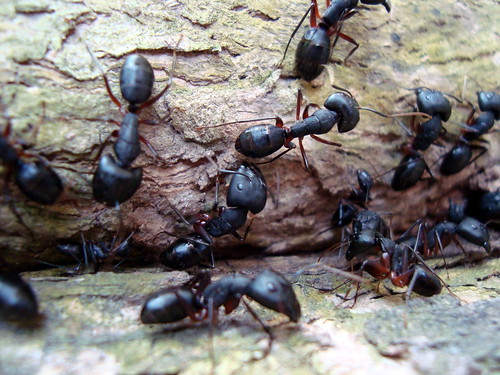
Lazy ants "social cancer" of colony

Lazy "cheater ants" have been observed to take advantage of the hard working members of their colony for their own evolutionary advantage, according to research published today in the journal Proceedings of the Royal Society B: Biological Sciences.

Scientists at the University of Tokyo found that larger ants in the colony laid more eggs, but hardly took part in any of the co-operative activities, thus resulting in a lower fitness of the colony as a whole. These larger ants have been identified as a distinct genotype that seems to represent a lineage that has specialized in cheating described as a "social cancer" of the colony.

An important first step in the field study was to find a system containing both co-operators and cheaters living together under natural conditions. In colonies of this particular ant, females reproduce asexually and there are very few males in the population as a result. The usual queen caste is absent and the females share reproductive and work duties over the course of their life.

Evidence of such cheating is rare in the animal kingdom, but co-operation within a species has always been vulnerable to strategies that exploit the benefits of co-operation without paying the fair cost. This discovery is an important step towards the major goal of evolutionary biologists to explain where co-operation originated and why it continues to thrive, despite the obvious opportunities for cheating.

What's That Smell?

The authorities have blamed subprime mortgages for the crisis. Why then does their solution fail to address the problem of the mortgages? Instead, the solution directs public money into an increasingly concentrated private financial sector, the management of which is not only vastly overpaid, but also has escaped accountability for the financial chicanery that, allegedly, threatens systemic financial meltdown unless bailed out by the taxpayers.

Perhaps my nose is too sensitive, but this bailout doesn't pass the smell test.

Read all of Paul Craig Roberts A Trillion Dollar Bait and Switch

Rescue for the Few, Debt Slavery for the Many

We are now entering the financial End Time. Bailout “Plan A” (buy the junk mortgages) has failed, “Plan B” (buy ersatz stocks in the banks to recapitalize them without wiping out current mismanagers) is fizzling, and the debts still can’t be paid. That is the reality Wall Street avoids confronting. “First they ignore you, then they denounce you, and then they say that they knew what you were saying all the time,” said Gandhi. The same might be said of today’s overhang of debts in excess of the economy’s ability to pay. First the policy makers pretend that they can be paid, then they denounce the pessimists as spreading panic, and then they say that of course students have been taught for four thousand years now how the “magic of compound interest” keeps on doubling and redoubling debts faster than the economy can squeeze out an economic surplus to pay.

What has ended is the idea that “the magic of compound interest” can make economies rich without having to work and without industry. I hope we have seen the end of derivatives formulae seeking to make money by playing in a zero-sum game. A debt overhang always ends either in foreclosure of the debtor’s property, or in a debt annulment to preserve the economy’s overall freedom and equity.

This means that the postmodern economy as we know it must end – either in financial polarization and debt peonage to a new oligarchic elite, or in a debt cancellation, a Jubilee Year to rescue society.

Michael Hudson details The Great Bailout Swindle

Wednesday, October 15, 2008

Isn't That Special?

Absolutely Priceless.....,

Jesse Jackson: Obama will rid United States of 'Zionist' control

Haaretz| The New York Post reported Tuesday that the Rev. Jesse Jackson said the United States will rid itself of years of "Zionist" control under an administration headed by Democratic presidential candidate Barack Obama.

The daily quoted the veteran civil rights leader on Tuesday as having said that although "Zionists who have controlled American policy for decades" remain strong, they will lose a much of their clout when Obama enters the White House.

Speaking at the first World Policy Forum event in Evian, France, Jackson promised "fundamental changes" in U.S. foreign policy. He said the most important change would occur in the Middle East, where "decades of putting Israel's interests first" would end.

Jackson said that Obama "wants an aggressive and dynamic diplomacy." He went on to criticize the Bush administration's handling of Middle East diplomacy, telling the Post, "Bush was so afraid of a snafu and of upsetting Israel that he gave the whole thing a miss. Barack will change that," because, as long as the Palestinians haven't seen justice, the Middle East will "remain a source of danger to us all."

Jackson has not always been such a strong Obama supporter. In July, he apologized to the Illinois senator for "crude and hurtful" remarks he had made about him after an interview with a Fox News correspondent. Speaking to a fellow interviewee without realizing his microphone was on, Jackson said, "See, Barack's been talking down to black people.... I want to cut his nuts off."

"It was very private," Jackson said, adding that if "any hurt or harm has been caused to [Obama's] campaign, I apologize."

National Review Boots Buckley Son For Obama Boost

Washington Post|
Buckley delivered his endorsement of the Democratic presidential nominee last Thursday in the cyberpages of the Daily Beast, a new, blog-heavy Web site launched by Tina Brown, the former editor of Vanity Fair and the New Yorker. "I went out of my way to spare NR from being associated with this endorsement," Buckley said.

In that piece, Buckley said that he has known McCain since 1982 and once wrote a speech for him but that the senator has changed, airing "mean-spirited and pointless" attack ads and -- "What on earth can he have been thinking?" -- picking Sarah Palin as his running mate. While the result was "genuinely saddening" and even "tragic" for the country, Buckley wrote, he had concluded that Obama has a "first-class temperament and a first-class intellect" and could be a great president. That is, "assuming anyone gives a fig" about his views.

Buckley noted that columnist Kathleen Parker, after a National Review Online piece declaring Palin unqualified to be vice president, had received 12,000 hostile e-mails. Parker, who is syndicated by The Washington Post Writers Group, described the reaction in her next column: "I am a traitor and an idiot. Also, my mother should have aborted me and left me in a dumpster, but since she didn't, I should 'off' myself."

In his embrace of Obama, Buckley quoted his father as saying,
"You know, I've spent my entire lifetime separating the Right from the kooks."

Smaller Banks Resist Federal Cash Infusions

Washington Post| Community banking executives around the country responded with anger yesterday to the Bush administration's strategy of investing $250 billion in financial firms, saying they don't need the money, resent the intrusion and feel it's unfair to rescue companies from their own mistakes.

But regulators said some banks will be pressed to take the taxpayer dollars anyway. Others banks judged too sick to save will be allowed to fail.[...] in offices around the country, bankers simmered.

Peter Fitzgerald, chairman of Chain Bridge Bank in McLean, said he was "much chagrined that we will be punished for behaving prudently by now having to face reckless competitors who all of a sudden are subsidized by the federal government."

At Evergreen Federal Bank in Grants Pass, Ore., chief executive Brady Adams said he has more than 2,000 loans outstanding and only three borrowers behind on payments. "We don't need a bailout, and if other banks had run their banks like we ran our bank, they wouldn't have needed a bailout, either," Adams said.

The opposition suggested that the government may have to continue to press banks to participate in the plan. The first $125 billion will be divided among nine of the largest U.S. banks, which were forced to accept the investment to help destigmatize the program in the eyes of other institutions.

In rolling out the program, Treasury said it would make the rest of the money available to banks that requested it. Officials said they expected thousands of banks to participate.

But both the American Bankers Association and the Independent Community Bankers of America said that they knew of few banks that planned to participate.

"I'm not sure we've heard from any that want to participate," said Karen Thomas, vice president for government relations at the community bankers group, which represents about 5,000 banks. "That said, if any community banks do enroll, we anticipate it will be just a small minority."

The Nuclear Illusion

A widely heralded view holds that nuclear power is experiencing a dramatic worldwide revival and vibrant growth, because it’s competitive, necessary, reliable, secure, and vital for fuel security and climate protection.

That’s all false.

In fact, nuclear power is continuing its decades-long collapse in the global marketplace because it’s grossly uncompetitive, unneeded, and obsolete—so hopelessly uneconomic that one needn’t debate whether it’s clean and safe; it weakens electric reliability and national security; and it worsens climate change compared with devoting the same money and time to more effective options.

Yet the more decisively nuclear power is humbled by swifter and cheaper rivals, the more zealously its advocates claim it has no serious competitors. The web of old fictions ingeniously spun by a coordinated and intensive global campaign is spread by a credulous press and boosted by the nuclear enthusiasts who, probably for the first time ever, now happen to lead nearly all major governments at once. Many people have been misled, including four well-known individuals with long environmental histories—amplified by the industry’s echo box into a sham but widely believed claim of broad green endorsement—and some key legislators. As a result, the U.S. Congress in late 2007 voted $18.5 billion, and the industry will soon be back for another $30+ billion, in new loan guarantees for up to 80% of the cost of new U.S. nuclear units. And the long-pronuclear British government, abruptly reversing its well-reasoned 2002 policy, has decided to replace its old nuclear plants with new ones, although, it claims, without public subsidy3—a feat no country has yet achieved. Thus policy diverges ever farther from market realities.

Dr Amory Lovins - head of the Rocky Mountain Institute - on the real status of nuclear power.

California Looks Like ‘Ground Zero’

Credit Crisis Meet Power Crisis - New Study Warns US Blackouts Loom in ’09
A new study warns crippling blackouts could hit the U.S. next summer, and the senior policy advisor to the nonprofit group that did the study warns California is most likely to be “ground zero” for a blackout that could take out most of the Western United States.

The study – from NextGen Energy Council, titled “Lights Out in 2009?” – adds up to what could be a knockout punch to an economy that will still be reeling next summer from the combined impacts of the credit crunch, rising unemployment and reduced consumer spending. America’s power markets are in crisis the way its credit markets are, the advisor, Jim Sims, former director of communication for President Bush’s National Energy Policy Task Force, told EnergyTechStocks.com. “We’re flirting with disaster,” he said.

While Sims said that inadequate generation and transmission have combined to leave California most exposed, he quickly added that, for the same reasons, people and businesses in Florida and throughout the Southeast are also at great risk. He further said that, notwithstanding greater industry efforts to stabilize the U.S.’s region-wide high-voltage power grids, once a blackout begins it could easily “cascade” for hundreds, even thousands of miles.

A blackout starting in California, he said, could reach all the way to the Rocky Mountains, while a blackout that started in Georgia might go as far north as Pennsylvania and New Jersey.

Tuesday, October 14, 2008

Remind You of Anything?

Yesterday in the Guardian, AC Grayling noted a most striking similarity;
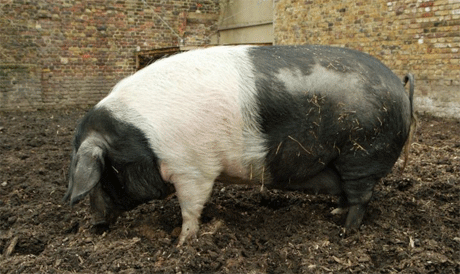
At the Anaplasmic Institute at Valles Marineris, an interesting experiment is being conducted into the appetite-passion cycle associated with the feeding habits of Sus scrofa peculata, this being the Latin zoological name of an otherwise familiar large semi-domestic mammal, the naked pin-striped hog. When released into a feeding pound, a square formed by full feeding-troughs, the hogs struggle, fight and squirm to get at the troughs, and eat as fast and as much as they can, typically submerging their whole faces into the swill and both swallowing and inhaling it in large quantities. Because of the speed with which they eat they almost as often regurgitate the swill as quickly as they ingest it, so that the volume of swill plus regurgitate stays almost constant for a time, though insensibly it diminishes in volume (some of it begins to find its way out of the other end of the hogs; but because many of them are in the troughs with all four feet this does not decrease the volume in the trough as much as it might otherwise do).

Because the nature of the contents of the trough are changing as they come to consist more and more of regurgitate and defecate, the capacity of the hogs' digestive system to cope with what they ingest begins to change. There are some warning signs: a few of the hogs begin to look a little green, and only then do their neighbours at the trough start to edge away, subconsciously aware perhaps that the gastric secretions and enzymes mixed into the regurgitations of the greener pigs are adding greater degrees of toxicity to the regurgitate. But at a certain point the level of toxicity in the swill-cum-regurgitate as a whole reaches a level at which the entire herd of hogs flips into a sudden panic mode: now aware that they cannot continue to eat very fast and in large quantities without doing themselves injury, they all immediately stop eating, and begin to run around the feeding pound emitting loud fear-and-warning noises – and at the same time emitting noisome efflations resulting from the degree of toxicity of the swill over-indulged in, which has caused them tremendous bloating. It is a truly pitiable spectacle to see so many frightened flatulent hogs dashing fruitlessly about, begging for the keepers to come and clean out their feeding troughs and to administer medications to solve their digestive crisis.

Researchers at the Valles Marineris institute point out that the noise and efflations of frightened squealing hogs have a serious effect on other animals in the farmyard, peaceably trying to go about their business. Although there is relatively little wrong with the rest of the farmyard, the disruptions caused by the furore in the hogs' feeding pound is seriously disruptive, and without swift firm action the whole farm can be harmed by the hogs' panic-attack.

The researchers further say that their original assumption had been that the hogs were intelligent creatures, able to self-regulate their feeding habits; they somewhat abashedly say that they had thought that the gobbling and elbowing that went on at the troughs in normal times was simply bad manners, not something systemic and dysfunctional, and not in need of keepers with sharp sticks to stop the hogs going too far. Fat hogs, they say, were thought to be good for the farmyard's income because of the revenue they generate, earning more than eggs and pick-your-own strawberry promotions. They now say that their studies of appetite and emotion in hogs has revealed that hogs have only one appetite – greed – and one emotion – fear – and that these govern all their behaviour in the feeding pound. In fact, they have concluded with surprise that the hogs' brains consist almost entirely of an amygdala, the organ responsible for arousal, autonomic responses associated with fear, emotion generally, and hormonal secretions. The hogs appear to be functionally bereft of higher cortical layers of the brain that in other animals are associated with rationality and intelligence; which makes them a much more dangerous farmyard animal than they had hitherto been believed to be.

Asked what solutions the researchers propose, the answer is: more keepers with sharp sticks, and encouragement to the public to eat more roast pork.

Treasury Invokes Patriotism In Pitch to Bank Executives

WashingtonPost| Because the financial system depends heavily on confidence, the government's response is aimed at repairing perceptions as well as problems. For that reason, the government ordered the chief executives of nine prominent banks to attend a meeting yesterday at the imposing offices of the Treasury Department, next-door to the White House.

The participants included: Bank of America, J.P. Morgan Chase and Wells Fargo, retail banking giants that together control 30 percent of the nation's deposits; Wall Street titans Goldman Sachs, Morgan Stanley and Merrill Lynch, which has agreed to be bought by Bank of America; and Citigroup, the most international of the American banks. Also invited were the Bank of New York Mellon and State Street, lesser-known banks that play a crucial role as the back offices for the financial system.

Treasury Secretary Henry M. Paulson Jr. told the executives that for the good of the nation -- patriotism was specifically invoked, according to a person briefed on the discussions -- they would each have to sell the government a stake in their companies.

Representatives of several banks underscored after the meeting that they did not need the government's money but said they cooperated out of obligation and to help heal the financial system.

U.S. Forces Nine Major Banks To Accept Partial Nationalization

Washington Post | The U.S. government is dramatically escalating its response to the financial crisis by planning to invest $250 billion in the country's banks, forcing nine of the largest to accept a Treasury stake in what amounts to a partial nationalization.

News that European governments also planned to take stakes in their banks and anticipation of new U.S. measures unleashed a tremendous surge in U.S. stock prices yesterday, with the Dow Jones industrial average soaring to the biggest percentage gain since the 1930s, up 11.1 percent. It ended 936.42 points higher, the largest point gain ever, just days after the Dow had its steepest weekly decline in history.

The Treasury Department's decision to take equity stakes in banks represents a significant reversal, coming just weeks after Treasury Secretary Henry M. Paulson Jr. had opposed the idea. In a momentous meeting yesterday afternoon in Washington, Paulson, flanked by top financial regulators, told the executives of nine leading banks that they needed to participate in the program for the good of the national economy, two industry sources said on condition of anonymity because they were not authorized to speak publicly.

The government's initiative, which was to be announced this morning before the markets open for New York trading, is part of a wider plan that goes beyond the $700 billion rescue package approved by Congress earlier this month. The Federal Deposit Insurance Corp. is also set to announce today the launch of an insurance fund to guarantee new issues of bank debt. It will provide unlimited deposit insurance for non-interest-bearing accounts, which are widely used by small businesses for payroll and other purposes.

In pressing the bank executives to accept partial government ownership, Paulson's message was clear: Though officially the program was voluntary, the banks had little choice in the matter. In exchange for giving the Treasury minority stakes, the nine firms would jointly receive an investment worth $125 billion. The government would make another $125 billion available for the next 30 days to thousands of other banks and thrifts across the country.

Our Catastrophic Ecological Trajectory

George Monbiot brings it in the morning's Guardian;

Ecology and economy are both derived from the Greek word oikos - a house or dwelling. Our survival depends on the rational management of this home: the space in which life can be sustained. The rules are the same in both cases. If you extract resources at a rate beyond the level of replenishment, your stock will collapse. That's another noun which reminds us of the connection. The Oxford English Dictionary gives 69 definitions of "stock". When it means a fund or store, the word evokes the trunk - or stock - of a tree, "from which the gains are an outgrowth". Collapse occurs when you prune the tree so heavily that it dies. Ecology is the stock from which all wealth grows.

The financial crisis for which we must now pay so heavily prefigures the real collapse, when humanity bumps against its ecological limits.

As we goggle at the fluttering financial figures, a different set of numbers passes us by. On Friday, Pavan Sukhdev, the Deutsche Bank economist leading a European study on ecosystems, reported that we are losing natural capital worth between $2 trillion and $5 trillion every year as a result of deforestation alone. The losses incurred so far by the financial sector amount to between $1 trillion and $1.5 trillion. Sukhdev arrived at his figure by estimating the value of the services - such as locking up carbon and providing fresh water - that forests perform, and calculating the cost of either replacing them or living without them. The credit crunch is petty when compared to the nature crunch.

The two crises have the same cause. In both cases, those who exploit the resource have demanded impossible rates of return and invoked debts that can never be repaid. In both cases we denied the likely consequences. I used to believe that collective denial was peculiar to climate change. Now I know that it's the first response to every impending dislocation.

Chipocalypse Now - I Love The Smell Of Deportations In The Morning

sky |   Donald Trump has signalled his intention to send troops to Chicago to ramp up the deportation of illegal immigrants - by posting a...