Friday, March 26, 2021

How About The Fancy Asian Human Traffickers And Local Government(s) Looking The Other Way?

CJR  |  Meanwhile, coverage of the shooting by national media outlets remained vague; reporters seemed reluctant (or were unable) to find details about the victims or pick up reports from the Korean press. Instead, the mainstream press published profiles of the shooter. And when the Atlanta Sheriff’s Office held a press conference on Wednesday morning, the press raced to take down the official statement, which uncritically echoed the suspect’s claims that he suffered from sexual addiction, and which minimized the role of racial animus in his motivation for the killing spree. 

Lee, who had worked the police beat in Korea earlier in his career, was in disbelief. “I’ve never before seen a case where the police suggest: ‘The suspect said it wasn’t the case, therefore it’s not the case,’ ” he says. Worse, the press replicated the official statement in headlines and presented it as breaking news. In most news pieces, the spokesperson’s words were treated as self-explanatory, without additional context or questions. “It was almost as though the press believed what was said to be correct, like they wanted it to be the case,” Lee says.  

To Lee, the official statement was “clearly too absurd to repeat.” He felt no obligation to cover the press conference or to recite the spokesperson’s words. Instead, Atlanta K ran a story that recounted the community response to the official statement, titled: “ ‘Does a bad day mean you can kill someone?’: white police officers’ protection of a white murderer.” 

The press corrected course a day later, but already, public perception of the suspect’s racist and anti-Asian motives had been muddied. The shooter’s explanation for the murders—sex addiction—had been widely circulated, giving weight to long-standing associations between Asian-owned massage shops and illicit sex work. Investigations into the spas in the past week cited suggestive customer reviews and a history of police raids (some of which had been undertaken wrongfully, Lee says), in effect imputing criminality to the women. The media should ask if it is meaningful to determine whether the victims had been offering sexual services, and whether such questions are worth stigmatizing the deceased women and risking harm to family members and other spa workers. This also means that survivors, who have long lived under the radar—fearful of losing their livelihoods and immigration statuses—feel discouraged from talking publicly. “Unless they have immense courage, it’s improbable for these women to want to put themselves out there,” Lee says. 

From the beginning, Lee had feared this sort of scrutiny. Reporters for national media outlets had asked him about criminal activity at the spas, to which he declined to respond. Why speculate on a question that lacks clear relevance to the story at hand? Already, the women have been unfairly immortalized in association with their place of work. The spas could never be a full reflection of who the women were; they were survival jobs—jobs the women might have worked tirelessly to retire from, had they been allowed to live out their lives.

Fancy Asians Are Like Vampires Hiding Among And Exploiting Regular Asian Folks...,

NYTimes |  Sue-ling Wang prided himself on being a self-made businessman.

The son of a farmer in Taiwan, he attended a vocational school that trained students at a factory producing zippers and ballpoint pens. But he made his ascent after arriving in America on a scholarship and obtaining a Ph.D., then starting his own company in the Atlanta area three decades ago.

He appeared at civic events, donated to Republican candidates and ensconced himself in an exclusive country club community northeast of Atlanta where he bought two stately homes, each valued at about $1 million.

Later this year, he will assume the role of head of the World Taiwanese Chambers of Commerce. It is a prestigious post: Taiwan’s government recently produced a 14-minute video of him discussing his life that included a photo of him with the island democracy’s president, Tsai Ing-wen.

“When we go abroad, we are not afraid of hardship, because we must raise our children, we want to glorify our ancestors,” Mr. Wang, himself a father, said in the video.

In telling his immigrant success story, Mr. Wang, 68, did not mention his tie to a business whose employees had little opportunity to follow his path: Gold Spa, one of the three Atlanta-area massage parlors where a gunman last week killed eight people and wounded another.

Six victims were of Korean or Chinese descent, fueling outrage and despair about the surge of anti-Asian violence, particularly against women, in the United States.

But as details about the employees emerged, so too did another narrative: the story of the wealth divide among people of Asian descent in America — a community often viewed by outsiders as monolithic and whose economic disparities have long been misunderstood.

The income gap between the rich and the poor in the United States is, in fact, greatest among Asians, who are considered the most economically divided group in the country, according to the Pew Research Center.


Fancy Asians Ruthlessly Exploit Other Asians - So You KNOW They Hate Black Folks....,

fearlessj1111  |  Sociologist Tamara K. Nopper argued against depicting these Black-Asian conflicts as “mutual misunderstanding” in a 2015 article. “The use of ‘mutual’ misunderstanding suggests shared status or power, with each group contributing to each other’s vulnerability and suffering,” Nopper wrote. “The employment of the mutual misunderstanding framework suggests Asian store owners desire identification with and from Black customers across class and race lines. Yet many studies of Asian immigrant storeowners show they hold racist views of Black people and associate them with negative qualities purportedy absent among Asians.”

Asian Americans must admit and rectify the ways we uphold white supremacy, namely our anti-Blackness. Much like the U.S., Asian countries suffer from colorism and caste systems within their own societies. “Anti-Blackness is foundational to the creation of America,” said Diane Wong, an assistant professor and faculty fellow at NYU Gallatin, whose research has focused on the gentrification of Chinatowns and Afro-Asian solidarities. “It’s no secret then that anti-Blackness is reflected in Asian immigrant families, businesses, institutions and interpersonal relationships on a frequent basis.”

As a society, we have “progressed” from lynchings to viral videos of violence against Black people, from police killings and brutality to baseless accusations of criminality. In retail spaces, Black people continue to experience racism and antagonization. When Asians internalize and perpetuate anti-Black racism and violence, we are reifying our complicity and driving a deeper wedge between the minority groups.

It’s important to note that two groups are not equally positioned in larger structures of power, especially when one racial group is profiting off the other, which is oftentimes the case in these violent clashes between Black people and Asians.

“Race is certainly a factor, but it is not the only factor,” Kang, an associate professor at the University of Massachusetts, Amherst, said in an interview. Kang’s research has focused on Asian-owned nail salons and their racially diverse customers. “Many nail salon workers are under pressure to work quickly and keep costs down, which does not create the best environment for building customer relations.

The potential for tensions is heightened by the intimacy of the service, which involves direct physical contact, and the fact that many of the workers and owners are immigrants who do not speak the language or understand the culture of their customers.” In these scenarios, the tension is stoked by economic stress: the salon workers who often work for low wages under poor conditions, and the mostly working class clientele who cannot afford to waste money on subpar service.

Kang stressed the importance of putting these largely publicized conflicts in context. “I have observed hundreds of interactions in salons in this neighborhood that were very cordial and where workers and customers were very respectful and appreciative of each other,” she said.

Our perspectives are largely shaped by the way Black-Asian conflict is covered in media. “There is a lot of misinformation when it comes to reporting on salient issues that affect both Black and Asian communities,” Wong said. However, when videos of Asian business owners and workers inflicting violence on Black customers go viral, when Asian American activists protest in support for Peter Liang, an NYPD officer who shot an unarmed Black man in a stairwell, the message received by the public is that Asians do not care about Black lives.

These acts of violence are only a microcosm of the conflict between the minority groups, moments when the tension bubbles up to the surface and pops. There have been many ways statistics about Asian American achievement and the “model minority” myth have been used as a wedge between Asians and other minority groups, most notably through Ed Blum’s anti-affirmative action lawsuit against Harvard.

Many Asian Americans have thrown their support behind ending affirmative action and in support of standardized testing in school admission, placing their own concerns ahead of the communities marginalized by these systems, namely Black, Brown, and indigenous peoples.


Fancy Asian Race Politics Fitna Cancel Alison Collins

KRON4 |   San Francisco school board members will move forward to remove Vice President Alison Collins from the board and other committee positions in a special meeting later this week. 

This comes after derogatory tweets Collins made in 2016 recently resurfaced.

On Tuesday night, the school board held a regular meeting where we heard an apology from Collins for the first time.

Despite this apology, Collins still made no suggestion of plans to step down from her position.

That’s why two other school board members plan to introduce a resolution at Thursday’s special meeting, calling for Collins to be stripped of her titles.

The San Francisco School Board met on Tuesday for the first time since derogatory tweets resurfaced from the board’s vice president, Alison Collins.

While Collins gave no indication of plans to resign, she made a public apology.

“I’d like to reemphasize my sincere and heartfelt apologies and I’m currently engaging with my colleagues and working with the community for the good of all children in our district,” Collins said. 

Fellow school board member Jenny Lam called for Collins to make this apology several days ago and stands behind demands for Collins to resign.

“I am not alone when I say I don’t have confidence in Commissioner Collins’s ability to fairly govern a school district that is almost half API with no bias. Restorative justice begins by acknowledging the harm and making the intentional effort to connect with those in the community that has been harmed,” Lam said.

Lam and board member Moliga will introduce a resolution at a special meeting on Thursday, calling for Collins to be stripped of her VP position and committee assignments.


Thursday, March 25, 2021

Has Beijing Rendered The U.S. Military Industrial Complex Redundant And Irrelevant?

tomdispatch |    For the next 40 years, Washington’s secret Cold War weapon, the Central Intelligence Agency, or CIA, fought its largest and longest covert wars around the rim of Eurasia. Probing relentlessly for vulnerabilities of any sort in the Sino-Soviet bloc, the CIA mounted a series of small invasions of Tibet and southwest China in the early 1950s; fought a secret war in Laos, mobilizing a 30,000-strong militia of local Hmong villagers during the 1960s; and launched a massive, multibillion dollar covert war against the Red Army in Afghanistan in the 1980s.

During those same four decades, America’s only hot wars were similarly fought at the edge of Eurasia, seeking to contain the expansion of Communist China. On the Korean Peninsula from 1950 to 1953, almost 40,000 Americans (and untold numbers of Koreans) died in Washington’s effort to block the advance of North Korean and Chinese forces across the 38th parallel. In Southeast Asia from 1962 to 1975, some 58,000 American troops (and millions of Vietnamese, Laotians, and Cambodians) died in an unsuccessful attempt to stop the expansion of communists south of the 17th parallel that divided North and South Vietnam.

By the time the Soviet Union imploded in 1990 (just as China was turning into a Communist Party-run capitalist power), the U.S. military had become a global behemoth standing astride the Eurasian continent with more than 700 overseas bases, an air force of 1,763 jet fighters, more than 1,000 ballistic missiles, and a navy of nearly 600 ships, including 15 nuclear carrier battle groups — all linked together by a global system of satellites for communication, navigation, and espionage.

Despite its name, the Global War on Terror after 2001 was actually fought, like the Cold War before it, at the edge of Eurasia. Apart from the invasions of Afghanistan and Iraq, the Air Force and CIA had, within a decade, ringed the southern rim of that landmass with a network of 60 bases for its growing arsenal of Reaper and Predator drones, stretching all the way from the Sigonella Naval Air Station in Sicily to Andersen Air Force Base on the island of Guam. And yet, in that series of failed, never-ending conflicts, the old military formula for “containing,” constraining, and dominating Eurasia was visibly failing. The Global War on Terror proved, in some sense, a long-drawn-out version of Britain’s imperial Suez disaster.

By grasping the geopolitical logic of unifying Eurasia’s vast landmass — home to 70% of the world’s population — through transcontinental infrastructures for commerce, energy, finance, and transport, Beijing has rendered Washington’s encircling armadas of aircraft and warships redundant, even irrelevant.

Those Farmboys From Langley VA. Are Ready To Do What Proletarian U.S. Military Won't Do...,

greenwald  |  A report declassified last Wednesday by the Department of Homeland Security is raising serious concerns about the possibly illegal involvement by the intelligence community in U.S. domestic political affairs.

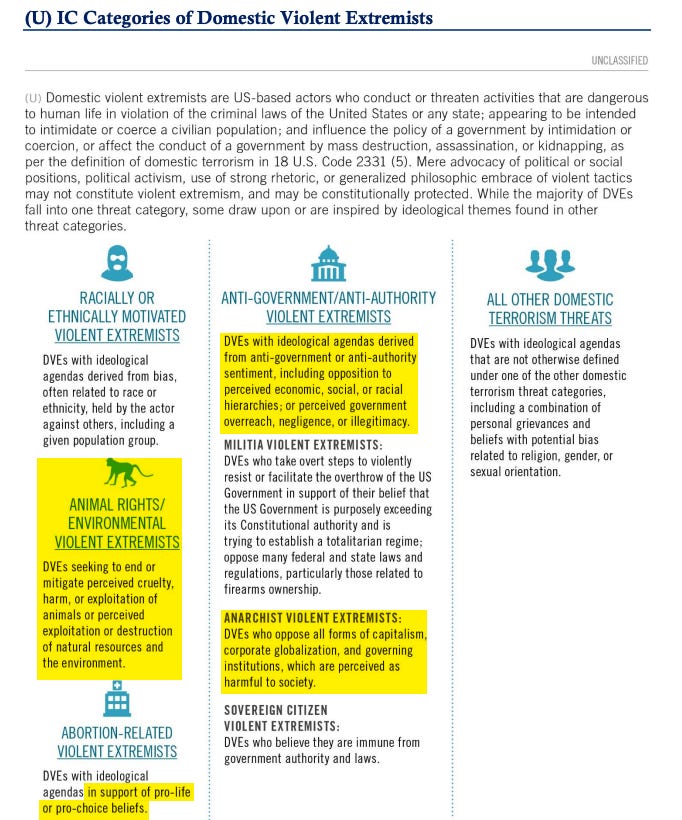
Entitled “Domestic Violent Extremism Poses Heightened Threat in 2021,” the March 1 Report from the Director of National Intelligence states that it was prepared “in consultation with the Attorney General and Secretary of Homeland Security—and was drafted by the National Counterterrorism Center (NCTC), Federal Bureau of Investigation (FBI), and Department of Homeland Security (DHS), with contributions from the Central Intelligence Agency (CIA) and the Defense Intelligence Agency (DIA).” 

Its primary point is this: “The IC [intelligence community] assesses that domestic violent extremists (DVEs) who are motivated by a range of ideologies and galvanized by recent political and societal events in the United States pose an elevated threat to the Homeland in 2021.” While asserting that “the most lethal” of these threats is posed by “racially or ethnically motivated violent extremists (RMVEs) and militia violent extremists (MVEs),” it makes clear that its target encompasses a wide range of groups from the left (Antifa, animal rights and environmental activists, pro-choice extremists and anarchists: “those who oppose capitalism and all forms of globalization”) to the right (sovereign citizen movements, anti-abortion activists and those deemed motivated by racial or ethnic hatreds).

The U.S. security state apparatus regards the agenda of “domestic violent extremists” as “derived from anti-government or anti-authority sentiment,” which includes “opposition to perceived economic, racial or social hierarchies.” In sum, to the Department of Homeland Security, an “extremist” is anyone who opposes the current prevailing ruling class and system for distributing power. Anyone they believe is prepared to use violence, intimidation or coercion in pursuit of these causes then becomes a “domestic violent extremist,” subject to a vast array of surveillance, monitoring and other forms of legal restrictions:

Department of Homeland Security report, Mar.1, 2021

It goes without saying that violence of any kind — including that which is politically motivated — is a serious crime under U.S. law, and it is the proper role of the U.S. Government to investigate and prevent it. But there are real and important legal and institutional limits on the authority of the intelligence community to involve itself in domestic law enforcement, or other forms of domestic political activity, that seem threatened here, if not outright violated.

Wednesday, March 24, 2021

Every System Of Power Manufactures And Polices Its Own "Reality"...,

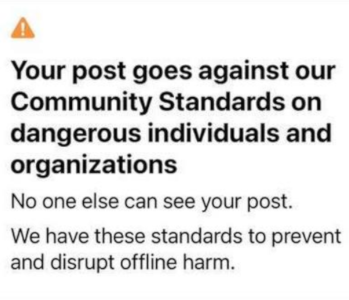
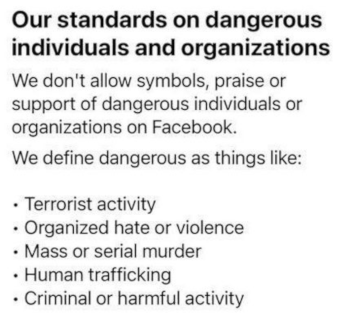
consentfactory  |  So, according to Facebook and the Atlantic Council, I am now a “dangerous individual,” you know, like a “terrorist,” or a “serial murderer,” or “human trafficker,” or some other kind of “criminal.” Or I’ve been praising “dangerous individuals,” or disseminating their symbols, or otherwise attempting to “sow dissension” and cause “offline harm.”

Actually, I’m not really clear what I’m guilty of, but I’m definitely some sort of horrible person you want absolutely nothing to do with, whose columns you do not want to read, whose books you do not want to purchase, and the sharing of whose Facebook posts might get your account immediately suspended. Or, at the very least, you’ll be issued this warning:

Now, hold on, don’t click away just yet. You’re already on whatever website you’re reading this “dangerous,” “terrorist” column on (or you’re reading it in an email, probably on your phone), which means you are already on the official “Readers of Mass-Murdering Content” watch-list. So you might as well take the whole ride at this point.

Also, don’t worry, I’m not going to just whine about how Facebook was mean to me for 2,000 words … well, all right, I’m going to do that a little, but mostly I wanted to demonstrate how “reality” is manufactured and policed by global corporations like Facebook, Twitter, Google, the corporate media, of course, crowdfunding platforms like Patreon and PayPal, and “think tanks” like the Atlantic Council and its Digital Forensic Research Lab (“DFRLab”).

First, though, let me tell you my Facebook story.

What happened was, I made a Facebook post, and a lot of people tried to share it, so Facebook and the DFRLab suspended or disabled their accounts, or just prevented them from sharing it, and sent them the above warning. Facebook didn’t suspend my account, or censor the post on my account, or contact me to let me know that they have officially deemed me a “dangerous individual.” Instead, they punished anyone who tried to “boost” my “dangerous” post, a tactic anyone who has been through boot camp or in prison (or has watched this classic scene from Full Metal Jacket) will be familiar with.

Wokeness Is A Colorful, Gendered Figleaf For Disguising Naked Western Imperialism

strategic-culture  |  In The Revolt of the Public, Martin Gurri, a former CIA analyst, contends that western élites are experiencing a collapse of authority deriving from a failure to distinguish between legitimate criticism and – what he terms – illegitimate rebellion. Once control over the justifying myth of America was lost, the mask was off. And the disparity between the myth and public experience of it became only too evident.

Writing in 2014, Gurri foresaw that the Establishment would respond by denouncing all evidence of public discontent, as lies and disinformation. The Establishment would, in Gurri’s telling, be so constrained within their ‘bubble’ that they would be unable to assimilate their loss of monopoly over their own confected ‘reality’. This Establishment denial would be made manifest, he argued, in a delusional, ham-fisted authoritarian manner. His predictions have been vindicated with Trumpist dissidence denounced as a threat to ‘our democracy’ – amidst a media and social platform crackdown. Such a response would only confirm the suspicions of the public, thus setting off a vicious circle of yet more “distrust and loss of legitimacy”, Gurri concluded.

This was Gurri’s main thrust. The book’s striking feature however, was how it seemed so completely to nail the coming Trump and Brexit era – and the ‘anti-system’ impulse behind them. In America, this impulse found Trump – not the other way around. The point here essentially being that America no longer saw Red and Blue as the two extended wings belonging to the bird of liberal democracy. For something around half of America, the ‘system’ was rigged towards a profiteering 0.1%, and against them.

The key point here surely is whether the élites’ Great Re-set – to reinvent themselves as leaders of the ‘re-vamped’ values of liberalism, overlayered by a newly up-dated, AI and robot-led, post-modernity – is destined to succeed, or not.

Continued ‘westification’ of the globe – the principal component to ‘old’ liberal globalism – though tarnished and largely discredited, remains mandatory, as made clear in the cogent reasoning recently advanced by Robert Kagan: Absent the justifying myth of ‘seeding democracy across the world’ around which to organise the empire, the moral logic of the entire enterprise begins to fall apart, Kagan argued (with surprising frankness). He thus asserts that the U.S. empire abroad is required – precisely in order to preserve the myth of ‘democracy’ at home. An America that retreats from global hegemony, he argues, would no longer possess the cohesive binding to preserve America as liberal democracy, at home either.

Gurri is ambivalent on the élite’s ability to stick fast. He both asserts that “the centre cannot hold”, but then adds that the periphery had “no clue what to do about it”. The public revolts would likely arrive unattached to coherent plans, pushing society into interminable cycles of zero-sum clashes between myopic authorities, and their increasingly furious subjects. He called this a “paralysis of distrust”, where outsiders can “neutralize, but not replace the centre” and “networks can protest and overthrow, but never govern”.

There may indeed be some truth in this latter observation, yet what is happening today in the U.S. is but one ‘battle’ (albeit a key one) in a longer strategic war, reaching far back. The notion of a New World Order is nothing new. Imagined by globalists today, as before, it remains a teleological process of the ‘westification’ of the globe (western ‘universal values’), pursued under the rubric of (scientific) modernism.

The First Amendment Was From A Time When Speech Was Expensive And Rare...,

taibbi  |  When Columbia law professor Timothy Wu was appointed by Joe Biden to the National Economic Council a few weeks back, the press hailed it as great news for progressives. The author of The Curse of Bigness: Antitrust in the New Gilded Age is known as a staunch advocate of antitrust enforcement, and Biden’s choice of him, along with the appointment of Lina Khan to the Federal Trade Commission, was widely seen as a signal that the new administration was assembling what Wired called an “antitrust all-star team.”

Big Tech critic Tim Wu joins Biden administration to work on competition policy,” boomed CNBC, while Marketwatch added, “Anti-Big Tech crusader reportedly poised to join Biden White House.” Chicago law professor Eric Posner’s piece for Project Syndicate was titled “Antitrust is Back in America.” Posner noted Wu’s appointment comes as Senator Amy Klobuchar has introduced regulatory legislation that ostensibly targets companies like Facebook and Google, which a House committee last year concluded have accrued “monopoly power.”

Wu’s appointment may presage tougher enforcement of tech firms. However, he has other passions that got less ink. Specifically, Wu — who introduced the concept of “net neutrality” and once explained it to Stephen Colbert on a roller coaster — is among the intellectual leaders of a growing movement in Democratic circles to scale back the First Amendment. He wrote an influential September, 2017 article called “Is the First Amendment Obsolete?” that argues traditional speech freedoms need to be rethought in the Internet/Trump era. 

Listening to Wu, who has not responded to requests for an interview, is confusing. He calls himself a “devotee” of the great Louis Brandeis, speaking with reverence about his ideas and those of other famed judicial speech champions like Learned Hand and Oliver Wendell Holmes. In the Aspen speech above, he went so far as to say about First Amendment protections that “these old opinions are so great, it’s like watching The Godfather, you can’t imagine anything could be better.”

If you hear a “but…” coming in his rhetoric, you guessed right. He does imagine something better. The Cliff’s Notes version of Wu’s thesis:


Tuesday, March 23, 2021

Internet Porn A MUCH BIGGER Cause Of Sex Addiction Than Evangelical Christianity Or Racism

nbcnews  |   While authorities said Atlanta-area spa shooting suspect Robert Aaron Long, 21, told investigators he was motivated by "sexual addiction" and claimed he had no racial motivation, health specialists say the explanation falls short.

Capt. Jay Baker, a spokesman for the Cherokee County Sheriff's Office, said Long — who is accused of killing eight people, six of them Asian women — indicated that the spas were "a temptation for him that he wanted to eliminate." However, experts say such rationale has been used before in attempts to exonerate white men. The explanation also discounts racial dynamics and can “cause harm” in the way the public understands these issues.

White men have traditionally been given a pass when they say it — and have the privilege of overlooking how race is a factor, experts say.

“Historically, the term ‘sex addiction’ has been used by white males to absolve themselves from personal and legal responsibility for their behaviors,” Apryl Alexander, associate professor in the Graduate School of Professional Psychology at the University of Denver, told NBC Asian America. “It is often used as an excuse to pathologize misogyny.”

The defense of sex addiction itself, Alexander said, is a highly controversial one as those in the fields of psychology, psychiatry and sex research continue to debate whether to formally recognize it. Currently, the idea that sex addiction is a disorder is not supported by research, nor is it accepted as a clinical diagnosis, she said.

“A lot of individuals who are doing this kind of self-reports of sexual addiction are having normative sexual behaviors and urges, but they might be excessive. Or for a lot of people, it's rooted in shame that ‘I'm having these attractions and emotional desires that are normal, but I don't recognize them as normal,’” Alexander said.

Though the American Psychiatric Association added the concept of sexual addiction to its Diagnostic and Statistical Manual of Mental Disorders in 1987, it later retracted the term and has since rejected the addition of the idea to its later editions including the DSM–5, which is widely seen as the definitive resource on mental disorders, on the basis of a lack of supporting evidence.

Alexander said this sexual behavior doesn’t affect the brain in the same ways other addictions, including substance use and gambling behavior, do, either, calling the characterization of Long’s behavior “concerning.”

The self-identification of sex addiction, she said, is often seen in individuals who are raised in conservative and religious environments, “where there's a high level of moral disapproval of their natural kind of sexual urges and desires.” Many of these populations are overwhelmingly white.


White Christian Nationalist Sexuality?

twitter |   I keep seeing "sex addiction" used as a term of agreed-on meaning, whether the speaker believes it explains the murders or not. But nearly all of what the conservative evangelicalism of the murderer describes as "sex addiction" is what the rest of the world calls sexuality...

America's Sexualized Racism?


nbcnews  |  The only time I was ever in Atlanta, where six Asian women were shot dead on Tuesday, a young white man shouted "Me so horny" to me at the airport. And as the only Asian woman in the space, I knew he was talking to me. I locked eyes with him for a second and then rushed off to catch my flight back to Los Angeles. I was in Atlanta to attend the annual meeting of the Association of Asian American Studies, presenting a paper there for the first time. It was a big deal for me professionally. But what I remember most about that trip were a white man's racist, sexist words.

Tuesday's killings occurred at three spas in the Atlanta area. Two other victims, a white man and a white woman, were also killed. Investigators said the white male suspect told them that he has a "sex addiction" and targeted the spas to "take out that temptation."

"He was fed up, at the end of his rope," Cherokee County sheriff's Capt. Jay Baker said. "He had a bad day, and this is what he did."

Based on the reported statement, investigators have so far concluded that the attacks did not appear to have been motivated by race. As an Asian American woman who has endured sexualized racism all of my life, such ignorance enrages me.

Asian women, along with Black and Indigenous women and other women of color, endure racism and sexism in intersectional ways constantly, and they have throughout history. As lawyer Jaemin Kim argued in 2009, prosecutors and police may be even less likely to add "hate crime" charges in cases of rapes and sexual assaults targeting Asian women.

In 1875, Chinese women were targeted by a federal immigration law called the Page Act. This law effectively banned the immigration of Chinese women to the United States based on a morals clause that considered all of them prostitutes at the time. There were apparently specific racist and sexist concerns that Chinese "prostitutes" would bring in "especially virulent strains of venereal diseases ... and entice young white boys to a life of sin." Sound familiar?


American Public School Districts Are Simply Economic Pinatas. Period.

jonathanturley |  We previously discussed the controversial position of Alison Collins, Vice President of the San Francisco school board, in her campaign against meritocracy and effort to shut down the gifted programs at Lowell High School.  The Asian community was particularly opposed to Collins’ efforts since Asian students composed 29 percent of the students but 51 percent of the Lowell student body. Now Collins is under fire for prior tweets attacking Asians as promoting “the ‘model minority’ BS” and of using “white supremacist thinking to assimilate and ‘get ahead.’”

These do not appear recent tweets but their content is obviously insulting for any Asian American. The Yahoo News story included such tweets as accusing “many Asian American Ts, Ss, and Ps” — teachers, students, and parents — of promoting “the ‘model minority’ BS” and of using “white supremacist thinking to assimilate and ‘get ahead.’” It also include a demand to know “[w]here are the vocal Asians speaking up against Trump?” and statements on how Asians are deluding themselves by not speaking out against former president Donald Trump: “Don’t Asian Americans know they are on his list as well?” Collins continued. “Do they think they won’t be deported? profiled? beaten? Being a house n****r is still being a n****r. You’re still considered “the help.”

While the use of the censored version of the “n word” has led to calls to terminate academics, I do not believe that such objections are fair in this or the prior cases. Indeed, this controversy should not take away from the campaign against meritocracy and the effort to eliminate programs for advanced or gifted students in the public school system. As I have previously discussed, I long been a supporter of public schools.  These advanced programs are needed to maintain broad, diverse, and vibrant school systems for cities like San Francisco.

Race politics seems a focus on every level in the school system, even in the regulation of student elections. Likewise, the controversy in San Francisco follows another controversy in Los Angeles where United Teachers Los Angeles (UTLA) Cecily Myart-Cruz has also criticized “Middle Eastern” parents in joining “white parents” in seeking school re-openings.  The UTLA was criticized after Maryam Qudrat, a mother of Middle Eastern descent, was asked by the UTLA to identify her race after criticizing the union’s opposition to reopening schools despite overwhelming science that it is safe. This effort to racially classify critics of the teachers followed Myart-Cruz attacking critics by referring to their race

Monday, March 22, 2021

What Has Marian Croak Changed At Google Or Ursula Burns At Xerox?

WEF  |  Global companies are increasingly taking up their role as responsible trustees of society and investing in actions for racial and ethnic equity in the workplace – not as an option but as a business imperative.

The World Economic Forum has convened a coalition of global corporations and their C-suite leaders committed to building equitable and just workplaces for professionals with underrepresented racial and ethnic identities.

Partnering for Racial Justice in Business as a global initiative, launched today Monday 25 January, during The Davos Agenda 2021, is focused on eradicating all strands of racism in the workplace against professionals with underrepresented racial and ethnic identities.

Professionals of colour and minority ethnic backgrounds continue to face racial injustice and inequity in the workplace, and they have been severely underrepresented in leadership. There have only been 15 Black CEOs over the course of the 62 years of the Fortune 500’s existence, and currently only 1% of Fortune 500 CEOs are Black. Below the top level, Black employees form approximately only 4.7% of executive team members in the Fortune 100 and 6.7% of the 16.2 million managerial level jobs.

To drive systemic and sustainable change towards racial justice, this initiative has been designed to operationalize and coordinate commitments to eradicate racism in the workplace and set new global standards for racial equity in business. It also provides a platform for businesses to collectively advocate for inclusive policy change.

The Forum unveiled the Partnering for Racial Justice in Business initiative with 56 founding partner organizations representing 13 industries, with more than 6.5 million employees worldwide.


Soldiers Understand "Our" Political Elites And Their Masters Aren't Good Stewards Of Society

military  |  Those conducting the sessions wanted "to make sure that military members understand the difference between Seattle and [the Jan. 6 riot in] Washington, D.C.," Colón-López said. "But some of our younger members are confused about this, so that's what we need to go ahead and talk to them about and educate them on, to make sure that they know exactly what they can and cannot do."

Colón-López also noted the military was called to respond after the Capitol attacks, but was not called up to support law enforcement during the Seattle protests.

And he drew a distinction between those who lawfully exercised their First Amendment rights to protest during last summer's protests in support of racial justice and the Black Lives Matter movement, and those who "latched on" to the protests to loot, destroy property and commit other crimes.

But sometimes, he said, younger troops see messages on TV that blur the lines between the two, and "we needed to educate them" on the difference.

"No, that's not what that meant," Colón-López said. "There were people advocating [against] social injustice, racial injustice and everything else, and it is the right of citizens."

When asked about networks or television personalities popular among service members who have drawn those equivalencies, Colón-López said, "Those are very, very tough conversations to have with people, because sometimes they're emotional about the subject."

While those TV personalities are exercising the right to free speech troops have fought for, he said, "make sure that you're well-educated and don't be an automatic mouthpiece for something unless you understand the issue."

Colón-López acknowledged that the "information overload" troops today face -- not just traditional media and memos from service leaders, but also a panoply of social media amplifying different messages -- can leave troops feeling confused and uncertain where to go to get reliable information.

"What I am committed to is to make sure that our people understand right from wrong," he said. "That our people ... are well-educated to be able to carry on, in an honorable fashion. And if they hear somebody saying the wrong things, that they're quick to go ahead and correct them ... without being confrontational."

Colón-López stressed the refrain commonly heard from top military leaders that the vast majority of troops do not share extremist views.

And the military isn't interested in monitoring troops' online activities at home, he said. A service member who Googles QAnon, for example, may just want to become educated on the online conspiracy theory movement, he explained. That wouldn't mean someone necessarily believes in that ideology.

But, he noted, the military needs to be watchful of how service members carry themselves while on duty, and what troops' friends say they are doing.

Vindictive "Morality" Is The Unenforceable Quintessence Of Woke-ism

theapeiron  |  Meanwhile, hundreds of miles away, Robert Aaron Long was trying to purge himself of his sex addiction by murdering women at spas and massage parlors. According to police, these spas were “a temptation for him that he wanted to eliminate.” Apparently, it never occurred to Long to see a therapist, or pick up a self-help book. Nope, his first thought was to go out and buy a handgun, and then go on a shooting spree. That’s what our dominant culture still teaches men, to solve their problems by punishing women. Long is just an extreme example of the violence we witness every day.

Maybe you don’t see much in common between a deadbeat dad and a mass shooter. I assure you, they have everything in common. They both practice vindictive morality. It’s a problem, especially for women — or anyone who can be turned into a scapegoat.

I’ll explain.

Genuine morality involves a deep, sincere sense of personal responsibility for your own actions. You follow the core western monotheistic principle of judging yourself before judging everyone else. You hold yourself to a higher standard. You focus on staying consistent with your own beliefs. You practice self-awareness and reflection, and you always try to understand how your actions affect those around you.

Sounds great, right?

In other words, you try to mind your own business. You don’t concern yourself with what other people might be doing, unless it presents an immediate threat to you or someone you care about.

Vindictive morality goes against all of that. You see it a lot in the Westboro Baptist types. They assume they’re inherently right, and morally superior to everyone else. They’re pure.

The only way they could possibly do something wrong is if an outside influence corrupts their immortal soul. Of course, this is always happening in their mind. They’re in an endless war against sin.

Vindictive morality is a way of not taking responsibility for your own actions. It’s a way of attributing any bad thoughts you might have to some external source, thus maintaining the illusion that you’re truly an innocent little kid at heart, incapable of malice. If they wind up hurting someone, then it’s always someone else’s fault.

It’s one of the oldest stories in the book. And that book is the bible.

Not Even The FBI Director Can Play Along With The Atlanta Anti-Asian Racism Trope...,

npr  |  So obviously, it's a heartbreaking incident, and it hits particularly close to home for me since I consider Atlanta home. And so I certainly grieve for the victims and their families. The FBI is supporting state and local law enforcement, specifically APD, the Atlanta Police Department, and the [Cherokee County] Sheriff's Office. So we're actively involved but in a support role.

And while the motive remains still under investigation at the moment, it does not appear that the motive was racially motivated. But I really would defer to the state and local investigation on that for now.

I elevated racially motivated violent extremism to our top threat priority level about a year and a half ago or so. And I've been trying to call out this threat for a number of years now since I've been in this job.

We have doubled the number of domestic violent extremist investigations we've had since where they were when I started as director, and we were up to about 2,000. And that was before the Jan. 6 siege. So I expect the numbers to be even higher this year. And arrests likewise went up dramatically from 2019 to '20.

And so at the same time, the international terrorism threat — especially international terrorist organizations that inspire homegrown violent extremists here in the U.S. — hasn't gone away by any stretch of the imagination. So we clearly are making do right now with what we have. But we need and will need more resources to tackle that problem.

The sprawling investigation into Jan. 6

You know, I was appalled that something like that could happen in this country and determined to make sure that it doesn't happen ever again. ...

We intend to see this to its conclusion, no matter how many people it takes us to devote to it, no matter how long it takes us to do it, we're going to see it to the end. ... If we have the evidence to charge somebody and they committed a crime on that day, I expect them to be charged. ...

We've arrested people all over the country. I think we have ... open investigations specifically related to the Jan. 6 siege in all but one of our 56 field offices, which gives you a sense of the national sprawl of the investigation. And in some of those instances, there have already been conspiracy charges — small, I would call them — sort of small cells of individuals working together, coordinating their travel, etc. I don't think we've seen some national conspiracy, but we're going to keep digging.


Rev. Sen. Raphael Warnock's Ex-Wife Paid To Keep Quiet By The American Baptist Home Mission?

dailymail | 'I'm going to stay focused': Georgia Dem Senate candidate Raphael Warnock dodges questions about police bodycam showing ex-wife accuse him of running over her foot with his car

  • Rev. Raphael Warnock, 51, declined to address police video of domestic dispute
  • Warnock and his ex-wife Ouleye Ndoye, 35, divorced in May
  • In March she called police to their Atlanta home after an incident in the drive
  • She accused him of deliberately driving over her foot during an argument
  • Warnock said he did not believe he ran over her and medics found no injuries 
  • No charges were filed following the incident 
  • Ndoye told officers that he was 'a very good actor' and obsessed with reputation
  • She said she had 'tried to keep the way that he acts under wraps' for the election

ouleye |  Ouleye Ndoye is a global leader in human rights with over a decade of experience in government, non-profits, and academia. She advocates for the health, education, gender equality, and religious freedoms of people around the world and has dedicated her academic pursuits to these issues. Ndoye earned her bachelor's degree in international studies from Spelman College in Atlanta, GA, where she graduated Phi Beta Kappa, summa cum laude with honors; master of science in Migration Studies from the University of Oxford, UK; and master of arts in History with a concentration on African and Global history from Columbia University in the City of New York. Ndoye currently serves as the National Coordinator for Scholarships and Emerging Leaders at the American Baptist Home Mission Societies. 

- The Baptists Paid this woman to keep quiet about Warnock after the Dailymail Domestic Violence story broke in December - It is an OH TOO SWEET Irony That She is a specialist in Human Trafficking in light of the human trafficking massage parlor murders last week.

pathwaystofreedom |  Spelman College graduate Ouleye Ndoinye Warnock brings a wealth of local knowledge to her new role as Atlanta’s human trafficking senior fellow. With more than a decade of experience working to address human trafficking and other human rights-related issues around the world, Ouleye is well-positioned to lead efforts to tackle labor and sex trafficking in a city with a rich history of civil rights leadership.


Sunday, March 21, 2021

Getting Close To The Secrets Of Superconductivity

quantamagazine  |  For the last three years, electrons have been toying with physicists.

The game started in 2018 when the lab of Pablo Jarillo-Herrero announced the find of the decade: When the researchers stacked one flat sheet of carbon atoms on top of another, applied a “magic” 1.1-degree twist between them, then cooled the atomic wafers to nearly absolute zero, the sample became a perfect conduit of electrons.

How were the particles conspiring to slip flawlessly through the graphene sheets? The kaleidoscopic “moiré” pattern created by the skew angle seemed significant, but no one knew for sure. To find out, researchers started twisting and stacking every material they could get their hands on.

At first, the electrons played along. Experiment after experiment found that, in an array of flat materials, frigid temperatures brought plummeting electric resistance. A more profound understanding of the conditions necessary for ideal conduction felt close, and with it, a tantalizing step toward an electronics revolution.

“It seemed like superconductivity was everywhere,” said Matthew Yankowitz, a condensed matter physicist at the University of Washington, “no matter what system you looked at.”

But the electrons proved coy. As researchers inspected their samples more carefully, the instances of superconductivity vanished. In some materials, resistance wasn’t actually getting down to zero. In others, different tests offered conflicting results. Only in the original double-layered graphene did electrons regularly achieve a frictionless flow.

“We had this zoo of different twisted materials, and twisted bilayer graphene was the only one that was clearly a superconductor,” Yankowitz said.

Then in the past month, two papers published in the journals Nature and Science described a second related superconductor, a three-layer graphene sandwich with the “bread” sheets aligned and the filling sheet skewed by 1.56 degrees. The unmistakable electron-carrying prowess of twisted trilayer graphene confirms that the two-wafer system was not a fluke. “It was the first of a family of moiré superconductors,” said Jarillo-Herrero, a physicist at the Massachusetts Institute of Technology who also led one of the new experiments, “and this one is the second member of the family.”

Importantly, this second sibling has helped to illuminate an underlying mechanism that could be what powers the superconductivity of these materials.

In the months after the 2018 discovery, one group of theorists began to puzzle over the mechanism that made bilayer graphene superconduct. They suspected that one particular geometric trait might allow electrons to swirl into exotic maelstroms that behave in an entirely novel manner. This mechanism, which is unlike any of the (few) known schemes responsible for superconductivity, would explain the superconductive success of bilayer graphene, as well as the failure of other materials. It also predicted that graphene’s trilayer sibling would superconduct as well.


Saturday, March 20, 2021

The SMART Healthcards Framework

unlimitedhangout |  The SMART Health Cards framework was developed by a team led by the chief architect of Microsoft Healthcare, Josh Mandel, who was previously the Health IT Ecosystem lead for Verily, formerly Google Life Sciences. Verily is currently heavily involved in COVID-19 testing throughout the United States, particularly in California, and links test recipients’ results to their Google accounts. Their other COVID-19 initiatives have been criticized due to still-unresolved privacy concerns, something that has also plagued several of Verily’s other efforts pre-COVID-19, including those involving Mandel.

Of particular concern is that Verily, and by extension Google, created Project Baseline, which has been collecting “actionable genetic information” with a focus on “population health” from participants since 2017. Yet, during the COVID-19 process, Project Baseline has become an important component of Verily’s COVID-19 testing efforts, raising the unsettling possibility that Verily has been obtaining Americans’ DNA data through its COVID-19 testing activities. While Verily has not addressed this possibility directly, it is worth noting that Google has been heavily involved in amassing genomic data for several years. For instance, in 2013, Google Genomics was founded with the goal of storing and analyzing DNA data on Google Cloud servers. Now known as Cloud Life Sciences, the Google subsidiary has since developed AI algorithms that can “build your genome sequence” and “identify all the mutations that an individual inherits from their parents.”

Google also has close ties with the best-known DNA testing companies in the United States, such as Ancestry.com. Ancestry, recently purchased by private-equity behemoth Blackstone, shares data with a secretive Google subsidiary that uses genomic data to develop lifespan-extending therapies. In addition, the wife of Google cofounder Sergey Brin, Anne Wojcicki, is the cofounder and CEO of DNA testing company 23andMe. Wojcicki is also the sister of the CEO of Google-owned YouTube, Susan Wojcicki.

Google and the majority of VCI’s backers—Microsoft, Salesforce, Cerner, Epic, the Mayo Clinic, and MITRE Corporation, Change Healthcare—are also prominent members of the MITRE-run COVID-19 Healthcare Coalition. Other members of that coalition include the CIA’s In-Q-Tel and the CIA-linked data-mining firm Palantir, as well as a myriad of health-care and health-record companies. The coalition fits well with the ambitions of Google and like-minded companies that have sought to gain access to troves of American health data under the guise of combatting COVID-19.

The COVID-19 Healthcare Coalition describes itself as a public-private partnership that has enabled “the critical infrastructure to enable collaboration and shared analytics” on COVID-19 through the sharing of health-care and COVID-19 data among members. That this coalition and VCI are intimately involved with MITRE Corporation is significant, given that MITRE is a well-known, yet secretive, contractor for the US government, specifically the CIA and other intelligence agencies, which has developed Orwellian surveillance and biometric technologies, including several now focused on COVID-19.

Just three days before the public announcement of VCI’s establishment, Microsoft Healthcare and Google’s Verily announced a partnership along with MIT and Harvard’s Broad Institute to share the companies’ cloud data and AI technologies with a “global network of more than 168,000 health and life sciences partners” to accelerate the Terra platform. Terra, originally developed by the Broad Institute and Verily, is an “open data ecosystem” focused on biomedical research, specifically the fields of cancer genomics, population genetics, and viral genomics. The biomedical data Terra amasses includes not only genetic data but also medical-imaging, biometric signals, and electronic health records. Google, through its partnership with the Pentagon, which was announced last September, has moved to utilize the analysis of such data in order to “predictively diagnose” diseases such as cancer and COVID-19. US military contractors, such as Advanced Technology International, have been developing wearables that would apply that AI-driven predictive diagnosis technology to COVID-19 diagnoses.

Chipocalypse Now - I Love The Smell Of Deportations In The Morning

sky |   Donald Trump has signalled his intention to send troops to Chicago to ramp up the deportation of illegal immigrants - by posting a...